Jason Lewis's Blog, page 5
September 20, 2014
Should expeditions have a purpose other than shameless self-promotion?
It’s a variation of the big “Why” question adventurers are always asked in media interviews. Why ride a bicycle to Timbuktu? Why be the two thousandth person to summit Mount Everest? Why row a bathtub to the North Pole?

Legitimate questions in their own right, you might say, but for some, embarking upon extraordinary feats of physical and mental endurance needs no explanation. “Because it’s there,” George Mallory famously told the New York Times when quizzed on his Everest obsession. Or, from Sir Ranulph Fiennes: “It is as well for those who ask such questions that there are others who feel the answer and never need to ask.”
Neither of these comebacks seemed plausible for my former expedition partner Steve Smith, who once offered a more light-hearted if unsparing take on his own motivation as an adventurer: “Because I have an enormous ego and suffer from a compulsive need to keep proving myself with pointless acts of endeavour.” And although painfully honest, his words are probably closer to a more widespread truth than the rest of us might like to admit.
Which leads me to the reason for asking the question in the first place. When you look at UK adventurers in particular, the overwhelming majority are white, privately educated males from upper middle class backgrounds. A surprising number went to Eton and studied at Oxford or Cambridge, or one of the country’s other leading universities. Thanks to subsidies for military personnel, I, myself, received an independent education (my father served as a career officer in the Royal Tank Regiment), begging the question: if I’d gone through the state education system instead, would I have become a so-called adventurer, writing books and speaking about my experiences?
Probably not, looking at the figures.
I suspect that, for the most part, adventurers from elsewhere in the world also come from privileged backgrounds. Perhaps they joined an adventure club at school, or spent their holidays abroad? Traditionally, in the UK at least, private school leavers take a gap year before going to college, giving them a taste for international travel that those directly entering the workplace wouldn’t experience. And with their academic edge, privately educated people are in a stronger position to make a living from their exploits, either in the form of selling articles to newspapers, writing books, or public speaking.
To my mind, this head start in life underscores the need for adventurers to seriously consider the reason behind their endeavours. We have a duty to do something useful with our abilities other than shameless self-promotion, not least because expeditions burden the taxpaying public and endanger the lives of those sent out to rescue us when things go wrong. We have a responsibility to give back to society, the very mechanism that provided us with the means to light out in the first place.
Since our earliest ancestors walked out of Africa some two million years ago, young men and women have set off on journeys into the unknown, quests that often served as a rite of passage from childhood to adulthood. But these coming-of-age initiates were also expected to return to their tribal group with something of shared value: a new medicine, new seeds to plant for food, the whereabouts of new hunting grounds, or perhaps some innovative technology (imagine the celeb factor of walking into camp and being the first to light a fire!). The act of adventure, therefore, was a reciprocal arrangement, in which even those working less exciting but essential jobs back home (the nine-to-fivers) received benefit. I wonder then: How did we lose that transaction in the modern adventure world, where expeditions have become more about fostering the cult of the individual than contributing to the greater good?
Part of the problem, admittedly, is that with the exception of deep oceans and space, every inch of the Earth and its atmosphere has been surveyed and claimed. The mysteries that stirred the imaginations of early explorers are largely solved; new technologies and medicines are gathered and disseminated by means other than physical journeys.
Nevertheless, I believe there is still a way for adventurers to legitimately earn their keep in the 21st century. Now, more than ever, given the formidable challenges we face in the wake of rising world population and global warming, we need travellers to share what they’ve learned about the planet and its people, including perspectives that offer an alternative path to the destructive one that industrial society has set us on to date. As humans, our identities, behaviours, and habits are conditioned by our geography and cultural norms. It will take looking at the world from many different points of view to understand what we need to change in our own lives to be part of the solution to a habitable planet, not part of the problem. If adventurers can help solve that mystery, one that secures our future wellbeing and even survival as a species, then we’ll never have to answer the big Why question again.
All Rights Reserved – © 2014 Jason Lewis
The post Should expeditions have a purpose other than shameless self-promotion? appeared first on Jason Lewis.


August 9, 2014
Biking India – The Tao of Poo and the Eightfold Path of Buddhism
“Malamūtra, excrement, is so intrinsic to life in rural India that for some it constitutes their sole reason to be. I saw a thirteen-year-old boy who should have been at school squatting under a cow’s backside instead, his job being to wait until the thing shat. When finally it did, he caught the deluge in a rudimentary baseball mitt fashioned from an old grocery bag. Like an expert pastry chef he then mixed in some straw and spanked the steaming matter into four dung-patties before laying them out in the sun to dry for fuel.

It wasn’t long before I, too, was using the road as a lavatory. Hygiene standards were scant in the truck restaurants I used as refueling stops (it was just samosas and occasionally dhal in the impoverished north, no rice or noodles), and after a few days I could last barely an hour in the saddle before having to dive off into a field and yank off my shorts. But the most distressing part of biking through Uttar Pradesh wasn’t so much the lack of sanitation, it was witnessing the pitiful value placed on human life: grannies armed with shovels loading gravel trucks by hand, cheaper than renting a loader, and young men squatting on farm harrows being jerked around behind a tractor, their lives worth less than a block of concrete.
And when it came to suffering, India was like nothing I’d ever encountered: stray dogs with open sores, maggots eating them alive from the inside out, and beggars with hideous deformities, arms shrivelled and legs missing, using sticks to manoeuvre themselves between lanes of traffic. A puppy was flattened before my eyes, followed by its mother, her teats heavy and swollen, trying to reach her stricken offspring. Destitute men, very obviously mentally ill, wandering naked, their hair filthy and matted, going—where?
And just when I thought I’d seen it all, I rode past a pile of hessian sacks dumped in a drainage ditch. I looked closer and saw a face, shrunken and cadaverous, hidden in the folds. It was ten in the morning, already blazing hot. Had anyone noticed the man was dead? Did anyone care?
Coward that I am, I rode on.
It was scenes like these in 534 BCE that shocked a local twenty-nine-year-old prince, Siddhartha Gautama, into renouncing courtly life to seek insight into the root cause of suffering. On a rare outing from the confines of his palace, he observed for the first time the horrors of penury: disease, malnourishment, and death. Deeply moved by what he’d seen, the young aspirant embarked on a spiritual quest, living first as an ascetic, before settling for a more moderate path between excessive self-mortification and material indulgence. After meditating for forty-nine days under a pipal tree in modern-day Nepal, he attained enlightenment. The rest of his life he dedicated to refining and disseminating a self-help programme for others, the so-called Middle Way of Buddhism.
I was also deeply moved by what I’d seen, but as an outsider, just breezing through, they were not my problems to get involved with. This had been firmly impressed upon me after witnessing a head-on collision between two buses on the road from Kathmandu. One of the drivers was pulled from the wreckage, unconscious and drenched in blood. When I’d stepped forward to offer cardiopulmonary resuscitation, the crowd, by now hysterical with grief, pushed me away, shouting: “Not your problem! Not your problem!” And the man had died at my feet.
The more horrors I encountered on my way through India, the more I realized that elevating the gaze an inch above the horizontal was a coping mechanism reserved for the foreigner, another baffling privilege of the antediluvian caste system. For the scheduled castes, immersed as they were in hardship and suffering 24/7, a very different means of detachment had been prescribed by the Buddha. At the heart of the Middle Way was a methodology allowing people to function regardless of what was going on around them, including tools to keep from turning to emotional mush every time life put the boot in. The key lay in addressing the nature of true Self. Did the sum and substance of a person reside in the corporeal world of flesh, blood, and bone? The senses? The so-called personality? No. In India, this take on reality was too grim and depressing. What was needed, according to Gautama, was a shift in consciousness, achievable through meditation, the same cognitive control technique I’d used myself on the Atlantic. By exercising One Pointed Attention, the phenomenal appearance of worldly existence, the layers of illusion, could be stripped away to reveal, at its innermost core, true Self, impervious to circumstance. For Hindus and Buddhists this was the Atman, the Supreme Reality inherent in all things.
Divine being or not, the Buddha was certainly a cracking shrink for his time. Equipped with this early form of Cognitive Behavioural Therapy, Indians living at the time of Christ could hope to secure some semblance of peace and composure in the gut-wrenching mayhem of their everyday lives. Moreover, from all that I had seen, the Middle Way seemed as relevant now as it was 2,500 years ago. Contrary to the success story on everybody’s lips, in particular the two percenters hogging ninety-eight percent of the nation’s wealth, India’s great leap forward was still a pie in the sky to the average farmer, of whom more than seventeen thousand committed suicide each year over crop failures and compounding debt.”
All Rights Reserved – © 2014 Jason Lewis
The post Biking India – The Tao of Poo and the Eightfold Path of Buddhism appeared first on Jason Lewis.
July 6, 2014
Which Takes True Grit: Long-Haul Expeditions or a 9 to 5?
In keeping with my last post about the aftermath of long-haul journeys, here’s a snippet from my upcoming book, To the Brink, about expeditions and whether they’re just an elaborate excuse to avoid responsibilities back home.

The uniformed ticket inspector handed me back my stub. “This is not a valid ticket,” he announced.
“But I bought it only fifteen minutes ago.”
I was on the 17.10 from Paddington to Reading, sharing a packed commuter carriage with several hundred weary London commuters returning home. Three days previously, I’d arrived back at Greenwich after 13 years of circumnavigating the planet by human power. This was the fastest I’d gone in a long time.
The inspector looked at me like I was an imbecile. “It is a receipt, not a ticket.”
Examining the stub closer, I realized what must have happened. More than ten years had passed since I last bought a rail ticket from a self-service kiosk. Back then ticket machines produced only tickets. Now, they apparently spat out receipts as well. I’d left the ticket in the dispensing tray by mistake.
I explained my oversight, but the inspector remained unimpressed. The commuters around me kept their noses glued firmly to their BlackBerrys and evening papers, oblivious to my predicament. British indifference at its best.
Tapping the receipt, I said, “But this shows I bought a ticket for £18.20 at 16.52, less than twenty minutes ago.”
“It doesn’t indicate the route. You could be going anywhere.”
“Well, obviously I’m going where this train is going, from London to Reading.”
“There’s no way to prove that without a valid ticket.”
The ridiculousness of the conversation triggered a corresponding rise in my blood pressure. “Let me ask you something,” I said crisply. “How much is a single fare from Paddington to Reading at this time of day?”
“Eighteen pounds and twenty pence.”
I felt like I’d made a breakthrough. “Exactly! So, if that’s the amount on the receipt, and I’m currently on a journey between two stations that costs that exact amount, then don’t you think it more than likely that the route marked on the original ticket was from London to Reading?”
My reasoning, however, fell on deaf ears. “I need to see a valid ticket,” the inspector repeated mantra-like. “If you cannot produce a valid ticket, then you will have to pay the penalty fare of two full singles.”
After nearly a decade and a half of rather more formidable encounters in far-flung corners of the Earth, this pasty-faced toad had got the best of me in less than a minute. The prospect of having to pay triple for a legitimate mistake put me over the edge.
“I’m not paying,” I yelled at him. “I mean, really. Do you people ever think for yourselves? Is there actually a human being in there, or just a bunch of f***ing wires?”
I was thrown off at Slough, the next station, not far from where I used to work as a window cleaner before setting off around the world. The poetic justice wasn’t lost on me. I’d come full circle. Literally. Watching the train pull away, I caught sight of a woman sitting beside a window. She was smiling at me in sympathy, and in that moment something twigged. It’s not adventurers who are the bravest, most patient, tenacious, or levelheaded—as I had been described in media interviews since re-crossing the prime meridian. It’s people with conventional occupations the world over who endure the petty humiliations of modern life, indignities that frequently involve the inflexibility and discrimination of mass transit employees, many who appear to have undergone personality bypass operations. With grace and aplomb, these nine-to-fivers hold down a job, raise a family, put food on the table, save for their kids’ education, and ride the 17.10 from London to Reading five days a week. They don’t lose their temper and get flung off the train if the ticket inspector is an arse. As mature, sensible members of society, they’ve learned to pick their battles.
And then I wondered: Are long-haul expeditions really just an elaborate excuse to avoid responsibilities back home? Much harder to stay put and face real life. That takes true grit.

The post Which Takes True Grit: Long-Haul Expeditions or a 9 to 5? appeared first on Jason Lewis.
June 21, 2014
Stem Cell Treatment & High Mileage Expeditions
“What is it like transitioning from a multi-year expedition back to regular life?”
This has been a frequent question since completion of my thirteen-year circumnavigation, and I usually talk about the psychological implications of coming home: of reintegrating back into society, of refocusing from the primary motivation of making miles west, and reacquainting myself with family and old friends.

But another, perhaps more obvious, effect of long-haul travel is one of physical wear and tear. A few years ago I started experiencing severe pain in my right knee, affecting my ability to remain active. Even going for short hikes triggered inflammation. An x-ray revealed worn cartilage to be the issue, but only after my entire body was examined by a chiropractor did the root cause come to light: my left leg was three quarters of an inch shorter than the right, upshot of being hit by a car while crossing North America on rollerblades in 1995. Left undiagnosed for years, the anomaly in length had knocked my pelvis out of alignment and caused the cartilage in my right knee to wear unduly. I would need an artificial knee in five to ten years, according to the docs, way too early for someone in their mid-forties.

Compound fracture to left leg. September 1995
Then I heard about stem cell treatment. Stem cells are cells in the human body capable of self-renewal and differentiation; in other words, that can morph themselves into specialized cells, such as cartilage, and multiply to produce more cells of the same. Supplying the body the means to essentially heal itself sounded an immensely attractive alternative to major surgery, so when the opportunity for stem cell treatment came up in December of last year at the Orthopedic Stem Cell Institute in Loveland, Colorado, I signed up. In this video clip, the surgeon, Doctor Pettine, draws around 80 millilitres of bone marrow from my iliac crest, spins it down in a centrifuge, and then re-injects the stem cell concentrate into the right knee joint. The whole process took less than 45 minutes and I was conscious throughout.
http://www.jasonexplorer.com/wp-content/uploads/2014/06/dec_17_2013_procedure-Broadband.m4v
Six months on, my knee is almost pain-free, and I’ve been able to reclaim much of my former mobility. A week ago I took a 15-mile hike in the mountains, unthinkable a year ago, and the next morning, instead of being crippled, I felt no ill effects at all. So, if you’re one of those high mileage explorer-types or athletes with worn out hips and knees, or someone simply having to consider surgery because of advancing age, you might want to look into stem cell treatment. In a few years we’ll be seeing it used to treat a whole variety of conditions, from baldness to blindness to Alzheimer’s.
In other news, The Expedition trilogy recently won the Da Vinci Eye Award for best cover art – congratulations to Tammie from BillyFish Books for her insightful design idea. For those left hanging at the end of The Seed Buried Deep (I know, again, sorry), you’ll be put out of your misery November of this year when the third and final part of the series, To the Brink, is published. Thank you all for being so patient with what has become a marathon project much like the expedition itself. I sometimes wonder if the physical journey wasn’t just an exercise for the much more onerous task of writing about it.

The post Stem Cell Treatment & High Mileage Expeditions appeared first on Jason Lewis.
February 15, 2014
Adventure books: The Seed Buried Deep published
If you haven’t already got your hands on a copy, the second part of The Expedition adventure book series is now available in print and ebook formats.

Book cover for The Seed Buried Deep by Jason Lewis
Those left hanging at the end of Dark Waters will find out what happens when you’re run down on an isolated stretch of American highway by the Worshipful Master of the local Masonic Lodge. Does he stop and call for an ambulance? Does he keep driving, later claiming that he thought he’d hit a deer (even though your rucksack has gone through the windshield and is sitting in his wife’s lap), leaving a working-class Hispanic guy to step up to the plate? As The Seed Buried Deep reveals, truth can be stranger than fiction.
DESCRIPTION: When adventurer Jason Lewis regained consciousness beside a busy Colorado highway, lower limbs shattered by a hit-and-run driver, he knew he was lucky to be alive. But would he ever walk again, let alone finish crossing North America by inline skates?
So begins part two of The Expedition, a stirring saga of hope, determination, and the kindness of strangers as Jason, taken in by the people of Pueblo, spent nine months in rehabilitation, legs pieced together with metal rods, before returning to the spot he was run over and continuing on.
Inspired by the journey, others sought to join, including a middle-aged mother-cum-schoolteacher yearning to see the world. For the expedition wasn’t just a line on a map. The real expedition was the seed buried deep in the heart of anyone who has ever dreamed of knowing what lies beyond their valley, and of embarking upon a grand adventure to find out…
USA: available from Amazon.com, BN.com, Books-a-Million, IndieBound and other online outlets listing adventure books.
UK: available from Amazon.co.uk, Blackwell’s and Waterstones.
CANADA: from Indiego.
AUSTRALIA: from Bookworld and Angus and Roberston.
OTHER COUNTRIES: search online or order through your local bookstore using ISBN reference number 0984915516.
Those residing in the US and Canada can order signed copies direct from publisher BillyFish Books.
The EBOOK version, supplemented with 37 colour photographs, is available on Kindle, Nook, iTunes, Google Play, and Kobo.
The post Adventure books: The Seed Buried Deep published appeared first on Jason Lewis.
June 8, 2013
BillyFish Books wins Benjamin Franklin Award
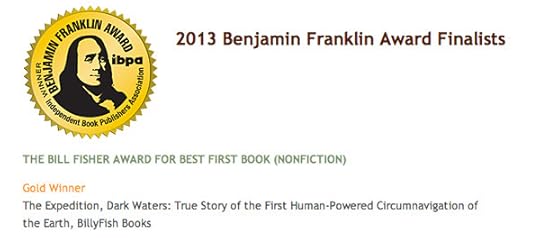
June 8, 2013. BillyFish Books wins best first book (nonfiction) for The Expedition, Dark Waters: True Story of the First Human-Powered Circumnavigation of the Earth, presented by Howard Fisher at the Independent Book Publishers Association (IBPA) gala in New York last week.
 Massive congratulations to managing editor Tammie Stevens for believing in the story and working tirelessly to bring it to publication. Two years ago no one wanted the manuscript. After turning down a six-figure advance from one of the big six for their crummy ghostwritten version, I’d been rubbished by mainstream publishers: “He’s too difficult to work with. Doesn’t do what he’s told.” Well, I’ve got news for you fatheads. Sometimes it takes a little time, love and effort to produce something with quality. Quality underpinned the expedition journey from the beginning: from Chris and Hugo’s attention to detail in Moksha, the boat that withstood the world’s biggest oceans; to hitting two pairs of antipodes en route, thereby completing a true circumnavigation as delineated by Explorers Web and Guinness World Records; to telling the story right.

A journey isn’t over until it’s told, and Tammie helped me do just that, and to do it right!
Check out the upcoming BillyFish Books title on Lazarus, the dog who came back from the dead. Sure to be another award winner.

May 7, 2013
Dark Waters wins Eric Hoffer Award for Books

May 6, 2013. BillyFish Books editor Tammie Stevens and I are delighted to announce that Dark Waters, first in The Expedition trilogy chronicling the first human-powered circumnavigation of the Earth, has won the First Horizon Award for the current Eric Hoffer Award season.
The First Horizon Award is given each year to the highest scoring books by debut authors. It honours the memory of the great American philosopher Eric Hoffer by highlighting salient writing, as well as the independent spirit of small publishers.
A little vindication after turning down six-figures for a ghostwritten version, and being blacklisted by the Big Six. Power to the little guy!
Jason

April 27, 2013
The Expedition book 1, Dark Waters, published in the UK and Rest of the World
After some distribution hiccups, I’m thrilled to announce UK and worldwide publication of Dark Waters, first in The Expedition trilogy chronicling the first human-powered circumnavigation of the Earth.

UK best price £9:16 with Amazon.co.uk, Blackwell’s or Waterstones. Australia: Bookworld, Angus and Roberston.
Ebook version available for Kindle, Nook, iTunes, Google Play, Kobo. Get signed copies direct from the publisher.
DESCRIPTION: He survived a terrifying crocodile attack off Australia’s Queensland coast, blood poisoning in the middle of the Pacific, malaria in Indonesia and China, and acute mountain sickness in the Himalayas. He was hit by a car and left for dead with two broken legs in Colorado, and incarcerated for espionage on the Sudan-Egypt border.
The first in a thrilling adventure trilogy, Dark Waters charts one of the longest, most gruelling, yet uplifting and at times irreverently funny journeys in history, circling the world using just the power of the human body, hailed by the London Sunday Times as “The last great first for circumnavigation.”
But it was more than just a physical challenge. Prompted by what scientists have dubbed the “perfect storm” as the global population soars to 8.3 billion by 2030, adventurer Jason Lewis used the expedition to reach out to thousands of schoolchildren, calling attention to our interconnectedness and shared responsibility of an inhabitable Earth for future generations.
The second book in the series, The Seed Buried Deep, will be available soon. Apologies for the delay in publication.
Special thanks for bringing this story to the written page go to Kenny Brown (photos), Tammie Stevens (editor), Rob Antonishen (maps), and Anthony DiMatteo (editing).

March 25, 2013
Film Preview Clip – Indonesia
A little preview of The Expedition film, from kayaking through Indonesia. Thanks to all who have contributed so far to raise finishing funds. Campaign ends in 3 days!

March 22, 2013
Last chance to bring The Expedition film to completion

Huge thanks to everyone who has pledged so far to Kenny Brown’s Indiegogo campaign. The funding drive ends soon. However, there’s still time to reserve your advance copy of the DVD, signed books, photos, and much more!
Jason Lewis