Jason Lewis's Blog, page 3
September 7, 2016
Stuart Smith 1939 ~ 2016
Some sad news to share with you all: Stevie’s father Stuart lost his battle with terminal cancer a week ago last Wednesday. He died peacefully in his sleep.

Stuart was one of the early driving forces behind the expedition. When few others took Steve’s embryonic idea seriously, Stuart became a walking, talking evangelist for Pedal for the Planet (the original project name), especially in his local watering hole. His infectious enthusiasm regularly convinced customers to hand over ten pounds for a vinyl name on a boat that didn’t even exist yet. This was the early seed money that helped purchase materials to start building Moksha, the unique craft that Steve and I would use to cross the world’s oceans by human power.

Lack of commercial backing would continue to be our nemesis for the next 11 years until the expedition reached Singapore, so we were very fortunate to have Stuart lead grassroots fundraising drives in Portugal, Miami, San Francisco, Monterey, and Hawaii. Looking back, I’m not sure the expedition would have remained afloat otherwise. When people ask what was the toughest part of the 46,500-mile journey, often they’re surprised to learn that it was generating the means to keep going financially, not the physical journey itself.
Many of you no doubt have special memories of Stuart, and a portion of them (I’ll wager) include good cheer and unbridled laughter. But one in particular stands out for me. I remember him appearing at my hospital bedside the morning after a drunk driver ran me down on my rollerblades in Pueblo, Colorado. After learning of the accident, Stuart had jumped on the first plane from Fort Lauderdale to come and care for me during the recuperation period. Over the ensuing months, he and I toured local schools, giving free presentations, and it was out of these introductions with teachers that our educational mission really took shape, eventually channelled through a bespoke 501(c) 3 non-profit organization.
Stuart was a larger than life character. He will be sorely missed.
There will be no church service. The family plans to scatter his ashes at sea at Salcombe, Devon, in a few months’ time, followed by a drink at the pub. If anyone wishes to pay their respects, please let Stevie know by email at: genshodaiku@gmail.com.
Jason

The post Stuart Smith 1939 ~ 2016 appeared first on Jason Lewis.


July 24, 2016
Micro Earths – Exploring Energy Efficiency
“We simply must balance our demand for energy with our rapidly shrinking resources. By acting now we can control our future instead of letting the future control us.”―JIMMY CARTER
Most of our household electricity still comes from burning fossil fuels—gas and coal accounts for 60% of total UK usage, for example. The typical North American uses 4,629 kWh of electricity each year, six times the global average of 731 kWh. Europeans use around 1,996 kWh. To become part of the solution to a sustainable energy future, we each need to take a look at where our electricity comes from, how much we use, and decide what to do differently.
Fortunately, there are some excellent models to guide us.
Some Micro Earths have reached 100% energy self-sufficiency by combining energy efficiency measures with renewable options. We’ll be travelling to these secluded communities to investigate how the residents not only save on their electricity bill but also earn residual income, experience fewer power outages, and enjoy greater energy security by making use of local resources rather than relying on imported fuels.
More at http://microearths.com/
* * *
All Rights Reserved – © 2016 Jason Lewis
The post Micro Earths – Exploring Energy Efficiency appeared first on Jason Lewis.
June 26, 2016
Micro Earths – Exploring Waste Matters
“Water and air, the two essential fluids on which all life depends, have become global garbage cans.”―Jacques Yves Cousteau
Those of us living in affluent countries discard an average of 4.3 pounds of waste a day, enough to fill a 3,100-mile-long column of refuse trucks bumper-to-bumper from New York to San Francisco.* This contributes to a global annual total of three trillion tonnes, the vast majority of which either ends up in methane-emitting landfills or is burnt, producing toxic chemicals known as dioxins. Two thirds of our waste is organic (mainly food, a quarter of which is never eaten), and a third of it paper and plastic. But, you may say, if I’m not personally affected by any of these things, why should I care?
To start with, we can save a lot of money—over £700 annually per household in the UK, for example. We’ll be targeting remote Micro Earths where people use imaginative ways to produce near zero waste and also maintain a high standard of living. What are they doing right that we can translate to in our own lives and draw benefit from?
More at http://microearths.com/
* * *
All Rights Reserved – © 2016 Jason Lewis
* Source: The World Bank
The post Micro Earths – Exploring Waste Matters appeared first on Jason Lewis.
June 9, 2016
Micro Earths – Exploring Food Sustainability
“Nothing will benefit human health and increase chances for survival of life on Earth as much as the evolution to a vegetarian diet.” ―Albert Einstein
The world’s growing appetite for meat and dairy products is now the leading driver of biodiversity loss and a major contributor to climate change and pollution. An average of 22.6kg of CO2 is emitted to produce just 1kg of beef, compared with 0.9kg of CO2 for the same amount of lentils. This and the release of methane and nitrous oxide has made the livestock sector one of the biggest emitters of greenhouse gases: 18% of the global total, more than all cars, trains, planes and ships combined.*
Scientists also warn the Earth’s sixth mass extinction, the man-induced Holocene extinction event, is already underway with a projected loss of over 75% of the world’s species—caused in large part by the clearing of habitat for livestock. In Central America alone, 40% of all rainforests have been cleared in the last 40 years for cattle pasture.
So what’s the good news?
There are isolated communities where for centuries people have used sustainable diets that deter disease and ensure the security of the biosphere they depend upon for survival. Eating sustainably can mean better tasting food with fewer pesticides and unhealthy food additives.
Our Micro Earths expeditions will set out to explore these examples of food sustainability in the hope of discovering the inhabitants’ secret to longevity.
More at http://microearths.com/
* * *
All Rights Reserved – © 2016 Jason Lewis
* Source: United National Food and Agriculture Organization
The post Micro Earths – Exploring Food Sustainability appeared first on Jason Lewis.
May 30, 2016
To the Brink ebook available
To the Brink is now available for Kindle, iPad, Nook and Kobo. If you can’t find a link for your country or device listed below, cut and paste the book’s ISBN into your browser: 9780984915552. Happy e-reading!

BILLYFISH BOOKS STORE
Master List
USA
Kindle, iTunes, Nook, Kobo, Google Play, Google Books
UK
Kindle, iTunes, Google Play, Google Books
INDIA
Kindle
* * *
All Rights Reserved – © 2016 Jason Lewis
The post To the Brink ebook available appeared first on Jason Lewis.
May 19, 2016
Micro Earths – Exploring Water Security
One pressing issue I’ll be exploring on the Micro Earths expeditions is water security.
Water security is one of the biggest challenges for global sustainability as aquifers continue to be over pumped, rivers dry up, and wetlands disappear to development.

The demand for water has been growing at twice the rate of population increase over the last 100 years, a rate that is set to accelerate in the next decade by 50% in developing countries and 18% in developed countries. By 2025, 1.8 billion people will be living in areas of absolute water scarcity and population growth alone will account for the consumption of 70% of all available fresh water.
Clearly, we cannot continue down this unsustainable path.
As well as industry initiatives in water treatment, re-use, and desalination, we can examine our own individual consumption patterns. Those of us living in affluent countries use between 30 and 100 gallons a day, well above the global average. Compare this with desert Micro Earths communities where people live comfortably on just a few gallons of water a day.
What can we learn from these communities to reduce household costs and guarantee future water security for our own families?
More at http://microearths.com/
Reference: UN-Water, the United Nations inter-agency coordination mechanism for all freshwater related issues
* * *
All Rights Reserved – © 2016 Jason Lewis
The post Micro Earths – Exploring Water Security appeared first on Jason Lewis.
Exploring Water Security – Micro Earths
One pressing issue I’ll be exploring on the Micro Earths expeditions is water security.
Water security is one of the biggest challenges for global sustainability as aquifers continue to be over pumped, rivers dry up, and wetlands disappear to development.

The demand for water has been growing at twice the rate of population increase over the last 100 years, a rate that is set to accelerate in the next decade by 50% in developing countries and 18% in developed countries. By 2025, 1.8 billion people will be living in areas of absolute water scarcity and population growth alone will account for the consumption of 70% of all available fresh water.
Clearly, we cannot continue down this unsustainable path.
As well as industry initiatives in water treatment, re-use, and desalination, we can examine our own individual consumption patterns. Those of us living in affluent countries use between 30 and 100 gallons a day, well above the global average. Compare this with desert Micro Earths communities where people live comfortably on just a few gallons of water a day.
What can we learn from these communities to reduce household costs and guarantee future water security for our own families?
More at http://microearths.com/
Reference: UN-Water, the United Nations inter-agency coordination mechanism for all freshwater related issues
* * *
All Rights Reserved – © 2016 Jason Lewis
The post Exploring Water Security – Micro Earths appeared first on Jason Lewis.
May 11, 2016
Micro Earths – Exploring a Sustainable Future
Following completion of The Expedition trilogy, I thought you might be interested to know how the human-powered circumnavigation segues into the next project: Micro Earths.
Throughout the journey I was dogged by a single burning question, one I feel we all have a moral duty to try and answer for the sake of future generations: How do you live your life so you’re part of the solution to a sustainable future, not part of the problem?

For the water sections of Expedition 360 we used a tiny boat (Moksha) powered by pedals to cross the Atlantic (111 days), Pacific (178 days) and Arabian Sea (54 days). With only 24 square feet (4x8ft) of living space, our world shrank around us, and performing even basic tasks like cooking, washing clothes, or going to the toilet proved a challenge.
We also became acutely aware of the finite limits of our floating universe. At sea for months on end, we learnt how to conserve water, food, energy, and other essential resources to survive. In short, we either adapted to the confines of our closed system or risked running out of resources and not making it.

The secret to responsible living on a crowded planet, I realized, was learning how to survive on a small boat. But that’s not something many people can relate to. Along the circumnavigation route we also encountered small, isolated communities that not only survive but thrive within finite constraints. The objective, therefore, is to return to these Micro Earths and unearth timeless sustainability lessons we can learn from in complex but unsustainable societies. This universal knowledge, aimed at countries fulfilling their COP21 Paris Accord commitments to limit global warming to below 2 degrees Celsius, will centre around 7 principles for a sustainable future.
More at http://microearths.com/
* * *
All Rights Reserved – © 2016 Jason Lewis
The post Micro Earths – Exploring a Sustainable Future appeared first on Jason Lewis.
May 1, 2016
To the Brink published & New Expedition Project announced
May 1, 2016. To the Brink, the last instalment of the Expedition 360 circumnavigation trilogy, is finally available. You can follow this link to place an order wherever you are (including signed copies) or search online referencing ISBN 0984915524. For those of you in the US, Amazon.com is the cheapest option with an impressive 40% discount (which is actually good for us). Ebook formats will be out in a week.
Now to the future! Today we announce an exciting new expedition project…
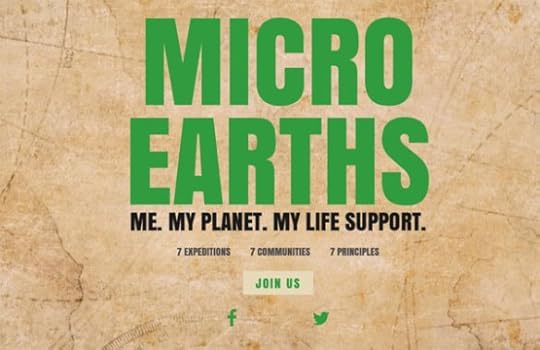
7 expeditions to 7 communities to explore 7 principles for a sustainable future.
More at microearths.com
* * *
All Rights Reserved – © 2016 Jason Lewis
The post To the Brink published & New Expedition Project announced appeared first on Jason Lewis.
April 17, 2016
To the Brink – Countdown to Book Launch
I’m sure you all thought I’d either died or given up trying to finish The Expedition story.
A year ago it was finished – or so I thought. I remember taking one last look at the manuscript before sending it off and realizing it needed another pass. Twelve months on, I have a physical copy in my hand.

To the Brink will be officially launched the end of next week.
My former uni pal Stevie Smith pitched me his hair-brained idea in 1992, suggesting it would take around three years to complete a man-powered circumnavigation. 24 years on, I can finally draw closure. 24 YEARS! That’s half a lifetime, literally (I’m now 48).
Having taken as long as it has to get the trilogy out, it may come as no surprise that I actually hate writing. Words and sentences rarely do my bidding (I nearly failed my English O Level), and it takes multiple edits to get something sounding vaguely coherent. But, like the proverbial tortoise, I get there in the end. On more than one occasion during the writing process, it occurred to me how the physical journey was merely a warm-up for a literary one, both being tortuously slow, tedious, largely solitary endeavours with no apparent end in sight.
And, as you’ll find out in the third and final instalment, it turned out to be a very good thing that I turned down the six-figure advance from HarperCollins and wrote the thing myself. Gut decisions have an uncanny way of being correct.
So what’s next?
I’ll be making an announcement in conjunction with the official book launch next week, and I promise this new project won’t take 24 years to complete!
* * *
All Rights Reserved – © 2016 Jason Lewis
The post To the Brink – Countdown to Book Launch appeared first on Jason Lewis.