
Michael Lopp's Blog, page 43
May 9, 2014
Pretending How to Fly
I still have not worn the Oculus Rift kit and I’m certain there is a holy shit moment in my future, but this (pretty cool) video only re-enforces my concern: do I want to spend my time pretending how to fly or learning how to fly.


May 7, 2014
May 5, 2014
Sponsor: A World Without Pens
I knew I was going to love Spike Jonze “Her”, but I didn’t know that my first opportunity to watch it was going to be on a long transatlantic flight where I’d be able to watch it… multiple times. Like three times. In a row.
There’s a longer article to be written about “Her”, but right now I want to bitch a bit. Jonze imagines a not-to-distant future where our operating system are becoming sentient. It’s not a science fiction movie because Jonze doesn’t get lost in in the science, he worries about how science might affect us socially. So, it’s a social science fiction movie?
There are small touches throughout the movie to remind you of this not-too-distant future. People dress like dorks, video games are awesome and immersive, and the denizens have strange new jobs appropriate to this future. Our protagonist writes personal letters for other people. Correction: he dictates these letters because in this future dictation is perfect and the need for keyboards has apparently vanished.
As I binged on “Her”, I became increasingly concerned about the absence of keyboards. I realized that if we had no keyboards, what happened to writing utensils? Pencils? And pens?
Look around where you’re sitting right now. Reach for a pen and something to write on. Sign your name and tell me how it feels. How does the pen feel in your hand? Too heavy? Too light? How does the ink land on the paper? Too thin? Too heavy? It’s probably been a long time since you’ve obsessed about a pen, you’ve taken it for granted. Now imagine a world with no pens.
What a fucking nightmare.
Jonze’s movie is about how technology is changing our relationship with each other. It’s funny, insightful, and often stop-you-in-your-head brilliant. Watch it. Watch it twice. Watch how in the future they never write, they just talk.
In the present, take some time to be aware of when you write. One of favorite ways to write is with a Zebra Sarasa 0.5mm black gel pen. It speaks to me. For the next two weeks, JetPens.com will throw this amazing pen into any order over $25 when you click on this coupon. This means there might be a great pen in your future.
May 4, 2014
Very Important Strangers
A few weeks ago I spoke at the excellent re:build conference in Indianapolis, Indiana. While it was my first time in Indiana, the setup was familiar. 200+ attendees, great venue, single track, and conference coordinators who know how to put on a great conference. (And one surprisingly gotham-y gorgeous building.)
I was the last speaker of the conference, which means I had a lot of time to sit in the green room and watch speakers go through their respective speaking pre-games. These observations resulted in a short list of pre-game activities that I believe are important to standing up and telling stories to groups of very important strangers.
Own your pre-game
You’re nervous. This is normal. The act of standing up in front of a room full of strangers and telling stories is not normal. Moreover, if you’re a frequent reader of this blog, you’re also likely a nerd-type person, which means your people skills are… unique.
To compensate for this nervousness, I give myself the illusion of structure by following the same pre-game for the two hours before a talk, and it looks like this:
In the hotel room, put on some music and lay out the outfit, which consists of a black button-up collared shirt, jeans, and my favorite black boots. If you’ve seen me speak in the last few years, you’ve seen this outfit.
If it’s an afternoon talk, take a shower.
Post-shower, primp, get dressed in the outfit, and keep rocking out.
With roughly an hour and a half until talk time, it’s time for a real drink. Via a bar I’ve already discovered (often the hotel bar), I have a double kamikaze, sit at the bar, and write. This is roughly a 30-minute activity, after which I head to the venue and start the serious obsessive compulsive preparation, which I’ll finish in a moment. First…
Reduce as many variables as possible
The downside of obsessive compulsive speaking prep is that when something unexpected goes wrong, you lose your shit. I’m following a well-designed workflow in the moments that lead up to me starting a presentation, and when that workflow is broken, I’m disproportionately aggravated and distracted. This is why I take every single precaution to make sure things can’t go wrong. My job is is to eliminate variables. This is why I start every presentation with the following slide:

I have this slide available in both current Keynote and Keynote ’09.1
When this slide is displayed at the venue, you can eliminate the following variables:
Are all the typefaces in your deck on the presentation machine? (Note: I use Futura Std, which you might not have. Its purpose is to trigger the font error message you’ll get when you open this. This is a problematic error message.23)
Is it the right typeface? (On my slide, I took a screenshot of 36 point Futura and placed it next to the Futura formatted in Keynote. If you don’t get an error and yet these look different, you’re sporting the incorrect Futura.)
Are your slides being cropped? (Can you completely see all five circles?)
Are your slides being stretched? (Are your circles circular?)
Is the color correct? (Are your colored circles the correct colors?)
Finally, I have a disaster prevention bag nearby, which holds:
power brick and power cord
international plug converter
presentation clicker
video cables specific to your computer (VGA to mini DVI, DVI to mini DVI).
Most conferences are well equipped and have all of this gear (and backups) on hand. They have this gear readily available because they are disaster specialists. But because disasters do frequently occur their gear has the ability to simply vanish. I use something out of this bag every single time I speak.
All of this preparation helps, but disasters still happen and my advice is easy: chill out. Remember that you are surrounded by well-intentioned people whose job it is to make sure things go smoothly, and who have likely seen your particular disaster recently. Ask for help. Their infectious calm can be helpful, which makes my next set of advice a little confusing.
Give yourself 30 to 60 minutes to panic
I arrive at the venue 30 to 60 minutes before the talk, take a glimpse of the venue to get a sense of the audience if they’re there, head to the green room or equivalent, and then I let myself panic.
The point again: standing in front of a bunch of strangers and baring your soul is not a natural act. There are humans who stand up there up and make it easy, but I know two things about these humans: the first time they did it, they were terrified, and the best ones are still a little terrified.
With my double kamikaze, black shirt, and panic, I find somewhere quiet and start playing that Sigur Rós song on repeat. I pace and let myself freak out a bit. Yes, I’m nervous. Yes, I am going to screw up in some unexpected way. Yes, there will be some unexpected disaster that will mess with my flow, but I also know that nervousness is normal and authentic. I know that every screw-up is an opportunity to improvise and create something new. I know there are helpful people hiding everywhere to fix disasters. But most important I remember my last thought…
Understand that they are you
The advice they will give you is: “The audience wants you to succeed”. This is correct, but only partial truth. I’m working on a talk about presentations for a future conference, and one of the aspects of speaking that I believe is part of the weird power dynamic that occurs between the speaker and the audience is the uncomfortable – perhaps even subconscious – understanding that the audience knows it could easily be them up there baring their souls.
The biggest lesson I’ve learned over the past 10 years is one I can tell you, but you will not understand. I’ve only become an okay speaker by being myself. I’ve only become okay when I started to believe that I’m up there with a few close friends – we’re shooting the shit – and, for now, it turns out that I happen to be telling the stories.
I’m a stranger to most people in the audience. Yes, they don’t want me to fail, but the reason they don’t want me to fail is that’s them up there. Ever been to a big concert? When the band is the stage, are you worried they’re going to fail? Nope. A speaking venue is different: they chose to attend this particular conference to hear a particular story, and you were chosen to be that storyteller. It’s more intimate. It’s more personal. We’re all humans – not rock stars.
The audience wants you to succeed because, weirdly, your failure would also be theirs. They’re invested in your speaking success and that helpfully makes them less strangers.
This version of the introduction slide is based on fork by Tim Brown from my original concept. ↩
There is a stunningly annoying bug in the latest Keynote that gives you warning when you don’t have a font installed used in the presentation (good), but Apple gives you absolutely no means for easily fixing this problem (bad). ↩
Rowan Manahan has a slick work-around for font replacement. Use Keynote ’09′s font replacement feature to get rid of pesky residual fonts. Nice. ↩
April 20, 2014
The Diving Save
Angela quit. She walked in on a Monday morning, went straight into Alex’s office, resignation letter in hand, and said, “I have a great offer from another company that I’ve accepted. My last day is a week from Friday.”
Alex reacted. After listening to Angela’s resignation, he told her simply and clearly, “I know you don’t want to hear this. I know you’re not asking for a counter offer, but let me see what I can do.” Alex got on the phone with his boss. He called HR, and he called Legal. During those calls, he got approval to give Angela a substantive raise, a stock grant, a bonus, and a promotion.
He did all of this before lunch.
After lunch, he took this counter offer to Angela and he did the most important thing. He showed her all the components of the counter offer and he told her a story. It was a story of why she should stay at the company as an engineer, her role in the company’s success, and all of the opportunity that was ahead of her. He told this story amazingly well.
A week later, Angela walked into Alex’s office and told him that she was staying. She stayed for years.
This is a well-performed Diving Save.
Diving Save Disclaimers
Diving Saves are usually a sign of poor leadership. People rarely just up and leave. There are a slew of obvious warning signs I’ve documented elsewhere, but the real first question you have to ask yourself once you get over the shock of an unexpected resignation is: “Did you really not see it coming? Really?”
There are unavoidable Diving Saves. There are lots of companies that are foaming at the mouth crazy about the idea of recruiting your bright people. Sometimes these companies successfully sneak in and recruit a perfectly happy person who really wants to stay, but the offer is just so… bright and shiny. They have to accept.
Whether you screwed up or they were enticed by something bright and shiny, you start the Diving Save answering a lot of questions in a very short amount of time. The big question you have to answer is:
Do You Really Want to Do This?
A Diving Save requires a lot of urgent work that needs to be done immediately, and there’s a good chance this person still might leave. It’s going to be a shock when they open their mouth and the unexpected words “I resign” come out. You’re likely going to have a strong emotional reaction, but before you act you need to quickly answer a lot of different questions, like…
What value is this person creating? What is the unique work this person is doing that would be hard to replace? List three things this person has built or accomplished in the last year. Do you need more of these things?
What would the obvious and non-obvious impact to the team be if this person left? Move away from the work – how does this person fit into the team? What role do they fill that doesn’t have a title? Are they serving as essential connective tissue? Who do they balance out? Who can they translate for? Who would storm into your office absolutely furious if this person left?
What would the impact to the company be if this person left? Now that you’ve considered team impact, what about company impact? What is the story that is going to be told by people outside of the team regarding this person’s departure? Do you care about this story? How is attrition in your company? How many people have left in the last six months? Could this person’s departure trigger an exodus?
What are the crazy, unpredictable side effects of this person leaving? Get paranoid now. What are the least likely things that might occur when this person leaves? These theories can be goofball, but now is a good time to be paranoid – someone just walked in and quit and you weren’t expecting it. What else might be up? How might this person’s departure accelerate these hopefully unlikely scenarios?
What is the impact of performing a Diving Save? Ideal professional protocol involves a departing person who legitimately cares about the health of the team and does as much as possible to prevent disrupting it with their potential departure. However, if this was the way that people worked, the fact that a successful Diving Save had been performed would never be known to anyone except a small handful of people who needed to know.
People don’t work this way. You have to assume that much of the narrative and compensation that you’re about offer will become known by the team. I understand why people share this confidential information, but I wish they wouldn’t. You need to first understand that some set of people are going to know you performed gymnastics to give this person a reason to stay (whether they stay or not), and also consider the impact of the team knowing this. Think about it like this: if you were to explain to a random person – in great detail – the potential intricacies of your Diving Save, would they agree that you are doing the right thing?
A Compelling, Unwavering Story and A Show of Force
Once you’ve chosen to perform a Diving Save, you need to adopt a specific mindset: This person is not leaving. It’s a bit of a delusional perspective, since there is a very good chance they might leave, but for now your opinion is a resolute no way.
It took quite a bit of courage for this person to resign. They had to completely decide to leave, and, by doing so, they have mentally prepared themselves. Your job is to stand in clear mental opposition to that decision. Your job is to elegantly and professionally disassemble their plan, and you’ll do so with three interrelated tasks: Story, Compensation, and Curveballs.
Story
Your first and most important task is to thoroughly answer the question: “Why should they stay?” You can start thinking about that answer by asking the question: “How did that other company sneak their way into this person’s head?” What was attractive to them about leaving? Was it the team? The opportunity? The compensation?
You had a unique opportunity to gather a lot of this data when they were resigning, but you were likely slightly in shock. Now is a good time to reflect on their resignation. What reasons, however small, did they give for leaving? You may or may not integrate this data into your Story, but as a starting point it is essential that you understand the mental conditions that led to their attempted resignation.
I start by framing the Story around opportunity. What is the narrative that I can tell about how this person can contribute to the company and to their team? What are the obvious opportunities ahead of them and what do they have to look forward to? Why have they stopped being able to see these opportunities themselves? What does winning look like? What are they going to build, why does it matter, and how it is going to help them grow?
The opportunity narrative is the cornerstone of your Diving Save. It frames everything that follows, and if you can’t define a compelling story regarding both the short-term and long-term prospects for this person, I’m not sure why you’re frantically working on a Diving Save.
Try a draft of your Story on a trusted, well-informed someone. They’ve got to have enough context about the person to know whether your story is credible and compelling. If, after a few practice rounds, your trusted someone isn’t sold, you don’t have a Story, yet.
Compensation
Salary, stock, bonus, and promotions. These are easy things to understand. They are a simple way to measure relative value, but completing this task starts with a warning: Is this situation completely about Compensation?
Here’s the situation I’d like you to avoid. If the person’s current compensation is fair, and simply raising it convinces them to stay, is this someone you want to stay? While Compensation is easy to compare, the reason I wanted you to start with developing the Story is because you want them to stay because of the compelling narrative, not simply because of compelling Compensation.
If it’s only about money, it will always be about money. You might be able to build a compelling Compensation package, and they might accept it, but if the only reason they are staying is money, not opportunity and growth, you’re delaying the inevitable. There is nothing preventing another enterprising company from building an even brighter and shinier offer and – guess what – they’ll be leaving… again.
If it’s not entirely about Compensation, my advice is, oddly: go big on Compensation. Let’s remember all the components:
Base salary
Bonuses
Title
Role
Stock.
For each of these aspects, you need to first ask yourself: “Is this fair? Is what I’ve compensated this person fair relative to their work?” If it’s not, what do you need to do to get it there? It’d be also good to understand why has it not been fair all this time? This is your baseline and it might clear up some friction between you and the employee, but you’re not done yet.
The next question is: “If this person kicks ass for the next two years, what would their compensation look like?” That’s probably a lot of money in salary, bonuses, and perhaps stock. That’s likely a promotion, too. I’m not saying this is your Diving Save package, but I want you to think about each aspect of compensation after two amazing years and then pick and choose the aspects that you believe will resonate.
As you’re planning the aspects of Compensation, you also want to understand your wiggle room relative to all the components. As we’ll see during the Pitch, you may need to adapt on the fly.
Two non-monetary aspects to consider: title and role. Title is the name that they can put on their business card. I believe in high tech this is becoming an increasingly irrelevant perk, but some folks grin when it says “Senior” in their title. So, go for it. The more important part of the promotion is the role: what is the work they are going to be doing? This is better defined and explained as part of your Story, but since title/role and compensation are often intertwined, you might be explaining it again here in Compensation.
The intent of the compensation package is a show of force. When you present the details of this offer, they should feel two things: you’ve considered everything, and holy shit.
Curveballs
With Story and Compensation built, your last task is Curveballs. This is a grab bag of hard-to-predict situations and questions that arise during a Diving Save, which might sound like, “Hey, I already gave my new employer a start date,” or “I already told a lot of people I was leaving. We had a party. What are they going to think if I stay?”
The core issue that you need to address is that this person likely fully decided to leave. This resignation (hopefully) wasn’t a ploy to get a raise; they were legit leaving and had altered their mindset appropriately. They were gone. You can start by working out in your head what you can do to make it socially ok and comfortable for this person to stay. Build a compelling reason and a one-liner answer for when the person inevitable gets asked why they chose not to leave.
If you’ve built a solid Story and have compelling Compensation, a lot of other Curveballs conveniently go away. If you understand your narrative about their career and reasoning behind how to compensate them, a lot of questions regarding “What are people going to think?” will be answered automatically. They are going to think you went with the best job available.
Before you pitch them on why they should stay, it’s worth replaying in your head every single word spoken when they resigned. You can’t predict all the Curveballs until you get to the Pitch, but from the time they resigned to the time it took you to build and present a response, small thoughts may have turned into scary Curveballs. The more you can predict and address before you pitch, the better your Story.
The Pitch
In the Angela Diving Save, one of the more impressive aspects of the action was the sense of urgency. Alex moved on the Diving Save swiftly and Angela noticed. He didn’t have to say a thing to for her to intuit that he believed that keeping her was his #1 priority. This sense of urgency is a great way to start a pitch – an unspoken but clear understanding that you, the hiring manager, are taking this situation seriously.
How you need to pitch the details of the Story and the Compensation, how you need to handle Curveballs, is entirely dependent on what this unique person – who is not resigning – needs to hear. Your Pitch needs to:
Be tailored to the person. What does this particular beautiful and unique snowflake need to hear? Have you addressed every single one of their concerns? Are they actually mad about something completely unrelated to their role and need to vent? I don’t know what specific advice to give you because I don’t know the specific person, but if you fail to hear them, you’re not going to save them.
Be delivered and then be adapted. When you get to the particulars of the Story and the Compensation, I like to tell the whole story. This is what I’m thinking… I deliver everything as one complete narrative, and then I shut the fuck up. The first few words out of their mouth, their immediate reaction, is going to tell you a lot. If they say the following, this is my initial reaction:
Wow. We’re in good shape.
Well. We’re in bad shape.
Hmmmm. We’re in particularly bad shape.
Of course, you can’t base your reaction on a single word, but every word matters. You need to listen hard to what they’re saying, and if you’ve done your homework, you can adapt your Save on the fly. They’re interested in more stock and less base? Great, what about X?
You’re going to want an answer at the end of the Pitch, but in my experience, this rarely occurs. They’ve had weeks to think about and deliver a resignation and you’ve had 36 hours filled with email, phone calls, and meetings to work out a response. Once you’ve Pitched, give them time to consider. Make sure you’ve answered every single one of their questions and then pick a time to meet again.
Saved
They stayed. All that work paid off. Congratulations. Don’t pat yourself on the back too hard. A Diving Save is not a professional move at which you want to learn to excel. If you’re the guy at the company who is great at Diving Saves, you’re also the guy who is working at a company where folks apparently need to resign in order to have a real conversation about their roles.
Last worry: you need to remember that this person who recently decided to stay also recently decided to leave. They completely imagined and started acting in a world where they were leaving the company. We humans are fond of structure, habit, and familiarity, and this recently-saved person picked a new company full of strangers and opaque opportunity. This human had to make a brave leap to make this choice, and just because they chose to stay for now doesn’t mean they’ll remain.
April 19, 2014
April 13, 2014
Protecting Yourself from Heartbleed
Earlier this morning, I tweeted:
Heartbleed == Change every single one of your passwords.
— rands (@rands) April 13, 2014
This is not actually good advice. You shouldn’t be changing your password on a server until the server administrator has confirmed whether their servers were affected and, if so, whether the server has been patched.
Mashable appears has an up-to-date breakdown of the most popular services out there and their disposition relative to Heartbleed.
April 6, 2014
Presentation Design Joy
As appears to be tradition now with the iWork suite of applications, Apple is slowly updating the applications to both address minor issues as well as introduce functionality that was removed in the most recent major update.
As is now custom, I keep the old version of Keynote around to compare and contrast feature set because while Apple’s “What’s New in Keynote” is useful, it often neglects to mention interesting changes to functionality and design.
The headline is: nothing earth shattering has landed in Keynote 6.2 that is going to affect my presentation design workflow. To determine this, I compared toolbars, preferences, inspectors, and menu bars between Keynote 6.1 and 6.2. It’s not an exhaustive comparison, but this is where I tend to spend my time and any improvement has potential to increase my presentation design joy.
So, yes, the toolbar is updated. Keynote 6.1′s toolbar is on the top, Keynote 6.2 is on the bottom – click to see a larger version:

This adds a button I don’t need – add a slide – because I’m a keyboard guy and Cmd-Shift-N works great. They’ve also changed the Setup “inspector” to Document which makes sense in my head. These palettes remain frustratingly docked in the main window. As I’ve written about before, I’m uncertain if this is usability improvement, but I’m about to enter a presentation heavy lifestyle over the next three months. I’ll have a better sense of the use of these embedded palettes.
Preferences were mostly unchanged. They added the ability to show slide layout names which I have not figured out. I can display ruler units as a percentage. Ok. Great?
Animations received love with the addition of new transitions and builds. They also added motion blur to the animations which is is a slick visual flourish you’ll never actually see, but will appreciate. Magic Move adds text morphing which means it will continue to be one of my go to animations as my presentations tend to be text focused1. Magic Move is still baffling to set-up and remains fragile as it relies on multiple slides to be… just right, but I’m happy to see it’s evolution.
Presentation view, I believe, remains functionally equivalent to the prior version, but did receive design love.
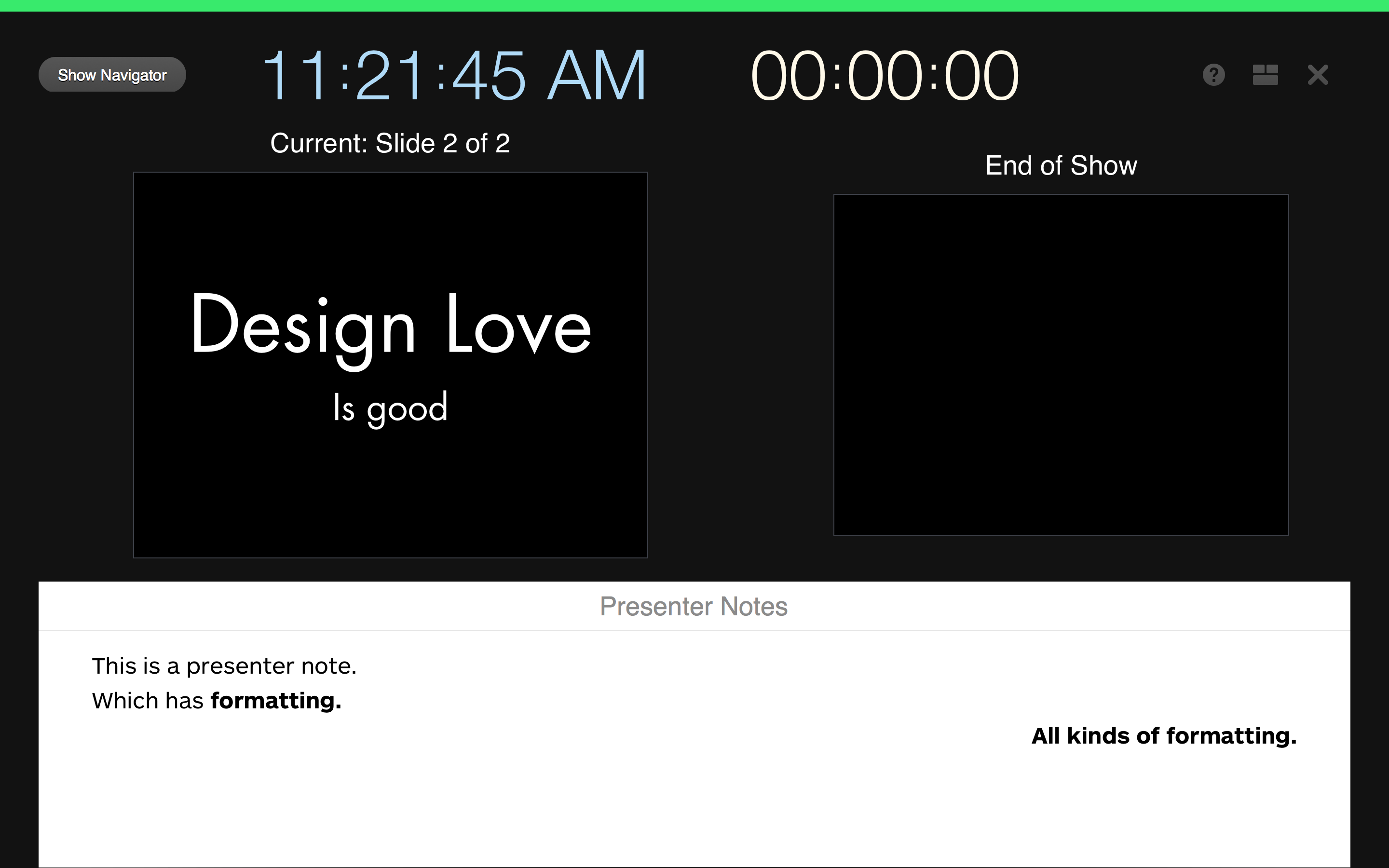
In both practice and play mode2, the presentation view now shows you when you’re ready to proceed with a clear green bar across the top of the view. When an animation is running, this bar is red which is handy. All of the buttons at the top of the window have been increased in size, altered in color, and have better placement to make your presentation practicing easier. Lastly and most importantly, while you still can not perform free form layout of the presentation view, Keynote does allow you to change the style of the presentation notes on a per slide slide. I’m not sure when this handy feature landed, it wasn’t Keynote 6.2. You still can’t change the presentation notes style at the master slide level which would be convenient and efficient at making sure that presentation notes are optimally sized while in the presenter view.
According to the What’s New update provided by Apple, there are many other new features: Alpha image editing, media browser improvements, custom data formats, improved AppleScript support, support for animated GIFS (yay?) and others. Again, nothing earth shattering, it’s a house cleaning release and it’s going to take a few weeks of regular use to see if they’ve increased my presentation design joy.
EDIT: I originally thought this was the returning of the same old text transforms. I was wrong. ↩
EDIT: There was some stop/advance visual cue work in Keynote 6.1 in real presentation mode, but it appears they flushed it out and finished it in 6.2. ↩
If You Happen to Be Building a New Operating System…
You could do a lot worse than the design for webOS. The team recently released a wiki full of documents, design assets, and working samples to the open source community.
Gorgeous examples of flat design.
If You Happen to Building a New Operating System…
You could do a lot worse than the design for webOS. The team recently released a wiki full of documents, design assets, and working samples to the open source community.
Gorgeous examples of flat design.
Michael Lopp's Blog

- Michael Lopp's profile
- 144 followers

