Annie Cardi's Blog, page 98
April 25, 2012
The Explosion of Plot
When I was in high school, I was really into writing stories without plot. Plot was old, I thought; existential angst was in! I wish I had seen this quote back then:
“Plot is people. Human emotions and desires founded on the realities of life, working at cross purposes, getting hotter and fiercer as they strike against each other until finally there’s an explosion—that’s Plot.”—Leigh Brackett
I love that description. Plot isn’t just action; it’s people getting in each other’s way and confronting each other.
Also, I hadn’t heard of Leigh Brackett before, but apparently she co-wrote The Empire Strikes Back. Awesomeness!
(via Writer’s Digest)


If Only Computers Could Write Standardized Test Essays, Too
You know those essay questions on tests like the SATs or GREs? Turns out the ideal reader/scorer is a computer:
“Turns out, though, that standardized test essays are so formulaic that test-scoring companies can use algorithms to grade them. And before you get worried about machines giving you a bad score because they’ve never taken an English class, said algorithms give the essays the same scores as human graders do, according to a large study that compared nine such programs with humans readers. The team used more than 20,000 essays on eight prompts, and you can see in the figure to the right, the mean scores found by the programs and the people were so close that they appear as one line on a chart of the results.”
Says a lot about how we evaluate students’ writing ability, doesn’t it? Ugh.


Be the Cool Kid at the Coffee Shop: Make Your Own Notebook
I’m pretty picky about my writing notebooks. In Writing Down the Bones, Natalie Goldberg advocates for cheap, drugstore notebooks to alleviate the pressure of having to write something grand, but I like having a little big of style in my notebooks. If you want to jazz up a plain notebook, A Beautiful Mess has a create tutorial for making a lace patterned notebook.
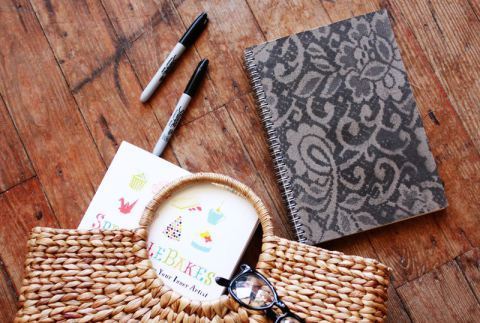
Wouldn’t that be a cool notebook to pull out of your bag at a coffee shop? I’m already feeling the writerly inspiration.
(image: Elise Larson/A Beautiful Mess)


April 24, 2012
Books for Our Boys: Armed Service Editions
My friend Caitlin wrote a fantastic article about a little-known aspect of WWII history: Armed Services Editions. Pocket-sized versions of popular novels like A Tree Grows in Brooklyn were given to soldiers to boost morale.
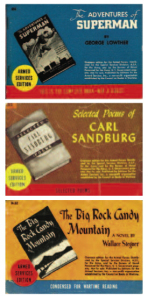 The history of how the books came to be published is fascinating. One part in particular I liked:
“The concept of issuing pocket-sized books to the military didn’t come to the government immediately, nor was the idea of sending books to those overseas new. Book drives for the military had occurred regularly at libraries across the country during World War I. But after the outbreak of World War II, Americans began raiding their personal libraries for books to send to troops overseas with a vigor that far outstripped their previous efforts—motivated this time by nearly a decade of exposure to news stories about Nazi book bans and photographs of towering infernos built to consume “un-German” tomes. The first Nazi book burnings, organized across 34 college towns by the German Students Association on May 10, 1933, reduced some 25,000 books to ash; by 1938, the Nazi government had outright banned 18 categories of books—4,175 titles in all—and the works of 565 authors, many of them Jewish. Now that the United States was officially at war, what better way to strike back at the enemy than by allowing soldiers to read exactly what they wished? Books were no longer simple diversions for fighting men—they had become totems signifying what those men were fighting for.”
I love this idea. Books aren’t just a form of entertainment–they signify intellectual freedom and an appreciation for humanity as a whole.
Make sure to read the whole article; it’s really moving.


Defining YA
From the Atlantic, surprisingly thorough look at the definition and history of YA. One part I liked:
“One thing Y.A. is not is a genre; it’s a category, as with adult literature, containing all sorts of types of writing, from fiction to nonfiction. As Tracy van Straaten, VP at Scholastic, reminded us, “Something people tend to forget is that YA is a category not a genre, and within it is every possible genre: fantasy, sci-fi, contemporary, non-fiction. There’s so much richness within the category.”"
This is rarely stated in other articles about YA. Just as in literature for adult readers, YA has a lot of variety in genre and in depth.
Even for those involved in the world of YA, it can be a hard category to define. So often writers try to figure out who their reader might be, and the divisions can be tricky. Even though readers could only be separated by a grade (say, 8th and 9th), the divisions in their worlds are vast. (Middle and high school are very different animals.)
I’m encouraged to see the Atlantic take on the question of YA without the immediate tone of condescension. (“I don’t tend to read YA, but…”) I hope this article helps readers who are curious about the category but are afraid to dive in because they don’t know much about it.


Around the World in a Library
Flavorwire looks at bookmobiles from around the world. A couple of my favorites:
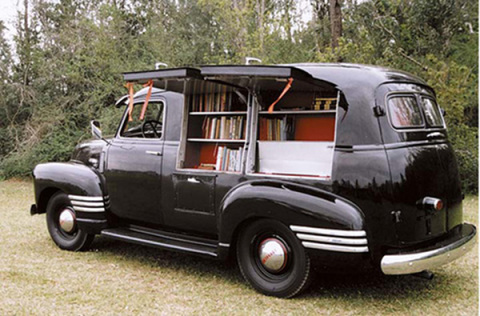
This 1949 bookmobile has so much style! I’d like to drive around in this one.
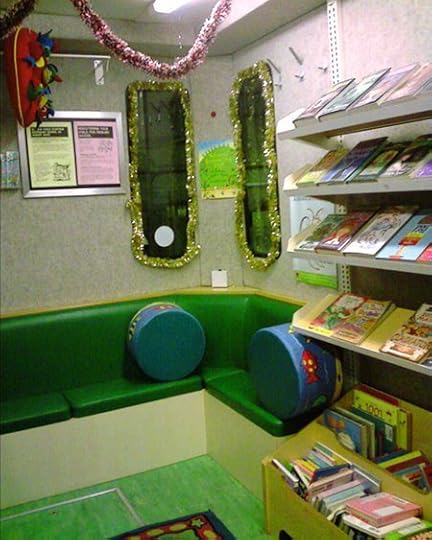
The Edinburgh book bus is the perfect balance of bright and cozy–perfect for young readers.
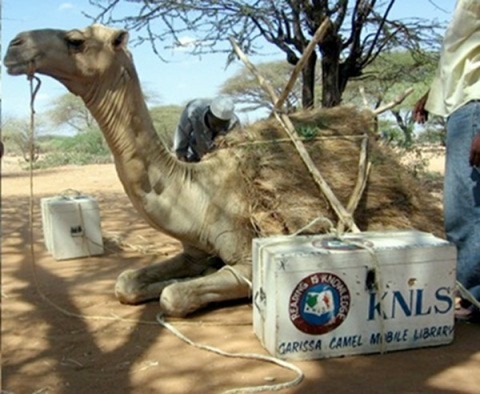
Have you ever seen a real camel? They’re huge! A book camel would be so intense.
(H/T The Paris Review)


April 23, 2012
Links Galore
Lots of cool links for the afternoon:
Cool look at typography and capitalization through body art.
HP Lovecraft is the new Carrie Bradshaw.
You can win at book collecting.
One man is trying to gather and catalog every book ever. He’s also working on every website ever.
Library cats from around the country. Five-year-old Annie would have freaked out over the awesomeness of library cats.


Writer as Curator of Life: E.B White and Writerly Responsibility
I love this article about E.B. White and the responsibility of an author. A quote from White:
“The writer’s role is what it has always been: he is a custodian, a secretary. Science and technology have perhaps deepened his responsibility but not changed it. In ‘The Ring of Time,’ I wrote: ‘As a writing man, or secretary, I have always felt charged with the safekeeping of all unexpected items of worldly or unworldly enchantment, as though I might be held personally responsible if even a small one were to be lost. But it is not easy to communicate anything of this nature.’
A writer must reflect and interpret his society, his world; he must also provide inspiration and guidance and challenge. Much writing today strikes me as deprecating, destructive, and angry. There are good reasons for anger, and I have nothing against anger. But I think some writers have lost their sense of proportion, their sense of humor, and their sense of appreciation. I am often mad, but I would hate to be nothing but mad: and I think I would lose what little value I may have as a writer if I were to refuse, as a matter of principle, to accept the warming rays of the sun, and to report them, whenever, and if ever, they happen to strike me. One role of the writer today is to sound the alarm. The environment is disintegrating, the hour is late, and not much is being done. Instead of carting rocks from the moon, we should be carting the feces out of Lake Erie.”
I think this is particular interesting when paired with E.B. White as a writer of early middle grade novels. I wish I could remember who said this, but within the last year or so I came across a blog post about how middle grade novels are often so full of heart and hope. It sounds like White’s views reflect that. And it’s part of why I like writing for teens–even if there’s a fair amount of anger in a YA novel, it’s not without hope. (Trying to think of a YA novel that doesn’t end with total despair, even if things aren’t perfect or even resolved.)
And I like that White balances out with the idea of “sounding the alarm.” Writing isn’t just meant to convey happy thoughts. We need to be aware of the bad stuff in the world, while also recognizing the good.





New Voices in YA Reading Recap
 The last week has been filled with writerly goodness. This weekend I was at the annual NESCBWI conference (more on that later); before that, I was part of the Brookline Public Library’s New Voices in YA and Children’s Literature series. It was awesome!
Confession: readings (or any kind of public speaking) make me nervous. I’ve never had a terrible experience, but I always get anxious a few hours before the actual event. Fortunately, the vibe at the reading was so enthusiastic and low-key that I quickly forgot about nerves.
I read with three other YA writers, two of whom (Beth Brenner and Mike Dwyer) are good friends. We all have fairly different styles, so it was cool getting to hear everyone’s readings. A few topics covered: girl detectives, reincarnated guards, magical families, and drivers ed. I’m sure it’s hard to plan for different styles in advance, but it worked out really well. Fellow New Voices writers, I need to hear more of your work, immediately.
Series organizer Dorrie was wonderful to work with. She made sure we had necessary info and felt taken care of beforehand, and she kept things interesting during the reading. Usually I stress about Q&A sessions, but Dorrie came up with fun questions that we all got into answering. Dorrie also included a drawing of a bird Amelia Earhart in the program handout. How cool is that?!
Many thanks to everyone who came out to hear us read. It made a huge difference to have so many friendly faces in the audience. And thanks to the wonderful librarians and staff at the Brookline Public Library for putting together such a cool event.





April 12, 2012
Be Good, Not Perfect
From Steinbeck's East of Eden:
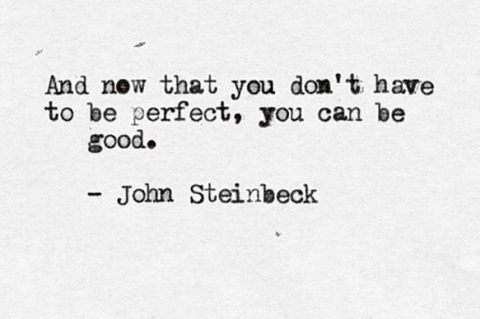
A nice reminder that perfection holds us back. Must keep that in mind for a current first draft that's plaguing me.
(via wit + delight)