Annie Cardi's Blog, page 117
February 10, 2012
A Cup of Tea and a Good Book
In case you need inspiration for what to give a loved one on Valentine's Day, check out these awesome literary-inspired mugs by Sarah Fritzler:
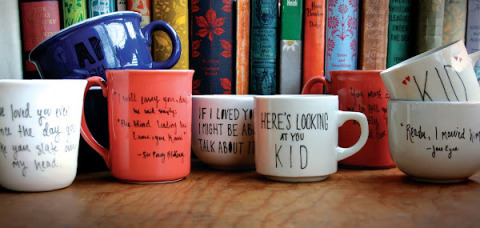
I think my favorites are the Jane Eyre mug and the Gilbert. And you can make these yourself! Sarah has the how-to guide on her post. Lots more pictures through the link, too! (image: Sarah Fritzler)





February 9, 2012
Nobody's Perfect
You know those people who seem to do everything right? Their hair always looks great; they scored a zillion on the SATs; they run marathons; they bake the best brownies you've ever had; they never get grouchy or say anything bad about anyone. You kind of hate those people, right? Me too.
The same goes for fictional characters. Generally, I like characters that have a few flaws. Maybe they say the wrong thing at the wrong time. Maybe they are a little selfish. Maybe they get flustered or overwhelmed. Maybe they burn the brownies. That doesn't mean your characters have to be heinous. They can still be upright, kind, honest people. But like real upright, kind, honest people, they have their own flaws.
At Rachelle Gardner's blog, Rosslyn Elliott has a great guest post about incorporating flaws into your characters. One point I especially like is about cosmetic character flaws, which are "victimless" in that they only hurt the protagonist. Like being self-conscious or self-critical. (Basically, things you say are your flaws in a job interview.) These flaws may be real, but they're not going to mean much to a reader who is looking to relate to someone non-perfect. To balance that out, Elliott suggests you need a real flaw that hurts other people in some way. Her examples:
"Cosmetic character flaw: Insecurity. Its real counterpart: envy and sabotage
Cosmetic character flaw: Fearfulness. Its real counterpart: disloyalty under pressure"
I love the idea that you need to connect these internal flaws with actual interactions with other people. This is how your flaws manifest themselves. And as Elliot points out, great fiction comes from real flaws and troubled interactions with other people:
"If our goal is to stir deep emotions or joyful laughter, to show real love, to comfort the lonely, to make readers think or remember…our characters need real flaws. We can't play it safe with our readers' sympathy–we have to let them go to the edge."
Make sure to check out the whole post. Do you specifically think about your characters' flaws?





A Whole New World
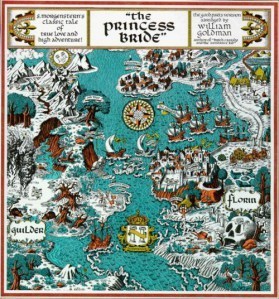 When I first read The Princess Bride, I thought Florin was a real place, or at least that it had been at some point. (Prussia was real.) Goldman crafted his novel so well that I really wanted it to exist. Also, my copy of the book included a map. It had to be real if some cartographer had written it down!
Okay, so I was a naive little reader. (Um, I still might be waiting for Goldman to finish Buttercup's Baby–WHY ARE YOU DOING THIS TO ME, GOLDMAN?!) But there is something exhilarating about fictional lands. World-building is difficult, but so necessary for novels, particularly in the fantasy realm. The Pevensies are great, but what I love most about Lewis's books is the possibility of Narnia. As a reader, you want to go to these places.
Part of world-building requires actually knowing where these places might exist. Maps like the the one in The Princess Bride can help a writer figure out how events can unfold and keep the narrative on track.
The Awl has a great collection of some literary maps, including Goldman's. Others I hadn't seen, like A.A. Milne's Hundred Acre Wood or Baum's map of Oz. Although it wasn't included in the actual books, the recent map of Panem also gets a shoutout.
In case that's not enough map-love for you, make sure to check out this gorgeous post from the Horn Book by Julie Larios. One point I especially enjoyed:
"I ask my writing students at Vermont College of Fine Arts to think long and hard about the setting they develop in their books for children. Kids want to be explorers, too. They don't always want to identify with a familiar character in a familiar world. Books, says Fran Lebowitz, should be doors, not mirrors. So I ask my students to think of offering the setting of their stories to young readers as a gift that opens doors. By doing so, they turn their readers into explorers, and what child doesn't want to explore?…We explore, and we come to know the unknown."
I love the connection between maps and children's literature in particular. Books are a major way (maybe the only way) children get to freely explore. Why not have fun with it?





Terrific, Radiant, Humble Shirts
I know that they're for kids, but who wouldn't want a Charlotte's Web t-shirt?
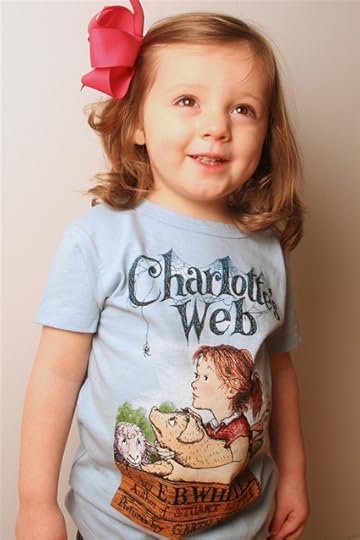
Out of Print's adult shirts are cool, too. (This one is my favorite.) My birthday is coming up, guys… (via Vintage Kids' Books My Kid Loves)





Don't Let This Be Your Unfinished Novel
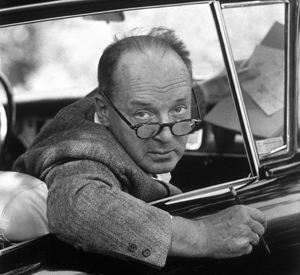 In case you need a little inspiration to finish your current project, check out this list of 10 Unfinished Novels by literary greats. Although I kind of like that The Mystery of Edwin Drood by Dickens is unfinished (it makes for a fun Clue-style murder mystery musical), but my heart goes out to Nabokov:
"Like many authors, feted Russian writer Vladimir Nabokov left express intentions that any unfinished work should be destroyed upon his death. Following his passing in 1977, his final book, The Original of Laura, wasn't destroyed but held in a bank vault as his son deliberated whether to publish it. In 2009, it finally saw the light of day. A fragmented novel concerned with aging and the complexities of love, literary figures despaired that the man behind the classic Lolita should not have had his final wish honoured."
If I had been left with the unfinished novel, I would have destroyed it as Nabokov intended. Obviously it wasn't finished, or even polished, so why publish it? It's going to disappoint readers who love his other work, and I find it sad that he couldn't show the world the version of The Original of Laura that he intended.
Just another reason to finish that draft!
(image: PBS, Carl Mydans/Time & Life Pictures/Getty Images)





February 8, 2012
Links Galore
A few more mid-week link:
How to use (appropriately) brackets, commas, and–gasp!–dashes.
The New York Times team pokes fun at their own "favorite" words.
A great round-up of writerly blogs.
You can win an ARC of Pieces of Us by Margie Gelbwasser.
If you're a member of SCBWI, get ready to apply for a Work-in-Progress Grant.





Editorial Eye
When I was an English major, people would ask me, "So are you going to teach?" I'd tell them that teaching is an entirely different skill (there's a whole different degree for it!) and just because you like reading or writing doesn't mean you can teach it or any other subject. On the same wavelength, editing is an entirely different skill from writing. A lot of times the two overlap, but getting an editorial eye on your work is a huge benefit.
Over at Writer Unboxed, Juliet Marillier talks about why editors are important. It's one thing to be able to write a novel. It's another to be able to write a good novel. And even if you can write the most stunningly beautiful novel on your own, usually having another pair of thoughtful, critical eyes helps a lot. As Marillier says:
"I mention this because, of recent times, social media sites and other forums have seen a rise in scathing comments about traditional publishing houses, mostly coupled with pro self-publishing arguments. People who make those derogatory comments generally disregard the huge amount of support a traditional publishing house offers a writer, and completely overlook the critical role an editor plays in helping that writer produce the best book she can.
Folks, whether you are self-published or mainstream published, please understand that producing that 'best book' includes having the manuscript professionally edited. Yes, there are some readers out there who won't notice (or who will forgive) your clunky prose, your typos, your misuse of words, your flaws in continuity, your gaps in logic, your weirdly random choice of character names. Maybe errors in your work don't bother you. They will bother the majority of your readers. Get your ms properly edited. A good editor is worth her weight in gold."
That doesn't mean that you have to wait until you're published to get a kind of editorial look. Obviously a professional editor has a lot of experience and talent, but even writerly friends can help catch mistakes or offer helpful advice. Anything you can do to polish your novel is worth it, and a sharp editor can help immensely. Ideally, your editor would also make you excited about your manuscript and any necessary revisions. They can give you all the suggestions in the world, but you need to craft them into an even better novel.





YA Protagonists in Non-YA Fiction
At Original Content, Gail Gauthier has an excellent post about what separates YA from fiction written for adults with young protagonist. She compares two works with similar plots (blending families), one that's YA and one that was written for adult readers. Although the waters are still murky, one difference Gauthier finds is interesting:
"The YA book has a more positive outcome than the adult short story. That is expected of books for young people. YA is expected to have a climactic epiphany of new maturity, maturity, I'm assuming, being considered a positive thing…I didn't see anything positive there or anything that suggested that Joe [in the non-YA story] is more mature as a result of his experience, just far more troubled."
For the most part, I think the term YA could be exchanged with Bildungsroman, so I think Gauthier's point about the climatic epiphany of new maturity is a good one. I'd be curious to take a further look at adult literature with young adult narrators and see if they go the "coming of age" route as well or, as in Gauthier's test, look more toward a downward spiral.
Also, I think voice ends up playing a big part. Adult lit with a teen narrator tends to have more of a distance–it could be the narrator looking back, or it could just be more of an authorial view. YA tends to stick closer with the narrator and his/her current emotional turmoil.
How do you differentiate the two?





Separating the Art from the Artist
With authors on Twitter and Facebook, it's easy to feel like we know them better as people. But what happens when authors aren't as cool in real life as their work? At Fiction Writers Review, Celeste Ng looks at what it means when an artist is a jerk–or worse. Where does the line fall for cutting a previously beloved piece of art out of your life because the creator is sketchy?
Ng writes: "If you, as a reader, know an author fervently supports a cause you hate, every word that author writes might seem tinged." I've certainly felt that before. She brings up Orson Scott Card, who is anti-gay. I read and enjoyed Ender's Game before finding that out. It hasn't made me burn my copy of Ender's Game, but I haven't picked up any of his other work. But I can ignore a generally unpleasant writer as long as his/her unpleasantness isn't morally offensive in some way. For the most part, I think a work of art should be able to stand on its own.
Fortunately, I can't think of a lot of people in the children's/YA world I'd have to cut out. (Writers, please don't give me a reason.) Do you ever stop reading someone's books because you found out something unpleasant about the author?





February 7, 2012
Bicentennial Man
 It was the best of birthdays, it was the worst of birthdays…
Well, hopefully not the worst. But it is the 200th birthday of Charles Dickens. Happy birthday, Charles! My favorite of his work is probably A Tale of Two Cities, which I first read when I was way too young to get most of it.
To celebrate, Masterpiece has shared the trailer for their upcoming production of Great Expectations. It looks awesome. I haven't actually read the book (I know, I know) but this might be the inspiration I need. Also, teachers and librarians should take note:
"Three video-based lessons will be posted in April on the free teacher resource, PBS LearningMedia. Using video clips from Great Expectations, English Lit classrooms can compare and contrast the film with the book, learn about the moral underpinnings of the work, and explore Dickens's writing process."
What's your favorite Dickens novel?