
Quinn Reid's Blog, page 26
July 5, 2011
Short Collections of Very Short Stories
I've been having an interesting time with my book Bam! 172 Hellaciously Quick Stories selling on Amazon for the Kindle. A while after I released it, I released a 99 cent sampler of stories from it (plus one new one) called 17 Stories About the End of the World. To my surprise, the sampler has been outselling the book even while they were temporarily at the same price, telling me that readers are interested in what kinds of stories they're getting and aren't likely to read otherwise.
So I've now broken out the remainder of the 172 stories into 8 new, short, 99 cent flash fiction collections. (I've also put a free first chapter of my novel Family Skulls–which itself is available for 99 cents as of this writing–at the end of each book.)

19 Very Short Stories of Gods, Demons, Robots, Golems, Zombies, and Death
Handy Tips for Detecting Interdimensional Travelers and 20 Other Very Short Stories
Up Late with All the Power in the Universe and 17 Other Very Short Stories
The War with the Clowns and 19 More Very Short Stories
My Friend in Hell and 19 Other Very Short Stories
Cinderella's Divorce and Other Romantic Disasters
19 Very Short Stories of Talking Animals with Serious Issues
19 Very Short Stories of Alien Invasion and Disaster in Space


July 1, 2011
Hope Addiction: Why and How Not to Camp Our Spawn Points
I wrote a dictionary of subculture slang that was published back in 2006, and in the "online gamers" section, it includes definitions for two terms that together have a lot to do with a common way we lose productivity and focus.
spawn point: A game location where characters or monsters regularly emerge.
camp: (as a verb) To take a position where many enemies emerge and ambush them there.
Some players, in some games, like to take up the practice of "camping a spawn point." You position yourself right near a place where new players are emerging into the game, or where computer-controlled antagonists (generally known as "monsters") are being created, and you just nail those suckers one after the other as they come out. It's annoying to the players (and probably annoying to the monsters too, although since they don't talk much about their feelings, we'll never know for sure), but players who are camping spawn points are really not playing the game: they're reactively taking easy pot shots at whoever shows up. In gaming, this may not be a problem as long as everyone's having fun. In life, it can become a serious impediment to happiness.
Camping the inbox
I don't play online games, but I do use e-mail–a lot. While I've gotten much better at using e-mail responsibly over the last few years, I've certainly had periods in my history when I was visiting it every few minutes, with a miniature rise and crash of hope every time I checked and something good hadn't shown up–which was most of the times I checked, of course, because you don't generally get good news a hundred times a day.
We can do the same thing with any number of sources: snail mail boxes, voice mail, text messages on cell phones, bank accounts, Twitter, Facebook, online sales reports, Web site statistics, the news, forums–all places where we hope some good news may suddenly appear. A deposit came through, or sales have taken an upturn, or the person we most want to hear from has gotten in touch, or something has sold, or our investments have gone up, or a package has arrived … in one way or another, a bit of hope has been gratified.
Hope is generally thought to be a good thing, the one consolation prize left at the bottom of Pandora's box, but it has its dark side too. Buddhist tradition knows about this, stating that the suffering in the world arises from attachment, where attachment means (this is my rough explanation) making your happiness depend on anything external to you. This would include the package you're hoping will ship today, the reply from the person you want to date, or the acceptance letter for the story you sent out last month. It's easy to fall into a habit of always looking for some new good thing to happen, and the results can be distraction, frustration, and repeated disappointment.
How not to camp
When we camp e-mail inboxes or other places where good things might emerge, we're either focusing our attention on something we want (for instance, a response to an e-mail, application, or submission) or being driven by habit. In both cases, one of the easiest and most effective ways to stop obsessing about what might come to us is to get engaged with something that's actually going on, to really dig into a project, connect with another person, or just get active.
So in practical terms, three especially good ways to stop camping are
Taking the next immediate step on a project you care about, so that you become involved (and ideally achieve flow–see "Flow: What It Feels Like to Be Perfectly Motivated").
Doing something with other people: human interaction can be absorbing and rewarding when it goes well.
Exercise. Taking a walk or doing more strenuous activities will offer all kinds of benefits even if you don't count the fitness payoff (see "Nothing to Do With Weight Loss: 17 Ways Exercise Promotes Willpower and Motivation").
To put it another way, the best way to stop camping is to energetically do something else constructive. Camping tends to happen when our attention is not engaged well–when boredom threatens or has overtaken us.
The difference in our experience can be dramatic. A day of camping can be exhausting even though not much might have gotten done. We feel distracted and often dissatisfied, and we have no reason to believe the next day won't be more of the same. By contrast, a day spent focused on engaging work or with other people–or at the very least spent actively–will feel more satisfying and build optimism, confidence, and focus.
June 29, 2011
Learning to Hate Google Books
Today's guest post about Google Books is by Judson Roberts, author of the Strongbow Saga. You can find him on Amazon.com, and his Web sites are StrongbowSaga.com and JudsonRoberts.com.

I don't actually hate all things Google. Google is still the Internet search engine I use more than any other, I love Google maps and Google Earth, and the free Google Navigation app on my Android phone is a wondrous thing, indeed.
But I am learning to hate Google Books. Let me explain.
I'm an author and, like many other authors, have been, over the course of the past year, republishing, as self-published books, some of my titles that my original publisher had taken out of print. So far, that's been a mostly very pleasing project. The Amazon Kindle e-book versions are doing very well–much better than they ever did when published by HarperCollins, their original publisher–and the new print-on-demand print editions are selling steadily, too. They're now for sale as Nook books at Barnes & Noble (and that has been a much less happy experience, but the problems with B&N I'll leave to a separate rant). So I decided my next frontier would be Google's relatively new e-book store.
I think I can honestly say that I have never–NEVER–dealt with a more user unfriendly operation. How can an organization that prides itself on creating intuitive, user friendly programs and applications have created such a monster?
An author cannot get to the Google e-book store, to place his books up for sale there, unless he first becomes a "partner" with Google Books. What does that mean? Well, I confess that I'm not totally sure. There are pages and pages and pages of legal mumbo-jumbo you have to wade through and agree to. I'm a lawyer, and usually actually read that kind of thing, but the Google Books disclaimers, agreements, etc., etc. left my head spinning. Hopefully I have not granted Google exclusive rights to the first born child for the next three generations of my family.
Then, you have to give Google Books a copy of the print version of your book. That's the heart of their whole plan: Google is trying to create a vast digital library of every book in print, and many now out of print, and if you want to sell e-book editions through Google, you have to give them the right to add your book to their digital library (what rights do they have over it once it's there? I don't know, which is scary). One option is to mail them a print copy, so they can disassemble the book and scan it into their database, but the alternative they strongly encourage is that you save them any effort by just uploading a PDF version of the book.
Okay–I do want to place my e-books in the Google e-book store, so I did. Or at least I tried. But the Google Book Uploader would not work for me. After an hour or more of digging through multiple layers of "help" pages, I discovered why. Google requires you to rename any book files you submit according to their internal naming conventions. If you do not, their Uploader will not accept them.
Think about that for a minute. And to help you, let me explain how the similar process occurs with Amazon. You enter the relevant data such as title, author, price, etc., then click on the file(s) to be uploaded to give Amazon the actual text, cover image, etc. Since you're uploading the file within the framework of all the other data about the book you've provided, there's really no possibility that the book file(s) will somehow get lost. But with Google, after you enter the title, author, etc., you also have to correctly rename any book files you upload, or they will not go through. It perhaps would be only a minor irritation if Google simply told you that up front, but when you have to dig through layers of unhelpful "help" pages to discover that fact, it's infuriating. Plus, the Uploader guidelines say check back regularly, and within a week they'll let you know whether your upload was successful, or you have to try again. I'm still in Google Books limbo.
And then there's the pricing issue. Google's e-book store sells internationally, as does Amazon's Kindle store. With Amazon, all an author has to do is set the U.S. price in dollars, and the price in other currencies, such as British pounds or Euros, will be automatically set to correspond. With Google, you have to "activate" each individual territory, and part of that process includes setting the price there. You can either accept Google's default option, which will set the e-book price at 80% of the print edition's price–a price I personally feel is too high for e-book editions in most cases–or you have to manually set the price in each given territory's currency. Thank you so much, Google, for being so author-friendly and helpful.
Photo by iansand
June 27, 2011
Codexian Writing Quotes: Joy Marchand
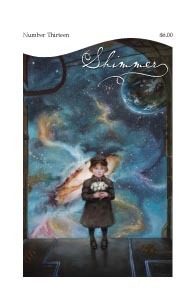 Joy Marchand is a writer, poet, and editor. I met her at the 2004 Writers of the Future workshop, where her terrific short story "Sleep Sweetly, Junie Carter" (written as Joy Remy) won her a spot in Writers of the Future XX. My "Bottomless," a story of a young man exiled from his village located deep within a bottomless pit, appeared in the same volume, but Joy's story of a woman trying to cope with more time than any human is made to handle may well be my favorite in the book.
Joy's Web site, with a bibliography of her short fiction, is at www.joymarchand.com (although it hasn't been updated for a while). Her blog, which is very much up to date, is at joymarchand.blogspot.com . Below you'll find some of her sayings from Codex that I've found most pithy over the last few years.
I'm sure folks don't mean to be a bundle of insecurities and make asses of themselves on an ongoing basis; I've certainly tried to cut down myself.
People do bad things, have naughty sex, make terrible decisions and sometimes hate their parents.
I'm a writer, after all. I have a great imagination and love filling the silence with paranoia.
Boring sex is boring sex, no matter who's having it.
If the back story doesn't influence a character's entire world view, then I think it's the wrong back story …
…we're all here to produce pages. Some of us do it for love of language, for glory, for groceries, for attention, for love of hearing ourselves talk. Some of us have noble motives and social awareness, and some of us are navel-gazing solipsists, and we really don't care about anybody else out there. Some of us use transparent prose and sell to Analog, and some of us are stylists and sweat to get our stuff published anywhere, including Bobby Joe's Navel-Gazing Gazette if it'll get us a little love. Some of us write from a place of peace and light and hope and puppies, and some of us hitch our gnarled demons to the plow and make those useful bastards work the back 40. And the only thing that glues us together is a smattering of markets we all submit to, and a vow to produce pages on a regular basis.
Asking me to write Patterson-esque potboilers would be like making a dog wear spanky-pants. Entertaining, but it pisses off the dog and ruins the pants.
June 24, 2011
Do Agents Own Authors, or Do Authors Employ Agents?
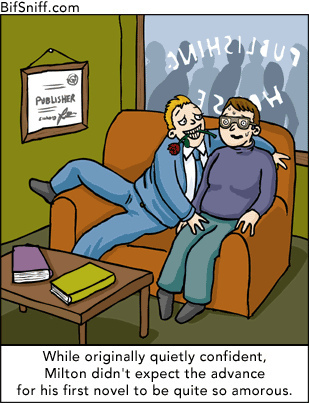
The way some of us writers talk, you'd think agents, editors, and publishers were celestial beings who descend from the firmament at whim to generously bestow grace (in the form of a publishing contract or literary representation) on us undeserving, lumpen creatures.
The way other writers talk, agents and publishers are scam artists and parasites who feed off the blood, sweat, and money produced by writers.
So what are we to think?
Who's in charge?
When I frame the two perspectives that way, you can probably tell I don't really subscribe to either extreme. Literary representation ought to be conducted as an equal relationship. Here's some of my discussion on the subject as responses to concerns I've heard about agents.
"It's the author's money"
Have you ever run a business? If so, reflect on how money came in: there will have been production (rendering the service, manufacturing the widgets, building the furniture, or what have you) as well as sales, billing, and support.
In an author-agent-publisher relationship, the author supplies the product, but a good agent sells that product to the publisher, negotiates (we hope) an appropriate deal, collects the money, keeps on the publisher to make good on commitments, etc. While it is possible for authors to sell their own books, when the author works with the agent the agent is generally doing the selling, and many authors cannot sell to big publishers without an agent. As such, the author producing the book doesn't amount to a pile of poo, monetarily speaking, unless the agent sells it or unless the author takes on the agent's job and sells it.
Production without sales and related services is worthless unless you have a business where your products automatically sell themselves, e.g., you inherit some kind of monopoly.
"The agent chooses the author" – or – "The author chooses the agent"
The author and agent choose each other. Can I go up to Agent X and say "You will now be my agent!"? (Well, of course I can, but I mean the average writer.) No. Nor can the agent come up to me and say "You will now be my client!" (Although admittedly, that's more likely to work.)
This is what I mean by a mutual business arrangement. Neither party is forced into the arrangement and neither party has sole say in what happens.
"Agents used to get only 10%: why is the norm now 15%?"
When talking to a very successful writer in 2001, I was advised to only ever sign with an agent who made 10% for domestic sales (the percentage is generally a bit higher for foreign sales), but even that far back, almost all agents had already gone to 15% for new contracts: the famous author in question had gotten an agent in an earlier and different publishing environment.
My guess is that the change in percentage is because the real value paid by publishers for books (taking into account inflation) went down and agents couldn't make a living otherwise. For instance, advances for first science fiction and fantasy novels appear to have been more or less flat from about the 80′s through now from what I've read (though some of the information going into that statement is anecdotal, so take it with a grain of salt).
If good agents were able to survive on 10%, those good agents would have snagged all the good writers and left none for the 15-percenters, most likely, and though I admit that collusion and other methods could conceivably get around this, I don't really believe anything like that happened.
My guess at why the value publishers pay for books went down is the rise of word processing: it became easier and faster to produce books, so publishers had more producers and product to choose from and had to spend more time sifting through submissions. If we want to point the finger at one factor that has lessened the power of individual writers in recent decades, the word processor is probably it. And yet, ironically, the word processor has also made us each much more powerful. Ah, the contradictions of technology!
"Agents have become irrelevant"
My personal sense is that agents will continue to be relevant to the extent that big publishing house tradpub continues to be relevant, and while I don't see tradpub holding onto its dominance in the long term, I also don't expect big publishing houses to die off entirely, so I think agents will be likely to still have a role. That said, selfpub seems to be taking an ever-growing slice of the pie, and agents are useless for that, so I sure as heck would not want to be starting a career as an agent right now.
It does seem to me that writers often have the habit of giving up their perception of power to agents and publishers when the writers' work is what the whole publishing industry is founded on and the only particular thing it can't do without. At the same time, I think it's misleading to imagine that either party has all the power in an agent-writer (or writer-agent) relationship, or for us writers to imagine that the world revolves around only us.
The power approach
Codexian Jake Kerr has a different perspective on the matter that I think is also worth hearing. He says:
[It's about] who has more power in the relationship. When you first start out as a writer, odds are that any agent looking at you sees you as a POTENTIAL moneywinner. How much of one depends on their confidence and your track record. In this scenario, I am sure they see you as little more than a calculated risk, and thus playing the "you work for me" card is somewhat foolish. You have no juice.
This changes dramatically as the money flows in. Then the reality is that the author has all the juice, and the agent really IS your employee. The more money = the more power you have over both your agent and your publisher.
Cartoon courtesy of Bificus
June 23, 2011
My Young Adult Novel Family Skulls Released for Kindle
My young adult novel Family Skulls is now available for the Kindle, temporarily priced at 99 cents. Here's the brief description. If you'd like a free review copy (electronic only), drop me a line!
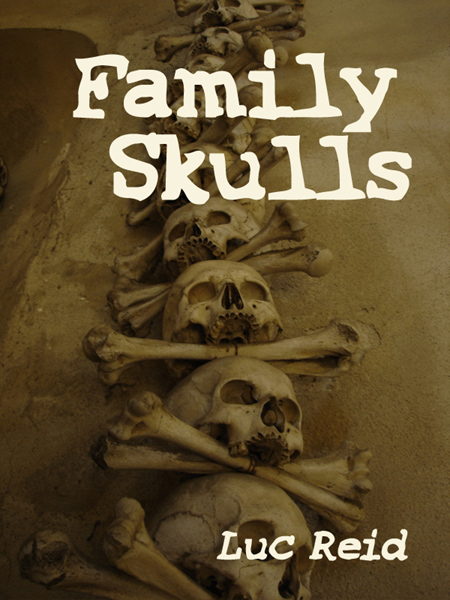
No one will help 16-year-old Seth Quitman–ever, with anything. Seth's family live in a small Vermont town under a curse that has hounded them for generations, one that makes anything they may need–from a bus ride to a recommendation letter to an ambulance–forever out of their reach.
Until now, Seth's family has done the best they could under the curse, knowing that the hill sorcerer family that cursed them could do much, much worse. But now things have gone farther than Seth can stand, and he plans to face down the curse-keeper and free his family–or die trying.
June 22, 2011
Getting Past Our Own Uncomfortable Silences

Unfortunately, these days I do a lot of driving. I say "unfortunately" for two reasons: the environmental impact (although I drive an extremely eco-friendly car, as cars go) and because the driving means more time spent away from my family.
Driven to think
But there are benefits from my drives, and one of the biggest is the chance to sit and think, alone and uninterrupted. I've come up with any number of writing ideas–books, stories, articles, blog posts, forum topics, and so on–plus solutions to mundane life problems, ways to attack complicated tasks, insights into my personal relationships, and so on. Perhaps most beneficially of all, I often use time alone in the car to think through my own mental and emotional state, as a way to reflect, clarify, understand, and transform.
This kind of thinking doesn't have to happen in a car, of course: I can talk with friends, family members, or mentors; write in journals or word processing files; reflect while out walking; or take other steps (see "How Feedback Loops Maintain Self-Motivation"). But I have to admit that being alone in a car has been better than any other method I've yet found for getting through the uncomfortable business of really looking at my thoughts, my problems, my baggage, and my bad habits.
The uncomfortable silence
I'm used to getting started thinking about my life. Sometimes it comes automatically, as when something's been bothering me and my wandering mind seizes on it and begins to tease out the contributing factors. Other times I have to dig in intentionally, either to try to address a particular problem or to find out why I'm feeling the way I am at that moment.
The hard part is the uncomfortable silence. You may be familiar with it: it's when you've had the first glimmers of self-reflection but haven't yet really dug in, so you're tempted to turn on the radio, listen to an audiobook, call someone on a cell phone, or do anything else to stop the quiet. My thoughts at these times are usually along the lines of "I'm too tired to deal with that right now," "I wonder what's happening in the news?" and "I should probably finish up with that audiobook so I can bring it back to the library." There are clues that I'm about to think about something that isn't ego-gratifying or fun, and my gut instinct is to avoid delving.
But I've done this kind of thinking enough to recognize those moments, and the discomfort itself these days stands out to me like a blinking red light: "Oh," I think. "Looks like I've got a bite!" Then, most of the time, I sit and wait for it to really come out. There are times when I give in to the urge to go to the radio or to listen to my current Kindle book or to call someone, which is fine in its way, even if not ideal, but when I steer clear of those distractions, I'm usually rewarded.
Why it's worth pushing through the uncomfortable part
My reward for outlasting the uncomfortable period is that I often get to whatever's making me uncomfortable in the first place and have a chance to first recognize it, then do something about it. For instance, I might realize that I've been acting in a way that I don't like, or that I need to put more time and effort into something neglected.
What's especially great about this is that digging into something that's causing me pain and making me uncomfortable tends to make the pain and discomfort go away. I start feeling I'm on top of the problem and get to experience some optimism that things will be better with it in future.
But if habits were easy to change and thought patterns were easy to fix, our bad habits and patterns of negative thinking wouldn't occur in the first place. The discomfort around difficult issues is one of the reasons those issues can continue doing us harm: it prevents us from digging in by scaring us off. If we get in the habit of pushing through that discomfort, then we have much more power over our own emotions and hang-ups.
Comfortable silences
Of course, there are times when reflection pays off without any discomfort. One especially useful form of this is spending time thinking about goals paying off: in effect, we can live in a future in which something wonderful has happened, simultaneously getting joy out of the future event and increasing motivation for working toward that future.
For more on that subject, see "Motivation through visualization: the power of daydreams."
Photo by John 'K'
June 20, 2011
Codexian Writing Quotes: Alethea Kontis
Codex is an online writing group I founded in 2004 that currently has about 200 active members, most writing science fiction or fantasy and all in the early stages of their careers, from some who have written a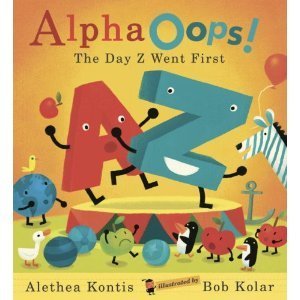 lot but not yet made their first pro sale to others who are seeing their third, fourth, or fifth novel coming out from a major publisher. Since the founding of the group, members have won major awards like the Campbell, Hubbard, Hugo, and Nebula, made hundreds (and possibly thousands) of short story sales, gotten top agents, sold their first book (or pair of books, or trilogy), made the New York Times bestseller list, achieved consistent financial and literary success with self-published eBooks, and so on. Some have transitioned to full-time writing careers, though most still write only when they can.


But I love the group not because of the amount of success of its members (which tests my envy tolerance on a regular basis) but because of the flood of wisdom, intelligence, kindness, encouragement, and enthusiasm that wells up every day through posts, e-mails, discussions, critiques, and in-person meetings. And while I can't share all of that material, I can and will share quotes that have cropped up on our forum, with the position of the originators.
 So with this post I begin a series of Codexian quotes, which I hope you will find as entertaining, illuminating, and/or perplexing as I have. This first set is all from my friend Alethea Kontis, whose work includes a persistently delightful picture book called AlphaOops: The Day Z Went First (with illustrator Bob Kolar), the New York Times bestselling Dark Hunter Companion (with Sherrilyn Kenyon), an upcoming fantasy novel, and much else.
Alethea's Web site and blog are at http://aletheakontis.com.
Never underestimate the value of Butt In Chair.
[on getting fit] "I've decided that every freaking day is just Day One all over again, so why bother numbering them?
I had a great time whipping 16 7-year olds into a complete frenzy. We ended up on the playground, drawing all over ourselves with Sharpies.
We are writers. We are meant to see and feel everything, the good and the bad, the best and the worst. We are meant to cut ourselves and bleed our souls onto paper and share them with the world. We breathe life into impossible cities and create alleyways of escape. We dredge up things that aren't discussed at the breakfast table and serve them as entrees. We are creators whose purpose in life is to balance out the entropy.
[At the time of this quote, Lee worked for a book wholesaler] 1:30 p.m. — Weekly Staff Meeting. We decide it should be spelled 'e-books.'
I smile at a baby in red socks and listen to Chris Martin from Coldplay tell me how beautiful I am. I know he doesn't mean it, but it's still nice to hear.
[in 2009] Imagine a world with 24356424 bazillion books and no brick-and-mortar stores, because everyone can publish their own grocery lists and advertise it on the internet (and then download it to folks' PDAs). How will anyone be able to find a good book anymore? How do you find them today? That's the part the publishing industry needs to focus on.
I FULLY EXPECT YOU ALL TO PARTICIPATE, OR I WILL CRY AND SEND YOU MY TEARS.
June 17, 2011
Top-Notch Advice About Literary Agents
In a recent online discussion about dealing with literary agents, Codexian Erin Cashier offered a link to an excellent article on AgentQuery called "When Agents Offer Representation," which thoroughly answers some key questions about dealing with literary agents. This is highly recommended reading for any writer interested in being represented by an agent, even if, as in my case, you already know a lot about the subject and/or have been represented before. The article covers subjects like:
When an agent wants to offer representation to me and my book, how will I know?
What happens if I receive an offer of representation from an agent, but I am still waiting to hear from other agents who also have my full manuscript? What do I do?
Once an agent has made me an offer of representation, how long can I keep them waiting for my decision?
Okay, so I understand that I have to alert the other agents who are reviewing my manuscript that I have an offer? What's the best way to contact them?
An agent has called and left me a message to call him back. Does that mean he is going to offer me representation?
THE CALL: when an agent calls to offer representation, what do I say? What questions do I ask? How can I make the best impression possible?
I have received an offer of representation from an agent, but he doesn't use a written agent-client contract. Is that a bad sign?
I have received an offer of representation from an agent, but he wants me to sign an agent-client agreement. Is that a bad sign?
An agent calls and tells me she enjoyed my book, but she thinks it still needs some work …
What should I expect from the agent-client relationship?
June 16, 2011
Have an account on Writerspace? Please change your password now!
It appears that some tens of thousands of e-mail/password combinations from Writerspace have been hacked and posted today (I won't post a link so as not to encourage further dissemination of the information). If you have an account on Writerspace, I'd strongly recommend changing your password there and anywhere else you might be using the same e-mail/password combination. Also, be sure that your new Writerspace password is not one you use elsewhere, in case of a repeat incident.
Good luck and godspeed.
Quinn Reid's Blog

- Quinn Reid's profile
- 6 followers

