
Matador Network's Blog, page 2086
July 10, 2015
12 reasons Vancouver is beer heaven
Vancouver is hailed and lauded as one of the most “livable cities on Earth” but if you ask a local, you’ll get mixed responses. Yes, we know it’s beautiful, but we can’t agree on if it’s worth the cost (which is astronomical), if there’s too much rain, the public transit situation, among many other things city struggles with. You know what one thing we can all agree on? (Hint, drinking it seems to help everyone get along.) Beer! Everyone knows that the craft-beer scene in Vancouver is seriously about as good as it gets.
1. Cheerful crowds
#CaskAleFest from #SteelToad and @camravancouver is off to a great start.
A photo posted by Steel Toad Brewing Company (@steeltoadbeer) on Jul 4, 2015 at 1:09pm PDT
Pretty much at the end of any given workday, and pretty much all weekend, all the breweries in the city look like this. Full of people, doing life over pints. The way has been for a thousand years. Except in here there’s a lot more beer options, cleanliness has seriously come a long way, and you really can’t barter anymore. This particular crowd has gathered at Steel Toad Brewery for a Cask Fest. Because around Vancouver, “Did you hear they’re tapping a fresh cask tonight?” is pretty much a new pick up line.
2. Acres of breweries
W33kend bottles. We now have 4 packs of our 9.2% Belgian Trippel. #33acres #b33r
A photo posted by 33 Acres Brewing Company (@33acresbrewing) on Jul 5, 2015 at 2:04pm PDT
For those in the city proper, 33 Acres is a hot pick with it’s clean bright whites and open spaces and touches of green and wood make it a popular haunt along the Main Street corridor. Oh, and the beer tastes like sunshine. So there’s that. And 33 Acres is just one of 7 breweries in and around South Main, just blocks from Brassneck, Main Street Brewing, Steel Toad, Craft Beer Market (which isn’t a brewery but serves hundreds of beers), Big Rock, R+B, and the newly opened (though long established) Red Truck which is a tasting room and a “truck stop” style diner. Further north and a bit more east is Hastings-Sunrise and you can find Off the Rail, Strange Fellows, Parallel 49, Powell Street Brewing, and the newest addition, Doan’s Craft Brewing.
3. No really, there’s a proverbial shit ton of breweries


American travelers problems

Photo: Gloria Atamno
Living in an international hub of Europe like Barcelona, it’s common to meet people from 10 different countries in one night. It’s even more common to feel comfortable discussing a country’s political affairs or status quo within minutes of meeting one another. When respect is the common core, everything’s fair play. We’re a curious breed, travelers especially, because we rather go out and seek the answers than sit in a classroom and have someone feed us their version of it.
So last weekend I was at a pub during a cultural night, and there were easily 10+ countries represented. We all scribbled questions down without names and put it in a hat, to keep the good conversations/exchanges going. I anonymously wrote down with the help of my homegirl Tequila and 3 of her close friends what the most annoying thing about American travelers was.
Now, before you take away my ‘Merica Card, I asked this question not to bash my own people, but rather out of genuine curiosity so I could work on my own habits and share with others to try and better the perception people have of our new generation of globetrotters.
There were about 15 questions in the hat, and with every question drawn, my palms got sweatier in anticipation of another awkward situation I could add to my weekly tally, surpassing quota — yet again.
There was one other American in the room and we both sunk in our seats waiting for the inevitable jabs.
Finally, I see the reader skim the question briefly in her head, make an expression like “sh*t’s about to get real” and I knew it had to be mine. She proceeds to ask the room full of slightly-inebriated-but-could-still-pass-a-walking-test crowd, “What’s the most annoying thing about American travelers?” There was one other American in the room and we both sunk in our seats waiting for the inevitable jabs. At that moment, I wanted to answer the question so as to take the pressure off people answering, and also maybe trick them into thinking I wasn’t the one who asked it in the first place. But then again, because of the person that I am, my awkwardness, and everything in between, my mouth glued shut and I forgot how to ‘human being’.
There was an awkward silence as people looked around the room scanning the mental balls of audacity to ask such a forward question. And then as if the Queen summoned him herself, a British man cleared his throat, in sync with my bowel movements imploding within and said, “You know what, I don’t have a problem with American travelers, because they’re at least making an effort to get out and see the world and experience other cultures. It’s the ones who DON’T travel that annoy me. They stay in the same city, state, and country all their lives, being comfortable never trying to learn or experience other cultures. I’ve visited America and met people who have never even ventured outside of their home state and it’s mind-blowing.”
And others started to chime in with mutual agreement, about the idea that people can be satisfied living a life on this beautiful planet, perfectly content without ever experiencing other parts of it. And this applies to citizens of every country.
I definitely wasn’t expecting such an enlightening and refreshing perspective. I was humbled.
If more people redirected their $200 shoes and $400 designer purses towards an experience that won’t get dirty, old, or eventually thrown away, how much greater would this millennial generation be? To experience another culture’s happiness that doesn’t come in the form of an XBOX or Wii is something I want my children to see firsthand. How grateful we’d be for our unspoken privileges. How soon we’d realize that half of our “necessities” are actually just luxuries.
I definitely wasn’t expecting such an enlightening and refreshing perspective. I was humbled.
And before the most common excuse comes up: traveling is no longer a matter of money because it’s become more affordable than ever before, and more people are taking advantage of that.
As Americans, we have one of THE strongest passports in the world, just behind The United Kingdom, Finland, and Sweden. Why are we not taking advantage of that? With the simple possession of an American passport, we are able to visit 172 countries around the world. We’ve hit gold! Just by being born on U.S. soil, we have the opportunity to explore this beautiful and dynamic world around us.
So, while I’m sure there are plenty of habits or things that foreigners get annoyed with by American travelers, it was nice to get a stamp of approval that no matter how we might come across, the fact that we’re at least trying is enough. And to that I raise my glass… again. 

This is Kyrygzstan at ground level
Take a walk with filmmaker Jeremy Ullmann and experience the welcoming people and extraordinary landscapes of Kyrgyzstan.
Follow Matador on Vimeo
Follow Matador on YouTube

What Hemingway has to do with drunk foreign bros flocking to Spain
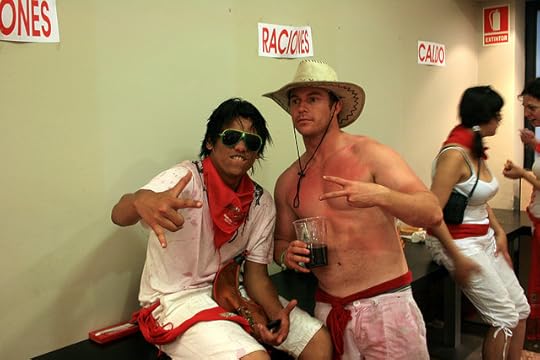
Photo: Abir Anwar
Ernest Hemingway likely had no idea what he was starting when he glorified the Spanish tradition of bull running in The Sun Also Rises.
The 1926 American literary classic brought international fame to the San Fermín festival bull runs, and used the tradition to redefine post-World War I masculinity.
“Nobody ever lives their life all the way up except bull-fighters,” says Jake Barnes, Hemingway’s desperately insecure protagonist.
Today, more and more foreigners are taking Barnes’ thoughts to heart and flocking to Pamplona, Spain to experience bull running themselves.
Last year, more than 17,000 people participated in the runs; 56 percent were from countries other than Spain, according to Pamplona city hall.
The United States, Australia, New Zealand and Britain provided the largest numbers of foreign bull runners. In these countries in particular, running with bulls is a YOLO-justified risk.
While the excitement appeals to many, the thrills come at a cost: hundreds of people are hurt in the runs every year, and fifteen people have been killed during them since 1910.
Many of the injured are the tourists who come to Spain to show their toughness.
In 1995, 22-year-old Matthew Peter Tassio from Glen Ellyn, Illinois was killed when he was gored by a bull in the town hall square of Pamplona.
Just on Tuesday, two Americans and a British man were gored by the running bulls in the streets of Pamplona. Three other Americans were lightly injured by the jostling crowds.
“It’s a macho thing. [At the end] you’re standing around counting your parts,” one American who had run with the bulls three times told the Chicago Tribune. “It’s like jumping out of an airplane.”
Festival officials say that too often the tourists participate with little knowledge of the dangers and insufficient training, not to mention on little sleep and hungover. That leaves them ill-prepared to outrun six bulls charging over the narrow half-mile route at an average of fifteen miles an hour.
After Tassio’s death, Spanish television and radio talk shows held debates about whether foreigners should be allowed to participate in bull running at all.
“Europeans and Spaniards see the running as a show or spectacle like bullfights and leave the performance to the professionals,” Daniel Ross, the US vice consul in Bilbao, told The New York Times. “Americans come here with the image of The Sun Also Rises and just don’t realize how dangerous it is and how easy it is to trip up.”
By Emilie Munson, GlobalPost
This article is syndicated from GlobalPost.

July 9, 2015
10 ways to go off-the-beaten path in Germany
Now that the world is truly a “global village,” places like Germany are often being looked over in favor of crazier, more unique, less guidebook-y experiences. When most of us think of Germany, we might think of a few things: maybe beer, or their turbulent history, or beer, or lots of English speakers, or schnitzel, or even beer. However, that’s been done, and there’s little adventure appeal in that. So what’s left?
Plenty. Here’s a few things you can do — once you get off your haunches at the Hofbräuhaus — to make sure your experience isn’t a TripAdvisor one:
1. Have dinner in a dungeon.
A photo posted by Jacqueline Kehoe (@j.kehoe) on Jun 5, 2015 at 8:31pm PDT
What makes any meal better? Having to wander through a series of underground tunnels lit by candles and wrought iron chandeliers to get to it. Felsenkeller in Pfullendorf is just one of these places, and the experience is damn near close to magical without being too Medieval Times. You can get a similar experience at Weinkeller Einhorn, in a cellar from before the actual medieval times (circa 700). That’s like 5 times older than the US, but infinitely cooler.
Also, there are hidden unicorns everywhere. Win.
2. Take a stroll along the big “blue pot.”

Photo: dierk schaefer
Blautopf, or “blue pot,” in Blaubeuren is a 21-meter deep spring as turquoise, teal, and aqua as that satin bridesmaid dress in your closet. It’s a limestone funnel (the reason for the color) and the source of the river Blau, which eventually flows into the Danube. If you were to dive into the spring, you would be lead into a 15-kilometer series of underground caves leading you to the river. It’s still being excavated and explored, so currently only professionals are allowed in.
3. Feel the gritty appeal of Sternschanze.
Enjoying our last night in Hamburg with a dinner at @bullerei
Africans fight stereotype on Twitter

Photo: Rod Waddington
AFRICA GETS SOME PRETTY SHABBY TREATMENT IN THE MEDIA. While most of the rest of the world is treated as complex and multifaceted, Africa is typically just portrayed as a basket case, riddled with corruption, violence, disease, and extreme poverty. Africans on Twitter are tired of this one-sided treatment, and have decided to show the Africa that they live with on a day-to-day basis. Using the hashtag #TheAfricaTheMediaNeverShowsYou, Africans from all over that massive continent are showcasing the staggering beauty, diversity, and complexity of their homes.
More #theafricathemedianevershowsyou this time #Rwanda pic.twitter.com/feaPf5bPO7
— Jonathan Tanner (@Tannerjc) July 3, 2015
Africa has 3 female heads of state.
#TheAfricaTheMediaNeverShowsYou pic.twitter.com/oH4AYRRV3w
— Nad!a A. (@Nadiaalie) June 24, 2015
Beautiful #Malawi. Welcome to the "Warm Heart of Africa." #TheAfricaTheMediaNeverShowsYou pic.twitter.com/t8BmIrT8NL
— Carly Farver (@CarlyFarver) July 9, 2015
Powerful mythbusting #TheAfricaTheMediaNeverShowsYou ->> http://t.co/D5trqxNh32 #action2015 #action1D pic.twitter.com/QZ1puRGj4P
— Action/2015 UK (@action2015uk) July 9, 2015
50,000 images that will change how you see Africa! http://t.co/yK9F4wIqJV #TheAfricaTheMediaNeverShowsYou pic.twitter.com/D7WcvrCVRj
— ONE (@ONEinAfrica) July 6, 2015
the Amazing pink lake in senegal #TheAfricaTheMediaNeverShowsYou pic.twitter.com/A2BDghfbMc
— K.Diallo (@nyeusi_waasi) June 24, 2015
Traditional #Swahili #cuisine. #Tanzania #Africa #food
#TheAfricaTheMediaNeverShowsYou in the West pic.twitter.com/ZtJsP4xrGX
— Emperor of Azania (@KaizariWaAzania) July 9, 2015
Mozambique #TheAfricaTheMediaNeverShowsYou pic.twitter.com/IMdyKqpVtn
— Cauphy Gumbo (@Darwan47) July 3, 2015
Etiopía #TheAfricaTheMediaNeverShowsYou pic.twitter.com/UALeLqCZ0b
— Ese Caleidoscopio (@Esecaleidosco) July 6, 2015
Head on over to Twitter and check out the page for the hashtag for more. 
How to survive Cardiff in 10 easy steps

Photo: caitlin_mcnabb
1. Forget introducing yourself with your name
When asking for directions, a drink or anything at all, make sure to introduce yourself as ‘alright how’s it going alright,’ for that is now your name.
Next
Prev
2. Don’t ask for recommendations at a bar
That’s something that happens in posh places, and you don’t want to go to any of them, and good luck finding one in any case. If in any doubt, order a Brains SA Gold — you won’t regret it. If you don’t drink beer then a double vodka lemonade should satisfy the bar staff and the regulars.
Next
Prev
3. Make sure you know how to survive the Six Nations
For every other weekend in February and March, the city becomes a living, breathing, drunken behemoth unlike anything you’ll have ever experienced, as the Six Nations rolls into town. Surviving these weekends should be a list in its own right, but summed up: Just go with it. You’ve got the rest of your life to come to terms with what you saw. France and Ireland provide the most and best fans, Italy the most attractive, Scotland the most debauched, and England the most entrenched — you might even be with one.
Next
Prev
4. Line your belly before drinking anything
Start your boozy day by lining your belly at the New York Deli (the meatball grinder works best).
Next
Prev
5. Always accept a challenge at pub games
If an old man in a quiet pub offers you a game of skittles, accept. You’ll be taken away to a room that almost certainly doesn’t exist for an hour that you’ll never be able to explain.
Next
Prev
6. Don’t go to Swansea
Never admit to having been to, or have any desire to go to Swansea.
Next
Prev
7. Remember the code word ‘Bluebirds’
If in danger shout ‘Bluebirds’ at the top of your voice. But you won’t ever feel uncomfortable because Cardiff is fantastically friendly.

This story was produced through the travel journalism programs at MatadorU. Learn More
Next
Prev
8. Be old-school
Cry over the demise of the real pubs (RIP Kitty Flynn’s) and the growth of gastropubs, and swear loudly at any menu that features olives.
Next
Prev
9. Enjoy the beautiful parks
Escape the concrete and take a timeout and stroll along the banks of the Taff in Bute Park, enjoying the flowers and sunbathing students, and stick your leg out at passing skateboarders.
Next
Prev
10. Embrace the Chippy
At the end of the night you’ve got a big choice — Chippy Alley or No Chippy Alley. On the one hand chips and a battered sausage could soak up the booze, reducing tomorrow’s hangover, but on the other hand there’s a decent chance you’ll get food poisoning — it’s up to you.
Next
Prev

15 bars and restaurants Oklahoma City locals swear by
Love fancy food. Love good friends. Love that my dessert was called a pecan half ball.
A photo posted by @bethanyhileman on May 13, 2015 at 5:59pm PDT
Cheevers is a little bit of a hidden gem found just off 23rd Street — an area in which you can buy gourmet cupcakes, start your next tattoo, and get a loan all on one block. Some people call it cozy, some call it cramped, but your day has nowhere to go but down after devouring the huge portions of chicken fried steak and their famed carrot cake. Before you leave, don’t forget to stuff the rest of the dinner rolls covered in sea salt butter and heaven in your purse for later.
2. The Mule
A love letter to West Virginia

Photo: Mike Nelson
I spent my entire childhood thinking of West Virginia as a dumping ground full of uncultured, uneducated, unfriendly, and uncouth people. This description didn’t really fit anyone that I knew, not my teachers, not my parents, or my neighbors, but I knew because this was the West Virginia that was all around me.
I knew from violent, ogre-like criminals in movies with a backwards outlook on life and southern accents as thick as tree roots. I knew from ignorant, bucktoothed country cousins in overalls that came to visit main characters in the cartoons I watched. I knew from history books that portrayed my home as this place spilling over with bumpkins too dumb and too weak to defend themselves and their land from big business. And I knew from jokes on the radio and on TV that made it ok for people to use the words “redneck” and “hillbilly” without understanding that it was (and is) extremely demeaning and insensitive to an entire culture.
If I could curb my accent, acquire a taste for the right clothes and the right food, and learn to love concrete, I could rise above a home that I understood as a prison.
I never questioned these stereotypes because I knew they had come from the outside, from somewhere bright and urban where everyone was tolerant, well-educated, kind and fair. True, I had never been that far outside of my home state because my family had very little money, but I just knew that if I could curb my accent, acquire a taste for the right clothes and the right food, and learn to love concrete, I could rise above a home that I understood as a prison.
What I didn’t know and wouldn’t know until I was in college — trying hard to pass as a kid who hadn’t grown up on a farm and who considered camping a few counties over a big vacation — was that my understanding of West Virginia was born out of a general hatred of poverty and a deeper, underlying hatred for the people who had come to work the land.
West Virginia was, and is, a state that nobody wanted. It isn’t quite Southern and it isn’t quite Northern, and the big boom in population came from other states pushing out or resisting to accept certain people — who ended up in West Virginia to work in coal mines, mills, on the railroad, or in other industries. I may have continued living the rest of my life in ignorance, but when I was a sophomore in college I was fortunate enough to have the then poet laureate of the state, Irene McKinney as a professor for a semester. If not for her, I may have never known that my accent wasn’t an improper way of speaking, but a dialect, and that much of the slang and colloquialisms came from those people who had come to West Virginia because they had no place else to go.
If not for Irene, I may have never realized that by attempting to “cure” myself of my accent, I was turning my back on my ancestors, I was saying that I was better than they were. Irene worked all semester to help my classmates and I understand why we should defend our identities as Appalachian. My becoming more knowledgeable about myself and my state made me question my unwavering distaste for West Virginia, but it did nothing to deter my dream of escaping. I decided I would keep my accent, but I was still working steadily towards a goal that I would never and could never get to.
I may have never realized that by attempting to “cure” myself of my accent, I was turning my back on my ancestors, I was saying that I was better than they were.
I thought I had reached it though when I was named a Fulbright Scholar during my senior year of college. I thought that my acceptance into this group of intellectuals meant that I had done it. I, a girl from a farm in West Virginia, who had never been on a plane until she was twenty, who came from a town called Hico — that’s right, Hico, it’s pronounced Hy-co, but still — had proved to everyone that she was different from the other people in West Virginia: I was smart, classy, and sophisticated. Then reality smacked me so hard that I saw stars for weeks. The moment I was outside of West Virginia or in a group of people who were not Appalachian I was transformed into an oddity.
People would tell me how cute my accent was and ask me to say the same word over and over. One of my Bulgarian students asked if people in West Virginia were cannibals like in Wrong Turn. A man who was chatting me up in a bus station in Bucharest asked me where I was from and when I told him, he said, “Oh, you mean where everybody marries their cousin?”
People would use the word “redneck” as an umbrella term to imply either ignorance or bigotry and then turn to me and say, “Oh, I’m sorry, I don’t mean you.” Once a concierge in Sweden even commented on how impressive it was that I still had all my teeth considering I was from, “the American South.” I had known that these stereotypes were out there, but I had always assumed that people outside of West Virginia understood that they were exaggerated. Everything that Irene had said about being proud to be from Appalachia, from West Virginia, flooded back, and I began to see my heritage as more of an identity than a secret burden. So I took off my mask, and stopped justifying myself as an exception from the stereotypical West Virginian, and instead, I just understood myself as someone who was from West Virginia.
People would use the word “redneck” as an umbrella term to imply either ignorance or bigotry and then turn to me and say, “Oh, I’m sorry, I don’t mean you.”
However, last year, after working with young women from West Virginia, I realized that the laughable, yet insulting, stereotypes I encountered while living outside of the state don’t always inspire people, but instead cause them to conform. According to every fairytale, if you wish hard enough for something, you can make it happen, but I prefer my great-grandmother’s saying: “If you look hard enough for something, you’re bound to find it”. Yes, some of the “You might be a Redneck…” jokes are funny, but they’re also harmful and so are all the questions mentioned above. If you are told by enough people for long enough that you’re trash, that you aren’t smart, that you are the lower rung of society and nobody ever tells you any different, you become exactly that.
Many visitors to West Virginia often complain that the people here aren’t friendly, or they paint a picture of trailer parks infested with drugs and desolate children. Do these things exist in my home state? I suppose so, but don’t they exist in all states? If you come to a place with a certain understanding of it already in mind, then your expectations will be met. I encountered some jerks while I was living abroad, but I didn’t go looking for them and most of the people I met were friendly.
As an adult who spends the majority of her time attempting to preserve Appalachian heritage and change perceptions about the place, I get asked a lot why I do what I do. The answer isn’t simple, except that it is. West Virginia is my home and I love my home, not because it’s perfect, but because it’s mine. My ancestors came here because they really had no place else to go and worked to make themselves and this place better. I feel as though it’s my privilege to continue that work. Sometimes they didn’t do such a great job at it and sometimes neither do I, but I keep going because I want to preserve and pass on the idea that West Virginia is more than a state made up of negative misconceptions. 
Matador Network's Blog

- Matador Network's profile
- 6 followers

