Michael Hyatt's Blog, page 37
October 16, 2018
Put Me in, Coach!
How Executive Coaching Saved Me From Myself

I switched jobs for the first time at age 49. Well, technically, I had several jobs between graduate school and then, but they were all at one employer, a small Midwestern nonprofit that published a monthly magazine and ran educational programs.
By the time I left that company in the spring of 2017, it was much leaner and meaner than when I arrived 22 years before. Very rarely was an employee let go. Almost all of the reduction in staff had been accomplished through a combination of adopting the latest publishing technologies as soon as we could, and continually refining our processes.
I had played a decisive role in both, and as a consequence, my final title—executive editor—encompassed the combination of editor and business duties typically found in the position of publisher. I left as a big dog in a small kennel.
Bigger kennel
I entered my new employer a few months later—another Midwestern nonprofit in the publishing sphere, with over 300 more employees—as a midlevel manager with no direct reports. To call the experience “culture shock” would be an understatement.
At my new employer, my experience was respected, and my input was greatly valued. But I was surrounded by others who had been there as long as I had been at my previous employer, and they, of course, knew their stuff as well.
I’ve always had a strong personality and a confidence in my abilities that can strike those who don’t know me well as arrogance. (For those who put stock in Myers-Briggs, I’m an INTJ.) That confidence grew from experience, and those who have known and worked with me have, over time, come to understand that there is a reason for it.
But now I found myself in a very different situation. Given my personality and my confidence in my abilities, and the fact that I was coming from an employer where I was at the top of the heap, there was a very real danger that I could have become the toxic employee, convinced that he was always right and always more insightful than those who had been there far longer, because they weren’t looking at the situation with fresh eyes.
That danger was magnified by the fact that I had been brought in, in part, to help the company expand into new areas, and because I quickly started to take on new responsibilities.
Wrong coaches for the job
Executive coaching has been around since the mid-to-late 1980s, and its reputation has waxed and waned.
In its June 2002 issue, Harvard Business Review ran a famous (and controversial) article entitled “The Very Real Dangers of Executive Coaching.” The author, Dr. Steven Berglas, was a psychologist turned executive coach, and he had a dog in the fight. He argued that too many executive coaches, often drawn from the ranks of “former athletes, lawyers, business academics, and consultants,” didn’t have the proper training in psychology to deal effectively with, well, people in my situation.
Rather than recognizing personality traits that may, in one situation, have helped their clients succeed, but now, in another (especially in a new company), were leading employees to revolt or abandon ship, these coaches tended to advise their clients to soldier on, and taught them techniques to manage their employees, placing the locus of the dysfunction always outside of the executive.
A true executive coach, Berglas argued, needed to be able to understand “the difference between a ‘problem executive’ who can be trained to function effectively and an ‘executive with a problem’ who can best be helped by psychotherapy.”
That may sound harsh, but even the most successful executive coaches have stories of their failures—if we measure failure by being unable to salvage the situation. And those stories center always on a client who has a problem that runs deeper than his ability to function in his role.
When I first read Judith E. Glazer’s Conversational Intelligence, I was struck by how some of her own stories of executive coaching ended in people other than the executive learning how to overcome the problems that the company faced, and the executive client moving on.
HR to the rescue?
It is a duty of human resources departments to ensure compliance with the law. That necessary function of HR can sometimes seem to place HR in an almost adversarial relationship with employees.
In my new company, HR takes a much more holistic view. Coaching is available at all levels and highly encouraged. In my 16 months there, I have not only seen the positive results of such coaching; I’ve been one of the success stories.
I read Glazer’s Conversational Intelligence as part of that coaching. Our director of human resources has offered coaching in conversational intelligence to a number of departments, and to employees at all levels.
Group coaching has its uses and its limits. In my case specifically, the breakthroughs that I made—the breakthroughs that helped me properly channel the personality traits that had made me successful at my former employer but potentially toxic in my new situation—happened not in group coaching, but in one-on-one sessions with the director of human resources.
Being able to talk through a situation, not with an eye to ensuring that I “won” an argument but that all involved left the discussion with a sense of having come together for the good of the company, before the discussion took place proved invaluable. In the heat of the moment, important discussions can and often do go off the rails, and those involved revert to defensive (at best) and offensive (at worst) behavior.
This loses sight of the true goal, which should always be to bring each person’s insights to bear on the topic at hand, and to arrive, not at a facile consensus where everyone wins a little and loses a little, but a true moment of what Glazer calls “co-creation,” where the whole is greater than the sum of the parts.
From discomfort to listening
While I had a great coach, that kind of coaching was not easy, given my personality traits. Early sessions were uncomfortable, to say the least. Our director of HR helped me see the words and phrases I tended to fall back on that would be likely to cause others to shut down (or, worse yet, see me as that annoying “new guy” who thinks he has all the answers even though his boots have barely touched the ground).
But over time, the coaching became easier, and as I watched what happened when I curbed my instincts and began to listen closely to others and to learn to co-create, I started to want every discussion to turn out that way. Faced with a potentially uncomfortable meeting, I’d set up a quick appointment with HR and walk through the way I thought the discussion would unfold, looking for the potential points of peril and asking advice on what language to use to navigate through them.
Had you asked me a year and a half ago, as I was preparing to leave my previous job, whether I thought I would benefit from executive coaching, I would have scoffed at the thought. Today, I can’t imagine where I would be without it.






The Fastest Way to Accelerate Business Growth
Your 10-Minute Next Step to Sustainable Momentum

As leaders we’re trying to grow our businesses, but momentum can be elusive. Before you can grow, you need clarity on where you are. In this episode, we unveil the brand new Business Health Assessment, a free online tool that gives an instant snapshot on the health of your company. We demonstrate this powerful free tool with a live coaching call with one of our clients.


The Science of Coaching
Good Ones Know to Ask the Right Questions

I met Dave at a residential behavioral health center in Arizona. An older man with stories to match his years, he was great with the clients and even better with our young coworkers.
One story he shared has stuck with me.
He had been working with a particularly unpleasant young man for several months. Let’s call him Bill. Bill hadn’t technically done anything wrong. He followed the rules and performed his duties, but every day was a chore. He made everyone around him miserable. Of course, you can’t fire someone for being grumpy or for being disliked.
Instead, Dave sat the man down for a heart-to-heart. The questions weren’t complicated. Is this really what you want to be doing with your life? What makes you happy? What makes you tick? Who do you want to be and how can you get there? Bill quit the next day. I imagine he is much happier now, Dave told me. So were his former coworkers.
Though Dave was a behavioral health coach and not trained to coach in the workplace, he had naturally developed a method of coaching that science is just beginning to recommend.
Strategies of coaching
Coaching is, by definition, a goal-oriented activity. Though the goal can be task-specific or developmental in nature, a coach’s job is to help the coachee get from point A to B. Identifying weaknesses with a set endpoint in mind and setting goals specific to addressing those weaknesses is a time-honored coaching tradition.
Recently, coaching strategists have questioned that tradition.
Dubbing traditional coaching strategies “negative emotion coaching,” proponents of Intentional Change Theory wondered how positive emotion coaching might work. The strategy would concentrate less on meeting particular pre-set goals and more on exploring and working towards the coachee’s personal dreams and aspirations.
The science of positive emotion coaching
With little more than a lofty theory, researchers set to work identifying how positive emotion coaching impacts the human brain. They recruited students, engaged in both coaching methods, and recorded brain activation patterns using functional MRI. The negative coaching questions related to school-specific tasks associated with scholastic success while positive coaching questions were more open-ended and future-oriented. When they had finished, the recorded brain patterns were distinctly different depending on the type of coaching used.
The takeaway message rests in the well-known dichotomy between sympathetic and parasympathetic nervous system reactions. You might know them as fight-or-flight and rest-and-digest.
Negative coaching activated our defensive instincts. The sympathetic system lights up, flooding the human system with stress and inducing protective, defensive reactions. As you might imagine, creativity does not live in the sympathetic nervous system.
In contrast, positive coaching activated the parasympathetic system. Participants were left feeling positive, relaxed, and open-minded. The Greater Good Magazine at Berkeley University reports that the same systems activated in the study are associated with an ability to better see the big picture instead of getting lost in the details and the motivation to tackle lofty goals.
In terms of outcomes, a 2014 study found that students tended to set more promotion-oriented goals after a positive emotion coaching session and were then more willing to work towards these goals. Goal-setting following a negative emotion coaching session was more likely to be prevention-oriented.
From individuals to organizations
Positive emotion coaching may be all well and good for individuals, but what about organizations? Do the personal benefits translate to increased productivity in a business environment? It’s a big question, and the confounding variables involved are numerous. The answer requires a tech god with unmatched processing power. Like Google.
Struggling with a unique mix of millennial and engineer culture, both of whom tend to dislike management, Google’s Project Oxygen parsed through years of data to peer into how managers impact performance and productivity. They came away with eight aspects of good management. Then they ranked them.
The very first directive is to be a good coach. Though Google didn’t define how one might accomplish this goal, the other highly ranked directives offer some clues. The second is to empower instead of micromanaging, for example. Number three on the list is all about caring for an employee’s personal well-being. Technical expertise ranked last.
Though good, old-fashioned fear is still an incredibly useful tool if you’re trying to get your kid to take out the trash or convince a burger-flipper to show up on time for their shift, it isn’t the best way to harness innovation, creativity or intrinsic motivation. For that, positive emotion coaching is a better answer.


Life’s Relief Pitching
How Coaching Can Help With Those Curve Balls

After years of tumult and uncertainty, major parts of Steve’s life were coming together nicely.
For more than four years, the website designer had held a staff position at a prominent management consulting firm. Invitations to speak on digital trends at industry conferences flowed to him. Off of work hours, the 43-year-old completed a steady stream of – paying – freelance projects.
On the home-front, Steve, a longtime bachelor, was six months into a relationship with a smart and attractive professional woman, Anna. After years of frustration on the dating scene, Steve figured had hit the lottery.
Then the good fortune turned sour and fast.
How times change
Steve’s firm sent in new management as “fixers.” The office director wanted to make change for the sake of change. Steve got hit with a layoff, as did several colleagues.
And within weeks his relationship with Anna was no longer so much fun. Minor differences apparent in the couple’s early days together grew into unbridgeable fissures. Anna’s proclivity for last-minute decisions increasingly galled Steve, who prided himself on planning ahead. And the introverted Anna had no interest in meeting, let alone socializing with, Steve’s group of close-knit friends. The pair soon split.
Steve felt like he had hit a wall. A job and relationship that each had seemed so promising just weeks before both crumbled. Depressed and broken emotionally, Steve questioned his own judgment and decision-making. He was unable to distinguish up from down, good from bad. His previous life presumptions were washed away. He had to start over.
Then came independent recommendations from family and friends: life coaching.
Steve wasn’t interested. As an independent-minded guy, he had always found his own jobs and girlfriends. What was a coach going to tell him that he couldn’t figure out on his own?
A week passed, then two, and three. As this time elapsed, Steve realized his situation hadn’t materially improved.
After sustained prompting from friends and family, Steve reversed course. He hired a life coach to assist in clarifying his life priorities and next steps.
Steve’s ten life coach sessions weren’t a panacea. They didn’t magically make him a happier, stronger and self-confident person. But by talking out frustrations – and sometimes just venting – he discovered root causes for his problems and how better to avoid them going forward. By the end of coaching, Steve embarked on a fresh, targeted job search that within two months resulted in a new position, and he began dating again.
Like an inning or two of good relief pitching in baseball, coaching can do wonders for those willing to accept the help.
Life coaching, broadly speaking
There’s no one definition of coaching. Life coaching, the type of help Steve (eventually) embraced, isn’t a licensed profession.
Life coaching is an umbrella term for any number of areas. Relationships, finances, and healthy eating habits are among the most common but there are plenty more. Coaches help clients identify blocks, challenges, and opportunities. Additionally, many life coaches are very accomplished in their own lives and are good at asking key questions to unlock their client’s potential.
Life coaching is admittedly the last resort for many, if not most, people. Steve had to hit bottom before buying into the value of coaching.
Life coaching is a process and requires the full commitment of the client. Steve, after all, had to be willing to share his innermost professional frustrations and make personal revelations about his troubled relationship with Anna.
What executive coaches can see
Coaching is being used increasingly in the professional realm, too. Particularly for those new to management duties.
Research has shown that most of us don’t see ourselves very clearly and that it matters: accurate self-awareness in leaders is highly correlated with organizational effectiveness and profitability. That’s where executive coaches come in.
When you engage with an executive good coach, he or she will generally gather input about how others see you at the beginning of the engagement and share it with you. Throughout the coaching engagement, your coach will also share his or her perceptions of you, based on the observation of you and your interactions with others.
Most important, if your coach is effective, he or she will help you build skills to see yourself more clearly: to question your assumptions about yourself, get curious about where you’re strong and where you need to grow, and learn to see yourself as others would – to the degree it’s possible to be objective about such things.
Executive coaches can help even the most accomplished professionals. Management requires a different skill set than the roles professional previously held.
After all, an insurance saleswoman might be the highest-grossing member in her office. But when asked to step into a leadership role, managing others who were previously her colleagues, she must tell them what to do. And she’s ultimately responsible for their performance.
That’s not an easy transition, and coaches are frequently best-positioned offer helpful and relevant guidance.
Career coaches ask questions
Most of the population must work, to earn a living for basics like housing, food, and clothes. Let alone put aside savings for retirement
Finding the right fit professionally can be hard, particularly as people get older and are less prone to change. A career coach’s job is to ask pertinent questions and suggest thought exercises to help to figure out the next career step.
That includes helping clients understand their current employment reality – whether they’re too inexperienced for the type of role they’re seeking, or to put it bluntly, too old. Career coaches help clients clarify their goals and identify actions needed to achieve them. The coach then assesses clients’ progress, reflects on their success in achieving those objectives, and works on establishing new goals.
No easy answers
Coaching can be extremely helpful, but coaches won’t simply give you all the answers. And they won’t do the work for you.
Think carefully whether your personal commitment to the hoped-for change is in line with the time and money required for a coaching relationship.
If so, it could be a worthy investment for needed relief pitching.


October 9, 2018
The Ultimate Collaborative Workplace

Collaborative workspaces are becoming more common, but productivity suffers when teams don’t have the environment they need to communicate and collaborate effectively. In this episode, we show you how to create the perfect hybrid workspace by incorporating four essential elements of team collaboration. We also take you behind the scenes for a guided tour of our coworking workspace at Michael Hyatt & Company.


A Place to Call Our Own
Taking Offices to the Next Level

“We really need an office space for our team.” It’s not something I ever expected to hear from our COO, Megan Hyatt Miller. After all, she loved working from home as much as any of us. I had recently stepped out of my role as Michael Hyatt’s Executive Assistant into the new role of Senior Director of Operations when she approached us with the idea.
The team was growing rapidly. We were having to make big decisions daily about what kind of culture we wanted to create as we scaled up, from benefits to communications. My first response was not positive. Michael had originally envisioned an exclusively remote workforce for our team and that’s what I had signed on for.
Like many who leave the corporate world, I’d had a grueling experience practically living in an office. I had also fallen in love with the freedom and margin that working from home produced. I just couldn’t imagine going back to a stuffy office lifestyle, so when Megan pushed for this, I pushed back.
Megan patiently listened to my concerns, and Michael’s concerns as well, and then presented her reasoning:
Though many of us now lived in the same city, our team was too big for most local meeting spaces, making group gatherings difficult.
We weren’t as connected as a team as we wanted to be. You could only foster so much connection on quick Zoom meetings each week.
Some of our team members were just plain lonely during their work days.
We needed to collaborate more. We were missing out on the opportunities for ideation that happen organically when you’re together in person throughout the week.
As I listened, I had to admit that she had good, solid points. The downside of not having a home base for the team was becoming increasingly obvious. We needed a physical space. But did we need the sort of culture that often goes along with a physical office?
A better way
Initially, we thought having a space would mean going back to a more traditional work environment. That changed in one dull flash of light.
We were touring one of several potential office space, discussing what mandatory office hours might look like for our team when Megan turned to me and said, “These fluorescent lights are literally making my soul sad. There has to be a better way.”
She explained that she wanted to create a beautiful and inspiring environment and something else besides. She thought that it was vital that our team be allowed to hold onto much of the flexibility we had grown to love.
From that moment on, I was sold. We started dreaming and went to work.
We quickly abandoned any spaces that felt too corporate for us. We landed on a space in historic Franklin, Tennessee that boasted exposed brick walls. It was in rough shape, but it was only a few blocks from Michael’s home and was within walking distance to many of our team’s favorite restaurants and coffee shops.
So we locked it in, interviewed contractors, met with our architect, and took the design trip of a lifetime to Atlanta. At the end of 2017, demolition was under way.
Best of both worlds
Like something out of a reality renovation show, we ran into many snags as we gutted our historic space. But we persisted.
Finally, after months of renovation, the Michael Hyatt & Co. Office officially opened to our team this Summer. It is our hybrid solution to the remote work vs. corporate office dilemma we were facing and, let me tell you, we have found the best of both worlds.

The office serves as our team’s co-working space. No one has an individual office (not even Michael). It’s a completely optional-use space, meaning everyone can still work from home and no one is required to be there. When you have a day where you need to get out of your home office or want to book a place to meet with your team, the office is there for you in all of its beauty.
And when I say beauty, I mean beauty, my friends. This space is truly the most inspiring workplace I’ve ever seen.
The design is inviting and warm with hints of southern charm and hospitality throughout (we’re based in Tennessee, after all, y’all). There are some beautiful historical elements that are original to the space, blended with modern and whimsical touches. It has a very true-to-Nashville vibe.

Michael has left his stamp on it too. The office is outfitted with the best technology including robust video conferencing systems, leading security access (no keys needed, just scan your phone), and lightning-fast Wi-Fi.
You can book any of the conference rooms using mounted iPads in the hallway or from your phone or computer using integration with Google calendars. The glass whiteboards mounted in every room are a dream for brainstorming—especially for a team who loves to blend analog with the best of technology.
Three zones
During the renovation, Megan decided we’d create three primary zones that represented the purpose of the space. When at the office, our team has a place to:
Create: This is a quiet space, much like a library, where people can quietly work on their most important projects. Stand up desks are provided, along with comfortable arm chairs and couches.
Connect: This is in the middle of the space. It includes the kitchen, a fancy coffee bar, lots of healthy snacks and beverages, plus places to eat and chat with our colleagues.
Collaborate: This is a series of spaces designed for interaction. We have one large table out in the open, two smaller “huddle rooms,” and one large conference room. We’ve also provided three Zoom Booths that are for individuals to use for calls with people who may not be in the space.
Beyond the technology, snacks, delicious coffee, and beautiful design, my absolute favorite part of the space is the intentionality we’ve put into aligning it with our values. Our Core Values are visually represented with custom art pieces and are on display in our Collaborate space.

The shelves are staged with beautiful representations of our products. These products are placed right next to framed photos of some of our team’s favorite memories together. This subtly communicates all that we’ve achieved together, while also highlighting our shared history and the strong relationships we’ve built while creating those products.
This connection to our values continues in the way we operate the office. It’s closed on nights and weekends to help guard our core value of intentional margin. Our Zoom Rooms have fully frosted glass doors allowing them to dually serve as private spaces for our nursing mothers to use. We allow babies under 6 months to be at the office with their parents when needed, and we’re fully stocked with fidget spinners and stress balls to hand out to visiting older kiddos (okay, we use them too!).
Whether we’re being health-conscious in our snack selections or planet-conscious in our recycling program, this space represents our heart as an organization. It’s been wonderful to see it come together.

Where the work happens
When the new office was proposed, I worried. But I learned that worry was misplaced well before the office opened, as I worked alongside Megan and Michael to make it happen.
This is a company that cares deeply about team culture and we’ve become increasingly aware that the space where the work happens has a direct influence on our productivity, collaboration, and innovation.
This is an insight that you can use as well. You may not be looking to renovate a downtown office space with a fleet of contractors right this moment, but surely there is something you can do this week to make your workplace more inspiring. That’s true whether you work at home, at the office, or some combination of the two.


The Winner in the Weeds
How We Use Asana for Agile Project Management

Michael Hyatt & Co. recently landed on the Inc 5000 list of the fastest growing private companies in America for the second year in a row. That’s a huge honor, and it represents how fast our team of high-achievers moves from one project to the next.
Managing a team of high-achievers in a high-growth company takes a balanced approach to leadership. You need high-level strategy, but you also need an effective system for keeping up with details while your team works “in the weeds.”
As the company has grown, so has our team—we now have more than 30 full-time employees across a half-dozen departments.
This year, we hit a breaking point where we realized that “What got us here won’t get us there” and we restructured our entire collaboration and project management approach, company-wide.
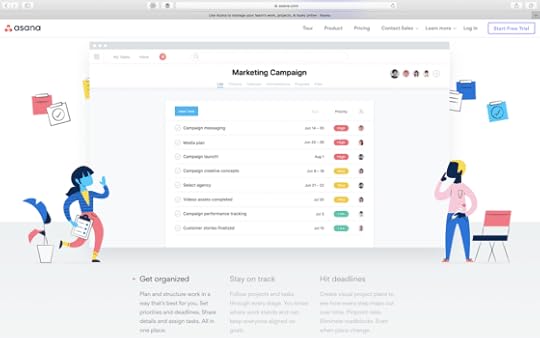
Why we chose Asana
Before making any radical changes, we formed a project management taskforce, including one or two members from each team, and made a list of the features we needed in a project management tool. We needed a way to plan long-term projects, manage short-term sprints, and collaborate across departments―all in one tool.
“
What got us here won’t get us there.
—JOHN MEESE

We quickly ruled out Trello and Monday as tools which were missing key features we needed, and while Todoist and Nozbe are well-loved by many members of our team they are primarily focused on individual task management, with project management as a secondary focus.
That left us with two final project management apps for our taskforce to test: Basecamp VS Asana.
While both tools are well-equipped for managing multiple, complex projects, Basecamp had serious limitations when it came to cross-functional collaboration between different departments on fast-paced projects―and by comparison, Asana was simply more intuitive to use.
Asana features we use everyday
If you’re considering using Asana for your team, you’ll need to know where to focus first. Asana has many useful features, many of which blend into the background when you’re not using them so you can selectively choose which features to use. Here are the five we’re using the most:
1. Managing both projects and individual tasks
One of the key reasons Asana serves us so well is because it provides multiple lenses for looking at the same project from distinctly different views. At its core, a project is made up of a collection of interrelated tasks, but Asana adds a second distinction by making it simple to break up a project into sections of tasks.
The project view provides leaders with a high-level perspective, and shows team members how their assignments fit into the bigger picture of whatever initiatives are going on. Asana includes the built-ability to view the same project from a calendar, timeline, or summary view.
Each task is assigned to a specific person, which allows them to view their assignments in a personal “My Tasks” feed, which can be individually sorted by due date, priority, or project.
2. Creating both list and board projects
One of the reasons why people love Trello so much is because it’s a visual tool, allowing you to view projects in a card-based layout and drag items from column to column to demonstrate progress rather than simply waiting to check them off.
This concept, called a Kanban board, comes from Toyota’s approach to continuous manufacturing by moving work-in-progress products from one phase to the next. While list-based projects are often better suited for planning out the details of a large project, they can be limiting when you’re in the messy middle of any project where a lot of tasks are half-done.
Asana allows you to create any project in a list or board format and also lets you add the same task to multiple different projects (without duplicating the individual task). That means you can create a list-based project to outline the comprehensive vision for the project and also create a board project to visualize your team’s weekly priorities or current work-in-progress tasks.
3. Integrating Asana with Slack
Ever since we started using Slack, we’ve relied heavily on the fast-paced communication that Slack makes possible with a mostly remote team. We have a well-developed system for how we use Slack, so we one of our first priorities with a new project management tool was to determine how the tools play well together.
Thankfully, many other companies have had the same questions before, which is why Asana has developed an incredibly robust integration with Slack. Within Slack, a quick chat can turn into a new task or update to an ongoing task with just a few clicks.
4. Use common language for labels
Without constant communication (or micromanaging), it’s easy to get lost without knowing the details of how each project is doing at any given point. Glancing at a project is helpful only if the information you need is available at a quick glance. That’s why we quickly adopted that habit of using Asana’s labels, or “Tags” to add color-coded updates to tasks when the need comes up.
A yellow “Waiting” tag signifies a task is on hold until after a meeting, decision, or another task is complete. A red “Roadblocked” tag is typically more intense, meant as a flag for tasks which are stuck without a clear path out until a senior leader steps in.
Which tags your team uses is completely custom, recently we added a pink “Cross-functional” tag to make special note of tasks that require contributions from multiple teams. From the project view, these colors and labels are immediately visible, providing a snapshot status update at any point.
5. Leverage Asana’s project templates
When you start using Asana, the app comes pre-loaded with a suite of project templates you may find helpful (especially the “Asana Onboarding” template which walks you through the app).
Even better, Asana allows you to easily convert any project into a re-usable template you can use to get more done in less time. Chances are, you have similar projects you repeat often. Taking a few minutes to create a project template will save you time getting started each time.
The first template we created was for our product promotions, so we could break our launch projects into five distinct phases and space the work out over time.
At the end of the day, no specific software, app, or other tool is going to be the deciding factor in whether or not your business succeeds. But when you’re managing high-paced projects with a team of high-achievers, you need a tool like Asana that helps you lead effectively without getting deep into the weeds yourself.


Stick Your Business in the Cloud
Ask the Right Questions, Avoid the Wrong Pitfalls

Having your files stored in the cloud is one of the most powerful tools in your business when it’s done right. If not, you’ll find yourself and your team spending unreasonable amounts of time tracking things down.
As with most teams that I work with, Michael Hyatt & Co was growing fast when they reached out for help organizing their file system. It still is. The big question for them was, “Which platform do we use? We have files on Dropbox, Google Drive, Box.com, and should we use OneDrive?”
Take a beat to ask better questions
This is the question most people start out with. What platform should I use? What’s the best tool?
This is a valid question, but it’s by no means the most important question. Each tool exists for a specific set of needs. If you’ve been following Michael for any length of time, you know specializing is your biggest strength even though some tools generalize to fit every possible need out there. For Michael Hyatt & Co, Google Drive was the best choice.
The most powerful questions you can ask yourself and your business when it comes to technology are these:
What am I trying to accomplish?
How should I use this platform or tool?
The questions we have determine our focus and where we go. If you’re asking what’s the best and latest tool in the world of fast-moving technology, you’re going to be stuck in analysis paralysis, or you’re probably giving your company whiplash. Can I get an amen?!
Answers, and more questions
When it comes to digital organization, we always start with the question of what we’re trying to accomplish. In this case, it was clearly stated: “To create a central repository for all digital assets that can easily be shared among employees and contractors in a clearly organized system that promotes easy collaboration and efficiency, while maintaining a high level of security and control of these assets.”
After an analysis of how the team works, what they create, related files to their projects, and the tools they were using for content creation, we decided Google Drive was the best choice.
Now the question, “How do I use this platform or tool?”, comes into play.
While there are infinite ways of organizing, after 11 years of teaching people how to use tools and helping them sort out big messes, I believe the best method for most people and businesses is based on category. For example:
General (Assets used across multiple brands, products, clients, etc.)
Corporate Branding
Documentation
Office policies
Templates
Courses/Products
Best Year Ever
Free to Focus
Platform University
Financial
Expense Reports
Monthly P&L
Strategy
HR
Benefits
Policies
Legal
Board Minutes
Corporate Licensing and Numbers
Form Templates
Forms Filled
Legal Engagements
Teams
Content
Customer Experience
Finance
HR
Marketing
Operations
How you go from The Big Mess to a clear organized system:
1. Decide on a platform
We chose Google Drive because we were already using G Suite and Google Docs heavily. The integration of Google products made the most sense.
2. Take inventory
You’re going hunting. Grab a sheet of paper and find where all your stuff is and write it down. E.g. Dropbox, Google Drive, OneDrive, Evernote, on my Mac – Desktop, Documents, Downloads, Pictures. Don’t get bogged down in this. Spend a max of 15 minutes.
3. Find the pattern
Write down the categories above in your notes and scan through the files you found. Did you find a number of things that warrant creating another major category? If so, add it to your list.
4. Start from scratch
We created a folder called DAR (Digital Assets Repository). Inside of DAR, we created our main categories and any obvious subfolders that should go in there.
5. Cannibalize the old system
Questioning whether or not you’ve already moved something to the new system is a recipe for a mental breakdown. Our goal is to feed the new organization system with the files from all other sources. This is absolutely critical. To keep your sanity during this process, clean up as you go. If you’ve just copied files from Dropbox to Google Drive, delete the stuff you just copied from Dropbox.
6. Broad strokes
The first goal when you’re organizing is consolidation. Don’t worry about organizing everything perfectly. Just get them from all the various sources into the main categories. Then celebrate!
7. Refine
Once you have everything in the big folders, it’s time to consolidate again. For example: Courses. If you have a number of courses, make a folder for each and put everything relating to that course in the folder. Inside of there should be things like: Media, Copy, Affiliates, Slide Decks, etc.
8. Maintain consistency
The first time you organize everything, it’s unlikely you’ll get it perfect. For now, just maintain consistency with your system. Create a document to share among the team for how things are working in the new system and how it can be improved. I suggest creating a channel in Slack just for this. Make sure you assign someone or a committee to own this project.
9. Pivot
You’re going to feel a massive sense of relief once everything is in this system. At the same time, you’ll gain clarity on how things could be even more clear. Take the notes the team has been giving you and implement those changes. This is where ownership comes in handy. You must make those changes as quickly as possible so as not to create confusion. Use the designated committee to accomplish this. Announce these changes and make sure everyone knows what’s about to happen to ensure a smooth transition.
The most important thing in the process is to commit to an organization system. What platform you use is important, but secondary to how you use it. Our biggest task is consolidating all the files to one place and putting them in the new system. From there, it’s all a matter of refinement.


October 2, 2018
Quash Rumors With Truth
4 Ways to Play It Straight and Get to Great

Rumors at work can be surprisingly destructive. Rumors undermine the confidence of an organization, both within and without; encourage infighting, backbiting, and other HR department fever dreams; deep six morale; make strategic hiring like extracting wisdom teeth; scare off would-be investors; and tank stock prices. What start as whispers can build to whirlwind force.
Because of these outsized effects, leaders are often tempted to treat rumors like word grenades and view those chucking them like the enemy. And in the case of persistent, malicious gossips, they are probably right to take direct action.
But in the vast majority of cases, it behooves leaders to take a step back and ask a really important question of their own leadership first: Why are these damaging rumors spreading?
Titanic talking
The first thing to remember is that people will talk about changes brewing at work. It’s our nature. One reason people spread rumors is that there’s a lack of information available about what is to happen. So they fill that vacuum with speculation, which builds on itself in an unhealthy way.
“
What start as whispers can build to whirlwind force.
—JEREMY LOTT
I observed this with one of my first jobs out of college. It was at a storied publication that had seen better days and was in some trouble. Workers there speculated like crazy about what was going to happen, in part, because they couldn’t get a straight answer from the people in charge. Stories and plans kept changing. The deck chairs kept being shuffled until it all sank into the icy depths.
Was it salvageable when I got there? Hard to say. But by the end, it was simply impossible to sustain trust within the organization, and this affected any attempts to keep things together. The dwindling number of employees trusted the rumors to be more accurate than whatever the leaders had to say that day, if they even bothered to say anything.
Give ‘em something to talk about
If people are going to talk, then, with apologies to Bonnie Raitt, it’s best to give them something to talk about. Let’s talk about truth, because consistent, truthful words are the best way to drive out rumors. There are at least 4 important aspects to this for leaders.
1. Create an expectation of truth
It’s not enough simply to tell the truth once in a while or even most of the time. Expectations matter greatly in setting the tone for a team. It’s important that your team has the expectation that what you say to them will be true.
That way, when rumors crop up, they will weigh your words and general reliability against the rumors and dismiss the rumors.
2. Admit when you don’t know things
It’s not fun to stand up in front of people and admit ignorance, so there is a very human tendency to guess at answers and assert those guesses as facts. We’ve all done this from time to time. As a leader, you must fight this tendency. When you don’t know an answer to something, say, “I don’t know.” Then maybe take a beat and say, “I’ll get back to you on that,” if in fact you will do so.
This bolsters the case for your honesty and it also models something important for your team. They will understand that it’s OK to admit ignorance and then go get answers. These habits will help them resist spreading rumors.
3. Get alignment with your leadership
If you manage managers and have to make a significant change, say for yourself and instruct them to say to all workers, “We still need to make a decision on that.” Which is the truth. That will start the rumor mills churning, so get your management team together with all deliberate speed, talk things out, and make the hard decision.
Don’t call for agreement, because people are going to have their opinions. Call instead for alignment: Here is the blueprint, the plan, and how we are going to pursue it.
Then make sure that they go out there and tell everyone what is happening. Doing so will knock the rumor mill right off its hinges.
4. Don’t let bad news linger
It is especially important to get the news out quickly if it is bad news. It’s bad enough if, let’s say, you have to lay off employees. It is far worse if the remaining ones or future prospective employees don’t expect that you’ll be straight with them.
That truth might hurt now. But if you need the courage to tell it, just remember that the vicious, rumor-torn future you could be facing down is a whole lot worse.


How to Dial Down Workplace Drama

Leaders build momentum. But nothing kills it faster than office gossip and departmental wrangling. Based on decades of experience in corporate leadership, we’ll show you four solid strategies for dialing down the theatrics so you don’t waste energy on needless conflict. When we’re done, you’ll have a clear strategy for creating a high-trust team that will hum along without a hint of drama.