Michael Hyatt's Blog, page 172
April 4, 2013
10 Commandments of DIY Design for Marketers [Slide]


 If you can’t see this slideshow in your RSS reader or email, then click here.
Visuals are becoming an increasingly important aspect of marketing, and with limited resources, you may need to create at least some of your own visual content. If you need to take the creation of various design elements of your marketing into your own hands, this slideshow by HubSpot will help you start off on the right foot.







April 3, 2013
#048: The 5 Characteristics of Weak Leaders [Podcast]


I have worked for more weak leaders than strong. I’ll bet you may have, too. However, I believe you can learn just as much from a weak leader—maybe more.
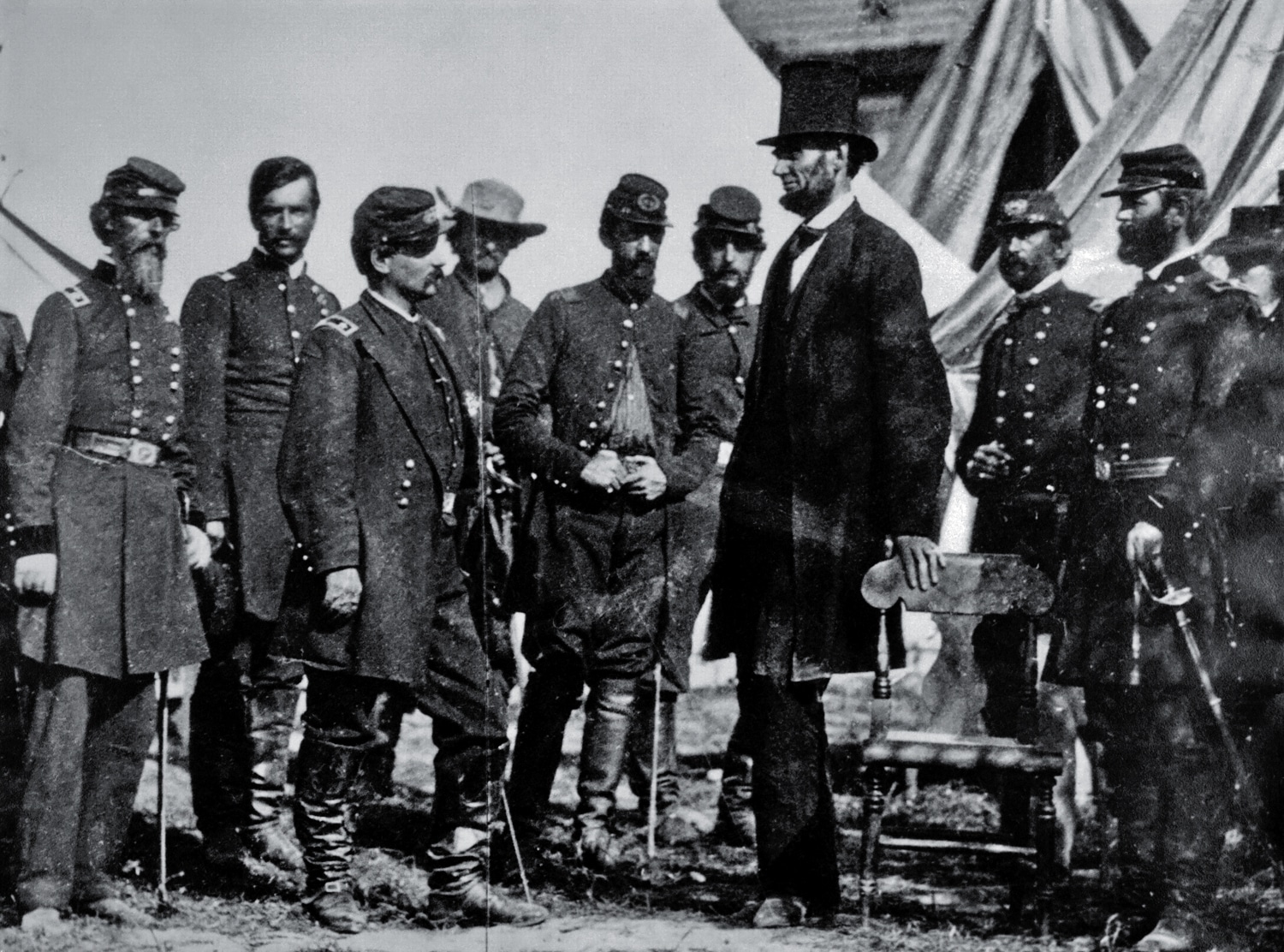
Lincoln and McClellan at Antietam
I was reminded of this again when I read Team of Rivals by Doris Kearns Goodwin. It is a page-turning account of Abraham Lincoln’s presidency and his political genius.
Click to Listen
Podcast: Subscribe in iTunes | Play in browser | Download
Though Lincoln was a strong leader, he wasn’t perfect. He occasionally selected men for public service who were unworthy of his trust. One such individual was General George B. McClellan, commander of the “Army of the Potomac” and, eventually, first general-in-chief of the Union Army.
General McClellan had significant character flaws. The good news for us is that they serve as warning signs to us. Ultimately, these flaws cost him dearly. He lost Lincoln’s confidence, he lost his job, and he later lost a run for the White House (against Lincoln).
McClellan’s weakness as a leader can be attributed to five fundamental flaws, and these are flaws that appear consistently in weak leaders.
Flaw #1: Weak leaders hesitate to take definitive action.
Flaw #2: Weak leaders complain about a lack of resources.
Flaw #3: Weak leaders refuse to take responsibility.
Flaw #4: Weak leaders abuse the privileges of leadership.
Flaw #5: Weak leaders engage in acts of insubordination.
President Lincoln had the patience of Job. He gave General McClellan numerous opportunities to correct his behavior and redeem himself. But in the end, McClellan either could not or would not do so. He left the President no choice but to relieve him of his duties.
In this episode, I also talk about how to deal with those flaws in yourself and in those who are leading you.
Listener Questions
Alan Williams asked, “How do I know if I’m doing a good job as a leader?”
Blessing Mpofu asked, “How do you lead people who are smarter and stronger than you in areas you are not?”
Brandon W. Jones asked, “How do you deal with a leader who has a Jekyll and Hyde personality?”
James Divine asked, “How can I influence other leaders who have a difficult time being courageous?”
Jonathan Lazar asked, “How do I know if the problem is me as a leader who needs to grow or if the problem is an employee who needs to go?”
Joseph Iliff asked, “Have you had any experience with leaders who are quick to blame and slow to accept responsibility?”
Kent Lapp asked, “What do you do if you feel you are working for a weak leader and you are actually a better leader?”
Robert Farrington asked, “Do you have any tips in giving feedback to new leaders—perhaps someone you work for or someone external to the company?”
Special Announcements
My business partner, Ken Davis, and I will be hosting the SCORRE Conference, May 6–9 at the beautiful Rosen Plaza Hotel in Orlando, Florida.
Whether you are a professional speaker—or just want to be—this conference will teach you how to prepare with focus, deliver with confidence, and speak with power. Bottom line: it’s a conference designed to maximize the impact of your speeches.
Honestly, this conference has had a bigger impact on my career than any conference I have ever attended. It revolutionized my speaking and his influenced every aspect of my communication, including my blogging and podcasting.
If you are serious about becoming a better speaking, you simply must attend. You can find out more at SCORREConference.tv.
If you are considering launching your own platform, you need to start with a self-hosted WordPress blog.
This is not as complicated as it sounds. In fact, I have put together a step-by-step screencast on exactly how to do it. You don’t need any technical knowledge. I walk you through the entire process in exactly 20 minutes.
And, for a limited time, Bluehost—the hosting company I personally recommend—is offering an amazing deal to my listeners. You can get web hosting for as little as $3.95 a month.
My next podcast will be on the topic of “The 3 Ingredients of Job Satisfaction.” If you have a question on this subject, please leave me a voicemail message. This is a terrific way to cross-promote your blog or website, because I will link to it, just like I did with the callers in this episode.
Episode Resources
In this episode I mentioned several resources, including:
Book: Team of Rivals by Doris Kearns Goodwin
Book: The Ultimate Sales Machine by Chet Holmes
Post: How to Get Your Boss to Say “Yes,” Part 1
Post: How to Get Your Boss to Say “Yes,” Part 2
Post: How to Get Your Boss to Say “Yes,” Part 3
Post: Leadership and Accountability
Post: 8 Leadership Lessons from a Symphony Conductor
Show Transcript
You can download a complete, word-for-word transcript of this episode here, courtesy of Ginger Schell, a professional transcriptionist, who handles all my transcription needs.
Subscription Links
If you have enjoyed this podcast, please subscribe:

iTunes

Zune

RSS
Your Feedback
If you have an idea for a podcast you would like to see or a question about an upcoming episode, e-mail me.
Also, if you enjoyed the show, please rate it on iTunes and write a brief review. That would help tremendously in getting the word out! Thanks.
Question: Do you see any of these five flaws in your own leadership? Where are you struggling? You can leave a comment by clicking here.




April 2, 2013
Temporary Defeat [Quote]

One of the most common causes of failure is the habit of quitting when one is overtaken by temporary defeat.”
Napoleon Hill
Think and Grow Rich: The Original 1937 Unedited Edition (Wise, VA: Napoleon Hill Foundation, 2012), 21



April 1, 2013
The Secret to Overcoming Any Fear
This post is an excerpt from my friend Ken Coleman’s new book, One Question: Life-Changing Answers from Today’s Leading Voices. This chapter is based on an interview he did with me. At the end of the post, I will share how you can get a free copy of the book. You follow Ken here on Twitter.
The name Walt Disney World conjures up words such as “wonder” and “imagination.” For most people, the renowned theme park’s moniker rarely summons up bone-rattling, tear-inducing fear. But my son Ty had a different experience during a recent family vacation to Disney’s Animal Kingdom.

From the moment we stepped onto the property, my family was met with all the pageantry for which Disney is famous. The five hundred-acre amusement park is home to seventeen hundred exotic animals. Iguanas sunbathe on rocks, giraffes strut along savannas, and macaws showcase their neon feathers from perches just beyond one’s fingertips. From the fanciful to the mighty, this Floridian wonderland is a kid’s dream.
As with other Disney properties, the directory located near the entrance is dotted with attractions. Only a few steps in, a particular marker caught Ty’s attention: Kali River Rapids. Contrary to its threatening name, the water ride is an opportunity for weary parents to put up their feet and exhale. A twelve-passenger circular raft winds down a picturesque river with jasmine-scented mists and majestic waterfalls. If you don’t mind getting wet, this ride is not to be missed, and Ty made sure we wouldn’t forget by reminding us about it every few steps we took.
Arriving at the entrance, I made sure my son met the height requirement, and we began the five-minute walk to the loading area. As we strode along, Ty’s countenance changed from excitement to malaise to suspicion to outright anxiety. Stepping up to the turntable that places visitors in rafts, his emotional dam broke. Tears poured from his eyes as he pleaded passionately to leave.
I knelt down and reasoned with him, something every dad attempts in such a situation even though he knows it’s futile. I explained that the ride wouldn’t scare him and that if he could just muster the courage to step into the boat, he’d be glad he did. A few minutes after launching into my monologue, we were trek-king back to the attraction’s entrance, serenaded by my son’s relieved sniffles.
Just as we entered the common area, a second transformation happened. When Ty’s little brother, Chase, proclaimed his desire to take on the rapids, Ty was suddenly convinced that he had made the wrong decision. He wanted to return to the Kali River Rapids turntable once more. My frustration over the whole ordeal had risen to boiling, but it was dwarfed by my own desire to experience the ride. So after a third five-minute walk, we were finally floating through the Asian-style jungle together.
I looked over at Ty after a few minutes and saw his characteristic smile, the one that never fails to melt me. He reached over, gripped my hand, and shouted, “Dad, I love it! It isn’t scary at all … thanks!” Suddenly, I was the one who was being transformed—from the emotionally and physically drained father to the proud daddy. Despite the hassle of the ordeal, I knew Ty had experienced something profound, a lesson he could never receive through lectures or logic: he’d discovered how to conquer his fear.
The image of my smiling son was in the front of my mind when I drafted an interview question for Michael Hyatt. He is the [former] chairman of Thomas Nelson Publishers, one of the largest book publishers in the United States. Highly respected among his peers and widely sought after for his leadership advice, Hyatt speaks often about how he’s had to push through fear in order to achieve great accomplishments in his life.
I wanted to know what his experiences could teach the rest of us who often find ourselves stopped dead in our tracks, begging to walk back the way we came.
Ken Coleman: Many times in life, people don’t go after what’s on their hearts because of fear. How can we conquer fear?Michael Hyatt: Fear is the number one obstacle that most people face in their lives. Very few people talk about it, but I can guarantee you it’s the biggest thing I face in my own heart. There have been times when I have lain awake at night wondering, particularly in this economy, “What’s going to happen to me? What’s going to happen to my company? What’s going to happen to my family?” Fear is a very debilitating thing. It doesn’t serve many useful purposes, and people can get really stuck in it.
When I’m afraid, I have a practice of walking right into my fears rather than away from them. If people can get used to that, their fear will dissipate. Most of the power of fear is in your mind; it doesn’t really exist. It’s just this idea that looms because we are unwilling to face it. But the way to declaw it, the way to defuse it, is to step into it—right into the middle of it—and do the thing that you are afraid to do.
How many times do we find ourselves frozen by fear? Our hearts palpitate, our eyes search frantically for an exit, and soon we’re paralyzed by trepidation. At moments when we need to lunge forward, our feet plant as though in cement.
Fear takes many forms. I find myself arrested by the fear of criticism. I fear looking back on my life and discovering wasted opportunities or unrealized potential. A great worry for me is that I will have lived life but never made a difference. Maybe you are a perfectionist and battle the fear of failure. Or you’re shy and stave off the fear of success. Whatever brand of fear you experience, the emotion can be debilitating.
Hyatt is right; fear lives mostly in our minds and festers as long as we fail to face it. Children, for example, often convince themselves that something is under their bed. The fear may not be rational, but it can cause much distress. Yet the emotion remains only as long as the child lies motionless in the dark. Once he or she looks under the bed and finds nothing, the panic dissipates.
Likewise, Ty didn’t have a real fear that memorable afternoon at Disney. I am his father, and he trusts me. He knows I wouldn’t endanger him physically or emotionally. But he still felt afraid, and facing that emotion was the only way to chase it away. What my son learned as a six-year-old, many of us need to learn at twenty-six or fifty-six: that fear can protect us from danger—but it can also keep us from life’s great adventures.
One Question is based on Ken’s popular blog, “One Question with Ken Coleman,” where well-known figures are asked one, solitary question. Drawing readers in with never-before-published interviews, this book delivers inspirational and applicable life lessons that can be digested in a matter of minutes.
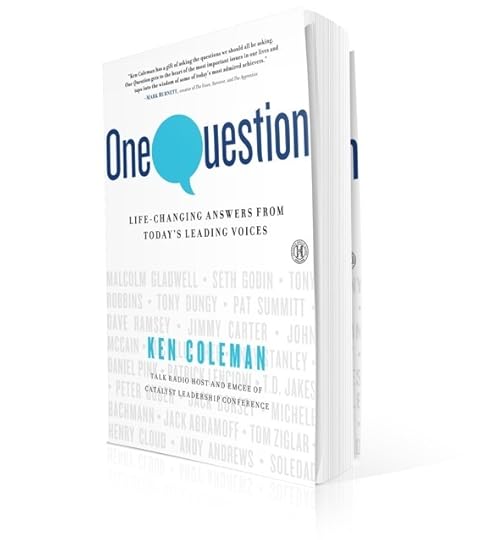
Simon & Schuster, Ken’s publisher, has agreed to give 50 copies of his new book, One Question to my readers. To get a chance at snagging one, you must take the following three actions:
Leave a comment below. Answer the question at the bottom of this post.
Fill out the special form. I have set up a separate contact form to make it convenient for you to provide your mailing address. Please do not put your shipping address in your comment. This will automatically disqualify you.
Twitter a link to this post. You can do so automatically by clicking here. If you don’t have a Twitter account, you can use Facebook.
On Friday, April 5th, I will select 50 people at random. If you are one of those selected, I will notify you via email. If you don’t hear from me, you can assume you were not selected.
Question: What appeals to you about this book and why do you want a copy? You can leave a comment by clicking here.



March 30, 2013
Join Me at the Chick-fil-A Leadercast 2013
I attend more leadership conferences than anyone I know, especially now that I am speaking professionally. It is simply amazing how many events leaders have to choose from today.
If you can’t see this video in your RSS reader or email, then click here.
But the Chick-fil-A Leadercast is still my top pick. Perhaps this is because I have hosted the Leadercast Backstage program where I have had the privilege of interviewing all the speakers on video. As a group, they are second to none.
This year, I will be hosting the Main Stage. I can’t wait.
The Chick-fil-A Leadercast will again be held live in Atlanta on May 5, 2013 and simultaneously broadcast to hundreds of locations around the world. In all, more than 140,000 people will attend. In a moment, I will tell you how you can participate.
What makes this event different? Three characteristics:
The diversity and experience of the speakers. This ensures that leaders are exposed to the best ideas from the corporate and faith-based worlds.
Leadership content that deals with both the head and the heart. This insures that leaders are not only taught but engaged and encouraged to put what they learn into practice.
The opportunity to interact with other leaders. There is something powerful about getting together with other like-minded leaders to spend the day focused on how to grow your leadership.
Jack Welch, former Chairman & CEO of General Electric
Andy Stanley, bestselling leadership author and communicator
Mike Krzyzewski, head men’s basketball coach, Duke University and Team USA
John C. Maxwell, bestselling author and leadership expert
Henry Cloud, bestselling author and leadership consultant
Rorke Denver, Navy SEAL and star of the 2012 movie Act of Valor
Sanya Richards-Ross, 2012 London Olympic gold medalist, track & field
David Allen, best-selling author of Getting Things Done and productivity expert
Condoleezza Rice, Secretary of State (2005-2009) Exclusive Simply Lead video interview with John C. Maxwell
You can get a feel for the event by reviewing the Chick-fil-A Leadercast Network.
If you are a business leader, this is great way for you to bring world-class training into your company. If you are a pastor, church staff member, or lay leader, this is a great way for your church to reach the business leaders in your community. You can make your event public or private. It’s your choice.
You can find out more about becoming a host site by clicking here. If you want to attend the event, you can find out more by clicking here or here. Trust me, these kinds of events are even better when you can bring your leadership team with you.
Again, I will be hosting the Main Stage program. I can’t wait to introduce and follow-up with this roster of speakers. I look forward to seeing you there!
Questions: Have you attended the Chick-fil-A Leadercast in the past? What was your experience? You can leave a comment by clicking here.



March 29, 2013
How to Solve Almost Any Problem (Hopefully)
I can’t complain. I don’t have many problems. I am healthy. I have a great marriage. My children all love me and live nearby. I make enough money to accomplish my goals. Life is good.

But I do struggle with one nagging problem I have yet to solve. It’s dogged me for five years. Just when I think it’s gone, it slips out of the shadows and bites me.
The problem is my voice.
I have always had a decent voice. In fact, one of my first jobs was as a DJ on a local FM radio station. I was the guy who announced, “That was ‘Appalachian Spring’ by Aaron Copland and the London Symphony Orchestra.”
For most of my life, I took my voice for granted. I sang in the choir. I spoke publicly. I recorded a number of audio programs. I always felt it was an asset.
But this all changed overnight. I can still remember the day it happened—September 15th, 2008. This was the very day Lehman Brothers declared bankruptcy. I was the CEO of Thomas Nelson Publishers at the time.
I was in New York City to meet with a group of bankers who held our debt. Our sales had fallen precipitously in the previous three quarters. (This was in the beginning of what would eventually be known as the Great Recession.) Understandably, they wanted to know why. They also wanted to know what we intended to do about it.
I told my wife, Gail, it was like being called to the principal’s office, only to discover there were twenty principals waiting. It was stressful to say the least.
Actually, the meeting went well. My team and I were prepared. We had credible reasons for our poor performance and a plan for correcting it. The bankers were respectful and asked thoughtful questions.
I tried to sound confident, but I was afraid.
I was worried about the economy, troubled about the future of publishing, and concerned about what this all might mean for the company I was leading. I was also very much aware my job was on the line.
During the meeting, my voice cracked several times. This surprised—and embarrassed—me, but I just assumed I was getting a cold. Maybe all this stress has compromised my immune system, I thought.
But it didn’t get better. The problem would disappear for weeks and then suddenly, out of the blue, strike. I would all but lose my voice.
Finally, in desperation, I went to the Vanderbilt Voice Center. (This is one of the benefits of living in Nashville, where we have so many singers.) They ran me through a battery of tests, including a stroboscopic exam that took digital images of my vocal folds.
The result? Nothing. Everything looked normal.
The doctor suggested I might want to signup for some sessions with a voice therapist. I declined.
This is stupid, I thought. If this is all in my head, I can solve the problem myself. I’ll just use some relaxation techniques and think happy thoughts.
Well, that didn’t work either. Over the last four-and-a-half years, the problem has persisted. Thankfully, it doesn’t usually afflict me when I speak publicly, though it does sometimes show up when I record my podcast, do interviews, or sing in church.
Finally, this last week I decided I had had enough. I was ready to solve the problem. I decided on a five-pronged approach:
Pray about it. As a person of faith, this is where it starts for me. I am specifically asking God to heal my voice. Unfortunately, for many people, this is where it starts and stops. While this is necessary, it usually isn’t sufficient.
Educate myself. I decided I would relearn the basics of vocal physiology. I bought a course by Roger Love, one of the world’s leading vocal coaches. It is called, “The Perfect Voice.” I have listened to it once through and am now listening a second time.
Think positively. Our thoughts have a huge impact on our experience—good and bad. As I began to analyze my thinking about my vocal problems, I realized my inner Narrator was telling me a bad story. I wrested back control and am now telling myself a better one.
Specifically, I am repeating these affirmations several times a day:
My voice is strong.
My voice is resonate.
My voice is clear.
Take action. This is where the rubber meets the road. Roger Love includes a fifteen-minute vocal warm-up in his Perfect Voice program. I put it on my iPhone and have now made it a part of my morning routine. It is specifically designed to strengthen one’s voice over time.
Seek outside help. I haven’t taken this step yet—at least not to the level I am willing to go. If the four steps above don’t solve my vocal problem in the next six weeks, I am going back to the Vanderbilt Voice Center and get professional help.
As I was thinking through this issue, I thought this is really the recipe for solving any problem in life. I know it is ridiculously obvious, but I am amazed how many people are stuck (like I was) and don’t know what else they can do.
Whether you want to lose weight, improve your marriage, heal your body, find a job, or get a promotion, this five-part approach provides a way to make it happen.
Question: What problem do you have that might benefit from this five-fold approach? You can leave a comment by clicking here.



March 28, 2013
The Science of Productivity [Video]
In today’s crazy world, productivity is a never-ending challenge. How do we become more efficient at working, and spend less time working overall?
In this short video, Mitchell Moffit and Gregory Brown share some interesting tidbits about productivity from the world of science.



March 27, 2013
#047: The Lost Art of Note-Taking [Podcast]
I don’t recall anyone ever teaching me how to take notes. I didn’t learn it in school—not even college. Nor did I learn it on the job. It was something I had to pick up on my own.

Maybe this is why so few people bother to take notes during meetings or presentations. No one has ever told them why it is important or how to do it. In this episode, I do both.
Click to Listen
Podcast: Subscribe in iTunes | Play in browser | Download
So let’s start with why. Why is note-taking important? Here are five reasons you should take notes in every meeting your attend:
Note-taking enables you to stay engaged.
Note-taking provides a mechanism for capturing ideas, insights and questions.
Note-taking helps you track assignments–yours and others.
Note-taking provides a handy reference weeks and months later.
Note-taking communicates the right things to the other attendees.
So, those are some reasons why note-taking is important. How, then, can you take better notes?
Don’t get hung up on the tool.
Record whatever you find interesting.
Give your notes structure, even if the meeting or presenter is unstructured.
Use symbols so you can quickly scan your notes later.
Schedule time to review your notes.
The method you use is secondary to the importance of doing it. Feel free to experiment. The key thing is to be intentional.
Listener Questions
Brandon Jones asked, “How can you effectively take notes and still be an active participant in the meeting?”
Cary Branscum asked, “What is the one favorite pen or pencil you have that you most enjoy using?”
Deborah Owen asked, “How can we teach students to take notes in a way that will ultimately be useful in the workplace?”
Erick Rheam asked, “How do you capture ideas and follow-up items on podcasts and audiobooks?”
Jared Easley asked, “What’s your advice on taking mental notes, when you don’t have a pen and taking notes on a cell phone is inappropriate?”
Jeremy Jones asked, “Do you have a regular process or system for making sure the notes you take get into your life?”
John Brubaker asked, “How do you get buy-in from people who work for you to become note-takers themselves without forcing it on them?”
Jordan Collier asked, “Can you recommend a system for reviewing or reflecting on your notes?”
Paula Gibson asked, “How can we encourage students, who are using digital devices, to take notes?”
Scott McFaddin asked, “How can we use digital devices in a corporate setting without making people wonder if we are taking notes or doing something else?”
Tom McFarland asked, “What do you do with your notes after you finish processing them?”
Victor H. Manzanilla asked, “How do you create a notes archive that is indexed and searchable?”
Special Announcements
I am speaking at Dan Miller’s Innovate Conference on Friday, March 29th, here in Franklin, TN. I am speaking on the topic of “Platform: Get Noticed in a Noisy World” with special emphasis on finding your voice.
Next week, April 2nd, I will be speaking at Merrimack College in North Andover, Massachusettes. It’s about a half hour north of Boston. I will be speaking on the topic of “Platform.” Previous speakers have included John C. Maxwell and Sir Ken Robinson.
Finally, on April 26th, I will be speaking at the CEO Summit in Frisco, TX on the topic of “Platform.” I’ll be there with my friends Bob Goff and Francis Chan.
Platform University continues to thrive! This week, I hosted our monthly Q&A call. Our members submitted hundreds of questions. My staff went through and collected the most often asked ones, and then we took several calls live.
My next podcast will be on the topic of “The 5 Characteristics of Weak Leaders.” I’ll talk about how not to be that guy and what to do if you work for that guy.
If you have a question on this subject, please leave me a voicemail message. This is a terrific way to cross-promote YOUR blog or website, because I will link to it, just like I did with the callers in this episode.
Episode Resources
In this episode I mentioned several resources, including:
Conference: Platform Conference
e-Book: Evernote Essentials
Hardware: JotPro Stylus
Hardware: Montblanc Meisterstuck Classic Ballpoint Pen
Notebook: Moleskine
Notebook: EcoSystems
Software: Evernote
Software: Nozbe
Software: Moleskine for iPad
Software: PenUltimate for iPad
Slide: Note Symbols
Show Transcript
You can download a complete, word-for-word transcript of this episode here, courtesy of Ginger Schell, a professional transcriptionist, who handles all my transcription needs.
Subscription Links
If you have enjoyed this podcast, please subscribe:
iTunes
Zune
RSS
Your Feedback
If you have an idea for a podcast you would like to see or a question about an upcoming episode, e-mail me.
Also, if you enjoyed the show, please rate it on iTunes and write a brief review. That would help tremendously in getting the word out! Thanks.
Question: What have you found helpful in taking notes? You can leave a comment by clicking here.



March 26, 2013
Cast a Compelling Vision by Being Concrete [Video]
The key to casting a compelling vision is to help people see what you see, by being concrete. This video by Corning envisions a future where technology is built on glass. Don’t believe that’s possible? This short video just might change your mind.
Question: What can you apply from this video for making your vision more concrete—and compelling? You can leave a comment by clicking here.



March 25, 2013
A 4-Step Process for Making Better Decisions [Book Giveaway]
Human beings are notoriously bad at making decisions. We seem to struggle with this in both our personal and professional lives.
For example:
Forty-one percent of first marriages end in divorce.
Forty-four percent of lawyers would not recommend a career in law to young people.
Eighty-three percent of corporate mergers and acquisitions fail to create any value for shareholders.
According to bestselling authors Chip Heath and Dan Heath, “When it comes to making decisions, it’s clear that our brains are flawed instruments.” Whether we rely on complex analysis or gut reactions, the results are about the same.
Unfortunately, merely being aware of these shortcomings doesn’t fix the problem, any more than knowing that we are nearsighted helps us to see. The real question is: How can we do better?
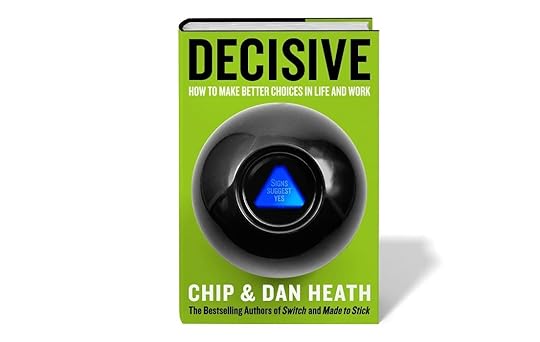
That’s why the Heath brothers wrote their new book, Decisive: How to Make Better Choices in Life and Work. I spent this last weekend reading it.
First, we have to understand the problem. The authors point out the “four villains” when it comes to making decisions:
We have too narrow of focus. We are guilty of “spotlight thinking.” We focus on the obvious and visible. We miss important facts outside our immediate view.
We fall into confirmation bias. We develop a quick belief about something and then seek out information that confirms that belief.
We get caught in short-term emotion. We are too emotionally connected to the decision and struggle with being appropriately detached.
We are guilty of overconfidence. We assume that we know more than we actually do know and jump to conclusions, thinking we can accurately predict the future.
The great value of the book is that it lays out a decision-making process that can be used in any situation. It is designed to counteract the influence of the four villains and consists of four steps:
Widen your options.
Reality-test your assumptions.
Attain distance before deciding.
Prepare to be wrong.
The authors refer to this as the WRAP Process from the first letter of each step. By the way, these four steps are sequential—you do them in order. And the more you employ this process, the better you get at it. With enough practice, it becomes second-nature.
In typical Heath brothers style, the book is filled with wonderful and memorable (dare I say “sticky”?) anecdotes that illustrate every principle. The book offers fresh strategies and fresh tools for making better choices.
The first thing I am going to do now that I have read Decisive is have everyone on my team read it. I can’t imagine anything that could impact the quality of our lives and business more than making better decisions.
Crown, Chip and Dan’s publisher, has agreed to give 100 copies of their new book, Decisive to my readers. To get a chance at snagging one, you must take the following three actions:
Leave a comment below. Answer the question at the bottom of this post.
Fill out the special form. I have set up a separate contact form to make it convenient for you to provide your mailing address. Please do not put your shipping address in your comment. This will automatically disqualify you.
Twitter a link to this post. You can do so automatically by clicking here. If you don’t have a Twitter account, you can use Facebook.
On Friday, March 29, 2013, I will select 50 people at random. If you are one of those selected, I will notify you via email. If you don’t hear from me, you can assume you were not selected.
Question: What appeals to you about this book and why do you want a copy? You can leave a comment by clicking here.