J.C. Martin's Blog, page 9
June 10, 2013
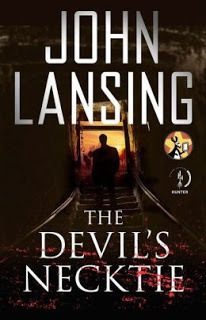
Book Shout-Out: THE DEVIL’S NECKTIE by John Lansing
%Úte%% | J.C. Martin

The Devil’s Necktie
by John Lansing
on Tour June 1st – July 31st 2013
Book Details
Genre:Â Crime/Thriller
Published by:Â Simon&Schuster
Publication Date:Â 12/31/12
Number of Pages:Â 295
ISBN:Â 1451698348
Note:Â Excessive strong language, Graphic violence, Explicit sexual scenes
Purchase Links:Â
       Â


Synopsis:Â
Retired Inspector Jack Bertolino had strict rules when dealing with confidential informants. But Mia had the kind of beauty that could make a grown man contemplate leaving his wife, his job, and his kids. After a passionate night together, Mia is found murdered, and Jack is the lead suspect. Facing threats from the LAPD, the 18th Street Angels, and a Columbian drug cartel, Jack delves deeper into the seedy world of drug dealers and Murderers. Jack is torn between fearing for his life and seeking revenge for his slain lover… either way the body count will rise.
Read an excerpt:
Jack Bertolino stood on the balcony of his loft in Marina del Rey, tending a dry-aged New York steak on his prized possession, a top-of-the-line Weber gas grill. He didn’t miss winter, not one little bit. Here he was manning the barbecue in his new uniform, a black T-shirt and jeans, while his cousins were chasing heart attacks shoveling snow off their Staten Island driveways. That image never ceased to put a smile on his face. That and the salty ocean breeze that floated in over the marina.
Jack nursed a glass of cabernet and watched the long line of bright white FedEx trucks return home from their final deliveries and park in neat rows in the lot next to his building. It sure beat the sight of patrol cars jammed onto the sidewalk in front of a precinct house.
Early evening was Jackâs favorite time of day. The sun was just starting to paint the clouds a muted orange. From his fourth-floor vantage point, Jack could see a string of jumbo jets in the distance, silently making their final approach to LAX. Stacked eight planes deep, their slim silver bodies glinted in the setting sun. For the first time in Jack Bertolinoâs life, he felt at ease.Â
His cell phone chirped, snapping him out of his reverie. He tossed some Japanese eggplant onto the grill, closed the lid, and checked his cell phone screen for the name of the caller.
âHello.â
âHowâs my Italian stallion?â
âMia . . . ,â he said instantly, his tone neutral, giving away nothing.âAll the planets are aligned, Jack. Itâs time for you to man up and make an honest woman out of me.â
Jack couldnât help but smile. Miaâs throaty voice and light Colombian accent had the power to make a grown man weep. More important, it could make a bad man give up his secrets. He hadn’t really been surprised when he received her text. He knew it was only a matter of time. Paybackâs a bitch.
âWhat can I do for you, Mia?â
âItâs what I can do for you, papi. My lips . . . theyâre still magic.â
âI love it when you talk dirty.â
âOnly for love or money.â
Although Jack was enjoying the back and forth, he was no longer in the business. âWhy are you calling, Mia?â
Mia dropped her act as well. âWe need to talk.â
âItâs not a good time,â Jack said as he opened the lid of the grill and pressed his fork against the steak, checking for doneness.
âFace-to-face, Jack.â
âIâm not in New York.â
âThatâs why Iâm in Los Angeles.â
Jack didnât reply right away. He did a quick analysis of how Mia could know he was living in L.A., what kind of trouble she might be in, what kind of blowback he was going to suffer just from having this conversation. He came to the instantaneous conclusion that however this new wrinkle in his life played out, it would definitely have an impact on his newly found state of bliss.
Mia answered some of his unspoken questions. âIâm still connected, Jack, and youâre still on the radar screen. There are certain peopleâwho will remain nameless, because Iâm not on your payroll anymoreâwho are not convinced youâre out of the game.â
âIâm happily retired,â Jack fired back, wondering if his response sounded forced, wondering why he cared.
âAnd happily divorced?â
Jack didnât respond. His private life was none of Miaâs business. He had strict rules when dealing with confidential informants, a line in the sand he never crossed. But Mia had the kind of beauty that could make a man contemplate leaving his wife, his job, and his kids. Jack had never taken the bait, but had to admit heâd been tempted.
Mia was one of the best CIs in the business, and she and Jack had done groundbreaking work together.Â
With the help of Mia and DEA agent Kenny Ortega, Jack and the team of NYPD narco-rangers he headed up had put away a heavy hitter in the cocaine trade. Manuel Alvarez was the head of a Colombian drug cell that had been importing a thousand keys of coke into Florida on a weekly basis, and the poison was dripping into New York City. Jack and his group had put away a major cartel scumbag, and Mia had gotten rich. The feds had a financial equation in place when dealing with CIs. The greater the quantity of drugs an informant was responsible for delivering, the more money it was worth to the United States government. They were happy to give to get. Mia did very well for herself at great personal risk. Informants had a short shelf life. Once a major domo got busted, the cartels worked very hard to discover where the âsicknessâ had come from. If your name ended up on the short list, you turned up dead.Â
Jack had made a promise to Mia that if things ever got too hot to handle, he would do whatever he could to help her out of the jam.
Mia was turning in her chit. âMeet with me in an hour, after I get settled in.â
âIâm about to have dinner, Mia.â
âVista Haven Road, 3468. You owe me, Jack.â
âIt was a two-way street,â he reminded her.
âAnd I donât want it turning into a dead end.â
Jack was about to protest, but she clicked off. He turned back to his grill, but now he was unsettled. Mia had always been a cool customer, but there was an edge of panic in her voice. Jack let out an irritated groan. He shut off the grill with a hard snap. He wouldnât be able to eat anyway until he found out what the hell was wrong.
Author Bio:

John Lansing started his career as an actor in New York City. He spent a year at the Royale Theatre playing the lead in the Broadway production of “Grease.” He then landed a co-starring role in George Lucas’ “More American Graffiti,” and guest starred on numerous television shows. During his fifteen year writing career, Lansing wrote and produced “Walker Texas Ranger,” co-wrote two CBS Movies of the Week, and he also co-executive produced the ABC series “Scoundrels.” John’s first book was “Good Cop Bad Money,” a true crime tome with former NYPD Inspector Glen Morisano. “The Devil’s Necktie” is his first novel..
Catch Up With John:


Tour Participants
Don’t forget – We’re hosting giveaways at each stop of this tour. Mr. Lansing is giving away copies of his book and a Kindle!
a Rafflecopter giveaway
Source: J.C. Martin, Fighter Writer


June 9, 2013
Crimefest 2013: My Panel Experience and Other Insights
%Úte%% | J.C. Martin
 I was fortunate enough to be a part of two discussion panels at Crimefest 2013. Being a first-timer at this, I was naturally nervous, but in the end, thanks to the moderators and the lovely welcoming audience, I thoroughly enjoyed both experiences!
FRI 30 MAY
Evening All: AÂ Policeman Calls
me
Kate Ellis
Pauline Rowson
Kerry Wilkinson
Participating Moderator: Ann Cleeves
This panel was all about the police detective as a protagonist. Everyone on the panel has featured a copper as the hero in their book(s). Being my first ever panel, I was understandably nervy, and the entire session went by in a blur, but fellow panellist Pauline Rowson has an excellent write-up of everything we discussed over on her blog. My only correction is my answer to my favourite fictional detective. I actually named Lei Texeira from indie author Toby Neal‘s brilliant series of crime novels set in the Hawaiian islands.
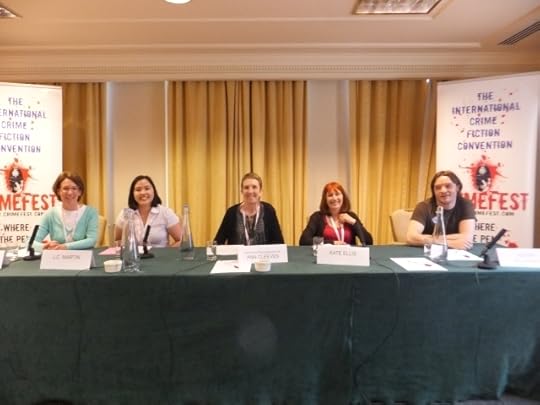
The panel for “Evening All: A Policeman Calls”. From left: Pauline Rowson, me, Ann Cleeves, Kate Ellis, Kerry Wilkinson.
(photo courtesy of Bob and Pauline Rowson)
I was so nervous leading up to this panel, I actually turned up 90 minutes early because I got my two panel start times mixed up! The fact I was sharing the stage with three established names like Ann Cleeves, Kate Ellis, and Pauline Rowson, as well as upstart Kerry Wilkinson, whose self-published first novel became such a runaway success he got snapped up by Pan Macmillan, made little old me with just one book under my belt published by an indie press, and miles from any bestseller list, feel way out of my depth.
But you know what? Ann was a brilliant and thoughtful moderator, and she really helped me feel at ease, as did the other panelists. The audience, too, seemed forgiving of my stammering and sometimes unintelligible mumble-rants.
SAT 1 JUNE
Fresh Blood: Debut Authors 1
me
Alex Blackmore
Fergus McNeill
Tom Vowler
Participating Moderator: Rhian Davies
This was the first of two panels chaired by the lovely Rhian Davies, introducing delegates to debut authors and their first novels.
Alex Blackmore’s debut Lethal Profit is a thriller about a ruthless biotech company turning a profit at the expense of human health.
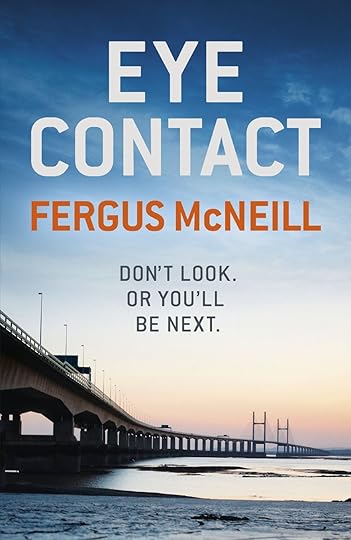
EYE CONTACT by Fergus McNeill
Fergus McNeill’s Eye Contact is, in his own words, a serial killer procedural. It describes how a serial killer chooses his victims: the first person who makes contact with him when he begins his ‘game’ is his next target, and they get 24 hours before he hunts them down. Kinda makes me wary of making eye contact with fellow commuters on the bus/train now!
What Lies Within by Tom Vowler is a psychological suspense that weaves together two stories, one of a mother fearing for her family’s safety after a prisoner escapes from the nearby prison, and the other about a teacher living with the consequences of being attacked by her pupil.
Apart from being the first panel of the day, when many delegates were probably still feeling the effects of the night before, our panel also clashed with another one featuring big names like Zoë Sharp and Barry Forshaw. Which was why I was surprised by the audience turnout. I, too, was feeling the effects of two sleep-deprived nights, thanks to a combination of panel nerves and a baby not used to sleeping in a hotel room, but do think I definitely did better than in my first panel. It also helped that my fellow panellists and I were all in the same debuts boat, and that Rhian asked some incisive and thoughtful questions.
Insights
Despite the shaky start, I thoroughly enjoyed being on these panels, especially answering audience questions, and speaking to readers after. It’s a great way of getting Oracle out there, and I thank everyone who’s given my book a chance since attending these panels. Given the opportunity, I would definitely do it again.
One thing I noticed, though, is how articulate the other authors are when speaking in a panel. Some were witty, others downright hilarious, but every one of them got their points across with smooth eloquence. I, on the other hand, felt like I was speaking guttural caveman speak by comparison.

That’s me, a wallflower! (Image source: stock.xchng)
Now as a former schoolteacher and a kung fu instructor, I’m no stranger to public speaking, but my experiences have always required me to disseminate information in the most effective way possible, i.e. short sentences, simple words. I admire people who can elaborate on what they have to say with clever anecdotes, witticisms and conjecture. Can eloquence be developed with more public speaking experience?
Another observation is how all the writers I met were extroverts, with the confidence to walk into a room and strike up a conversation with complete strangers. As a self-confessed wallflower, am I just not meant to fit the image of the successful, loquacious, outgoing author?
Whether I can become more eloquent or outgoing with time and practice will remain to be seen, but in the meantime, roll on Crimefest 2014! 
EDIT: National Crime Writing Month
Crimefest marks the start of National Crime Writing Month, an annual initiative promoting the crime genre, both fiction and non-fiction, nationwide. It is a great opportunity for writers and readers to connect, so check out your local library to see if they have anything on!
If you prefer to stay home, then check out the Crime Readers’ Association (CRA) blog. They’ve got a whole month of author spotlights, interviews, guest posts (look out for mine on 24 June!), and giveaways planned, so keep checking back!
What do YOU think? Can eloquence be learned? Are all successful authors articulate extroverts? If you are a fellow shrinking violet, how do you make yourself known?
Source: J.C. Martin, Fighter Writer
June 8, 2013
Crimefest 2013: Event Summary Part 3
%Úte%% | J.C. Martin
This is the 3rd and final part of a summary of the talks and panels I attended at Crimefest 2013 (click here for part 1 and part 2). I admit, I was at more panels than I’ve reported on, but as the weekend wore on, the sleepless nights got to me (combination on nervous anticipation of my own panels, and a baby not used to sleeping in a strange hotel room). As a result, I didn’t take as many notes at some of these panels than I would have liked!
SAT 1 JUNE
Crime & Crossover: Different Genres, Different Audience?
Colin Cotterill
Yrsa Sigurðardóttir
Dana Stabenow
Evonne Wareham
Participating Moderator: Kevin Wignall
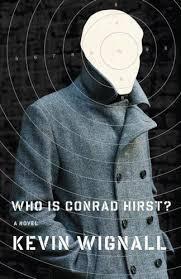
WHO IS CONRAD HIRST? by Kevin Wignall
Moderator Kevin Wignall’s witticisms and comedic banter made this one of the most enjoyable panels I attended. To start, Kevin, who also writes YA horror as KJ Wignall, introduced the members of this very international panel.
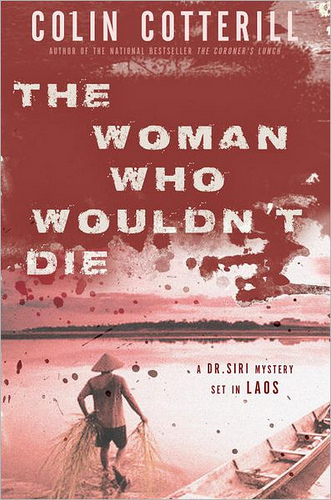
THE WOMAN WHO WOULDN’T DIE by Colin Cotterill
Colin Cotterill (have you checked out his hilarious website?) writes humourous mystery novels with supernatural elements set in Laos. Evonne Wareham writes romantic suspense, a sub-genre she said seems more popular and established in America than in Europe. Apart from writing crime fiction, Icelander Yrsa Sigurðardóttir also writes children’s fiction, and has recently released her first horror novel. Finally, American Dana Stabenow used to write science fiction before branching into crime.
Kevin then asked if there were any other genres the panellists would like to write. Evonne and Dana both said they would like to try writing something historical, whilst Colin joked that he’d like to attempt something erotic, with “Shades of…”
Kevin wondered if cross-genre authors enjoy wider reading tastes. Dana and Evonne both said they read anything. Yrsa enjoys horror, and Colin admitted that his work doesn’t give him time to read fiction. Rather, he reads a lot of non-fiction materials to research his novels.
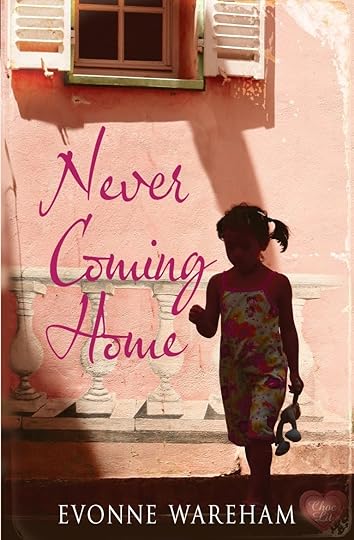
NEVER COMING HOME by Evonne Wareham
Kevin then asked if genres are becoming less distinct. Evonne said that e-books are no longer shelved, and e-book readers tend to be more broad-minded, making them happy to try different genres.
Colin recalled how bookstores used to be confused as to where to shelve his books. He mentioned it was not long ago that publishers and awards committees used to dismiss any books with supernatural elements. But readers are getting bored with what their preferred genres have to offer, and are more willing to experiment with cross-genre books. As an example, classic crime fiction is an overworked genre, which is why crime novels with different settings (e.g. Nordic) are becoming increasingly popular.
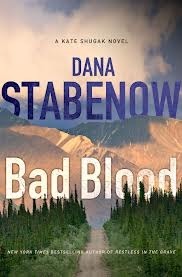
BAD BLOOD by Dana Stabenow
Directing his question at Dana and Yrsa, Kevin asked if some of their readers have followed them cross-genre. Dana said her sci-fi fans have definiely crossed over to crime with her, and she recalled how she was given one of her old sci-fi titles to sign at a recent book-signing. She felt that publishers underestimate readers in that respect, when they balk at an author considering a switch in genres. Yrsa’s debut horror, I Remember You, became a bestseller in her native Iceland despite her being established as a crime writer.
Kevin asked the panel if readership differed across genres. Evonne and Dana commented that crime fans were more sedate. Evonne she recalled a romance conference whereby bare-chested male models milled amongst the crowd. Dana joked that it was better than having Klingons in the lobby. Yrsa didn’t notice a difference across genres, but rather across nations. Unlike in the UK, Icelandic crime fans seem more reserved. They say very little during a panel, and no one wants to ask the first question, but would rather speak with the author one-on-one after the talk.
“Are there any differences between writers across the genres?” was Kevin’s next question. Colin, after checking there were no literary writers or fans in the audience, commented, rather tongue-in-cheek, that crime writers are definitely friendlier than literary writers. Evonne, who is a member of both the Crime Writers’ Association (CWA) and the Romantic Novelists’ Association (RNA), said both are very welcoming. Dana, too, said that crime and sci-fi writers are both helpful.
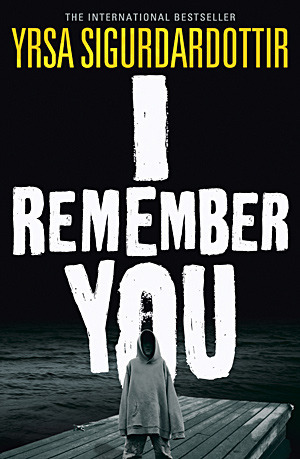
I REMEMBER YOU by Yrsa Sigurðardóttir
Yrsa recounted a conversation with a professional photographer who specialised in author portraits, who claimed that crime writers were the nicest and most amiable, perhaps because they have vented all their anger and violence on paper. Ironically, the photographer said humour writers were the most depressing!
Finally, Kevin asked each panellist to recommend one book not in the crime genre.
Evonne recommended works by romantic suspense author Karen Rose.
Dana recommended sci-fi novel Jumper by Steven Gould.
Yrsa’s favourite horror read is Dark Matter by Michelle Paver.
Kevin himself recommended YA classic Holes by Louis Sachar.
Police Detective, Amateur, P.I. or Bad Guy — Who Makes the Best Protagonist?
Sheila Quigley
Jane Finnis
Nick Quantrill
Howard Linskey
Participating Moderator: Jake Kerridge
ln this panel, each author must make their case for their choice of protagonist.
Sheila Quigley, who writes Detective Inspector Mike Yorke in her Holy Island Trilogy, said that there is no questioning why her protagonist is snooping around the crime scene — it’s his job! With so many police detectives as protagonists, the challenge is making DI Yorke stand out.
Jane Finnis writes historical mysteries starring innkeeper Aurelia Marcella in Roman Britain. She stressed that writing an amateur detective is always more interesting as there is always something personal at stake, i.e. there is always a personal reason to want to solve the crime.
Nick Quantrill started off writing a detective novel, but it just never felt right, so he chose private investigator Joe Geraghty as his hero. As such, he is not constrained by bureaucratic procedure or decorum, giving his protagonist free rein in investigations.
Howard Linskey’s protagonist is one of the bad guys, David Blake, a white-collar criminal working for a gangster kingpin. There is always something intriguing ad almost sexy about the bad guy, and the fact that Blake has corrupt coppers on his payroll makes writing him all the more fun.
Major Cities, Major Crimes
K.O. Dahl
David Jackson
Pierre Lemaître (with translator Frank Wynne )
Barbara Nadel
Participating Moderator: William Ryan
This panel was all about setting crime novels in big cities. Moderator William Ryan sets his books in Moscow. Norwegian author K.O. Dahl’s stories unfold in Oslo. David Jackson’s Callum Doyle series is set in New York City. Frenchman Pierre Lemaître’s Alex is set in Paris. Barbara Nadel writes two separate crime series, one set in London and the other in Istanbul, Turkey.
It was generally agreed that crime novels set in large metropolises are more believable than those set in a rural setting (someone joked that in many of these mysteries set in an idyllic little village, the body count exceeded the population). So why does a city landscape generate crime? The following reasons were suggested:
Anonymity, both for the killer and their victim(s).
Crowding that could lead to friction and increased anti-social behaviour.
Not just a large population, but one that is constantly shifting, with people always moving in and out, hence making a killer harder to track, and harder to notice if someone’s gone missing.
A large population, especially of so-called ‘unsavoury’ people: prostitutes, drug addicts, the homeless, etc., people whose disappearance will not be missed. This raised a discussion of how the murder of a respectable middle-classed woman, for instance, will always generate more publicity than the murder of a prostitute.
SUN 2 JUNE
Fresh Blood: Debut Authors 2
Hanna Jameson
David Mark
Derek B. Miller
Kate Rhodes
Participating Moderator: Rhian Davies
Book reviewer, crime buff and keen supporter of debut and mid-list authors Rhian Davies introduced us to four new crime writers and their debut books:
At just 23 years of age, Hanna Jameson has published Something You Are — a story she wrote when she was 17 — to rave reviews. It is a thriller about a contract killer in London who falls in love with his employer’s wife.
David Mark’s debut novel Dark Winter introduces us to the enigmatic detective Aector McAvoy in the British city of Hull. When asked about his choice of setting, he joked that it is in response to the rising popularity of Scandinavian crime fiction– bleak, dull landscapes appear to be in vogue!
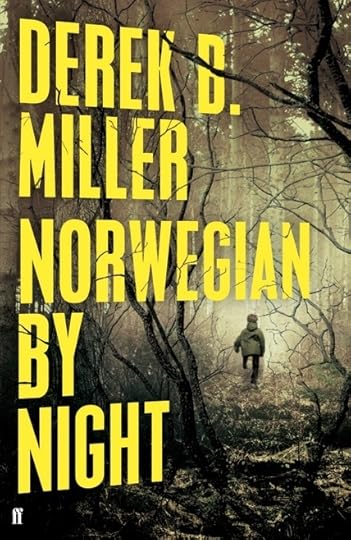
NORWEGIAN BY NIGHT by Derek B. Miller
Norwegian By Night by Derek B. Miller is something I’m keen to read: it’s about an 82-year-old ex-Marine and widower who moves to Oslo with his granddaughter and Norwegian husband. There, he witnesses the murder of a woman and rescues the victim’s 6-year-old son. As he tries to protect the boy from the gang hunting him, an unexpected bond forms between the two, even though they don’t speak the same language.
Finally, Kate Rhodes’s debut is entitled Crossbones Yard. It is about a body found in Crossbones Yard in London with markings similar to the signature of a pair of serial killers already behind bars. Is this the work of a copycat killer? It is up to psychologist Alice Quentin to find out. This, too, is on my to-read list, because I’ve actually been to the yard that inspired her title — on a location photo shoot, no less! (This was way back in the day before I hit the big three-oh!)
[image error]
The photographer used the blurred-out ribbons and offerings on the Memorial Gates as a colourful backdrop. Hmm … come to think of it, was he insinuating something when he made me pose in front of a graveyard for prostitutes?
Crossbones Yard is a medieval burial ground for thousands of prostitutes (for more information, see the website). Today, the graveyard is just a concrete-covered plot of land owned by Transport for London and earmarked for development.
Readers, would you read your favourite author if they wrote in a different genre? Are there any genres you wouldn’t read?Would you read Stephen King’s debut crime novel, Joyland?
Writers, what genre(s) do you write in, and are there any genres you’d like to try your hand in writing?
What’s your favourite kind of fictional sleuth?
Has this post helped you discover any new authors you’d like to read?
Come back tomorrow for a reflection of my panel experiences!
Source: J.C. Martin, Fighter Writer
June 7, 2013
Crimefest 2013: Event Summary Part 2
%Úte%% | J.C. Martin
This is part 2 of a summary of the talks and panels I attended at Crimefest 2013 (click here for part 1).
FRI 30 MAY (cont’d)
How Self-Publishing Fits into the Current Publishing Ecosystem

Joanna Penn
Author, online entrepreneur and public speaker Joanna Penn of the popular writing/publishing site TheCreativePenn.com gave a 20-minute spotlight talk on self-publishing. It drew an eclectic audience comprising both aspiring authors considering self-publishing their first book, to published authors considering a change of publication route, or are considering hybrid publishing (a mixture of traditional and self-publishing), to established authors thinking about self-publishing their backlist. The general consensus seems to be that 20 minutes was not nearly enough!
Joanna started by pointing out examples of self-published authors whose books sold so well that they are later picked up by a literary agent. As such, self-publishing is a very viable option.
According to a Book Expo America study, the main reasons authors choose to self-publish are: creative control, money, and ease of process. Most authors who choose traditional publishing want only the prestige of seeing their books on bookshelves.
Like anything else, self-publishing is a business, and to see returns you have to first invest in creating the best product you can. At the most basic, you would need to hire an editor, a cover designer, and an interior book designer (click on the links for a list of Joanna’s recommended editors/cover designers).
Joanna advised that you should start off by releasing an e-book only, as it is cheaper, and easier to make changes. Primary sites to publish your book are Amazon KDP (which garners the majority of e-book sales) and Kobo. Secondary sites include sites like Smashwords. If you want to release a print book, use print on demand (she recommends Createspace or Lightning Source).
Once your book is released, you must know how to market it (Joanna has a free Auhor 2.0 Blueprint on her site). Some examples:
Key words and correctly classifying your book
Encourage readers to sign up for e-mail blasts
Consider paid advertising
LET’S GET VISIBLE by David Gaughran
Gain some understanding of Amazon algorithms (suggested read: Let’s Get Visible by David Gaughran)
Finding the right price: from Joanna’s experience, her sweet spot is pricing the first book in a series at $2.99, and pricing subsequent books in the same series between $3.99 and $4.99.
Consider the perma-free option: making the first book in a series permanently free
Price pulsing: drop the price of your book (to $0.99, say) for a limited time as a promotion. This will bring the book up the Amazon charts. Once this happens, up the price of the book again.
Moral Hypocrisy in Crime Fiction? Not Me!
Felix Francis
Penny Hancock
Steve Mosby
Stav Sherez
Participating Moderator: Sophie Hannah
Moderator Sophie Hannah started by saying crime fiction provides a framework for good versus evil. How important is this battle? Should there be a move towards less judgmental fiction, perhaps as a battle within one person?

ELEVEN DAYS by Stav Sherez
Stav Sherez said that the good v evil battle is more sophisticated now, with more grey areas. The best crime fiction makes you aware that resolution does not ti
e everything up in a neat bow, and that crime will continue (perhaps another baddie will fill the void).
Steve Mosby said he doesn’t see good and evil, but rather people doing good and evil acts. Crime fiction nowadays is more adept at dealing with social issues.
Penny Hancock was more interested in what might tip a person over the edge, and believed that everybody has the potential for good and evil. Felix Francis agreed, but noted that there are some people who do very evil things, and these people are the interesting ones in society. He also noted that a crime story should always have a conclusion.
Sophie then pointed out how many crime novels sought to understand the motivation of a psychopath. Is this a way of excusing or condoning their act?
Stav could understand a crime of passion, but not others. In any case, the police in real life will not be interested in motive but only in apprehending the criminal.
Penny said she felt an urge to understand and to not judge. On speaking with a criminal psychologist, psychopathic killers tend to exhibit a combination of t
he following:
Childhood adversity
Mental illness
Drug abuse
“X factor”
Felix argued that many people suffer from 1-3, yet they do not kill. We may understand them, but never excuse their actions.
During audience questions, someone asked if there were such things as morally neutral acts. The idea of group evil was also raised, where it is much easier to do evil as part of a large group due to deferred responsibility and peer pressure. It was also discussed how psychopathy can now be detected using brain scans. The question is: can it then be used as a valid defence in court?
Serial Killers: Why Do We Love Them?
Xavier-Marie Bonnot
Steven Dunne
Matt Hilton
David Mark
Participating Moderator: Caro Ramsay
Moderator Caro Ramsay opened proceedings by providing the definition of a serial killer: someone with 3 or more victims over a period of no longer than 30 days. She then asked why we all have such a fascination for serial killers.
Steven Dunne said a serial killer makes a worthy opponent for your protagonist, depicting a battle between good and evil. Also, they interest us because we not only want to know whodunit, but ‘why’dunit.
Both Xavier-Marie Bonnot and Matt Hilton agreed that the fascination with serial killers like Ted Bundy is that they are criminals you could like as people. David Mark pointed out that there is a major difference between the cool, sexy, charming, and intelligent serial killers in crime fiction and those in real life. He wondered how they are wired differently. Steven added that in reality, serial killers are very unsettling, as there is often a sexual or control element in their killings, and very few are actually evil geniuses as depicted by Hannibal Lecter.
Caro ended the panel with an interesting question: which serial killer, real or fictitious, would you like to have dinner with, and why?
To be continued…
Come back tomorrow for part 3 of the Crimefest 2013 Event Summary
Self-published authors: have you tried any of Joanna’s suggested marketing tactics (price pulsing, perma-free, etc.)? How did they work for you?
Could and should a clinical diagnosis of psychopathy using brain scans become admissible evidence in court?
Which serial killer would YOU like to have dinner with?
Source: J.C. Martin, Fighter Writer
June 6, 2013
Book Shout-Out: THE DISILLUSIONED by D.J. Williams
%Úte%% | J.C. Martin
 The Disillusioned
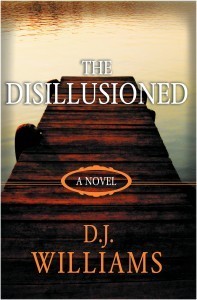 A motherâs suicide threatens to destroy a family legacy. Her sons, Sam and Daniel, are forced to leave their comfortable worlds behind and search for a woman they believe can unlock the secrets that have remained hidden. They are propelled into separate journeys from Los Angeles to the heart of the Zambezi where they are forced to confront a man known as Die Duiwel, the Devil. On their adventures they will find themselves in a place where death is one breath away, where thousands of children are disappearing into the darkness, and where the woman they are searching for is on the hunt for revenge. When they stand face-to-face with the forgotten slaves of Africa they will fight to redeem what has been lost.  Â
Purchase Links: Amazon
Excerpt
Ten years later I had my hands full with two young boys while John was busy traveling the world. I went with him on occasion, but for the most part I stayed home and watched my babies grow into young men. At times it was as if I were a single parent. I couldâve spoken up. I couldâve objected to the sacrifices we made in the name of God. Maybe I should have, but I didnât. Instead I enjoyed the comforts of being a wife, our beachfront home, a private jet leased by the church, a cabin in Lake Isabella, Johnâs seven figure salary, as well as his book royalties. A bonus was the respect given to us whenever we entered a room by those who didnât know us. It was flattering, and addicting.
This isnât my life anymore.
Iâve been locked up here for one thousand and ninety five days. Iâve had time to think about the choices Iâve made. Iâve thought about what is best for everyone. Iâve become a burden. I know it. I feel it. I hate it. The whispers inside tell me thereâs only one decision to make, undoubtedly the hardest one of all. It goes against everything Iâve believed.
But nothing is the same as it once was.
God forgive me.
About the Author
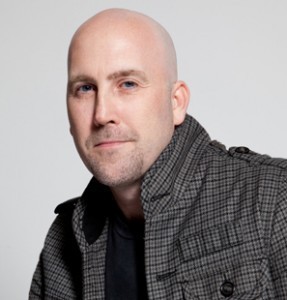
D.J. Williams
With the DNA of a world traveler, Williams was born in Hong Kong, has ventured into the jungles of the Amazon, the bush of Africa, and the slums of the Far East, to share stories of those who are overcoming incredible odds. He is the co-author of Restoration Road with Mitch Kruse and has produced and directed over 140 television episodes syndicated on NBC, ABC, FOX and various cable networks worldwide. Currently, he lives in Los Angeles, California with his wife.
Contact: Website/Blog | Twitter
Giveaway!
D.J. is giving away a $30 Amazon gift card to one lucky commenter on the tour. All you have to do to enter is to leave a comment below.
Why not visit the other tour stops? The more you comment, the better you chances of winning!
Source: J.C. Martin, Fighter Writer
June 5, 2013
Crimefest 2013: Event Summary Part 1
%Úte%% | J.C. Martin
Crimefest 2013 lasted from Thursday 30 May to Sunday 2 June. Below is a summary of all the talks and panels I attended — not as many as I would have liked, but Papa Martin was babysitting Baby Martin and constantly phoned for help.
THU 30 MAY
Leslie Charteris & Other Forgotten Authors
John Curran
Ruth Dudley Edwards
Adrian Magson
Zoë Sharp
Participating Moderator: Martin Edwards
Zoë Sharp’s recommended forgotten authors:

The first book in Charteris’s series, ENTER THE SAINT.
Leslie Charteris, author of 90 books starring protagonist Simon Templar, a.k.a. “The Saint”, who was played by Val Kilmer in the 1997 film of the same name
James Munro, who wrote crime fiction and spy thrillers
Ruth Dudley Edwards then talked about:
The works of Edmund Crispin , who wrote humourous mystery novels
Cyril Hare
John Curran’s recommendations were:
Dorothy Bowers
Patrick Quentin , a pseudonym under which four different people wrote detective fiction
Adrian Magson’s forgotten authors were:
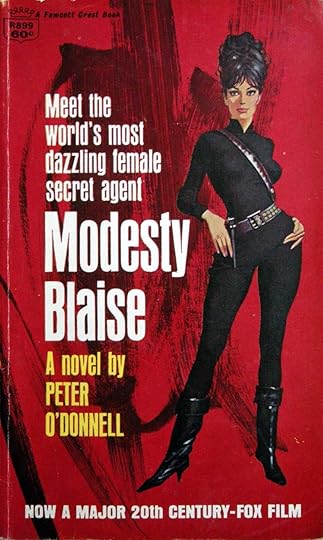
Peter O’Donnell’s skintight clothes wearing heroine.
Peter O’Donnell and his Modesty Blaise comic series
Sylvia Hamilton
FRI 31 MAY
Is it Rocket Science? The Joys & Pitfalls of Technology in a Crime Novel
Alex Blackmore
Dean Crawford
L.A. Larkin
Richard Jay Parker
Participating Moderator: Emlyn Rees
The writers were first asked by moderator Emlyn Rees to describe the technologies used in each of the the panelists’ recent novel.
Alex Blackmore’s soon-to-be released debut Lethal Profit concerns a ruthless biotech company turning a profit at the cost of human health.
Dean Crawford’s latest book has to do with the possible physics of time travel.
L.A. Larkin is working on a book dealing with genetic engineering and food.
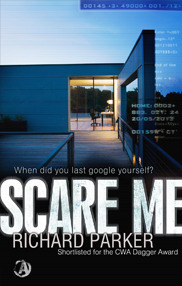
Richard Parker’s SCARE ME.
Richard Parker’s thriller Scare Me deals with the Internet, and asks “When was the last time you Googled yourself?”
Richard commented that it is almost unavoidable not to include technology in contemporary novels. Dean Crawford agreed, and said modern scientific advances could inspire a plot. However, as a writer, you need to be excited by the topic.
Moderator Emlyn Rees asked if it was important to get the science right.
L.A., who credited Michael Crichton as the best author at combining science and fantasy, said that to put the reader in the moment, the writer needs to get details right and be authentic. Researching for her book Thirst took her to Antarctica, not just to understand but to experience life in Antarctic research stations. However, she quoted Jeffrey Deaver, who said that “The skills is knowing what to use.” The trick is taking just the right information and turning it into an exciting scene, and also to know when to stretch the truth, e.g. to show the personality of a character who defies convention.
At this point, I regretfully had to slip out to prepare for my panel. 
Who is Everyman & What is He Doing in My Novel?
Simon Kernick
Louise Millar
Michael Ridpath
Simon Toyne
Participating Moderator: Chris Ewan
Louise Millar defined everyman in literature as an ordinary person placed in extraordinary circumstances. As such, an everyman in Victorian times, say, will not be viewed as such in contemporary times. With technology changing so quickly, it is difficult now to predict a threat and where it’s coming from.
Simon Kernick said that the attraction of an everyman character is that it could happen to you. Michael Ridpath added that writing about everyman makes that everyman distinctive, and thus it can be argued that he is no longer an everyman. Additionally, for character longevity, he or she has to have that special something making them different from everyman.
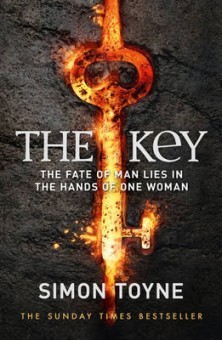
Simon Toyne’s THE KEY
Simon Toyne’s The Key is a philosophical and religious examination of where patriarchal religions come from, the church’s attitude to women, etc. As such, he chose a female journalist — an everywoman — as his protagonist.
Moderator Chris Ewan asked what could rule a character out as an everyman hero. Bruce Willis’s John McClane in the Die Hard series came up as an example.Simon Kernick said that being a cop, where he is hardened by his experiences, excludes McClane from being an everyman. Simon Toyne argued that in the film, he had an everyman aim: to rescue his wife. An everyman should highlight emotions, like fear and love, in readers. Kernick responded that an everyman should not know what to do under extreme circumstances. As a cop, McClane would. Someone asked if a cop could be everyman in his personal life, or if it was just a way of humanising the character.
Michael stated that the story of finding bravery within is appealing to readers, hence it is interesting to put everyman in a very difficult situation where they reveal their true mettle.
Louise’s stories play on everyday anxieties and uncertainties. Her everyman character can’t just call the police as their fears are based on instinct and not evidence.
Chris asked about the importance of the police or some other character who can do what your everyman can’t. Toyne said that it’s good to have an authority figure everyman could turn to.
During audience questions, someone asked how key point of view is in everyman scenarios. (Sorry, I lost track of who said what at this point) Using “I” places the reader in the scene, and the limited perspective can be used to create tension. First person also increases sympathy, but without using a narrative switch, you wouldn’t be able to show the unseen bad guy, and this could lose tension. However, this all depends on the book and character.
To be continued…
Come back on Friday 7 June for part 2 of the Crimefest 2013 Event Summary
Will you be checking out any of these forgotten authors?
What draws you to reading a story with an everyman hero?
Source: J.C. Martin, Fighter Writer
June 4, 2013
HIDDEN Blog Tour: Character Interview
%Úte%% | J.C. Martin
 Hidden
 Sixteen-year-old Leah Grant has given up on being normal. Sheâd settle for stopping the voices in her head, intrusive visions of the future, and better odds of making it to her seventeenth birthday.
Thatâs the thing about pretending to be human in a world where magic used to exist â at any moment, her cover could be blown and sheâll be burned to death like the rest of the witches.
Everything changes when she loses control of her powers and flees the orphanage she grew up in. She desperately wants to be invisible but finds her face plastered on every news channel as humans panic over the possible resurgence of her kind. And now the hunters wonât give up until they find her.
Making friends for the first time in her life and falling in love with one of them drives her to discover why she is unlike any being sheâs ever met â human or otherwise. The dangerous powers inside of her that would repel Nathan, her new, handsome reason for living, are priceless to some. The locked up forever kind of priceless. And to others, they are too dangerous to allow her to live.
Letâs hope she can stay hidden.
Purchase Link: Amazon
Character interview with Leah/Christine
So, Leah ⦠or is it Christine?
Leah is what the nuns named me at my school. My real name is Christine.
Which one would you like me to call you?
Whichever you want.
Okay, Iâll go with Leah. First, I want you to relax. I know what youâre hiding. Your secret is safe with me. Okay?
Okay.
So when did you first realize you werenât ⦠human?
It sort of becomes apparent when you canât seem to think of another room without accidentally moving to it.
That must have been scary. I guess I can answer my next question on my own, then. I was going to ask if you had one wish, what would it be. Iâd bet it would be to be human. Am I right?
Yeah. Life would be ⦠uh ⦠simpler that way.
Tell me a little about the disguise you keep up. How do you hide your powers?
Itâs difficult. I have to be quiet and careful. I have to watch my every move. But Iâm still alive so ⦠I obviously donât suck at it too much.
Obviously. Hats off to you. Have you picked up anything from imitating a human? Do you have typical teenage quirks? A favorite color or food?
I guess I have a favorite food. If oranges count.
Yeah, that counts. What about other typical high school things? Do you have a most embarrassing moment?
Thereâs too many to choose from. Let me see. Eighth grade, right after a math test Iâd completely bombed. Iâd been fighting with my magic all day. It seemed like every time I moved, something else in the classroom would move with me. So naturally, Iâd stopped moving.
A girl I hate, Sienna, screamed my name from the back of class and asked if I was constipated. I guess I looked kind of constipated. Anyway, I tried to move so I wouldnât look as strange, and the American flag hanging over the chalkboard crashed to Sister Margaretâs desk. Scared out of my mind, I ran out of class. Of course, everyone thought I ran to the bathroom because of stomach issues.
They called me Pepto for weeks.
Yikes, thatâs embarrassing, all right. It doesnât sound like you have friends, so what do you do in your spare time?
I draw. Iâm pretty good at it. I did a full-scale sketch of the orphanage with shading and everything when I was six. That should have tipped me off that I wasnât normal.
That sounds spectacular. Do you see yourself becoming an artist when you grow up?
Grow up? Iâve never thought about it. I guess Iâll have to pray that Iâll live long enough to make career decisions. Wish me luck.
Good luck, and thanks for chatting with me today.
About the Author

M. Lathan
M. Lathan lives in San Antonio with her husband and mini-schnauzer. She enjoys writing and has a B.S. in Psych and a Masters in Counseling. Her passion is a blend of her two interests â creating new worlds and stocking them with crazy people. She enjoys reading anything with interesting characters and writing in front of a window while asking rhetorical questions ⦠like her idol Carrie Bradshaw.
Giveaway!
Source: J.C. Martin, Fighter Writer
June 3, 2013
Crimefest 2013 & Getting Off My Backside (a.k.a. Reclaiming My Blog)
%Úte%% | J.C. Martin
It was my third year attending Crimefest, a small but steadily growing crime fiction convention in the city of Bristol. It was my first year attending as a published author and as a speaker on two of the event’s scheduled panels. It was a fantastic opportunity to connect with readers old and new, to meet my writing idols, and to meet fellow crime fiction writers (a few agents and publishers also lurked among the crowds!).
Throughout this week, I’ll be posting about my experiences at Crimefest 2013 in between scheduled posts:
Wed 5 June         Crimefest 2013: Event Summary
Fri 7 June            Crimefest 2013: My Panel Experience
In other news…
Perhaps meeting all those successful writers at Crimefest has motivated me into action, but now that Baby Martin is 6 months old I’m going to start easing myself back into a writing groove whenever he lets me. Top on the agenda is to get back on the blogging horse — that means fewer pre-prepared blog tour features, and more actual posts from yours truly. Of course, I’ll honour all features I’ve agreed to post, but do forgive me should my blogging over the next few months become erratic as I try and get used to the swing of things.
Readers: would you prefer more blog posts from me, or should I just shut up and continue showcasing other authors and their books?
Source: J.C. Martin, Fighter Writer
May 30, 2013
Getting into a Teenage Frame of Mind by Emi Gayle & GIVEAWAY
%Úte%% | J.C. Martin
Day After, book 2 in Emi Gayle’s 19th Year trilogy, released on May 6th. Today, as part of her blog tour, YA author Emi visits the Fighter Writer to talk about writing from the teenage perspective.
***Read on for giveaway details***
Getting into the Teenage Frame of Mind
by Emi Gayle
Whatâs it like writing as a teenager when youâre not … ahem … a teenager? And … if your generation is decades away from being a âcurrentâ teen? Is it possible?
Sure it is! Now it helps for me that I have a teenage son, so I spend a lot of time watching and observing him. This is great fodder for my writing, but can also be trying because while being a teen now is still the same in many ways itâs also very different. And heâs a boy and Iâm not so our perspectives on life are the same just from that.
In any case, the key thing to the teenage frame of mind is remembering what I didnât know as a teen because I know it all now and back then I only thought I knew everything (or so my dad used to say!).
That really is the key though. I have to forget. And by forgetting, I can relearn, as a younger one again instead of as me-myself-and-I. So thatâs what I do. No matter the character, I just try to think about what I did and didnât know at that age.
Voila!
About the Author

Emi Gayle
Emi Gayle just wants to be young again. She lives vicariously through her youthful characters, while simultaneously acting as chief-Mom to her teenaged son and searching for a way to keep her two daughters from ever reaching the dreaded teen years.
Ironically, those years were some of Emi’s favorite times. She met the man of her dreams at 14, was engaged to him at 19, married him at 20 and she’s still in love with him to this day. She’ll never forget what it was like to fall in love at such a young age â emotions she wants everyone to feel.
Contact: Website | | Twitter | Facebook
Day After
 Demon crypts. Vampire lairs. Glowing angels. Sexy sirens. The stuff of fiction.
Or so Winn Thomas always thought.
Since being accepted into the fold of the supernatural, he knows better. None of what he imagined is true, but everything he feared is, and binding himself to his Changeling girlfriend until her nineteenth birthday will give him an education far beyond what heâd get at his human high school.
Luckily, Winnâs not giving up, he wonât back down, and he definitely isnât going to run away with his tail between his legs. After all, only werewolves have tails. Right?
In this, the second of the 19th Year trilogy, Winnâs facing the challenge of one lifetime. If he doesnât learn the truth about mythological creatures, his girlfriend Mac Thorne wonât either. That means, in six months, when she chooses her final form, she wonât know what to pick.
Winn, though, has his own ideas about Macâs final selection â plans she knows nothing of.
He intends to have her pick human.
Whether she can or not.
Purchase Links: Amazon | Barnes & Noble
Giveaway!
To enter Emi’s grand blog tour giveaway, all you have to do is fill in the Rafflecopter form below.
Good luck!
Source: J.C. Martin, Fighter Writer
May 28, 2013
Book Shout-Out: UPRISING by Jessica Therrien
%Úte%% | J.C. Martin
 Uprising
Jessica Therrien follows up her bestselling novel OPPRESSION with UPRISING, the second book in the Children of the Gods series.
OPPRESSION, translated and sold around the world, was one of the best selling YA novels of 2012. UPRISING continues the story of Elyse, William and the Descendants.
Elyse has been in hiding for most of her life. Only now sheâs hiding with William, and she knows who sheâs hiding from. The Council wants a child Elyse and William have yet to conceive, a child who will be the next oracle, and who will provide the final piece to a plan Christoph has been organizing for years. Charged with leading the rebellion against Christoph and his Council, Elyse feels well out of her depth. But she has good friends and strong allies who are willing to fight with her to the end, regardless of how far they have to go, and how many lives will be lost in the process. They have one goal: to live freely and openly with the rest of humanity, out from under The Councilâs oppressive rule. The stakes could not be higher for Elyse and the Descendants longing for freedom. They’ll have to learn to fight if they want to stand up against The Council, and to find allies in a world ruled by their enemies. The hardest part of waging a war is knowing who to trust. Elyse knows their uprising will change the world. She doesnât realize it will change her, too.
Purchase Links: Amazon | Barnes & Noble
About the Author

Jessica Therrien
Jessica Therrien is the author of the young adult paranormal fiction series Children of the Gods. Book one in the series, Oppression, was published by ZOVA Books in February of 2012 and became a Barnes & Noble best-seller shortly after its release. The second book in the series, Uprising, will be available in May of 2013.
Aside from her Children of the Gods series, Jessicaâs work can also be found in a published collection of flash fiction stories called Campaigner Challenges 2011. Out of over 350 submissions her story, The Soulless, won first place for peopleâs choice and fourth place in the judging round of Rachael Harrieâs Writing Campaign Challenge. Her story, Saved, is also available as part of the anthology.
Jessica currently lives in Chula Vista with her husband and is working on book three in her Children of the Gods series.
Contact: Blog | Twitter | Facebook | Goodreads
Source: J.C. Martin, Fighter Writer