Crimefest 2013: Event Summary Part 1
%Úte%% | J.C. Martin
 Crimefest 2013 lasted from Thursday 30 May to Sunday 2 June. Below is a summary of all the talks and panels I attended — not as many as I would have liked, but Papa Martin was babysitting Baby Martin and constantly phoned for help.
THU 30 MAY
Leslie Charteris & Other Forgotten Authors
John Curran
Ruth Dudley Edwards
Adrian Magson
Zoë Sharp
Participating Moderator: Martin Edwards
Zoë Sharp’s recommended forgotten authors:
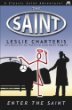
The first book in Charteris’s series, ENTER THE SAINT.
Leslie Charteris, author of 90 books starring protagonist Simon Templar, a.k.a. “The Saint”, who was played by Val Kilmer in the 1997 film of the same name
James Munro, who wrote crime fiction and spy thrillers
Ruth Dudley Edwards then talked about:
The works of Edmund Crispin , who wrote humourous mystery novels
Cyril Hare
John Curran’s recommendations were:
Dorothy Bowers
Patrick Quentin , a pseudonym under which four different people wrote detective fiction
Adrian Magson’s forgotten authors were:
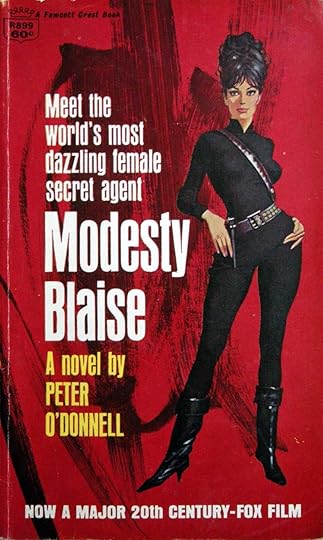
Peter O’Donnell’s skintight clothes wearing heroine.
Peter O’Donnell and his Modesty Blaise comic series
Sylvia Hamilton
FRI 31 MAY
Is it Rocket Science? The Joys & Pitfalls of Technology in a Crime Novel
Alex Blackmore
Dean Crawford
L.A. Larkin
Richard Jay Parker
Participating Moderator: Emlyn Rees
The writers were first asked by moderator Emlyn Rees to describe the technologies used in each of the the panelists’ recent novel.
Alex Blackmore’s soon-to-be released debut Lethal Profit concerns a ruthless biotech company turning a profit at the cost of human health.
Dean Crawford’s latest book has to do with the possible physics of time travel.
L.A. Larkin is working on a book dealing with genetic engineering and food.
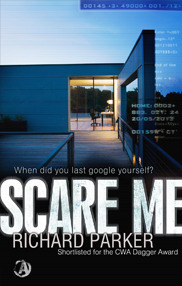
Richard Parker’s SCARE ME.
Richard Parker’s thriller Scare Me deals with the Internet, and asks “When was the last time you Googled yourself?”
Richard commented that it is almost unavoidable not to include technology in contemporary novels. Dean Crawford agreed, and said modern scientific advances could inspire a plot. However, as a writer, you need to be excited by the topic.
Moderator Emlyn Rees asked if it was important to get the science right.
L.A., who credited Michael Crichton as the best author at combining science and fantasy, said that to put the reader in the moment, the writer needs to get details right and be authentic. Researching for her book Thirst took her to Antarctica, not just to understand but to experience life in Antarctic research stations. However, she quoted Jeffrey Deaver, who said that “The skills is knowing what to use.” The trick is taking just the right information and turning it into an exciting scene, and also to know when to stretch the truth, e.g. to show the personality of a character who defies convention.
At this point, I regretfully had to slip out to prepare for my panel. 
Who is Everyman & What is He Doing in My Novel?
Simon Kernick
Louise Millar
Michael Ridpath
Simon Toyne
Participating Moderator: Chris Ewan
Louise Millar defined everyman in literature as an ordinary person placed in extraordinary circumstances. As such, an everyman in Victorian times, say, will not be viewed as such in contemporary times. With technology changing so quickly, it is difficult now to predict a threat and where it’s coming from.
Simon Kernick said that the attraction of an everyman character is that it could happen to you. Michael Ridpath added that writing about everyman makes that everyman distinctive, and thus it can be argued that he is no longer an everyman. Additionally, for character longevity, he or she has to have that special something making them different from everyman.
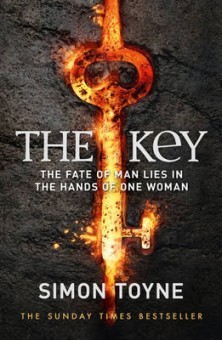
Simon Toyne’s THE KEY
Simon Toyne’s The Key is a philosophical and religious examination of where patriarchal religions come from, the church’s attitude to women, etc. As such, he chose a female journalist — an everywoman — as his protagonist.
Moderator Chris Ewan asked what could rule a character out as an everyman hero. Bruce Willis’s John McClane in the Die Hard series came up as an example.Simon Kernick said that being a cop, where he is hardened by his experiences, excludes McClane from being an everyman. Simon Toyne argued that in the film, he had an everyman aim: to rescue his wife. An everyman should highlight emotions, like fear and love, in readers. Kernick responded that an everyman should not know what to do under extreme circumstances. As a cop, McClane would. Someone asked if a cop could be everyman in his personal life, or if it was just a way of humanising the character.
Michael stated that the story of finding bravery within is appealing to readers, hence it is interesting to put everyman in a very difficult situation where they reveal their true mettle.
Louise’s stories play on everyday anxieties and uncertainties. Her everyman character can’t just call the police as their fears are based on instinct and not evidence.
Chris asked about the importance of the police or some other character who can do what your everyman can’t. Toyne said that it’s good to have an authority figure everyman could turn to.
During audience questions, someone asked how key point of view is in everyman scenarios. (Sorry, I lost track of who said what at this point) Using “I” places the reader in the scene, and the limited perspective can be used to create tension. First person also increases sympathy, but without using a narrative switch, you wouldn’t be able to show the unseen bad guy, and this could lose tension. However, this all depends on the book and character.
To be continued…
Come back on Friday 7 June for part 2 of the Crimefest 2013 Event Summary
Will you be checking out any of these forgotten authors?
What draws you to reading a story with an everyman hero?
Source: J.C. Martin, Fighter Writer