
Denise Duffield-Thomas's Blog, page 28
December 6, 2022
Denise on the Melissa Ambrosini Show
What do millionaires know that other people don’t?
Is it possible to build a massively successful business while still having a life?
And what’s the secret to hiring a dream team of rockstars who can help you turn your vision into reality?
Author and money mindset expert Denise Duffield-Thomas is back for a second appearance on the show to answer these life-changing questions and more.
Listen to this episode to learn her best-kept secrets on how to move past imposter syndrome, how to start the right business for you, how to nourish and protect your #1 most important asset, and an answer to the question: should you work with your spouse?


November 18, 2022
Even if you love your business, these 3 things will stop you making money
Today we’re talking about mixing love and money.
It’s frustrating when you’ve built a business based on your passions, put your heart and soul into your products and services and then
... crickets. 🦗🦗🦗
Maybe you’ve been limping along for months or years not making much money, and you’re considering giving up.
Maybe you’re even getting pressure from other people in your life to quit your business and go back to your day job.
But before you panic, there might be some practical reasons this is happening – and we’re going to get real on what’s going on and how you can fix it.
You can have a business you love AND make money.
The belief that you can’t is SUCH a common thing - I see it all the time.
Entrepreneurs who have found something they love to do, but who just can’t seem to make any money from it.
When business doesn’t work, we tend to make up stories about why this is happening: usually the old story that we’re not good enough, or that we’re not allowed to live our passions.
Trust me – most of these stories are crap, and you need to deal with the blocks that are behind them so you can move on and start making money from something you love.
Let’s get real and honest before you chuck it all in.
3 things to check if you’re not making profit from your passion:
#1. Is your idea a valid business for YOU?
What does that mean exactly?
I mean: is it a business that sells something people will actually PAY you for?
Is it something you even WANT to do?
This can be a hard one to admit you’re doing wrong.
A good business is an intersection between three things:
What you love to do,
What you’re good at, and
What people will pay you for.
You really need all three if you want not only a profitable business, but something that has longevity for you.
It’s tempting to make a business out of something you’re good at, even if you don’t quite love it.
For example – I used to do private coaching even though I’m much better teaching in group situations. When I admitted to myself that I didn’t really like it anymore, it freed up my time and energy to create my Money Bootcamp.
Just because something is a good business idea, it doesn’t mean that you have to be the one to bring it into the world.
So, do a check on your business right now: is it something that you love, that you’re good at, AND that people will pay you for?
Yes? Yay! You’re on track!
No? Time to go back to the drawing board and see if you can tweak the business, otherwise, give yourself permission to let it go.
I know it can be really hard to take an objective look at the business you’ve set up and realise that it’s just not going to cut it, but it’s an important step if you want to make more money with less effort.
#2. Not everything has to be a business!
If you really enjoy your hobby, it can be tempting to turn it into a business.
Omg, I’ve so done this.
For example, one of my very first blogs was “Neicey’s Movie Reviews” (Neicey is my childhood nickname).
I thought that because I loved movies and writing, it would be an awesome business. But then I sat in the movie theatre with my notebook and I realized that it completely ruined my experience of the movie!
Going to the movies was my escape, it didn’t have to be my livelihood too. As business-minded entrepreneurs, we see the potential in everything, but the harsh truth is that:
Most hobbies should stay hobbies.
For most of us, the hobby-turned-business might be fun for a while, but it might not be something we’d get paid to do.
And after all, if you turn it into a business, you’ll have to find a new hobby! It’s totally safe for you to have some down-time and do things just for fun.
You don’t have to monetize everything... even though that’s how we work as entrepreneurs. We’re always thinking of money making ideas. But it can be distracting if you don’t follow through.
My advice is to find something that you love to do, that fits the “good business” model I spoke about before. That way, you still get to enjoy your hobby while also building a business you love.
#3. You have to learn to love marketing
Yes. LOVE. Truth time. Every business needs marketing.
Yes, you can “manifest” new clients, but the Universe needs you to meet it half way. Btw - marketing is manifesting too!
Getting good at marketing is simply a skill that’s essential for all entrepreneurs, and if you’re not marketing your business then your business will reach an inevitable plateau.
It’s totally normal to feel a bit icky about marketing and feel like it’s sleazy or even dirty to “brag” about ourselves.
Honestly – this is a money block.
You really must be doing some regular marketing activities in order to bring in the clients.
Otherwise, you’re just hiding your talents away from the world.
It’s totally safe for you to market your business.
Money needs marketing AND mindset.
And it’s totally possible to deal with those blocks and learn what you need to learn to take your business from flatlining to growing fast.
So you either need to learn about marketing fast, or delegate it out. Either way, you can totally figure it out!
So lucky bee – that’s where the money is!
You’re allowed to love your business AND make money out of it.
Want to upgrade your mindset and marketing?
Not sure where to start?
Grab a copy of my book Chill and Prosper and when you want my support, come and join us in Money Bootcamp - this is the type of stuff we work on every day in our community.
Here’s to getting through your blocks and building a business you love!
It’s your time, and you’re ready for the next step.
xx DDT
November 17, 2022
3 ways to deal with unsolicited business advice
Here’s something that almost every entrepreneur can relate to - getting unsolicited business advice from friends and family.
We’ve all been there, and it sucks.
Maybe your loved ones have you doubting your services and second-guessing your prices…
Maybe they just don’t get what you do at all...
Today we’re going to talk about why unsolicited advice is such a problem, and three suggestions for dealing with it.
Because, here’s the thing...
People love to give advice.
But well-meaning “advice” from friends and family doesn’t always feel so… supportive...am I right?
Things like:
Honey, wouldn’t you be better off going back to your job?
I’m just not SURE you can make a living doing that
My friend tried starting a business like yours, and he FAILED... (and now he lives under a bridge!)
Don’t you need more qualifications before people will pay you for that?
At important times in your business journey, you’re incredibly vulnerable to this kind of negativity.
And it can feel nearly impossible to tell people that you just don’t want to hear it.
It’s natural to want to share what you’re doing with your loved ones.
And let’s be fair to your family for a minute.
A few years ago, the businesses most of us now run didn’t even exist!
Just imagine what my family thinks: “Oh, Denise just talks to people on the internet about their money blocks.” WHAT?!
So yes.
Your grandma probably thinks you’re doing something weird or dodgy.
Your sister might well think that blogging is a made-up thing.
It’s not their fault!
I’ve said it before: the single most important factor in successful manifesting is your mindset.
And listening to negative comments from people you care about is one of the quickest ways to derail that positive energy.
Most of us have our own negative chatter going on inside our heads, so we really don’t need external negativity too.
So here’s a question for you...
Are you actively inviting unwanted feedback?
For example:
Are you oversharing about your business?
Maybe hoping for a gold star or a pat on the back?
Are your friends and family successful entrepreneurs too?
Do they study business as much as you do?
Your friends and family just don’t need to hear the minute details of your business or problems with your clients.
So don’t tell them everything, unless you’re prepared to hear potentially unwanted advice.
And unless your Uncle Bob is either an ideal client or an expert in your field, his thoughts on your pricing structure just don’t matter.
Sorry Uncle Bob!
Get your business feedback from your coach, or confidence-boosting validation from your mastermind group.
That’s way more appropriate than expecting a pat on the back from your friends and family.
So here are my top three favorite ways to respond to unwanted feedback:
#1. Focus on the positive:
If someone asks how your business is going and you KNOW they are going to say something triggering, just smile and say, “It’s going great, thank you for asking!”
Even if they ask something specific like “how many clients do you have”, you can answer in the same way.
“It’s going great - thanks for asking”
Remember that your family doesn’t need to hear everything about your business.
#2. Turn the question around:
If you need to head off a potentially negative comment, ask THEM questions,
“Business is awesome, thank you! How’s everything in your job/life?”
People love talking about themselves.
#3. Completely change the subject:
if you know someone’s likely to trigger you, change the subject before they can get started.
Practice saying something like, “Everything’s going great, thanks. You got any holidays planned?”
Remember: it’s super important to have a safe place to share wins and to get feedback on challenges.
That’s why I really recommend having a mastermind of like-minded entrepreneurs or a well screened business coach to help you navigate the normal ups-and-downs of business.
Otherwise, your business is LITERALLY not other people’s business.
Trust your own wisdom and experience: you’re in the business trenches every day, so you know what’s best for you.
Here’s a bonus tip. My family totally didn’t understand what I did until I wrote a book.
THAT they understood!
So, self-publish an ebook, and then Grandma can tell her friends at Bingo that her granddaughter is an author rather than some sort of weird online thing they think you do now.
Now - I have a free resource for you.
I think that being in business is basically just a string of potentially awkward conversations.
How do you have boundary conversations with people?
Whether it’s a client, a supplier or a friend who wants free advice, I’ve got some great scripts for you in a free ebook.
Download your free book on how to have awkward money conversations at denisedt.com/awkward
I can tell you that learning to set boundaries has absolutely changed my life and business.
If you need help to have some potentially awkward conversations, you just need to practice a few phrases and they work like magic.
Hope it’s been helpful today - and that your next interaction is way less awkward.
It’s your time and you’re ready for the next step!
November 16, 2022
How To Stop Money Leaks In Your Business
Here’s a little unsexy secret – I regularly hunt out money leaks in my business.
I’ll sit down and look at where costs have crept up, and where money’s leaking out.
It doesn’t take long and I really recommend it!
If you're trying to manifest money and it's not coming in, it might be that you need to fix some leaks.
Are there services, subscriptions or software in your business that you're not using?
How about personal things like gym memberships, or cable TV subscription, for example?
What about domain names? I know I’ve got a few!
Maybe there’s a membership or mastermind that you've outgrown? And you're keeping it out of a sense of guilt or obligation. It’s a money leak. Time to let go.
It’s also worth checking out how you spend your time. Where are you over-delivering? Where are you worrying or giving too much headspace to things?
Click here to listen to my latest episode and you’ll learn;
Quick easy hacks to save you money today
The cost of my ADHD tax
The exact ways you’re holding yourself back
The simple way to plug a hole in your abundance bucket
How my office chair actually stopped me making money
We can also cause money leaks in our business by not having the right systems.
Go and look at your website right now – is there a big “buy now” button on the top half of the page?
Check your links - is it easy for people to give you money?
Fix the leaks - it’s time to fill your bucket.
Get it all down on paper - what’s really stopping you from making money? Is it logistical – your website’s not live? Or practical – lack of childcare? Or time and energy?
Don’t over complicate things. What's the path of least resistance? Who do you need? What do you need to get something to market?
Start now. Improve it later.
I’d love to hear from you - tell me what money leak you are either cleaning up or upgrading in your business.
It’s your time and you’re ready for the next step,
xx Denise
October 31, 2022
Since joining, I've consistently had 5 figure months every month
MONEY BOOTCAMP REVIEW
Carla Marie-Lett
Business Coach and CEO of My Bump 2 Baby Ltd
Lancashire, UK
Member since January 2022
What was your money situation when you joined Money Bootcamp?
I was working 25+ hours per week and earning around 5k per month.
What is your money situation like now?
Since joining Money Bootcamp I have consistently had 5 figure months every month.
Why did you decide to join Money Bootcamp?
I listened to Denise's books and knew I had money blocks and limiting beliefs to work through.
What's the biggest lesson you've learned from Money Bootcamp
Earning more doesn't have to mean working harder. My business now regularly generates 5 figures each month and I work a maximum of 10 hours per month.
What are your top 3 wins since joining Money Bootcamp?
Having consistent 5 figure months
Working less but earning more
Increasing my prices
How would you describe the Money Bootcamp community and Facebook group?
I love it, the community is a great place to hang out, be inspired and watch people grow before your eyes. I love looking back at my posts from when I started and seeing the difference in only a few months.
What's your advice to someone considering joining Money Bootcamp?
Joining Money Bootcamp is the best investment I have made and it paid itself off in the first month for me.
Anything else you want to add or share?
When I started my business my goal was to reach a point in my business where I could walk in to my favorite store and buy whatever I wanted without worrying about the financial impact, I now do that regularly.
What's next for you?
I am currently working on a blogging masterclass for those that want to learn to blog for success, my business began as a blog and is now the UK's leading pregnancy - pre-school platform generating a regular passive income stream for me and my family and I want to share my knowledge.
Ready for a Money Breakthrough?
This could be you too!
With the right mindset training and mentor you can break through your income plateau, and elevate your business to next level success!
Money Bootcamp is THE proven and practical comprehensive money mindset training, with an awesome private community of entrepreneurs.
Click here to find out how you can transform your relationship with money and move towards financial freedom for you and your family.


October 25, 2022
Challenges & Successes From My Second Year In Business (& How I Doubled My Income)
I’m thrilled at all the comments and discussions around the first instalment of this series. It’s awesome to meet SO many entrepreneurs!
Click here if you missed it: Behind the Curtains of My First Year in Business
I’m doing this series because honestly – I love sharing stuff. I’ve always been a bit of a know it all – and I really love deconstructing success.
But first…
Let’s address the COMPARISON thing
Remember – success is completely subjective. I told you in the first post that I made 60k in my first year. Some people would be intimidated by that. Others would think “Is that all?!”
Let’s get this out of the way. In my second year, I made around $146k. You might not think that’s possible or typical, but at least I’ll be honest about how I did it.
The only reason I’m telling you this is because NOBODY EVER TALKS ABOUT IT. If you’re feeling deflated by my honesty – remember this is YOUR JOURNEY.
It doesn’t matter about the time frame. Maybe you need to hustle more. Maybe you’re in the wrong business (it’s totally ok to quit, even if you put HEAPS of time and effort into it). Maybe your time is just around the corner. Maybe it’s something practical like a branding or communications issue or you need a bigger list. Maybe you’re EXACTLY where you need to be.
I really stopped comparing myself to others, or even READING about my competition in my second year and it made a WORLD of difference.
It’s a GOOD thing to be triggered by others – I’ve often used it to fuel my fire. Remember, my journey is my journey. Yours will look completely different.
Let’s get onto my second year of business (for me, this was 2012)…
Challenges in my second year of business
I think this was my busiest, often most stressful and definitely the biggest learning curve time. Here’s what I struggled with the most:
Shiny object syndrome
Should I do this… or that?
What is the ONE THING I should do now? (hint – there isn’t usually one thing – it’s usually several things repeated several times over)
Personal development conferences took up a LOT of time and income. I travelled from Australia to the States five times in 2012, mainly because I didn’t want to miss out on an amazing conference.
Were they all amazing? Hmmm – mostly, but I spent more than $20,000 on travel and expenses alone.
(For those of you who don’t know the distance, you’re looking at a 17 hour flight just to LAX, then wait times and transfers. A typical Economy flight is between $1800-$2500)
I felt like I had to do EVERYTHING – create a mastermind, no-wait – maybe I should offer retreats…? I think I need to write another 5 books… make a zombie film (for real).
I also spent HOURS (literally hundreds of hours) and thousands of dollars in a recording studio, doing the audio versions of both my books plus a complete manifesting program. None of these have seen the light of day. Never.
I spent more than $4000 on a virtually finished book about manifesting your soul mate and decided to kill it (that was actually a great decision).
For the first part of the year, I probably spent more time being distracted by what other people were doing, or what new course I should do, than really buckling down to work. But it was FUN!!!
Spend, spend and SPEND some more
Omg, I’m making heaps of money – what should I buy?
I’m not talking about STUFF, although I bought some nicer clothes and handbags.
I spend a SHIT TONNE on courses and programs. I kind of went wild on spending – courses, conferences, coaching sessions, tools and various things that I never used.
Some was incredibly helpful (see the Investments section below), some was literally just because I had the money. I justified it because it was for my business = tax deductible.
I spent at least $25k on personal development, coaching and courses. For SURE most of it was useful, but it wasn’t necessarily the best use of my cashola!
I wasn’t putting any money away for tax (and suddenly I was paying GST too). So, even though I was earning good money, I was having major cash flow issues. My payments for my mastermind bounced more than once!
My book-keeper would say “So, you didn’t make any profit this month“, and I was thinking “Wow – I’m so clever to have spent it all – less tax to pay!” (See the problem with that?)
It wasn’t all big things – I spent $150 in one day on Fiverr. On kind of weird things, just because. I was going to do a whole video on Fiverr fails and then I got bored and thought of something else.
I spent $5 on this…
I think some of it was just getting it out of my system – wow, I finally have some CASH. Some of it was a money block – I’m earning too much – I must get rid of it quickly. I was definitely having fun, but I was creating my own FEAST and FAMINE cycles…
An entrepreneur’s work is NEVER done (work/life balance)
You that feeling when you’ve ticked off your To-Do list but you still feel vaguely naughty, like you SHOULD be doing more?
Being an entrepreneur isn’t like studying. You finish an assignment, you’re done. You hand in your project at work and you’re done.
But when you’re an entrepreneur, there is always MORE you can do.
I really suffered from that in my second year. It meant that I worked REALLY LONG HOURS – from 6am in the morning, I’d be at my desk and I’d finish around 9 at night. I worked most weekends when I could. My work-life balance really suffered – even more than my first year.
I procrastinated doing my launches, which meant I had to pull several all-nighters. I once finished a sales page at 4am, but decided to stay up because I had a US-based mastermind call at 5:30am, then I had my own teleseminar at 8am, followed by a day of back to back coaching appointments. NOT GOOD FOR YOUR BODY.
Some of this is just being in business, but honestly, I was creating the extra workload because either I was procrastinating during the day, or spent time on non-income producing activities that I thought were important.
I often got a crazy new idea and just HAD TO LAUNCH IT NOW. Lots of adrenaline and new ideas all the time.
Suddenly, I had a LOT more clients, which was great, but I felt like I had to be working ALL the time. My husband was working long hours too, so I could get away with it and I didn’t really have any friends in our town (been there a year by that point). The only people I knew were clients because I spent so much time doing events and networking!
I started dreaming about work. Not like, nightmare scenarios, but really mundane dreams like filling in spreadsheets, proof-reading articles and even coaching in my sleep. This reached a peak towards the end of the year, when I started to reduce my client load and focus on doing group programs instead of so much 1:1 coaching.
Client boundaries
The biggest boundary problem I experienced in my second year, was clients wanting to contact me all the time in between sessions or asking questions over email.
I didn’t know how to handle it or say no. They’d email, Skype and FB message me, “Hey, just a quick question“. But of course, when you have 20 regular clients, it’s a nightmare, because you can never switch off.
After stressing ALL night one time, I told a few clients. “Hey – just to let you know that unlimited support in between sessions isn’t offered in your package. You’re welcome to email me your questions, but I’ll wait and answer them in our weekly session. Oh and keep them to email rather than Skype and FB message so they can be in one place“.
OMG – I felt like the BIGGEST BITCH in the world. But it cut down on my workload, got my clients to think a bit more for themselves and to value my time more. (They weren’t going to waste their valuable coaching hour on something they could Google themselves, but were happy to ask me over Skype, especially when I kept enabling that behaviour with a 5 minute response time).
Think VERY carefully about adding unlimited email support into your coaching packages. It’s rarely worth it and teaches your clients to rely on you for EVERYTHING. I find that new coaches especially want to do this – because they think it’s being really generous for their clients, but it doesn’t always work out too well. You have to believe in the value of your face time and pad it out with unnecessary extras. If you don’t believe me, try it and see for yourself
Fear of being visible
I was starting to get a name for myself but honestly, it was kind of painful sometimes.
Most people don’t believe me, but I’m a total introvert. I love working at home by myself all day. I don’t like nightclubs or noisy restaurants and I’m really happy with a small group of friends. I would always rather sit and read a book than virtually ANYTHING else.
But I LOVE my business. I love helping other people. Just doing it so publicly could feel overwhelming at times.
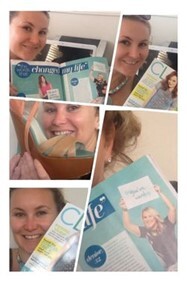
Me showing off my Cleo magazine spread
I got a few traditional media interviews, but I felt really self-conscious. One part of it was feeling like a fraud – thinking that traditional media didn’t understand my business (they don’t really) and the other part was not wanting to be visible.
So paradoxically, as I was looking to increase my social media presence, it felt good from a business point of view, but hard personally. I also felt immense pressure to be this perfect, happy-go-lucky, sunny and pretty person. I was also starting to put on weight and worried about what people would think of me. Surely I have a PERFECT life?!
Nope. Sometimes I’m a grumpy bitch who nags my husband because he stacked the dishwasher wrong. (I’m not even going to put quote marks on the “wrong” – it just is). I don’t have all the answers. I get scared about my business too and wonder if I’m doing the right thing.
By the end of the year, I started feeling less self-conscious and just put more boundaries around my social media / public presence.
For example – I don’t always Instagram while I’m out. I’ll take pictures, but might post them hours or even days later. Although I’m happy to talk numbers and tell stories from my business, I only share what I’m comfortable sharing.
Fear of making mistakes
This might sound REALLY f-cking dumb, but when anyone bought anything from me, it would make me physically sick. Like, WHY WOULD YOU BUY THIS? You’re going to see all my mistakes! The weirdest thing is that I KNEW there were mistakes – like broken links on my website or things that didn’t work, but I felt completely PARALYSED to do anything about them. SO WEIRD.
I think anyone who finishes their sales page a minute before they launch, or creates their course as they go feels the same way. We think that everyone else has it all together, but guess what? I’ve even heard the same thing from MY million dollar coaches! They still sometimes do things last minute! They feel like they’re making it up too!
Who knew, right?
THINGS I DID GREAT IN MY SECOND YEAR
List building
This was a big focus. I started the year with 1826 people on my list and ended with 5275.
This made a HUGE difference to my income, especially when I started running group programs (more on that in a second)
What really worked for me (in order of results)
Running regular free teleseminars on different topics
Weekly blog posts (really trying to avoid writing generic content)
Guest posts (but being REALLY picky about choosing popular blogs)
Participating a LOT in forums (particularly, Marie Forleo’s Rich, Happy & Hot B-school and Gabby Bernstein’s Her Future)
Doing interviews galore (sometimes with really random people)
I didn’t do ezine article marketing, any paid advertising or SEO. I only started doing Facebook advertising in my third year.
I tracked my list building numbers every month:
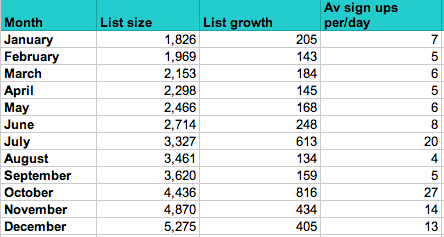
(By the way, this is minus unsubscribes. I go through and delete anyone who has unsubscribed each month, just to keep my list clean)
My website traffic definitely increased from the year before (again, those spikes are blog posts – SO important to be consistent with your content)
Blue line is first year of business, orange is the second year.

I increased my prices regularly
To be honest, I started pricing out some of the time-wasters because I started the year with some random clients.
In my first year, I started out at $75 a session, then increased to $97, then $149, then $249. In the second year, I went to $330 for a while, and then to $550 for a package of a one hour session and 30 minute follow up.
If you’re curious on HOW I increased my prices, I have an Ultimate Guide to Pricing that has all the scripts and psychology behind it. Access it here (it’s free)
I also offered several special packages, for 6 or 12 sessions at a discount. Every time I increased my prices, I’d lose some clients, but overall my workload remained the same.
I’d usually see about 15 clients a week in a good week. Some were on weekly packages, others on bi-weekly.
Here was a fairly typical client load for me
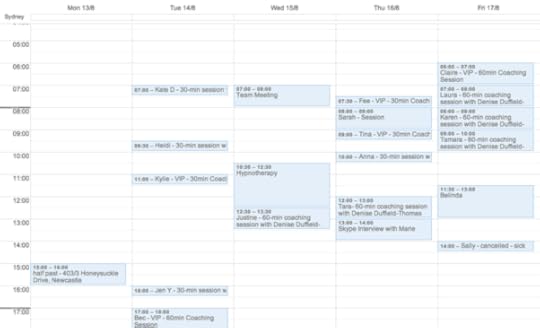
I couldn’t really do more without feeling burnt out. I’m definitely not the kind of coach who can speak to people back to back all day long.
That’s why increasing your prices as you get better is SO IMPORTANT. It means that you don’t just have to keep working harder and harder.
I also started phasing out of coaching towards the end of the year. It’s a brilliant way to make money and serve people, but honestly, I can’t handle the repetitive conversations. After two years of coaching, I got the same problems over and over again, which made me really frustrated and wasn’t good for my clients.
I also realised that I was actually better at teaching and consulting, than coaching. I just didn’t have the patience to work with people over the long haul. I knew that I wasn’t doing people any favours by continuing to offer coaching, so I stopped doing it altogether in my third year (more on that in the next instalment).
HOWEVER – don’t jump out too soon, unless you have a growing newsletter list or you’re prepared to offer something high priced enough to warrant a tiny workload. If you’re sick of coaching 1:1 – that’s cool – but come up with your back up plan.
I got REALLY picky with my clients
I started saying no to people who weren’t a great fit.
Definitely started saying no to male clients, or people who didn’t have businesses.
The male clients was a super personal thing. First, I didn’t feel like my coaching style really worked with the masculine energy. Secondly, you’re having quite intimate conversations with your coach – often telling them things that you’re not telling your friends and sometimes even your partner. I felt like it was an inappropriate “relationship” to have as a married woman. It didn’t work for ME.
Most of my regular clients, I absolutely LOVED working with, but I’d still get a few randoms, even at the $550 price point. I didn’t feel like I could really help them change their entire business in 90 minutes, but their expectations were REALLY high for the cost of the coaching and they couldn’t afford to invest in a longer term program.
I definitely got the best results with people who committed for 3-6 months, and were willing to put the work in over time. Successful businesses aren’t built in a month, and I found it stressful dealing with people with unrealistic expectations. I decided to start working with people who had already started making money – rather than people who were desperate for their first client.
Remember – you don’t have to help EVERYONE – you can choose not only the type of client, but their life stage as well. You might specialise in start-ups, or you might work best with people already earning a certain amount of money.
I also started being clearer with my hours. I took Monday off coaching (and eventually Friday as well) and instead of giving clients pick of a million different appointment times from 6am-6pm, I gave them only a few choices. (You can set this up easily using TimeTrade, a great online scheduler).
Again – something really interesting here about when you’re TOO generous. One of my clients saw that she could have a pick of roughly 40-60 time-slots and told herself “Oh, Denise mustn’t be that successful“.
So, trying to be TOO accommodating, had a negatively perceived affect, even though I had maxed out my preferred client load. Interesting, right?!
I ran regular group programs
This really kicked up my income and was mainly responsible for taking me from 60k to $146k in one year.
I knew I didn’t want to take on more 1:1 clients because my workload was enough for me and I didn’t feel like I wanted to increase my prices from $550 to the next price point. It didn’t feel energetically “right”.
I told you that in my first year, I ran the Inspired Life Formula course – a kind of generic “improve your life” course.
In my second year, I started running a few different ones. The least successful was my “Manifest Your Soul Mate” course in May, which I think had 14 women on it (it was really cheap, maybe $97).
Remember, the shiny object syndrome. I WAS NOT AN EXPERT ON SOUL MATES. I wasn’t even particularly interested in the conversation, but I thought it would be a good idea. Total distraction!
In July, I also created a cheap product, a $50 video course, which also included a copy of my book, Lucky Bitch. This was always intended as a placeholder product for something better along the track, but it was nice extra income. It was a no brainer price and it paid for some of my regular business expenses. Over the year, it amounted to $3750. Not bad for a “place-holder” program that I never really advertised much. I just put it on my thank you pages for my freebies.
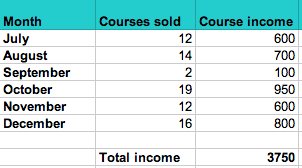
LESSON: Don’t wait to put together a program – do it quickly!
The most successful was my “Lucky Bitch Money Bootcamp“. It sold for $1,000 for a six week live course, and I offered a $750 “early bird” rate. The first few times, the videos were done at home, on my iPad and me in my PJs. It still sold well, but in September, I upgraded to a video day to make them more professional. (I’ll probably update and re-record that course every two years to keep it looking good).
Over that year, I sold 128, mostly all at the early bird rate. I had a handful of refunds, not very many, but I was TERRIBLE at chasing people whose payment plans defaulted. I really had to start putting together some more sophisticated policies but I was “too busy”.
In my third year of business, I made this a home study course because after running it live four times, I got bored answering the same questions over again and realised that I didn’t NEED to do it like that to give people the benefit of the course. I had to get over a bit of guilt and a feeling of “this is too easy” to be able to do that (more on that in a future post).
Here’s the interesting thing… (and why it’s SO important to grow your list)
Each time I ran the program, I had approximately 1% or less of my entire list sign up to do the course. Let’s take a look at the numbers….
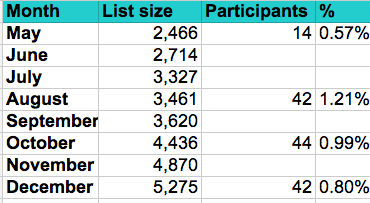
I definitely improved my sales page between May and August, but I still only sold it to 1.21% of my entire list. I also got better at sending out emails promoting the courses. I sent WAY more than I was comfortable with, and realised that most people wait for the deadline to sign up, but you get scared to send a reminder email (or two), they’ll never remember to sign up.
I see people get discouraged about not filling their programs, when literally the numbers don’t work out.
It doesn’t mean that it’s not good. That doesn’t mean you CAN’T sell a program with a small list size, it just means that you’ll have to do more high-touch marketing, for example, getting people on the phone and selling them 1:1 – and that’s only worth it for a high end program.
I starting saying NO THANK YOU to random stuff

Speaking at my old dance school!
At the beginning of the year, I started to get some really weird speaking requests – like government team days, charity events, even my old High School.
I spoke at the local University on networking, the local business club about writing a book and even did motivational gigs as a favour to my awesome dance teacher, talking about personal development for the dancers. “Denise, is that you on the trophy wall who won ‘Best Dancer’ in 1992? I wasn’t even BORN yet“.
It was awesome for my ego to get paid for speaking, even the free ones were exciting. Telling people I had a speaking gig just felt SO COOL! I felt like I was a serious business lady.
By the way – if you’re ever unsure about what to charge for speaking – just simply ask what their budget is. They’d say “Our budget is around $500” and I’d say “Well, that’s a happy coincidence because that’s exactly my speaking fee!“. (You say that no matter what figure they mention)
After a while, the novelty of speaking wore off, especially since I felt like I had to constantly mould myself to a different topic every week.
Could you speak about time management? SURE I CAN.
Could you come and speak at my real estate office? NO PROBLEMO.
Can you talk to our students why they should study harder? I DON’T SEE WHY THE F-CK NOT?
I actually started saying NO, just to see what it felt like.
Then I’d say “You know what, that’s not really my speciality – can I recommend someone for you?”.
Do you know how HARD it was admitting that I wasn’t good at something? (Especially for a Virgo?!) I was used to being the Jill of All Trades – and if I had to stay up all night researching a topic, I would do it. Because I was getting involved in so many corporate clients, I also started feeling like I couldn’t really be myself. I couldn’t swear and be silly. I had to dress up reasonably nicely and be on my best behaviour.
Boring.
So, I started saying NO to every request that wasn’t in my zone of genius. I actually even started saying no to speaking gigs in my town. I figured that I could find clients online, I didn’t need to sh-t where I slept (so to speak). It also felt nice having my town as my home, instead of my place of business.
The lesson really – is that business gets so much better when you do the things you like. Your business, your choice.
BUSINESS INVESTMENTS I MADE IN MY SECOND YEAR
I already mentioned, that I spent a SH-T tonne of money on courses, travel for conferences and personal development.
To be honest, I joined a mastermind that probably wasn’t the best investment at the time. Again, it required quarterly travel to the States (effectively doubling the cost of the mastermind itself), the calls were at an ungodly hour for my timezone and it wasn’t the best cultural fit. That was probably a $25k investment that wasn’t the best (not totally worthless, because I DEFINITELY got new insights, it just wasn’t really what I needed for the year).
Staff / Contractors
One thing I realised about myself in my second year is that I’m a total introvert who likes to work largely by myself.
I HATE MANAGING PEOPLE. Always have. All of my jobs have been largely individual. I never liked working with others… no wonder then that I struggled to work with employees!
I went the Indian V.A route and it really didn’t work out. I had two different people working for me part time each, for about $1200 a month. But I just wasn’t ready to have two part time staff and I found myself giving them really random instructions, because I didn’t know what else to give them and also the language barrier was sometimes a problem. I’d be like “um, can you find me 200 quotes on finding your soul mate” but the result would be kind of random and not the voice I was looking for.
My best staffing hire was towards the end of the year when I worked with an Online Business Manager, who helped me systemise processes. She basically got me organised, helped me prioritise projects when I said I was going to launch 5 things in one month and was a valuable sounding board to help me when I was having a challenging week.
Other things I contracted out: graphic design, recording and editing audio, a video day re-recording my money bootcamp, (with a guy who also edited them) and a book project manager (more on that in a sec). I also changed accountants from using one of my best friends to a local guy who came recommended from a business friend.
I don’t think I’ll ever be someone with a large full time team. I really like to streamline and hire people when I need them. I always prefer contractors over full time staff.
Went PRO in some of my systems
I moved from 1ShoppingCart to Infusionsoft to deal with my newsletters and opt-ins. It was a big learning curve, but it was a great time to do it.
Started using DropBox to back up all my files (it sounds like a small thing, but losing data is a bitch).
My website was still on Typepad and I was tempted to move over to WordPress several times but it felt like too big a project (I ended up changing over in my third year – should have done it sooner).
Good photos
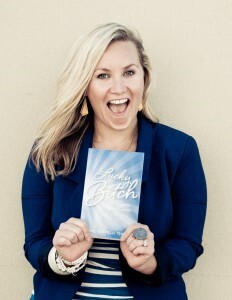
This makes SUCH a difference. Truly, you can get away with crappy branding if you have good pictures. That’s all anyone will notice.
In my opinion, good photos will be more useful to your business than a logo (I STILL don’t have a logo!). It also has a crazy effect that people think you’re more credible and well-put together.
Seriously, this is a good investment. I didn’t spend thousands, I spent a couple of hundred bucks and it was so much better than I was using before. I noticed a big leap in my income and confidence from having them, because even if I was working at home wearing no bra, people had a good public impression of me
I ended up with several hundred really good pics, that I’ve used over and over again. I only wish that I’d changed clothes a few more times in my session. I got super lazy, so I’m just wearing the same thing in virtually every picture.
Oh well, it’s good consistency! By the way – have you ever noticed why I post SO many pictures of myself all over my website? It’s a brainwashing thing…
Made a HUGE lifestyle upgrade
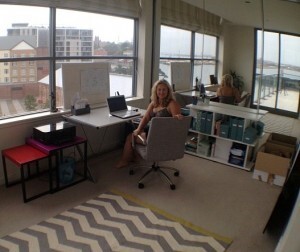
This became my new office view.
One of the BEST things I did in my second year of business was to drastically increase our standard of living. We were still living in a small apartment, even though we both had six figure incomes. Mainly because I was stressing about how to afford a big house deposit and how to get a mortgage considering that we were both new to the country (I am Australian but spent all of my twenties living in London).
I was reading a book by Chris Guillebeau and he said “You don’t have to live your life the way other people expect you to.”
He also spoke about how he rents instead of being locked into a mortgage. It was like a light went on in my head.
I turned to Mark and said – “Let’s rent somewhere SPECTACULAR!”
Literally, within the next six weeks, we were living in a waterside penthouse apartment. That moved made a HUGE increase in my income. I felt WAY more abundant with my life and the energy trickled down to my clients. I had MORE people who wanted to work with me.
I remember we were looking around the new apartment with the estate agent. Mark was looking at me, mouthing “Don’t even THINK about it”. But we did the numbers and it was doable. I just knew how many more coaching clients I needed, which made me hugely more motivated in my business.
Seriously – I know this isn’t a BUSINESS investment because it was a personal cost, but it completely upgraded my business too.
Invested in writing a second book!

This was the BEST investment I made all year. But not for the reason you think…
Books in general aren’t the best source of income. For me in my second year of business, it was worth almost $4000 in income. This is pretty typical for an author, (self-published or not) unless it’s a runaway success.
Books are a business card and a marketing tool. They give you credibility. They get you speaking gigs. They introduce your work to a new audience. But you need to have a money making strategy off the back end of your book. Ie. People buy your book, they come to your website to get an exclusive freebie, you nurture them and build a relationship, and then they’ll become a client in another (more lucrative) way.
Here’s how much I made from selling my book on Amazon, iBooks, Barnes & Noble (online) and the Diesel e-reader store. Kindle was the most popular, followed by paperback on Amazon – honestly the rest were negligible and not worth the effort.
I make on average, about $4 per book.
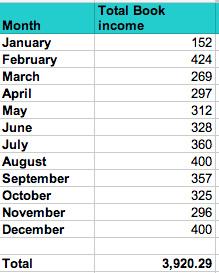
Not exactly a full time income, is it? Yes, it all adds to the pot, but that’s the point – you need other things in the pot to make good money.
You will find this though – to your friends and family, your book IS your business. So they’ll ask you “How’s your book going?“, when it fact, it’s just a tiny marketing strategy out of the whole mix.
It kind of deflates them when you say, “Well, I only make a few hundred a month out of my book, but I made $10,000 last month on my info product!“. They just don’t understand, so it’s easier to say “Great. The book is doing great!”.
The second book….
Was done VERY differently to my first one. This is my book about money – Get Rich, Lucky Bitch!
I wanted to write a second book, because I knew that I wanted to shift my focus exclusively to money and wanted a low cost entry point into working with me. But I was procrastinating.
The first one, I sat down and wrote it like a college assignment – stressed and last minute. I obsessed over the word count and it really was a HUGE pain.
This time, I partnered with a local editor and book writing team. I sent them about 500 pages of transcripts from when I first ran the money bootcamp, and they trimmed and edited it down to about 180 pages. I then went through it, added additional stories and material (about 40 pages extra), and then sent it back to them for a final proof read. SO MUCH EASIER than starting from scratch.
Between the book editing team, the cover, the formatting, etc – the book cost me about $6000 to produce.
Here’s though where it’s SO important to have a marketing plan for your book. I knew that I’d only need to sell 6 full price money bootcamps to break even.
Even though the book was essentially finished at the end of my second year in business, I then actually launched this in my third year – because predictably, I got distracted on something else! (More on that in the third instalment.)
I was thinking that I could write a few books every year but to be honest, it’s a BIG project. One or two books is enough for credibility and to get your name out there. Focus the rest of your energy on getting clients, creating info products or group coaching programs.
Where did my income come from?
The majority of my income came from my Money Bootcamp, followed by private coaching, then affiliate income and then a random assortment of book and speaking income.
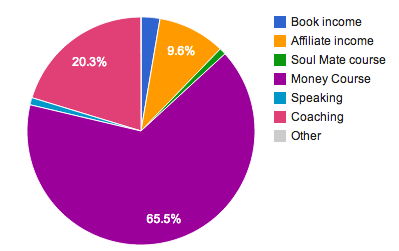
And this is how it played out throughout the year… most of the income came in the last few months – this is where I started running regular group programs.
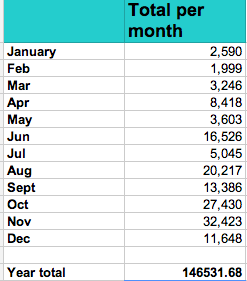
(These are the running totals that I kept throughout the year – my “official” figures from my book-keeper might look a bit different, but it’s a good rough estimate)
The affiliate income came mostly from promoting Marie Forleo’s, Rich, Happy & Hot B-School which was a $1000 commission. Because that experience was so good, I realised that it probably takes just as much work to make $1000 commission as it does to make $5 promoting someone’s ebook. So it’s a business decision for me now to be REALLY picky about who I promote as an affiliate. It has to be a great fit and it has to be worth it. Otherwise, I’d just rather promote something I believe in, without bothering with the commission.
So in summary…
My second year in business was one of MAJOR turning points. A lot of experimentation, sometimes a frenzy of random activity, but that’s pretty normal. It was a thrill to be making six figures in my second year, but honestly, try not to spend it all like I did
It’s okay to try things and then realise that it doesn’t work. It’s okay to quit things, even if you spent time and money on them.
Boundaries with clients will make your life SO much easier (and they won’t think you’re a bitch)
Create your first info product (even if it’s a small thing, like my $50 course), it makes the transition easier if you decide that 1:1 service isn’t for you and gives you some leverage.
Try and hire your first employee. It’s a great learning curve and you’ll get the hang of it eventually.
Keep hustling, keep trying and DON’T GIVE UP.
Being in business for myself has been better than I ever imagined. It’s literally a dream come true to get up every day and choose how I’ll change the world.
It’s there waiting for you and you can do it too!
xx
Denise
October 18, 2022
Launch debrief (pt. 2): Sales breakdown, unsubscribes, refund rates and ad spend
Welcome back to part two of the debrief from the recent PLF-style launch of our new business course.
If you missed part one covering the background, schedule and sales results, you can read it here.
Today we’ll be sharing STATS!
Stats, stats, and more stats from behind the scenes of one of our most complex and successful launches.
I love sharing the REAL numbers and Mark loves pulling together these launch debriefs.
We're taking you behind the scenes of our marketing campaign so you can find just one thing to improve your next launch - whether it's your first or tenth launch and whatever stage of business you're at.
As I’ve said before, there are people doing much bigger and better launches than us - we make mistakes EVERY launch but we share this to help learn to launch in your own way.
Later this month, you’ll also have the opportunity to learn “how to launch” from my mentor and launch expert, Jeff Walker. Jeff will be running a 3-day live Launch Masterclass starting Friday 28 October - click here to join my notification list to hear when Jeff releases more details.
Now let’s get started with part 2 of our launch debrief… if you like stats, this one is for you!
40% of sales in 48 hours!
From past experience and from learning Product Launch Formula from Jeff we know that the final 48 hours often make or break a launch.
This is the time to leave it all on the field, increase our ad spend, and deploy our final strategies to drive sales.
40% (340) of our sales came in the final two days of the launch. Here’s how we made both the 14th and 15th September $200,000 days for us in terms of overall revenue:
Announcing a new longer-term payment plan with a $111 per month price point to remove the cost barrier to people joining
Using individual sales messages and ads for each Archetype
Sending casual video messages to each Archetype about the offer closing and encouraging them to join
Driving conversion throughout Close Cart day with regular and varied emails
Using the payment plan, testimonials, and the money-back guarantee more prominently in ads and emails
Adding a larger, bolder, and red-colored countdown timer to the sales page
Investing more time in the Messenger inbox and our sell-by-chat initiative
The priority for the end of the sales period is maximizing the number of people who are still engaged with the launch and getting as many as possible to see the sales page. This gives you the best chance of converting all of the previous good work from your launch.
This chart shows when people joined - sales started as soon as we began the promotion, then spiked on Webinar day and in the final 48 hours of the launch.
During this launch, we tracked as much data as possible regarding which of the 8 Money Archetypes engaged and when.
We tracked leads, sales, and Archetype breakdown daily and monitored which Archetypes converted most and best.
We saw some patterns in terms of when each Archetype decided to join:
Mavericks started very strong, with more than half of Maverick sales in the Early Enrolment and Webinar periods.
Celebrity, Nurturer, and Romantic sales started slowly - these Archetypes sometimes have challenges with spending and money boundaries and may have needed to leave their purchase to the last moment.
Celebrities and Romantics likely didn't watch the webinar live or stay on the call until the end, so sales from these Archetypes from the call were lower.
The majority of Nurturers and Connectors purchased in the final 48 hours.
Mavericks were less likely to join in the final 48 hours because they hate anything that’s too popular and hate feeling like they're going with the crowd. Mavericks are less influenced by FOMO and a deadline.
If you know more about your customer or the type of customers you want to attract, you can tailor your launch and know what to expect in terms of buyer behavior.
Sales by Archetype
The most common Archetypes amongst our leads were Accumulator and Nurturer, accounting for 18% and 17% of our launch leads, respectively.
But we saw some big differences in the Conversion Rate across the Archetypes with Celebrity and Romantic being top performers with conversion rates over 5%.
Accumulators, Rulers, and Nurturers generated the most sales, and despite the high conversion rate, Celebrities had the lowest number of sales.
We were surprised not to see more sales from Alchemists and Mavericks, especially because Mavericks started very strong with early sales.
Which payment option did each Archetype prefer?

Over three-quarters of Accumulators preferred to pay in full and avoid finance charges.
Compared to only a third of Celebrities and about 40% of Romantics who paid the larger upfront amount.
Spreading the cost of enrolment with either the 4Pay or 11Pay option was most popular with the Celebrity, Nurturer, Romantic and Ruler Archetypes.
The long-term payment plan released in the final 48 hours was also most popular with Celebrities, Nurturers, and Rulers and was a factor in getting these people to join in the final few hours.
Again, if you’re goal is to attract a certain type of customer, you can choose a payment plan option that will suit them.
Launch Ad Spend
This launch generated in excess of $1.5m AUD in revenue, with $873,000 of this being received upfront during the launch.
Our expenses are normally around 20% of launch revenue, including ad spend, team, production and web design. But the complexity and production value we wanted for this launch and the level of styling and staging involved meant the cost of this launch was much higher.
I’ve got a separate post coming breaking down what we spent in detail, but here’s a look at our biggest expense, which as you’d expect, was advertising.

We spent $117,000 on ads and ad management, which is about 8% of total revenue, but for future launches we’ll aim to spend closer to 10% and increase spending on increasing consumption of the pre-launch content - getting more people to actually watch videos 2-4 of the workshop.
List growth and unsubscribes
One of the main long-term benefits of a launch and investment in lead generation is growing your email list for future launches.
We added 19,000 new leads to our list during this launch (yay!), but a little over 5,000 of these new leads then went on to unsubscribe during the launch (boo!).
This is high but expected with a quiz launch - these 5,000 people most likely just discovered Denise, started the quiz, maybe didn’t complete it, or unsubscribed due to the large volume of launch emails.
Our overall unsubscribe rate was about 10% - which is high, and this sort of unsubscribe level would be unsustainable every month without a major ad spend. This was exaggerated by people who just wanted to take the quiz and get the result e.g. people sharing the quiz with their customers or family.
Normally we average around 0.5% unsubscribe rate per newsletter email we send (this is pretty low), so given the volume of launch emails and the 4 podcast episodes released during the launch, this overall level of unsubscribes is high but not a disaster.
We do two launches a year and spend the rest of the year list-building and providing valuable free content to build a strong relationship with our list.
We will, however, review the number of emails during the next launch to look for ways to reduce this unsubscribe rate.
The truth is – every time you send an email, you’ll get people leaving your list. And although you’ll want to grab hold of their ankles as they walk away and scream…
WHY ARE YOU LEAVING MEEEEEEEEEE……..?
The best thing for you (and your dignity) is to let them go. It’s not personal.
There are many reasons why someone unsubscribes during a launch…
They are annoyed at the number of emails you’re sending
They don’t want what you’re buying
They are SHOCKED, DISAPPOINTED and even ANGRY that you’re selling them something. Yep - be prepared for some really pissed-off emails.
They’re just not that into you.
Either way, it’s not really your business. It’s totally okay for someone to decide that they’re not a fit for you anymore and declutter your emails out of their inbox.
Also, don’t stress when people don’t read your emails. Our open rates during the launch ranged from 28-40%. When they are ready, people will read your emails and click your links - the stats play out, and even with more than 50% of our list not opening our emails our launch was still a big success.
You can read more about my approach and mindset regarding unsubscribes here.
Refunds
As well as unsubscribes, another thing that’s inevitable about launching and being in business is refunds.
Refunds suck, but there are lots of reasons why someone may request one - it could be you, it could be them or just a money thing.
We try to reduce our refund rate by providing lots of value and support in the first 14-days, by having a clear refund process, and by connecting with everyone who asks for a refund.
But we’re also not triggered or stressed by refunds. They happen, and we give people their money back if their not happy or decide the course is not for them.
We use our refund policy in our marketing as a guarantee and reassurance for people who join, and we don’t fight people over refunds - if you request one during the 14-days, you’ll get your money back.
During this launch, we had 56 refund requests. Once again, this sounds like a lot, and in dollar terms, it is - over $80,000 in money refunded.
But a higher than normal refund rate is to be expected in a launch with a deadline and longer-term payment plan - people often get buyer's remorse or have other financial challenges pop up, which means they request a refund.
A refund rate of 5-6% is in line with our other launches, so we know what to expect. Of course, I would love to have a 3% or 0% refund rate, but if we didn’t offer the generous refund policy, we may have lower upfront sales.
We also survey people to find out why they want a refund and send a survey to our launch list to find out why they didn’t buy, so that we can work on increasing conversions and lowering refunds next time.
If you have 100 people join your next course launch, expect for 5 refunds, and if you get fewer, than you’re doing great.
Offering two payment plans and a longer-term payment plan for people who could not afford the first option could also have contributed to a higher refund rate.
The refund rate for people who paid in full was 20% lower than for people on payment plans.
We also saw the highest refund rate amongst Accumulators, who often find investing in themselves a challenge and suffer buyer's remorse.
Mavericks also refunded at a higher-than-average rate as the course became more popular, and they likely wanted to rebel against being involved or doing the work.
There’s more!
Honestly, Mark has charts coming out of his ears! There’s a lot more we can share about this launch and everything we’ve learned from over a decade of launching.
Check out the blog for our launch lessons, and we wish you the absolute best as you work towards your next and best launch.
Launching has created a lot of abundance for our family, and it’s so worth it to push past your blocks and resistance.
People need what you offer! YOU CAN DO IT!
xx Denise & Mark
P.S. HAPPENING SOON >> A special opportunity to learn from my launch mentor, Jeff Walker.
Next week we'll share details of a new training from our launch mentor, Jeff Walker.
We have studied and implemented Jeff Walker's Product Launch Formula in our business over the last six years, including attending conferences and masterminds with Jeff – I'm not exaggerating when I say he has changed our business and life.
Using the Product Launch Formula (PLF), we've generated over $10m in revenue from product launches, and we're now one of the top affiliate partners who work with Jeff on his annual launch.
This is an incredibly valuable opportunity to learn from the guy who invented launches and get insight into the latest trends and strategies that are working in launching.
October 2, 2022
Part 1 // Launch debrief: Real $ results revealed from our recent launch
Once a year, I pull back the curtain on how I run my product launches by sharing what's working right now in my business.
I love sharing the REAL numbers, our wins, and our mistakes. Plus, the challenges and changes I'm seeing in the online marketing space.
Cos - trust me, we're not perfect either!
Over the next few weeks, along with my launch manager (and hubby) Mark, we'll share a lot of launch content with you - reviews, free training, and honest articles.
We'll take you behind the scenes of our marketing campaigns so you can find just one thing to improve your next launch - whether it's your first or tenth launch and whatever stage of business you're at.
Even if you've never launched, don't have a business yet or if you hate the idea of launching, stay tuned because I want you to know that it's possible to launch in your way - with integrity and without sleazy marketing techniques.
The world needs YOU to show up, and trust me when I say that learning how to launch can take you to the next level so you can help more people.
To kick off one of my favorite topics (and certainly Mark's fave), I want to share a breakdown of my most recent launch.
This is hot off the press - the launch of our Sacred Money Archetypes® business course was only completed a few weeks ago, and we're delivering the course right now.
Mark has put together this "Part 1" debrief to share a summary of our results from our most complex (and fun) launch ever.
We don't share these numbers to gloat - there are so many more people doing bigger and better launches than us, we're trying to remove some of the smokescreen from launching.
My goal is that by the end of this month, you feel a little more informed, inspired, and excited to try a launch or achieve your best month in business.
So let's get into this… dive in below.
Background
We first launched Sacred Money Archetypes® in 2017 and then had a small annual promotion for a few years after that.
Honestly, it was always kind of disappointing.
I love the SMA framework; it has been a game-changer for my business and relationship. I know it has helped hundreds of our members, but we never quite got the messaging, promise, or pricing right. There was always something that tripped up our previous efforts to launch this course, and I was fired up to see SMA fulfill its potential.
So I started again from scratch. I went all in because I had a big vision about what this launch and course could be.
My creative juices were flowing, and I got to work re-designing and re-writing the course, re-creating all videos and materials, and completely changing the branding and marketing.
I realized that all my previous efforts to market this course were based on my own Archetype, the Ruler, so I created eight different marketing funnels with different messages, videos, and looks to speak to each of the 8 Money Archetypes.
We invested heavily in staging, styling, video production, and social media - I really want this to be a game-changer launch where I could showcase the power of using the Archetypes in your marketing and getting some fun and creativity back in my marketing.
This meant eight different launches - 8 sets of pre-launch videos, eight sales videos, and eight versions of the course - it was a lot for my team and me. It's kinda traumatic to think back about how much work and time we've put into this.
So to say I was heavily invested in the outcome of this launch was an understatement.
I've never done such a complex and involved launch as this, and I REALLY wanted it to go well - which of course, brought up plenty of my own blocks and fears.
You can see more detail from behind-the-scenes and how this launch was styled and produced here, including an extended interview with me about our approach to this launch.
I also recorded a podcast episode here about how I nearly sabotaged this launch before it started!
The goal
We wanted to launch SMA in a way befitting just how good the new course is and how much we believe in this work.
So we invested heavily in upgrading the pre-launch content, marketing, and branding, and we devoted six months to prepare for this launch.
This meant we had an ambitious goal for this launch - we needed at least 300 sales to cover our costs, and 500 was our initial goal.
I love having a big goal for launches and a project to get excited about (usually a property for us). For example, we just bought an old bank to renovate as an Airbnb, and a big chunk of the profits from this launch was earmarked for that project.
Our big stretch goal was one thousand sales and $1m of revenue.
We wrote "$1m+ SMA" on our shower screen daily and used it as our passwords and phone backgrounds.
Given the $997 price, we knew that hitting 7-figures was a big stretch that would require a lot of leads.
Previous SMA launches had low conversion rates between 0.3% - 1.2%, and this is why we wanted to redo and improve the course.
(You can read about the mistakes we made in our worst SMA launch here)
We knew we could improve the conversion rate and engagement but hitting $1m even with a 2%+ conversion rate would require 50,000 leads.
We had doubts about whether we had the reach and advertising budget to generate enough leads to hit our target.
This is why it's essential to know your numbers and work backward from your revenue/sales target to know how many leads you need and what you'll need to spend on ads or via affiliate partnerships.
Do you know the number of leads and sales you need to hit your launch goal?
Our main launch targets were:
20-25,000 leads
3-4% conversion rate (this is about the CR for our Bootcamp launches, but we'd never got close to this in the past with SMA)
800-1000 sales
$1m+ revenue
The schedule
We originally planned to do this launch in April, then at the start of August, and both times we had to push back. There were production delays, team members getting sick with Covid, and we were overwhelmed by the sheer volume of work required to get eight different pre-launch workshops and courses ready.
We eventually run the launch for three weeks from 25 August - two weeks of generating leads followed by a week-long sales push as follows:
25 August - 6 September - Lead generation
We needed an extended pre-launch period because we had six pieces of content with the quiz, the four videos, and all of the BTS content. Plus, we had a big leads goal, so we felt we needed extra time to engage both warm and cold audiences.
6 September - Live call/sales webinar
7-14 Sept - Main sales period
14 September - Close cart day
15 Sept - 30 Oct - Live course
For the first time, we made early enrolment in the course available immediately, so people could join as soon as they had done the quiz or workshop. We had 270 people join / 28% of sales come in before the webinar.
We did this because some Archetypes love instant gratification and hate waiting to buy - they'd rather jump straight in and take action quickly.
The results
Although sales started slow, we had a really strong final 36 hours, averaging $10,000 per hour in revenue.
Our final numbers were:
952 new members
$1.55m AUD / $1.04m USD
57% of the money was received upfront, contributing to September being our highest-ever cash-received month.
Five hundred eight sales at the pay in full $997 price, and 180 people, chose the four pay price option. Two-hundred and sixty four took advantage of the extended 11-month payment plan when it was announced in the final two days of the launch - this was undoubtedly one of the reasons 40% of sales came in the last two days.
We hit our $1m revenue target and got close to our stretch target of 1,000 sales.
We threw all of our Law of Attraction manifesting techniques at this goal, and despite being exhausted, we were thrilled with these numbers.
25,682 people opted into the launch by taking the quiz or registering for the video workshop and webinar.
So 952 sales represented a 3.7% conversion of total leads - close to our 4% target.
We tracked leads and sales by Archetype and recorded when, each Archetype decided to join, and we'll reveal more of this in part 2 of this launch debrief.
The conversation rates for the various Archetypes varied from 2.4% to 6%, so next year we'll aim to attract more of the highest converting customer groups.
Overall, we TRIPLED our previous best conversation rate for an SMA launch.
Here are three factors that contributed to our 3x improvement in launch conversions…
1. Clear promise
We created new training modules and focused the marketing message on "leverage your strengths and make more money."
This clarity worked well in our biggest customer groups - Accumulators and Rulers - and clarified why people should join the course.
We added secondary messages tailored to each Archetype based on research we had done about what each Archetype looks for in a course and sales process.
2. Creative marketing
Advertising is becoming harder to track and more expensive, plus organic reach is declining. So because we had a significant reach and leads goal, we needed to get creative in our marketing.
We doubled down on fun, eye-catching social media content and videos and tailored marketing to the 8 Archetypes.
This drove this launch's engagement, energy, and excitement to a new level.
You don't need to create eight versions of marketing content or a music video, but how can you bring your personality into your marketing, so you stand out and get people talking?
3. Incremental improvement across the board
Your final conversion rate is influenced by many factors. A slight improvement - even a tenth of a percent - in many different areas can significantly affect the overall conversion rate.
We invested in improving the performance of ad targeting, ad copy, click-through rates, email copywriting, SEO, re-designing our sales page, improving video consumption, abandon cart rates etc.
One of the most significant improvements compared to our January launch was achieving a much lower cost per lead with the quiz and better ad targeting. We'll share more about our ad spend in future debriefs because we were getting new leads between $1-$4.
Small tweaks make a big difference when you uplevel copy, messaging, and performance across a whole funnel. This was only possible because Denise advocated for her vision for the launch and made SMA a priority for six months across the company.
This bet on SMA paid off and has created a new multi-million dollar asset for our company.
Despite the results, there are still so many areas where we can improve and fix things that didn't go well - webinar show-up rate, pre-launch video consumption, early refunds, and better use of testimonial videos, to name a few.
Did you play along with the launch? Did you join SMA this year?
What stood out to you as better or different with this launch? What should we do differently?
Debrief part 2 is coming soon…
In part two of this launch review, we'll share more on how much this launch cost (a lot), our major expenses, and things we will do differently for next year's launch.
With so much complexity in this launch and the extra workload of creating the course at the same time as running the launch, we were so grateful to have the PLF framework to fall back on.
The Product Launch Formula course gave us templates for video scripts and checklists for precisely what to include in crucial emails and videos.
Without PLF, this type of complicated launch would not have been possible. Having Jeff in our corner as a mentor and point of reference is the only way we stay sane and don't sabotage our big launches.
Make sure you check out Jeff's free live launch masterclass when it's available later this month. Click here to join my PLF waitlist here.
xx Denise and Mark
P.S. HAPPENING SOON >> A special opportunity to learn from my launch mentor, Jeff Walker.
Over the next few weeks, we'll share a new training from our launch mentor, Jeff Walker.
We have studied and implemented Jeff Walker's Product Launch Formula in our business over the last six years, including attending conferences and masterminds with Jeff – I'm not exaggerating when I say he has changed our business and life.
Using the Product Launch Formula (PLF), we've generated over $10m in revenue from product launches, and we're now one of the top affiliate partners who work with Jeff on his annual launch.
In late October, Jeff will run a free Live Launch Masterclass and open enrolment for this Product Launch Formula Coaching Program.
This is an incredibly valuable opportunity to learn from the guy who invented launches and get insight into the latest trends and strategies that are working in launching. Click here to join my PLF waitlist list, and I'll send you details about the Masterclass soon!
I am also a proud affiliate partner with Jeff, and I support Product Launch Formula each year by offering an epic free bonus and launch training. To be the first to find out about the 2022 enrolment and my behind-the-scenes bonus, join my PLF notification list here.
Sacred Money Archetypes® is a registered trademark of Heart of Success, Inc. and licensed by Lucky B Pty Ltd. Copyright 2022 Kendall SummerHawk.
September 17, 2022
3 signs you need to work on your mindset around pricing
Pricing’s tricky right?
When you go into business for yourself it's like you have to put a value on yourself. Urgh!
You might have some mindset stuff around wanting to be accessible and affordable for everyone.
So, if you are struggling with prices right now, here are a couple of different ways it could be showing up for you.
#1. You hide. You don't tell people about what you do. You procrastinate posting, launching or publishing. It’s so normal to get into analysis paralysis.
#2. You think someone else must know better than you. You might canvas for prices on business forums or with your friends and family. Big mistake.
#3. You believe there's a critic-proof price. There’s no perfect price. There’s no price that will make everyone say yes.
Click here to listen to my latest episode and you’ll learn:
Being in business is NOT about getting everything right
How to avoid other people’s money blocks when setting your price
That you may lose some clients and that’s ok
The EXACT thing that’s holding you back
What happens energetically when you get paid well
Know this: you can't help people if you burn yourself out.
If you have to have a job that you hate to subsidize your business you’re not going to be able to bring your best self.
It's okay to charge for your work.
You serve, you deserve.
I’d love to hear from you what mindset issues are coming up for you with pricing. Reach out at @denisedt
It’s your time and you’re ready for the next step,
xx Denise
P.S. Don't forget I have a free pricing ebook for you - it’s my ultimate guide to all things pricing including ALL the scripts you need in it for setting and increasing your prices. Snag your copy at denisedt.com/pricing
September 11, 2022
I almost sabotaged this launch… here’s how to make sure you don’t
There are only a few days left, so let’s go even further behind the scenes of my current launch.
You know how I love sharing so you’re gonna get the good, the bad, and the ugly!
The truth is that me or my launch manager/hubby Mark sabotage our launches almost every time (it’s usually ‘cos of our archetypes).
My archetype is Ruler-Maverick, and my sabotages are trying to do all the things at once, overlapping projects, and not giving myself time off.
For this launch, I had serious shiny object syndrome – I filled my house with stuff for each archetype. We had clothing racks everywhere, and everything was a big, old mess.
So, there are eight archetypes, and my aim was to film each one in two hours. That’s four costume changes and one complete set change for each. No problemo!
Rulers think that time and space don't apply to them, and Mavericks think that the rules of physics don't apply to them, so it was all cool, right?
On the first day, I realized my mistake.
It didn't take two hours per archetype. It took at least double; I was frantically changing outfits, earrings, bracelets, rings, and shoes!
We started at 7am for hair and makeup and finished at midnight that night. We'd done two archetypes. I panicked.
Of course, we did it – my amazing videographer is an Accumulator, and we totally made it happen over the next week.
But I’ve learned lessons…
Click here to listen to my latest episode and you’ll learn:
How I screw up almost all my launches (how NOT to launch!)
What each archetype needs to know before they’ll purchase
The secret to discovering your ideal customer
How to avoid cookie-cutter launches
EXACTLY what happened when I broke through my sabotages
This launch is next level!
I usually always film barefoot, but this time I chose shoes to match the energy of each archetype! From snakeskin cowboy boots to silver platforms – go to denisedt.com/bts to see every outfit that I wore.
I can’t wait to share it with you - hit reply and let me know your favorite outfit combo!
xx Denise
P.S. Enrollment for my new Sacred Money Archetypes® business course is closing soon.
We’ll be spending six weeks working on leveraging your Money Archetype and tweaking your business model, marketing, and passive income to earn more.
Click here to find out all the details, read the reviews and join us for live coaching and business training tailored to your Money Archetype.


