
Jonathan Auxier's Blog, page 8
December 9, 2011
PETER NIMBLE Book Party!
A lot of friends have expressed disappointment that they were unable to attend my launch party in August. Well, good news! The fine folks at Pittsburgh's own Penguin Bookshop are throwing a Peter Nimble book party!

The event will be on Saturday, Dec 17th from 1-3pm. There will be hot cocoa, cookies, readings, games, and more! If you live or know anyone who lives in the Pittsburgh area, please tell them to come! I'll also be using this as an opportunity to introduce the community to my school programs — so those of you who have been dying to see some costumes and yo-yo tricks would be advised to come!


November 26, 2011
Hello Again …
The last five weeks have been an insane grind for Team Auxier. I was planning to do several posts announcing various things as they came up, but time got away from me. Instead, I'm just going down the list …
BOOK TOUR
I've been touring schools and bookstores all over California — about thirty events in the last month. (Click here to see pictures from a recent event … and video of me doing a favorite YO-YO trick!) I also managed to sneak out to Wordstock in Portland and the Miami Book Fair International.1
I OPTIONED A MOVIE
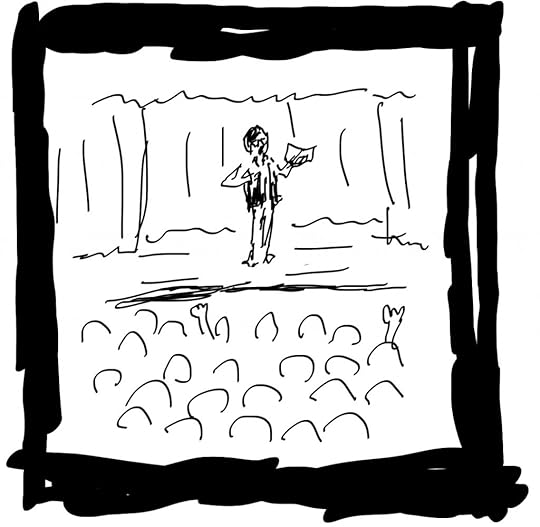
To real producers! With real money! The story is one I've been working on for a while — a period ghost tale in the tradition of Washington Irving about a haunted tree. The one problem was that selling the movie meant I had to completely re-write the last half while on book tour. I finished last night!

WE MOVED!
This month, Mary and I packed up all our dishes and made the 3000 mile trek to Pittsburgh, PA!2 The 'Burgh is a wonderful city that has topped virtually every "most livable" list for the last decade. Also, we met there.

WE BOUGHT A HOUSE!
One great thing about Pittsburgh is an abundance of amazing old homes. Coming from the West Coast, I thrill at the idea of living in something not covered in stucco. As of last night, Mary and I are the owners of this hundred year-old gem on a tree-lined street in Regent Square. How's that for a black Friday purchase?

AND THE LAST THING …
You might be asking yourself why a young couple might leave sunny Los Angeles for snowy Pittsburgh? Well, Mary grew up here, and we want to be near family when we have our baby in May. Did I mention we're having a baby? Because we so totally are.

Where I had a fantastic time hanging out with the likes of Tom Angleberger, Dan Santat, Grace Lin, Gene Yang, and Matt Phelan! Even better, I got Dan to promise to put me into his next picture book! ↩
Actually Mary packed our house; I was too busy hanging out at schools and bookstores. ↩
October 14, 2011
Maria Tatar and Child Worlds …
 First off, a note for the locals: I'm having a signing this Sunday at 5pm at lovely Laguna beach books! You should come by and say hello! For directions and more info, click here. If you can't make it, I'd love for you to spread the news by Tweeting the word — just click here!
 ON TO REAL BUSINESS: This week there was a kerfuffle about a NYT op-ed by children's lit scholar Maria Tatar called "No More Adventures in Wonderland."1 Tatar argues that children's books of the present lack the "redemptive beauty, cathartic humor and healing magic of an earlier time."
Lots of people in the kidlit community got very upset by this article. I urge you to read the comments at the School Library Journal's Heavy Medal and Fuze #8 blogs. I generally agree that Tatar is exercising some willful blindness (I'd hardly call Peter Pan a "redemptive" figure), but I also think the children's publishing community does themselves a disservice by automatically shouting down an established children's literature scholar such as Tatar.
[image error]For my money, the best response has come from Monica Edinger, who took a moment to consider why Tatar chose Peter Pan and Alice in Wonderland as her touchstones.2 Edinger rightly observes that both books were very much about the act of constructing a world in which actual children (the Liddels and the Davies) were meant to play. In fact, story details in both Neverland and Wonderland were actually taken from these children's own playtime adventures.
Perhaps what Tatar is trying to say is that in this current market of well-plotted, well-written stories — ones that adhere closely to the rules of dramatic structure — we lose the chance to create worlds that are incomplete … places that invite a child not to re-create the actions of a hero, but to inhabit the same spaces as the hero inhabits?
 This subject looms large in my mind right now because my wife is currently writing a dissertation that deals with the role of "child worlds" in early children's literature. Tatar might have given the wrong diagnosis, but her op-ed still speaks to a legitimate difference between books of today and books of the past. Any contemporary reader of Alice in Wonderland will have to admit it contains a pretty lack-luster story … but what a world it creates.
For a completely different view on the subject, I urge people to check out this recent article from Salon magazine that argues for the value of teens reading adult fiction — darkness and all.
Scop readers will remember that I reviewed one of Tatar's books earlier this year. ↩
You may recall from a previous post that Monica Edinger is always right about everything. Nice to see her holding up the tradition! ↩
October 12, 2011
Geek Dad Interview …

I've got an interview up at the WIRED GeekDad blog today. This is a big deal for me, as I've been a gigiantic fan of the blog ever since they taught me about this dot-matrix printer made from Legos and Crayola markers:
I was interviewed by Jonathan Liu, who also happens to be a virtuoso Etch-a-Sketch artist. Check it out:
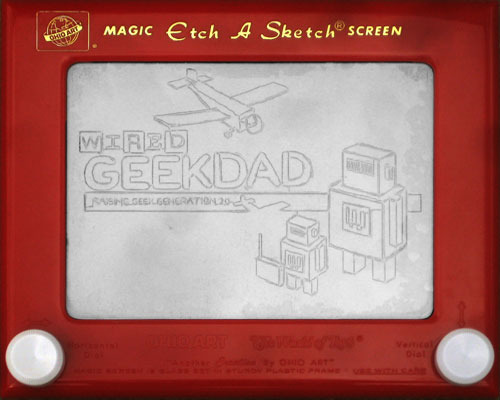
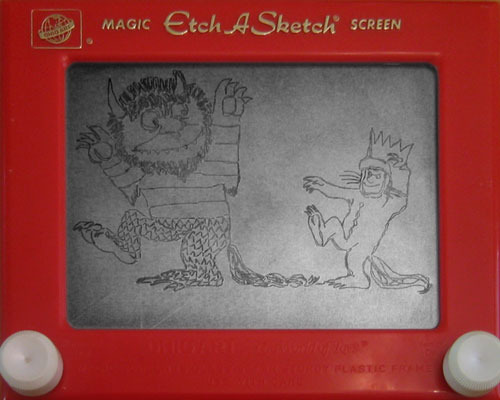
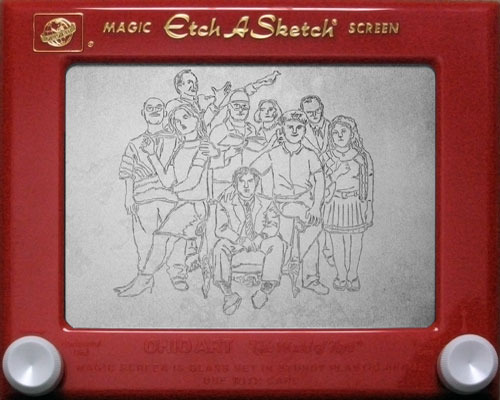
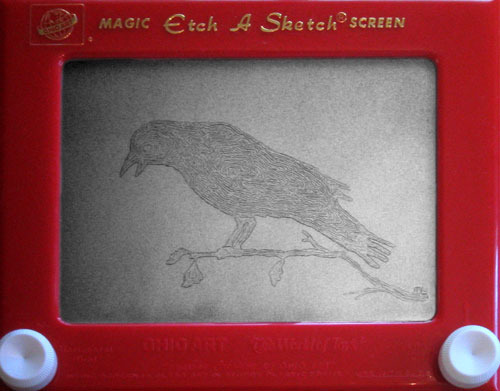
You can see more of his wizardry at Rainy Bay Art. (He also does commissions … don't think I'm not tempted!)
 And while you're at it, check out our interview. Mr Liu and I covered a ton of great topics — including the importance of men modeling reading, the impact of nonsense on children's literature, the writing process, Laurence Sterne, yo-yos, etc. Also, I finally talk about the single work of children's literature that influenced me more than any other! (Hint: it's NOT Peter Pan!) Wanna know what book it was? Find out here.
October 8, 2011
Writing With One-Arm Tied Behind Your Back
This weekend, I'm headed up to Portland for the Wordstock Writer's Festival! I'll be doing signings, reading, a few panels about writing for young readers (with a whole host of awesome authors). What's more, I'm also teaching a workshop this Sunday:
ONE ARM TIED BEHIND YOUR BACK:
"Harnessing the Hurdles Unique to Your Work-in-Progress"
This topic was borne out of a recent observation made by Mary. It came during the heat of final revisions for Peter Nimble. I was cursing how much extra work it was to tell a visually rich story from the perspective of a blind child — going through every line to make sure I wasn't taking my own sight for granted. Mary heard my grumbling and responded with typical perspicacity: "But isn't that what you always do? You only pick the stories that force you to write with one arm tied behind your back."
Of course, she was right. I have never had a shortage of story ideas, but the projects I actually finish all contain some ridiculous formal hurdle that makes them insanely difficult. Why write a feature film when I can write a silent feature film? Why tell a horror story when I can tell a horror story for children? Why inhabit the real world when I can build an entirely different world from scratch?
Readers love stories that tackle hurdles, but writing them is a serious pain! Now, however, I'm starting to believe that the formal challenge is the very thing that gets me through a draft — long after I have grown bored with my plot and characters, I have this "Pet Hurdle" to keep me involved. Since then, I've started doodling pictures of my Pet Hurdle:

Isn't he cute? The workshop on Sunday will walk writers through the process of identifying the Pet Hurdle in their own work-in-progress and give them some tools for turning that challenge into an asset.
It makes me wonder: if Peter Nimble hadn't been blind … would I even have finished telling his story?
October 5, 2011
GUEST POST: Harry is a Tool, Aang is a Hero
Hey, Readers! Today I have a treat for you lucky folk in the form of a wonderful guest post by my friend Rob. Some months ago, Rob and I found ourselves in a debate about stories that include a "chosen one" (read about it here). Rob has some interesting ideas — including a theory as to why Harry Potter isn't really a hero. I'll let him explain …
* * *
 Hi. I'm Rob. Jonathan and I were good friends back when I was handsomer and less hairy. I live in South Korea (not the scary one), and write a blog about South Korea. I'm no expert in fantasy or young adult books, but I am a breathless lover of awesome things and a frustrated thinker-abouter (some editors prefer 'think-abouterer') for things that try to be awesome but fail: for example, stories, songs and raspberry sorbets.
We once discussed what Jonathan called "prophecy stories," stories featuring "Chosen Ones" like Harry Potter, Ender Wiggin and King Arthur, here, here, here and here. "Chosen Ones" have some great destiny expected (sometimes prophesied) of them. Now, I thrill to a great hero story, but not any old hero thrills me: I'm not easy. So let's talk about some "Chosen Ones" I adore:
**Spoiler Alerts** for The Harry Potter Series, Ender's Game, and Avatar: The Last Airbender (TV series)
 Harry Potter started off as my favorite hero ever. The first three books were fun and gripping, the characters were lively and hilarious. Courage, cleverness, and awesome friends helped Harry, and the author threw him a rope when he got in too deep.
Then, in book four, Harry's preparations for the Triwizard Tournament were as last-minute and half-hearted as his quest for a date to the Yule Ball. When Harry learns he won the tournament because somebody wanted him to, a hero would think, "That should have been my hide. I'd better not bank on luck again." The time had come to start kicking butt through resourcefulness and preparedness, not courage and luck.
Cue training montage:
Harry forms Dumbledore's Army. He also lies about his connection with Voldemort, quits Occlumency, walks into more traps, and fails to get the information Dumbledore needs without JK Rowlicis… oops I mean felix felicis.1 Instead of watching a kid learn from mistakes and improve, we watch Harry beat himself up for his mistakes and resent a lot of stuff. Holden Caulfield, yes. Heroic, no.
But the undoing of Harry the hero is this: long ahead of time, Dumbledore and Snape knew Harry had to die to destroy Voldemort2 Except they didn't tell Harry! In Chamber of Secrets, Dumbledore says, "It is our choices, Harry, that show what we truly are," but by hiding vital information until it was far too late for Harry to do anything but sacrifice himself, Snape and Dumbledore (mostly J.K. Rowling) robbed Harry of real choice.
And that means I read seven books to learn Harry's a weapon aimed by Dumbledore and Snape, or a cog in Rowling's plot mechanism: less heroic either way. It means the first three books telling me he was the crucial choice-maker in the series, were misleading me.

Yet I give Ender Wiggin a pass, though he had no choice in Ender's Game, either. Why? Because once he learned the consequences of his choices, he took ownership of them. Because heroes live with their choices, and learn from them, and change (heroes don't walk into another trap in book five, and another in Godric's Hollow, despite what happened to Cedric and Sirius).
Also, nothing in Harry Potter reaches the level of nuance and insight Ender displays here:
"In the moment when I truly understand my enemy, understand him well enough to defeat him, then in that very moment I also love him. I think it's impossible to really understand somebody, what they want, what they believe, and not love them the way they love themselves. And then, in that very moment when I love them–"
"You beat them."
Ender Wiggen was special from birth, but he was also recruited for his talent: Ender had to pass a test before going to Battle School to fulfill his destiny. Excalibur didn't magically come out of the stone for him. His talents, though, made him especially suited to perform his task.3

Finally, which "Chosen One" checks every box? My favorite hero right now is a boy named Aang, from the awesome Nikelodeon cartoon series "Avatar: The Last Airbender".
 In Aang's world, some people can "bend" or control one of the four elements — Earth, Air, Water, and Fire. The Avatar is a continually reincarnating person with power to control all four, tasked with keeping the four elements in balance. So … imagine the Dalai Lama was a diplomat with superpowers. But Aang ran from his Avatar training, and got frozen in ice for a century while the Fire Nation took over. Now, he must take up the responsibility he once shirked, master all four elements, and then defeat the Fire Nation king to restore balance.
Traveling with a team of friends, Aang masters the four elements. He learns, in his training and in his relationships. Aang deals with the guilt of abandoning the Air Nation (who were wiped out). He is also a kid, and acts like one. He plays pranks, cracks people up, and makes faces at babies. The supporting characters are humans too, with strengths and flaws, journeys, and tough choices. They suffer loss, and even grieve. They learn from mistakes. Or they don't. Each earns the fate they receive.
For the final battle, sprits of previous Avatars encourage Aang to kill the Fire King. Aang's journey has made him hate killing, so he is unwilling to live with having made that ultimate choice. Instead, Aang negotiates a new path, true to his values as well as his duty as Avatar. By balancing his individuality and his destiny, Aang's "Chosen One" journey is totally satisfying.
These stories show me I like heroes who take control of their situations, earn their victories, and own their choices – including mistakes. Their authors put them in situations where they are real people with real choices, not just props and placeholders. Without these elements, even "Chosen Ones" (perhaps especially them) fail to move me.
Call me picky.
* * *
Thanks for the fantastic insights, Rob! Bloggers Matt Bird and Tanner Higgin have been after me to watch Avatar for ages now … between your three recommendations, I find myself with no choice but to check it out! Ooh, look! It's on Netflix … (promptly wastes the entire afternoon)
A description of felix felicis can be found here ↩
As revealed in Deathly Hallows, pg 686 ↩
Jonathan here: Rob also made a generous comparison between Peter Nimble and Ender Wiggen, which I cut because it made me blush. ↩
September 28, 2011
One Word Every Writer Should Know …
 Last week, I had the pleasure of watching a staged adaptation of CS Lewis' Till We Have Faces. In advance of the show, I sat down and read the book.1 There was something near the end of the story that seemed like a good jumping-off point for a topic I've been meaning to blog about for ages.
First, a little setup: Lewis' book is a retelling of the myth of Cupid & Psyche. It follows Psyche's scorned older sister, Orual. After losing her beloved sister, Orual becomes embittered and angry. At the end of the story, she finally gets an audience before the gods — a chance to make her case for how they have wronged her. But instead of giving a sympathetic plea, she unleashes a tirade that betrays her own selfishness.
Orual hears the ugliness of her own anger, and it prompts a revelation:
"Lightly men talk of saying what they mean. … When the time comes to you at which you will be forced at last to utter the speech which has lain at the center of your soul for years, which you have, all that time, idiot-like, been saying over and over, you'll not talk about joy of words. I saw well why the gods do not speak to us openly, nor let us answer. Till that word can be dug out of us, why should we hear the babble that we think we mean? How can they meet us face to face till we have faces?"2
This "word" that Lewis eludes to is the magical, rare moment when a person sees him or herself with clarity for the first time. Aristotle (the grandfather of writing analysis) had a word for this moment in a character's journey: "anagnorisis."
Let's let the man himself explain the term (through Wikipedia):
 There you have it. Anagnorisis is the moment when someone understands a Truth so powerful that it effects change in their lives. I don't know about you, but this moment is the reason I read stories. In fact, I judge the quality of a story by the quality of its anagnorisis, because when done right, I share in the character's epiphany.
A great number of Aristotle's playwriting terms have survived into the present age (climax, catharsis), but none of them are so valuable to understanding the power of a story as anagnorisis.3 Unfortunately, this word is all but forgotten — it's not even in the OED.4 
I have a card with "anagnorisis" on it taped to the wall above my desk, because I never want to forget that every chapter, scene, and word is working to that one profound moment. After all, How can my characters meet audiences face to face till they have faces?
This was long overdue; people have been telling me that I would *love* this novel for years. Summary judgment: I think this is a book that would have blown my mind in college, but less so as an adult. ↩
The excerpt is from Part II, ch. 4 ↩
For those interested in learning a bit more about Aristotle, screenwriter Matt Bird just posted a great summary of how Poetics has influenced screenwriting for better and worse. ↩
Neither, I might add, is the word "scop." ↩
September 27, 2011
Announcing PeterNimble.com!
At long last, PeterNimble.com is live!
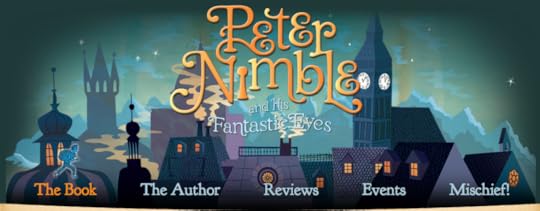
 The site is the result of some work by me and a ton of work by the brilliant Amanda McPherson (who also designed The Scop)! At PeterNimble.com, you'll find everything you'd ever want to know about the greatest thief who ever lived — including reviews, an illustration gallery, interviews, event photos, and an awesome "mischief!" page for aspiring delinquents!
Also, if you're so inclined, I would love for fans to Tweet the word by clicking here!
September 23, 2011
Darth Vader Takes a Break …
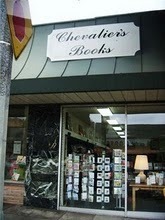 No fancy post today because I'm visiting schools in anticipation of a signing event at Mrs. Nelson's Bookstore in LaVerne TONIGHT at 5:00pm!!!! Come check it out. If you can't make that, I'm having my first LA signing tomorrow at Chevalier's in Hollywood from 1-3pm — please, oh please come!
In the meantime, I thought I'd post a picture I drew a while back. I was showing my younger cousins Jude and Asher (5 and 7, respectively) how the drawing tablet on my computer worked. I asked the oldest one what I should draw. He said, "Darth Vader!" I asked the younger one where Darth Vader should be. He said, "In the bathroom!" And there you have it …

I'll admit, not my finest work!
September 21, 2011
Great Books That Turned Me Off From Reading

The above picture is from Kelly Butcher's excellent blog, the Lemme Library. Note the second name on that checkout list!1 Yesterday I had the honor of teaming up with fellow Abrams' author Tom Angleberger to write a guest post for Kelly on a topic very dear to my heart: What to do when you hate a classic
It's a lively conversation and definitely worth checking out if you've ever felt at odds with the critical mass. (Tom may or may not refer to Peter Pan as "dreck!") In the post, I mention three books that I was forced to read in school that turned me off from reading: The Yearling by Marjorie Rawlings, A Tale of Two Cities by Charles Dickens, and Romeo & Juliet by … some dude … can't remember his name …
Anyway, a few readers expressed a desire to learn what about those particular books bothered me so much. I thought I'd take a crack at answering the question here!
First off, a disclaimer: I am not saying these books are actually bad, only that my experiences with them were negative. But the fact remains that they did more damage than good.
 The Yearling – I read this book in seventh grade Language Arts class. Nothing too pointed in my criticism beyond the fact that this book had nothing to do with me or my life. By that age, I was enough of a reader to know that there were many wonderful, exciting books out there. But instead of reading Ray Bradbury or SE Hinton, we were stuck with this story of a farm kid and his pet deer. What was the damage? The choice of text led me to believe that great stories (which I read at home) and English Literature (which I read in class) were completely unrelated things.
 Romeo & Juliet - I read this play in grade ten. There is a common problem in pop culture where Romeo & Juliet is peddled as a love story when it's actually a cautionary tale. Even as a young adolescent, I could tell that whatever Romeo and Juliet had going on between them was not real love — certainly not an ideal to aspire to. And yet the play was presented to me as some kind of timeless love story. I remember reading it and thinking, "If this is Shakespeare's idea of true love, then he doesn't really know much about the world." What was the damage? When I later read other Shakespeare plays (Hamlet, Midsummer Night's Dream), I was unreceptive; I had already made up my mind that this was a writer who had nothing to teach me.2
 A Tale of Two Cities – I don't know what makes educators think that this book is a good introduction to Dickens — yes, it's short, but it is also devoid of Boz' trademark humor and charm. I read this in my junior year of high school, and I hated every word.3 I already knew and liked some of Dickens more kid-friendly stories (Oliver Twist, A Christmas Carol), and I deduced wrongly from Tale of Two Cities that this was what happened when authors wrote "serious" books … they got boring. I suppose a positive effect of this experience was that it drove me to further embrace children's literature as the sort of stories I wanted to write!4
So those were a few classic books with which I really struggled. I've since gone back and re-read the latter two, and I have to say they were better the second time around. I'm not sure whether a different teacher could have gotten me to respond to the books or whether I was simply too young.
My wife and I were discussing this topic yesterday, and I asked her what the solution might be. She said the best thing for her in high school was a (wonderful) English teacher who alternated between fun and challenging texts: students read one difficult assigned book, and then they read one book of their choosing (from a list). Seems like a nice carrot-and-stick compromise!
I would be lying if I said the thought of Peter Nimble checking out a book also read by Lucy Pevensie and Edward Tulane didn't make me cry a bit! ↩
Of course I could not have been more wrong on this point — I owe a tremendous debt to both Julie Taymor and Niel Gaiman for setting me straight! ↩
Looking back now, I think I struggled because I lacked the necessary historical context. To really appreciate this book, you need to have a sense of both the French Revolution and the Victorian social reform movement — only then can you start to understand why Dicken's English readers would be interested in things that transpired half a century earlier in a different country. ↩
It took me even longer to come around to Dickens; I didn't start reading him again until I went to graduate school and met an pretty young Victorianist with pigtails! ↩



![[image error]](http://www.thescop.com/wp-content/uploads/2011/10/JMB_and_Michael_L._Davies.jpg)