
Jonathan Auxier's Blog, page 11
July 22, 2011
Interview at the Literary Asylum …
For those interested, I've got an interview running over at the Literary Asylum. The Literary Asylum is a fantastic children's book site run by screenwriter and author Matt Cunningham. Matt is an awesome guy and something of a Batman expert.1 He and I talk about the differences between writing books and writing screenplays/comics. I also give up some of the back story about about how Peter Nimble came to be.
Even better, Matt hotseats me into answering this all-important question:
MATT: Finally, if there was a zombie apocalypse (or I should say when!) and you were trapped inside a building with only one book to read, what would it be and why?
Now aren't you just dying to know what I picked? Click here to find out.
Lisa Yee used Matt as a Batman encyclopedia while writing her latest novel Warp Speed. ↩


July 20, 2011
Drawing in Church …

The above picture is one I drew in church last week. My whole life, I've drawn in church. My father was a pastor when I was growing up, and my mum understood that drawing can help right-brained people concentrate.1 And so every Sunday, when my father started his sermon, she would pull a box of art supplies from her purse so the two of us could draw.
Drawing can have a powerful meditative effect. My mother's work – which she affectionately refers to as her "knittings" — elevates this idea to a new level. Each painting represents hundreds of hours of meticulous, repetitive mark-making to build textures. All of these large-scale paintings began as tiny "knittings" worked out in small notebooks, sometimes in church.


I recently discovered another artist who draws in church. Abrams illustrator John Hendrix has an entire section of his website devoted to drawings he's done while sitting through sermons. I'll let him explain:
"Drawing in my sketchbook is the very best part of my work. I love it because it is linear improvisation. Much like jazz, it is unpredictable, exciting and unfiltered. Often with very good and very bad results. I attend church every Sunday, and I draw during the sermon. All of these pages were done in a pew (though I don't bring my watercolors with me- that waits till I get home). Simultaneous drawing and listening transforms familiar language into something new- a feedback loop of symbols, theology and wonder."
John's work puts me to shame. Behold:


I think this sort of meditative drawing extends beyond the pews.2 When I got to college, I started drawing in journals while I listened to lectures. A lot of the pictures were mnemonic devices related to the lecture, others were the germs of what would later become stories. (I still remember the afternoon in graduate school when I found myself sketching a certain blind thief!)
College also happens to be when I started to become a better student — my grades went up, and I started to take a more active role in what I was learning. I don't think that's a coincidence. I can't help but wonder whether there are kids out there struggling with school who might be helped by being given a box of art supplies?
My mum never wore the "pastor's wife" hat too comfortably. More than once she was confronted by ladies in the congregation for wearing too much black. ↩
Just to be clear, the sermon I heard this week had nothing to do with baseball or monsters … though part of me wishes it had. ↩
July 19, 2011
GIVEAWAY PART II: Bigger, Badder, Givier!
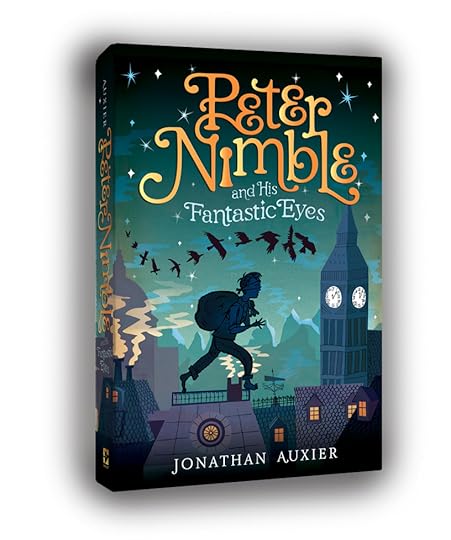 Hello readers! I'm excited to announce phase two of the Peter Nimble giveaway!1 This time around, I'm giving away five prizes!
Each winner will receive a Peter Nimble galley as well as a rad Peter Nimble t-shirt! These shirts were designed with the help of Nick Caruso from Campfire Goods and will be printed on American Apparel 50/50 tees. While I was up in Canada, I got the neighbour kid to model a shirt for the site:

Nifty, right?2 To enter, just do THREE simple things:
1) Like my Facebook author page or add me to your circle on Google+
2) Follow me on Twitter
3) Spread the word by re-tweeting this message
If you want to read the first chapter of the book, mosey on over here. I've also listed a few reviews here. Now get Tweeting before I sick the Beibster on you!3
For the curious, there is a phase three and the prize is A-W-E-S-O-M-E! ↩
The shirts are currently being printed, which is why I couldn't show a real photo. Just to be clear: actual t-shirts will not come with Justin Beiber inside them. Sorry ladies. ↩
A few rules: Each person will only be entered once. US and Canadian applicants only. The contest will end at Midnight PST, July 31. Winner will be selected by randomizer and notified by direct message. ↩
July 14, 2011
THE GIVING TREE: A Picture Book Without a Hero
Few picture books seem to be so divisive as Shel Silverstein's The Giving Tree. 1 While the book has no shortage of fans, many other people protest how the story sentimentalizes (and promotes) a one-way relationship in which a Tree gives and gives and gives without ever getting so much as a "thank you" from the capricious, selfish boy.
This criticism puts me in a mind of one other great doormat in literary history: William Dobbin from Thackeray's Vanity Fair.2 In a nutshell, Dobbin is a sweet, loyal soldier in love with the vapid-but-beautiful Amelia Sedley. Dobbin spends much of the book as Amelia's friend, caretaker, and confidant — putting up with an endless stream of abuse in the process. At first a reader admires Dobbin's loyalty and firm character, but slowly we start to get the feeling that we are not watching a hero, but a chump.
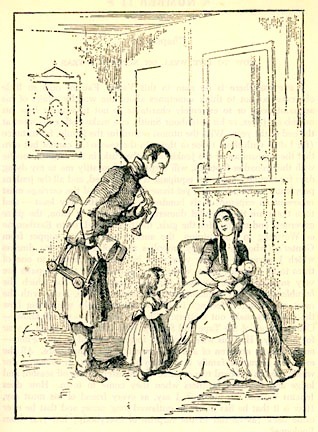
One of the most shocking (and delightful!) moments in the book comes late when Amelia — who has since fallen on hard times — finally condescends to accept Dobbin's oft-repeated proposal of marriage. And that's when something wonderful happens: Dobbin rejects her! He finally shows some self-respect and demands a woman who actually appreciates him for who he is. Awesome.
Unlike Vanity Fair, The Giving Tree does not have this satisfying reversal — at no point does the Tree stand up for herself. Instead she continues to be exploited and (the narrator would have us believe) continues to be "happy".
What could Shel Silverstein have been thinking?
I've recently been spending a bit of time with the book, and I think I've found some things in the text that actually complicate the offensive "doormat reading". Let's dive in …
2) WHAT KIND OF LOVE? An essential assumption of the doormat-reading is that the book's relationship is meant to be an allegory for romantic love.3 However, there are clues in the book that indicate that the dynamic is much closer to parent/child than girl/boy. Consider the fact that the boy moves from child to old man, while the tree essentially stays in a fixed state, always older and wiser. Consider the fact that the Tree shows no jealousy or feelings of betrayal when the boy courts a girl under her eaves. Consider the fact that at every stage, the boy comes to the tree as a provider, rather than a romantic companion. I don't know why, exactly, but I am much more comfortable with the doormat reading when it is taken out of a romantic setting. No matter what happens, the parent in a parent-child relationship always maintains a degree of dignity and power.
1) "BUT NOT REALLY" Every scene in The Giving Tree ends with a refrain: "And the Tree was happy." Some readers see this phrase as a tacit endorsement of the relationship — and the boy's terrible behavior. This, however, assumes that the author is being completely straightforward with the word "happy." Wouldn't it be nice if Shel Silverstein found a way to indicate that the refrain "And the Tree was happy" was, in fact, ironic? Lucky for us, he does just that! Right before the final scene, Silverstein adds a twist: "And the Tree was happy … but not really." Of course this does not instantly negate all of the Tree's aforementioned happiness, but it does point to the fact that the author understands the difference between declaring oneself happy and actually being happy.
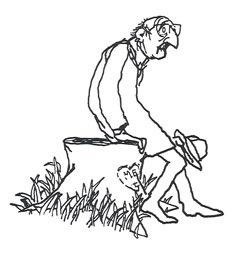
3) "I AM VERY TIRED" I have long maintained that an author cannot hide from his ending: the final scene of every story works as a key with which the reader can unlock and interpret every scene before it. Throughout much of The Giving Tree, it does indeed seem as though Silverstein is sentimentalizing a doormat relationship. The end, however, tells a different story. In the final scene the boy returns to the Tree one last time, now old and decrepit. He is made to remember all the things that he has taken from the tree, each one more humiliating than the last ("My teeth are too weak for apples," "I am too tired to climb," etc.). While he does not openly apologize for his past behavior, I do think that some sense of remorse is implicit in his tone.4
* * *
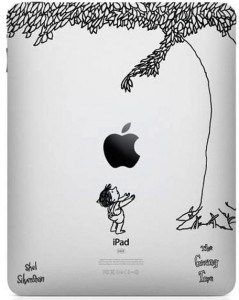
I suspect the one thing missing for people are the actual words "I'm sorry." The old man may be sad and humiliated, but he is not repentant in a way that we wish he were. To this I would answer that an overt apology would undermine the entire book. The point of unconditional love is that it has no conditions.
Of course, we will never know what Uncle Shelby meant to say in his book. However, I tend to believe that if there are two valid readings of a text — one of which makes the book awful, and the other makes it better — we would be best served to grab hold of the reading that lets us enjoy the book. Call it an Occam's Razor of Interpretation.
The movie Blue Valentine contains a charmingly direct critique of the book, which you can read about here. Also a nice article on Silverstein's unlikely rise to kidlit stardom here. ↩
Mary and I have long hoped to one day name a dog "Dobbin" … it is a good name for a loyal friend. (Also, for the curious, the title of this post is a reference to Vanity Fair's subtitle: "A Novel Without a Hero". ↩
This is a moment where CS Lewis' exploration of The Four Loves becomes very helpful in articulating such differences. I would argue that Giving Tree haters assume it is a story of "eros" love, whereas defenders see the book as a portrait of "agape" love. ↩
You will notice that this is the only scene in the book in which he does not directly ask for anything from the tree. Perhaps because he is too ashamed? ↩
July 11, 2011
We Have a Winner!
The tweets are in from the first Peter Nimble giveway! I used a random number picker to determine the winner … Zoe Rain Dasher Benji!
Congrats! Judging from the name, I'm pretty sure Zoe is a Jedi knight. You can learn more about her at her website, where she posts reviews and runs giveaways of upcoming YA books! Enjoy your copy of Peter Nimble, Zoe … and thank you to everyone for participating!
* * *
Right now, the awesome folks at Penguin Canada have me hanging out with booksellers in beautiful Victoria, British Columbia.1
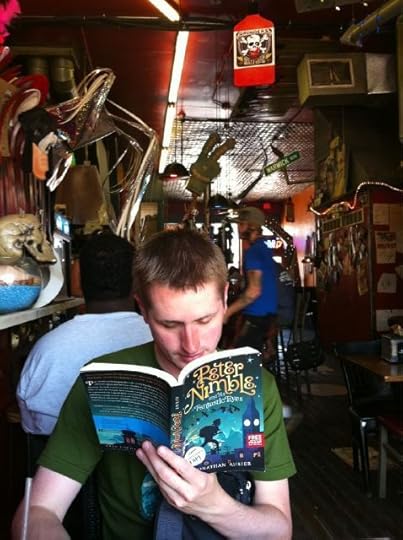
Speaking of spreading the word, everyone should check out what Librarians Mr. Schu and Donna are up to on their annual road trip across the country. They stop along the way reading books at various attractions.2 Here's John Schu reading Peter Nimble at what seems to be a restaurant run by a serial killer –>
Later in the week, I'll announce another (EVEN BIGGER) giveaway! Stay tuned!
I even got to meet the folks from Canadian trade publication Quill & Quire who gave Peter Nimble a wonderful writeup last week! ↩
I think the official selections are Frankie Pickle and Owly … I can hardly imagine better traveling companions! ↩
July 8, 2011
Advance Reviews and–OMG FREE BOOK!!!
July 6, 2011
Toward a Definition of Children's Literature
This morning I read an engaging rant on a topic close to my heart: Whither the children's book?1 The post came from Australian Judith Ridge's excellent book blog, Misrule. "Misrule" is the name of a cluttered, sprawling home (think Von Trapp family crossed with the Lost Boys) in Ethel Turner's Australian classic Seven Little Australians.2 Mary and I have, in fact, long dreamed of one day christening our own home "Misrule" and then filling it with lots of ill-mannered children.
 Ridge's post bemoans what she sees as a trend in the book industry of labeling books written for children as "Young Adult" … some even going so far as to call chapter books "Young Young Adult." This is obviously a market-directed phenomenon, and thus something that will pass after a few more YA movies flop at the box office3
Of course, this new trend begs an old question: what is children's literature? It's a slippery question because for every rule you put down (Rule #1: "Children's Books Feature Child Protagonists"), you can find an adult book featuring the same trait.
After many years of wrestling with this definition, I came across one trait that might actually apply to every children's book … and is virtually antithetical to adult literature. It is something my wife (who studies Victorian children's literature) learned while working with children's literature scholar June Cummins. Are you ready?
children's literature assumes a teachable audience
This is not limited to books with obvious morals. Nor does it specify that this "teachable audience" must be a literal child. Rather, it specifies a tone in which the author is speaking to a reader who is still unformed in his/her opinions.
I understand that this is an infuriatingly-vague definition. It's akin to "defining" comedy as being anything that's funny. But unlike the a posteriori checklists obsessed with reading level and plot specifics, Cummins' definition is both parsimonious consilient.4
What really excites me about this definition is that it might also be applied to YA books … and it goes a long way toward explaining why some Young Adult titles feel like adult books and others feel like children's books.
thanks to Fuse #8 for pointing me to the story! ↩
Seven Little Australians is a delightful book that, along with The Paper Bag Princess (Canada) and The Wonderful Adventure of Nils (Sweden), seems to have been relegated to "local favorite" rather than part of the larger international canon. This is a pity. ↩
Note how Cowboys vs. Aliens and The Walking Dead are not being touted as a comic book adaptations — quite the change from five years ago when everything was boasting its comic creds. ↩
Which my freshman geology course instructed me was essential for any good scientific theory! Go college! ↩
July 4, 2011
Born on the Fourth of July!

 Today is the birthday of America! Also my wife! Last year I found an old bicycle and re-painted it for her. As everyone knows, bicycles need names. Mine is "Danny the Champion of the World". I named Mary's after one of her favorite Dickens' characters: "Little Dorrit".
I leave you all with a patriotic quote from children's author and all-round smartypants, EB White:1
"Democracy is the recurrent suspicion that more than half of the people are right more than half of the time."
And while we're at it, something from Mark Twain:
"God created war so that Americans would learn geography."
I might add that this is also why God created Where in the World is Carmen Sandiego. Do it, Rockapella!
Thanks to Cheryl Klein for the quotes ↩
July 1, 2011
Lewis Carroll and Portmanteaus …

I recently stumbled across commenter Lisa's new word blog This Wretched Hive.1 Lisa writes smart, succinct posts about words old and new. One of my favorite pieces discusses portmanteaus. Portmanteaus are words that combine two different words to make something new: televangelist, spork, interrobang, etc.
I love portmanteaus because when done well, they brush up against word play. In fact, without that element, portmanteaus pretty much fail. Consider the example Lisa discovered in her grocery store:

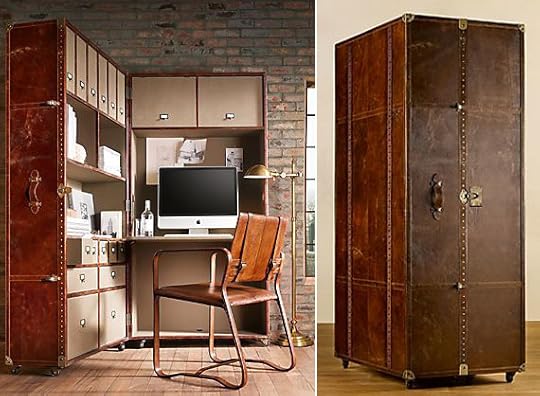
"Portmanteau" is actually a French word for an upright trunk that has dresser-like compartments in one half and a hanging closet in the other.2 I first discovered the word as a child when I read Lewis Carroll's introduction to "The Hunting of the Snark." He observes:
Humpty Dumpty's theory, of two meanings packed into one word like a portmanteau, seems to me the right explanation for all. For instance, take the two words "fuming" and "furious". Make up your mind that you will say both words, but leave it unsettled which you will say first … if you have the rarest of gifts, a perfectly balanced mind, you will say "frumious".
Carroll is referring to something Humpty Dumpty says in Alice in Wonderland3 in order to explain how a reader might be able to decode the made-up words in his famous nonsense poem, "The Jabberwocky."
 A few years later, while scouring footnotes in Martin Gardner's Annotated Alice (which I read nightly for over a decade), I discovered that Alice in Wonderland was actually the first time portmanteau was used in this linguistic sense. Way to be awesome, Lewis Carroll!
The title of Lisa's blog makes me think all blogs should be named after things Obi Wan said. ↩
I find a beautiful irony in the fact that the word portmanteau is a portmanteau — being a combination of "porter" (to carry) and "manteau" (cloak). ↩
"You see it's like a portmanteau — there are two meanings packed up into one word." ↩
June 29, 2011
Five Things I Learned at ALA
After a brief and incredibly productive hiatus, I'm back in blogger mode!1 This last week was an exciting one, as it officially marked the debut of Peter Nimble. Well, pre debut.

Every year the American Library Association holds an annual conference wherein a million librarians descend on an unsuspecting town.2 A post about ALA is basically a post about hanging out with amazing authors, librarians, editors, and illustrators. Instead of name-checking all the swell people I spent time with (save that for Twitter), I've decided to write a post about the five things I learned from my time at ALA:
1) Always Wear a Name Tag
For many years, I have considered myself too cool for name tags. In the same way that I refuse to run across busy streets (why run when you can walk slow and scowl?), I also refused to wear name tags. This changed at ALA. As I was about to pocket my name tag, a woman beside me saw it and exclaimed "You're taller than I thought you'd be!"3 This woman was author Jo Whittemore, and she promptly introduced me to the Texas Sweethearts author clan. Within seconds, I was on my way to lunch with a half-dozen YA novelists who had plenty of good advice for a nervous newbie. That never would have happened without the name tag.
I also noticed that wearing a name tag seems to improve conversation. I forgot to wear it to a few events, and those were the same events where small talk stayed small — never really moving beyond "Where are you from?" and "Oh, the humidity!" I realize now that the purpose of a name tag isn't to help identify yourself on a handshake, but to help five minutes after the handshake. It allows the person talking to you to casually glance down and remind themselves who you are … and the less time they spend thinking "What's his name again?" the more time they can spend actually having a real conversation.
2) Ugly Ducklings Abound
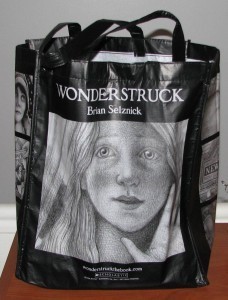
I had a chance to to talk with a number of authors and illustrators about how their careers started. More than a few of them had published in obscurity for years before hitting it big. Some were trapped on the midlist. Others had their aquiring editors change jobs, leaving their books orphaned at the house. A few were even dropped outright. This really hit home when I heard Brian Selznick talking with Horn Book editor Roger Sutton. He eluded to a frustrating period during which he could only get hired to draw biographies of dead presidents. From that dark period came Hugo Cabret — a book that changed both his career and (arguably) children's literature. This was but one of probably a dozen stories I heard with the same trajectory.
This is a good reminder for me as I'm about to send a book I love out into the world. This industry can be a real crap shoot. Sometimes great books can fall through the cracks. Sometimes terrible books are huge hits. The key thing for a writer is to keep believing that the greatest story they will ever tell has yet to be written.
3) Stay Humble
Related to the above lesson, I noticed how much of an impression it makes when a successful author hasn't lost sight of the fact that they were once merely aspiring. This lesson was perfectly illustrated when I had the privilege of eating dinner with Abrams authors Tom Angleberger and Jeff Kinney.4 Jeff is a HUGE author. He's pretty much ruled the publishing industry for the last few years. When he met both Tom and I, he asked us the same question: "What was it like when you got the call saying you were going to be published?" It was clearly a go-to question for him, and one that speaks to his character. For him to ask other authors about "the call" not only graciously indicates that he considers us his peers, but also acts as a reminder that all the Wimpy Kid success he's enjoyed is actually just gravy. The dream-come-true part of his life has nothing to do with bestseller lists, merchandising, or feature films … it is simply that he got to be published at all.
4) Don't Tell Lauren Myracle Anything
One night at a party, a woman with whom I had been chatting mentioned that she thought I resembled Seth Rogen — not the most flattering comparison I've ever gotten.5 Even worse, my wife hates Seth Rogen, and she often uses his name as a sort of shorthand to describe all that is wrong with mankind. I mentioned this unfortunate comparison to YA author Lauren Myracle at the Newbery Banquet. Lauren is not one to pass up this sort of information (by "this sort of information," I mean information that will allow her to mock you), and she promptly brought it up to the whole table — at which point I was forced to sit through a serious debate over whether or not the comparison was apt. Then she started bringing other people into the mix. For the rest of the night, I had strangers coming up to tell me I looked like this actor. The highlight was when an older librarian tapped me on the shoulder and asked if I was "Steph Rogaine" …
I have a henceforth enacted a "Don't tell Lauren Myracle anything" policy; I would advise you all to do the same.

5) Librarians Love Free Crap
This weekend marked my first ever Peter Nimble signing event! Before the big night, a few experienced authors warned me that signings for debut authors can be humbling — nobody knows you, so why would they want to wait in a line to talk? This is probably true, but none of these authors knew that my publisher had armed me with a secret weapon: free crap!

The above picture is of the special eyeball tote that Abrams was giving away with copies of Peter Nimble. Within about thirty seconds of the doors opening, I had a line around the corner – all eager to get a bag. Here is a picture of my first ever signature for librarian and blogger @Jenbigheart:

The second day was even better, and we ran out of ARCs after 20 minutes! Even after the books were gone, people were running up to the booth asking about the eyeball bags.

Never again will I doubt the power of SWAG. Speaking of, for those of you who missed out on scoring a free copy of the book, know that I will be doing a ton of Peter Nimble giveaways this month, so stay posted!
While I cannot promise that I will never take breaks from blogging, I can promise that I will only take breaks in order to write new books for you to read — as was the case this month. ↩
I think the actual number was something under 30,000. But still, that's a lot of ladies in glasses. For a video-look at the weekend, check out Travis Jonker's post here. ↩
I get this a lot. Apparently I look short in my headshot. ↩
Tom's kindness to me on this trip cannot be understated — he is truly a Gentleman among men. ↩
For the record, the most flattering comparison I've gotten is "they guy who plays Darth Maul" … which I've gotten repeatedly. ↩



![[image error]](http://www.thescop.com/wp-content/uploads/2011/07/giving-tree-4.jpg)
![[image error]](http://www.thescop.com/wp-content/uploads/2011/07/SevenLittleAustralians.jpg)

![[image error]](http://www.thescop.com/wp-content/uploads/2011/06/Tom-Stays-Humble.jpg)