
Jonathan Auxier's Blog, page 9
September 19, 2011
Irony vs. Sarcasm
What's the difference between irony and sarcasm? Most thesauri list them as synonyms, but anyone who's been on the receiving end of either type of humor can tell you the difference at once: ironic statements make you laugh, and sarcastic statements make you cry.
Many a protective parent has assured his or her teased child that sarcasm is the lowest form of humor. And the word sarcasm literally translates to mean "to tear the flesh." But what exactly is it it about a sarcastic statement that makes it a low form of humor? And what makes it "tear the flesh?" I've been mulling over this question for a while now, and I think I've landed on an answer:
Sarcasm happens when the observed irony does not extend to the speaker.
That is to say that an ironic person includes himself among the mocked, whereas a sarcastic person stands outside the situation in judgement. See how it might play out in the below scene involving a bunch of nerds camping outside of a movie theater:

In this instance, the guy making fun of the people is including himself in the joke — after all, he's in the line, too! But consider what happens when the speaker is not in line with the others:

Sarcasm is the one kind of joke that can be made by someone who does not actually find something funny — it is humor for the humorless. In life, I have a problem with sarcasm because I don't believe that any person has the right to laugh at others unless he can first laugh at himself.
And what about sarcasm in storytelling?
To be clear, I'm all for sarcastic characters (I enjoy Holden Caulfield as much as the next guy!). But sarcastic authors are a different thing altogether. Sarcastic authors attempt to point out absurdities in the world, but they try to do it from a safe distance — never letting themselves become a part of the joke. The only way to do this is by creating straw men for the express purpose of knocking them down. Ironically(!), this ends up undercutting the author's initial goal, because now instead of critiquing the world, he is critiquing some flimsy characters who bear little resemblance to the world.
The end result is a thing neither funny nor true.


September 16, 2011
School Visits, T-Shirts, and Signings — Oh my!
Now that the craziness of the book release has calmed down, I'll be returning to a more regular posting schedule (MWF) in which I discuss broader subjects in children's books.1
 In the meantime, I wanted to share about my absolutely crazy week. First off, I managed to get invited to an amazing party at author Cornelia Funke's house. I got to hang out with a slew of teachers and booksellers … as well as Newbery winning author Susan Patron.2
Even more awesome, this week I did my very first SCHOOL VISITS! I did four middle schools in two days — each group was between 300-400 kids. The presentation included candy, costumes, toilet plungers, yo-yos and, of course, Peter Nimble! The whole thing culminated in a signing at Redlands Barnes & Noble. We had a huge turnout of awesome kids at the signing! Here's a picture of me doing a little lightning quick sketch-artistry to explain some of the story: 
Also, check out this ridiculous photo from an article in the local paper about the event. I especially love how this photo features my many weak chins:
I owe a huge thanks to librarian Joan McCall and B&N's Laurie Aldern for organizing the event. I've got a whole slew of signings and presentations in the coming months … check out my events tab to see the full list. Once I get a few more of these visits under my belt, I'll be writing a post with tips about what I've learned presenting to schools. Until then, consider booking me in a school or store near you!
This is as good a time as any to point my Los Angeles friends to TWO upcoming signings that I'll be doing next week:
I will be at the famous Mrs. Nelson's Books & Toys on Friday the 23rd at 5pm in conjunction with another school visit. And the following day (Sept 24), I will be at Chevalier's Books in Los Angeles from 1-3pm. The store is on Larchmont in Mid-Wilshire. For my LA friends, I urge you to please, please, PLEASE come to the Chevalier's signing. Seriously, what else are you doing at 1pm on a Saturday?
And finally, I've picked winners from the Peter Nimble t-shirt giveaway! The winners were selected from anyone who wrote a Peter Nimble review on Amazon, Goodreads, or B&N.com before August 31. Here they are:
Karissa Eckert – "A creative world, interesting plot, and wonderful characters make this a book that is fun to read and hard to put down."
Nicola Manning – "A wonderful story that quickly grabs your attention with delightful characters one becomes fond of right away."
Joceline Foley – "Peter Nimble and His Fantastic Eyes is a classic hero-on-a-quest novel, yet it manages to be anything but predictable and boring. The archetypal characters are fresh, funny, and smart."
Aislynn Thompson – "The author did a fantastic job of weaving all the various stories of each character together – from the evil kind, the lost princess, the mysterious desert with the thieves, the crows, the missing children … all of it was woven together into a story that I couldn't put down!"
Francine Kizner – "Peter Nimble is a fun and exciting adventure story that brings a fresh voice and perspective to children's literature. It's enthralling, funny, and very entertaining."
I've contacted the winners — congrats, gang!
 I've had a number of people ask about buying Peter Nimble t-shirts. For those interested, you can grab one for $20 (this includes shipping). The shirts are hand-printed on American Apparel 50/50 tees. Please specify size (XS, S, M, L, XL) whether you want green or blue. Click below to pay through paypal, or contact me directly to mail a check.
Size
XS $20.00
S $20.00
M $20.00
L $20.00
XL $20.00
Color
Blue on Green
Blue on Blue
Yellow on Black

Next week's topics will include the allure of genre mashups as well as a post about the difference between sarcasm and irony — stay tuned ↩
Susan was delightful and very nice. She's having a signing at Skylights Books on the 18th for anyone interested in meeting her. ↩
September 14, 2011
Four More Thoughts on Writing Action …
I wanted to write a follow-up to my previous post about the importance of specificity in action scenes. Namely, four things:
1. You do not have to be super to be a hero
 Many writers make the mistake of thinking that action sequences are about showcasing a hero's strengths … but for my money, the drama is found in exposing their weaknesses. A while back, a good friend of mine wrote a NY Magazine piece on this very subject entitled Are Martial Arts Ruining Action? The article traces the origins of the martial arts explosion in Hollywood action movies and laments how every actor now goes through months of training in order to make the wire-Fu look authentic in their cop movie. Why is this bad? Because no matter how well executed and thoughtful the fights may be, no character in a cop movie has any business doing backflips.1
2. Superhuman action is low-stakes action
 So what about stories where the superpowers are already built into the plot? Shouldn't the X-Men be able to do backflips? Perhaps, but it's still important to make the super-punches mean something. If characters can take an unlimited (or even undefined) amount of damage, it's hard for audiences to care about the outcome. Screenwriter and friend Matt Bird has a great piece about this subject over at his blog, The Cockeyed Caravan. Check it out!
3. Above all, action should make sense
 Last week, movie critic Jim Emerson launched a great series examining how action sequences can go wrong simply by ignoring the 101 of filmmaking. His first example? The Dark Knight Returns. Emerson goes shot-by-shot through an epic car chase, revealing how careless editing can lead to a needlessly disorienting experience. This reinforces my longstanding belief that James Cameron is the greatest living director of chases for the simple fact that he makes sure that at all times the audience knows the following three things:
1) where the good guys are
2) where the bad guys are
3) where the exits are
Don't believe me? I invite you to watch for yourself.
4. Sometimes no action is the action
 While I generally think it's bad for writers to summarize action scenes, there are some stories that deliberately do so because its essential to their overall message. A good example of this is Tolkien. Despite having written an epic trilogy about the battle between good and evil, Tolkien keeps his action scenes infuriatingly short — usually under a page. Roger Ebert observed as much when he reviewed The Fellowship of the Ring, in which he points out that the central action set piece of the movie (the fight with the Balrog) takes up less than 500 words in the original book. So was Tolkien being lazy with his action writing? I'd say in this case, sidestepping the action was the action — the author was signaling to readers that the meaningful events of this particular story were found in the journey itself, not the skirmishes.
The Rush Hour franchise, of course, gets a pass on this particular gripe. ↩
September 12, 2011
September 9, 2011
Friday is for WINNERS!!!
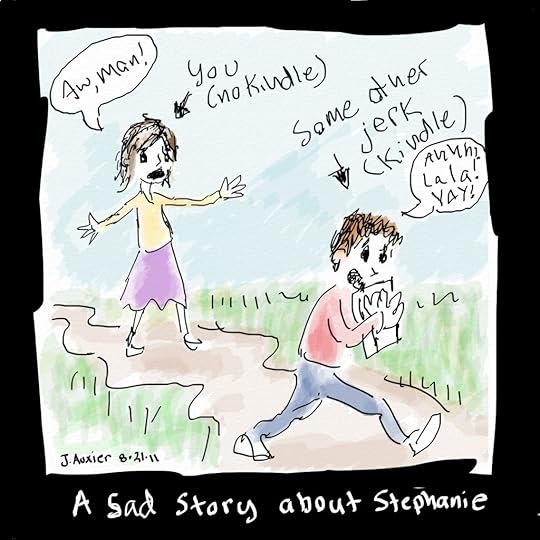
Last month's Kindle giveaway came to an end, which means it's time to announce the winner! I actually had to draw a winner twice. Here's the story:
 Over the course of the contest, I compiled my list of entries based on people who re-tweeted the announcement. Using a random number picker, I landed on blogger and Harry Potter nut Stephanie Pellegrin. I excitedly contacted Steph to let her know she had been chosen. In hindsight, this was a mistake, because when I dug through records to see what her #GreatestThiefWhoEverLived confession was, I couldn't find it.
I asked her to re-send it to me, and that's when she emailed with the confession that she hadn't written one! Points for honesty, but with a prize this size, I through it was important to play strictly by the rules. Steph took the bad news like a true Hufflepuff. I offered her a free signed copy of Peter Nimble, but she told me that she already had one from my debut signing at ALA. And so as a (very meagre) consolation prize, I drew the picture of Stephanie's tragic tale, shown above. Moral of the story: Stephanie Pellegrin is awesome and you should become her friend.
So who was the "some other jerk" who actually won the prize? I picked another random number from the list of entries and ended up with Joseph Garcia of San Jacinto. Joseph actually took the children's literature course that Mary and I co-taught last spring. He is also an aspiring comic artist — check out this awesome picture he drew of an Octopus-Shark-Stingray-Crab Monster:
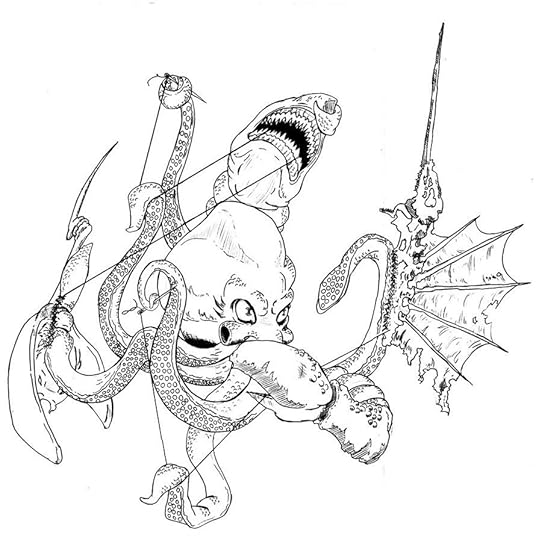
Yikes! That thing puts Holo-Shark to shame! One can only imagine that the man twisted enough to draw the above creature would have a really great #GreatestThiefWhoEverLived confession. Let's see, shall we?
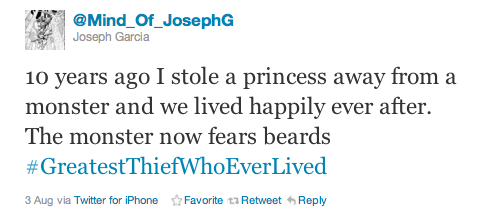
Awwww, so sweet.1 That guy deserves a free Kindle!
For those wondering what MY greatest thieving confession might be, I urge you to check out my recent interview at the National Post, where among other topics, I discuss my past life of crime!
Also, accurate — I have seen Joe's beard in person, and I can confirm that it is indeed terrifying! ↩
September 7, 2011
Five Things I Learned From Making my own Book Trailer

I wanted to post about what I learned while cutting the book trailer for Peter Nimble. In part this is a way for me to make a document that I can refer to the next time I am foolish enough to try something like this. Much of what I learned is fairly technical — stuff only another person animating in Adobe Flash would want to know. I'm aware that most people don't need those details, and so I'm limiting all the computery stuff to footnotes, which you can read at your own peril.
FIVE THINGS I LEARNED FROM MAKING MY OWN BOOK TRAILER:
It's Advertising, not Art I originally saw this trailer as a chance to highlight some of my favorite illustrations from the book. So instead of writing a script that properly introduced the story, I wrote something that tied together images that may-or-may-not have been essential to the premise … the result looked pretty but was fairly meaningless to viewers who had not already read Peter Nimble. I eventually scrapped this concept in favor of something that could draw in new audiences — After all, a book trailer is advertising not art.1
Measure Twice, Cut Once
As a writer and artist, I spend a lot of time stepping back and surveying my work mid-process I'll print out pages to read aloud. I'll photocopy a drawing and look at it upside-down. I believe this is a valuable practice in the making of art. In book trailers, it's a huge waste of time. That didn't stop me from doing it: as soon as I would create a rough image for the trailer, I'd scramble to insert it (half-finished) into the video to see what it looked like. I wasted a lot of hours going back and forth between Photoshop and Flash in order to make little tweaks. It would have been much smarter to discipline myself and only switch programs when I had completely finished my task at hand.2
Simple Is Better I sort of went overboard creating distinct animations for each part of each object. That shadow of Peter walking past the window had seventeen moving parts — it took me three straight days to get it not to resemble a lurching zombie. Looking back now, I think I could have gotten away with moving a still image across the window (shadow puppet-style). Instead, I labored far too long over something that is only on screen for a few seconds.3
Don't Blink
I have very little success writing when I am near distractions (I'm looking at you, Internet!). This is because every time I pull myself out of a story, it takes me a lot of time just to get back in. When I first started started learning Adobe Flash, I was cramming so much new information into my head that stepping away for a day or two was like hitting the reset button — I'd sit down to the computer having forgotten everything. If I had really kept my head down and barreled through the trailer, I think I could have finished this whole thing in three weeks. As it was, with all the the stopping and starting, it took me over two months.4
Consider the Cost
It is an absurdity of our age that a person with a hole in his sock will spend less in buying a brand-new sock than he would in buying needle and thread to darn the old one. Book trailers might also fit into this category. I spent almost two months learning Adobe Flash and animating the video. Between software, music, and voice over, I shelled out about $900 — and it could have been a lot more if my composer and actor hadn't been kind enough to give me "friends and family" discounts! This is still well below market rate, but when I add to it my own time investment (est. 200 hours), an outside book trailer company starts to look like a worthwhile investment.5
I wanted to make my own trailer because I figured it would (a) be fun and (b) learning Flash would empower me to make trailers for subsequent books. Much of it was fun, and I am indeed now capable of making my own trailers … but it was also a pretty big investment both in time and money. Also, a lot of frustration.6 There were also logistical costs: in the perfect world, the trailer would have come out in mid July, not last week.
So was it worth it?
You tell me …
Know your medium: what looks good in print does not work for video. I spent countless hours pixel-editing illustrations in Photoshop only to have them look grainy and jagged in Flash. It wasn't until I gave up and started re-drawing images from scratch using a softer brush, lower dpi (150), and Gaussian blur that images started looking smooth in Flash. ↩
Don't export your art until you've optimized it for Flash. Also, take an extra five minutes and add a solid light-gray layer beneath your image so you can erase any errant pixels/lines obscuring the transparency — take you time with this last step because otherwise you'll have to go back to Photoshop do it again. (and again, and again). ↩
Learn how to use a "boning tool" … which is designed to make puppet skeletons easier. As it was, every time I made a minor adjustment to Peter's body, I had to re-animate every one of his limbs to match! ↩
Adobe Flash is a ridiculous program that I wouldn't wish on my worst enemy. Just because you know things like Illustrator, Photoshop, and Final Cut, do not think that knowledge will apply to Flash. For that reason, I was incredibly dependent on my one-month subscription to Lynda video tutorials, which do a marvelous job of walking even the most clueless user through Flash. ↩
If I do this again, I will make a point of paying to upgrade the RAM on my Macbook Pro from 4gb to 8gb … as it was, I had trouble keeping both Flash and Photoshop open at the same time. ↩
One last tip (gripe) about Adobe Flash: I couldn't export my 24fps video without getting all sorts of awful "artifacts" in the final product. Many hours of experimentation and Googling taught me that if I exported at 1/2 the frame rate, I could speed it back up in another program (iMovie, also terrible) without problems. ↩
September 5, 2011
I'm on Brain Burps!
You may recall that I went on blogging hiatus a few months back to complete the illustrations for Peter Nimble.1 One of the wonderful things about drawing for days on end was that it gave me time to listen to all the audiobooks and podcasts I'd been putting off. One of the best things I listened to during this time was Katie Davis' Brain Burps About Books.
Brain Burps is a podcast dedicated to the world of children's literature — every week Katie has marketing tips, business talk, interviews, and book reviews. I listened to every back episode of Katie's Podcast (nearly 50 hours!) while drawing one particularly frustrating picture. To my mind, this will always be the "Katie Davis" chapter:

So imagine my delight when Katie Davis asked if she could interview me for her show! We had a great time trying to conduct a conversation in post-hurricane conditions. Among the topics covered were inspirations for Peter Nimble, the importance of rules in a magical world, and our mutual love of the movie Jaws.2
Anyone interested in entering the world of children's literature need only to listen to Katie's show to learn the ropes … any why not start with my episode? Check it out!
This was an ordeal that ended in my losing my eyesight for a few days. You can read about it here. ↩
As if Katie wasn't cool enough to begin with, I learned in the interview that she was actually in the movie Jaws as an extra! ↩
September 1, 2011
Behold the Peter Nimble BOOK TRAILER!!!
Ladies and gentlemen, I present to you the Peter Nimble & His Fantastic Eyes book trailer:
Neat, right? The music was done by Aaron Roche. Narration was read by . The video took me a little longer to finish than I had hoped. This was mainly because I had to learn how to use Adobe Flash from scratch. The good news is that I learned lots of valuable lessons for the next time I make a book trailer, all of which I will share with you in an upcoming post!
In the meantime, I would love it if you Tweeted the word about this trailer!
August 31, 2011
PETER NIMBLE is an ABA New Voices Pick!
Every year, the American Bookseller's Association selects ten children's books from debut authors for their New Voices list. I am delighted to announce that Peter Nimble & His Fantastic Eyes made the cut!!!

 In fact, little ol' Abrams had THREE different authors on the list! Julie Sternberg's Like Pickle Juice on a Cookie and Troy Howell's The Dragon of Cripple Creek were also honored! To see the full ABA New Voices list, click the thumbnail. Then go out and hug an independent bookseller!
 Also, I should remind readers that today is the LAST DAY to enter to win an awesome Peter Nimble T-Shirt! All you have to do is leave a Peter Nimble review (good or bad) at Amazon, Goodreads, or Barnes & Noble. Every review you submit counts as an entry, so you can triple your chances by doing all three. Now get reviewing!1
for official giveaway rules, click here. ↩
August 22, 2011
Feeling Misunderstood & The Writer's Praxis …
Last week author Nathan Bransford posted a question on his blog that I have been thinking about for a long time:
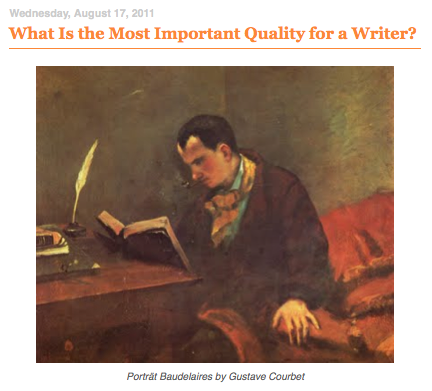 He elaborated very little on the question, only adding that his gut said it might be determination. The power of Mr. Bransford's blog is such that he can sort of just lob a huge question into the universe and get a gigantic response from enthusiastic readers — I'm talking hundreds of people weighing in.1,2
When I glanced down the many responses from readers, I noticed that they fell into two distinct camps. The first group agreed with Bransford, listing traits that point to a strong work-ethic — "determination," "passion," "persistence," etc. The second group focused more on traits that make up the writerly psyche — things like "curiosity," "honesty," and (my favorite) "bloody mindedness." Obviously, this is a trick question; there's no one answer to what makes a writer. But looking down this list, I felt like both types of answers were missing an essential element.
 Consider the work-ethic answers. Are determination, passion, and persistence important to a writing career? Of course! However, they are in no way unique to writers. Success in any career requires these qualities.
The other camp at first seems more tailored to writers. They perfectly capture the fact that every writer has a unique point of view that (arguably) deserves expression. There's only one problem: these personality traits have nothing to do with the actual act of writing. Curiosity, honesty, and bloody-mindedness could just as easily apply to a person who aspires to write but never gets around to it.3
To truly answer the question, we need to find a trait that combines the artistic outlook with the professional drive to get things done … in short, we need praxis. "Praxis" is a theological term that essentially refers to the point where faith becomes action.4
So praxis for a writer would be the thing that makes them translate their unique personality onto a page. My storytelling gut tells me that this praxis would likely be some kind of personal experience — an event (possibly traumatic?) that forces them to react by writing. I can't speak for every author, but when I consider events/moments that spur me to actually write, I think of one thing:
feeling misunderstood
This feeling has plagued me my whole life. Every time I've sat down to write something, it's because I feel fundamentally misunderstood by those around me. Writing is a chance for me to articulate all the things going on inside me in a way that I hope will make sense to others.
The good news is that this never goes away. As of this month, I finally have my first novel in the world(!), and every time I read a minor quibble in a review, I feel the same burning shame and frustration that filled me as a child whenever a teacher or parent misunderstood what I had been trying to say.
It's that feeling of being misunderstood that pushes me to write another story. And another. And another.
UPDATE: Nathan Bransford just revisited the topic on his blog, highlighting what he thought was a particularly poignant response from one reader. Click here to read.
Not that I'm jealous. ↩
Yes I am. ↩
Also, serial killers. ↩
Students of philosophy might recognize the term from reading Kant, who argued that praxis was the application of philosophy to actual events. ↩



![[image error]↩](http://www.thescop.com/wp-content/uploads/2011/09/they-fight.jpg)

