
Jonathan Auxier's Blog, page 13
May 9, 2011
Easter Traditions …
Mary and I are orphans here in Los Angeles. For the last few years, we've taken shelter each Easter with some kindhearted relatives. These relatives are big fans of games and such, and so last year, they initiated a holiday tradition of doing dollar-store crafts. We began with paint-by-numbers. As some of you may recall, I have a low tolerance for toys that require patience or instruction-reading.1 So in order to keep myself interested in such projects, I have to add a few personal touches. Here's what I came up with last year. It's a landscape entitled Dragon and Valley, a Study:

The more observant among you will notice that the above painting has a frame around it. That's because it is Art, ladies and gentlemen. Art that currently hangs on the wall of my office. And, as of yesterday afternoon, it will be kept company by another addition to the oeuvre.
[image error]This year, I decided to tackle the art of engraving (on holographic foil, no less!).2 The task took many hours, and when the flimsy metal "scraper thingy" became worn down to a nub, I turned to a 120v Dremel electric engraver to finish the job.3 While traces of my earlier style are still present, I think you'll agree that my technique has grown to accommodate my conceptual ambitions.
Without further ado, I present HoloShark with Easter Bunny:

You're welcome, Art World. See you next year.
Mary and I are very different in this regard. While she could do puzzles all day long, I can only sit down at a puzzle long enough to … hey look, cartoons!" ↩
The holographic foil is why the image looks funny (like any good artist, I blame all flaws on the materials). ↩
This is true — my uncle has the best tool shed ever. ↩


Behold the Library of the Future!

After spending waaaaay too many hours with ink-stained fingers, I recently decided to drag myself into the digital world. This included buying and learning Adobe Photoshop — a double-challenge as I am both stingy and lazy. I asked Mary what I should draw to practice, and she suggested The Library of the Future.
"The what," you say?
A few weeks ago, Brooklyn librarian Rita Meade participated in a city-wide competition in which kids wrote essays describing "The Library of the Future." She recently posted some of her favorite responses on her excellent blog, Screwy Decimal.1 I'll reprint them here (her responses are in parentheses):
1) "The future library will be located in a spaceship. The spaceship will have blue tables and purple chairs. The walls of the future library will be green and magenta. Also, the future library will have many skylights."
2) "Libraries will have flying desks and iPads for each person." (Is this in the budget?)
3) "The future library will be open twenty four hours." (I'm not sure, but I THINK this goes against union bylaws.)
4) "The library will have ninety thousand computers. The library will also have a café."
5) "If you have a book that is out of date, it will warp back to the library. It also allows you to warp to other libraries."
6) "Libraries will be floating in the sky. People will have their own planes to get there."
7) "As much as I love the library, I'm 100% sure future libraries would be even more awesome. Just think how amazing the library will be in the future, with robots and electronics."
8) "I also believe that there will be robot librarians. But then again a lot of people know that someday robots will take over the world. Also people think that there will be a war of good robots vs bad robots but here is the good part about all this is that the good robots will be teamed up with all of humanity. But earth is a very strong place and can fight with or without human help." (This kid's going to be a sci-fi writer, you wait and see.)
9) "[Robot librarians] will be very cost effective because we will not have to pay them." (Thanks, kid!)
10) "The librarians are so friendly, even the shyest person in the world won't be shy anymore." (Awww.)
So, I sat down and tried my best to draw a picture of the wonders described by our young prophets. To see all the details, click through the image:
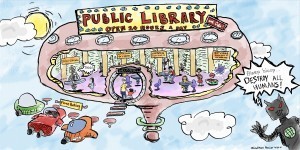
Awesome, right? I fit in pretty much everything but the iPads, which I sincerely doubt will be around in the future (unlike evil robots, which are fact).
Screwey Decimal is sort of a repository for all the adorable things kids say to her at work. For a less adorable blog about things overhead at work, I direct you all to Our Valued Customers, where Mr. Tim does a daily comic strip documenting something he overheard at his local comic shop. ↩
The Shame Shelf …

Some of you might remember when I posted a link to Kirby Field's fantastic article about file-sharing.1 Well, clear your schedules because Mr. Fields has struck out on his own! He recently launched a site called Reading Remainders, in which he will slowly tackle all the unread books on his shelf.
This is a noble pursuit. Pretty much every reader I know is plagued by stacks and stacks of unread books. For years, I had a personal rule that I could not put a book on a shelf unless I had read it in its entirety. I considered a shelved book no different than the mounted head of a deer — it was a trophy.
 Of course, this all got ruined when I met Mary. All of a sudden there were somebody else's books cluttering up my shelf. The horror!2 I eventually managed to convince her to at least allow me the "no unread books on the shelf" rule. Those books can be broken up into two basic categories:
1) the one book Mary is about to actually read
2) the many books Jonathan swears he will read so can he pretty-please buy them all?
These books are strategically-placed above Mary's desk, where they can inspire maximum guilt. My old pal Kirby, however, has elected to display his shame shelf before the whole world. And it's not just a bunch of classics that everybody knows of and hasn't read — he's also reading all the crappy books that have somehow ended up in his possession. Consider this week's piece, which is an extended, thoughtful meditation on an Anthony Robins self-help book from the 80s.
These are less book reviews than platforms for reflection on a lifetime of reading and thinking. (The above Anthony Robins piece, for example, is set against Kirby's first-ever brush with unemployment.) In his NFQs page3, he refers to the blog as an "online manuscript." Whatever you call it, it's a fun way to spend an afternoon.
I also encourage you to check out his great Popmatters article about his favorite childhood used bookstore. ↩
One of our first real arguments was about how to organize said books … during which I was informed that my longtime sorting method ("grouped conversations") is nothing short of insane. ↩
Which I can only assume stands for "Never Asked Questions" ↩
Drumroll Please …
This has been in the works for a while now, and it has been killing me not to be able to share it. But at long last Abrams has released their Fall 2011 catalog, which means I can finally unveil the cover for Peter Nimble & His Fantastic Eyes!

It was drawn by Gilbert Ford (of "" fame) and designed by Chad Beckerman (of Chad Beckerman fame). The two of them went through a couple of rounds of brainstorming — including a fairly involved cover involving cutaway eyes. I am truly astounded with the final product. Seriously. Just look at the thing …
To see a little bit more Peter Nimble (and to see the other wonderful books Abrams will be putting out this year) check out the catalog. Then rush to Amazon and pre-order 100 copies.
LA Times Festival of Books …

This last weekend was the LA Times Festival of Books. I have somehow managed to live in LA for many years without ever attending. This year, however, I find myself actual in the publishing industry … so I decided to check it out.
The day got off to a nice start when I met and had lunch with picture book legend Laura "If you Give…" Numeroff, who is absolutely delightful. Among topics discussed was the story of how she obtained an original piece of art from Stuart Little!1
I also had a chance to meet up with writer and frankenblogger Matt Cunningham, who runs the Literary Asylum.2 Like myself, Matt is a screenwriter transitioning into publishing. He is also an incredibly nice guy. After walking the campus a few times, we stopped to watch Lisa Yee's presentation on the Target Stage3
Today Lisa was reading excerpts from the American Girl books she wrote. Usually I would have no interest in hearing about a girl book, but Lisa's book also involves an awesome scene with monk seals … and she was kind enough to bring along visual aids:

I very recently became involved with a group called the LAYAs (Los Angeles Young Adult Authors). While my book is technically middle-grade, they were more than willing to welcome me into the fold. This included participating in a trivia show on the YA Stage. The event was moderated by author Cecil Castellucci, who solicited book-related questions from authors earlier in the week.4 There I am in the middle, playing for "Team Holden":

This is quite literally the finale of the show. Mike Reisman (Team Holden) is squaring off with Kami Garcia (Team Scout) in a tie-breaking lightning round. Tragically, our team lost. Even more tragically, we lost on a question that I wrote:
All of these major children's authors wrote books set in England. One of them, however, actually grew up in America. Who was it? 5
a) E. Nesbitt
b) P.L. Travers
c) Frances Hodgson Burnett
d) AA. Milne
I'm pretty sure this means my new LAYA friends will never talk to me again.
Garth Williams is a favorite of mine; he was also a major touchstone for the art in Peter Nimble (more on that another day!). ↩
I've got an interview coming there soon … you've been warned. ↩
Fun fact: Matt is a Batman fanatic, and he acted as Lisa's resident expert for her newest book, Warp Speed. ↩
I should also mention that she was just last week hired on as the children's editor for the Los Angeles Review of Books — congrats, Cecil! ↩
The answer is Burnett, by the way … a fact I know only because of my smartypants wife. ↩
I'm Sorry, Pigeons …
[image error]For as long as I've known her, my wife has had a profound hatred of pigeons.1 She claims this has something to do with having grown up on a farm. However, I suspect her feelings are part of a larger cultural bias. While I don't have anything against pigeons per se, I try to make a practice of taking Mary's side whenever I can. It is for that reason that I turned a blind eye after a trip we took to New York last year. The trip was publishing related, and while I was talking with editors and such, Mary was free to wander the city. One afternoon, we met up and she was so excited to tell me what she had done at Central Park, something she had dreamed of doing for years: She kicked a pigeon.
You know how pigeons are always playing chicken (as it were) with pedestrians? Remaining in place until just the last second before flying away? This mocking behavior had led to something of an obsession in my wife — she had long grumbled that one day she'd show those pigeons who was boss. At last that day had come. She kept revisiting the scene that night, explaining how she snuck up on it, closed her eyes, and gave it a good wallop — "Pow! Right in the tail-feathers!"2 I even drew a picture of her triumph in my journal:

End of story. Or so I thought. During my recent illustration bonanza, however, I found myself free to listen to a lot of podcasts.3 Among those podcasts was the show Radiolab. For those that don't know, Radiolab is a show that blends pop-sociology and science — if This American Life interviewed scientists and had sound effects, it would be this show. One of the episodes I listened to was called "Lost & Found". It was all about navigation, and it featured a profile on carrier pigeons. Over the course of the show, I learned the following facts about these so-called "soccer-balls with wings" (another of Mary's nicknames):
- Carrier pigeons are monogamous. In fact, if you make a carrier pigeon think his mate is being hit upon by a rival, he will fly home even faster.
- While many birds have a sort of internal compass, carrier pigeons have an internal GPS. This means you can knock one unconscious, ship it halfway around the world, and when it wakes up it will instantly know its coordinates.
- There was a carrier pigeon in WWII named "G.I. Joe" who single-wingedly saved an entire Italian village.
Pigeons, you have my heartfelt apologies.
Actually, there is one pigeon that Mary approves of. It is her yellow Flying Pigeon Bicycle, imported from China. It is magnificent … and it weighs 500 lbs. ↩
After reading this post, Mary has asked me to clarify that she "barely grazed" the bird, and that the creature sustained no injuries. Having been kicked by Mary before, I sincerely doubt it. ↩
This was also my chance to work through many episodes of Katie Davis' publishing podcast Brain Burps About Books … truly wonderful stuff. ↩
SPEAK, JELLICOE ROAD, and Revelation Narratives

My first year of grad-school, I wrote a terrible play about a woman who hadn't slept for 17 years. At the center of the story was a mystery regarding what had happened to make her stop sleeping. When I went back home over holiday, I had a former drama professor look at the script. He promptly told me why the play didn't work: I had written a revelation story and didn't know it.
Revelation stories, he explained, are plots in which the central dramatic event is the revelation of information to the audience. The key phrase in that definition is "to the audience". In revelation plays, the climax takes place not on stage, but in the seats.1
These sorts of narratives are hardly limited to theatre. A recent(ish) example from the literary world might be Laurie Halse Anderson's Speak.
 [COMMENCE SPOILER ALERT!]
Speak tells the story of a high school freshman recovering from a recent sexual assault. The book begins after this assault took place, and its climax involves the protagonist learning to "speak" of what happened. While Anderson does a pretty good job of making this revelation feel dramatic, the early chapters of her book rely heavily on the assumption that readers will readily identify with the protagonist's emotional life – and that that identification will be enough to carry them all the way to the climax. While the gamble pays off in this book, I have seen many other stories (my play included) where it blows up in the author's face.
[END SPOILER ALERT.]
The primary problem with revelation narratives is that all the interesting stuff happens in flashback. So how does an author bring those past events into the present-tense (where the audience can experience it in realtime)? Usually authors spice up the revelation by making the characters deal with the past trauma. But on the spectrum of dramatic impact, "dealing with issues" is pretty weak — no matter how well it's written.
Even if you pull this off, there's still the added challenge of not pissing off your reader. In her recent book on publishing, children's book editor Cheryl Klein talks briefly about the storytelling power behind mystery:
"I want to think about mystery a little more because it's probably the single most effective plot technique for hooking a reader: Have a secret, let the reader know there's a secret, and then don't tell them what it is until it absolutely serves your purpose to do so. It's a classic childhood strategy, the equivalent of dancing around your reader saying 'neener-neener-neener.'"
I think that Cheryl is spot-on so far as it relates to individual scenes. However, occasionally a story drags out the mystery so long that reading the book feels like 300 pages of "neener-neener." Not exactly the best way to win over your audience.
[image error]Rashomon-style twist to the moments of revelation — and it also keeps the storytelling focus on the chracters, where it belongs.
Mystery writer Dorothy L. Sayers has talked about the danger of art whose sole purpose is in manipulating the audience: "In the end it is directed to putting the behaviour of the audience beneath the will of the spell-binder, and its true name is not 'art,' but 'art-magic.' In its vulgarest form it becomes pure propaganda." A bit extreme for me, but still interesting. ↩
Several other characters in Jellicoe Road also have secrets that are constantly being teased — the book is nothing if not teasy. ↩
AFTERWORDS: I'll Chop off Your Head Alot!
One of the things that bothers me most about social media is its ephemerality.1 I hate that idea that a person could spend hours crafting a witty tweet, only to have it disappear by the next day.2 And so I've decided to try out a new feature on The Scop — a sort of roundup of things I've found on the internet each week.3 It will also be a chance for readers who subscribe to my RSS feed or only check the site once a week to see the Marginalia quotes taken from books I'm currently reading. We'll see how it goes …
LINKS:
 First thing's first — Saturday is National Free Comic Book Day. Yes, it's as good as it sounds — just show up at a comic shop and they'll give you a comic. More info here. Also, kidlit podcaster Katie Davis just posted a great interview with comics veteran Barbara Slate about her new book designed to teach kids how to make comics — it's worth a listen.
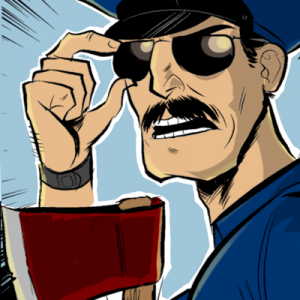 Since we're on the subject of comics, let's talk about Axe Cop. For the unitiated, Axe Cop is a brilliant webcomic in which artist Ethan Nicolle collaborates with his six year-old brother to write the ongoing adventures of a cop with an axe. It's truly amazing. Even better, there is now a cartoon version of Episode Four: The Snow Planet. Eat your heart out, Hoth.
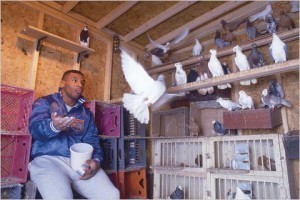 I had a lot of responses from readers about my recent post on how my wife hates pigeons. Every friend, to a person, made a point of telling me that they, too, hate pigeons. So it was a nice change of pace to see author Lisa Brown post a link to a New York Times piece written by Mike Tyson about how pigeons are great.
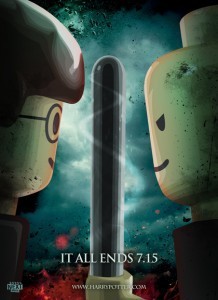 And in silly movie news. Some website re-drew all the big Summer blockbusters as Lego products. Which might be cool were it not for the fact that Lego is totally lame.
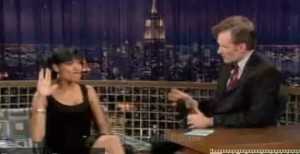 And finally, this little gem from Salon magazine, talking about the trend in which hot movie starlets fall all over themselves to declare their geek bona fides. I am embarrassed for parties on both sides of the equation.
 Ooh! One more thing! Cartooning genius Allie Brosh is finally writing a book. I think we can all agree that the world will be the better for it.
MARGINALIA:
This week, I finished posting the last of my favorite lines from Robert Cormier's The Chocolate War. This man is a much better writer than I am …
From chapter 25: "'That's right,' Jerry said, his voice small, a wrong-end-of-the-telescope kind of voice."
"Rippled" is the perfect word: "A second chocolate followed the first. And a third followed the second. His mouth was crammed with the candy now and his throat rippled as he swallowed. 'Delicious,' he said."
Talking to a crank caller: "'Who is this?' Jerry asked. And then the dial tone, like a fart in his ear."
Chapter 31: "Why did the wise guys always accuse other people of being wise guys?"
Talking while jogging: "'He got transferred,' Jerry answered, squeezing the words out of himself like toothpaste from a tube. He was in good shape because of football but he wasn't a runner and didn't know the tricks."
The book's central question: "The poster showed a wide expanse of beach, a sweep of sky with a lone star glittering far away. A man walked on the beach, a small solitary figure in all the immensity. At the bottom of the poster, these words appeared — Do I dare disturb the universe? By Eliot, who write the Waste Land thing they were studying in English."
To see more Chocolate War quotes (or quotes from any other books I read), check out the marginalia section here. Next week I'll be posting favorite lines from Adam Gidwitz's A Tale Dark & Grimm. Have a good weekend — may you all succeed in disturbing your respective universes.
Come to think of it. Ephemerality is also what bothers me about life in general. ↩
Yes, I have actually spent hours on a tweet before. What can I say? I'm a big fan of the editorial process. ↩
I'm aware that a lot of blogs already do Friday Roundups, so if you don't want me to add to the noise, please let me know. ↩
Mum's the Word…

Last month I wrote a post about how my father shaped me as a reader — so I thought today it would be appropriate to talk about my mum.1 That's her in the photo, reading to my cousins … but it's a pretty accurate picture of my own childhood.
I come from a family of serious readers. When my mother was growing up in the middle of South Dakota farmland, she read every book in her local library. My parents didn't have much money growing up, but they did have stacks upon stacks of books. In fact, it wasn't until I got to college that I learned that reading at the dinner table was considered rude. Auxiers were readers — end of story.
Or at least that's how I remembered it. But recently, I learned something from my mother that made me take a second look at my upbringing … and made me love her all the more:
 It happened right before I entered second grade. It was the end of summer, just before class would start, and my parents sat me down to explain that I would not be going back to my elementary school. Instead I would take a year off for something called "home schooling". At the time, my mother was completing an MA in Gifted Education, and I suspected at once that this whole home schooling thing was something she had made up. Not that I objected. As I recall it, my home school year consisted of playing Construx and memorizing lists of random facts she fed me — art history, prepositions, the presidents, and other things no seven year-old had any business knowing.2 At the end of the year, I went back to regular school. Only I didn't go into third grade with my former classmates … instead I was put into a second-grade class with kids that were younger. It was only then that I realized the truth:
I had been held back.
I remember being confused at why my parents might have thought me unfit for the rigors of second grade. I mean, it's second grade. It wasn't like I couldn't handle the workload. So why hold me back? Whenever I asked my mother, she would just shrug and say that she had wanted to spend some more time with me.
 My second try at second grade was a blast. The big thing I remember was a year-long reading competition. Students were required to fill out little book reports, and the kid with the most book reports at the end of the year got an awesome plastic trophy.3 My parents, who are some of the least competitive people I've ever known, were uncharacteristically invested in the event — there were constant trips to the library, and a gentle-but-unmistakable pressure to make sure I handed in those reports. All told, I read 88 books that year. Even better than that trophy (which I totally won), were all the great authors I had discovered! Over those months, I had transitioned from stupid formulaic mysteries to Roald Dahl, Shel Silverstein, John Fitzgerald, and Lloyd Alexander.
 It wasn't until almost 20 years later that I made the connection between these two memories. It came while I was teasing my mother for taking me out of school just so I could learn to say all my prepositions in a single breath (which I can still do). To this she replied: "I couldn't care less about prepositions … I took you out of school because you didn't like reading."
Huh? I loved reading! What was she talking about?!
My mother explained that even though I knew how to read as a kid, my teacher had warned her that I didn't seem to enjoy it very much. And so she made an executive decision: pull me out of school and FORCE me to love reading. Every single day she would sit down and read a book to me, and then she would make me read a book myself. After that, I was allowed to do whatever I wanted (Construx!).
To this day, I have no memory of this home school reading regiment. But when I think about the year that followed, about all the wonderful books that I devoured, I start to see that it may have worked. Thanks, mum.
Yes, Canadians actually say "mum." Why? Because we're adorable, that's why. ↩
Mary has since informed me that lots of kids are forced to learn prepositions — but nobody can touch this guy for shere awesomeness. ↩
In my day, you had to earn those dollar-store trophies, damnit! ↩



![[image error]Rashomon](http://www.thescop.com/wp-content/uploads/2011/05/Jellicoe-Road.jpg)