Jonathan Auxier's Blog, page 12
June 6, 2011
Pashminas and Pipes …

The above picture is a mulberry tree I drew for my cousin Sarah's wedding invitations. The wedding itself was a wonderful, magical event — unlike any I had ever attended. All those who plan on inviting me a wedding in the future, please take careful notes:
- They fed us barbecue cooked over an old chuck wagon
- They filled the grounds with tiny fire pits and dusty wingback chairs
- The Ring-bearer came down on a zip-line, wearing a Jedi robe
Even better were the gifts for guests. Women were all given pashmina shawls to keep warm into the night. Men were each given a handmade tobacco pouch and new pipe. Being a master of the Pretentious Arts, I was asked to draw instructions on how to pack and light a pipe:

Congratulations, Sarah and Jake. You kids deserve every happiness.


June 3, 2011
Harry, Neo, and Prophecy Stories

Well, I'm supposed to be furiously working on a new script right now … but I hated the idea of not following up on this particular topic. Last week I wrote a piece that compared rolling the dice in a board game with authorial intervention in a plot. The comments that followed were lively and engaging. One early remark (by friend and K-Blogger Robosoyo) went off on an interesting tangent:
I'll be honest: this is why I was disappointed by the last two, and especially the very last Harry Potter book. Because by book 4, Harry's luck should have run out, and his own skill/inventiveness/wit should have been the thing saving him. Instead, Who He Was got him all the way to defeating Voldemort, rather than What He Learned. The end of book 7 and the git still only knew about five spells, two of which were "Authorio Intrusio" (accio and apparating).1
He makes some good points ("authorio intrusio" is truly inspired), and several commenters voiced their support. I get it; everyone hates lazy prophecies. However, I cringe to think that just because a story contains a prophecy it must be obligated to subvert it. Rowling is a smart writer, and she went out of her way to make it clear that Harry Potter would never be the most skilled/smart/witty of his friends … I have to think that that was intentional. Maybe it even has something to do with the point of the whole series?
 This question sparked an off-blog conversation about "prophecy stories." As I see it, prophecy stories contain unexceptional protagonists who have been selected as The One. Why have they been selected as The One? Well, that's sort of the point: they've done nothing to deserve the title; it is thrust upon them and the central question of the story is "Will they live up to it?" In our current world, which places great emphasis on personal merit and individual choice, this concept may seem completely unrealistic — but remember that for thousands of years people lived in a world where a baby could become a king by virtue of bloodline, and another baby could be born into slavery for similarly arbitrary reasons. In that older world, the idea of being The One might actually speak very directly to the human experience.
In fact, I would argue that "older world" is a key distinction here. Prophecy stories almost all take place in ancient worlds (even high tech sci-fi stories Star Wars and Battlestar Galactica occurred long ago in galaxies far away). This is different from our current age. Nowadays we crave stories about characters who shape their own destiny. We want to believe that individual choice and personal merit are the most important determinants of success.2 While true to an extent, it is occasionally very untrue. Just ask the victims of a natural disaster.
The world is a big place, and there is plenty of room for both kinds of stories. The problems start when authors try to have it both ways. That's usually the point when readers start to revolt. Any time I see a story about a hero with superpowers (personal merit) who also was predicted by The Ancients (destiny), I start to get nervous. It means that no matter how the story ends, it will betray one of its central metaphors.3
 What happens when authors betray their metaphor? Well, consider the Matrix trilogy. Everyone loved the first movie and hated its sequils. Why? some people claimed they were too confusing, but so was the original. Some claim it had too many pointless special effects, to which I ask Why did they feel pointless? Looking back over what happened in that series, I suspect that one of the central problems is that the story transitioned from one of choice to one of destiny. The first movie is all about Neo choosing to become a hero (as exemplified by the red-pill/blue-pill scene). The later installments, however, take pains to reveal that Neo has never really been in control of his own destiny — that everything he's ever done has been part of a plan. This is a literal slap in the face for the audience, as it's telling us that we (along with Neo) were fools for ever caring about which pill he chose. Ha ha. Joke's on us.
So how does this tie back to Harry Potter? Well, I would argue that just as The Matrix began with the premise of choice, the Harry Potter books built their foundation on prophecy. Baby Harry defeated Voldemort not by his actions, but simply by being The One. In the end, [SPOILER ALERT] he defeats Voldemort in the very same way — and, to me, any other outcome wouldn't have felt half so magical.
This is actually an abridged version of a much more in-depth rant Rob published a few years back on his own blog, which is worth a read provided you can accept the premise that Tolkein is a great writer. ↩
I can't say for sure, but I suspect this storytelling sea-change has something to do with the Enlightenment, the Protestant Reformation, and Shakespeare. ↩
This idea has been stolen directly from Matt Bird's excellent blog post on the subject. ↩
May 30, 2011
AFTERWORDS: Fridays are for Suckers …
LINKS!
 This last week marked the Book Expo of America in New York City. But for those who could not attend, there was the Armchair Bea — a big ol' blogging event where tons of people talked about books, blogging, participated in giveaways and were generally awesome. The last day included some nice pieces about book blogging.
 On the topic of BEA, Peter Nimble made its debut there! A few friends snapped photos of the book in my absence. Thanks to Lisa Yee, Michael Scotto, Frank Polito, Mercedes Fernandez, and everyone else who picked up a copy. Hope you enjoy! If you missed it, no fear, both Peter and I will be attending ALA this summer in full force!
 I don't read many Young Adult (YA) blogs, but recently I've been enjoying Stephanie Sinkhorn's site Maybe Genius. She does a great job of tackling big themes in the genre, such as Cliches of YA Fantasy or. Check it out.
 A few weeks back I found The House of Automata — an online repository of all things clockwork. They have a workshop dedicated to pieces they're restoring, as well as some fantastic videos. Even better, you can commission custom jobs from them.
 If that's too expensive, perhaps you'd prefer to assemble your own time machine from Ikea. The folks at College Humor have created Ikea-style instructions for a variety of sci-fi treasures … including a Jedi "Litsabbur" and the "Tjardiis." All you need is some plutonium and a hex-wrench and you're set!
Marginalia!
Mary and I recently finished reading Adam Gidwitz' A Tale Dark and Grimm aloud to each other. Readers of the blog will know I am a big fan of his dedication. As it turns out, I'm also a big fan of his book. Here are some choice quotes …
A nice bit of narrative intrusion: "Now, my young readers, I know just what you're thinking. You're thinking,Hmmmm. Stealing a girl. That's an interesting way of winning her heart. Allow me to warn you now that, under any other circumstances, stealing a girl is about the worst way of winning her heart you could possibly cook up. But because this happened long ago, in a faraway land, it seems to have worked."
A paragraph I wish I'd written: "But she wasn't a witch. The Brothers Grimm call her a witch, but nothing could be further from the truth. In fact she was just a regular woman who had discovered, sometime around the birth of her second child, that while she liked chicken and she liked beef and she liked pork, what she really liked was child.I bet you can figure out how this happened. "
Some lovely description: "…the little village that stood near the Schwarzwald was not dark at all. No, no: It was ringed by trees that, when Gretel arrived, had just slipped into their golden robes of autumn."
What do you eat for breakfast?: "The next morning, the Devil arose and readied himself for another day of soul-collecting. His grandmother made him a breakfast of human fingernails — scrambled, of course — and packed up his lunch bag."
About false apologies: "This I would not recommend. It's sort of like sweeping broken glass under the carpet; the floor still isn't clean, and somebody's going to end up with a bloody sock."
Again, jealous: "Of course, getting trapped in the stomach of a dragon is, even for a creature that cannot die, an incredibly unpleasant experience…. Though not quite as unpleasant, I would imagine, as getting out again."
Some final wisdom: "You see, to find the brightest wisdom one must pass through the darkest zones. And through the darkest zones there can be no guide."
Now doesn't that make you want to run out and buy the book? It should. Also, the comments thread in last week's piece about Boardgames and Storytelling has sparked not one, but two new posts coming this week. Stay tuned!
May 27, 2011
Wood Ports and Good Plots …
May 19, 2011
Shadowboxing
Mary is an insane crafter. I turn my back for ten seconds, and the next thing I know she's making a quilt, or painting a chair, or re-wiring an old chandelier. As you can imagine, a number of the crafts in our house are book-related. I thought I'd start sharing some of our more bookish creations on The Scop. First up, a series of shadowboxes we made for our bookshelves:
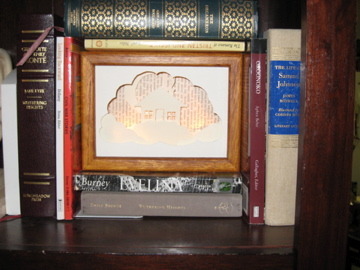

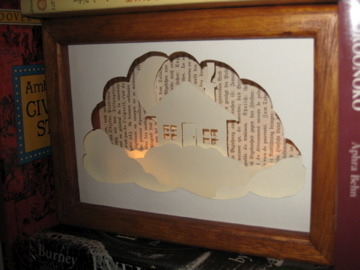
The inside is cut from pages of an old German hymnal. Here are a few pics from an angle:

But the coolest part is when we put lights in the frames:
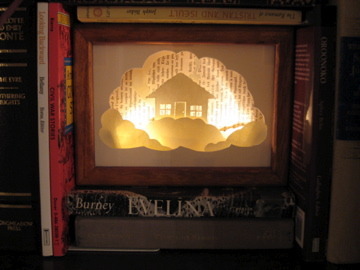

Neat, eh? In the coming weeks I'll try to post some other book-related crafts (mostly Mary's). If you've made anything bookish and awesome, send me some pics and I'll feature it!
May 18, 2011
Guess What Came in the Mail Yesterday?!?!


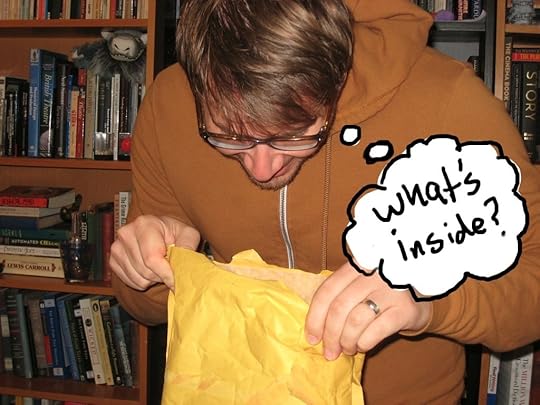

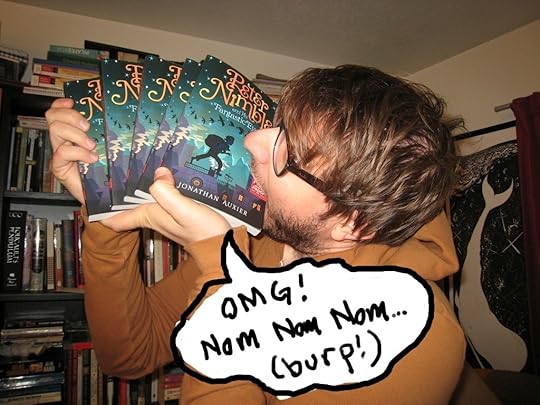
I Promptly gobbled up all the Advanced Reader Copies (ARCs) that my publisher sent me. However, if you're coming to ALA this summer, there will be zillions of copies available for free!1
If you're a book blogger and you aren't going to be at ALA, let me know and I'll have the a copy sent to you post-haste! ↩
May 17, 2011
"Blogs, and Poetics, and Hermeneutics — Oh My!"

Over the last year-and-a-half, my wife and I have been reading Lloyd Alexander's Chronicles of Prydain aloud to each other.1 While doing so, I started to form a brilliant theory about how traveling parties in quest stories often function as reflections of a specific trait in the protagonist — it was going to be the Greatest Blog Post that the world had ever seen! That is, until Betsy Bird at the School Library Journal went and ruined everything by beating me to the punch.
 Last week Betsy posted a piece entitled The Oz Quest Theory: Are Four Characters Too Many? She suggested that Wizard of Oz is but one example in a long list of quest books in which the hero picks up three sidekicks who represent guts, heart, and brains. One of the reasons I like Betsy's blog is that everybody reads it, which means that everybody also leaves comments. Some readers mentioned titles that either broke or followed the "rule of three", others floated theories about what might be motivating the pattern, a few even chimed in to ask "what's the point?"
While reading these comments, I noticed that there seemed to be two separate conversations taking place — each exploring different questions:
1) How might three be a uniquely suitable number for storytelling?
2) Why might three be a uniquely significant number in our culture/world?
These are two fundamentally different questions, and looking back you can see the tension that stems from people talking at cross purposes.2 The comments thread is also a perfect snapshot of a philosophical battle as old as literature. It's the reason MFA writing programs are distinct from Lit PhD programs. It is the difference between poetics and hermeneutics.
If you want a scholarly breakdown of these terms, click here. In the broadest sense, poetics is concerned with how and hermeneutics is concerned with why. Poetics people look at stories the way auto mechanics look at a car engine: they want to know how every moving part fits together to make a unified machine (maybe in the hope they might one day build a car of their own?). Sticking with the metaphor, hermeneutics people don't really care about what's under the hood; instead they're more concerned with what it means to live in a world with cars.
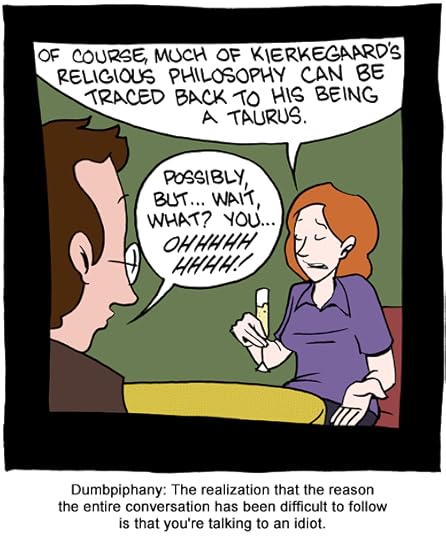 Often, the people most drawn to poetics are people who work directly with the nuts and bolts of storytelling — authors, editors, and dramaturges. People who deal with hermeneutical questions are those whose job it is to administer books to the world – scholars, librarians, and teachers. I have often found that people from one camp have little interest in the questions of the other. (My own marriage is an example of this Capulet-versus-Montigues battle.)
So which camp is better? Well, I might be slightly more interested in poetics, but I'd be a fool to argue that hermeneutics isn't absolutely essential. After all, hermeneutics is what justifies the very act of making of books (as Mary has informed me on more than one occasion!).
Perhaps this is what I find so compelling about the children's literature community? There exists an unusual amount of cross-fertilizaton between poetics and hermeneutics — authors, editors, librarians, teachers, and readers all coming together to discuss this thing they all love.3 Is it messy? Of course! Is it frustrating? Sometimes. But what fun would a quest be without a few friends?
For the record, I do a pretty awesome Gurgi … ask me to bust it out the next time you see me. ↩
As for my own contribution, I stupidly tried to tackle both questions simultaneously — which just made me sound scatterbrained. ↩
Except, I would point out when it comes to booking conferences: ALA always seems to book the same weekend as major literary conferences (MLA and ChLA). Because of this, Mary will miss my first book signing, and I will miss her presenting a paper on Octavian Nothing. Not cool, conference planning people, not cool… ↩
May 13, 2011
Peter Nimble in Brazil!
Just a short note to announce that Brazil is the latest addition to the ever-growing list of awesome countries that "get it" … and by "get it," I mean "are willing to publish my book!" The publisher will be Leya, and they will also be using my illustrations — Hooray!
Really, this is just an excuse for me to include a video from Terry Gilliam's 1985 movie, Brazil:
Recognize that music? You should, because it's used in a million trailers. Have a swell weekend!
May 11, 2011
My Editor can Beat up Your Editor …
A few months back, my editor and I were caught in a heated "discussion" regarding a certain passage of Peter Nimble.1 Essentially, she wanted me to remove a paragraph on the grounds that it slowed down the action. Understand that I am usually very eager to rip apart my own work in response to a note … but this particular passage was different.2 When I sat down to write Peter Nimble, I essentially sat down to write this passage — and now I was being told to cut it out entirely!
There were a LOT of phone calls, during which I would list countless reasons why these few sentences were necessary to the book. Every time she would say she understood my feelings, but that she couldn't in good conscience agree. Finally, after what seemed like weeks of back-and-forth, I tried cutting it out — just to see how it read.
You know how this story goes: she was right, I was wrong, "kill your darlings," blah, blah, blah.3
When I looked over the final proofs of that chapter a few weeks ago, I was overwhelmed with gratitude. My editor is a busy lady, and I'm sure it would have been much easier for her to just let me have my way. But she stuck to her guns, and the book is better for it.
Shortly after that issue was resolved, I sent over a picture as a sort of peace offering:

Way to be awesome, Editorus Rex.
My editor has a pretty low online profile, so I'll respect that by not publishing her name … of course if you reallywant to know who she is, it's printed in back of Peter Nimble! ↩
In fact, both my wife and agent have at times argued that I can be too eager in this regard. Perhaps that's a subject for another day. ↩
Author and blogger Wendy Palmer has a neat little series on writing rules that are often misapplied — including the infamous "Kill your darlings." It's worth reading, if for no other reason than to learn that Faulkner didn't originate that phrase. ↩
May 9, 2011
Introducting … PETER NIMBLE!
Abrams had previously requested that I not publish too much information on my book just yet, but after their own creative director released this info on his blog, the gig was up. Below is a first peek at Peter Nimble & His Fantastic Eyes:

This is a marketing sheet that was handed out at ALA Midwinter. The figure in the top left was scanned from one of my old sketchbooks. The silhouette and background were drawn by the brilliant Gilbert Ford, who created the book cover.1 For those who can't be bothered to click through the image, I'll reprint the text here:
"Now for those of you who know anything about blind children, you are aware that they make the very best thieves. As you can well imagine, blind children have incredible senses of smell, and they can tell what lies behind a locked door—be it fine cloth, gold, or peanut brittle—at fifty paces. Moreover, their fingers are small enough to slip right through keyholes, and their ears keen enough to detect the faintest clicks and clacks of every moving part inside even the most complicated lock. Of course, the age of great thievery has long since passed; today there are few child-thieves left, blind or otherwise. At one time, however, the world was simply thick with them. This is the story of the greatest thief who ever lived. His name, as you've probably guessed, is Peter Nimble."
So begins PETER NIMBLE & HIS FANTASTIC EYES, the first novel from 29-year-old Jonathan Auxier. Overflowing with wit and invention, PETER NIMBLE is the utterly beguiling tale of a ten-year-old blind orphan who has been schooled in a life of thievery by his brutal master, Mr. Seamus. One fateful afternoon, as he's picking the pockets of townspeople enraptured by a traveling haberdasher, he "discovers" (steals) a box of magical eyes. When he tried on the first pair, he is instantly transported to an island at the top of the world, where he meets the maker of the eyes, Professor Cake. The professor gives Peter a choice: travel to the mysterious Vanished Kingdom and try to rescue a people in need … or return back to his master and a life of crime. Peter chooses wisely, and together with Sir Tode, a knight errant who has been turned into a rather unfortunate combination of human, horse, and cat by a grumpy witch, he embarks on an unforgettable adventure in a book destined to become a classic.
At ALA, I noticed a typo in the first paragraph2 and declared that whichever librarian spotted it first would win a hand-drawn portrait. For about ten minutes there was much yelling and scrutinizing-of-text, until librarian and poet Nina Lindsay spotted the error. Here she is:
 Nice work, Nina!
Just to be clear, this is not the cover of the book. The real cover is amazing and I can't wait to show it to you! In the meantime, here's a sneak preview! ↩
To be fair to my copy editor, it was less a typo than an ambiguous pronoun. ↩