
Heather Solos's Blog, page 85
May 22, 2011
Site Admin Sunday May 22, 2011
 Heather says:
It's good to see all of you, hope most of you aren't too hungover after celebrating the non-end of the world. If any of you have a cure for removing REM from my internal playlist, I'd be forever grateful.
Next week will be a bit unusual. I have posts from the Home-Ec 101 Crew lined up to keep you entertained while I'm in NYC for Blog World Expo. I have some time to explore the city on Friday before my afternoon flight. Is there something other than the usual suggestions (Statue of Liberty etc) that I shouldn't miss? I do plan on visiting Ground Zero.
And finally, all electronic versions of Home-Ec 101 Skills for Everyday Living are on sale through May 25, 2011 for $4.99. If there is a new grad in your life, this may be a good gift idea.
If you have any wild parties while I'm gone, please clean up after yourselves. There's a whole section on cleaning if you run into trouble.
See you next week!
Site Admin Sunday May 22, 2011 is a post from: Home Ec 101 ©Home Ec 101.com 2007 - 2011


May 20, 2011
What is Modified Food Starch?
Heather says:
Yesterday on Twitter, during the What is Vegetable Extract kerfuffle, my good friend @notoriouslynice asked:
@HeatherSolos I'd like to know, too, if you find out. Also, what is modified food starch?
First what is starch?
Starch is a white, odorless complex carbohydrates that serves as primary means of energy storage for plants.
When we talk about starches in reference to food, we usually have a couple of different meanings in mind. Sometimes we say that foods like potatoes are starches. In that case we just mean that the food contains a lot of starch. Other times we refer to products like corn starch. In this latter case, we are more concerned with what the starch does than what it is.
Starches are well known for their thickening properties and are often used to thicken gravies and soups. Corn starch doesn't work well under certain conditions, if the liquid is too cold it will remain grainy and if the mixture is subjected to heat that is too high, the starch breaks down.
On a nutritional label, modified starches are plant starches whose chemical structures have been changed through physical or chemical changes. Sometimes the starches are treated with acid other times heat or the way in which they are dried achieves the changes necessary to give the desired properties.
Why are the starches modified?
When the structure has been changed it can be used as a thickening agent under many different conditions
The starches have many applications in processed food:
thickening agent at low temperatures – instant puddingability to withstand high temperatures – instant cheese sauce -this is why your powdered mac and cheese sauce won't "break" and become grainy no matter how badly you abuse ituse as a fat substituteanti-caking agent -keeps foods like shredded cheese separatehumectant -can keep some foods moistLike many things found in food, a modified starch isn't in and of itself a bad thing. However it might be time to take a look at your overall diet if most of your foods contain this ingredient.
Why?
Puddings, canned soups, sauces, and gravies probably shouldn't be the bulk of your diet.
Those who have celiac disease or are avoiding gluten should avoid any food item with modified food starch on the label, unless the food is specifically labeled gluten free. Without the gluten free label, the modified food starch may contain gluten.
Submit your questions to helpme@home-ec101.com
What is Modified Food Starch? is a post from: Home Ec 101 ©Home Ec 101.com 2007 - 2011


May 19, 2011
What is Vegetable Extract?
Heather says:
This question is specifically for my UK readers or maybe they have it in AUS or NZ, too. What is vegetable extract?
Is it broth, base, or bouillon? Or is it something completely different?
I found an old recipe from the rationing years and it called for a teaspoon of vegetable extract. A brief search on Google only yielded others asking the same question or what looked like health food additives.
INGREDIENTS
Take 1Ib each of diced potatoes, cauliflower, swedes and carrots;
Three or Four spring onions;
One teaspoonful of vegetable extract and
One teaspoonful of oatmeal.METHOD
Cook all together for ten minutes with just enough water to cover.
Stir occasionally to prevent the mixture from sticking.
Allow to cool; put into a pie dish, sprinkle with chopped parsley and cover with a crust of potatoes or wholemeal pastry.
Bake in a moderate oven until the pastry is nicely brown and serve hot with brown gravy.
I thought it might make an interesting side dish to riff on, without the pie crust.
Submit your questions to helpme@home-ec101.com.
What is Vegetable Extract? is a post from: Home Ec 101 ©Home Ec 101.com 2007 - 2011


May 18, 2011
Talk on Tuesday: Share Your Best Tightwad Tips
Heather says:
They said gas prices would drop. I'm not seeing it, are you? Without a drop in fuel prices, it won't be long until the cost of goods are raised to cover production and transportation costs. With that in mind, I'd love to hear your best tips for saving money.
Some of our favorites:
Cut the cable. It's been seven years since we've paid a cable bill, a monthly subscription to Netflix has more than filled in the gap. We don't watch sports, but ESPN is stepping up to fill that gap and I'm sure there are other options out there, too.
Cook once eat twice. Some items like chicken, ham, and brisket are even better cold on sandwiches the next day.
Use powdered milk for cooking. When powdered milk is cheaper than fresh we use it for cooking and baking, anything where that slightly funky taste isn't going to noticed. See How to Use Powdered Milk to Save Money for more ideas. I know some of you swear by it for drinking. I just can't.
Buy beef in bulk. We save a lot of money by purchasing a side of beef and storing it in our deep freeze.
Buy produce in season. Local, seasonal produce lacks the markup to cover long distance transportation. By buying in season and preserving food by freezing, drying, or canning, we ensure we have a varied diet throughout the year without the shipping costs. CSAs are a great resource, but we also use farmers markets, produce stands, and some of our grocery stores also carry local produce.
Use the library. Libraries are there to use, visit yours and see everything they have to offer: movies, music, audio books, and e-books. My favorite part about the mp3 audio books and ebooks is they expire automatically, there's no chance of a late fee.
Look for bumped and bruised produce. Everything you eat doesn't have to be showcase perfect.
Ok Home Eccers, it's your turn. Share your favorite money saving tips.
Talk on Tuesday: Share Your Best Tightwad Tips is a post from: Home Ec 101 ©Home Ec 101.com 2007 - 2011


May 17, 2011
How to Save Rock Hard Granulated Sugar
Dear Home Ec 101,
I have a 5lb bag of white sugar that is rock hard. Can it be saved? Is it safe to eat?
Signed,
Sugarland
Heather says:
Don't worry your granulated sugar is not unsafe, it's just inconvenient in its current form. White sugar does not support microbial growth, so it's not going to go "bad." Sugar is hygroscopic -it absorbs water from the air- this is why it is recommended to store sugar in an air tight container.
All you have to do is break your sugar back into very small pieces.. There are a variety of ways, but whichever you choose, just make sure you plan wisely.
If you choose the drop the bag on the floor repeatedly method, you'll want to be sure the bag is INSIDE another bag. If the bag bursts open, well that's not going to be fun to clean up.
Meat mallets, rolling pins, or even hammers are all useful in this chore. Just make sure you aren't pulverizing the bag into the sugar. No one wants paper or plastic bits in their morning coffee. Any of these have the added bonus of being a fantastic stress reliever.
Once the pieces are small enough you can use a food processor or blender to finish the job. Just make sure you don't overload the motor. Sugar is relatively inexpensive compared to replacing an appliance.
Submit your questions to helpme@home-ec101.com.
Be sure to check out our forums, too.
How to Save Rock Hard Granulated Sugar is a post from: Home Ec 101 ©Home Ec 101.com 2007 - 2011


May 16, 2011
How to Remove Gum from the Dryer
Dear Home-Ec 101,
I / my husband / my kid didn't check their pockets and now my dryer smells minty fresh, but is covered with with gum. How do I get the gum out of the dryer and off of the clothing?
Signed,
Several Home-Ec Readers this Week
Heather says:
Thankfully, removing gum from the dryer is more of a pain in the butt than actually difficult. There are a couple of approaches you can take.
The Melt it off Method.
Use a hair dryer to heat the gum until it is pliable and then scrape the gum off of the dryer.
The Freeze it Off Method.
Get a handful of ice cubes and a nylon scraper or an old credit card. Apply the ice cube to the gum and then scrape it off. Repeat until all of the visible gum has been removed.
Whichever method you use, inspect the drum carefully, the gum is sneaky and will hide where the fin meets the drum and on the back wall, and on door, etc. Use a flashlight to be sure there isn't any gum hiding in the drum.
Then get either Goo Gone or for electric dryers WD-40 works, too -do NOT use WD-40 in a gas dryer- and apply the solvent to paper towels. Carefully and thoroughly wipe out the entire inside of the dryer drum. This is to get rid of any lingering gum residue that might be hard to see. Do not skip the rinsing step. It is especially important if you used WD-40.
The next load through the RINSED dryer should be a load of rags, not your best blouse or favorite jeans. Got that?
How to Remove Gum from Clothing
First pick off as much gum as possible. To remove the rest of the gum from put the article of clothing in the freezer until the gum becomes brittle or apply an ice cube directly to the gum. Then use a credit card or nylon scraper on sturdy fabrics, like denim, to scrape off the remaining gum. On more delicate fabrics, use your fingers to pick off the brittle gum and then use an old toothbrush to remove the rest.
Good luck!
Submit your questions to helpme@home-ec101.com.
Check out the forums and meet other Home Ec 101 Community Members.
How to Remove Gum from the Dryer is a post from: Home Ec 101 ©Home Ec 101.com 2007 - 2011


May 15, 2011
Site Admin Sunday May 15, 2011
Heather says
Some of you may have noticed a post was prematurely published yesterday. Ok, a lot of you may have noticed. Don't worry that post will be back. It's scheduled for May 24.
I'd like to apologize for any confusion. I'm very excited to welcome Vera to Home-Ec 101. I first met Ver at the first blogger meet up -that I know of- in Charleston and she mentioned at CREATE South that she wanted to write for other sites; I jumped on the opportunity. I'm a complete and total noob when it comes to fiber arts. Some of you have been asking for tutorials and videos that are just beyond my scope of knowledge. I think we're very lucky to have Vera.
Just hang tight until the 24th when you'll officially meet her.
Other odds and ends:
Tomorrow evening I'll be at the Main Branch of the Charleston County Library for a book signing at 6:30pm. I've asked for those attending to consider bringing an item donation for My Sister's House. Don't know what to bring? Check out their wishlist.
Saturday morning I'll be giving a two hour workshop at the Charleston Center for Women.
Then Monday it's off to NYC for Blog World Expo. If you are also going, I plan on standing a few shifts at the Cooking with the Troops display.
Please bear with me if I'm slower than usual to respond. As is the nature of the universe, this all coincides with my oldest's last week of school. (We use a virtual charter school, so it's like homeschooling but with a lot of accountability).
I'm also the new editor of the Home Channel on BlissfullyDomestic.com.
I think that's all that's new around here. I'll keep you updated.
Site Admin Sunday May 15, 2011 is a post from: Home Ec 101 ©Home Ec 101.com 2007 - 2011


May 14, 2011
How to be a Fabulous Knitter/Crochter–Introduction
[image error]Vera says:
Have you ever…
Come across a stunning, yet astronomically priced crocheted skirt or a simply darling crocheted baby sweater and wished you could make it yourself?Been intrigued by someone knitting away in public and wanted them to teach you? Perhaps you learned to crochet as a child and would like to reconnect? Wanted to learn a technique new like sock knitting, granny squares, or working with colors.Desired to crochet even though you can knit or vice versa?Thought about having something to do that's relaxing, enjoyable, portable and productive? An endeavor that sharpens your reflexes, brain and is good for many social settings or going solo?If you answered "Yes" to any of the above (or have other reasons), then knitting and crocheting may be in your future.
You'd also become a part of a large–and growing–family of crafters. Over 50 million people in the United States alone knit and crochet.
I came to knit and crochet via Reason #2. As a child in New York City, I was fascinated by the women I would see on the city subways and buses working away. I ended up using my allowance to buy needles, hooks, and yarn, but had no idea what to do, so I just made something up.
In time, I purchased books and taught myself again and spent my grade school and high school years making mostly afghans, vests, and pillows; hey, it was the 70′s. I pretty much put down my needles for some years while in college and the military, but connecting with others on line and in person encouraged me to pick them back up again and sharpen my skills.
Today, I'm rarely without a project, and my crafting helps keeps me focused. I enjoy knitting while watching television, on my lunch breaks, or crocheting to smooth my frayed nerves in a traffic jam. Although I mostly knit and crochet in private, I love knitting in public, and I have made connections with people locally and all over the world.
I'd love to pass along my knowledge, tips, tricks, triumphs, and disasters gleaned over the years with you. Let me know your interests in the comments. Some ideas I have are the following…
Tips, Tricks, and TechniquesReader Q &AInstructional videosKnit and Crochet Alongs–a virtual knitting circleThe Crafting Life–Commentary on the world of needlecraft, needles, yarns, patterns, magazines, etc.Feel free to pass along any ideas you have as well.
In any event, it's all about helping each other to become–and remain, no matter what the level–fabulous knitters and crocheters!
Vera Hannaford lives and crafts in Charleston, South Carolina and wishes she'd make more things for her husband, but can't seem to get around to it. You can follow her adventures in needlework on Vera's Crafty Blog and on, occasion, get some helpful hints at KnittingTips on Twitter
How to be a Fabulous Knitter/Crochter–Introduction is a post from: Home Ec 101 ©Home Ec 101.com 2007 - 2011


May 13, 2011
What Causes Black Underarm Stains and How to Prevent Them
Funky in Franklin
Heather says:
Antiperspirants and deodorants are two distinct products, but in our everyday speech we tend to use the terms interchangeably and I have done so throughout this response as a way to help people using search find what they need.
You were on the right track when you tried switching deodorants. If you take a walk down the antiperspirant / deodorant aisle, you'll notice quite the selection. Most of the antiperspirants / deodorants you see will all have the same active ingredient(s): aluminium chloride, aluminium chlorohydrate, aluminium-zirconium or a combination of thereof. Did you notice something about those three active ingredients? They all contain aluminum.
For most of us the aluminum in antiperspirants isn't a big deal, it helps us stop sweating from our underarms for a few hours and we go through the day without offending our neighbors. Neat.
However everyone's body chemistry is a little different, it's the food you eat, the water you drink, and your genetics. You know how everyone likes to giggle about what eating asparagus does to urine? Well it doesn't do that to everyone's. Some people think cilantro tastes like soap -and I cry a little for all they miss. Your quirk is that something in your sweat, is making that aluminum show up on your shirts, lucky you.
Since we're all special snowflakes the first tip is specific to people, like you, who have dark stains from their deodorant / antiperspirant.
Avoid the aluminum
Try switching to an aluminum free antiperspirants / deodorants I did a search on Amazon that will show you specific brands and labels to look for the next time you head to the store.
On a side note, some people avoid aluminum because they believe that aluminum is the cause of of Alzeheimer's. That hasn't been proven, what they've found is that people with Alzheimer's tend to have more aluminum in their brains, this doesn't mean that the the aluminum was the cause, it just means that it shows up in people's brains when they have Alzheimer's. It could be like the way ketones show up in the urine of diabetics, the insulin is absent so ketones show up where they normally wouldn't. Just because something is there, doesn't mean it is the cause. (I haven't done a lot of research lately, but feel free to link to peer reviewed sources, if you want to discuss this point).
You didn't mention where you moved from. Why do I ask? Well, if you moved from a cooler climate, there is a chance part of the problem is that you haven't had to use as much antiperspirant as you do now.
Use less antiperspirant.
Antiperspirant works by blocking your pores -I'm simplifying here- once those pores are blocked an extra coat of the white stuff isn't going to be helpful, it's just going to rub off on the inside of your clothing. When your antiperspirant wears off and you begin sweat, you'll have more aluminum hanging out on your shirt to react with your sweat and create that dark stain.
For those of us that don't react to aluminum, this means we have to remove deodorant build up from our shirts. You can try to remove the dark stains with the same tips as in that article, but with the chemical change, it may be permanent.
Additionally, try to let your antiperspirant or deodorant dry completely before putting on your shirt. This will also help reduce the amount absorbed by the fibers of your clothing.
So your homework is to find an aluminum free antiperspirant / deodorant, use less, and try to let it dry before putting on your shirt to prevent future stains.
Got it?
Submit your questions to helpme@home-ec101.com.
What Causes Black Underarm Stains and How to Prevent Them is a post from: Home Ec 101 ©Home Ec 101.com 2007 - 2011


May 12, 2011
Is Rust on the Microwave Door a Safety Issue?
Dear Home-Ec 101,
There has always been a bit of rust spots along the bottom of the micro door, but just now I noticed it's suddenly become quite extensive. I wiped it, shut the door & reopened it, and rust dust was spreading around. Barring the question of microwave safety in general, is it still safe to use? I only use it for reheating the occasional steak or cup of coffee, or steaming a package of green beans. Which does, by the way, create a LOT of steam, which may be why it's gotten so rusty.
Signed,
Rusty Redhead
PS Here's a picture to illustrate my question.
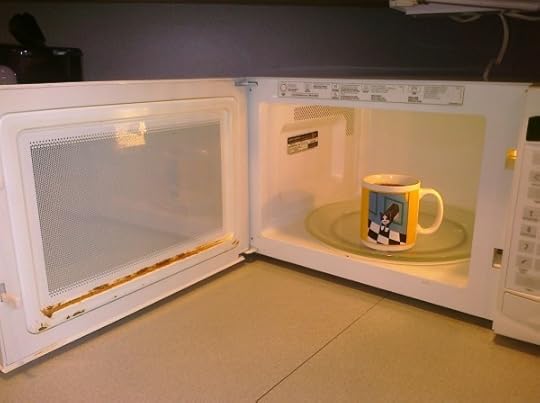
Heather says:
I've written previously about how microwaves work, they act as boxes that keep the microwaves in a confined area. IF the rust were to reach a point where it compromised the integrity of the door, there would a potential for microwaves to escape. Now, don't freak out, they aren't going to chase you down the hall, out the door, and down the street, but it is something you don't necessarily want to expose yourself to.
The Michigan State University Extension says:
If there are signs of rusting inside the oven, have the oven repaired.
Cosmetic surface rust is not a safety issue, but don't ignore it either.
I did a quick search for appliance parts and it does not seem as though the door is replaceable, however I may be mistaken. I would call your local appliance repair store to be sure. Since I tend to run on the very conservative side, I would begin looking for a replacement microwave.
To prevent rust from occurring in your replacement microwave, leave the door ajar after cooking or cleaning to allow the moisture a chance to escape. Wiping down the door and cavity walls of the unit with a dry towel would also help prevent the problem. But just knowing how hard it is for some people to cover their food while using the microwave, I can see how most would balk at the idea of ANOTHER extra step.
Good luck!
Submit your questions to helpme@home-ec101.com.
Is Rust on the Microwave Door a Safety Issue? is a post from: Home Ec 101 ©Home Ec 101.com 2007 - 2011


Heather Solos's Blog

- Heather Solos's profile
- 12 followers

