
Heather Solos's Blog, page 88
April 17, 2011
Shrimp Quesadillas
 Heather says:
I promise you, that if you can make grilled cheese, you've got these shrimp quesadillas in the bag. In our house as the weather gets warmer we find ourselves reaching for lighter and lighter fare. Shrimp quesadillas are a perfect main dish item for spring and summer. Don't go too heavy on the cheese, allow the shrimp to take center stage. If you want to go even lighter, skip the butter on the tortilla, it's delicious with or without. Serve these as a main dish or appetizer with salsa and guacamole. A handful of raw bell peppers are a perfect side. If you're only cooking for two, just reduce the shrimp to one pound and use half the tortillas.
If you want these shrimp quesadillas to have a kick, go ahead and leave the jalapeño seeds and ribs intact. Just don't come crying to me later. Be careful not to boil the shrimp too long, they'll get rubbery.
I will note that if you use carb balance tortillas, you just might find yourself eating just the filling. Not that anyone around here is guilty of that.

Summary: Quick and easy shrimp quesadillas, perfect for a beginner cook.
Ingredients2 lbs peeled and deveined shrimp 1/2 cup lime juice – about 2 medium limes2 TBSP ground cumin3 green onions, chopped1 handful cilantro, chopped1 jalapeño, seeded and chopped8 tortillas (burrito size)Shredded cheeseButterInstructions

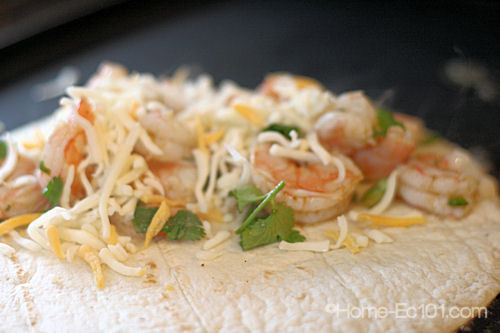 Heat a large skillet or griddle to medium. Place a buttered tortilla in the skillet and add 1/4 lb of the shrimp mixture to one half of the tortilla. Sprinkle with cheese and fold the tortilla. Cook for a couple minutes on each side until the desired level of browning has been achieved. (If you skip the butter your tortilla won't brown)
Cooking time (duration): 30
Diet type: Pescatarian
Number of servings (yield): 4
Meal type: dinner
Culinary tradition: USA (Southwestern)
I'm trying out some new recipe software, tell me what you think. Do you like the format?
Shrimp Quesadillas is a post from: Home Ec 101 ©Home Ec 101.com 2007 - 2011


April 16, 2011
Retro Saturday: April 16, 2011
Heather says:
Before I dive into the archives and unearth the best of Home-Ec 101, I'd like to say hi to all the people stopping by from SimpleMom.net. Thank you for taking a moment to check out the site. If you look in the upper right corner there are several ways to subscribe: RSS, via email, Twitter updates, and of course by being a Facebook fan. The email subscription is available in two formats both daily and a weekly digest. The second one isn't as timely, but if your inbox is anything like mine, it's a nice option.
If you look in the menu bar ↑ up there, you'll see a category called "Read It." That category has its own feed and is for random articles and items I think Home Ec Readers may enjoy. These posts are not shared on the home page or in the main feed, to reduce the amount of visual clutter. Sometimes interesting conversations happen over there, too.
If you have a household question you'd like answered, just send it to helpme@home-ec101.com.
This year Home-Ec 101 is growing and since Home Ec is a topic far bigger than Heather Solos, I'm bringing on authors. Brian, Bran, Bobbie have begun to contribute. Don't worry, their whole name thing is just an interesting coincidence. Soon Vera will be giving tutorials on crocheting and knitting, since I'm rather hopeless in the whole crafting department. My husband Tim also contributes from time to time, usually talking about electricity.
If you have any other questions, they may be answered on the About page or in the FAQ.
Now on to Retro Saturday.
Retro Saturday is my chance to highlight my favorite posts from this week in previous years.
In 2010:
Seasonal Recipes for April – As an aside, I need to touch base with Cameron and see if we can't relaunch this project. I enjoyed finding recipes to share and loved the results. Things just got a bit crazy and I dropped the ball.
A year ago I also answered possibly my favorite reader question ever: Dear Home-Ec 101, I'm Overwhelmed.
In 2009:
Have you ever made donuts from biscuit dough? I suppose I could make my own biscuit dough for these donuts, but for something deep fried, I think really improving the health aspect is sort of pointless: How to Make Simple Donuts.
Herb Crusted Steaks with Grilled Tomatoes
Back in 2008:
Readers shared their best cleaning tips.
And all the way back in 2007, when the site was rough, unpolished and brand spanking new:
The Curse of Builders Grade Carpet and Mystery Spots
Potluck Etiquette (Who is responsible for the return of a dish?)
Retro Saturday: April 16, 2011 is a post from: Home Ec 101 ©Home Ec 101.com 2007 - 2011


April 14, 2011
Why Is There Rust on My Stainless?
Dear Home-Ec 101,
My very nice, very expensive stainless steel Mikasa silverware is picking up rust spots. I know it's not rusting, because it's stainless, and the spots appear to be surface. How do I get rid of the rust spots on my flatware? I'm so tired of them looking icky, it happens to my good knives too. Could it be coming from my dishwasher?
Signed,
Rusting in Rutherford
Heather says:
I'm going to let you in on a secret. There's a reason stainless steel is called stain LESS and not stain FREE. The stainless steel we see so often in our homes is corrosion resistant, not corrosion proof.
Let's start by thinking about what steel is. Steel is an alloy – not too get into too many details, a blend, if you will- of iron and usually carbon. When the steel cools, the carbon atoms fit into the lattice / matrix structure of the iron atoms and give it slightly different properties. Sometimes other elements are used in addition or instead of carbon, with stainless it's chromium and sometimes nickel. The exact blend is what determines its susceptibility to rust.
What you are seeing on your flatware is a tiny bit of surface rust. It's pretty harmless, but my old standby – Bar Keepers Friend – is a great solution. Just follow the directions on the can.
Never try to remove the surface rust with steel wool, you're just going to exacerbate the problem. At first it will look better, but given time the problem will be back and look much worse. If you must use an abrasive, use something like a Scotch Brite pad and only rub with direction of the brushing.
Now, keep in mind that stainless steel is different from the carbon steel you'll find used to make some knives. I highly recommend you stay away from carbon steel. Check out this post on how to sharpen your knives for the full explanation.
Send your questions to helpme@home-ec101.com
Why Is There Rust on My Stainless? is a post from: Home Ec 101 ©Home Ec 101.com 2007 - 2011


April 13, 2011
How to Use Rubbing Alcohol Safely
Heather says:
This is another post in the series on household chemicals. Rubbing alcohol is frequently recommended by frugal and green bloggers for use as household cleaner.
Rubbing alcohol a general term that most often refers to isopropanol, but can also refer to ethanol. It is very important to understand that there is a difference between ethanol and isoproponal. Ethanol is the same type of alcohol you'll find in your liquor cabinet while isoproponal is the alcohol we're familiar with in medical applications – the pads used to wipe your skin before receiving a shot as an example. Both can be used as a topical disinfectant -think back to all the movies where nothing but a bottle of liquor was available- and this is how the term came about (the topical application, not the movie scenes).
To keep things simple, from this point forward the rubbing alcohol referenced is the white bottle of 60% – 90% isopropanol most of us are familiar with from the pharmacy department.
Rubbing alcohol should always be used in a well ventilated area.Isopropanol is volatile which means that it evaporates quickly, creating flammable fumes. Never use rubbing alcohol near open flames or while smoking.
Ispropanol is converted to acetone in the human body. Do not drink it, do not use in an unventilated area, do not use over large areas of skin.
To understand why rubbing alcohol is so often recommended as a household cleaning solvent, let's dive back into high school chemistry for a moment.
Dear Fellow Chem Nerds,I know I'm playing fast and loose with some terms. I'm just going for the gist, not prepping people for their Organic Chem final.
Just breathe.
Love,
Heather
There is an adage like dissolves like, this refers to two types of compounds polar and non-polar. Water is a polar compound, each V shaped H20 molecule has an area with a slightly positive charge and an area with a slightly negative charge. Compounds such as fats are non-polar and do not have these charged areas. In most cases, at least without playing chemist, you won't get a non-polar solution to mix with a polar solution. If you want to visualize this, head into the kitchen put some water a jar and add a few tablespoons of olive oil. Close the lid and shake the heck out of it. You'll see tiny droplets of oil suspended in the water (until they eventually float to the top) but these droplets are not part of the solution.
Alcohols, like rubbing alcohol are also polar molecules, but they are organic compounds, this means they have at least one carbon atom, the longer the carbon chain, the less likely the molecules are soluble in water. The carbon chain helps the compound bring non-polar compounds into solution. So alcohols like isoproponal (which pretty much makes up rubbing alcohol) can act as a solvent for non-polar compounds like dyes and fats.
This is why you see both rubbing alcohol and hairspray recommended to remove ink from fabric. The alcohol brings the ink into solution where it can be wicked away with a paper towel or cloth.
Rubbing alcohol, can strip the fats and oils that protect your skin.
If this is allowed to happen for a long time, this can lead to cracking which can set you up for dermatitis and other even less fun infections. Use gloves or limit the contact with your skin.
When used properly rubbing alcohol is a fairly safe cleaning agent. The main problem is its effectiveness as a solvent, sometimes it will destroy the item you're trying to clean. You must use care and understand that alcohols are not always a safe choice for some surfaces and finishes.
Keep rubbing alcohol away from many painted surfaces, shellac, lacquer, and some man-made fabrics.
In some cases denatured alcohol -ethanol alcohol with bittering agents to make it unpalatable- may be a better choice. Don't worry, I'll get to denatured alcohol in a future article.
Send your questions to helpme@home-ec101.com
How to Use Rubbing Alcohol Safely is a post from: Home Ec 101 ©Home Ec 101.com 2007 - 2011


April 12, 2011
Rising Fuel Prices, Are You Adjusting Your Budget?
Heather says:
Instability in the Middle East, oil futures speculation, fears of peak oil whatever the actual cause, once again it's getting a little more costly each time we have to put fuel in the car. Some of the pain associated with rising fuel prices is immediately felt, right there at the pump. Ouch. Other effects are not quite as immediate, but all consumers should be aware of the following trends:
Food prices will rise
It takes fuel to plant, care for, and transport food. Sure all consumer goods have a fuel cost associated with them, but due to the relatively high turnover rate, food -specifically perishable food- is where people will next feel the impact of rising fuel prices.
In the past, it seems I notice the cost of milk and other dairy rising first
Individuals who work for tips will likely see their income fall.
As budgets get tightened to deal with the increase in food and fuel prices, the amount of money left over for eating out and other discretionary spending will fall. Some people continue to go out and just reduce the tip, which they view as non-essential. Is it right that consumers make this choice? Of course not, but it happens. I spent ten years in food and bev, it's just a part of the business.
Those who deliver pizza will likely be hit on two fronts.
Households who live on lower incomes will disproportionately feel the impact of rising fuel costs.
Why?
Think of everyone's income as a pie. Regardless of how big that income is, there is a minimum that must be spent on necessities. With a lower income, that minimum is a larger piece of the pie.
So, what can you do?
The answer is not running out and buying a brand new, fuel efficient car.
Think a little more long term. The additional 15 or 20k that would be spent on that new car can buy a lot of gas. If you have any extra discretionary income -money that could be spent on treats or non-essentials- it is time to make sure you stop the outflow. Pay off any small debts, store credit card for example. Sure it's only $20 or $30 a month, but that may be what keeps your budget in balance with the increase in fuel costs. Get rid of it, yesterday. Go all Dave Ramsey debt snowball if you can.
Check your budget for any forgotten recurring fees. Do you have membership to something you're not using. The gym perhaps? -raises a guilty hand-
Stopping the bleeding while it's an annoyance can save a lot of stress.
Use all of the fuel saving tips we learned the last time around.
Walk or bike when possibleUse mass transit when possibleCut all extraneous car trips -don't make that mid-week run to the grocery storePlan your route – this is especially helpful if you're going somewhere newPool errands with neighbors -offer to return their library books or dry cleaning if you are going to be in that area. Chances are, they will return the favor. -This tip mostly applies to those of us who live outside of city limits.Before the prices trickle down, stock up on non-perishable foods -only the kind you actually eat and not outside your food budget. Get rid of one treat and buy something on sale that will last instead. Please don't act like I'm saying run out and prepare for the zombie apocalypse. This isn't that. This is going to be another summer with high fuel costs. If the budget to get to work has to come from the food budget, wouldn't it be better to be ready?Lastly please keep in mind that sometimes the lowest immediate cost has the highest price of all.
This summer look for chances to spend some money on local food producers. Maybe joining a CSA is an option you haven't considered before. Sure you will end up with some vegetables you may not have seen before, but consider that you could be one of the individuals or families that helps prevent one more farm from going to the auction block.
Are you thinking about the cost of fuel or is it something you've managed to avoid?
For more posts on this topic, scroll to the bottom of the page and click on any of the titles under Start Saving.
Rising Fuel Prices, Are You Adjusting Your Budget? is a post from: Home Ec 101 ©Home Ec 101.com 2007 - 2011


Rising Fuel Prices, Are You Adjusting Your Budget
Heather says:
Instability in the Middle East, oil futures speculation, fears of peak oil whatever the actual cause, once again it's getting a little more costly each time we have to put fuel in the car. Some of the pain associated with rising fuel prices is immediately felt, right there at the pump. Ouch. Other effects are not quite as immediate, but all consumers should be aware of the following trends:
Food prices will rise
It takes fuel to plant, care for, and transport food. Sure all consumer goods have a fuel cost associated with them, but due to the relatively high turnover rate, food -specifically perishable food- is where people will next feel the impact of rising fuel prices.
In the past, it seems I notice the cost of milk and other dairy rising first
Individuals who work for tips will likely see their income fall.
As budgets get tightened to deal with the increase in food and fuel prices, the amount of money left over for eating out and other discretionary spending will fall. Some people continue to go out and just reduce the tip, which they view as non-essential. Is it right that consumers make this choice? Of course not, but it happens. I spent ten years in food and bev, it's just a part of the business.
Those who deliver pizza will likely be hit on two fronts.
Households who live on lower incomes will disproportionately feel the impact of rising fuel costs.
Why?
Think of everyone's income as a pie. Regardless of how big that income is, there is a minimum that must be spent on necessities. With a lower income, that minimum is a larger piece of the pie.
So, what can you do?
The answer is not running out and buying a brand new, fuel efficient car.
Think a little more long term. The additional 15 or 20k that would be spent on that new car can buy a lot of gas. If you have any extra discretionary income -money that could be spent on treats or non-essentials- it is time to make sure you stop the outflow. Pay off any small debts, store credit card for example. Sure it's only $20 or $30 a month, but that may be what keeps your budget in balance with the increase in fuel costs. Get rid of it, yesterday. Go all Dave Ramsey debt snowball if you can.
Check your budget for any forgotten recurring fees. Do you have membership to something you're not using. The gym perhaps? -raises a guilty hand-
Stopping the bleeding while it's an annoyance can save a lot of stress.
Use all of the fuel saving tips we learned the last time around.
Walk or bike when possibleUse mass transit when possibleCut all extraneous car trips -don't make that mid-week run to the grocery storePlan your route – this is especially helpful if you're going somewhere newPool errands with neighbors -offer to return their library books or dry cleaning if you are going to be in that area. Chances are, they will return the favor. -This tip mostly applies to those of us who live outside of city limits.Before the prices trickle down, stock up on non-perishable foods -only the kind you actually eat and not outside your food budget. Get rid of one treat and buy something on sale that will last instead. Please don't act like I'm saying run out and prepare for the zombie apocalypse. This isn't that. This is going to be another summer with high fuel costs. If the budget to get to work has to come from the food budget, wouldn't it be better to be ready?Lastly please keep in mind that sometimes the lowest immediate cost has the highest price of all.
This summer look for chances to spend some money on local food producers. Maybe joining a CSA is an option you haven't considered before. Sure you will end up with some vegetables you may not have seen before, but consider that you could be one of the individuals or families that helps prevent one more farm from going to the auction block.
Are you thinking about the cost of fuel or is it something you've managed to avoid?
For more posts on this topic, scroll to the bottom of the page and click on any of the titles under Start Saving.
Rising Fuel Prices, Are You Adjusting Your Budget is a post from: Home Ec 101 ©Home Ec 101.com 2007 - 2011


April 11, 2011
Home Ec 101 Weekly Menu and Shopping List #15
Heather says:
Welcome to week 15 of the weekly menu plan and shopping list journey. Some of you may notice that there are fewer simple carbohydrates on this menu (two notable exceptions). I will be doing my best over the next few weeks to continue adding more vegetables and legume recipes to the site.
Here is the printable -and easily edited- shopping list for this weekly menu, courtesy of SayMmm.com. We are working to compile all of the Home Ec 101 weekly shopping lists into one convenient location. Please bear with us while we get that worked out.
Monday – Black Bean Soup, Taco Salad -just make a tossed salad, but instead of your usual dressing use salsa and sour creamTuesday – Balsamic Chicken, Wilted Spinach, Oven Roasted Green BeansWednesday – Clean Out Refrigerator NightThursday – Sausage, Peppers, and Onions, CornbreadFriday – Lentil Casserole, Roast BroccoliSaturday – Country Style Cube Steak, Rice and Peas, Spinach Salad with PecansSunday - Chili Maple Pork Chops, Asparagus, Lentil PilafIf you're already a menu planning pro, I'd love to hear what you are eating this week. Partly because I love to talk about food and partly because it helps boost my own creativity. Tell me Home Eccers, what's on your menu?
Home Ec 101 Weekly Menu and Shopping List #15 is a post from: Home Ec 101 ©Home Ec 101.com 2007 - 2011


April 8, 2011
Share Your Emergency Budget Ideas
Heather says:
I talked about this yesterday on the Facebook Fanpage, but I thought it would be a good idea to continue the discussion over here.
Home-Ec101.com is an apolitical site; this means that neither party will get an endorsement, political bashing is not allowed, and for the most part I really hope that political discussion will happen somewhere else -anywhere else- on the internet. Sometimes specific laws, events, and policies are important to discuss. The comment policy, look in the navigation bar, remains in effect at all times.
Right now I am furious, but it's an empty, helpless rage.
I don't think the people in DC live in the same world as everyone else. If at one point in their lives they lived paycheck to paycheck, they have forgotten what that means. I don't think these people have any concept of what delaying a week's pay can do to people on the brink of poverty. They do not realize that the only people who win will be the payday lenders. Payday lending operations are predatory, they take advantage of people who feel they are in a desperate situation. For the record, I do not mean the clerks, some of them haven't been able to find another job and are just working to put food on their tables. I'm only talking about the lenders themselves.
Right now, my heart hurts most for young military families. Young men and women signed up, willing to put their lives on the line, for guaranteed pay. Many of them have kids and it's hard enough to be separated from your family without having to worry about your next paycheck, too.
Home Eccers, many of us have been in desperate situations where the only concerns are about your next meal, keeping the lights on, or not losing your house. Please share your knowledge in the comments.
Help those that may be facing difficult choices know which bills can slide for a month with the least damage.
Share your best emergency menu plans.
But most of all be respectful, civil, and do not judge. Many of the people who will hurt the most, if this shut down happens are young. Please remember your late teens and early twenties when it was hard to look past the next week.
Share Your Emergency Budget Ideas is a post from: Home Ec 101 ©Home Ec 101.com 2007 - 2011


April 7, 2011
The 'Ultimate' Fried Chicken Recipe
[image error]Brian says:
Cast-iron skillets, stainless steel pans, Fry Daddies. There are so many ways that people implement to fry up a good batch of chicken. Some tend to work better than others, but they all have the same, delicious end product that's, for absolute lack of a better term, finger-licking good. By why must one settle for just "good" when you could be great? You could be that absolute greatest when it comes to throwing down, Southern-style in the kitchen.
Now, there's no division in which side of the Mason-Dixon line serves up the best fried chicken, but I assure you if any Yankee claims their recipe superior probably has a little southern blood in them.
Ingredients
1 1/3 cups of vegetable or canola oil, for frying 1/3 cup of reduced fat milk 1/2 cup water (trust me on this one) 2 large eggs, beaten 2/3 cup of all-purpose flour 2-3 pounds of chicken pieces, thawed, dried and separated Fresh pepper and kosher salt1. Pour oil into a deep and wide, stainless-steel skillet. The oil should be about an inch or so deep. Heat oil over medium-high heat to about 375 degrees. Note: If you find yourself strapped for time or just without a cooking thermometer, flick a few drops of water into the pan before heating and once the water starts popping vigorously, the oil should be ready to go.
2. While the oil is heating, be careful that it doesn't smoke over, take a medium-sized bowl and mix together the eggs, milk and water together. Season the chicken with salt and pepper, then dip them in the egg/milk wash. Transfer the meat over to the flour and dust liberally. To minimize mess, use a paper or plastic bag to toss and flour your chicken. Just make sure it's clean before using.
3. Here's the important part: Take the floured chicken and repeat the process, minus the salt and pepper, making sure that you have two layers of egg, milk and flour.
4. Slowly add chicken to the oil making sure you don't crowd the pieces. Be careful, because the splash back can be most unkind. Make sure you turn the pieces regularly. It shouldn't take more than 20-25 minutes to cook to a golden brown. Then place the chicken unto either a drying rack or paper towels will do.
This is the way my mother makes it (don't tell her I told you), and I'm pretty sure this is the way my grandmother made it. By default, I consider it the best there is. I implore you submit your nuances on a time-tested recipe. What makes your version the "ultimate"?
Brian Wilder is a writer for Home Ec 101. You can also find him at Things My Grandfather Taught Me.
If you have a question you'd like Brian to answer send it to Brian@home-ec101.com.
Don't forget to stop in and say hello on the brand new Home-Ec101 Forums.
The 'Ultimate' Fried Chicken Recipe is a post from: Home Ec 101 ©Home Ec 101.com 2007 - 2011


April 6, 2011
How to Remove Heat Marks from Furniture
Dear Home-Ec 101,
I'm having some dining room table woes. The wood is super sensitive to heat. when it was given to me it had a couple of small white marks, I just put a table cloth over it an called it good, even with out they weren't that bad. well at Thanksgiving I was being so careful not to put anything down with out a trivet but then I did it- I knocked over one of my candles and spilled wax all over it. There's now a huge white mark from the heat of the wax. Is the finish of my table completely ruined? Is there anything I can do?
Signed,
Splotchy in Spartanburg
Heather says:
The white you see is caused by moisture trapped in the finish of the table. This is why water rings and heat marks often look the same. However the moisture from heat damage is usually a little more difficult to fix than moisture from a simple condensation ring.
Be extremely cautious with the advice I give, if you are a bit too enthusiastic with the application of heat you can melt the finish and exacerbate situation.
Find a clean, lint free, white t-shirt -no, not one with screen printing- and an iron. Fold the t-shirt several times, creating a pad several layers thick. Carefully iron the t-shirt over the white heat mark. You'll want to make quick passes with iron and never hold it still over the mark. The goal is to heat the finish just enough to allow the moisture to escape, but not so much that you create more steam that gets trapped in the finish.
Another technique is to use a hair dryer, this will take a bit more patience, but the technique should be similarly effective.
Be aware that sometimes the damage left by heat is pretty severe and you may only be able to reduce the appearance of the mark, not eliminate it completely.
Good luck!
Send your questions to helpme@home-ec101.com.
How to Remove Heat Marks from Furniture is a post from: Home Ec 101 ©Home Ec 101.com 2007 - 2011


Heather Solos's Blog

- Heather Solos's profile
- 12 followers

