Susanna Fraser's Blog, page 17
June 13, 2013
Coming Christmas 2014...
I happy to announce that I already have a release scheduled for the end of next year--a Regency Christmas novella from Carina Press.
The title and release date remain TBD, so for now I'll just say that, as one of my characters puts it, it's the story of "a handsome officer home for Christmas, young lovers torn apart by the machinations of cruel guardians, reunited at last."
My plan is for there to be at least one and ideally two releases between A Dream Defiant and this novella, so keep watching this space!
The title and release date remain TBD, so for now I'll just say that, as one of my characters puts it, it's the story of "a handsome officer home for Christmas, young lovers torn apart by the machinations of cruel guardians, reunited at last."
My plan is for there to be at least one and ideally two releases between A Dream Defiant and this novella, so keep watching this space!


June 8, 2013
2013 Reading, Books 55-57
55) Heart of a Knight, by Barbara Samuel.
For the 2013 TBR Challenge. Detailed post to come on the 19th.
56) Napoleon in Russia, by Alan Palmer.
My newest work-in-progress is about Napoleon's invasion of Russia--really, more about his retreat from it--so I'll be reading many books in this vein in the coming months. This is one I'd recommend just as much for readers with an interest in the era as Moscow 1812. Both are highly readable narrative histories with just the right level of detail to make a good story, and I found myself reading Palmer's book just as feverishly as if I didn't know what happened at Borodino or the Berezina.
57) Jenna Starborn, by Sharon Shinn.
Jane Eyre IN SPACE! Literally. It's a plot point by plot point, character by character retelling of Jane Eyre set in a future world with stratifications in status and wealth much like those of Victorian England. It worked for me, though more as a way of revisiting my youthful love for Jane Eyre than as a story in its own right. Do note that I got it from the library--I wouldn't pay $18.99 for the Kindle edition of any book that's been out since 2002, though in general I'm happy to pay about the same price as I used to for a mass market paperback, and I wouldn't complain about $18.99 if I wanted to read, say, the new George R.R. Martin whenever he finishes writing it the instant it releases. But for an eleven-year-old book? I don't get it.
For the 2013 TBR Challenge. Detailed post to come on the 19th.
56) Napoleon in Russia, by Alan Palmer.
My newest work-in-progress is about Napoleon's invasion of Russia--really, more about his retreat from it--so I'll be reading many books in this vein in the coming months. This is one I'd recommend just as much for readers with an interest in the era as Moscow 1812. Both are highly readable narrative histories with just the right level of detail to make a good story, and I found myself reading Palmer's book just as feverishly as if I didn't know what happened at Borodino or the Berezina.
57) Jenna Starborn, by Sharon Shinn.
Jane Eyre IN SPACE! Literally. It's a plot point by plot point, character by character retelling of Jane Eyre set in a future world with stratifications in status and wealth much like those of Victorian England. It worked for me, though more as a way of revisiting my youthful love for Jane Eyre than as a story in its own right. Do note that I got it from the library--I wouldn't pay $18.99 for the Kindle edition of any book that's been out since 2002, though in general I'm happy to pay about the same price as I used to for a mass market paperback, and I wouldn't complain about $18.99 if I wanted to read, say, the new George R.R. Martin whenever he finishes writing it the instant it releases. But for an eleven-year-old book? I don't get it.
June 6, 2013
At Romancing the Past...
Today I'm at Romancing the Past, talking about what inspired me to write A Dream Defiant.
June 4, 2013
Random Cookbook of the Week - Good Eats 2
This week's chosen cookbook was Good Eats 2: The Middle Years, and I settled on a recipe from the Field of Greens episode:
Lemon Sesame Glazed Greens
- 1 to 1 1/4 lbs stemmed hearty greens such as mustard greens or kale, weighed after stemming but before washing
- 1 T olive oil
- 2 cloves garlic, minced
- zest of 1 lemon
- 2 tsp lemon juice, freshly squeezed
- 1 T honey
- 1 1/2 tsp kosher salt
- 1/4 tsp freshly ground black pepper
- 1/2 tsp red pepper flakes
- 1 T sesame seeds
Wash the greens thoroughly; it's best to do this in a sink with at least 5 inches of water. Move the leaves around in the water and let them sit a few minutes so any sand or dirt will fall to the bottom of the sink. Dry them thoroughly in a salad spinner and coarsely chop the pieces.
Heat a 13 x 11 inch roasting pan over 2 burners on medium heat. Once hot, add the oil. Add the garlic, lemon zest, lemon juice, honey, salt, and pepper and stir to combine. Add the greens and saute for 4-5 minutes, stirring continuously. Add the red pepper flakes and the sesame seeds. Toss to combine. Adjust seasoning if needed. Serve immediately.
I used chard, since my choices at the grocery store were chard and collards, and I thought collards might be a bit too robust and hearty for this application. And it turned out tasty, but didn't blow me away with its spectacularness. Still, since it's fairly quick and simple, I may add it to my repertoire of leafy green preparations.
Lemon Sesame Glazed Greens
- 1 to 1 1/4 lbs stemmed hearty greens such as mustard greens or kale, weighed after stemming but before washing
- 1 T olive oil
- 2 cloves garlic, minced
- zest of 1 lemon
- 2 tsp lemon juice, freshly squeezed
- 1 T honey
- 1 1/2 tsp kosher salt
- 1/4 tsp freshly ground black pepper
- 1/2 tsp red pepper flakes
- 1 T sesame seeds
Wash the greens thoroughly; it's best to do this in a sink with at least 5 inches of water. Move the leaves around in the water and let them sit a few minutes so any sand or dirt will fall to the bottom of the sink. Dry them thoroughly in a salad spinner and coarsely chop the pieces.
Heat a 13 x 11 inch roasting pan over 2 burners on medium heat. Once hot, add the oil. Add the garlic, lemon zest, lemon juice, honey, salt, and pepper and stir to combine. Add the greens and saute for 4-5 minutes, stirring continuously. Add the red pepper flakes and the sesame seeds. Toss to combine. Adjust seasoning if needed. Serve immediately.
I used chard, since my choices at the grocery store were chard and collards, and I thought collards might be a bit too robust and hearty for this application. And it turned out tasty, but didn't blow me away with its spectacularness. Still, since it's fairly quick and simple, I may add it to my repertoire of leafy green preparations.
May 31, 2013
2013 Reading, Books 52-54 (wherein Susanna decides to withdraw a manuscript from submission)
52) Sacred Games, by Gary Corby.
Third in a series of light, fun, yet richly researched mysteries based in Periclean Athens. This entry is set at the Games of the 80th Olympiad in 460 BCE, and our sleuth, Nicolaos, a fictional elder brother to Socrates, has to pair up with a Spartan to investigate the death of a star Spartan athlete the night of the opening ceremonies. (The primary suspect is an Athenian, and everyone agrees the only fair solution is to have one man from each city investigate, because at that point in history there was no such thing as a neutral city in any dispute between the two rival powers.) Corby does an excellent job bringing the bloodthirsty, superstitious, and quirky aspects of Greek culture to life, while simultaneously making his characters and their world human and relatable. I recommend this especially for fans of Lindsey Davis's Falco series, as the tone is quite similar.
53) 2K to 10K: How to Write Faster, Write Better, and Write More of What You Love, by Rachel Aaron.
I bought this on a whim a few days ago (since one can afford to be whimsical with $0.99 e-books), because I'm always interested in ways to improve my writing efficiency and generally make better use of my limited time. And I happen to be sort of between projects, waiting for my editor's feedback on a recently sold novella while researching two new ideas, so it's a timely read.
I've been known to disagree vehemently with writing advice, since there is no One True Path, but I'm going to try Aaron's methods with my next story. I tend to be what's known as a "pantser"--i.e. I just sort of plunge into my first draft, flying by the seat of my pants, with a lot of backtracking and rewriting upon discovering my first idea or two doesn't really work. The opposite type of writer is a plotter, whose techniques I've always found off-putting, at least in the extreme versions, like the writing class I heard about where the instructor wouldn't let the writers start actual drafting until they'd produced fifty-page outlines.
Aaron is a plotter, but not at the extreme end of the scale. She seems to take an organic approach to plot and character development, letting them sort of feed off each other, which feels right to me, like an extension of how I already write the last quarter or so of my manuscripts. There's usually this point I describe as "And DOWN the stretch they come!" (you have to imagine this in an excited, racetrack caller voice), where I can suddenly see everything that needs to happen between where I am now and the end. I jot down every scene, every emotional turning point, on post-it notes, slap them on my office door, and write them, one after the other. I know exactly what I need to do and do it FAST, but it doesn't feel robotic or paint-by-numbers at all. Aaron's advice feels like it might give me a way to write entire manuscripts in Down the Stretch They Come mode. I just need to get past my self-identity as a pantser, along with my bad habit of thinking that only time spent drafting is Real Writing, even if spending a particular hour researching or planning would've enabled me to write faster and better the next day.
54) The Strange History of the American Quadroon, by Emily Clark.
This is by the same author who wrote Masterless Mistresses, which I read at the beginning of the month. I stumbled across this brand-new book--I'm the first person to check out the UW Library's copy--by accident on Amazon, and I'm glad I did. You see, I started a manuscript set in the aftermath of the Battle of New Orleans whose heroine was a free woman of color, a fourth-generation native of the city, and I made her a placee (i.e. a white planter's mistress with a long-term contract for an almost marital relationship) who had followed in her mother's footsteps in adopting such a life. I'd heard about such arrangements all my life, and I found info in my initial research that seemed to confirm what I'd been told. So I started writing, figuring I'd research as I wrote to flesh out my setting and my character's background.
I went ahead and submitted a proposal (i.e. opening chapters and synopsis) to my publisher, but the more I researched, the more nervous I felt about my heroine's placee status. While there were plenty of interracial relationships going on in 18th and early 19th century New Orleans, I just wasn't finding anything that matched the backstory I'd written for my heroine. And this book turned out to be the final nail in my manuscript's coffin. By the time I'd read a few chapters, I knew I had to withdraw my proposal from consideration, and I emailed my editor to do so. Because it turns out the whole placee system is little more than an urban legend, and insofar as it existed at all, it wasn't a long-established local tradition in 1815. And while I don't claim perfect historical accuracy (what novelist could?), I'm not so brazen as to try to tell a story I know couldn't have happened, especially not when the false foundation is a lurid, titillating, racist stereotype.
What really happened? Well, there were quite a few life partnerships, marriages in all but name, between white men and free women of color in early New Orleans. Both groups had skewed sex ratios, with white men far outnumbering white women and free black women outnumbering free black men in similar proportions, so such pairings were all but inevitable. But there wasn't a formalized system for how the relationships were managed, and the women didn't groom their daughters to follow in their footsteps. If anything, as the sex ratios started to even out among the free black population, they encouraged them to marry and live in middle-class respectability with free black men--all the more so as American inheritance law made it harder for white fathers to leave property to their illegitimate mixed-race children from 1808 forward. There was an uptick in concubinage and high-class prostitution among free black women in the early decades of the 19th century, but it mostly took place among the Haitian refugees who came to the city starting around 1809--another group where women outnumbered men, and one lacking the long-term connections within the city and dowries to make them desirable brides. It still didn't look quite like placage as it's been handed down to us in fiction and legend, but it was close enough to start that legend--and by the middle of the 19th century to create in a self-fulfilling prophecy a particularly unsavory sort of sex tourism. E.g. if you were a slave dealer in, say, Virginia, and you happened to have in your inventory a beautiful, light-skinned young slave woman, why would you sell her locally when she'd fetch a far higher price in New Orleans?
I'm still going to write a post-Battle of New Orleans story, and its heroine will still be a free woman of color. But I'm aiming for a far less stereotypical portrayal--I'm thinking I'll take advantage of those troublesome inheritance laws--and will hopefully write a far better book as a result.
May 30, 2013
Random Cookbook of the Week: Southern Biscuits
Awhile back I stumbled upon the Kindle version of Southern Biscuits on sale for $0.99, or maybe it was $1.99--a price point that silenced the voice in my head that says, "You don't need another cookbook."
I grew up eating, and taking for granted, my mother's amazing homemade buttermilk biscuits. She whipped them together without a recipe or even measuring her ingredients, and they were wondrous tangy, buttery, airy bits of deliciousness. Unfortunately I spent my entire childhood trying my hardest to prove I wasn't like my mother AT ALL, thank you very much, and by the time I wanted to learn to make her biscuits, she'd stopped making them. You see, she'd found a frozen brand she liked, and she thought they were just as good for far less trouble. I didn't quite agree. To me the frozen biscuits, though far better than any national brand I could get up here in Yankee country (I'm using the Southern terminology by which the Pacific Northwest is every bit as Yankee as New England), were nowhere close to my mom's. (And, for those of you NOT in Yankee country, I unfortunately can't recall the brand she swore by. She bought them at Piggly Wiggly, and they came in large quantities in a clear plastic bag.)
Anyway, this week's cookbook. I've tried to make biscuits in the past without any grand success, so I deliberately picked something from the beginner chapter, knowing full well I wasn't going to resurrect Mom's biscuits, but hoping for something better than what I can buy frozen or refrigerated up the street at Safeway.
Rachel's Very Beginner's Cream Biscuits
- 2 1/4 c. self-rising flour, divided
- 1 1/4 c. heavy cream, divided
- Butter, softened or melted, for finishing
Preheat oven to 450 F. Select either a 8 or 9-inch cake pan or oven-proof skillet if you want to nestle to biscuits together to create a soft exterior, or a baking sheet or pan where the biscuits can be placed wider apart for a crisper exterior, and brush the pan with butter.
Fork-sift or whisk 2 cups of flour in a large bowl, and set aside the remaining 1/4 cup.
Make a deep hollow in the center of the flour with the back of your hand. Pour 1 cup of cream into the hollow, reserving 1/4 c. of cream, and stir with a rubber spatula or large metal spoon, using broad circular strokes to quickly pull the flour into the cream Mix just until the dry ingredients are moistened and the sticky dough begins to pull away from the side of the bowl. If there is some flour remaining on the bottom and sides of the bowl, stir in 1 to 4 T. on reserved cream, just enough to incorporate the remaining flour into the shaggy wettish dough. If the dough is too wet, use more flour when shaping.
Lightly sprinkle a board or other clean surface using some of the reserved flour. Turn the dough out onto the board and sprinkle the top of the dough lightly with flour. With floured hands, fold the dough in half, and pat dough out into a 1/3 to 1/2-inch thick round using a little additional flour only if needed. Flour again if necessary and fold the dough in half a second time. If the dough is still clumpy, pat and fold a third time. Pat dough out into a 1/2-inch thick round for a normal biscuit, 3/4-inch for a tall biscuit, and 1-inch for a giant biscuit. Brush off any visible flour from the top. For each biscuit, dip a 2 1/2-inch biscuit cutter into the reserved flour and cut out the biscuits, starting at the outside edge and cutting very close together, being careful not to twist the cutter. The scraps may be combined to make additional biscuits, although these scraps make tougher biscuits.
Using a metal spatula if necessary, move the biscuits to the pan or baking sheet. Bake on the top rack of the oven for a total of 10-14 minutes until light golden brown. After 6 minutes rotate the pan in the oven so that the front of the pan is now turned to the back. When the biscuits are done, remove from the oven and lightly brush the tops of the biscuits with butter.
Behold, biscuits! The lumpy-looking ones were made from scraps, and were indeed tougher, but they all tasted good. Southern, even. We had them for breakfast Monday, half sandwiched with sausage and half with jam, and we three Frasers, even the finicky 9-year-old, made short work of ten biscuits.
Though this is a recipe for beginning biscuit makers, I wouldn't call it one for beginning cooks. Sure, there are three ingredients, and it takes maybe fifteen minutes to assemble counting the time spent rummaging for the right pan, but it takes a certain amount of culinary judgement to know when the dough is just right. I doubt I could've pulled it off before I started challenging myself as a cook a few years ago.
I grew up eating, and taking for granted, my mother's amazing homemade buttermilk biscuits. She whipped them together without a recipe or even measuring her ingredients, and they were wondrous tangy, buttery, airy bits of deliciousness. Unfortunately I spent my entire childhood trying my hardest to prove I wasn't like my mother AT ALL, thank you very much, and by the time I wanted to learn to make her biscuits, she'd stopped making them. You see, she'd found a frozen brand she liked, and she thought they were just as good for far less trouble. I didn't quite agree. To me the frozen biscuits, though far better than any national brand I could get up here in Yankee country (I'm using the Southern terminology by which the Pacific Northwest is every bit as Yankee as New England), were nowhere close to my mom's. (And, for those of you NOT in Yankee country, I unfortunately can't recall the brand she swore by. She bought them at Piggly Wiggly, and they came in large quantities in a clear plastic bag.)
Anyway, this week's cookbook. I've tried to make biscuits in the past without any grand success, so I deliberately picked something from the beginner chapter, knowing full well I wasn't going to resurrect Mom's biscuits, but hoping for something better than what I can buy frozen or refrigerated up the street at Safeway.
Rachel's Very Beginner's Cream Biscuits
- 2 1/4 c. self-rising flour, divided
- 1 1/4 c. heavy cream, divided
- Butter, softened or melted, for finishing
Preheat oven to 450 F. Select either a 8 or 9-inch cake pan or oven-proof skillet if you want to nestle to biscuits together to create a soft exterior, or a baking sheet or pan where the biscuits can be placed wider apart for a crisper exterior, and brush the pan with butter.
Fork-sift or whisk 2 cups of flour in a large bowl, and set aside the remaining 1/4 cup.
Make a deep hollow in the center of the flour with the back of your hand. Pour 1 cup of cream into the hollow, reserving 1/4 c. of cream, and stir with a rubber spatula or large metal spoon, using broad circular strokes to quickly pull the flour into the cream Mix just until the dry ingredients are moistened and the sticky dough begins to pull away from the side of the bowl. If there is some flour remaining on the bottom and sides of the bowl, stir in 1 to 4 T. on reserved cream, just enough to incorporate the remaining flour into the shaggy wettish dough. If the dough is too wet, use more flour when shaping.
Lightly sprinkle a board or other clean surface using some of the reserved flour. Turn the dough out onto the board and sprinkle the top of the dough lightly with flour. With floured hands, fold the dough in half, and pat dough out into a 1/3 to 1/2-inch thick round using a little additional flour only if needed. Flour again if necessary and fold the dough in half a second time. If the dough is still clumpy, pat and fold a third time. Pat dough out into a 1/2-inch thick round for a normal biscuit, 3/4-inch for a tall biscuit, and 1-inch for a giant biscuit. Brush off any visible flour from the top. For each biscuit, dip a 2 1/2-inch biscuit cutter into the reserved flour and cut out the biscuits, starting at the outside edge and cutting very close together, being careful not to twist the cutter. The scraps may be combined to make additional biscuits, although these scraps make tougher biscuits.
Using a metal spatula if necessary, move the biscuits to the pan or baking sheet. Bake on the top rack of the oven for a total of 10-14 minutes until light golden brown. After 6 minutes rotate the pan in the oven so that the front of the pan is now turned to the back. When the biscuits are done, remove from the oven and lightly brush the tops of the biscuits with butter.
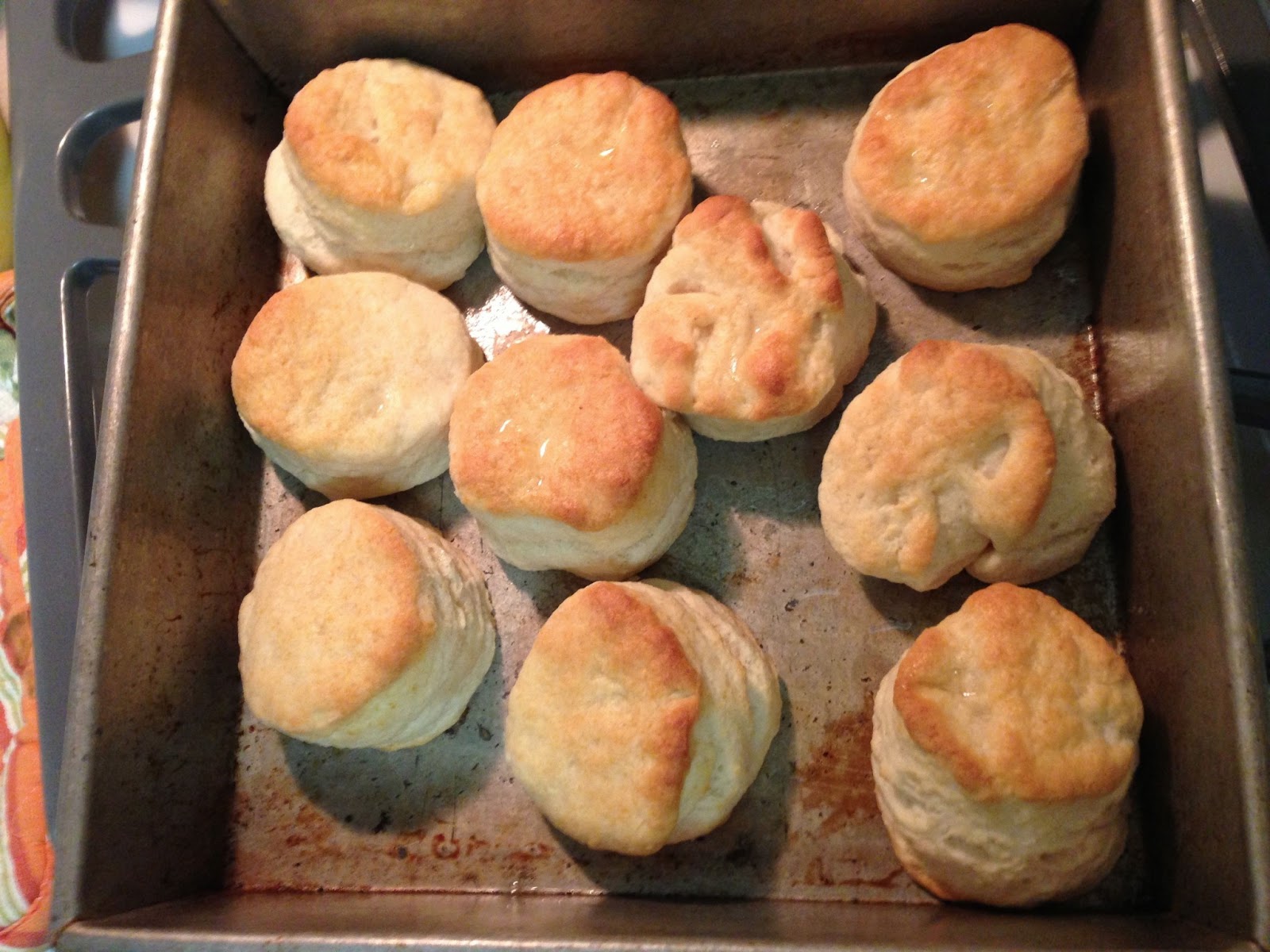
Behold, biscuits! The lumpy-looking ones were made from scraps, and were indeed tougher, but they all tasted good. Southern, even. We had them for breakfast Monday, half sandwiched with sausage and half with jam, and we three Frasers, even the finicky 9-year-old, made short work of ten biscuits.
Though this is a recipe for beginning biscuit makers, I wouldn't call it one for beginning cooks. Sure, there are three ingredients, and it takes maybe fifteen minutes to assemble counting the time spent rummaging for the right pan, but it takes a certain amount of culinary judgement to know when the dough is just right. I doubt I could've pulled it off before I started challenging myself as a cook a few years ago.
May 25, 2013
2013 Reading, Books 49-51
All non-fiction this time out, since the library delivered me a huge stack of holds I'm trying to work my way through...
49) Help, Thanks, Wow: The Three Essential Prayers, by Anne Lamott.
I read this book after Bloodlands through sheer coincidence; they came from the library at the same time. But I'm glad it worked out this way, since Lamott's book was the perfect spiritual refreshment after the long, bleak reminder of the worst humanity is capable of that I'd just completed. It's also perfect for the kind of faith I've been assembling for myself after having lost the airtight certainty of my youthful beliefs--more about holding on to hope and wonder, and, since I've chosen to join an Episcopal church, about experiencing a beautiful tradition and liturgy. The Thanks and Wow chapters in particular helped me remember to stop and revel in the Eternal Now of the current moment, instead of always straining toward a longed-for future when I might be able to quit my day job and write full-time, or else flinching away from the inevitable future in which someday I must die. I found myself reveling in the life all around me, even in the spring pollen that makes me sneeze and coats my pretty black car with an unsightly yellow film. I remembered my favorite lines from For I will Consider My Cat Jeoffry:
...and also quoting one of my favorite lines from a character in the Vorkosigan saga: "Every day is a gift. Me, I tear open the package and wolf it down on the spot," not to mention, of all people, Bon Jovi: "I just want to live while I'm alive."
So I guess you might say the book made an impression on me. Thanks, Anne Lamott!
50) The Normal Bar, by Chrisanna Northrup, Pepper Schwartz, and James Witte.
This is a book of marriage/long-term relationship advice, based on a voluntary survey of couples in long-term relationships. It both describes what's normal in the population surveyed and suggests ways to improve your own relationship's "normal." It's a quick, light read, but gave me enough to think about that I'm thinking of buying my own copy (the one I read is the library's) and trying out some of the suggestions and exercises with Mr. Fraser.
51) The Year Without Summer: 1816 and the Volcano that Darkened the World and Changed History, by William Klingaman and Nicholas P. Klingaman.
This book's two authors, who I believe are father and son, hold PhDs in history and meteorology, and their expertise comes together perfectly in this fascinating account of the 1815 Tambora eruption--the largest volcanic eruption in recorded history--and its disruption of the climate for several years thereafter, but most notably in 1816, when the young United States and much of Western and Central Europe had no summer to speak of. (I understood the history better than the meteorology, but, basically, Europe was unseasonably cold all year and hammered with rain from North Atlantic storms, leading to crop failures, while America got pounded by unseasonable arctic storms--snow in June and July!--interspersed with a cold yet severe drought, again leading to crop failures.) We follow various well-known figures ranging from Lord Byron to John Quincy Adams as they live through a disastrous season in nations already reeling from a severe postwar recession, and get a glimpse of how various governments and their citizens/subjects responded to the crisis. I kept finding parallels to the present day--the British government's debates about how much they could and should help their people were depressingly reminiscent of the current drive for austerity at all costs, and there was apocalyptic fervor, most notably over a prediction that the sun was going out and would die entirely on July 18, ending life on Earth. You see, it was a high sunspot year, and all the ash in the atmosphere made it easer to spot the spots, so...panic! No one at the time realized the real cause of the bad weather, though Benjamin Franklin had speculated decades earlier that volcanic ash could lead to temporary cooling.
As the subtitle states, the world was changed. The crop failures in New England sped the settlement of the Old Northwest--Ohio, Indiana, and Illinois. Mary Shelley wrote Frankenstein. The expectations of what a government should do for its people shifted. The cycle of hunger and disruption in Ireland that culminated in the 1840's potato famine began. And while we don't know as much about the eruption's impact on the Asian climate, the authors speculate that the first cholera pandemic might have been connected to it, when a disease that had evidently been endemic to India already began to spread in early 1817.
49) Help, Thanks, Wow: The Three Essential Prayers, by Anne Lamott.
I read this book after Bloodlands through sheer coincidence; they came from the library at the same time. But I'm glad it worked out this way, since Lamott's book was the perfect spiritual refreshment after the long, bleak reminder of the worst humanity is capable of that I'd just completed. It's also perfect for the kind of faith I've been assembling for myself after having lost the airtight certainty of my youthful beliefs--more about holding on to hope and wonder, and, since I've chosen to join an Episcopal church, about experiencing a beautiful tradition and liturgy. The Thanks and Wow chapters in particular helped me remember to stop and revel in the Eternal Now of the current moment, instead of always straining toward a longed-for future when I might be able to quit my day job and write full-time, or else flinching away from the inevitable future in which someday I must die. I found myself reveling in the life all around me, even in the spring pollen that makes me sneeze and coats my pretty black car with an unsightly yellow film. I remembered my favorite lines from For I will Consider My Cat Jeoffry:
For he counteracts the Devil, who is death, by brisking about the life.
For in his morning orisons he loves the sun and the sun loves him.
For he is of the tribe of Tiger.
For the Cherub Cat is a term of the Angel Tiger.
...and also quoting one of my favorite lines from a character in the Vorkosigan saga: "Every day is a gift. Me, I tear open the package and wolf it down on the spot," not to mention, of all people, Bon Jovi: "I just want to live while I'm alive."
So I guess you might say the book made an impression on me. Thanks, Anne Lamott!
50) The Normal Bar, by Chrisanna Northrup, Pepper Schwartz, and James Witte.
This is a book of marriage/long-term relationship advice, based on a voluntary survey of couples in long-term relationships. It both describes what's normal in the population surveyed and suggests ways to improve your own relationship's "normal." It's a quick, light read, but gave me enough to think about that I'm thinking of buying my own copy (the one I read is the library's) and trying out some of the suggestions and exercises with Mr. Fraser.
51) The Year Without Summer: 1816 and the Volcano that Darkened the World and Changed History, by William Klingaman and Nicholas P. Klingaman.
This book's two authors, who I believe are father and son, hold PhDs in history and meteorology, and their expertise comes together perfectly in this fascinating account of the 1815 Tambora eruption--the largest volcanic eruption in recorded history--and its disruption of the climate for several years thereafter, but most notably in 1816, when the young United States and much of Western and Central Europe had no summer to speak of. (I understood the history better than the meteorology, but, basically, Europe was unseasonably cold all year and hammered with rain from North Atlantic storms, leading to crop failures, while America got pounded by unseasonable arctic storms--snow in June and July!--interspersed with a cold yet severe drought, again leading to crop failures.) We follow various well-known figures ranging from Lord Byron to John Quincy Adams as they live through a disastrous season in nations already reeling from a severe postwar recession, and get a glimpse of how various governments and their citizens/subjects responded to the crisis. I kept finding parallels to the present day--the British government's debates about how much they could and should help their people were depressingly reminiscent of the current drive for austerity at all costs, and there was apocalyptic fervor, most notably over a prediction that the sun was going out and would die entirely on July 18, ending life on Earth. You see, it was a high sunspot year, and all the ash in the atmosphere made it easer to spot the spots, so...panic! No one at the time realized the real cause of the bad weather, though Benjamin Franklin had speculated decades earlier that volcanic ash could lead to temporary cooling.
As the subtitle states, the world was changed. The crop failures in New England sped the settlement of the Old Northwest--Ohio, Indiana, and Illinois. Mary Shelley wrote Frankenstein. The expectations of what a government should do for its people shifted. The cycle of hunger and disruption in Ireland that culminated in the 1840's potato famine began. And while we don't know as much about the eruption's impact on the Asian climate, the authors speculate that the first cholera pandemic might have been connected to it, when a disease that had evidently been endemic to India already began to spread in early 1817.
May 24, 2013
A Dream Defiant cover reveal!
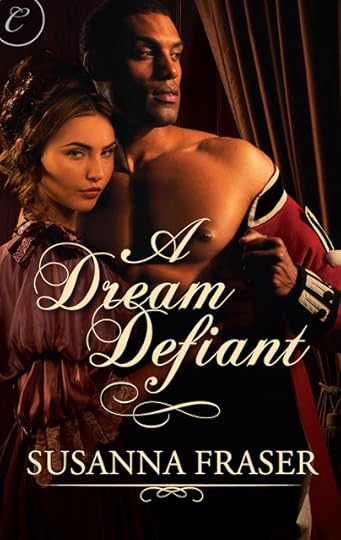
My July 29 release, A Dream Defiant, now has a cover!
Spain, 1813
Elijah Cameron, the son of runaway slaves, has spent his whole life in the British army proving that a black man can be as good a soldier as a white man. After a victory over the French, Elijah promises one of his dying men that he will deliver a scavenged ruby necklace to his wife, Rose, a woman Elijah has admired for years.
Elijah feels bound to protect her and knows a widow with a fortune in jewels will be a target. Rose dreams of using the necklace to return to England, but after a violent attack, she realizes that she needs Elijah's help to make the journey safely.
Her appreciation for Elijah's strength and integrity soon turns into love, but he doubts she could want a life with him, knowing the challenges they'd face. As their relationship grows, she must convince Elijah that she wants him as more than a bodyguard. And she must prove that their love can overcome all obstacles, no matter the color of their skin.
28,000 words
A Dream Defiant is available for preorder now at Amazon, Amazon UK, Google Play, and Barnes & Noble, with more e-tailers to come as my release date approaches.

Spain, 1813
Elijah Cameron, the son of runaway slaves, has spent his whole life in the British army proving that a black man can be as good a soldier as a white man. After a victory over the French, Elijah promises one of his dying men that he will deliver a scavenged ruby necklace to his wife, Rose, a woman Elijah has admired for years.
Elijah feels bound to protect her and knows a widow with a fortune in jewels will be a target. Rose dreams of using the necklace to return to England, but after a violent attack, she realizes that she needs Elijah's help to make the journey safely.
Her appreciation for Elijah's strength and integrity soon turns into love, but he doubts she could want a life with him, knowing the challenges they'd face. As their relationship grows, she must convince Elijah that she wants him as more than a bodyguard. And she must prove that their love can overcome all obstacles, no matter the color of their skin.
28,000 words
A Dream Defiant is available for preorder now at Amazon, Amazon UK, Google Play, and Barnes & Noble, with more e-tailers to come as my release date approaches.
May 17, 2013
2013 reading, books 46-48
46) Rick Steves' France 2013
More early scouting for my 2015 European trip, which continues to fill me with wistfulness that my 4-6 week dream trip of a lifetime (at least half of which will be spent in France) is going to fly by in an instant, and at best I'll see a tiny fraction of what I'd like. At this point the France plan, assuming I'll be coming in from Spain and working my way up to Belgium in time for the Waterloo anniversary, is to settle in to the Dordogne for at least 4 days, where I will eat amazing food and tour every prehistoric cave site open to visitors, head to Paris for another several days of museum and sightseeing, and then see either Normandy and the D-Day beaches or WWI battlefields around Verdun, because I probably won't have time for both. Maybe if money and work leave allow the 6-week trip, I'll be able to add Provence...or just spend more time in Paris!
47) The Way Back Home, by Barbara Freethy.
Chosen for my 2013 Rita-finalist reading challenge. Detailed commentary here.
48) Bloodlands: Europe Between Hitler and Stalin, by Timothy Snyder.
A dense, dark recounting of the mass murder of fourteen million people in twelve years (between 1932 and 1945) by Stalin's Soviet Union and Hitler's Germany in what the author describes as "the bloodlands"--i.e. those parts of Eastern Europe that fell under both Hitler's and Stalin's sway over the course of the era, basically Poland, the Ukraine, Belarus, Lithuania, Latvia, Estonia, and western Russia. Where most histories treat the various waves of murder as separate events, Snyder shows them as a kind of continuous flow from the collectivism famine in the Ukraine in the early 30's on through to the Holocaust. It's hard to take in, too horrific to make sense of, but I'm glad I read it nonetheless. And I like Snyder's closing point that it's not so much fourteen million victims dead as fourteen million times one lives ended--that each one of those people was an individual with a unique life and aspirations cut short, and the best way to honor them is to remember that, to not let them become a mass of dead as Stalin and Hitler wanted them to be.
May 15, 2013
2013 TBR Challenge - Sweet Awakening
The May theme for the 2013 TBR Challenge was More Than One--i.e. books by an author with more than one work in your TBR pile. I had many choices, especially after my discovery last month of a box in the basement, unopened since we moved into this house back in 2010, containing most of my old, pre-Kindle TBR shelf.
As a result, this month's book, Sweet Awakening, is the first book I've read for this challenge that isn't available as an e-book, though if it sounds like your kind of thing, it looks like there are plenty of affordable used copies out there.
I've read 2 or 3 of Farrell's books already, and I always enjoy them as a change of pace. They tend to cover a longer time period than today's historical romances, and though the central love story is important to the plot, they often have saga or adventure elements that might get them tagged as "mainstream with strong romantic elements" in today's hyper-niched market.
This book was a harrowing read, but I found it hard to put down. The heroine, Clare, was always expected to marry her childhood friend, Giles--and she expected the same until she was swept off her feet by a dashing, mysterious, intense, and darkly handsome aristocrat. The new man, Justin, has all the usual romance hero markers, until after Clare marries him. Even then all is wonderful at first, but soon he shows his true colors as a jealous abuser, especially while drunk. Eventually Clare kills him in self-defense, and Giles is there for her to help her pick up the pieces. But after all she's been through, it isn't easy for her to learn how to function in a healthy relationship, or for him to accept that he can't make it as if her years with Justin never happened.
It was painful to watch Clare keep forgiving Justin and letting him back into her bed and her life. I know she had fewer options than a modern woman in her situation, but she still could've returned to her parents, gone into hiding, etc. But I also know her behavior isn't uncommon, even now, and Farrell made me understand the combination of hope and despair that might make a woman forgive the unforgivable better than I ever have before.
Though I definitely enjoyed the book, it would be remiss of me not to include two caveats, one serious, one less so:
1. The abuse is graphically described enough that I expect it would be very triggering to some readers.
2. I forgave certain anachronisms and errors (e.g. incorrect titles and forms of address) I'd normally have very little patience for because the story and characters worked so well for me.
As a result, this month's book, Sweet Awakening, is the first book I've read for this challenge that isn't available as an e-book, though if it sounds like your kind of thing, it looks like there are plenty of affordable used copies out there.

I've read 2 or 3 of Farrell's books already, and I always enjoy them as a change of pace. They tend to cover a longer time period than today's historical romances, and though the central love story is important to the plot, they often have saga or adventure elements that might get them tagged as "mainstream with strong romantic elements" in today's hyper-niched market.
This book was a harrowing read, but I found it hard to put down. The heroine, Clare, was always expected to marry her childhood friend, Giles--and she expected the same until she was swept off her feet by a dashing, mysterious, intense, and darkly handsome aristocrat. The new man, Justin, has all the usual romance hero markers, until after Clare marries him. Even then all is wonderful at first, but soon he shows his true colors as a jealous abuser, especially while drunk. Eventually Clare kills him in self-defense, and Giles is there for her to help her pick up the pieces. But after all she's been through, it isn't easy for her to learn how to function in a healthy relationship, or for him to accept that he can't make it as if her years with Justin never happened.
It was painful to watch Clare keep forgiving Justin and letting him back into her bed and her life. I know she had fewer options than a modern woman in her situation, but she still could've returned to her parents, gone into hiding, etc. But I also know her behavior isn't uncommon, even now, and Farrell made me understand the combination of hope and despair that might make a woman forgive the unforgivable better than I ever have before.
Though I definitely enjoyed the book, it would be remiss of me not to include two caveats, one serious, one less so:
1. The abuse is graphically described enough that I expect it would be very triggering to some readers.
2. I forgave certain anachronisms and errors (e.g. incorrect titles and forms of address) I'd normally have very little patience for because the story and characters worked so well for me.