Susanna Fraser's Blog, page 19
April 15, 2013
A Dream Defiant - now available for preorder on Amazon!
I still don't have a cover for my July 29 release, A Dream Defiant, but it's now available for preorder on Amazon.
Spain, 1813
Elijah Cameron, the son of runaway slaves, has spent his whole life in the British army proving that a black man can be as good a soldier as a white man. After a victory over the French, Elijah promises one of his dying men that he will deliver a scavenged ruby necklace to his wife, Rose, a woman Elijah has admired for years.
Elijah feels bound to protect her and knows a widow with a fortune in jewels will be a target. Rose dreams of using the necklace to return to England, but after a violent attack, she realizes that she needs Elijah's help to make the journey safely.
Her appreciation for Elijah's strength and integrity soon turns into love, but he doubts she could want a life with him, knowing the challenges they'd face. As their relationship grows, she must convince Elijah that she wants him as more than a bodyguard. And she must prove that their love can overcome all obstacles, no matter the color of their skin.
28,000 wordsI'll post the cover as soon as I get it. Also, Amazon always posts books for preorder way ahead of anyone else, but like my other books, this will be available wherever ebooks are sold in due course.


April 14, 2013
2013 Reading, Books 34-36
34) Ghost Planet, by Sharon Lynn Fisher. Part of my Rita-finalist reading project, and already blogged about here.
35) Race, Sex, and Social Order in Early New Orleans, by Jennifer Spear.
Friday night I left this book on the dining room table while I was getting dinner ready, and as I brought my 9-year-old daughter's plate to the table, she looked at me in some indignation and pointed to the book. I got it from the University of Washington library, and it's in the dullest academic binding imaginable, with no cover image at all. So I asked her what was wrong, and she pointed more specifically to the word "Sex" printed on the spine. I informed her that in this case "sex" just meant gender, whether you're a man or a woman, and that the book was about how being male or female and the color of your skin impacted your life in 18th century New Orleans. At that point she looked suitably bored.
That said, the book didn't bore me. It covers how interracial relationships evolved and how they were conceptualized from New Orleans' earliest years on into the mid-19th century, an extremely relevant topic for my current work-in-progress set in 1815, whose heroine is a mixed-race fourth generation native of the city. However, it is a dryly academic work that assumes its reader has a decent grounding in the city's colonial history, so it's hardly a general-interest book.
36) Hominids, by Robert J. Sawyer.
A fascinating science fiction novel wherein, in a parallel world, Neanderthals rather than Homo sapiens are the sole surviving hominids. Neanderthal physicist Ponter Boddit accidentally passes through a portal to our Earth, leading to parallel plots as our world tries to figure out what to make of him (and he, of us) and his family and friends try to figure out what happened to him--his partner is accused of murder. I read the book in one sitting this morning, and I'll definitely get the sequel. That said, I thought the Neanderthal society was almost too ideal to be believed, in contrast to our species' warring, overpopulating, and environment-degrading ways, and I thought the use of rape as a plot device was much too heavy-handed. (One of the major Homo sapiens characters is raped by a stranger early in the book, in a scene graphic enough that I expect it would be triggering for quite a few readers.)
35) Race, Sex, and Social Order in Early New Orleans, by Jennifer Spear.
Friday night I left this book on the dining room table while I was getting dinner ready, and as I brought my 9-year-old daughter's plate to the table, she looked at me in some indignation and pointed to the book. I got it from the University of Washington library, and it's in the dullest academic binding imaginable, with no cover image at all. So I asked her what was wrong, and she pointed more specifically to the word "Sex" printed on the spine. I informed her that in this case "sex" just meant gender, whether you're a man or a woman, and that the book was about how being male or female and the color of your skin impacted your life in 18th century New Orleans. At that point she looked suitably bored.
That said, the book didn't bore me. It covers how interracial relationships evolved and how they were conceptualized from New Orleans' earliest years on into the mid-19th century, an extremely relevant topic for my current work-in-progress set in 1815, whose heroine is a mixed-race fourth generation native of the city. However, it is a dryly academic work that assumes its reader has a decent grounding in the city's colonial history, so it's hardly a general-interest book.
36) Hominids, by Robert J. Sawyer.
A fascinating science fiction novel wherein, in a parallel world, Neanderthals rather than Homo sapiens are the sole surviving hominids. Neanderthal physicist Ponter Boddit accidentally passes through a portal to our Earth, leading to parallel plots as our world tries to figure out what to make of him (and he, of us) and his family and friends try to figure out what happened to him--his partner is accused of murder. I read the book in one sitting this morning, and I'll definitely get the sequel. That said, I thought the Neanderthal society was almost too ideal to be believed, in contrast to our species' warring, overpopulating, and environment-degrading ways, and I thought the use of rape as a plot device was much too heavy-handed. (One of the major Homo sapiens characters is raped by a stranger early in the book, in a scene graphic enough that I expect it would be triggering for quite a few readers.)
April 11, 2013
Susanna reads the Ritas: Best First Book
A few weeks ago Romance Writers of America announced the 2013 finalists for the Rita awards. I judged four entries this year, and thought two of them so strong that I was disappointed not to see them among the finalists. And I was a bit dismayed to discover I hadn't read ANY of the books that made the cut.
I figured that as a romance author, I should educate myself about what a jury of my author peers has judged the best the genre had to offer in 2012. I'm not going to read ALL the finalists. I counted 81 on the list, and I'm just too busy between the day job and my own writing commitments to take that on. In a typical year I finish about 100-125 books, not counting re-reads, and I'd like to leave a certain amount of room for books chosen just because they sound cool or intriguing or are the latest release by a beloved author, you know?
So I'm going to read one book per category, one category per month. There are 11 categories, so I should finish up just in time to see how many of the 2014 finalists I've read...

Since alphabetical is good an order as any, I started with the finalists for Best First Book and chose Ghost Planet, by Sharon Lynn Fisher. I enjoyed it, though the romance is better developed than the science fiction premise. It's not that I'm asking for plausible science, per se--I was happy with the premise that a newly discovered barren world was spontaneously generating an Earthlike environment, even down to Earth life forms that hadn't been imported there, and intrigued that it went as far as providing each human with a "ghost"--a corporeal revenant of some dead person from their past. It's the kind of premise I'd expect for, say, a Star Trek: Next Gen episode, and I loved Next Gen. No, my only problem was that after setting up such a cool premise, the second half of the book is almost all romance and action plot, when I would've liked a little more exploration of the wonder of seeing a fresh, unpolluted Earth springing to life and more exploration of the philosophical issues and long-term implications of the ghosts. E.g. if a ghost is killed, it comes back, at least if its human host still lives--what are the limitations of that? Will they age normally and die natural deaths? Will the planet be swamped by colonists hoping to get their dead children/lovers/etc., and how will that shape the society? Can the ghosts visit Earth? If they do, will they still regenerate if killed? At least at this point there's no sequel in the works, so the loose ends that bugged me won't be tied anytime soon. That said, I do think this is an excellent debut, and I can definitely see myself reading more books by Fisher.
Next month, Contemporary Single Title.
I figured that as a romance author, I should educate myself about what a jury of my author peers has judged the best the genre had to offer in 2012. I'm not going to read ALL the finalists. I counted 81 on the list, and I'm just too busy between the day job and my own writing commitments to take that on. In a typical year I finish about 100-125 books, not counting re-reads, and I'd like to leave a certain amount of room for books chosen just because they sound cool or intriguing or are the latest release by a beloved author, you know?
So I'm going to read one book per category, one category per month. There are 11 categories, so I should finish up just in time to see how many of the 2014 finalists I've read...

Since alphabetical is good an order as any, I started with the finalists for Best First Book and chose Ghost Planet, by Sharon Lynn Fisher. I enjoyed it, though the romance is better developed than the science fiction premise. It's not that I'm asking for plausible science, per se--I was happy with the premise that a newly discovered barren world was spontaneously generating an Earthlike environment, even down to Earth life forms that hadn't been imported there, and intrigued that it went as far as providing each human with a "ghost"--a corporeal revenant of some dead person from their past. It's the kind of premise I'd expect for, say, a Star Trek: Next Gen episode, and I loved Next Gen. No, my only problem was that after setting up such a cool premise, the second half of the book is almost all romance and action plot, when I would've liked a little more exploration of the wonder of seeing a fresh, unpolluted Earth springing to life and more exploration of the philosophical issues and long-term implications of the ghosts. E.g. if a ghost is killed, it comes back, at least if its human host still lives--what are the limitations of that? Will they age normally and die natural deaths? Will the planet be swamped by colonists hoping to get their dead children/lovers/etc., and how will that shape the society? Can the ghosts visit Earth? If they do, will they still regenerate if killed? At least at this point there's no sequel in the works, so the loose ends that bugged me won't be tied anytime soon. That said, I do think this is an excellent debut, and I can definitely see myself reading more books by Fisher.
Next month, Contemporary Single Title.
April 10, 2013
Random Cookbook of the Week: New Covent Garden Soup Company's Book of Soups
As I may have mentioned here, Mr. Fraser and I met in England, though we're both American, as part of a volunteer program that placed young adults from around Europe in North America in various British nonprofits. During our year there he picked up The New Covent Garden Soup Company's Book of Soups. To date I've tried two recipes from it, and both turned out winners, so it qualifies for me as a cookbook deserving more attention.
This weekend I made...
Grandad Elf's Spring Herb Soup
25 g (1 oz) butter
1 large onion, finely chopped
1 garlic clove, crushed
1 stick celery, finely chopped
110 g (4 oz) lentils
1.2 liters (2 pints) vegetable stock (I made a homemade batch)
225 g (8 oz) fresh spinach
1 T each chopped Italian parsley, chives, tarragon, thyme, and marjoram
1 t lemon juice
150 ml (1/4 pint) Greek yogurt
salt & freshly ground black pepper
Melt the butter and cook the onion, garlic, and celery gently for a few minutes in a covered saucepan, without coloring. Add the lentils and stir to coat well. Add the stock, cover, bring to a boil and simmer for about 20-30 minutes until the lentils are soft. Reserving 1 t. of the chopped herbs for garnish, add the spinach and remaining herbs to the soup and cook for 1 minute until the spinach has wilted. Cool a little, then puree the soup along with the lemon juice and most of the yogurt, reserving 6 t. of the yogurt and the remainder of the chopped herbs for garnish.
This was a nice recipe, not the best thing I've ever made, but a bright, springlike soup that even with all the chopping time involved was quick and straightforward to make. I forgot to take a picture, unfortunately.
This weekend I made...
Grandad Elf's Spring Herb Soup
25 g (1 oz) butter
1 large onion, finely chopped
1 garlic clove, crushed
1 stick celery, finely chopped
110 g (4 oz) lentils
1.2 liters (2 pints) vegetable stock (I made a homemade batch)
225 g (8 oz) fresh spinach
1 T each chopped Italian parsley, chives, tarragon, thyme, and marjoram
1 t lemon juice
150 ml (1/4 pint) Greek yogurt
salt & freshly ground black pepper
Melt the butter and cook the onion, garlic, and celery gently for a few minutes in a covered saucepan, without coloring. Add the lentils and stir to coat well. Add the stock, cover, bring to a boil and simmer for about 20-30 minutes until the lentils are soft. Reserving 1 t. of the chopped herbs for garnish, add the spinach and remaining herbs to the soup and cook for 1 minute until the spinach has wilted. Cool a little, then puree the soup along with the lemon juice and most of the yogurt, reserving 6 t. of the yogurt and the remainder of the chopped herbs for garnish.
This was a nice recipe, not the best thing I've ever made, but a bright, springlike soup that even with all the chopping time involved was quick and straightforward to make. I forgot to take a picture, unfortunately.
April 7, 2013
2013 Reading, Books 31-33
31) The Generals: American Military Command from World War II to Today, by Thomas Ricks.
I caught part of an author interview on NPR and determined to read this book, even though in general the second half of the 20th century isn't a corner of history that holds much interest for me. (Part of that is because it doesn't really seem like history--I was born in 1971, so I remember world events from, oh, 1979 or so on pretty clearly, albeit with the skewed perspective of having been a kid and therefore having absorbed unquestioningly my family and community's beliefs until I left home at 18.)
I'm glad I made the effort to read it. I feel like I have a much better understanding of the Korean and Vietnam Wars, which I've never much studied, and even of the First and Second Gulf Wars and the war in Afghanistan, which I lived through as an adult but focused on the politics rather than how effective the military was and what caused its weaknesses.
To sum up very succinctly, the WWII US Army was about as effective as an army could be, largely due to the leadership of Marshall and Eisenhower. But it imploded quickly, with the nadir of Vietnam, largely because of failures of leadership--the Army tended to award organization men who knew how to go along to get along rather than thoughtful, assertive leaders who understood strategy and where each war fit into national and world interest, and they failed to quickly relieve generals who couldn't hack it. After Vietnam the Army recovered tactically, such that the enlisted personnel and lower-ranking officers are excellent, but the system is still largely failing to produce gifted strategists to fill the rank of general.
Definitely a worthwhile read for anyone interested in military history or who wants to look at the last 60-70 years from another angle.
32) The Midwife, by Carolyn Davidson. My April read for Wendy the Super Librarian's 2013 TBR challenge. More detail to come April 17.
33) Suffering Succotash: A Picky Eater's Quest to Understand Why We Hate the Foods We Hate, by Stephanie V.W. Lucianovic.
I'm a recovering picky eater. As a child, I practically lived on Campbell's Chunky Chicken Noodle Soup, fried chicken (only I mostly ate the crust and left the meat behind), black-eyed peas (but all other legumes, especially lima beans, were GROSS), white bread wadded up into a ball (WHY, child me, WHY?), biscuits, chocolate milk, and a very narrow range of other foods. I still can't figure out how I managed to grow up 5'7" (average for a woman in my family), intelligent, and healthy rather than stunted, dull, and brittle-boned. Who knows? Maybe I was meant to be 6'0", have Nobel-prize-winner brains, and never to suffer from mild asthma. Or maybe the human body is more resilient than we generally think.
Now if anything I'm a foodie, though I still have some aversions I'm fighting to overcome--e.g. to me most fish has an off-puttingly squishy texture and tastes like a beach town smells on a hot, windless day--and I've decided I'm really not missing anything by avoiding brussel sprouts, asparagus, and desserts with raisins in them. I've never been tested for it, but given my dislike of coffee and beer (seriously, how can anyone stand anything that bitter?) I suspect I'm a supertaster. But within those constraints I'm an adventurous eater who'll try just about any cuisine, spice, or flavor combination.
And now I'm raising a picky 9-year-old. She's better than I was with fruits and vegetables--as long as they're raw and plain--but I worry how little protein she eats. She barely eats meat and doesn't like beans, which leaves her with peanut butter, yogurt, and milk. I want her to eat more variety so it'll be easier to feed her and take her to restaurants, and so she'll enjoy the pleasures of the table--and also because despite the fact she's tall for her age, has only had to stay home sick once this year, and just tested into the gifted program, I'm still afraid she'll turn up stunted, dull, and brittle-boned. I parent, therefore I worry.
This is more a light, quick read than an in-depth study with step-by-step recommendations for overcoming your own and your child's pickiness, but I liked its emphasis on never treating pickiness--your own or others'--as a character flaw. I mean, it's not like I find fish squishy and smelly on purpose, it just IS for me. I didn't choose my taste buds and my sense of smell any more than I chose to have brown eyes, straight hair, or astigmatism. It also made me realize how much of Miss Fraser's pickiness seems to be about control, so I'm going to phase out our one-bite rule, because she always and only takes one bite of ANYTHING not on her narrow preferred list. Even if she thinks it's OK, she never eats more. So I think that's control--we can make her eat one bite, but she won't let us convince her to LIKE cheese or steak or cooked broccoli or whatever. I think from now on we just put new foods on her plate along with at least one food we know she'll eat, even if that's just a slice of wheat bread or a handful of cherry tomatoes, and talk about the meal, how it was cooked, and how it tastes to us. When she's ready, she'll try more. If health becomes an issue, that's a different story, but for now her picky diet seems to be enough to keep her growing, and slightly on the slim side but not unhealthily thin, so I should probably worry less. (Heh. Yeah, right.)
April 3, 2013
Random Cookbook is back! The Best Recipes in the World
Even though I'm still busier than usual, I decided I missed randomly cooking. All work and no play and all that.
So, this week I drew The Best Recipes in the World, by Mark Bittman, wherein he offers a sampling of recipes from the great world cuisines made accessible for the home cook. (It's a long cookbook.)
Busy as I am, I wanted something with a nice short ingredient list, so I selected...
Chicken With Vinegar
(A French peasant classic, though Bittman cut the butter content from a whole stick to two measly tablespoons plus an optional extra.)
- 2 T butter or olive oil (I used butter)
- 1 chicken, 3-4 lbs, cut into serving pieces, or 2 1/2 to 3 lbs chicken parts, trimmed of excess fat (I used ~2.5 lbs of drumsticks and thighs)
- Salt and black pepper to taste
- 1/4 c. minced shallot
- 1 c. good-quality red wine vinegar
- 1 T butter, optional (I exercised the option)
Preheat the oven to 450 F. Set a large skillet, preferably with steep sides, over medium-high heat. Add 2 T butter and wait a minute. When it is good and hot, place the chicken in the skillet, skin side down. Cook undisturbed for about 5 minutes, or until the chicken is nicely browned. Turn and cook for three minutes on the other side. Season with salt and pepper.
(I did this step in two batches, because even though all the pieces fit in my skillet, I didn't want to brown them all at once because the pan would've been too crowded and they wouldn't have had as much of a Maillard reaction.)
Place the chicken in the oven. Cook 15-20 minutes, or until it is just about done (the juices will run clear, and there will be the barest trace of pink near the bone). Transfer the chicken to an ovenproof platter and place the platter in the oven; turn off the oven and leave the door slightly ajar.
Pour most but not all of the cooking juices out of the skillet. Place the skillet over medium-high heat and add the shallot, sprinkle with a little salt and pepper and cook, stirring until tender, about 2 minutes. Add the vinegar and raise the heat to high. Cook for a minute or two, or until the powerful smell has subsided somewhat. Add 1/2 c. water and cook for another 2 minutes, stirring, until the mixture is slightly reduced and somewhat thickened. Stir in butter if desired.
Return the chicken and any accumulated juices to the skillet and turn the chicken in the sauce. Serve immediately.
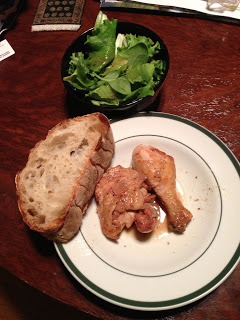
Not too exciting to look at, but this is a very good recipe--straightforward and simple but with a distinctive, interesting taste. I bet it'd be AMAZING with the full stick of butter, but I'm on Weight Watchers (I've lost 25 lbs since December 1!), so I should probably stick to this version.
So, this week I drew The Best Recipes in the World, by Mark Bittman, wherein he offers a sampling of recipes from the great world cuisines made accessible for the home cook. (It's a long cookbook.)
Busy as I am, I wanted something with a nice short ingredient list, so I selected...
Chicken With Vinegar
(A French peasant classic, though Bittman cut the butter content from a whole stick to two measly tablespoons plus an optional extra.)
- 2 T butter or olive oil (I used butter)
- 1 chicken, 3-4 lbs, cut into serving pieces, or 2 1/2 to 3 lbs chicken parts, trimmed of excess fat (I used ~2.5 lbs of drumsticks and thighs)
- Salt and black pepper to taste
- 1/4 c. minced shallot
- 1 c. good-quality red wine vinegar
- 1 T butter, optional (I exercised the option)
Preheat the oven to 450 F. Set a large skillet, preferably with steep sides, over medium-high heat. Add 2 T butter and wait a minute. When it is good and hot, place the chicken in the skillet, skin side down. Cook undisturbed for about 5 minutes, or until the chicken is nicely browned. Turn and cook for three minutes on the other side. Season with salt and pepper.
(I did this step in two batches, because even though all the pieces fit in my skillet, I didn't want to brown them all at once because the pan would've been too crowded and they wouldn't have had as much of a Maillard reaction.)
Place the chicken in the oven. Cook 15-20 minutes, or until it is just about done (the juices will run clear, and there will be the barest trace of pink near the bone). Transfer the chicken to an ovenproof platter and place the platter in the oven; turn off the oven and leave the door slightly ajar.
Pour most but not all of the cooking juices out of the skillet. Place the skillet over medium-high heat and add the shallot, sprinkle with a little salt and pepper and cook, stirring until tender, about 2 minutes. Add the vinegar and raise the heat to high. Cook for a minute or two, or until the powerful smell has subsided somewhat. Add 1/2 c. water and cook for another 2 minutes, stirring, until the mixture is slightly reduced and somewhat thickened. Stir in butter if desired.
Return the chicken and any accumulated juices to the skillet and turn the chicken in the sauce. Serve immediately.

Not too exciting to look at, but this is a very good recipe--straightforward and simple but with a distinctive, interesting taste. I bet it'd be AMAZING with the full stick of butter, but I'm on Weight Watchers (I've lost 25 lbs since December 1!), so I should probably stick to this version.
March 27, 2013
2013 Reading, Books 28-30
28) Sidelines, by Lois McMaster Bujold.
Last week was an exhausting week in a stressful month--and, in probably not unrelated news, a week of both writer's block and reading drought. Reading this collection of essays, talks, blog posts, etc. by one of my favorite authors helped me break out of both problems. The short pieces on already-familiar works held my attention, and Bujold's thoughts on writing helped me look at my WIP with a new eye.
29) Riders of the Purple Sage, by Zane Grey.
I don't consider myself a fan of Westerns, and I've read very little in the genre. But some readers whose taste I trust mentioned this as an interesting book, so I gave it a try. And...it's interesting. It has a lush, old-fashioned style that kept me at something of a distance from the characters and their story. Though I'm not sure "old-fashioned" is the best way to describe it--I mean, Jane Austen wrote a good century earlier, and I never feel distanced from HER characters, nor do I from LM Montgomery's, who was a contemporary of Grey's. Anyway, Riders of the Purple Sage was interesting as an artifact of its time and a classic of its genre, but I'm not champing at the bit to read more like it.
30) Avatar: The Last Airbender - The Search, Part 1, by Gene Luen Yang, Michael Dante DiMartino, Bryan Konietzko, Gurihiru, Dave Marshall.
First volume in a new series of graphic novels set between Avatar: The Last Airbender and The Legend of Korra, and promising to solve the biggest mystery in the series--the fate of Zuko's mother. I enjoyed it and can hardly wait for the next volume in July...but mainly I'm dying to find other readers who've finished it so I can talk about the big wham reveal/cliffhanger on the last page and what it means for Zuko and the Fire Nation. (I'm torn between, "Wow, that explains so much," and "Wow, what a cop-out," and I can't decide whether I like the message of the story and Zuko's Hero's Journey better or worse with the new information in hand.)
March 20, 2013
2013 TBR Challenge - Hot Under Pressure
March's theme for the 2013 TBR Challenge was Series Catch-Up, an appealing one for me because I do tend to hoard books in romance series I enjoy against reading droughts, long flights, etc.--any situation where I know I'll want a reliably good book. So I wasn't lacking for choices for this one.
(In other genres, I'm a lot more likely to inhale a new book in a series within days or even hours of its release because the previous volume probably ended on a cliffhanger, or at least with tons of unanswered questions that have been bugging me for months or YEARS. Since romances have to at least feature a happy ending for that book's central characters, there's less of that "FINALLY a new book, must read NOW!" stress.)
Anyway, this month my selection was...
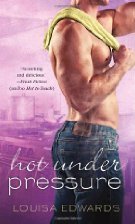
23) Hot Under Pressure, by Louisa Edwards.
This book is the third in a trilogy about restaurant teams competing in a Rising Star Chef competition.
I don't read a lot of contemporary romance, in large part because so much of the subgenre runs to hymns to the glories of small town life. I grew up in a small town. I went to college in Philadelphia and have settled down to live my adult life in Seattle. Never, in all the times I've gone back to my hometown, have I felt the slightest hunger to hook up with an old flame or to turn my back on my empty urban existence for the authentic community of people I'm probably some kind of distant cousin to, what with Great-Great-Granddaddy Stone's 17 children who married into practically every family in the southeast corner of our county. I can relate to Barrayar and Narnia and Terre d'Ange and any number of invented fantastical worlds. To small town romances, not so much.
Which is a big reason why one of my few contemporary romance autobuy authors is Louisa Edwards. Her stories of love among young, elite chefs are hymns to the glories of city life, of how found family can be even more important than the one you were born into. And, they're about food and cooking, which is close behind books and history on my personal obsessions list. Hot Under Pressure is a worthy final installment to the Rising Star Chef series. It's a second chance story about a couple who married very young, only to be driven apart by tragedy...until a decade or so later they find themselves competing against each other in the finals, representing their New York and San Francisco restaurants.
(In other genres, I'm a lot more likely to inhale a new book in a series within days or even hours of its release because the previous volume probably ended on a cliffhanger, or at least with tons of unanswered questions that have been bugging me for months or YEARS. Since romances have to at least feature a happy ending for that book's central characters, there's less of that "FINALLY a new book, must read NOW!" stress.)
Anyway, this month my selection was...
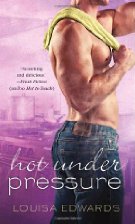
23) Hot Under Pressure, by Louisa Edwards.
This book is the third in a trilogy about restaurant teams competing in a Rising Star Chef competition.
I don't read a lot of contemporary romance, in large part because so much of the subgenre runs to hymns to the glories of small town life. I grew up in a small town. I went to college in Philadelphia and have settled down to live my adult life in Seattle. Never, in all the times I've gone back to my hometown, have I felt the slightest hunger to hook up with an old flame or to turn my back on my empty urban existence for the authentic community of people I'm probably some kind of distant cousin to, what with Great-Great-Granddaddy Stone's 17 children who married into practically every family in the southeast corner of our county. I can relate to Barrayar and Narnia and Terre d'Ange and any number of invented fantastical worlds. To small town romances, not so much.
Which is a big reason why one of my few contemporary romance autobuy authors is Louisa Edwards. Her stories of love among young, elite chefs are hymns to the glories of city life, of how found family can be even more important than the one you were born into. And, they're about food and cooking, which is close behind books and history on my personal obsessions list. Hot Under Pressure is a worthy final installment to the Rising Star Chef series. It's a second chance story about a couple who married very young, only to be driven apart by tragedy...until a decade or so later they find themselves competing against each other in the finals, representing their New York and San Francisco restaurants.
March 17, 2013
Five favorite books you've (probably) never heard of
A couple of weeks back, fellow Carina author Veronica Scott challenged me to a Five Favorite Books meme. Since I find it all but impossible to narrow it down to just five for all time out of all the books I've ever read, I toyed with various ways to limit the list. Five Favorite Historical Romances. Five Favorite Non-Historical Romances. Five Favorite Classics. Five Favorite Kids' Books. Five Favorite Research Sources. Etc. (And now that I think about it, I can do just that for future posts, whenever I'm stuck for something to blog about. Win!)
But for this challenge I decided to do Five Favorite Books You've (Probably) Never Heard Of. OK, it's not like I'm the only literary omnivore out there, so you may have heard of some of them. But if anyone else out there has read and loved all these books, you're my long-lost sister or brother, and I want to compare libraries with you next time I'm stuck for what to read next.
1) In This House of Brede, by Rumer Godden.
I'm a married Episcopalian romance novelist, so you wouldn't expect me to be the target market for a book about a woman who leaves behind a high-powered career (at least, by 1950's standards) in her 40's to become a Benedictine nun. But this is a gorgeously written book whose characters and their community spring to life on the page. I've re-read it more times than I can count, and I expect to go back to it again and again in the years to come.
2) The Jennie trilogy, by Elisabeth Ogilvie.
Jennie, About to BeThe World of Jennie G.Jennie GlenroyThis trilogy, sadly, is out-of-print and unavailable as e-books, but there seem to be plenty of affordable used copies on Amazon. I read and adored the first two books from my hometown library when I was in high school and later picked up the whole trilogy at a library book sale.
If you like my books (and maybe you do, since you're reading my blog!), there's a good chance you'll like these, even though they're historical fiction with romantic elements rather than romance. They're Regency in time period but not in tone, the heroine is gentry rather than aristocratic, and the hero...well, I'm not going to give you spoilers! The first book is largely set in Scotland, and Scottish culture pervades all three.
3) Wellington: The Years of the Sword, by Elizabeth Longford.
My favorite Wellington biography. (Between being a military history geek and research I did for the alternative history that's my book-under-the-bed, I own several. I know. I'm quite aware what a big geek I am.) It's a beautifully written, human portrait of a fascinating man.
4) The Old Buzzard Had It Coming, by Donis Casey.
This one you can buy for your Kindle or Nook, and right now it's only $0.99 as an e-book! First in a mystery series set in rural Oklahoma in the early 20th century, with an amateur sleuth who's the mother of nine children on a farm. It sounds too unlikely to work, but IMHO it does. The voice is lovely, with lots of historical detail and texture.
5) Nathan Hale's Hazardous Tales, by Nathan Hale (and yes, that's his real name).
One Dead SpyBig Bad IroncladDonner Dinner Party (available for preorder)
These fall into the select category of books Miss Fraser and I love equally, though at age 8 she's the one in their target market. They're graphic novels about American history, with the conceit that Nathan Hale (the spy one, not the author) as he's about to be hanged is taken up into a history book, where he sees what's to come for the new nation. With his newfound knowledge, he delays his execution by telling stories to his hangman and the British officer there to supervise. They're equal parts hilarious and historical. I'm not sure I'd recommend them if you don't have a kid (or niece, nephew, grandchild, etc.) to share them with, but if you do, buy them now.
But for this challenge I decided to do Five Favorite Books You've (Probably) Never Heard Of. OK, it's not like I'm the only literary omnivore out there, so you may have heard of some of them. But if anyone else out there has read and loved all these books, you're my long-lost sister or brother, and I want to compare libraries with you next time I'm stuck for what to read next.
1) In This House of Brede, by Rumer Godden.
I'm a married Episcopalian romance novelist, so you wouldn't expect me to be the target market for a book about a woman who leaves behind a high-powered career (at least, by 1950's standards) in her 40's to become a Benedictine nun. But this is a gorgeously written book whose characters and their community spring to life on the page. I've re-read it more times than I can count, and I expect to go back to it again and again in the years to come.
2) The Jennie trilogy, by Elisabeth Ogilvie.
Jennie, About to BeThe World of Jennie G.Jennie GlenroyThis trilogy, sadly, is out-of-print and unavailable as e-books, but there seem to be plenty of affordable used copies on Amazon. I read and adored the first two books from my hometown library when I was in high school and later picked up the whole trilogy at a library book sale.
If you like my books (and maybe you do, since you're reading my blog!), there's a good chance you'll like these, even though they're historical fiction with romantic elements rather than romance. They're Regency in time period but not in tone, the heroine is gentry rather than aristocratic, and the hero...well, I'm not going to give you spoilers! The first book is largely set in Scotland, and Scottish culture pervades all three.
3) Wellington: The Years of the Sword, by Elizabeth Longford.
My favorite Wellington biography. (Between being a military history geek and research I did for the alternative history that's my book-under-the-bed, I own several. I know. I'm quite aware what a big geek I am.) It's a beautifully written, human portrait of a fascinating man.
4) The Old Buzzard Had It Coming, by Donis Casey.
This one you can buy for your Kindle or Nook, and right now it's only $0.99 as an e-book! First in a mystery series set in rural Oklahoma in the early 20th century, with an amateur sleuth who's the mother of nine children on a farm. It sounds too unlikely to work, but IMHO it does. The voice is lovely, with lots of historical detail and texture.
5) Nathan Hale's Hazardous Tales, by Nathan Hale (and yes, that's his real name).
One Dead SpyBig Bad IroncladDonner Dinner Party (available for preorder)
These fall into the select category of books Miss Fraser and I love equally, though at age 8 she's the one in their target market. They're graphic novels about American history, with the conceit that Nathan Hale (the spy one, not the author) as he's about to be hanged is taken up into a history book, where he sees what's to come for the new nation. With his newfound knowledge, he delays his execution by telling stories to his hangman and the British officer there to supervise. They're equal parts hilarious and historical. I'm not sure I'd recommend them if you don't have a kid (or niece, nephew, grandchild, etc.) to share them with, but if you do, buy them now.
March 13, 2013
2013 Reading, Books 25-27
I'm overdue to respond to Veronica Scott's tagging me for a Five Favorite Books post, but it'll have to wait until I a) finalize and submit a manuscript that's due on Friday and b) write my next Risky Regencies post, also due on Friday.
Meanwhile, I've managed to squeeze in a few reading hours--nonfiction, because that's what my library holds list has been hitting me with of late:
25) Rick Steves' Portugal.
As with other travel books I'm counting toward my total this year, I didn't read this one cover to cover. I figure I'll have about a week, maybe a little less, for Portugal on my big 2015 trip, and that I'll therefore have to focus on Lisbon, Porto, and the Douro Valley, so those are the parts I read about in detail. Rick Steves was my go-to writer for figuring out where to visit in Britain and Ireland the year I lived in England, mostly because he assume you're not rich (correct!) and therefore provides a lot of budget options, and also because he's thorough without being encyclopedic. Anyway, I now feel like I know where to begin planning the Portuguese leg of the trip, which is all I need two years in advance. Once it's six months away I'll buy the most current guidebooks and start booking hotels.
26) The Wild Life of Our Bodies, by Rob Dunn.
A wide-ranging survey of the current state of the science about how humans evolved as part of an ecology that still impacts us today--from the more-or-less beneficial bacteria that live in our guts to having a fear response more suited to our ancestral status as prey than to our current role as ultimate apex predator to the speculative, but suggestive, theory that the reasons humans, along with other African primates, see so very well and in such a wide, discerning range of color relative to most mammals is that the African forest where those primates evolved teemed with a wide variety of poisonous snakes. (Sounds wacky, I know, but think about it--unlike, say, a lion or leopard that you might smell or hear coming from a distance, the primary defense against snakes is being able to see them in time. And the primates with the best color vision are the ones from the snakiest environments--there are no poisonous snakes native to Madagascar, for example, and lemurs have poor color vision compared to primates from the African mainland.)
Anyway, this is a fascinating, thought-provoking book I'd recommend to anyone interested in evolutionary biology or ecology.
27) French by Heart, by Rebecca Ramsey.
This memoir of an American family spending four years in France after the husband gets a job there is fun, though I wish there'd been a bit less focus on one irascible neighbor with a heart of gold and a bit more, well, France.
Meanwhile, I've managed to squeeze in a few reading hours--nonfiction, because that's what my library holds list has been hitting me with of late:
25) Rick Steves' Portugal.
As with other travel books I'm counting toward my total this year, I didn't read this one cover to cover. I figure I'll have about a week, maybe a little less, for Portugal on my big 2015 trip, and that I'll therefore have to focus on Lisbon, Porto, and the Douro Valley, so those are the parts I read about in detail. Rick Steves was my go-to writer for figuring out where to visit in Britain and Ireland the year I lived in England, mostly because he assume you're not rich (correct!) and therefore provides a lot of budget options, and also because he's thorough without being encyclopedic. Anyway, I now feel like I know where to begin planning the Portuguese leg of the trip, which is all I need two years in advance. Once it's six months away I'll buy the most current guidebooks and start booking hotels.
26) The Wild Life of Our Bodies, by Rob Dunn.
A wide-ranging survey of the current state of the science about how humans evolved as part of an ecology that still impacts us today--from the more-or-less beneficial bacteria that live in our guts to having a fear response more suited to our ancestral status as prey than to our current role as ultimate apex predator to the speculative, but suggestive, theory that the reasons humans, along with other African primates, see so very well and in such a wide, discerning range of color relative to most mammals is that the African forest where those primates evolved teemed with a wide variety of poisonous snakes. (Sounds wacky, I know, but think about it--unlike, say, a lion or leopard that you might smell or hear coming from a distance, the primary defense against snakes is being able to see them in time. And the primates with the best color vision are the ones from the snakiest environments--there are no poisonous snakes native to Madagascar, for example, and lemurs have poor color vision compared to primates from the African mainland.)
Anyway, this is a fascinating, thought-provoking book I'd recommend to anyone interested in evolutionary biology or ecology.
27) French by Heart, by Rebecca Ramsey.
This memoir of an American family spending four years in France after the husband gets a job there is fun, though I wish there'd been a bit less focus on one irascible neighbor with a heart of gold and a bit more, well, France.