Rachel Maddow's Blog, page 3410
May 21, 2013
Obama to Oklahoma: 'You will not travel that path alone'
President Obama spoke from the White House this morning on yesterday's devastation in Oklahoma, giving the public an update on rescue efforts and how Americans can help with emergency relief.
For those who can't watch clips online, I posted a full transcript after the jump.
"Good morning, everybody. As we all know by now, a series of storms swept across the Plains yesterday, and one of the most destructive tornadoes in history sliced through the towns of Newcastle and Moore, Oklahoma. In an instant, neighborhoods were destroyed. Dozens of people lost their lives. Many more were injured. And among the victims were young children, trying to take shelter in the safest place they knew -- their school.
"So our prayers are with the people of Oklahoma today.
"Our gratitude is with the teachers who gave their all to shield their children; with the neighbors, first responders, and emergency personnel who raced to help as soon as the tornado passed; and with all of those who, as darkness fell, searched for survivors through the night.
"As a nation, our full focus right now is on the urgent work of rescue, and the hard work of recovery and rebuilding that lies ahead.
"Yesterday, I spoke with Governor Fallin to make it clear to Oklahomans that they would have all the resources that they need at their disposal. Last night, I issued a disaster declaration to expedite those resources, to support the Governor's team in the immediate response, and to offer direct assistance to folks who have suffered loss. I also just spoke with Mayor Lewis of Moore, Oklahoma, to ensure that he's getting everything that he needs.
"I've met with Secretary Napolitano this morning and my Homeland Security and Counterterrorism Advisor, Lisa Monaco, to underscore that point that Oklahoma needs to get everything that it needs right away. The FEMA Administrator, Craig Fugate, is on his way to Oklahoma as we speak. FEMA staff was first deployed to Oklahoma's Emergency Operations Center on Sunday, as the state already was facing down the first wave of deadly tornadoes. Yesterday, FEMA activated Urban Search and Rescue Teams from Texas, Nebraska, and Tennessee to assist in the ongoing search and rescue efforts, and a mobile response unit to boost communications and logistical support.
"So the people of Moore should know that their country will remain on the ground, there for them, beside them as long as it takes. For there are homes and schools to rebuild, businesses and hospitals to reopen, there are parents to console, first responders to comfort, and, of course, frightened children who will need our continued love and attention.
"There are empty spaces where there used to be living rooms, and bedrooms, and classrooms, and, in time, we're going to need to refill those spaces with love and laughter and community.
"We don't yet know the full extent of the damage from this week's storm. We don't know both the human and economic losses that may have occurred. We know that severe rumbling of weather, bad weather, through much of the country still continues, and we're also preparing for a hurricane season that begins next week.
"But if there is hope to hold on to, not just in Oklahoma but around the country, it's the knowledge that the good people there and in Oklahoma are better prepared for this type of storm than most. And what they can be certain of is that Americans from every corner of this country will be right there with them, opening our homes, our hearts to those in need. Because we're a nation that stands with our fellow citizens as long as it takes. We've seen that spirit in Joplin, in Tuscaloosa; we saw that spirit in Boston and Breezy Point. And that's what the people of Oklahoma are going to need from us right now.
"For those of you who want to help, you can go online right now to the American Red Cross, which is already on the ground in Moore. Already we've seen the University of Oklahoma announce that it will provide housing for displaced families. We've seen local churches and companies open their doors and their wallets. And last night, the people of Joplin dispatched a team to help the people of Moore.
"So for all those who've been affected, we recognize that you face a long road ahead. In some cases, there will be enormous grief that has to be absorbed, but you will not travel that path alone. Your country will travel it with you, fueled by our faith in the Almighty and our faith in one another.
"So our prayers are with the people of Oklahoma today. And we will back up those prayers with deeds for as long as it takes.
"Thank you very much."


Parties moving in opposite directions
I suspect Republican officials, especially in Washington, had high hopes about the latest batch of polls. After all, the Beltway has embraced "scandal mania" in recent weeks, subjecting President Obama to near-constant criticism, even though the controversies don't relate to him directly.
But with several new national polls released this week -- CNN, Pew Research Center, USA Today, Washington Post/ABC News -- there's very little good news for Republicans. On the contrary, it seems the party's lack of popularity is preventing Republicans from taking advantage of the larger scandal-generated opportunities.
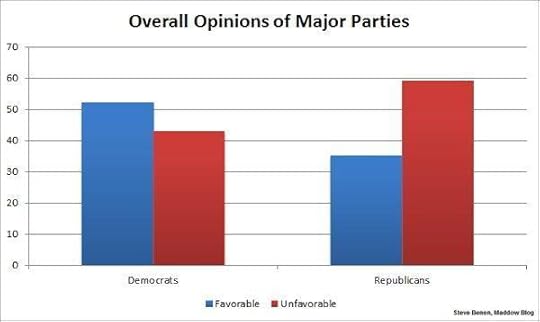
This chart, for example, shows the results from the CNN poll, which asked respondents for their general attitudes towards the two major political parties. For Democrats, support is up, and a 52% majority has a favorable opinion of the party. For Republicans, support is down, and a 59% majority has a unfavorable opinion of the party.
Adding insult to injury, the GOP's standing in the poll is at its third-lowest point since CNN started doing polls a couple of decades years ago.
In the Washington Post/ABC News poll, respondents were asked whether Congress is concentrating on issues that are important to them personally. While 43% said congressional Democrats are focused on the correct priorities, only 33% said the same about congressional Republicans.
Meanwhile, President Obama's approval rating is up to 53% in the CNN poll, up to 51% in the Post/ABC poll, and up to 53% in the USA Today poll. (The Pew Research poll did not publish a presidential approval rating.)
It's worth emphasizing that much of this week's polling was on the major controversies of the day -- last September's violence in Benghazi, the IRS scrutiny of tax-exempt groups, and the subpoenas of Associated Press reporters -- and opinions vary widely in the various surveys. The one constant is predictable: those predisposed to like the president largely believe him and are uninterested in the "scandals," while those predisposed to oppose the president believe the worst and are deeply interested in the "scandals."
This isn't what Republicans were hoping for, either. The more the recent messes are seen as partisan food-fights in Washington, the less the GOP can exploit the controversies for partisan gain.
As for why the president's support is unexpectedly buoyant in so many polls, Nate Silver makes a compelling case that it's the improving economy that's giving Obama a boost.
I'm sure there's something to that argument, but Dems shouldn't get cocky. For one thing, sequestration will continue to serve as a drag on the recovery, and there's very little the White House can do about it. For another, "scandal mania" may have left the president unscathed for now, but that may not last indefinitely.
Why Virginia Republicans are 'panicking'
Jamelle Bouie summarized the issue perfectly yesterday: "The Virginia GOP has essentially posed an experiment: Can we win off-year elections regardless of who we run?"
That's funny, but it's not hyperbolic. Virginia is no longer the Republican stronghold it once was, and at least on a statewide level, is competitive Democratic territory. President Obama carried the state twice; the commonwealth has two Democratic U.S. senators, and Democrats have won two of the last three gubernatorial races.
But it's an off-year cycle, and Republicans are optimistic about their chances this November. At least, they were -- in the wake of the party's convention over the weekend, the state GOP is suddenly "panicking," largely because this guy is their candidate for lieutenant governor.
Watch on YouTubeNational Review reports this morning:
A minister who compared gays to pedophiles and Planned Parenthood to the Klu Klux Klan is not the No. 2 candidate Republican Party reformers had in mind for the marquee race of 2013.
Neither did the top of the ticket, Republican gubernatorial nominee Ken Cuccinelli, who has been downplaying his own socially conservative record in favor of a more mainstream message focused on the economy.
The GOP's slate is, by any fair measure, jarring. The Virginia Republicans' gubernatorial candidate is one of the fiercest culture warriors of any officeholder in the country. The Virginia Republicans' candidate for lieutenant governor is almost comically extreme on social issues. The Virginia Republicans' candidate for attorney general once advocated requiring women to report miscarriages to the police -- or face jail time.
It's almost as if the state GOP went out of its way to think of a scheme to motivate the listless Democratic base, alienate as many women as possible, and drive moderate voters away from Republicans in droves.
Virginia Lt. Gov Bill Bolling, a Republican, said Monday that the surprise GOP pick to succeed him had made "simply indefensible" comments in the past that would only serve to reinforce negative perceptions about the party.
Almost immediately after E.W. Jackson, an African-American pastor, won a stunning, fourth-ballot victory at Saturday's Virginia GOP convention, a number of inflammatory statements he's made about gays, race and abortion surfaced, casting a cloud over gubernatorial nominee Ken Cuccinelli and the newly minted Republican ticket.
"These kinds of comments are simply not appropriate, especially not from someone who wants to be a standard bearer for our party and hold the second highest elected office in our state," Bolling said in a statement to POLITICO. "They feed the image of extremism, and that's not where the Republican Party needs to be."
Perhaps not, but that's where the Republican Party finds itself anyway.
May 20, 2013
April 2013, not April 2012
It appears this is the political story generating the most attention this afternoon, though I think there's less here than meets the eye.
The White House first learned of a draft report detailing abuses by IRS officials in targeting conservative groups in late April, though the top administration spokesman maintained on Monday that President Barack Obama was not notified of the emerging controversy at that time.
White House press secretary Jay Carney, in a bid to further the administration's public response to revelations that the IRS had singled out conservative groups seeking tax-exempt status for additional scrutiny, disclosed at his daily press briefing that White House counsel Kathy Ruemmler was informed of the report on April 24. She, in turn, told senior White House staff -- including chief of staff Denis McDonough -- of the then-incomplete report, though Carney said those details were never conveyed to Obama.
So, about a year ago, in response to complaints, the IRS decided to investigate the process through which groups applied for tax-exempt status. In July 2012, the agency's Inspector General got to work, initiating an investigation. The IG's office did its due diligence, without interference from the White House or anyone else, and wrapped up its audit last month.
At that point, a variety of top officials, including senior folks at the White House, were made aware of the broad outlines of the IG's findings, which apparently is pretty routine -- IG offices in other agencies alert the White House to the release of upcoming reports, too.
I'm not altogether sure why this is important, or even interesting. When it comes to potential areas of political controversy, there are a series of obvious questions: did the White House interfere with the IG investigation? Did the White House publicly comment on the IG investigation in order to influence its outcome? Was there any reason to notify the White House of the probe earlier?
As best as I can tell, the answer to all of these questions, at least given the available information, is "no." So, I'm left to wonder once more why this is a major development.
If the White House's detractors hoped to argue that President Obama's team learned about the trouble at the IRS last year and did nothing, that could conceivably be a real controversy, but it's not what happened -- the White House learned about the IG investigation in late April 2013, not April 2012. Besides, it's not as if nothing happened in response to the IRS criticisms -- the Inspector General launched an audit, as Congress requested.
Similarly, if Obama's critics believed the White House learned of the controversy last year, but kept it under wraps before the election, this too might be the basis for a genuine controversy, but that's not what happened either -- Congress was notified of the investigation back in July 2012. That notification included House Oversight Committee Chairman Darrell Issa (R-Calif.), who hates the president with the heat of a thousand suns, but who nevertheless said nothing during the 2012 campaign about the ongoing probe.
For all the intense complaining from Republicans on the Sunday shows about the "culture of intimidation," this appears to be evidence of the exact opposite. The White House didn't try to bully the IG's office; it didn't even know the IG's office was doing an investigation until the report was ready to be released.
And when the IG's report was finally released to the public, it confirmed what the White House has said all along -- that no one outside the IRS was involved with the scrutinizing of prospective non-profits.
So what's the problem? Who cares that White House officials were notified about the report a few weeks ago?
Karl Rove's area of expertise
Associated Press
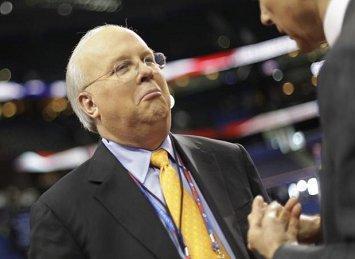
The controversy surrounding Justice Department leak investigations, and surveillance of journalists and phone logs, is clearly a serious matter. But is Karl Rove is the best person to be discussing this?
Appearing Monday on Fox News, Karl Rove attacked the Obama administration's surveilling of Fox reporter James Rosen in a leak investigation as "chilling" and its rationale for doing so "beyond the pale."
"We had to confront this question during the Bush administration," he said. "There were leaks of classified information and in each and every instance, the focus was on the potential leak, not the reporter who received it."
Rove defended the need to prosecute leaks but said the media shouldn't be targeted. "This is really chilling," he said.
If we remove Rove from the equation, I'm sympathetic to concerns about the chilling effect the leak investigations will have on journalists and their sources. It's a point Rachel will probably explore on tonight's show in more detail.
But if we keep Rove in the equation, there are some noteworthy angles to keep in mind. First, like Dave Roberts, I'm not sure how we arrived at the point at which Karl Rove can appear on national television to scrutinize White House controversies. The guy was, after, responsible for more than his share of meaningful scandals.
Second, I'm even less sure how we arrived at the point at which Karl Rove can appear on national television to discuss scrutinize White House controversies involving leaks of classified information. It was Rove, after all, who was very nearly indicted for his role in the White House outing an undercover CIA official as part of a larger political strategy.
Third, the focus during the Bush/Cheney era was "on the potential leak, not the reporter who received it"? I don't mean to sound picky, but during Bush/Cheney era, the Justice Department "improperly gained access to reporters' calling records as part of leak investigations." Indeed, it happened quite a bit. One reporter went to jail to protect a White House source during a leak investigation, and another reporter very nearly met the same fate.
Does Rove not remember any of this?
Flake hopes dissembling will solve his gun problem
A month after Sen. Jeff Flake (R-Ariz.) joined his GOP colleagues in killing a bipartisan background-check bill, the rookie senator is still struggling with the political fallout. This ad from Mayors Against Illegal Guns is the latest to put Flake on the defensive.
Watch on YouTubeFlake's strategy, at least for now, is built entirely on dissembling.
Sen. Jeff Flake (R-Ariz.) is pushing back against attack ads that say he broke his promise to support passing new gun laws.
"If you are anywhere close to a television set in Arizona in the coming days, you'll likely see an ad about gun control financed by NYC Mayor Bloomberg," Flake wrote Friday on his Facebook page. "Contrary to the ad, I did vote to strengthen background checks."
I can appreciate why the ads have gotten Flake's attention, but this "vote to strengthen background checks" rhetoric is exactly the sort of thing that rankles. Flake must realize how misleading this is, but is counting on public confusion to make his political troubles go away. It's cynical, and the public deserves better.
Indeed, it's apparently become the standard strategy for every Republican senator facing pushback from his his/her constituents -- Sen. Kelly Ayotte (R-N.H.) is pulling exact same stunt.
Let's set the record straight once more.
Flake's pitch -- "Contrary to the ad, I did vote to strengthen background checks" -- is technically true. It's also true that Flake filibustered the Manchin/Toomey compromise on background checks that enjoyed broad public support. So, Flake is relying on semantics games as a defense for doing the wrong thing? Yes, that's exactly what he's doing.
As we've discussed before, conservatives are relying on specific definitions of words and phrases that don't quite line up with what everyone else is talking about. As Sahil Kapur explained recently:
There's a critical distinction to be made between universal background checks, a robust policy that would require criminal checks for virtually all gun purchases -- and a more milquetoast proposal to beef up mental health information in existing databases. The former is championed by gun control advocates and experts who say it would have a significant impact. The latter is supported by the NRA and does nothing to make it harder for criminals to buy firearms at private sales or gun shows, where background checks are not required by law.
It's obviously an important clarification. The right is generally comfortable with improving the National Instant Criminal Background Check System, by integrating mental health records, for example. When Flake endorses stronger "background checks," this is what he's talking about, not closing the gun-show loophole.
Flake is counting on voters losing sight of the distinction.
Just as important, though, is the unstated concession: Flake is feeling defensive, which gives away much of the game. Under the NRA's worldview, which Flake supports and defends, there's nothing for conservative senators to be embarrassed about -- by crushing expanded background checks, Republicans are taking a stand against tyranny. Voters love freedom and need not fear electoral consequences for voting the way the NRA demands.
Or so the argument goes.
But Flake's cynical defense suggests that below the surface, he knows the NRA's boasts about the political landscape aren't true.
Star Trek's intergalactic war on terror
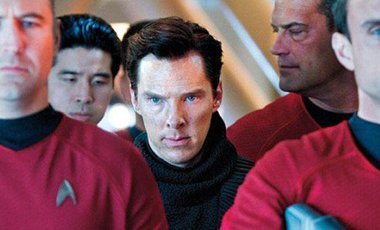
John Harrison (Benedict Cumberbatch) in custody
Certain corners of the right wing are apoplectic about director J.J. Abrams' just released blockbuster, Star Trek Into Darkness, claiming it condones an appeasing, liberal spin on the Bush Administration's War on Terror.
Here's the set-up: (some spoilers ahead) After a terrorist attack in London, vengeful star fleet commander Admiral Marcus (Peter Weller) lusts to wage war not only against the perpetrator of the attack, John Harrison (Benedict Cumberbatch), but also against the Klingons, who, while belligerent, were in no way responsible. 9/11? Check. The Iraq War? Check. Dick Cheney? Double check.
Simon Pegg, who plays Scotty in the film, broke it down this way:
There is a parallel with the terrorist activities of Osama bin Laden and the decision to attack Iraq. Iraq had nothing proven to do with 9/11, and yet [President] Bush used that as an excuse to start a war with those people. You can always see the Klingons as like Iraq and John Harrison the proxy for Osama bin Laden."
Admiral Marcus certainly seems like a stand-in for former Vice President Cheney. "Absolutely," Pegg laughs. "He's definitely a Republican."
Observed Pop Matters:
Star Trek Into Darkness is immersed in a series of lessons regarding the war on terror: the dark side is still the dark side, violence breeds violence, we make our own demons.
Not surprisingly, the conservatives at PJ Media pounced, saying:
In case you missed any of the signals scattered throughout the movie, Abrams’ writers tell you exactly what to think about the War on Terror in the closing seconds. One of the leads argues in the end that there will always be those who will wish to do us harm — but that to stop them we risk awakening evil in ourselves. Sure, and Guantanamo must be closed immediately, right, fellas? Amusing as it is to realize that Hollywood is well to the left of even Barack Obama — and that this is just the beginning of the age of disguised cinematic attacks on The One from the left — the moral equivalence argument simply won’t wash in a country that welcomes and celebrates immigrants like the Tsarnaev brothers, only to be savagely attacked in return. Sorry, Hollywood, we’re not just like them. We’re better.
"We're better." Yeah, that attitude will solve everything. Bring it on, Klingons.
FWIW, my takeaway from Star Trek Into Darkness was the same message as all the Star Trek stories: there is no Them, there are only increasingly complex manifestations of Us.
A different leak, a different probe, a familiar problem
Associated Press
It wasn't just the Associated Press.
When the Justice Department began investigating possible leaks of classified information about North Korea in 2009, investigators did more than obtain telephone records of a working journalist suspected of receiving the secret material.
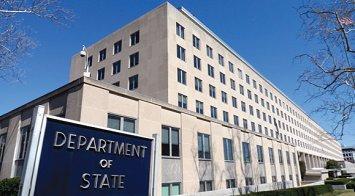
They used security badge access records to track the reporter's comings and goings from the State Department, according to a newly obtained court affidavit. They traced the timing of his calls with a State Department security adviser suspected of sharing the classified report. They obtained a search warrant for the reporter's personal e-mails.
This case has nothing to do with last week's story involving AP phone logs, but rather deals with Fox News chief Washington correspondent James Rosen and government adviser Stephen Jin-Woo Kim. About four years ago, Rosen reported on possible North Korean nuclear tests, the same day Kim, at the time a State Department arms expert with security clearance, was briefed on the matter. FBI investigators "used the security-badge data, phone records and e-mail exchanges to build a case that Kim shared the report with Rosen soon after receiving it, court records show."
The scope of the probe is certainly alarming and worth checking out in detail.
The next question, at least in my mind, is whether these law-enforcement tactics are legally permissible. There are legal experts who can speak to this with far more authority than I can, but most of the reports I've seen of late suggest that these leak investigations may be excessive and chilling, but are probably within the law.
But shouldn't that necessarily lead to a debate over whether it should be legal?
Part of the frustration with last week's scandal-mania is the way in which the underlying policy problems were obscured. On Beghazi, there is no political scandal, but there's room for a debate about how best to improve security at diplomatic outposts and implement Mullen/Pickering recommendations. On IRS, there's probably is no real scandal, but there's still a need for discussion about how to improve the process through which groups seek non-profit status, and the need to clarify what on earth a "social welfare" group really is.
And when it comes to leak probes affecting journalists, now seems like an ideal time to explore the merits of a media shield law, checks and balances against abuses, and the necessary protections under the First Amendment.
The Rosen/Kim story only makes the need for such a debate more acute.
If we look at controversies primarily as political scandals, their importance hinges on political and/or electoral considerations -- who'll get fired, who'll be held accountable, whose poll numbers will go up or down, etc. But if we look at these primarily as policy problems, it shifts the focus to substantive resolutions.
And when it comes to reporters in need of protection, some substantive resolutions are welcome.
'[S]elf-defense with a measure of wisdom would be a lot better than self-defense that screams fear and a lack of confidence in your ability to keep yourself safe.'
-- Karen J. Greenberg, director of the Center on National Security at Fordham law, on the 89 percent conviction rate in 509 terrorism cases in federal courts since 9-11, versus seven convictions for cases handled by military commissions.
["Bearing Witness at Terrorism Trials," NYT]
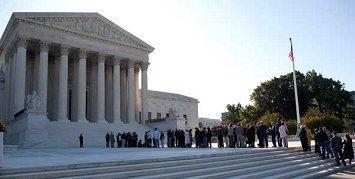
Supreme Court agrees to hear major church-state case
Associated Press
In many parts of the country, it's not at all unusual for locals to attend a meeting of their city council or county commission, and see local officials begin the meeting with an official prayer. What if the invocation doesn't reflect your religious beliefs? That's a shame, but you're out of luck -- you can sit silently or wait in the hall.
Is this permissible in a country that honors the separation of church and state? We'll apparently get an answer to that question fairly soon.
The Supreme Court on Monday agreed to decide whether a town board in upstate New York violated the First Amendment by starting its sessions with a prayer.
The case comes from Greece, a town near Rochester. For more than a decade starting in 1999, the town board began its public meetings with a prayer from a "chaplain of the month." Town officials said that members of all faiths and atheists were welcome to give the opening prayer.
In practice, the federal appeals court in New York said, almost all of the chaplains were Christian.
Indeed, the 2nd Circuit Court of Appeals ruled unanimously against the official prayers, noting, among other things, that most of the invocations "contained uniquely Christian language," and there's nothing in the local policy that requires that the prayers be inclusive or non-sectarian. "The town's prayer practice must be viewed as an endorsement of a particular religious viewpoint," the appeals court concluded.
Whether a Supreme Court majority will agree remains to be seen. The most recent case on the matter was in 1983, in a case called Marsh v. Chambers, in which the high court upheld daily invocations in the Nebraska legislature.
The case was brought by my friends at Americans United for Separation of Church and State, which brought the litigation on behalf of two community residents, Susan Galloway and Linda Stephens. They objected to the Greece Town Board's practice of inviting clergy to open its meetings with sectarian prayers.
The Rev. Barry W. Lynn, executive director of Americans United (and full disclosure, a long-time friend of mine), said, "A town council meeting isn't a church service, and it shouldn't seem like one. Government can't serve everyone in the community when it endorses one faith over others. That sends the clear message that some are second-class citizens based on what they believe about religion."
It's a case worth watching.