Rachel Maddow's Blog, page 3407
May 24, 2013
Watching a scandal slowly 'metastasize'
Associated Press
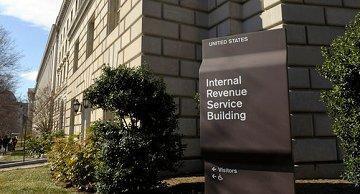
When the recent Inspector General's report was released on problems at the Internal Revenue Service, the public got a good look at an ugly picture: overwhelmed IRS bureaucrats struggled with the ambiguities of federal tax laws, and ending up crafting unwise standards for groups seeking tax-exempt status.
Over the last week or so, we've seen several detailed reports -- from the Wall Street Journal, the Washington Post, and the New York Times, among others -- each of which say roughly the same thing: officials with little direction or legal clarity struggled to implement vague guidelines.
And barring additional information, that's pretty much the end of the story as it relates to the White House. For all the talk on the right about President Obama's possible involvement in the matter, there's just nothing to even hint in that direction.
The result, Jon Chait argues, is a "metastasizing" controversy, created by desperate conservatives.
[T]he accusation is metastasizing into the claim that Obama has sicced the agency on conservatives through audits of their tax returns. Peggy Noonan sees dark patterns of Republicans facing audits, apparently unaware that there are lots of audits every year and nearly half the country voted Republican. Larry Conners, a local reporter in St. Louis, became a right-wing hero by claiming the IRS started persecuting him after he asked Obama tough questions in an interview, only for Conners to subsequently concede, “I should disclose that my issues with the IRS preceded that interview by several years.” Tom Coburn and John Cornyn’s spokesman today began echoing the audacious claim that the IRS unfairly singled out Romney donors.
And sure — it could be true. Absence of evidence is not evidence of absence, as a wise man once said. But the entire basis for this belief appears to be that something bad has happened at the IRS, and Richard Nixon once directed the IRS to do bad things, therefore Obama has probably directed the IRS to do bad things. Instead, down, down, down the rabbit hole we go.
Also keep in mind, the IRS is not in a position in which it can fairly defend itself. In Peggy Noonan's mind, there are Republicans who've been audited, ergo, Obama is a power-mad tyrant. Maybe the IRS had perfectly legitimate reasons to launch those audits? Of course, but therein lies the rub -- the IRS auditors can't talk about the process, leaving those who've been audited to say anything they please with impunity.
But I remain fascinated by the ever-changing trajectory of the allegations, which have quickly become incoherent.
Phase One: Maybe the Obama White House gave orders to the IRS!
Phase Two: We demand to know why the Obama White House didn't give orders to the IRS!
Phase Three: The president must have known what was going on at the IRS!
Phase Four: We demand to know why the president didn't know what was going on at the IRS!
Phase Five: Never mind all that other stuff, maybe the president ordered IRS audits on Republicans!
Look, this is getting a little silly. If Republicans want the American mainstream to see this as a legitimate "scandal," they're going to have to get their story straight. Because at this point, listening to the White House's GOP critics get increasingly confused about details they should understand by now is getting a little tiresome.
There's a real story here: the IRS appears to have made some poor decisions, which were a direct result of flawed tax laws. It deserves scrutiny, accountability, and action. But the conspiracy theories and contradictory allegations aren't getting anyone anywhere.


Friday's campaign round-up
Today's installment of campaign-related news items that won't necessarily generate a post of their own, but may be of interest to political observers:
* In Massachusetts' U.S. Senate special election, Republican Gabriel Gomez, already under fire for running an ad with false claims, is starting to lose his cool. Yesterday he called his Democratic opponent, Rep. Ed Markey (D), "pond scum." For what it's worth, Gomez's over-the-top complaints really don't make sense.
Watch on YouTube* On a related note, Gomez trails Markey in a new Emerson College poll, 45% to 33%. The Democrat's 12-point lead is double the advantage he enjoyed in a similar poll earlier this month.
* The news for Gomez is not, however, all bad -- the National Republican Senatorial Committee has committed to sending at least four staffers to give the Republican candidate a boost. The special election is a month from tomorrow.
* Rep. Jo Bonner (R-Ala.) announced late yesterday that he will resign later this year after a decade in Congress to take a job at the University of Alabama. There will be a special election to fill his vacancy, and while the date has not yet been set, the seat is expected to remain in Republican hands.
* In anticipation of a likely presidential campaign, Wisconsin Gov. Scott Walker (R) has scheduled a series of out-of-state visits, including an appearance in Iowa yesterday.
* In Arkansas, as expected, Mayors Against Illegal Guns is continuing to run ads against Sen. Mark Pryor (D), who appears to be a vulnerable incumbent next year.
* And in Louisiana, there's growing chatter about Sen. David Vitter's (R) interest in possibly running for governor after Bobby Jindal (R) wraps up his second term.
Sore 'losers'
Associated Press
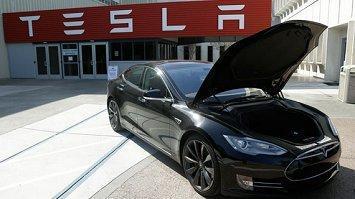
After all the Republican complaints last year about the Obama administration's loan to Tesla Motors, I was eager to hear how GOP officials would respond to the news that the auto manufacturer is paying off its taxpayer loans nine years earlier than expected.
Alas, they're not responding well.
"When they're picking all these losers, it's nice for them to have one where they can point to," Representative Jim Jordan, an Ohio Republican who held a hearing last month on Fisker's loan, said in an interview yesterday.
There are two broad problems with this approach -- one political and one substantive.
On the former, as Markos noted yesterday, it is a bit unseemly to see an elected member of Congress root against a loan program that benefits American companies. There's nothing wrong with cheering some good news, even if you predicted bad news.
On the latter, Rep. Jordan makes it sound as if the Department of Energy's clean-energy loan program has generally been a failure, and isolated success stories don't change that. Except, that's backwards -- the program has generally done quite well, and isolated failures don't change that. As the New York Times reported yesterday
"Today's repayment is the latest indication that the Energy Department's portfolio of more than 30 loans is delivering big results for the American economy while costing far less than anticipated," Ernest Moniz, the energy secretary, said in a statement. [...]
"Tesla is arguably making the most exciting car in the world today," said [Greg Kats, president of Capital-E, a firm that invests in clean-energy companies], who worked in the Energy Department during the Clinton administration. "This loan program has exceeded expectations."
Fortune's Dan Primack added that there is "now a very real chance" that the Department of Energy loan program "will end up in the black."
Anything to add, Congressman Jordan?
May 23, 2013
Ahead on the 5/23 Maddow show
Tonight's guests include:
Jameel Jaffer, deputy legal director of the ACLU
Robert Gibbs, former White House press secretary and MSNBC contributor
Jeremy Scahill, national security correspondent for The Nation and author of “Dirty Wars: The World is a Battlefield”
Daniel Klaidman, correspondent for Newsweek/The Daily Beast, author of “Kill or Capture: The War on Terror and the Soul of the Obama Presidency”
And here is executive producer Bill Wolff with how tonight's show will blow your mind:
Thursday's Mini-Report
Today's edition of quick hits:
* A bipartisan group of senators today unveiled new legislation intended to prevent sexual assault in the military.
* Oklahoma: "Three days after one of the most destructive tornadoes to strike Oklahoma in decades, people here [in Oklahoma City] filed into a mortuary chapel Thursday morning amid heavy rain and flashes of lightning for the first of two dozen funerals."
* A shift in posture? "A North Korean envoy, Marshal Choe Ryong-hae, said the North would 'accept the proposal' by China to "open up dialogue," the China News Service reported Thursday. The comments were reported after Marshal Choe met Liu Yunshan, a member of the Communist Party Standing Committee and the politician who heads ideological affairs for the Communist Party."
* House Republicans embraced the one resolution they know won't become law, because they're not especially serious about governing: "The House on Thursday passed legislation to head off a doubling of student loan interest rates on July 1, instead tying rates to prevailing market trends and ending federal subsidies."
* London: "A day after two alleged Islamic extremists brutally killed a British soldier, Prime Minister David Cameron vowed that his nation would not succumb to fear and promised a vigorous investigation into what appears to be this city's first successfully executed terror attack since the coordinated transit system bombings in 2005."
* Ricin: "The FBI has arrested a suspect in a case involving the discovery of a pair of letters containing the deadly poison ricin and says investigators are working "around the clock" to address any remaining risks."
* Middle East: "As he embarked on another round of meetings with Israeli and Palestinian leaders on Thursday in an effort to revitalize the peace process, Secretary of State John Kerry acknowledged the doubts being expressed on both sides over his chances of success."
* Responsible policymakers need to know when to ignore constituents who are mistaken: "Sen. Tom Coburn (R-Okla.) said Thursday his constituents have suggested they were audited by the Internal Revenue Service because they donated to Mitt Romney's 2012 presidential campaign."
* And when conservative pundits get to the point at which they think sexual assaults in the military may be a secret ploy to divert attention away from White House "scandals," maybe it's time they write about something else for a while.
Anything to add? Consider this an open thread.
'This war, like all wars, must end'
We're accustomed to President Obama delivering big political speeches, and thinking about them in political terms -- was the rhetoric persuasive, will various constituencies approve or disapprove, how will the arguments be received, etc. But some speeches are important for reasons that have nothing to do with politics and everything to do with policy.
President Obama's speech on national security this afternoon, delivered at the National Defense University, clearly falls into this latter category. This wasn't about inspirational oratory; this was a war-time president charting a new, more constructive course when it comes combating terrorism.
Indeed, it was arguably a key moment in marking a possible end of the 9/11 era. [Update: Transcript here.]
It's a little tough to summarize, largely because the president covered so much ground, and for detailed analysis, I'd strongly encourage you to tune in to tonight's The Rachel Maddow Show. But for now, let's talk a bit about Obama's approach to national security going forward.
"[M]ake no mistake: our nation is still threatened by terrorists. From Benghazi to Boston, we have been tragically reminded of that truth. We must recognize, however, that the threat has shifted and evolved from the one that came to our shores on 9/11."
This isn't what the right wants to hear, of course, but it's very much in line with the assessments of nearly all credible experts on counter-terrorism. The nature of the threat has changed, and a responsible U.S. policy must change with it. That the president realizes this is a low bar to clear, but it's nevertheless encouraging.
"America is at a crossroads. We must define the nature and scope of this struggle, or else it will define us, mindful of James Madison's warning that 'No nation could preserve its freedom in the midst of continual warfare.' Neither I, nor any President, can promise the total defeat of terror. We will never erase the evil that lies in the hearts of some human beings, nor stamp out every danger to our open society. What we can do -- what we must do -- is dismantle networks that pose a direct danger, and make it less likely for new groups to gain a foothold, all while maintaining the freedoms and ideals that we defend. To define that strategy, we must make decisions based not on fear, but hard-earned wisdom."
Right. The "total defeat" of a possible terrorist threat, now and forever, is not going to happen, and basing a national foreign policy on such a goal is counter-productive.
"[W]e must define our effort not as a boundless 'global war on terror' -- but rather as a series of persistent, targeted efforts to dismantle specific networks of violent extremists that threaten America."
It's a genuine relief to hear a president say this out loud.
"[A]s our fight enters a new phase, America's legitimate claim of self-defense cannot be the end of the discussion. To say a military tactic is legal, or even effective, is not to say it is wise or moral in every instance. For the same human progress that gives us the technology to strike half a world away also demands the discipline to constrain that power -- or risk abusing it. That's why, over the last four years, my Administration has worked vigorously to establish a framework that governs our use of force against terrorists -- insisting upon clear guidelines, oversight and accountability that is now codified in Presidential Policy Guidance that I signed yesterday."
All of this was in reference to drone strikes, and while I'm glad the policy has been codified, it's worth emphasizing that this policy was signed "yesterday." That said, Obama went on to explain the fact that the "need for unmanned strikes" will "reduce" once the war in Afghanistan ends, that the U.S. "does not take strikes when we have the ability to capture individual terrorists," and that Congress "is briefed on every strike that America takes."
And what of the civilian deaths? "For me, and those in my chain of command, these deaths will haunt us as long as we live, just as we are haunted by the civilian casualties that have occurred through conventional fighting in Afghanistan and Iraq."
As for the Stand with Rand crowd, the president added, "For the record, I do not believe it would be constitutional for the government to target and kill any U.S. citizen -- with a drone, or a shotgun -- without due process. Nor should any President deploy armed drones over U.S. soil."
"I believe, however, that the use of force must be seen as part of a larger discussion about a comprehensive counter-terrorism strategy. Because for all the focus on the use of force, force alone cannot make us safe. We cannot use force everywhere that a radical ideology takes root; and in the absence of a strategy that reduces the well-spring of extremism, a perpetual war -- through drones or Special Forces or troop deployments -- will prove self-defeating, and alter our country in troubling ways."
In this context, it was especially heartening to hear the president tout the benefits of foreign aid as being "fundamental to our national security and any sensible long-term strategy to battle extremism."
"The Justice Department's investigation of national security leaks offers a recent example of the challenges involved in striking the right balance between our security and our open society. As Commander-in Chief, I believe we must keep information secret that protects our operations and our people in the field. To do so, we must enforce consequences for those who break the law and breach their commitment to protect classified information. But a free press is also essential for our democracy. I am troubled by the possibility that leak investigations may chill the investigative journalism that holds government accountable. Journalists should not be at legal risk for doing their jobs. Our focus must be on those who break the law."
A media shield law will still be a heavy lift in Congress, but I'm glad it's part of Obama's comprehensive vision.
"The AUMF is now nearly twelve years old. The Afghan War is coming to an end. Core al Qaeda is a shell of its former self. Groups like AQAP must be dealt with, but in the years to come, not every collection of thugs that labels themselves al Qaeda will pose a credible threat to the United States. Unless we discipline our thinking and our actions, we may be drawn into more wars we don't need to fight, or continue to grant Presidents unbound powers more suited for traditional armed conflicts between nation states. So I look forward to engaging Congress and the American people in efforts to refine, and ultimately repeal, the AUMF's mandate. And I will not sign laws designed to expand this mandate further. Our systematic effort to dismantle terrorist organizations must continue. But this war, like all wars, must end. That's what history advises. That's what our democracy demands."
This is no small moment. In the immediate aftermath of 9/11, the United States adopted a war footing -- and never stopped. What Obama is describing here is a fundamental shift.
As for the detention facility at Guantanamo Bay, this is when protestors began interrupting the speech, but Obama nevertheless characterized the prison as a facility that needs to be closed and "should never have been opened." The president is asking for Congress to lift the restrictions; he's appointing a new envoy to complete transfers; and he will demand "judicial review be available for every detainee."
And what about those protestors? It was interesting to hear Obama express some sympathy for their perspective, saying he's willing to cut one of his interrupting critics "some slack, because it's worth being passionate about." After another interruption, he added, "The voice of that woman is worth paying attention to. Obviously I do not agree with much of what she said. And obviously she wasn't listening to me and much of what I said. But these are tough issues, and the suggestion that we can gloss over them is wrong."
It would have been easy for the president to ignore these critics, or dismiss their outbursts as fringe nonsense. I'm glad Obama chose a more substantive approach.
These are just some of the elements from my notes, and whether you agree with it or not, the video of the speech is worth your time. For real analysis, I'd strongly recommend tuning into MSNBC tonight at 9 p.m. eastern.
Senate unanimously approves Srinivasan
Associated Press
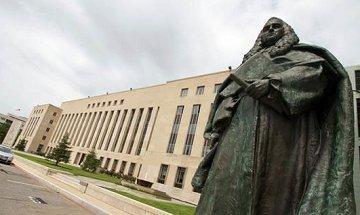
The D.C. Circuit Court of Appeals
Of all the recent judicial confirmation votes, today's was the most important.
After five years of trying, President Barack Obama has placed his first nominee on a key appeals court in Washington.
The Senate voted unanimously on Thursday to confirm Sri Srinivasan to the U.S. Court of Appeals for the District of Columbia Circuit. The court is considered the most important in the country after the Supreme Court. The Senate voted 97-0 in favor of his nomination.
Srinivasan is currently the principal deputy in the Office of the Solicitor General. He has worked in both Democratic and Republican administrations and served as a law clerk to former U.S. Supreme Court Justice Sandra Day O'Connor.
Srinivasan's name also came to public prominence in March: he's the attorney who argued before the U.S. Supreme Court that the Defense of Marriage Act should be struck down.
So why is his confirmation so important? For one thing, the D.C. Circuit is generally considered the second highest federal bench in the nation, behind only the U.S. Supreme Court, in part because it hears so many regulatory cases related to the federal government. President Obama named exactly zero jurists to the D.C. Circuit in his first term, which has proven to be a problem.
Indeed, Senate Republicans, as recently as last month, said they hoped to keep that going indefinitely, preventing each of the president's nominees from reaching the D.C. Circuit for both of Obama's terms. Obviously, as of today, that strategy is no more.
Also note the circumstances that led to today's vote.
[T]his week, Reid used the Senate rules to provoke a confrontation: Technically he filed cloture on Srinivasan's nomination, guaranteeing him at least a test vote this week. More meaningfully, he forced McConnell to choose between sustaining a filibuster against Srinivasan through early June (a move that would have helped Reid build his case for changing the rules this summer) and agreeing to a confirmation vote now (effectively caving).
McConnell caved Thursday morning on the Senate floor. A small cave. But a cave nonetheless.
So, does all of this mean people like me should complain less about judicial vacancies and Republicans blocking the president's nominees? Well, no, at least not yet. Srinivasan's confirmation was a welcome development, but let's not forget that his seat on the D.C. Circuit has sat empty for nearly five years.
What's more, Srinivasan enjoyed unanimous support, but it nevertheless took nearly a full year to confirm him (Obama nominated him last June).
As for what's next, three of the 11 seats on the D.C. Circuit are still vacant. The White House insists nominations for each of these vacancies is on the way.
Postscript: If you haven't already heard the scuttlebutt, Srinivasan is already being talked about as a possible Supreme Court justice in the future. In other words, remember the name.
Virginia's McDonnell facing probe from outside prosecutor
Associated Press
It's an election year in Virginia, and it doesn't help the state Republican Party that its slate of statewide candidates are dominated by right-wing extremists. It also doesn't help that the outgoing Republican governor of the commonwealth is in the middle of a scandal that now has an outside prosecutor.
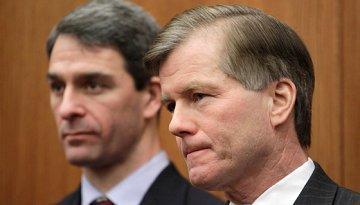
Virginia's attorney general has appointed an outside prosecutor to investigate Gov. Bob McDonnell's financial disclosures, in a widening scandal over a political donor who wrote a $15,000 check for the wedding of the governor's daughter, and who was also a benefactor of the attorney general.
Kenneth T. Cuccinelli II, the attorney general, who is also the Republican candidate for governor this year, said on Wednesday that he named the outside prosecutor last November to look into Mr. McDonnell's disclosures.
Mr. Cuccinelli said "information came to my attention" triggering the appointment of the prosecutor. His referral of the case to the Richmond commonwealth's attorney, Mike Herring, whose role is similar to that of a district attorney, "was not a conclusion that any violation occurred,'' Mr. Cuccinelli said in a statement.
Cuccinelli did not, by the way, make this announcement proactively, but rather, acknowledged the investigation after the Richmond Times-Dispatch uncovered the investigation through a Freedom of Information Act request.
What's more, it's not immediately clear whether Cuccinelli appointed an outside prosecutor because he's caught up in the same controversy, because the governor is currently working to help elect the state A.G., or perhaps a combination of the two.
Regardless, the scandal is an increasingly serious problem for the Virginia governor. For background on what the story is all about, take a look at our previous coverage.
At the intersection of bad policy, bad theology, and hypocrisy
Getty Images
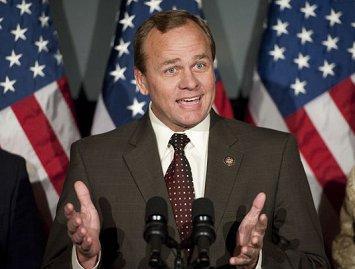
Rep. Stephen Fincher (R-Tenn.)
The ongoing congressional debate over the Farm Bill has made clear just how eager Republicans are to cut the Supplemental Nutrition Assistance Program (SNAP, the program formerly known as food stamps). Despite high unemployment, a Senate committee approved striking $4.1 billion from the program over 10 years -- and the House GOP is looking for cuts five times as large.
Helping lead the way is none other than Rep. Stephen Fincher (R-Tenn.), who balked when Democrats on the House Agriculture Committee urged Republicans to remember "the least of these." The Tennessee Republican, defending the cuts, countered with 2 Thessalonians 3:10: "For even when we were with you, we gave you this command: Anyone unwilling to work should not eat."
As a theological matter, this isn't constructive -- as Jack Jenkins explained, the Bible verse "was actually referring to ancient Christians who had stopped working in anticipation of Jesus' Second Coming. The verse is concerned with correcting a theological misunderstanding (i.e., don't just wait around for Jesus, live an active faith), not passing judgment on the poor."
But wait, it gets much worse.
A Tennessee congressman who supports billions of dollars in cuts to the food stamp program is one of the largest recipients of federal farm subsidies, according to new annual data released by a Washington environmental group.
Using Agriculture Department data, researchers at the Environmental Working Group found that Representative Stephen Fincher, a Republican and a farmer from Frog Jump, Tenn., collected nearly $3.5 million in subsidies from 1999 to 2012. The data is part of the research group's online farm subsidy database from which the group issues a report each year.
In 2012 alone, the data shows, Mr. Fincher received about $70,000 in direct payments, money that is given to farmers and farmland owners, even if they do not grow crops.
So, the guy who's trying to slash assistance for struggling families, arguing that it's necessary to cut spending and let the poor fend for themselves, is also the beneficiary of generous agricultural subsidies? This Tea Party Republicans wants the Department of Agriculture to give him money, but not the poor?
Yep, pretty much.
Note, we've known about the generous taxpayer-financed subsidies Fincher collects for a while -- I first wrote about it in April 2011 -- and the fact that they seem to contradict his political ideology. Asked two years ago whether he's prepared to stop taking these agricultural subsidies, Fincher wouldn't say.
But that was before he started pushing aggressively for cutting food stamps, which makes this story considerably worse.
During the committee debate, Fincher declared, "We have to remember there is not a big printing press in Washington that continually prints money over and over. This is other people's money that Washington is appropriating and spending."
Right, and Washington has been appropriating and spending our money by giving it to wealthy farmers like congressman Fincher.
Ohio GOP: Oops on bill to curb student voting
Ohio's House Republicans last month passed a bill that would punish universities if they help students vote. Included in the regular budget, the proposal would force universities to charge out-of-state students the lower in-state tuition rate if the universities give the students a letter or utility bill proving they live at school. Ohio universities say that would cost them as much as $370 million each year.
To which Ohio's House Speaker responded, verbatim, "That's a rather gigantic amount of money, and I just couldn't respond to it. I don’t know what to say."
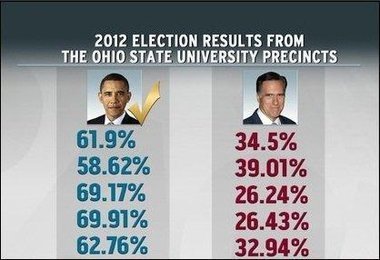
Meanwhile Republicans in the Ohio Senate have desperately been trying to slam the brakes on their colleagues' plan. For one thing, $370 million is truly a gigantic amount of money. For another, the House Republicans would create an incentive for more students to register to vote, and students tend to vote Democratic. It seems that Ohio's House Republicans had not thought about that part, either. From a Cincinnati Enquirer editorial:
Backers of the bill say they are rethinking the proposal because they hadn't considered the unintended consequences.
So it never occurred to them that making it easier for out-of-state students to get the lower in-state tuition rate -- indeed, requiring it if they want to vote here -- would not turn them away from voting but might in fact encourage them to vote, precisely to obtain the lower rate?
In 1979, the U.S. Supreme Court ruled that students have the right to vote in person at college. The court said it is students' constitutional right, under the 26th Amendment. Three decades later, Ohio Republicans are not satisfied with that. Republican State Senator Randy Gardner says the question of student voting belongs "in a separate election-reform bill," reports the Columbus Dispatch.
Some senators share concerns that students who have no intention of living in Ohio after college are voting not only in presidential elections in a vital swing state, but also on local tax levies.
"To dismiss this as a nonissue would not be fair," Gardner said.
Ohio's Senate is expected to decide on changes to the budget, including the student measure, by June 5.