Rachel Maddow's Blog, page 3412
May 17, 2013
Two presidents, one bad comparison
Associated Press
I suppose it's only natural to evaluate a president by comparing him or her to previous presidents, and President Obama has been the subject of quite a few of these analyses over the years. Is he Clinton (modern, two-term Dem who bounced back after a rough midterm cycle) or maybe JFK (dynamic young speaker with an ambitious vision)? Is he FDR (leading the nation through an economic crisis and time of war) or LBJ (breakthrough legislative accomplishments)?
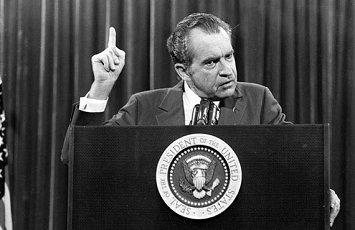
For much of the Beltway, however, there's been an ongoing urge to draw parallels between Obama and a much more notorious predecessor.
Back in 2009, the Washington Post's Ruth Marcus was so bothered by Obama's criticism of Fox News that she said the White House had a "Nixonian ... aroma." More recently, a pointless dispute between Bob Woodward and Gene Sperling led to a flurry of equally pointless comparisons between Obama and Nixon, for reasons that still don't make any sense.
And, of course, this week, following the IRS controversy and the Justice Department's AP subpoenas as part of a leak investigation, the Nixon comparisons are practically ubiquitous.
They're also dumb.
Just yesterday, the media's fascination with the bizarre comparison even reached a White House press conference, with this exchange between Obama and Reuters' Jeff Mason.
Q: [H]ow do you feel about comparisons by some of your critics of this week's scandals to those that happened under the Nixon administration?
OBAMA: Well, I'll let you guys engage in those comparisons and you can go ahead and read the history and draw your own conclusions.
Yes, and the conclusion is history points in a very different direction.
There is no comparison. Nixon, in a series of crimes that collectively came to be known as Watergate, directed from the White House and Justice Department a concerted campaign against those he perceived as political enemies, in the process subverting the FBI, the IRS, other government agencies and the electoral process to his nefarious purposes. Mr. Obama has done nothing of the kind.
This is not to say the recent stories are unimportant, but Nixon ran a criminal conspiracy out of the Oval Office, using federal agencies and law enforcement as weapons against his perceived enemies. The fact that some bureaucrats in Ohio asked some Tea Party groups some unnecessary questions in IRS paperwork doesn't even belong on the same page as Watergate.
Is these controversies worthy of investigation? Of course. Are they proof that Obama resembles Nixon? Not if you know anything about Nixon.
Indeed, part of the problem may be that the president's detractors have been so desperate to draw these invisible parallels that the entire exercise has become farcical. Updating a post from October, Republicans think:
* Benghazi is "worse than Watergate." [Update: this argument comes up quite a bit.]
* The IRS controversy carries "echoes of Watergate."
* National security leaks are "worse than Watergate."
* A job offer for former Rep. Joe Sestak (D-Pa.) might be "Obama's Watergate."
* "Fast and Furious" might be "Obama's Watergate."
* Solyndra "makes Watergate look like child's play."
* The White House's relationship with Media Matters might be "Obama's Watergate."
Peggy Noonan is so overwhelmed by her contempt for the president, she wrote in her column this morning, "We are in the midst of the worst Washington scandal since Watergate," and then neglected to mention which perceived "scandal" she was even referring to.
Whether you consider the ongoing controversies as serious or trivial, there has to be a smarter way of looking at the news.


Reid's 'nuclear' shot across the GOP's bow
Associated Press
The so-called "nuclear option" first came up eight years ago, when Senate Republicans, in the majority at the time, were apoplectic about Democrats obstructing Bush/Cheney nominees. GOP senators considered a sweeping tactical move that would eliminate all filibusters on administration nominees forevermore.
Ultimately, that didn't happen -- the "Gang of 14" struck a deal, which Republicans have since shredded, that put the "nuclear option" back on the shelf -- but the GOP's idea never fully went away. Indeed, now that the partisan tide has turned; there's a Democratic majority and a Democratic White House; and Senate obstructionism has reached a level unseen in American history, the "nuclear option" is suddenly in vogue once more.
Indeed, Greg Sargent has quite an interesting scoop this afternoon.
Senate Majority Leader Harry Reid is increasingly focused on the month of July as the time to exercise the so-called "nuclear option" and revisit filibuster reform, and he has privately told top advisers that he's all but certain to take action if the Senate GOP blocks three upcoming key nominations, a senior Senate Democratic aide familiar with his thinking tells me.
Reid has privately consulted with President Obama on the need to revisit filibuster reform, and the President has told the Majority Leader that he will support the exercising of the nuclear option if Reid opts for it, the aide says, adding that senior Democrats expect the President to publicly push for it as well. "If Senator Reid decides to do something on nominations, the president has said he'll be there to support him," the aide says.
Obviously, Obama would not get a vote, but the White House's support matters more than you might think. For one thing, there would be some members of the Senate Democratic old guard who may be resistant, and presidential nudging could prove important. For another, without digging too deep into the procedural weeds, Vice President Biden's vote would be necessary in his capacity as president of the Senate, so the White House kinda sorta would have a vote.
And why wait until July, when there are so many procedural breakdowns now? A couple of reasons, actually.
First, it's likely Reid and his office see this as an opportunity to send a shot across the GOP minority's bow. "Stop the obstructionism," the argument goes, "or we will." Putting a timeline on this effectively gives Republicans a deadline to stop playing their ridiculous games.
Second, as Greg explained, the idea is to delay a confrontation until after immigration reform is complete. It's called the "nuclear option" because of the fallout -- the minority party will be so outraged by the tactical move that it'll likely be a long while before the Senate even tries to function again. Dems really want to get immigration done, so the idea is to do that first, then consider procedural changes.
Of course, it's worth noting that this would represent a rather permanent change. Yes, President Obama's nominees -- both to the courts and to administration posts -- would be subject to majority-rule, up-or-down votes, which would greatly reduce gridlock in the chamber. But as members of both parties should realize, it would also mean that every future president would be afforded the same opportunity.
Recently, some Senate Dems were cautious about this very point, wanting to preserve the right to block future GOP nominees (as if Republicans wouldn't use the nuclear option the moment they felt it necessary). But that caution is reportedly fading.
With this in mind, keep a close eye on three specific nominations: Richard Cordray (Consumer Financial Protection Bureau), Thomas Perez (Labor Secretary), and Gina McCarthy (EPA administrator). Greg's Senate source said if there's Republican obstructionism against these nominees, "then our position will be very easy."
Rice's rehabilitated reputation
Getty Images
When Time's Michael Crowley reported this week on what we learned from the disclosure of internal administration emails on Benghazi, it noted three larger takeaways, one of which was "Susan Rice got hosed."
That was true before, but it's even more obvious now. Republicans, led by Sen. John McCain (R-Ariz.), set out to destroy the U.S. ambassador to the United Nations last November, blaming her for Benghazi talking points. The campaign against Rice worked -- she was not nominated for Secretary of State -- but it's now painfully clear she "played no role in crafting the talking points," and simply shared with the public the best information available at the time.
Indeed, our friends at Politics Nation are asking a good question: "Where's the apology for Susan Rice?" The Rev. Al Sharpton added, "The GOP smear campaign against Ambassador Rice was vicious, personal, and wrong. That's why she deserves an apology, but I won't hold my breath."
Neither will I, though there will apparently be a consolation in prize.
Insiders with ties to the Obama administration tell The Cable that U.S. ambassador to the United Nations Susan Rice has become the heir apparent to National Security Advisor Tom Donilon -- a post at the epicenter of foreign-policy decision making and arguably more influential than secretary of state, a job for which she withdrew her candidacy last fall amid severe political pressure.
"It's definitely happening," a source who recently spoke with Rice told The Cable. "She is sure she is coming and so too her husband and closest friends."
"Susan is a very likely candidate to replace him whenever he would choose to leave," agreed Dennis Ross, a former special assistant to President Obama and counselor at the Washington Institute. "She is close to the president, has the credentials, and has a breadth of experience."
The post would not require Senate confirmation, so it wouldn't much matter if Republicans hoped to destroy her again, but Foreign Policy added that "prominent Republicans don't seem inclined to make a fuss" about Rice again.