Rachel Maddow's Blog, page 3404
May 29, 2013
Where Congress manages to excel
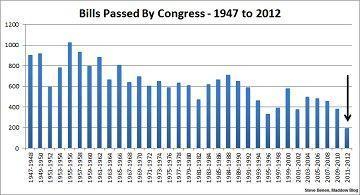
I have been known, from time to time, to draw attention to the fact that Congress is a dysfunctional mess, seemingly incapable of governing and completing basic tasks. But perhaps I've been too hasty -- there's one thing our legislative branch is apparently able to do quite well (thanks to my colleague Anthony Terrell for the heads-up).
Pillory Congress all you want as do-nothing or dysfunctional, as its critics often have. But in one respect, lawmakers in the Capitol are remarkably productive: they name post offices like nobody's business.
A new report from the Congressional Research Service, the nonpartisan research division of Congress, found that about 20 percent of laws passed in recent years were for naming post offices.
Yes, in the 112th Congress -- the one that wrapped up in January, before the start of the current Congress -- lawmakers successfully passed 240 statutes overall. That happens to be the lowest number since the U.S. House Clerk's office started keeping track in the 1940s. But if that weren't embarrassing enough, 46 of the 240 laws -- nearly 20% -- named post offices.
The House, where most of the measures naming post offices originate, has evidently become somewhat self-conscious about the amount of time it spends on the issue. So for this Congress, the 113th, the House committee that oversees the issue produced new guidelines that direct members to consider such bills expeditiously "so as to minimize the time spent."
That's fine, I suppose, but the concern isn't really that Congress spends too much time naming post offices, but rather, that Congress isn't doing enough other legislating. I don't think anyone would much care how many hours are spent on post offices if plenty of other worthwhile bills were becoming law.
But other bills aren't passing, and it has nothing to do with the time allotted for post-office naming.


'What happened to the Republican Party that I joined?'
Associated Press
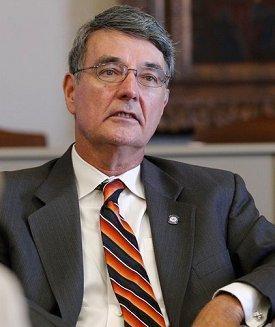
Oklahoma state Rep. Doug Cox (R)
Last week, a deadly tornado did serious damage in Oklahoma, leaving 24 people dead. Just two days later, Oklahoma state senators got to work -- defunding Planned Parenthood.
Oklahoma state Rep. Doug Cox (R), an obstetrician, published a piece today in The Oklahoman asking whether his Republican colleagues live in "the real world."
...I cannot convince my Republican colleagues that one of the best ways to eliminate abortions is to ensure access to contraception. A recent attempt by my fellow lawmakers to prevent Medicaid dollars from covering the "morning after" pill is a case in point. Denying access to this important contraceptive is a sure way to increase legal and back-alley abortions. Moreover, such a law would discriminate against low-income women who depend on Medicaid for their health care.
But wait, some lawmakers want to go even further and limit everyone's access to birth control by allowing pharmacists to refuse to fill prescriptions for contraception.
After lamenting his own party's culture-war agenda, Cox goes on to ask, "What happened to the Republican Party that I joined? ... What happened to the Republican Party that felt that the government has no business being in an exam room, standing between me and my patient? Where did the party go that felt some decisions in a woman's life should be made not by legislators and government, but rather by the women, her conscience, her doctor and her God?"
I'm certainly sympathetic to Cox's concerns, and I'm glad he's speaking up in such a direct and forceful way. His message is one his party clearly needs to hear.
But I confess to being puzzled when Cox asks "what happened" to his Republican Party.
My sympathies for his perspective notwithstanding, is he just now realizing that the contemporary GOP is aggressively hostile towards women's reproductive rights? Is he just now noticing that Republicans at the state and federal level reject emergency contraception and access to birth control?
The point isn't that Cox is wrong on the merits -- on the contrary, it's always heartening to hear from a red-state Republican whose uncomfortable with the GOP's culture-war agenda as it relates to reproductive rights -- but rather, it's a little late in the game for a state representative to wonder aloud "what happened" to the Republican Party that adopted its far-right positions years ago.
Fear leads to McConnell's mendacity
Senate Minority Leader Mitch McConnell (R-Ky.) has reason to be concerned about his political future. Despite his leadership post, his reliably "red" state, and his nearly three decades on Capitol Hill, the most recent polling shows the Republican senator tied with an unannounced Democrat.
And we've seen McConnell's anxiety manifest itself in a variety of interesting way. It started back in December, when McConnell aides aggressively went after Ashley Judd, and it continued throughout the spring, when McConnell became the first incumbent to launch television ads -- 20 months before Election Day.
The senator's fear has become so acute that Team McConnell launched the above video this morning, which hopes to exploit the IRS controversy to make the bizarre case that President Obama is Richard Nixon (thanks to Joe Sonka for the tip).
"I think that the leader of the free world and his advisers have better things to do than to dig through other people's tax returns," McConnell says in the video, apparently working under the assumption that voters in Kentucky are easily fooled into believing nonsense. (The president never dug through anyone's tax returns, and doesn't appear to have had anything to do with the IRS's tax-exempt office in Cincinnati.)
But it's the message in the closing seconds that arguably matters most: as the video ends, and viewers see the words "Intimidation. Retaliation. Secretive" on screen, we hear the president say, "We're going to punish our enemies and reward our friends."
And that's a problem, not because Obama said something outrageous, but because McConnell is taking the president wildly out of context in order to mislead the public.
Jamelle Bouie caught the deception:
The ad ends with a quote from Obama, where he seems to admit to punishing opponents of his administration: "We're going to punish our enemies, and we're going to reward our friends." But this is an out-of-context quote, pulled from a comment made more than two years ago in an interview with Univision radio. "If Latinos sit out the election instead of, 'we're going to punish our enemies and we're going to reward our friends who stand with us on issues that are important to us' -- if they don't see that kind of upsurge in voting in this election, then I think it's going to be harder," Obama said in that interview. McConnell's use of the quote is the dishonest capstone to an intensely dishonest piece of political rhetoric.
Two things to keep in mind here. The first is that McConnell's dishonesty is simply breathtaking. Obama was paraphrasing the strategic thinking of Latino voters, not saying that he, himself, intends to punish his enemies and reward his friends.
The second is that there's a remarkable pattern of these out-of-context attacks:
1. The Romney campaign took Obama out of context in its very first television ad of the race.
2. When the president told business leaders that U.S. policymakers have been "a little bit lazy" when it comes to attracting businesses to American soil, Republicans took that out of context and launched a series of attacks.
3. When Obama said private-sector job growth is "fine" relative to the public sector, Republicans took that out of context, too.
4. Obama said public institutions help businesses succeed, and Republicans took that out of context.
5. When Obama said he hoped to mobilize the electorate to change politics from the grassroots up, that too was taken out of context.
Note to Team McConnell: it's time for a new schtick. This one's as tiresome as it is deceptive.
Rhode Island's Chafee to run as a Democrat
Associated Press
It appears the number of Democratic governors is about to go up by one.
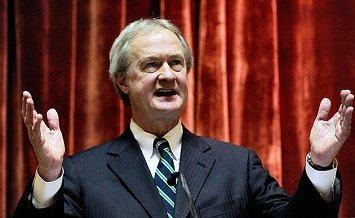
First Read has confirmed that Rhode Island Gov. Lincoln Chafee (I) will run for re-election next year as a Democrat, according to a Democratic source with knowledge of the decision.
Before running as an independent during his successful 2010 gubernatorial bid, Chafee served as Republican senator (from 1999 to 2007) before losing his Senate seat to Democrat Sheldon Whitehouse in 2006.
This is not Chafee's first foray into Democratic politics -- he's endorsed Democratic candidates, including President Obama -- but this will be the first time he's identified himself as an actual member of the party.
Chafee no doubt hopes this will improve his re-election odds -- not only is Rhode Island generally a pretty "blue" state, but the one-term governor eked out a narrow win in 2010 and recent polls suggest he's an underdog heading into 2014. Support from in-state Dems, and perhaps even the Democratic Governors Association, would boost his prospects considerably.
But it may not be that easy. Chafee ran for governor as a center-left independent, and at times, he's drawn criticism from Rhode Island Democrats. Indeed, well in advance of this apparent party switch, Providence Mayor Angel Taveras and state Treasurer Gina Raimondo -- both prominent Democrats -- have been gearing up for gubernatorial campaigns of their own. Will they stand aside for Chafee now? It's unlikely. In fact, I'd expect a crowded Democratic primary.
That said, in the bigger picture, the Chafee news does reinforce a larger thesis about the contemporary Republican Party. Remember, Chafee was a Republican senator, the son of another Republican senator, and a member of a prominent Republican family. But as the GOP moved to the far-right, he found himself out of step with his party, ultimately feeling the need to leave.
Background checks remain popular in Deep Southern states
We talked last week about the results of the latest Pew Research poll, which found support for background checks remaining quite high, even as we get further away from the massacre at Sandy Hook Elementary. Pew found that 81% of Americans support broader background checks on firearm purchases, including 81% of self-identified Republicans.
But surely there are regional differences, right? Yes, but they're not as dramatic as one might think.
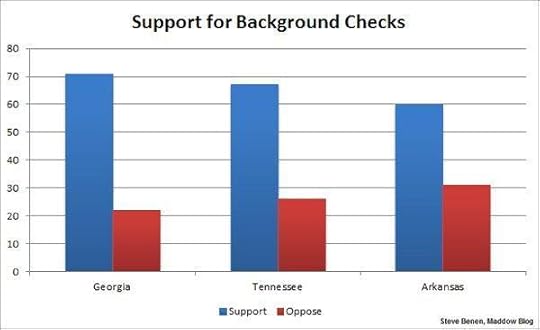
I put together this chart to highlight the results of new results from Public Policy Polling, which asked about background checks in some red states in the Deep South.
New PPP polls in Arkansas, Georgia, and Tennessee find that even in dark red states there's strong, bipartisan support for expanded background checks. And as we've found elsewhere, voters are unhappy with their Senators who voted against them.
In Georgia there's 71/22 support for them, in Tennessee it's 67/26, and in Arkansas it's 60/31. Female voters that the Republican Party really needs to reach out to if it's going to be successful moving forward are even more supportive of background checks. They favor them 81/12 in Georgia, 73/21 in Tennessee, and 67/25 in Arkansas. The support for stronger background check laws cuts across party lines in all three of these states.
In each of the three states, voters disapproved of their senators' decision to oppose the bipartisan compromise on background checks, which Republicans killed in April. PPP's analysis concluded, "Our polling on background checks since last month's Senate vote has been incredibly consistent. Whether it's in blue states, purple states, or red ones support for a stronger law remains overwhelming and bipartisan. And the voters are extremely unhappy with the Senators who are serving as an obstacle to that."
Senators hoping to curtail gun violence intend to push the issue once more, and it's a safe bet polling results like these will play a role in the argument.
Wednesday's campaign round-up
Today's installment of campaign-related news items that won't necessarily generate a post of their own, but may be of interest to political observers:
* In Massachusetts' U.S. Senate special election, just four weeks away, Rep. Ed Markey (D) has a new ad stressing the contrast between his preferred tax policies and that of his Republican opponents, Gabriel Gomez.
Watch on YouTube* In Michigan, former Rep. Mark Schauer (D) officially launched his gubernatorial campaign yesterday, and hopes to take on incumbent Gov. Rick Snyder (R) next year. Schauer has considerable Democratic support and may not face a credible primary opponent.
* In Alaska, right-wing activist Joe Miller (R) has launched another Senate campaign, just three years after losing his last one, though he will probably not be the only Republican candidate in the field.
* To the disappointment of the NRSC, Rep. Cory Gardner (R) announced yesterday that he will not take on Sen. Mark Udall (D) in Colorado next year.
* Former President George W. Bush's reputation has apparently been rehabilitated to the point that the National Republican Congressional Committee is comfortable using his name for fundraising purposes.
* Republican officials were so freaked out about the Public Policy Polling survey in Kentucky yesterday, showing Senate Minority Leader Mitch McConnell (R) tied with an unannounced Democrat, that the NRSC's Brad Dayspring got confused and mistakenly labeled it a "push poll."
* And in Arkansas, party leaders are reportedly pressuring right-wing freshman Rep. Tom Cotton (R) to run for the Senate, seeing him as the party's strongest candidate to take on incumbent Sen. Mark Pryor (D).
Sequestration continues to do real harm to real people

Getty Images
Education Secretary Arne Duncan and HHS Secretary Kathleen Sebelius at a Head Start program in Maryland in March.
There's an unfortunate correlation between the political world's focus on sequestration cuts and the scope of the damage done by the cuts themselves -- the more the sequester hurts people, the less attention it receives. The political world's interest in sequestration was great in February and March, when the effects of the policy were minimal, but that interest faded when the damage started kicking in.
Adding insult to injury, the political world took notice of the policy again briefly in April, but only because people with political capital -- air travelers -- started feeling the pinch. In a matter of days, Congress provided a fix, and the sequester was quickly forgotten all over again.
Brad Plumer takes stock of the overlooked story this morning.
So it's worth asking: Whatever happened to the sequester? Is it still a big deal? We decided to check in on what was going on around the country. As it turns out, plenty of people have started to notice -- about 37 percent in a May 19 poll said they'd been personally affected. And the sequester is starting to have an impact around the country, although many of the cuts haven't yet sunk in. Here's a round-up:
An ABC News/Washington Post poll in May found that 37 percent of Americans say they've been negatively affected, up from 25 percent in March. And 18 percent say they've felt a "major impact." ... And what sorts of impacts is sequestration actually having?
Plumer's list isn't short, highlighting Head Start programs that are kicking out preschoolers, federal courts facing new backlogs, housing programs that are starting to deny aid to low-income families, national parks that are scaling back services, military families feeling adverse effects, federal agencies beginning mass furloughs, cancer clinics turning away patients, and states that are paring back unemployment benefits.
The policy was designed to hurt people and it's working as intended.
The Washington Post ran a feature piece today on Rep. Mick Mulvaney (R-S.C.), who already recently got an earful on this.
Earlier this month, a friend and former campaign volunteer stood up at one of the town hall meetings to tell Mulvaney that the defense cuts had cost him his job of five years with a large defense contractor. "I just want you to know that these cuts are real and they hurt me," said Jeffrey Betsch, a single father of three daughters, who was on the verge of being evicted from his home.
All of this undermines the economy and none of this is necessary. Even the Republican chairman of the House Appropriations Committee recently called the sequestration policy "idiotic."
But it continues anyway, doing deliberate harm, because congressional Republicans will neither compromise nor turn it off.
Senate GOP decries non-existent 'court packing'
Getty Images
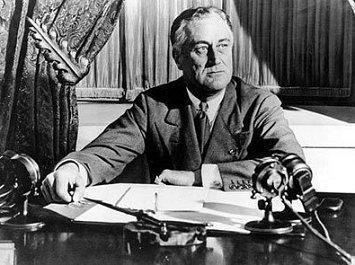
FDR pursued court packing; Obama has not.
Last week, Sen. Chuck Grassley (R-Iowa) got a little confused. During a Senate Judiciary Committee hearing, the Iowa Republican read brief remarks in which he condemned the Obama administration for pushing a "court-packing" strategy in which the president would nominate judges to fill existing vacancies. It was left to Sen. Sheldon Whitehouse (D-R.I.) to gently explain that Grassley had no idea what he was talking about.
I assumed at the time that this was an amusing-but-isolated misstep involving a Republican senator who routinely gets baffled by details. But I assumed wrong -- this is apparently the new GOP talking point.
...Grassley isn't alone in making these charges. During floor remarks last week, Senate Minority Leader Mitch McConnell (R-Ky.) accused Democrats of plotting with the White House "to pack the D.C. Circuit with appointees," and Sen. Mike Lee (R-Utah) worried aloud that Democrats may "decide to play politics and seek -- without any legitimate justification -- to pack the D.C. Circuit with unneeded judges simply in order to advance a partisan agenda."
Even The Wall Street Journal piled on last week, arguing in an editorial that the D.C. Circuit "doesn't need new judges to handle the workload" and filling those vacant seats would be akin to "packing the court for political ends."
Not to put too fine a point on this, but the argument is simply crazy. In the American system of government, it's madness to suggest the president is doing something controversial when he nominates qualified jurists to fill vacancies on the federal bench.
"Court packing" has a specific meaning: it was an FDR-era idea in which the executive branch would expand the number of seats on a bench in order to tilt the judiciary in the president's favor. The idea was floated in the 1930s, before being abandoned.
Is Obama planning a similar ploy? Not even a little. What we're talking about here is an elected president sending qualified judicial nominees to the Senate for consideration. What Republicans are condemning is basic American governance -- they hope to characterize Civics 101 as something abusive and offensive.
I hate to break this to Senate Republicans, but President Obama was elected -- twice. Presidents submitting judicial nominations to the Senate to fill vacancies is pretty much the definition of normal presidential behavior. If the GOP finds this annoying, they'll have to take it up with the Constitution.
Or, I suppose they can try court-packing in reverse, which appears to be growing in popularity.
We first talked in April about Chuck Grassley's idea of shrinking the D.C. Circuit, removing seats from the bench, so that there would be no vacancies for Obama to fill. Grassley's bill wasn't just a partisan stunt -- yesterday, Sen. Susan Collins (R-Maine), an alleged moderate, endorsed the proposal.
It's reached the point at which the White House feels the need to respond to the idea.
[O]n the merits, Senator Grassley's "court unpacking proposal" fails to make any sense. In fact, in 2005, the Senate -- including Senator Grassley -- voted to confirm Judge Janice Rogers Brown to the D.C. Circuit as the tenth active judge and Judge Thomas Griffith as the eleventh active judge. In 2006, the Senate -- again, including Senator Grassley -- voted to confirm Judge Brett Kavanaugh as the tenth active judge. Voting for judicial nominees for court seats under one president while proposing to eliminate those same seats under the president of a different political party smacks of partisan politics.
The proposal raises even more questions because in 2007, Congress passed a law to move the D.C. Circuit's 12th seat, agreeing that the Court needed 11 seats. What has changed since then, other than the President? There are currently eight active judges on the D.C. Circuit. Republicans had no problem filling the ninth, tenth, and eleventh seats on this Court during Republican presidential administrations, but under this President, they want to remove them. In fact, the past five presidents each have had at least three judges confirmed to the D.C. Circuit -- and 15 of the past 19 judges confirmed to this Court have been appointed by Republican presidents. But so far, only one of President Obama's nominees has been confirmed.
Make no mistake about it: this is court packing in reverse and a cynical attempt to manipulate the third branch of government.
During Reagan's two terms, he named nine judges to the D.C. Circuit. Was this "court packing"? No, it was a president sending judicial nominees to the Senate, which then confirmed those nominees. It's the way the system is supposed to work, whether you like the president at the time or not.
Senate Republicans would have us believe that judicial nominations -- not the individual nominees, but the existence of the nominations themselves -- are now so controversial that they must resist. Election results don't matter; the constitutional process doesn't matter; the merit of the nominees doesn't matter.
This is nothing short of twisted, even by 2013 standards, and it should send a loud signal to the Senate majority that the "nuclear option" will likely be unavoidable.
May 28, 2013
Al Qusayr, crucial city to Syrian rebels
More on this later, but if you're popping over here from watching Richard Engel talk with Rachel about the situation in Syria, here is the city he was talking about at the end of the interview, al Qusayr:
View Larger Map
Ahead on the 5/28 Maddow show
Tonight's guests include:
Steve Schmidt, Republican political strategist and former senior strategist to the 2008 McCain/Palin campaign
Richard Engel, NBC News chief foreign correspondent, live from Beirut, Lebanon
Here's executive producer Bill Wolff to explain why tonight's show will be at least ninety-nine pounds of awesome: