
Yanis Varoufakis's Blog, page 62
May 13, 2020
Bernie Sanders, Ilhan Omar, Carlos Menem, Yanis Varoufakis & Richard Durbin and 300 other lawmakers call for a cancellation of developing world’s’ debt – Washington Post
“The vulnerable communities that lack the resources and privileges to adopt adequate public health measures will ultimately face the disproportionate burden of coronavirus,” read the letter, a draft of which was shared with Today’s WorldView. “Such harm means that global supply chains, financial markets, and other interconnected exchanges will continue to be disrupted and destabilized.”
The two U.S. lawmakers called for a technocratic instrument in the IMF’s tool kit known as special drawing rights, or SDRs, that could bring hundreds of billions, even trillions, of dollars of new liquidity into the global economy. The last time the IMF allowed for a major infusion of additional SDRs was in 2009 as part of a $1 trillion injection into the global economy that followed the financial crisis.
The IMF’s gold reserves have soared $19bn since #coronavirus pandemic. This is more than the entire debt the poorest countries owe. The IMF should use these windfall profits to #CancelTheDebt to avert catastrophic loss of life in developing countries
Sanders and Omar, widely seen as occupying the left flank of Democratic Party politics, are pushing ideas about debt relief and crisis spending that are becoming increasingly mainstream. Economists and policymakers to their right have already made similar calls for a new round of SDRs, which would not make much of a difference for taxpayers in wealthy nations. Boosters of the idea say that rich countries could voluntarily transfer some of the funds generated by the SDRs — which are allocated on the basis of IMF quotas that give richer nations much larger shares — to poorer ones.
“Taking commonsense measures to cancel debts and provide financial stability — steps which do not cost U.S. taxpayers a penny — is the very least we can do to prevent an unimaginable amount of poverty, hunger, and disease that could harm hundreds and hundreds of millions of people,” Sanders said in an email to Today’s WorldView.
So far, the Trump administration, whose Treasury Department carries enormous influence over the IMF, has balked at the idea. One reason for its opposition is an unwillingness to create a mechanism that boosts the foreign reserves of adversarial countries such as China, Iran or Venezuela without forcing them to make any concessions…
For the letter’s signatories, debt forgiveness is an essential plank of a broader global recovery. “What this crisis shows us is that we are all in this together, as a global community,” said Sanders. “We have got to show unprecedented compassion, solidarity, and cooperation right now, because this pandemic has revealed for everybody that we are only as safe and healthy as the most vulnerable among us.”
For the original Washington Post article click here


May 12, 2020
Covid-19 has “turbocharged” the EU’s failures – Interviewed by the NEW STATESMAN’s George Eaton
 For Yanis Varoufakis, lockdown has not been a time of contemplation. “I have more work now than I ever did. As you know, everything has shifted to Zoom meetings, which means zero separation between the private and the public,” he explained when we spoke recently, during one such video call.
The 59-year-old economist, former Greek finance minister, game theorist and “erratic Marxist” has divided his time since Greece’s lockdown began in mid-March between his summer house on the island of Aegina and his country’s parliament in Athens. Varoufakis was returned as an MP last July as one of nine representatives of MeRA25, the Greek wing of the pan-continental Democracy in Europe Movement 2025 (DiEM25), which he co-founded in 2016.
“It is a humbling process, it’s quite frustrating at times,” he said of the challenge of “building up a parliamentary party from scratch” (Varoufakis resigned from Syriza in 2015, in protest at then prime minister Alexis Tsipras’s support for a third austerity programme).
“We’re the smallest party in parliament but in the past couple of weeks I don’t think it would be an exaggeration to say that we have been the official opposition, the only ones who really make the government feel fragile. Because when Tsipras gets up, my former comrade, there is a standard line from the government which steamrolls over him: ‘This is exactly what you were doing for four years.’”
Varoufakis, who excoriated the EU for the austerity imposed on Greece in his memoir Adults in the Room: My Battle With Europe’s Deep Establishment , believes the Covid-19 pandemic has exposed the same flaws as the eurozone crisis. “Even more so — it’s exactly the same category error. 2010 was a crisis of insolvency and the EU treated it like a crisis of liquidity, so they kept lending, and the only way could pass these huge bailout loans through their parliaments was by attaching austerity strings to the loans.
“Now we have, even more evidently, an issue of bankruptcy. The tide has gone out… capitalism has been suspended, both supply and demand. That leaves behind a trail of bankruptcies. And they [the EU] continue to treat the problem as if it is one that can be solved by the means of loans… Covid-19 has turbocharged the failures in the handling of the euro crisis.”
Does he agree with those commentators who predict that the pandemic could lead to the collapse of the EU or the eurozone? “John Maynard Keynes’s expression that the market can remain irrational longer than I can remain solvent is apt here because Europe is a very rich bloc, particularly the eurozone, there is so much wealth to fritter and waste and that’s exactly what they’re doing, they are imposing stagnation upon the eurozone in a way that magnifies the imbalances and the centrifugal forces that will eventually end this experiment. But I may not be around to see it because the wealthier an unsustainable system is, the longer it can be sustained.
“The more rigid the system becomes, the harder it is for it to break — but when it breaks, it will break with a gigantic bang,” he warns. “That’s my great fear.”
Varoufakis, who opposed Brexit during the 2016 EU referendum campaign (and helped persuade Jeremy Corbyn to endorse Remain), now believes that the UK should leave the current transition period without a new trade deal.
“After four years, you should just get out now, without a deal. I didn’t have that view two months ago but things change. So for instance, the Michel Barnier argument that you can’t pick and choose – if you want to have increased access to the single market, you have to take the single market as it is – well, that has collapsed. The single market no longer exists. You already see that under the weight of the coronavirus crisis, the rules have been suspended… I hate to admit it, but if I was close to Boris I would say ‘get out’.”
The UK’s initial handling of the pandemic, however, has been viewed with concern in Greece, which has recorded only 150 deaths after imposing tough restrictions early in the crisis. “Most Greeks have taken the view that Boris Johnson got his comeuppance, both personally and as PM, from endorsing an outdated and callous social-Darwinist approach to Covid-19.”
Varoufakis singled out Germany – a country with which he clashed intensely as Greece’s finance minister – for praise. “I think Germany has done reasonably well, at least on the pandemic front, combining the lockdown with a superbly executed plan for moving to phase two through massive testing – that’s typical German ingenuity when it comes to organisation.”
On a geopolitical level, Varoufakis is haunted by the spectre of military conflict between the US and China. “The United States is going to become increasingly aggressive and belligerent in the South China Sea, so I’m very worried about war erupting there. And I will say something that I’m sure is going to be used against me, but I’ll say because I believe it, this is especially the case if Donald Trump loses the White House. Whoever comes next, whether it’s Biden or some stooge decided at the Democratic National Convention in August, is going to be far more war-prone than Trump is. One good thing about Trump – there aren’t many – is that he seems to be shying away from armed confrontation.
“A Democratic president that does not command respect like Obama did will be on very fragile ground. What is the best way of uniting the US behind the president? You start a war.”
Varoufakis may consider capitalism to have been “suspended”, but he does not share the optimism of those commentators who have hailed this as a “social democratic” or “socialist” moment. “I listen to my friends and comrades, like Slavoj Žižek, who are struggling to conjure up optimism out of this mess,” he explains, “and they leave me cold. Because already it’s quite remarkable — the financial markets are doing quite well, thank you very much, so much liquidity has been pumped into them. Once we are out of lockdown, I believe that this liquidity is going to translate into two things: first, greater inequality; and second, greater nationalism.”
Varoufakis emigrated to the UK aged 17 and stayed for over a decade, studying mathematics at the University of Essex, where he also gained a PhD in economics, before teaching at Essex, East Anglia and Cambridge universities. The Thatcher years were for him a debilitating lesson. “I remember when unemployment shot up from 750,000 people in the UK to 3.5 million. I thought right, that’s ok, that’s it — now the working class will automatically begin to organise and the bourgeoisie are going to get their comeuppance. And look what happened: the only beneficiaries were the spivs and the money markets, and the big banks in the City of London. The left was decimated and remains so to this day. There are no iron laws of history favouring the left.”
Nor is Varoufakis, who remained a consistent supporter of Corbyn, enthused by Keir Starmer’s leadership of Labour. He describes Starmer as a “very sweet bloke, but totally harmless from the perspective of the establishment”.
“It’s undoubtedly the case,” he adds, “that a Starmer administration is going to be business as usual, with a kinder face and a few tweaks of policy here and there to give some of the suffering people a little bit more. But this will not constitute an alternative in the way that the Corbyn-McDonnell Labour Party was intending to put on the table.”
What of Varoufakis’s own plans for the future? He is currently completing what he describes as a work of political science fiction that has, he quips, been “written exclusively on aeroplanes before lockdown and toilets”.
“I needed to write a sequel to Talking to My Daughter About the Economy [2017],” he explains, “because there was a very apt criticism that I’m shitting on capitalism, and then of course the question is, ‘so what’s the alternative?’ And I can’t say the Soviet Union, I can’t say Sweden, so I always resisted for decades coming up with an answer to this question – but I don’t think I can continue to resist it.
“Then again, I could not sit down and write a book on utopia. So I ended up narrating it as a science fiction story… It’s called Another Now : Dispatches from an Alternative Present . The gist of it is that in 2008 the crisis was so large that the timeline bifurcated; we are on one trajectory but there is another, socialist, one.”
In the real world, Varoufakis is not short of what the Italian Marxist Antonio Gramsci called “pessimism of the intellect”. But does he retain optimism of the will? “I have no optimism at all, zero optimism,” he says, explaining that optimism requires evidence that things will change for the better.
“But I have hope,” he adds. “Hope is something you choose.”
George Eaton is senior online editor of the New Statesman.
For the New Statesman site, click here.
May 11, 2020
Progressive International: Today we began organising the world’s progressives. Join us!
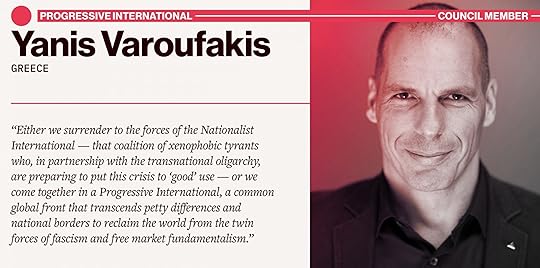
In December 2018, the Democracy in Europe Movement (DiEM25) and the Sanders Institute issued an open call to all progressive forces to form a common front.”It is time for progressives of the world to unite. The Progressive International takes up that call. We unite, organise, and mobilise progressive forces behind a shared vision of a world transformed.”
Become a member today. If you have any questions or comments, please write to info@progressive.international and a member of our team will get in touch with you.
Our Vision
We aspire to a world that is:
Democratic, where all people have the power to shape their institutions and their societies.
Decolonised, where all nations determine their collective destiny free from oppression.
Just, that redresses inequality in our societies and the legacy of our shared history.
Egalitarian, that serves the interests of the many, and never the few.
Liberated, where all identities enjoy equal rights, recognition, and power.
Solidaristic, where the struggle of each is the struggle of all.
Sustainable, that respects planetary boundaries and protects frontline communities.
Ecological, that brings human society into harmony with its habitat.
Peaceful, where the violence of war is replaced by the diplomacy of peoples.
Post-capitalist, that rewards all forms of labour while abolishing the cult of work.
Prosperous, that eradicates poverty and invests in a future of shared abundance.
Plural, where difference is celebrated as strength.
Council
The Council of advisors is responsible for setting the strategic direction of the Progressive International. In September – pandemic permitting – the Council will convene for the inaugural Summit in Reykjavik, Iceland, hosted by the Prime Minister of Iceland and the Left-Green Movement.
Julian Aguon – Micronesia
Julian Aguon is a human rights lawyer and founder of Blue Ocean Law, a progressive firm working across Oceania at the intersection of indigenous rights and environmental justice.
Kali Akuno -United States of America (USA)
Kali Akuno is a co-founder and co-director of Cooperation Jackson. He served as the Director of Special Projects and External Funding in the Mayoral Administration of the late Chokwe Lumumba of Jackson, MS.
Slim Amamou – Tunisia
Slim Amamou is a blogger, activist, and a former Secretary of State for Sport and Youth in the transitional Tunisian government. He resigned from the role in 2011 — protesting the transitional government’s censorship of a number of websites.
Celso Amorim – Brazil
Celso Amorim is the longest serving foreign minister of Brazil to date (1993-1994 and 2003-2010). He also served as Minister of Defense (2011-2014). Amorim remains active in academic life and as a public figure, having written a number of books and articles on matters ranging from foreign policy to culture.
Andrés Arauz – Ecuador
Andres Arauz is a former Minister of Knowledge of Ecuador and a former Central Bank General Director. He is a founding member of the Dollarization Observatory and a former board member of the nascent Bank of the South. He is currently based in Mexico City as a Doctoral Fellow at the National Autonomous University of Mexico, UNAM.
Niki Ashton – Canada
Niki Ashton is a Member of Parliament for Churchill–Keewatinook Aski. She serves as the NDP’s Critic for Democratic Reform and Transport, and Deputy Critic for Women and Gender Equality.
Renata Ávila – Guatemala
Renata Ávila is an international human rights lawyer. She is a 2020 Stanford Race and Technology Fellow at the Center for Comparative Studies in Race and Ethnicity. She is a Board member for Creative Commons, the Common Action Forum, Cities for Digital Rights, Article 19 Mexico & Central America, and a Global Trustee of Digital Future Society. She also serves as a member of the Coordinating Collective of DiEM25.
Edil Baisalov – Kyrgyzstan
Edil Baisalov is the current ambassador of Kyrgyzstan in London. A renowned human rights defender and civic activist, Edil played a key role in bringing down authoritarian and corrupt governments in 2005 and 2010. His voice was persistent in the fight against corruption and organised crime, often at great risk to his safety. In 2008-2010 he lived in Sweden as a UNHCR refugee after facing a jail term for his opposition work as executive secretary of the Social Democratic Party of Kyrgyzstan.
Nnimmo Bassey – Nigeria
Nnimmo Bassey is the director of the Health of Mother Earth Foundation (HOMEF). He is a member of the steering committee of Oilwatch International, and was the chair of Friends of the Earth International (2008-2012) and Executive Director of Nigeria’s Environmental Rights Action (1993-2013). He is also a Member of the Action Research Network for a Wellbeing Economy in Africa (WE-Africa).
Sami Ben Gharbia – Tunisia
Sami Ben Gharbia is a Tunisian human rights campaigner, blogger, writer, and freedom of expression advocate. He is the Founding Director of the Advocacy arm of Global Voices Online, the anti-censorship network dedicated to protecting freedom of expression and free access to information online. He is a co-founder of the award-winning collective blog Nawaat, a Tunisian citizen journalism website.
Khaled Ali – Egypt
Khaled Ali is a prominent lawyer and advocate of social justice and workers’ rights against corruption in Egypt. He is the former head of the Egyptian Center for Economic and Social Rights (ECESR) and co-founder of the Front for Defending Egypt’s Protesters and the Hisham Mubarak Law Center (HMLC).
Áurea Carolina – Brazil
Áurea Carolina is a federal deputy for Minas Gerais state (BR), affiliated with the Socialism and Liberty Party (PSOL). Áurea is part of the Muitas municipalist movement, of #partidA (an informal party composed dedicated to electing women into office), and of the Ocupa Política network (devoted to boosting the occupation of the institutional politics by progressive activists). Together with Andréia de Jesus, Bella Gonçalves, and Cida Falabella, she takes part in the “Gabinetona”, a forum where four parliamentary mandates work collectively.
Alicia Castro – Argentina
Alicia Castro is political and union activist. She was was the General Secretary of the Union of Aeronavegantes, the founder of the Argentine Workers Movement (MTA), and a member of the ITF Council. She served as the Argentine ambassador to the United Kingdom from 2012 to 2016. Before that, she served in ambassadorial posts in Venezuela and as the National Deputy for the Province of Buenos Aires.
Noam Chomsky – United States of America (USA)
Noam Chomsky is considered the founder of modern linguistics. He has received numerous awards, including the Kyoto Prize in Basic Sciences, the Helmholtz Medal and the Ben Franklin Medal in Computer and Cognitive Science. Chomsky joined the UA in fall 2017, coming from the Massachusetts Institute of Technology, where he worked since 1955 and was Institute Professor, later Institute Professor emeritus.
Rafael Correa – Ecuador
Rafael Correa is former Constitutional President of the Republic of Ecuador, 2007- 2017, and Chairman of the Eloy Alfaro Political and Economic Thought Institute (IPPE). Rafael holds a Ph.D. and MSc. in Economics from University of Illinois at Urbana-Champaign and a MA in Economics from the Catholic University of Louvain- la-Neuve, Belgium. He obtained his first economics degree from the Catholic University of Santiago de Guayaquil, Guayaquil, Ecuador.
Vanessa Nakate – Uganda
Vanessa Nakate is a climate activist. She was the first Fridays For Future activist in Uganda and founded the Rise up Climate Movement, which seeks to amplify the voices of activists from across Africa. She also spearheaded a campaign to save Congo’s rain forest, which is facing rapid deforestation. She is currently working on a project to install solar panels and stoves in schools.
Jean Drèze – India
Jean Drèze is a development economist and Visiting Professor at Ranchi University in India. His recent books include An Uncertain Glory: India and Its Contradictions (with Amartya Sen) and Sense and Solidarity: Jholawala Economics for Everyone. Jean is also active in various campaigns for social and economic rights as well as in the worldwide movement for peace and disarmament.
Tasneem Essop – South Africa
Tasneem Essop is Executive Director of Climate Action Network International (CAN-I). She served in the first democratic provincial parliament in South Africa, and later in the Provincial Cabinet. She was an anti-apartheid activist from an early age in different capacities, student and youth activist, teacher and trade unionist.
Nick Estes
Nick Estes is a citizen of the Lower Brule Sioux Tribe. He is an Assistant Professor in the American Studies Department at the University of New Mexico. In 2014, he co- founded The Red Nation, an Indigenous resistance organization. For 2017-2018, Estes was the American Democracy Fellow at the Charles Warren Center for Studies in American History at Harvard University. Estes is a member of the Oak Lake Writers Society, a network of Indigenous writers committed to defend and advance Oceti Sakowin (Dakota, Nakota, and Lakota) sovereignty, cultures, and histories.
Miatta Fahnbulleh – United Kingdom (UK)
Miatta Fahnbulleh has a wealth of experience in developing and delivering policy to empower communities and change people’s lives. She has been at the forefront of generating new ideas on reshaping our economy inside government and out. Prior to joining the New Economics Foundation as Chief Executive she was Director of Policy & Research at the Institute of Public Policy Research. Before this, she has worked at senior levels for the Leader of the Opposition, the Cabinet Office, and the Prime Minister’s Strategy Unit in the United Kingdom.
Gael García Bernal – Mexico
Gael García Bernal is an actor. He began performing in stage productions with his parents in Mexico, and later studied at the Central School for Speech and Drama in London. He is a founder and the president of Ambulante, an itinerant not-for-profit documentary film festival promoting documentaries within Mexico and abroad. He has recently opened his new production company, La Corriente del Golfo, together with Diego Luna.
Álvaro García-Linera – Bolivia
Alvaro Garcia-Linera is a Bolivian politician from Cochabamba. He led the indigenist Tupac Katari Guerrilla Army rebel group during the early 1990s, and he was imprisoned from 1992 to 1997. In 2005, he was elected Vice President of Bolivia, serving until his resignation in November 2019.
Elizabeth Gómez Alcorta – Argentina
Elizabeth Gómez Alcorta is the Minister of Women, Genders and Diversity of Argentina. Previously, she practiced law from more than twenty years, representing victims of state terrorism and political prisoners. She is also Professor at the University of Buenos Aires, where she teaches criminal law. She has published numerous articles on criminal law, human rights law and gender. She holds a law degree from the University of Buenos Aires and has completed postgraduate studies in law, sociology and political sciences.
Fernando Haddad – Brazil
Fernando Haddad is a Brazilian politician and academic who served as Minister of Education (2005-2012) in the cabinets of both Luiz Inácio Lula da Silva and Dilma Rousseff, served as Mayor of São Paulo (2013- 2017), and was the Worker’s Party (PT) candidate in the 2018 presidential elections in Brazil. Haddad holds a Bachelor’s Degree in Law, a Master’s Degree in Economics and a Doctorate in Philosophy from the University of São Paulo (USP). He is a professor of Contemporary Political Theory at USP and of Public Administration at Insper.
Harry Halpin – United States of America (USA)
Harry Halpin is the CEO of Nym Technologies SA, a Swiss privacy company that produces mixnet technology that can even resist NSA-level surveillance. Previously, he led research projects at Inria, W3C/MIT, and received his Ph.D. from University of Edinburgh in Informatics. He is currently active in the global movement for democratic confederalism as inspired by Rojava.
Hilda Heine – Marshall Islands
Hilda Heine is Senator for Aur Atoll, Republic of the Marshall Islands. She served as President of the RMI from 2016 to 2020, and the Minister of Education before that. As RMI President, Heine took the issue of climate change, an existential threat for the peoples of the Marshall Islands and others in similar situations, to the international stage to share the story and to increase others’ awareness of RMI and the difficulties it faces due to climate change.
Srećko Horvat – Croatia
Srećko Horvat is a philosopher. He has been active in various movements for the past two decades. He co-founded the Subversive Festival in Zagreb and, together with Yanis Varoufakis, founded DiEM25. He published more than a dozen books translated into 15 languages, most recently Poetry from the Future, Subversion!, The Radicality of Love and What Does Europe Want?.
Aruna Roy – India
Aruna Roy isa Founder-Member, Mazdoor Kisan Shakti Sanghathan (MKSS), National Campaign to People’s Right to Information (NCPRI), and the School for Democracy (SFD). She was with the IAS from 1968-1975. In 1975 she came to Ajmer District, Rajasthan to work with the SWRC and the rural poor. In 1987 she moved to live with the poor in a village called Devdungri, Rajsamand District in Rajasthan. In 1990 she was part of the group that set up the MKSS. She has worked for accessing constitutional rights for the poor – Right to Information, Employment, Food Security etc.She was a member of the National Advisory Council (NAC) from 2004-06 and 2010-13. She is President of the National Federation of Indian Women (NFIW).
Wang Hui – China
Wang Hui, the founding Director of the Tsinghua Institute for Advanced Study in Humanities and Social Sciences, Beijing. He teaches at Tsinghua University, Beijing as Distinguished Professor of Literature and History. One of the esteemed scholars in fields of intellectual history, social theory and modern literature, and a leading figure of the “Chinese New Left”, Wang Hui’s work has attempted to chart the intellectual and political conditions of contemporary China and has remained committed to the project of deep engagement with both the history and the consequences of Chinese modernity.
Giorgio Jackson – Chile
Giorgio Jackson is a politician and activist. He started as an activist by being a national leader in the student mobilizations of 2011. He is founder and first congressman of the political party Democratic Revolution and the coalition “Frente Amplio” (Broad Front), achieving the highest number of votes in the last national elections. His main concerns in politics are the disputes on knowledge and technologies, and how international trade agreements contribute to global inequality, injustice and unsustainability. He is the co- author of Copia o Muerte (Copy or Death).
Katrín Jakobsdóttir – Iceland
Katrín Jakobsdóttir is the Prime Minister of Iceland and the Leader of the Left-Green Movement. Katrín was first elected to the Icelandic Parliament in 2007 and she served as Minister for Education, Culture and Science in the post-crash left wing government from 2009 to 2013. She is the second female prime minister of Iceland, representing Nordic left-wing politics linking democratic socialism, environmentalism, feminism, and anti-militarism.
Vicenta Jerónimo Jiménez – Guatemala
Vicenta Jerónimo Jiménez is deputy to the Congress of the Republic of Guatemala for the Movement for the Liberation of Peoples (MLP). She is the founder of Mujeres Madre Tierra México in Guatemala, with years in the struggle for indigenous rights and social justice in Guatemala.
Joacine Katar Moreira – Portugal
Joacine Katar Moreira is a historian, feminist and anti-racist activist, and an elected Member of Parliament. She is part of the Constitutional Affairs, Rights, Freedoms and Guarantees Committee and of the Environment, Energy and Territorial Planning Committee. She holds a Ph.D. in African Studies, a master’s degree in Development Studies and a BA in Modern and Contemporary History at ISCTE — University Institute of Lisbon. Katar Moreira is also the founder of INMUNE — Black Woman Institute and has been an active participant in public and academic debates on gender, colonialism, slavery, and racism.
Burcu Kilic – Turkey
Dr. Burcu Kilic directs the Digital Rights Program at Public Citizen and serves as the US Chair of the Digital Policy Committee at the Trans-Atlantic Consumer Dialogue. She was listed among the “300 Women Leaders in Global Health” by the Graduate Institute in Geneva in 2015 and currently leads a project on the intersection of health policy and digital rights. She completed her Ph.D. at Queen Mary, University of London, holds L.L.M. degrees in Intellectual Property Law from Queen Mary, University of London and Information Technology Law from Stockholm University. She obtained her law degree with distinction from Ankara University.
Naomi Klein – Canada
Naomi Klein is an award-winning journalist and New York Times bestselling author of No Logo, The Shock Doctrine, This Changes Everything, No is Not Enough and On Fire: The Burning Case for a Green New Deal. She is Senior Correspondent for The Intercept, a Puffin Writing Fellow at Type Media Center and is the inaugural Gloria Steinem Chair in Media, Culture and Feminist Studies at Rutgers University.
Ertuğrul Kürkçü – Turkey
Ertuğrul Kürkçü is the current Honorary President of the Peoples’ Democratic Party (HDP) and Honorary Associate of the Parliamentary Assembly of the Council of Europe (PACE). He was the co-chair of the HDP in 2013-14 and the member of parliament for three successive terms between 2011-2018. He spent 14 years as a prisoner between 1972-1986 for his political activism in Turkey, after which he helped found the Freedom and Solidarity Party (ÖDP). After its disintegration, he joined the united block of ‘Labor, Democracy and Freedom’ in 2011 what successfully transformed into the HDP.
Avi Lewis – Canada
Avi Lewis is an award-winning documentary filmmaker, journalist, and lecturer in Journalism and Media Studies at Rutgers University. His 25-year journalism career has spanned local news reporting to hosting and producing a variety of current affairs shows for television networks worldwide, to directing theatrically released documentaries that premiered in festivals like TIFF and the Venice Biennale. In 2017, he co-founded and is now Strategic Director of The Leap — an organization launched to upend our collective response to the crises of climate, inequality and racism.
Scott Ludlam – Australia
Scott Ludlam is a writer, activist and former Australian Greens Senator. He served in Parliament from 2008 – 2017, and as Co-Deputy Leader of his party from 2015 – 2017. Currently working as a freelance researcher and troublemaker, while writing occasional pieces for Meanjin, the Monthly, Junkee and the Guardian.
Harsh Mander – India
Harsh Mander is human rights and peace worker, writer, columnist, researcher, and teacher. He works with survivors of mass violence, hunger, homeless persons and street children.
John McDonnell – United Kingdom (UK)
John McDonnell is a Member of Parliament for Hayes and Harlington. From 2015 to 2020, he served as Shadow Chancellor of the Exchequer under party leader Jeremy Corbyn.
Kavita Naidu – Fiji
Kavita Naidu is Climate Justice Programme Officer at Asia Pacific Forum on Women, Law and Development (APWLD) based in Thailand. She specializes in the area of international climate law and human rights, working with grassroots women in the Asia Pacific region.
Leah Namugerwa – Uganda
Leah Namugerwa is a 15-year-old climate activist from Uganda. She’s the Team Leader of Fridays for Future Uganda. She’s the Founder of Birthday Trees Project.
Nanjala Nyabola – Kenya
Nanjala Nyabola is a writer, independent researcher, and political analyst. Her work focuses on conflict and post-conflict transitions, with a focus on refugees and migration, as well as East African politics generally. She is the author of Digital Democracy, Analogue Politics and the co-editor of Where Women Are. Nanjala holds a BA in African Studies and Political Science from the University of Birmingham, an MSc in Forced Migration, and an MSc in African Studies, both from the University of Oxford, which she attended as a Rhodes Scholar, and a J.D. from Harvard Law School.
Lyn Ossome – South Africa
Lyn Ossome is Senior Research Fellow at the Makerere Institute of Social Research, where she teaches politics and political economy. She is the author most recently of Gender, Ethnicity and Violence in Kenya’s Transitions to Democracy: States of Violence and co-editor of the forthcoming volume Labour Questions in the Global South. She serves on several boards, including the International Association for Feminist Economics (IAFFE) and the Council for the Development of Social Science Research in Africa (CODESRIA), and organizes on several fronts with feminist and agrarian movements.
Varshini Prakash – United States of America (USA)
Varshini Prakash is the Executive Director and co-founder of Sunrise, a movement of young people working to stop climate change, build economic prosperity for all through a Green New Deal, and elect a new generation of politicians to office. Varshini has been a leading voice for young Americans, inspiring thousands of young people to fight for the Green New Deal alongside the likes of Alexandria Ocasio-Cortez and Bernie Sanders and helped put the climate crisis at the top of the political agenda in the states.
Vijay Prashad – India
Vijay Prashad is the Director of Tricontinental: Institute for Social Research, Chief Editor of LeftWord Books, and Chief Correspondent of Globetrotter. He is the author of thirty books, most recently Washington Bullets with a preface by Evo Morales Ayma.
Carola Rackete – Germany
Carola Rackete studied nautical science in Elsfleth and conservation management in Ormskirk, England. She has mainly been working on polar research vessels and spent eight seasons in the Antarctic. Since 2016, she has been volunteering on NGO ships and aircraft in the central Mediterranean and, as captain of the SEA-WATCH 3, was arrested in 2019 for entering an Italian port to safeguard a group of rescued refugees.
Trusha Reddy – South Africa
Trusha Reddy is Head of the Energy & Climate Justice Program of the WoMin African Alliance. She is an experienced advocate for climate justice with more than 15 years in the fight for a jus transition in the Global South and around the world.
Asad Rehman – United Kingdom (UK)
Asad Rehman is the Executive Director of the radical anti-poverty and social justice charity War on Want. He was a founder of the Stop the War Coalition and the Global Campaign to Demand Climate Justice, amongst other initiatives. He has also served on boards of Amnesty International UK, Friends of the Earth International, Global Justice Now, and Newham Monitoring Project.
Arundhati Roy – India
Arundhati Roy is a novelist, writer and activist. She is the author of The Ministry of Utmost Happiness and The God of Small Things, which won the Booker Prize. She also has published several books of nonfiction including The End of Imagination, Capitalism: A Ghost Story and The Doctor and the Saint.
Apolena Rychlíková – Czechia
Apolena Rychlíková is a Czech filmmaker and journalist at A2larm.cz. Her feature film Limits of Work was named Best Czech Documentary in the Czech Joy section at the 21st Ji.hlava International Documentary Film Festival and won also Audience Prize. She has also won a prize for Best Opinion Journalism in 2017. She is founder of project Memory of city — interdisciplinary collective of people researching on housing issues, overtourism and gentrification. Apolena has two daughters and believes that a better world is possible.
Alexey Sakhnin – Russia
Alexey Sakhnin is a Russian activist and a member of the Left Front. He was one of the leaders of the anti-Putin protest movement from 2011 to 2013, and was later exiled to Sweden.
Pierre Sané – Senegal
Pierre Sané is the Founder & President of Imagine Africa Institute was UNESCO’s Assistant Director-General for Social and Human Sciences from May 2001 – June 2010. He was Secretary General of Amnesty International from October 1992 to April 2001.
Mona Seif – Egypt
Mona Seif is an Egyptian human rights activist and struggling scientist. She is co-founder of the No Military Trials for Civilians movement, and the sister of software developer and political activist Alaa Abdel Fattah.
Céline Semaan – Lebanon
Céline Semaan is a Lebanese-Canadian researcher and designer, and the founder of Slow Factory. With a background in digital literacy, transparency, and open data, Céline has worked at the intersection of fashion, politics, and climate since 2003. In 2013, she launched Slow Factory, a non-profit that works with companies to develop actionable and tailored solutions for a wide range of climate-related issues, with science and post-colonial theory at the forefront.
Sarika Sinha – India
Sarika is a part of the autonomous women’s movement in India and works with caste based sex workers, manual scavengers, Dalit, tribal, and Muslim women. She was instrumental in setting up the first one-stop crisis center in India for women survivors of violence. Sarika works closely with progressive social movements across India
Ahdaf Soueif – Egypt
Ahdaf Soueif is the author of the bestselling novel The Map of Love. Her account of the Egyptian revolution of 2011, Cairo: a City Transformed, came out in 2014. She is the Founder and Chair of the Palestine Festival of Literature (PalFest) and a widely published political and cultural commentator.
Keeanga-Yamahtta Taylor – United States of America (USA)
Keeanga-Yamahtta Taylor is an author and professor of African American Studies at Princeton University. Her books include From #BlackLives Matter to Black Liberation, How We Get Free: Black Feminism and the Combahee River Collective and Race for Profit: How Banks and the Real Estate Industry Undermined Black Homeownership. She is also a contributing writer to The New York Times and The New Yorker.
Ece Temelkuran – Turkey
Ece Temelkuran is one of Turkey’s best- known novelists and political commentators, appearing in the Guardian, New York Times, New Statesman, and Der Spiegel. Her recent novel Women Who Blow on Knots won the 2017 Edinburgh International Book Festival First Book Award. She is the recipient of the PEN Translate Award, the New Ambassador of Europe Prize, and “Honorary Citizenship” from the city of Palermo for her work on behalf of oppressed voices.
Fawwaz Traboulsi – Lebanon
Fawwaz Traboulsi teaches Political Science, History and Middle Eastern Studies at the American University of Beirut. He has been a visiting professor at New York University, the University of Michigan, Columbia University, and Vienna University. He is a fellow of St. Antony’s College, University of Oxford, and the Wissenschaftskolleg zu Berlin.
Yanis Varoufakis – Greece
Yanis Varoufakis is a member of the Hellenic Parliament and the Secretary-General of MeRA25. He is the co-founder of DiEM25, and the former finance minister of Greece. He is the author of several books, including Adults in the Room and And The Weak Suffer What They Must?.
Paola Vega – Costa Rica
Paola Vega is a Costa Rican congresswoman. She is the chair of the Environmental Committee and a member of the Economic and Women’s Committees. Her main goals in environmental matters are to change plastic consumption, pass a new and modern water law, ban gas and oil exploration and exploitation, evolve to sustainable fishing practices, and to promote green businesses and circular economies.
Paola Villarreal – Mexico
Paola is a systems programmer who, since 1998, has worked and played with all things ‘open’ in governments, NGOs, and the private sector. She is the Coordinator of Data Science for the National Advisory Board for Science and Technology in Mexico’s government. In 2018, she was awarded the MIT Innovators Under 35 LATAM and the Visionary of the Year 2018 awards for her work at the intersection of data science and justice. She was also a 2016-2017 fellow at the Berkman Klein Center for Internet and Society at Harvard University.
May 10, 2020
Τα νέα δάνεια από τον ESM “εγγυώνται” το 5ο Μνημόνιο – Συνέντευξη εφ’ όλης της ύλης ΚΟΝΤΡΑ-NEWS
Η κυβέρνηση είχε δύο υποχρεώσεις.
Πρώτον, να επενδύσει στο αποψιλωμένο ΕΣΥ, προσλαμβάνοντας χιλιάδες γιατρούς και νοσηλευτές, και εξοπλίζοντάς τους με τα απαραίτητα μέσα. Δεν το έκανε. Για την ακρίβεια, η Ελλάδα ήταν ουραγός της Ευρώπης όσον αφορά τις επί πλέον δαπάνες για την υγεία.
Δεύτερον, είχε την υποχρέωση να σχεδιάσει την μετάβαση από τη φάση της γενικής καραντίνας στη δεύτερη φάση των μαζικών εξετάσεων με στόχο τον διαχωρισμό των πολιτών σε εκείνους που είναι εν δυνάμει μεταδοτικοί φορείς και στους υπόλοιπους. Χωρίς ένα τέτοιο διαχωρισμό ο κίνδυνος είναι μεγάλος για αναζωπύρωση της επιδημίας με αποτέλεσμα την καταστροφική (για ό,τι απέμεινε από την οικονομία) επιστροφή στη φάση της γενικής καραντίνας. Αυτό, όμως, προαπαιτεί σχέδιο για το που και πως θα εξετάζονται οι πολίτες και, βέβαια, με ποιες τεχνολογικές υποδομές (π.χ. εφαρμογές τηλεφώνου) θα αποκτούν το προσωρινό διαβατήριο, εφόσον είναι αρνητικοί στον ιό, για να κυκλοφορούν. Τέτοιο σχέδιο η κυβέρνηση δεν είχε εκπονήσει, επιλέγοντας να αφήσει τις τύχες των πολιτών στην… τύχη.
Ο Πρωθυπουργός σας κάλεσε να παραβρεθείτε στην αποκάλυψη της πλακέτας στη μνήμη των νεκρών της Μαρφίν. Γιατί δεν πήγατε;
Μαζί με βουλευτές του ΜέΡΑ25, καταθέσαμε στεφάνι την Παρασκευή το μεσημέρι στο τέως κτήριο της Μαρφίν. Εκεί τιμήσαμε με απροσμέτρητο σεβασμό τη μνήμη της Παρασκευής Ζούλια, της Αγγελικής Παπαθανασοπούλου, του Επαμεινώνδα Τσάκαλη – τους πρώτους νεκρούς που «άνοιξαν» τον μακρύ κατάλογο των θυμάτων της βίαιης μνημονιακής εποχής. Κατόπιν, πήγαμε στην Πλατεία Συντάγματος όπου καταθέσαμε δεύτερο στεφάνι στο δένδρο που ξεψύχησε ο Δημήτρης Χριστούλας ώστε να τιμήσουμε κι όλους εκείνους που υπέκυψαν μην αντέχοντας την αναξιοπρέπεια που τους έριξαν οι μνημονιακές πολιτικές.
Η επικοινωνιακή φιέστα του κ. Μητσοτάκη στόχο είχε να διαχωρίσει τους νεκρούς ώστε να διχάσει τους ζωντανούς. Εμείς, το ΜέΡΑ25, τιμούμε όλους τους νεκρούς της εποχής των αποπνικτικών μνημονίων, χωρίς διακρίσεις. Και προετοιμάζουμε τη παλλαϊκή συστράτευση όλων ανεξαιρέτως ώστε να αποτραπεί το 5ο Μνημόνιο που απεργάζεται η κυβέρνηση – ένα νέο σκληρό Μνημόνιο που θα έχει και αυτό ως απόρροια (εφόσον δεν το αποτρέψουμε) φτωχοποίηση και βία.
Έχετε προβλέψει πολύ μεγάλη ύφεση την επομένη του κορωνοϊού. Ανησυχείτε πως έρχονται δύσκολα μέτρα για τον λαό;
Στην καλύτερη των περιπτώσεων το εθνικό εισόδημα θα πέσει από τα 190 δις το 2019 στα 162 δις το 2020. Στα μέσα Μαρτίου μιλούσα για ύφεση στην καλύτερη των περιπτώσεων μείον 10%. Τότε κάποιοι με λοιδορούσαν. Και μετά βγήκε το Διεθνές Νομισματικό Ταμείο τρεις βδομάδες αργότερα και το επιβεβαίωσε. Αυτό σημαίνει ένα κρατικό έλλειμμα τουλάχιστον 16 δις ή μείον 15% ως προς ποσοστό του εθνικού εισοδήματος. Κάποια στιγμή, μάλλον την Άνοιξη του 2021, θα έρθει η ενισχυμένη επιτήρηση – με άλλα λόγια, η τρόικα – να πει: «Ελάτε εδώ κ. Σταϊκούρα. Έχετε δεσμευτεί σε 3,5% πρωτογενές πλεόνασμα. Εντάξει, δεν θα το απαιτήσουμε αυτό. Είχατε μια μεγάλη κρίση. Όμως, να μην σας επιβάλουμε να πάτε από το μείον 15% στο μείον 5%;». Μια τέτοια λιτότητα ισοδυναμεί με εκείνη του 2010-11 που έφερε την κοινωνική καταστροφή!
Ποια θα πρέπει να είναι η στάση της Ελλάδας απέναντι στην αδυναμία της Ευρώπης να αντιμετωπίσει επαρκώς τις συνέπειες της κρίσης;
Βέτο, βέτο και ξανά βέτο σε κάθε Eurogroup, σε κάθε Σύνοδο Κορυφής, έως ότου υπάρξει συμφωνία για βαθιά αναδιάρθρωση του ελληνικού δημόσιου χρέους αλλά και αποδοχή του ευρωομόλογου.
Η αναδιάρθρωση του χρέους μας απαιτείτο και πριν τον κορωνοϊό. Σήμερα, η χώρα αντιμετωπίζει ένα δημοσιονομικό κενό κατ’ ελάχιστον 60 δις. Είναι, λοιπόν, πιεστική η ανάγκη της αναδιάρθρωσης καθώς το ευρωομόλογο το οποίο βοηθά ως εξής: Μεταφέρει από τον κρατικό προϋπολογισμό των κρατών που έχουν πληγεί τα μέγιστα ένα κομμάτι του δυσβάσταχτου χρέους στην ΕΕ, που δεν έχει χρέος. Έτσι, λόγω του μικρότερου επιτοκίου της ΕΕ, συρρικνώνεται η διαχρονική αξία του συνολικού ευρωπαϊκού χρέους.
Δυστυχώς, την 9η Απριλίου, πριν ακόμα πάει στην τηλεδιάσκεψη του Eurogroup, ο κ. Σταϊκούρας είπε στη Βουλή ότι δεν θα γίνει «Βαρουφάκης», δηλαδή ανακοίνωσε εκ προοιμίου ότι δεν πρόκειται να προβάλει βέτο για να υποστηρίξει το ευρωομόλογο. Έτσι, προσήλθε στο Eurogroup ως θλιβερός παρατηρητής.
Σαν να μην έφτανε αυτό, την 25η Απριλίου, στην τηλεδιάσκεψη της Συνόδου Κορυφής, ήρθε η σειρά του Πρωθυπουργού να δεχθεί, χωρίς να ασκήσει βέτο, την ταφή του ευρωομόλογου με αντάλλαγμα νέα δάνεια που θα επιβαρύνουν το ελληνικό κράτος. Έτσι, «πουλήθηκε» το ευρωομόλογο και δρομολογήθηκε το 5ο Μνημόνιο.
Θεωρείτε πιθανές τις πρόωρες εκλογές; Θα μπορούσατε να συζητήσετε με τον ΣΥΡΙΖΑ και ίσως με το ΚΙΝΑΛ το ενδεχόμενο μια μετεκλογικής συνεργασίας;
Η κυβέρνηση έχει πάψει να κυβερνά. Βλέπουν το τσουνάμι που έρχεται κι έχουν πανικοβληθεί. Καταλαβαίνουν ότι σε ένα χρόνο η τρόικα θα τους επιβάλει να επιβάλουν στο λαό ένα 5ο Μνημόνιο καταστροφικότερο και του 1ου. Για αυτό όλοι οι χειρισμοί της κυβέρνησης έχουν ένα μόνο στόχο: Να αποφανθεί πόσο γρήγορα μπορεί να κάνει εκλογές με τις οποίες να υφαρπάξει μια εκλογική νίκη πριν οι πολίτες συνειδητοποιήσουν τη μνημονιακή λεηλασία που σχεδιάζει για λογαριασμό της τρόικας και της εγχώριας παρασιτικής ολιγαρχίας.
Πολλοί με ρωτούν, όπως κι εσείς τώρα, αν το ΜέΡΑ25 είναι έτοιμο να συνεργαστεί με άλλα κόμματα μπροστά στις νέες απειλές για το λαό μας. Απαντώ ότι το θέμα δεν είναι άλλη μια κυβερνητική εναλλαγή. Μια αναδρομή στις πολιτικές εξελίξεις της περασμένης δεκαετίας είναι χρήσιμη.
Το 2010, η κοινωνία μας βρέθηκε απροετοίμαστη. Αιφνιδιάστηκαν οι πολίτες και υπέκυψαν στην ενορχηστρωμένη επίθεση της τρόικας και τα όργανα βασανισμού της, τα μνημόνια. Δοκίμασαν όλα τα κόμματα. Και προδόθηκαν από κάθε ένα εξ αυτών: Το ΠΑΣΟΚ τους έριξε στη Φυλακή Χρέους. Η Νέα Δημοκρατία του αντιμνημονιακού, δήθεν, κ. Σαμαρά, αγκαλιά με ΔΗΜΑΡ και ΛΑΟΣ, τους έσπρωξε βαθύτερα στη Χρεοδουλοπαροικία. Η κυβέρνηση ΣΥΡΙΖΑ-ΑΝΕΛ, που θα έσκιζε τα μνημόνια, έλαβε εύσημα από τον κ. Σόιμπλε ως εκείνη που τα εφάρμοσε με τη μέγιστη αποτελεσματικότητα. Η σημερινή Νέα Δημοκρατία τους υποσχέθηκε ανάπτυξη και τους έφερε ύφεση πριν ακόμα μας επισκεφτεί ο κορωνοϊός.
Όταν λοιπόν με ρωτούν αν θα μπορέσαμε να τα «βρούμε» με τον ΣΥΡΙΖΑ ή το ΚΙΝΑΛ, τους απαντώ: Το τελευταίο που χρειάζεται ο τόπος είναι άλλη μια κυβερνητική εναλλαγή που θα νομιμοποιήσει με «προοδευτικό πρόσημο» αυτή τη φορά το 5ο Μνημόνιο – όπως το 2015 όταν ο Σύριζα νομιμοποίησε το 3ο Μνημόνιο στη βάση της «αριστερής» εκδοχής του Θατσερικού δόγματος «Δεν Υπάρχει Εναλλακτική».
Για να αποτραπεί το 5ο Μνημόνιο δεν αρκεί, λοιπόν, μια κατ’ όνομα «προοδευτική» κυβέρνηση. Αυτό μας έμαθε η περασμένη δεκαετία. Για να αποτραπεί το 5ο Μνημόνιο απαιτείται μια Δημοκρατική Πολιτική Επανάσταση. Και για να γίνει εφικτή μια τέτοια Δημοκρατική Πολιτική Επανάσταση απαιτείται παλλαϊκή συστράτευση γύρω από συμφωνία επί συγκεκριμένων σημείων.
Ποια είναι αυτά τα σημεία; Για το ΜέΡΑ25 είναι τα εξής επτά:
ΔΗΜΟΣΙΟ ΧΡΕΟΣ: Βέτο σε κάθε Eurogroup και Σύνοδο Κορυφής, έως ότου αναδιαρθρωθεί βαθιά το ελληνικό δημόσιο χρέος και προχωρήσει, στην πράξη, ο επιμερισμός των βαρών της Κρίσης σε πανευρωπαϊκό επίπεδο
ΚΟΚΚΙΝΑ ΔΑΝΕΙΑ: Ίδρυση Δημόσιας Εταιρείας Αναδιάρθρωσης & Διαχείρισης Ιδιωτικών Χρεών που βάζει τέλος στο σχέδιο «Ηρακλής», καταργώντας τον ζωτικό χώρο των αρπακτικών ταμείων και εξασφαλίζοντας, έτσι, τη δίκαιη προστασία της λαϊκής κατοικίας και των μικρομεσαίων
ΤΡΑΠΕΖΕΣ-ΣΥΣΤΗΜΑ ΠΛΗΡΩΜΩΝ: Οι ελληνικές τράπεζες πτώχευσαν και πάλι. Αυτή τη φορά δεν θα επιτρέψουμε να τους δοθεί δημόσιο χρήμα, χωρίς: (α) την κρατικοποίησή τους και (β) το σπάσιμο του τραπεζικού μονοπωλίου στις ηλεκτρονικές πληρωμές, μέσω της ίδρυσης Δημόσιου Συστήματος Ηλεκτρονικών Πληρωμών σύστημαπου θα επιτρέπει τις δωρεάν συναλλαγές, χωρίς τραπεζική διαμεσολάβηση.
ΕΡΓΑΣΙΑ: Καθιέρωση Αξιοπρεπούς Βασικού Εισοδήματος για όλους, άμεση κατάργηση του καθεστώτος των «ενοικιαζόμενων» εργαζόμενων, και Συλλογικές Συμβάσεις για όλους
ΦΟΡΟΛΟΓΙΑ: Άμεση κατάργηση προπληρωμών φόρων και βαθιά κουρέματα σε φόρους νοικοκυριών και μικρομεσαίων επιχειρήσεων, ιδίως όσων χτυπήθηκαν από την καραντίνα
ΤΕΛΟΣ ΣΤΙΣ ΕΞΟΡΥΞΕΙΣ: Τα ορυκτά καύσιμα να μείνουν στα έγκατα της γης
ΣΤΡΑΤΟΠΕΔΑ ΣΥΓΚΕΝΤΡΩΣΗΣ: Άμεση κατάργηση όλων των «κλειστών κέντρων» συγκέντρωσης των μεταναστών
Γιατί καταψηφίσατε το πρόσφατο νομοσχέδιο του υπ. Περιβάλλοντος
Επειδή κάθε διάταξή του υπονόμευε το περιβάλλον με στόχο πρόσκαιρα οικονομικά οφέλη της γνωστής παρασιτικής ολιγαρχίας που στηρίζει την σημερινή κυβέρνηση.
Αν είχαμε βγει από το ευρώ το ‘15 η κοινωνία σήμερα θα ήταν σε καλύτερη κατάσταση;
Χωρίς αμφιβολία. Για σκεφτείτε το: Θα είχαμε κουρέψει το δημόσιο χρέος. Οι εξαγωγές μας θα ήταν φθηνότερες. Το ίδιο και ο τουρισμός. Θα μειώναμε το ΦΠΑ και άλλους φόρους. Η προστασία της πρώτης κατοικίας δεν θα χρειαζόταν την έγκριση καμίας τρόικας. Μετά από την πρώτη υποτίμηση το νόμισμα θα είχε σταθεροποιηθεί μέσω σωστής νομισματικής πολιτικής. Και το καλύτερο; Αν ο κ. Τσίπρας ήταν έτοιμος να φτάσει έως τη δραχμή, δεν θα χρειαζόταν να είχαμε βγει από το ευρώ καθώς, επειδή το Grexit θα τους κόστιζε 1 τρις ευρώ, η κα Μέρκελ και ο κ. Ντράγκι θα αποδέχονταν την αναδιάρθρωση του χρέους εντός του ευρώ που απαιτούσαμε!
Οι ηχογραφήσεις των Eurogroup δεν φαίνεται να είχαν την απήχηση που αναμενόταν… Γιατί πιστεύετε πως συνέβη αυτό;
Είχαν εξαιρετική απήχηση, αν κρίνει κανείς από τις επισκέψεις και τις ακροάσεις απ’ όλο τον κόσμο. Αυτό που φαντάζομαι ότι εννοείτε είναι ότι τα συστημικά μέσα μαζικής αποβλάκωσης δεν είπαν τίποτα, δεν αναπαρήγαγαν τίποτα, έκαναν σαν να μην υπήρξε η δημοσιοποίηση. Αυτό με χαροποιεί επειδή καταδεικνύει την αμηχανία τους. Μετά από πέντε χρόνια που βυσσοδομούσαν εκθειάζοντας τους τροϊκανούς «τεχνοκράτες», ακόμα και τους Ντάιζελμπλουμ και Σόιμπλε, και παρουσιάζοντάς με ως αντι-ευρωπαϊστή τσαρλατάνο που εξέθετε τη χώρα στο Eurogroup, οι ηχογραφήσεις αποδεικνύουν ποιος ήταν πραγματικά σοβαρός, ευρωπαϊστής, προετοιμασμένος και με σοβαρές προτάσεις εκεί μέσα. Κι έτσι ποιούν την νήσσαν…


Κόντρα News 9 Mαΐου 2020 pdf
Το ΜέΡΑ25 για την παλλαϊκή συστράτευση κατά του 5ου Μνημονίου – Εφημερίδα των Συντακτών
Πριν από δέκα χρόνια, για να διασώσουν τις γαλλογερμανικές τράπεζες, προσποιήθηκαν ότι το κράτος μας δεν χρεοκόπησε, ώστε να μπορέσουν να στείλουν 100 δισ. ευρώ των Ευρωπαίων φορολογούμενων στις εν λόγω τράπεζες μέσω της… πλατείας Συντάγματος.
Ο όρος που έθεσαν οι βουλευτές της κ. Μέρκελ για να συναινέσουν σε αυτή την κυνική μεταβίβαση τραπεζικών ζημιών ήταν η εξοντωτική λιτότητα για τους Ελληνες σε συνδυασμό με πλιάτσικο της δημόσιας και ιδιωτικής τους περιουσίας (π.χ. 14 αεροδρόμια τότε, αρπακτικά Ταμεία σήμερα).
Ετσι γεννήθηκε το 1ο Μνημόνιο και η μόνιμη λιτότητα. Αποτέλεσμα ήταν το εθνικό εισόδημα να μειωθεί κατά 26%, την ώρα που το χρέος αυξήθηκε από τα 300 στα 357 δισ. ευρώ. Η εμβάθυνση και μονιμοποίηση της γενικευμένης χρεοκοπίας απαιτούσε κάθε λίγο νέο μνημονιακό δάνειο, για να προσποιούνται ότι αποπληρωνόταν το προηγούμενο.
Σαν μια δεύτερη πιστωτική κάρτα που δίνεται για να αποπληρωθεί η πρώτη, και μια τρίτη για να αποπληρωθεί η δεύτερη, ήρθαν το 2ο και το 3ο Μνημόνιο – κάθε φορά με νέα εμβάθυνση της λιτότητας και της χρεοκοπίας. Κι επειδή η τρόικα ποτέ δεν χάνει την ευκαιρία να αποσπάσει από κάθε νέο Μνημόνιο κάτι που την ενδιαφέρει, χρησιμοποίησε:
το 2ο Μνημόνιο για να αλώσει, με τη βούλα του ελληνικού Κοινοβουλίου, τον κρατικό μηχανισμό θέτοντας τα δημόσια έσοδα, την περιουσία του Δημοσίου, τη στατιστική υπηρεσία και τον έλεγχο των τραπεζών στη δικαιοδοσία οργάνων (ΓΓΔΕ, ΤΑΙΠΕΔ, ΕΛΣΤΑΤ, ΤΧΣ) υπό τις προσταγές και δικαιοδοσία της,
το 3ο Μνημόνιο για να αποκομίσει τεράστιο πολιτικό κεφάλαιο από την καθυπόταξη και τον ηθικό εξανδραποδισμό μιας κυβέρνησης της Αριστεράς που, συνθηκολογώντας, νομιμοποίησε και εμπέδωσε την άλωση της δημόσιας και ιδιωτικής περιουσίας και των κρατικών θεσμών.
Το 4ο Μνημόνιο διέφερε σε δύο σημεία από τα προηγούμενα: επειδή το αφήγημα «μνημόνια τέλος» εξυπηρετούσε πολιτικά τόσο την τρόικα όσο και τα ελληνικά μνημονιακά κόμματα, ονομάστηκε «μετα-μνημόνιο». Πώς θα μπορούσαν όμως και να μιλάνε για «μετα-μνημόνιο» και να συνεχίσουν την προσποίηση ότι το χρεοκοπημένο κράτος αποπλήρωνε το χρέος του, όταν αυτό απαιτούσε νέο μνημονιακό δάνειο 130 δισ. ευρώ;
Για να μπορεί να σταθεί το νέο «μετα-μνημονιακό» αφήγημα, έπρεπε να βρεθεί εναλλακτική της τέταρτης πιστωτικής κάρτας. Σκαρφίστηκαν λοιπόν το εξής: για να μπορούν να ισχυριστούν ότι δεν χρειαζόταν νέο δάνειο (νέα πιστωτική κάρτα), τα 30 δισ. θα μετακυλίονταν από το 3ο Μνημόνιο (το περίφημο «μαξιλαράκι»), ενώ τα επιπλέον 100 δισ. αποπληρωμών που έπρεπε να γίνουν ώς το 2031 απλά θα αναβάλλονταν για μετά το 2032.
Με άλλα λόγια, αντί για τέταρτη πιστωτική κάρτα, άλλαξαν τους όρους της τρίτης επεκτείνοντας την περίοδο αποπληρωμής για μια δεκαετία, χωρίς βέβαια να παγώσουν τους τόκους. Δεδομένου ότι αυτή η «διευκόλυνση» είχε ως όρο τη μονιμοποίηση της λιτότητας (πρωτογενές πλεόνασμα τουλάχιστον 2,2%) ώς το… 2060, το 4ο Μνημόνιο ήταν όχι μόνο σκληρότατο, αλλά και ετοιμόρροπο – καθώς με μαθηματική ακρίβεια η δυνατότητα αποπληρωμών θα κατέρρεε με την παραμικρή ύφεση.
Οπως και τα προηγούμενα, έτσι και το 4ο Μνημόνιο θα γεννούσε νομοτελειακά το 5ο με την πρώτη ένδειξη περαιτέρω μείωσης του εθνικού εισοδήματος. Το ΜέΡΑ25 ήταν το μοναδικό κόμμα που προέβλεπε ύφεση εντός του 2019 – κάτι που επιβεβαιώθηκε (μείωση ΑΕΠ τους τρεις τελευταίους μήνες του 2019 και τον Ιανουάριο του 2020). Με άλλα λόγια, οι μέρες του 4ου Μνημονίου ήταν μετρημένες πριν ακόμα φτάσει προ των πυλών ο κορωνοϊός.
Με τον κορονοϊό να δημιουργεί ύφεση -10% με -15% και έλλειμμα κρατικού προϋπολογισμού περί το -15%, η βαθιά αναδιάρθρωση του χρέους, δημόσιου και ιδιωτικού, είναι η μόνη εναλλακτική σ’ ένα 5ο Μνημόνιο καταστροφικότερο και του 1ου: χωρίς αυτήν το 2021/2 η τρόικα θα απαιτήσει μείωση του κρατικού ελλείμματος μέσω λιτότητας αντίστοιχης εκείνης του 1ου και 2ου Μνημονίου – δηλαδή νέα κοινωνική καταστροφή.
Ενώπιον αυτής της προοπτικής ο ενστερνισμός από τον κ. Μητσοτάκη του αιτήματος για ευρωομόλογο (δηλαδή πανευρωπαϊκό επιμερισμό του νέου χρέους) ήταν η «Τελευταία Μπλόφα» του. Οταν του το αρνήθηκαν, απλά το «ξέχασε» και έτσι έστρωσε τον δρόμο για την απάνθρωπη Νέα Λιτότητα που θα φέρει το 5ο Μνημόνιο από τα μέσα του 2021 και για χρόνια πολλά.
Το 2010 η κοινωνία μας βρέθηκε απροετοίμαστη. Αιφνιδιάστηκαν οι πολίτες και υπέκυψαν στην ενορχηστρωμένη επίθεση της τρόικας και τα όργανα βασανισμού της, τα τέσσερα συναπτά μνημόνια.
Το 2020 πια γνωρίζουμε. Αυτή τη φορά άγνοια δεν συγχωρείται. Το ΜέΡΑ25 καλεί σε παλλαϊκή συστράτευση που θα αποτρέψει το 5ο Μνημόνιο, η οποία όμως απαιτεί συμφωνία επί συγκεκριμένων σημείων:
Εως ότου αναδιαρθρωθεί βαθιά το ελληνικό δημόσιο χρέος και προχωρήσει στην πράξη ο επιμερισμός των βαρών της κρίσης σε πανευρωπαϊκό επίπεδο, βέτο σε κάθε Eurogroup και σύνοδο κορυφής.
Κατάργηση του ζωτικού χώρου των αρπακτικών Ταμείων με κατάργηση του «Ηρακλή» και δίκαιη προστασία της λαϊκής κατοικίας και των μικρομεσαίων μέσω Δημόσιας Εταιρείας Αναδιάρθρωσης & Διαχείρισης Ιδιωτικών Χρεών.
Ούτε ένα ευρώ δημόσιου χρήματος σε τράπεζα χωρίς την κρατικοποίησή της. Σπάσιμο του τραπεζικού μονοπωλίου στις ηλεκτρονικές πληρωμές μέσω της ίδρυσης δωρεάν Δημόσιου Συστήματος Ηλεκτρονικών Πληρωμών.
Καθιέρωση Αξιοπρεπούς Βασικού Εισοδήματος, άμεση κατάργηση του καθεστώτος των «ενοικιαζόμενων» εργαζόμενων και συλλογικές συμβάσεις για όλους.
Αμεση κατάργηση προπληρωμών φόρων και βαθιά κουρέματα σε φόρους, ιδίως όσων χτυπήθηκαν από την καραντίνα.
Τα ορυκτά καύσιμα να μείνουν στα έγκατα της γης.
Αμεσο κλείσιμο όλων των «κλειστών κέντρων» συγκέντρωσης των μεταναστών.
Μόνο μια τέτοια συμφωνία μπορεί να φέρει την Πολιτική Επανάσταση που απαιτεί η ιστορική συγκυρία, όχι μια απλή κυβερνητική εναλλαγή που απλώς θα νομιμοποιήσει το 5ο Μνημόνιο με «προοδευτικό» πρόσημο.
Η Λούκα Κατσέλη στο ΜέΡΑ-TV
May 8, 2020
In conversation with David McWilliams on the future after Covid-19 – The Guardian
David McWilliams: I think it is fair to say that capitalism – in the course of this unprecedented crisis – has been suspended. We are not going back to where we were, to business as usual. The state has come back, and this episode will not be forgotten by the electorate. I don’t know where we are going, but one thing seems clear: we are not going back.
Yanis Varoufakis: I like this phrase: capitalism has been suspended. The last time capitalism was suspended in the west was during the second world war, with the advent of the war economy: a command economy that fixed prices. The war economy marked the transcendence of the standard capitalist model.
But what we see now is not so much the suspension of capitalism. The rules of capitalism may have been suspended – all those sacrosanct policies are gone, the neat separation of fiscal and monetary policy is gone, the idea that public debt is a bad thing is gone.
But the institutions that are necessary to build “the war economy without war” so to speak – to suspend and transcend capitalism – those have not been put in place. There is a profound difference between saying: “It’s all going to shit, so we don’t expect you to stick to the rules,” and saying: “The rules themselves have changed, and we must make new ones to prevent an economic collapse.” All this talk of quantitative easing by the European Central Bank suggests that we remain very far from a war economy mindset.
DM: This is a familiar category error in Europe. If you are basing your economic policy on the willingness of people who are too traumatised and sick to borrow – which is the core logic of quantitative easing – then you have a very serious problem. A common image of quantitative easing is the hose: a huge monetary hose, with water gushing out to stop the fire of crisis. But the hose of monetary policy is limited by this little valve called the banks, a little valve called the credit committee, a little valve called the “willingness of business to borrow money”. And ultimately, that hose of money becomes a trickle – and even that trickle stands to benefit the wealthy much more than the poor.
So I take your point that despite the suspension of the rules, the infrastructure remains in place. But people across Europe are now saying: “Hey, there is an alternative.” This second phase will be about how we move ahead in rethinking capitalism, in rethinking finance, rethinking how economies work and for whom – potentially toward a new Bretton Woods-style settlement for the entire global economy.
So that’s where we are: in the first year of the third decade of the 21st century. Looking out at the next decade, armed with history as well as economics, what do you think the global and European economy will look like?
YV: We are sitting on a saddle point, prepared to tip in either direction. It is utterly indeterminate which of the two directions we travel.
Let us start with the positive scenario. It builds from your point about the prospects for a new Bretton Woods – with its particular manifestation in the European Union.
The fact that Germany is now in the same pile of shit as the rest of us offers a glimmer of hope
If we are going to have continental consolidation, what should it look like? It would not be a federation, because – even though that is more necessary than ever – it is less likely than ever, because the centrifugal forces of the coronavirus crisis, the migration crisis, and the euro crisis are pulling us apart. But the alternative is to deploy the existing [EU] institutions in a way that can simulate a federated Europe, and we can do this tomorrow, if we so choose: to provide immediate cash to all those who are struggling in poverty, to invest in the green transition.
There is a glimmer of hope here, because there is a profound difference between 2020 and 2010. Back then, when Ireland and Greece went belly up, there were remarkable dissimilarities between what our countries were experiencing and what Germany was experiencing, what Holland was experiencing. Today, Germany’s industrial machine is broken – and was broken long before coronavirus hit. Two main industries – automobiles and machine tooling – were already in serious trouble. So the fact that Germany is now in the same pile of shit as the rest of us offers a glimmer of hope that they might say: what should we do? It’s no longer: “Your problem: here’s the Troika.”
DM: And we will send you the bill as well! So that’s the positive scenario. The interruption of “business as usual” gives way to new policies and new possibilities for Europe and beyond. What’s the other option?
YV: Well, we humans – and we Europeans, in particular – love to miss fantastic opportunities and end up with dystopian outcomes instead. It’s very likely that we will encounter the same recalcitrance by the same set of European ordoliberals, who will keep putting roadblocks in the way of moves toward a genuine, democratic federalism.
DM: Obviously, such a roadblock will have a disproportionate impact on the southern member states of the European Union. What do you think the impact of this particular trauma will have on, say, Italy – a founding member of the European Union, and a crucial part of Europe’s emotional hinterland?
YV: Every time there is a crisis in Europe, Italian growth rates fall. Every time there is a problem, Italy sinks deeper into stagnation – with Salvini waiting in the wings. If Frankfurt, Berlin, and Brussels fail again to move toward the positive scenario, Italy – not just Italy, but all of Europe’s most devastated regions – will move again toward the neo-fascist right. In that case, all bets are off.
This is the endpoint of the negative scenario: a giant domino effect, leading to the disintegration of the European Union. Not that the EU will cease to exist. Only that it will become irrelevant, like the Commonwealth of Independent States.
DM: Oh, I remember the Commonwealth of Independent States very well …
YV: It still exists! It still has an office in Moscow. So the negative scenario is that the European Union will become like the CIS. And that will be music to the ears of the Trumps, Bolsonaros, and Modis of this world. We would move into a transactional, Hobbesian global economy: nasty, brutish, and poor for the majority of people.
My sense is that the period when you could travel, engage, move, we might have reached the end of that open period.
DM: When I was born in Ireland, the country was very poor. And then it became quite wealthy, on the back of the European project, on the back of Europe’s position in the global supply chain, and with a tax policy that attracted lots and lots of capital. My sense is this model might be gone, and this style of globalisation along with it. I fear that the period when you could travel, engage, move – we might have reached the end of that open period. People will say: “This virus came from the cosmopolitan world, from the world of international movement.” Whether it’s right or not, we might begin to blame people. We know that the Black Death resulted in ferocious antisemitism in Europe. People asked: “Who can we blame for this?” And so they blamed the one community that was already in isolation in the ghetto.
This is what terrifies me most, sitting here in the first year of the third decade of the 21st century. What we saw before may come again, and we turn back to Yeats: “Turning and turning in the widening gyre / The falcon cannot hear the falconer; / Things fall apart; the centre cannot hold; / Mere anarchy is loosed upon the world.” I fear now, unless we move quickly and in a new direction, the world that my kids will inherit is going to turn very nasty, indeed. So it’s a clarion call.
YV: The loudest call in a generation. I share all of your concern for the future, although I must challenge the analysis on which it is based. The openness that you describe has always gone hand in hand with severe restriction: Nafta and the US-Mexico border; freedom of movement in Europe and Frontex along the Mediterranean. This is not a contradiction; it is the logic of a system that prizes the movement of capital over the freedom of human beings.
If we fail now to stand together – to rally around a new Bretton Woods, to deliver the investments that humanity and the planet so desperately need – my fear is that this system will only deepen its cruel logic. Surfing on the hose of liquidity unleashed by the policies like quantitative easing, the financial sector will increase its grip on the global economy; bankers are very good at getting rich from such volatility. So now is the time for us, here in Europe as around the world, to mobilise behind this shared vision of a global new deal. Because without it, the walls between us will only get taller and thicker: porous only to the money that flows through them.
May 6, 2020
Διακήρυξη του ΜέΡΑ25: Παλλαϊκή συστράτευση για να αποτραπεί το 5ο Μνημόνιο – BINTEO
Στον Καιρό του Κορωνοϊού, μπροστά στο φάσμα της νέας οικονομικής κατάρρευσης και του νέου εκτροχιασμού του Χρέους, ο ενστερνισμός από τον κ. Μητσοτάκη του αιτήματος για ευρωομόλογο ήταν η «Τελευταία Μπλόφα» του. Όταν του το αρνήθηκαν, απλώς το «ξέχασε» και, έτσι, έστρωσε το δρόμο για την απάνθρωπη Νέα Λιτότητα, που θα φέρει το 5ο Μνημόνιο από τα μέσα του 2021 και για χρόνια πολλά.
Από σήμερα, όλοι οι χειρισμοί της κυβέρνησης στοχεύουν μόνο και μόνο σε εκλογική νίκη, την οποία θα προσπαθήσει να υφαρπάξει από το λαό πριν οι πολίτες συνειδητοποιήσουν τη λεηλασία που σχεδιάζει για λογαριασμό της παρασιτικής ολιγαρχίας.
Η μετά μετά-τον-κορωνοϊό εποχή απαιτεί Ενότητα κι Αγώνα. Για αυτό, το ΜέΡΑ25 καλεί τους πολίτες σε παλλαϊκή συστράτευση στη βάση συμφωνίας που περιλαμβάνει επτά σημεία:
ΔΗΜΟΣΙΟ ΧΡΕΟΣ: Βέτο σε κάθε Eurogroup και Σύνοδο Κορυφής, έως ότου αναδιαρθρωθεί βαθιά το ελληνικό δημόσιο χρέος και προχωρήσει, στην πράξη, ο επιμερισμός των βαρών της Κρίσης σε πανευρωπαϊκό επίπεδο
ΚΟΚΚΙΝΑ ΔΑΝΕΙΑ: Ίδρυση Δημόσιας Εταιρείας Αναδιάρθρωσης & Διαχείρισης Ιδιωτικών Χρεών που βάζει τέλος στο σχέδιο «Ηρακλής», καταργώντας τον ζωτικό χώρο των αρπακτικών ταμείων και εξασφαλίζοντας, έτσι, τη δίκαιη προστασία της λαϊκής κατοικίας και των μικρομεσαίων
ΤΡΑΠΕΖΕΣ-ΣΥΣΤΗΜΑ ΠΛΗΡΩΜΩΝ: Οι ελληνικές τράπεζες πτώχευσαν και πάλι. Αυτή τη φορά δεν θα επιτρέψουμε να τους δοθεί δημόσιο χρήμα, χωρίς: (α) την κρατικοποίησή τους και (β) το σπάσιμο του τραπεζικού μονοπωλίου στις ηλεκτρονικές πληρωμές, μέσω της ίδρυσης Δημόσιου Συστήματος Ηλεκτρονικών Πληρωμών· σύστημα που θα επιτρέπει τις δωρεάν συναλλαγές, χωρίς τραπεζική διαμεσολάβηση.
ΕΡΓΑΣΙΑ: Καθιέρωση Αξιοπρεπούς Βασικού Εισοδήματος για όλους, άμεση κατάργηση του καθεστώτος των «ενοικιαζόμενων» εργαζόμενων, και Συλλογικές Συμβάσεις για όλους
ΦΟΡΟΛΟΓΙΑ: Άμεση κατάργηση προπληρωμών φόρων και βαθιά κουρέματα σε φόρους νοικοκυριών και μικρομεσαίων επιχειρήσεων, ιδίως όσων χτυπήθηκαν από την καραντίνα
ΤΕΛΟΣ ΣΤΙΣ ΕΞΟΡΥΞΕΙΣ: Τα ορυκτά καύσιμα να μείνουν στα έγκατα της γης
ΣΤΡΑΤΟΠΕΔΑ ΣΥΓΚΕΝΤΡΩΣΗΣ: Άμεση κατάργηση όλων των «κλειστών κέντρων» συγκέντρωσης των μεταναστών
Το 2010, η κοινωνία μας βρέθηκε απροετοίμαστη. Αιφνιδιάστηκαν οι πολίτες και υπέκυψαν στην ενορχηστρωμένη επίθεση της τρόικας και το όργανο βασανισμού της, το 1ο Μνημόνιο.
Το 2020 πια γνωρίζουμε. Αυτή τη φορά «άγνοια» δεν συγχωρείται. Οφείλουμε εγκαίρως να προετοιμάσουμε, ενωμένοι, τον αγώνα για την αποτροπή του 5ου Μνημονίου.
May 5, 2020
Ο Γιώργος Αυγερόπουλος στο ΜέΡΑ-TV
Yanis Varoufakis's Blog

- Yanis Varoufakis's profile
- 2449 followers

