Yanis Varoufakis's Blog, page 36

July 9, 2021

Central bank independence is a myth. What about green central banking? – op-ed in Green Central Banking

Last week the ECB announced its new policy of ‘going green’. How can a conventional central bank do this? Only by discriminating against bonds and equities issued by companies damaging the environment that it accepts as collateral, or which it buys, in return for loans ‘greening’ its  purchase/acceptance policy. Is ‘green central banking’ a move in the right direction? Or is it a sign of desperate times?The very fact we’re discussing the idea of green central banking is a reminder that we live in desperate times. It demonstrates that good people, who care passionately about the green transition, have given up hope of living in functioning democracies willing and able to pursue our common interest.Since the 1970s, our Western regimes have adopted the mantle of central bank independence. Independence from what? From grubby politicians eager to use the central bank’s printing presses to feather their nests, comes the standard answer. Which, in practice, means independence from parliament.But this also places highly political decisions (for instance, an increase in interest rates that shifts power from debtors to creditors, or the purchase of an energy company’s bonds) beyond the reach of the demos and into the hands of an oligarchy which has traditionally profited from policies destroying the planet. Indeed, every time political decisions are disguised as technical ones and removed from the democratic realm, the result is toxic policies and economic failure.While I am heartened by the recent urgency to enlist monetary policy in the pursuit of the green transition, what fills my heart with sadness is that all the recent talk of ‘greening’ central banks is unaccompanied by any challenge to the notion of central bank independence.Depoliticising political decisionsJust like monetary policies, green policies are – and can never be anything other than – political choices. Whether we introduce a carbon tax or divest from fossil fuels or boost nuclear energy, every such decision has different effects on different people, communities and social classes. They are political through and through. To leave both monetary and green policies to nominally independent central banks is, effectively, to subcontract every decision that matters to the oligarchy to which central banks are beholden.In reality, what has been happening is that since the 1970s central bank independence has been an excuse for formally depoliticising political decisions. In other words, of intentionally shrinking democracy and ditching the notion that crucial political decisions must be reached democratically.Central banks can never be, and have never been, independent. Their legal independence has simply bolstered their dependence on bankers, on creditors, on multinational corporate interests. To place one’s hopes of a green transition on these same central banks is to legitimise the dwindling of democracy while turning citizens into denizens pleading with central bankers to save the planet on their behalf.Understandably, central bankers like Christine Lagarde, president of the European Central Bank (ECB), cannot come out into the open to challenge basic articles of the charters that bind them professionally and legally. Being legally bound to not criticise central bank independence, it is natural for them to express any concern they have for the planet by seeking to ‘green’ their institution’s practices – for instance, to rule out collateral bonds that were used to finance lignite-powered electricity generation.But for democrats keen to push for the green transition, it is logically and ethically impermissible to go on and on about the importance of ‘greening’ our central banks while staying mute on the antidemocratic travesty that is a pretence to central bank independence.One may counterargue that, be that as it may, we are saddled with central banks whose charters are what they are. Given the climate emergency, can we afford to waste years debating new charters and fresh mandates for our central banks? Should we not do whatever it takes in the short term, within existing central bank charters, to discourage pollution and bolster green investments?Yes, of course we should. Central banks must be pressed immediately into the service of the task in hand. Except this cannot and should not be done by having them apply political or environmental criteria to their lending practices, including quantitative easing.Modifying the ECB’s mandateTo illustrate my point, compare and contrast two approaches for using the ECB’s firepower in pursuit of a genuine European green new deal.One approach, which I refer to as ‘collateral tinkering’, is to tamper with the ECB’s collateral rulebook, by linking the haircut it applies to collateral corporate bonds to the carbon footprint of the relevant corporation. For instance, lending only 40% of an ExxonMobil bond posted as collateral, but raising this to 70% if the oil giant mothballs all future drilling projects.The problem with this is threefold: legal, political and practical. Legally, the ECB’s mandate as specified in its charter must be extended beyond its current mono-commitment to price stability – a task that will involve 27 parliaments agreeing to a new charter.But, even if this obstacle can be overcome or sidestepped, and everyone turns a blind eye to the new collateral rules, the political problem remains: who will decide which haircut applies to which bond? Subcontracting such a colossal political decision to unelected central bankers would constitute democracy’s last straw.And then there is the question of the policy’s impracticality: how can the ECB monitor that ExxonMobil will make best green use of the funds it receives, courtesy of divesting from future oil drilling and securing a smaller haircut for its bonds? What can the ECB do if, say, it discovers that ExxonMobil took the money and, instead of investing into solar or wind, used it to buy back its own shares? The answer is depressingly little.Forging an EIB-ECB allianceThe second approach is to leave the ECB’s charter alone (for now at least), but have the EU Council announce that it is instructing the European Investment Bank to issue new bonds annually to the tune of 5% of EU GDP to fund the green transition. As the ECB is already buying as many EIB bonds as it can find, legally within its existing charter, this announcement effectively forges an EIB-ECB alliance.A casual statement by the ECB that it will continue to purchase EIB bonds will ensure that, without a cent of new taxes, the EU now has 5% of its GDP to invest annually directly into green energy, transport, agriculture and heavy industry. This will allow the EU to channel real money into green investments of our governments’ collective choice. No ECB charter changes, no collateral tinkering, just immediate green action.While this move would not democratise the ECB in itself (that would have to come later), it would limit the ECB’s political decision-making and assign the selection of green projects to elected politicians at the EU Council and the European Parliament.And yet we hear nothing of an EIB-ECB Alliance – such a move would be legal and most effective in harnessing the ECB’s firepower to Europe’s green transition. But our ears are buzzing with all the talk about green central banking relying on legally suspect and practically inefficient ‘collateral tinkering’.Why? Because the powers-that-be are prepared to sacrifice the Earth before they allow for the re-democratisation of political decisions it took them so long to take off the demos’ hands.

For the original site of GREEN CENTRAL BANKING see here

The post Central bank independence is a myth. What about green central banking? – op-ed in Green Central Banking appeared first on Yanis Varoufakis.

 •  0 comments  •  flag
Share on Twitter
Published on July 09, 2021 21:59

July 7, 2021

Open Letter to Joe Biden by 95 Greek MPs: “Drop all charges against Julian Assange!”

As part of the international mobilisation to apply pressure on the US government to end the persecution of Julian Assange, MeRA25 invited members of Greece’s Parliament to co-sign the letter below, addressed to President Biden.The letter reminds the US President that, as Obama’s Vice-President, he took the decision not to prosecute Julian. Indeed, the prosecution – and request to the UK authorities that he be extradited to the US – went ahead under President Trump. The letter also reminds Mr Biden that Julian is fading daily in solitary confinement because his Department of Justice chose to appeal a British court’s verdict not to extradite him to the US – and, thus, calls upon him to drop all charges and rescind Julian’s persecution.Similar letters have been sent to the US President by British and Australian MPs, including some representing the two countries’ conservative parties. In this spirit, MeRA25 invited MPs from all wings of Greece’s Parliament to join its 9 MPs as co-signatories – an invitation that SYRIZA MPs accepted. [Nb. Conservative New Democracy and the former PASOK party did not reply, while the Communist Party of Greece refused the request.]The significance of freeing Julian and ending his persecution cannot be overstated. By subjecting him to a slow death, the powers behind his incarceration are targeting the right of Europeans and Americans to know about the crimes perpetrated in their name and behind their back by their governments, with the help of corporates.The struggle to free Julian is also a struggle to prevent the dying of the last hope that barbarism can be resisted.LETTER TO PRESIDENT BIDEN 


The post Open Letter to Joe Biden by 95 Greek MPs: “Drop all charges against Julian Assange!” appeared first on Yanis Varoufakis.

2 likes ·   •  0 comments  •  flag
Share on Twitter
Published on July 07, 2021 10:01

July 5, 2021

Techno-Feudalism Is Taking Over – Project Syndicate op-ed
This is how capitalism ends: not with a revolutionary bang, but with an evolutionary whimper. Just as it displaced feudalism gradually, surreptitiously, until one day the bulk of human relations were market-based and feudalism was swept away, so capitalism today is being toppled by a new economic mode: techno-feudalism.This is a large claim that comes on the heels of many premature forecasts of capitalism’s demise, especially from the left. But this time it may well be trueThe clues have been visible for a while. Bond and share prices, which should be moving in sharply opposite directions, have been skyrocketing in unison, occasionally falling but always in lockstep. Similarly, the cost of capital (the return demanded to own a security) should be falling with volatility; instead, it has been rising as future returns become more uncertain.Perhaps the clearest sign that something serious is afoot appeared on August 12 last year. On that day, we learned that, in the first seven months of 2020, the United Kingdom’s national income had tanked by over 20%, well above even the direst predictions. A few minutes later, the London Stock Exchange jumped by more than 2%. Nothing comparable had ever occurred. Finance had become fully decoupled from the real economy.3But do these unprecedented developments really mean that we no longer live under capitalism? After all, capitalism has undergone fundamental transformations before. Should we not simply prepare ourselves for its latest incarnation? No, I do not think so. What we are experiencing is not merely another metamorphosis of capitalism. It is something more profound and worrisome.Yes, capitalism has undergone extreme makeovers at least twice since the late nineteenth century. Its first major transformation, from its competitive guise to oligopoly, occurred with the second industrial revolution, when electromagnetism ushered in the large networked corporations and the megabanks necessary to finance them. Ford, Edison, and Krupp replaced Adam Smith’s baker, brewer, and butcher as history’s prime movers. The ensuing boisterous cycle of mega-debts and mega-returns eventually led to the crash of 1929, the New Deal, and, after World War II, the Bretton Woods system – which, with all its constraints on finance, provided a rare period of stability.The end of Bretton Woods in 1971 unleashed capitalism’s second transformation. As America’s growing trade deficit became the world’s provider of aggregate demand – sucking in the net exports of Germany, Japan, and, later, China – the US powered capitalism’s most energetic globalization phase, with a steady flow of German, Japanese, and, later, Chinese profits back into Wall Street financing it all.To play their role, however, Wall Street functionaries demanded emancipation from all of the New Deal and Bretton Woods constraints. With deregulation, oligopolistic capitalism morphed into financialized capitalism. Just as Ford, Edison, and Krupp had replaced Smith’s baker, brewer, and butcher, capitalism’s new protagonists were Goldman Sachs, JP Morgan, and Lehman Brothers.While these radical transformations had momentous repercussions (the Great Depression, WWII, the Great Recession, and the post-2009 Long Stagnation), they did not alter capitalism’s main feature: a system driven by private profit and rents extracted through some market.Yes, the transition from Smithian to oligopoly capitalism boosted profits inordinately and allowed conglomerates to use their massive market power (that is, their newfound freedom from competition) to extract large rents from consumers. Yes, Wall Street extracted rents from society by market-based forms of daylight robbery. Nevertheless, both oligopoly and financialized capitalism were driven by private profits boosted by rents extracted through some market – one cornered by, say, General Electric or Coca-Cola, or conjured up by Goldman Sachs.Then, after 2008, everything changed. Ever since the G7’s central banks coalesced in April 2009 to use their money printing capacity to re-float global finance, a deep discontinuity emerged. Today, the global economy is powered by the constant generation of central bank money, not by private profit. Meanwhile, value extraction has increasingly shifted away from markets and onto digital platforms, like Facebook and Amazon, which no longer operate like oligopolistic firms, but rather like private fiefdoms or estates.That central banks’ balance sheets, not profits, power the economic system explains what happened on August 12, 2020. Upon hearing the grim news, financiers thought: “Great! The Bank of England, panicking, will print even more pounds and channel them to us. Time to buy shares!” All over the West, central banks print money that financiers lend to corporations, which then use it to buy back their shares (whose prices have decoupled from profits). Meanwhile, digital platforms have replaced markets as the locus of private wealth extraction. For the first time in history, almost everyone produces for free the capital stock of large corporations. That is what it means to upload stuff on Facebook or move around while linked to Google Maps.It is not, of course, that traditional capitalist sectors have disappeared. In the early nineteenth century, many feudal relations remained intact, but capitalist relations had begun to dominate. Today, capitalist relations remain intact, but techno-feudalist relations have begun to overtake them.If I am right, every stimulus program is bound to be at once too large and too small. No interest rate will ever be consistent with full employment without precipitating sequential corporate bankruptcies. And class-based politics in which parties favoring capital compete against parties closer to labor is finishedBut while capitalism may end with a whimper, the bang may soon follow. If those on the receiving end of techno-feudal exploitation and mind-numbing inequality find a collective voice, it is bound to be very loud.

The post Techno-Feudalism Is Taking Over – Project Syndicate op-ed appeared first on Yanis Varoufakis.

1 like ·   •  0 comments  •  flag
Share on Twitter
Published on July 05, 2021 02:52

Discussing books by Atwood, Balchain & Reid with Harriet Gilbert & Patrick McGrath – On BBC Radio 4’s A GOOD READ

In this episode of Radio 4’s THE GOOD READ, I found myself choosing Margaret Atwood’s treatise on debt (Payback: Debt & The Shadow Side of Wealth) for discussion with presenter Harriet Gilbert and author Patrick McGrath. In Payback, Atwood examines money lending throughout the ages and how it has been portrayed in classic literature.Meanwhile, Harriett’s choice is by Kiley Reid: a smart look at race politics in the USA through the story of a young black nanny and her white employer, white boyfriend and black friends. Such A Fun Age was longlisted for the Booker Prize in 2020.Patrick McGrath’s choice is a novel by Nigel Balchain set during the London Blitz: Darkness Falls From The Air which he loves for its humour and for its stoic main character Bill Sarratt, a civil servant whose attempts to get anything done are thwarted by bureaucracy – something of a ‘Sir Humphrey’ from Yes Minister character bundled together with some character from an Iris Murdoch novel.

For the BBC’s website click here

The post Discussing books by Atwood, Balchain & Reid with Harriet Gilbert & Patrick McGrath – On BBC Radio 4’s A GOOD READ appeared first on Yanis Varoufakis.

 •  0 comments  •  flag
Share on Twitter
Published on July 05, 2021 02:23

July 3, 2021

Πλατεία Ελπίδας: Μνήμες της συγκέντρωσης του ΟΧΙ έξι χρόνια μετά

Η συγκλονιστική νύχτα που ο Δήμος, έστω και για λίγο, βρήκε την ακηδεμόνευτη φωνή τουΤο απόγευμα της Παρασκευής 3 Ιουλίου, λίγο πριν από τις 5 μ.μ., αναστέναξα με ανακούφιση. Μία εβδομάδα κλειστών τραπεζών τελείωνε. Παρά τις μεγάλες ουρές στα ΑΤΜ και την αβεβαιότητα για τη Δευτέρα που μας περίμενε, δεν είχε σημειωθεί κανένα βίαιο περιστατικό, κανένας πανικός, καμία αναταραχή. Ο ελληνικός λαός είχε αποδείξει περίτρανα τη σύνεσή του.Τα μέσα ενημέρωσης, αντιθέτως, είχαν καταφέρει να πέσουν πιο χαμηλά και από το ήδη ευτελές επίπεδό τους και συναγωνίζονταν ποιο θα ανακαλύψει τον πιο ευφάνταστο τρόπο για να τρομάξει τους ψηφοφόρους και να τους αποτρέψει από το να ψηφίσουν ΟΧΙ. Σε άλλη χώρα πολλά από τα ρεπορτάζ τους που στοχοποιούσαν τους εισηγητές και υποστηρικτές του ΟΧΙ θα θεωρούνταν προτροπή προς τη βία. Οι δημοσκοπήσεις τους προέβλεπαν σταθερά νίκη του ΝΑΙ με ποσοστό μεγαλύτερο του 60%, ενώ τα φερέφωνά τους άφριζαν με το «θράσος» της κυβέρνησης να προκηρύξει το δημοψήφισμα ενάντια στις επιθυμίες των δανειστών. Εν τω μεταξύ, η μνημονιακή αντιπολίτευση είχε καταφέρει μέρες πριν να κινητοποιήσει υποστηρικτές της στην Πλατεία Συντάγματος, οι οποίοι ανέμιζαν σημαίες της ΕΕ και πλακάτ που διατυμπάνιζαν «Μένουμε Ευρώπη!» – ένα ενδιαφέρον σύνθημα αν σκεφτεί κανείς πόσο αντιευρωπαϊκή ήταν η ταύτιση της Ευρώπης με τους Ντάισελμπλουμ, Σόιμπλε και τα μνημόνιά τους.Αργότερα εκείνο το απόγευμα της Παρασκευής έλαβα mail από τον Κλάους Ρέγκλινγκ, τον επικεφαλής του Ευρωπαϊκού Μηχανισμού Σταθερότητας (ESM), τον ίδιο εκείνο γκρι υποτακτικό του Σόιμπλε που κάποια στιγμή τον Μάρτιο με είχε συμβουλεύσει να σταματήσω την καταβολή των συντάξεων για να πληρώσω το… ΔΝΤ. Υπό τύπον νομικής υπενθύμισης, μου «θύμιζε» ότι ως ο βασικός δανειστής μας, και δεδομένης της λήξης της δανειακής συμφωνίας, δικαιούνταν να απαιτήσει από μένα την πλήρη και άμεση αποπληρωμή των 146,3 δισ. των δύο πρώτων μνημονιακών δανειακών συμβάσεων. Το κείμενο ήταν διατυπωμένο μάλιστα με τέτοιον τρόπο που να υπαινίσσεται ότι, ως υπουργός Οικονομικών, ήμουν προσωπικά υπεύθυνος γι’ αυτό το ποσό! Παραήταν καλή ευκαιρία για να την αγνοήσω. Ήταν σαν να πήγαινε γυρεύοντας. Του απάντησα με δύο λέξεις: «Μολών λαβέ».Εκείνο το απόγευμα είχαν προγραμματιστεί δύο συγκεντρώσεις, μία υπέρ του ΝΑΙ στο Παναθηναϊκό Στάδιο και μία στην Πλατεία Συντάγματος υπέρ του ΟΧΙ. Η συγκέντρωση υπέρ του ΝΑΙ ήταν προγραμματισμένη για αργά το απόγευμα. Είχε κόσμο και παλμό. Όμως η συγκέντρωση του ΟΧΙ θα έμενε στην ιστορία. Από μικρό παιδί είχα βρεθεί σε συγκλονιστικές συγκεντρώσεις στο Σύνταγμα, από εκείνες που σου αλλάζουν τη ζωή. Όμως αυτό που ζήσαμε με τη Δανάη εκείνο το βράδυ ήταν πρωτόγνωρο.Περπατήσαμε από το Μαξίμου μέχρι το Σύνταγμα μαζί με τον Αλέξη και άλλα μέλη του Υπουργικού Συμβουλίου, τους συντρόφους τους και τους βοηθούς τους. Στη διαδρομή το πλήθος δημιουργούσε ανοίγματα- αγκαλιές τόσο για να περάσουμε όσο και για να απορροφηθούμε από τη χαρά, την προσδοκία, την ανάτασή τους. Καθώς πλησιάζαμε στην πλατεία, η συσσωρευόμενη, αυτοτροφοδοτούμενη ενέργεια του πλήθους έσπασε όλα τα όρια. Μια θάλασσα πεντακοσίων χιλιάδων ανθρώπων μας κατάπιε. Βυθιστήκαμε σε δάσος από χέρια: σκληροτράχηλοι άντρες με βουρκωμένα μάτια, μεσήλικες γυναίκες με την αποφασιστικότητα χαραγμένη στα πρόσωπά τους, νεαροί άντρες και γυναίκες που ξεχείλιζαν από ενέργεια, ηλικιωμένοι που προσπαθούσαν να μας αγκαλιάσουν και να μας γεμίσουν ευχές, μια παλλόμενη ανθρώπινη μάζα μας περιέκλειε. Για δύο ώρες, προσπαθώντας να μην αφήσουμε ο ένας το χέρι του άλλου για να μη χαθούμε, με τη Δανάη αφεθήκαμε να παρασυρθούμε από τη λαοθάλασσα εκείνων που έλεγαν με τα στόματα και τα κορμιά τους: «Φτάνει πια! Ως εδώ!»Εκείνο το βράδυ διαφορετικές γενιές είδαν τους ξεχωριστούς τους αγώνες να σμίγουν σε μια γιγαντιαία γιορτή απελευθέρωσης από τον φόβο. Ένας ηλικιωμένος αντιστασιακός έχωσε στην τσέπη μου ένα γαρίφαλο κι ένα κομματάκι χαρτί στο οποίο έγραφε: «Η αντίσταση δεν είναι ΠΟΤΕ μάταιη». Φοιτητές που είχαν αναγκαστεί να μεταναστεύσουν λόγω της κρίσης, κι είχαν γυρίσει για να ψηφίσουν, με εκλιπαρούσαν να μην εγκαταλείψω τον αγώνα. Ένας συνταξιούχος μου υποσχέθηκε πως δεν τον ένοιαζε, ούτε αυτόν ούτε την άρρωστη γυναίκα του, αν έχαναν τις συντάξεις τους, αρκεί να ξαναέβρισκαν την αξιοπρέπειά τους. Και όλοι, όλοι ανεξαιρέτως, μου ούρλιαζαν: «Καμία παράδοση, όποιο κι αν είναι το τίμημα!»Αυτή τη φορά ήξερα πως το εννοούσαν. Οι τράπεζες ήταν ήδη κλειστές για μία ολόκληρη εβδομάδα. Οι κακουχίες που επέβαλαν οι δανειστές ήταν εμφανείς. Κι όμως, είχαν μαζευτεί εκεί, όλοι αυτοί οι υπέροχοι άνθρωποι, για να φωνάξουν με μία λέξη αυτά που το δίκιο, η λογική και το χρέος απέναντι στην Ιστορία απαιτούσαν από εμάς να πούμε: Όχι! Δεν έλεγαν ΟΧΙ λόγω αρνητισμού ή αντιευρωπαϊσμού. Τίποτα δε θα ήθελαν περισσότερο από το να πουν ένα ολόψυχο ΝΑΙ στην Ευρώπη.Αλλά ένα ΝΑΙ σε μια Ευρώπη για τους λαούς της, όχι σε μια Ευρώπη αποφασισμένη να τους συντρίψει.Εκείνο το βράδυ, όταν πια η συγκέντρωση τελείωνε, και καθώς ανεβαίναμε με τη Δανάη τα μαρμάρινα σκαλοπάτια που οδηγούσαν στη Βουλή, γύρισα προς τα πίσω κι έριξα μια τελευταία ματιά στη λαοθάλασσα. Ξαφνικά βρήκα τη φράση που αναζητούσα για να περιγράψω τι ήταν αυτό που μας συνέδεε: εποικοδομητική ανυπακοή. Μου την κατέδειξαν αυτοί οι άνθρωποι, με την πραγματιστική ανυπακοή τους. Αυτό ήταν που προσπαθούσα να εφαρμόσω σε όλα τα Eurogroup από την αρχή: να καταθέτω ήπιες, μετριοπαθείς, λογικές, εποικοδομητικές, φιλο-ευρωπαϊκές προτάσεις, όμως, όταν το βαθύ κατεστημένο αρνούνταν να συμμετάσχει έστω σε διάλογο γι’ αυτές, δεν είχα κανέναν ενδοιασμό να αψηφήσω τις προσταγές τους και να πω ΟΧΙ! Ο ηγετικός πυρήνας γύρω από τον Αλέξη δεν έδειξε να το ενστερνίστηκε ποτέ αυτό – ούτε καν φάνηκαν να το κατάλαβαν. Το πλήθος που γέμισε την Πλατεία Συντάγματος εκείνο το βράδυ το κατάλαβε και με το παραπάνω…Εκείνο το βράδυ ένιωσα να ξεπλένεται από πάνω μου όλη η πικρή εμπειρία της σταθερής φθοράς των προηγούμενων εβδομάδων, κάθε φρικτή στιγμή στο Μαξίμου, κάθε απογοήτευση με τους συντρόφους μου, όλη η κακεντρέχεια που εισέπραξα κι όλη η αγωνία ενός ολοένα και μοναχικότερου αγώνα κεκλεισμένων των θυρών. Το μόνο που απέμεινε ήταν το αίσθημα ικανοποίησης.Κι όμως, δεν ήμουν ακόμη πεπεισμένος πως το ΟΧΙ θα κέρδιζε δύο μέρες μετά. Το συλλαλητήριο στο Σύνταγμα έδειχνε ότι το ρεύμα στήριξης του ΟΧΙ είχε δυναμική, αλλά με τις τράπεζες κλειστές και τα μέσα ενημέρωσης να εξαπολύουν ενορχηστρωμένες επιθέσεις εναντίον όποιου σκεφτόταν να ψηφίσει ΟΧΙ, η νίκη φαινόταν δύσκολη. Το ίδιο εκείνο βράδυ, με τη Δανάη συναντηθήκαμε με τον Τζέιμι, που ήταν σαν μεθυσμένος μετά την εμπειρία του Συντάγματος, και μερικούς άλλους φίλους και συνεργάτες. Ρωτήθηκα αν ο Αλέξης κι ο Ευκλείδης θα παραιτούνταν σε περίπτωση επικράτησης του ΝΑΙ. «Ο Αλέξης θα σχηματίσει κυβέρνηση συνασπισμού με την αντιπολίτευση», ήταν η πρόβλεψή μου, «αφού παραιτηθούν ή εξοστρακιστούν πρώτα οι αληθινοί πιστοί». «Φυσικά, εγώ θα ανήκα ήδη στο μακρινό παρελθόν τους», κατέληξα. Ο Τζέιμι επέμενε πως έσφαλλα. Θα κέρδιζε το ΟΧΙ, πίστευε, και η επιρροή μου στον Αλέξη θα εκτοξευόταν στα ύψη εξαιτίας της σημαντικής μου συμβολής στη νίκη. Παρά τη βαθιά δυσπιστία μου, σήκωσα το ποτήρι μου και ήπια στην αισιοδοξία του Τζέιμι. «Hasta la victoria siempre!» αναφώνησε εκείνος με έμφαση και σιγουριά – μέχρι τη νίκη, πάντα!

Απόσπασμα από το  ΑΝΙΚΗΤΟΙ ΗΤΤΗΜΕΝΟΙ, Κεφάλαιο 17

The post Πλατεία Ελπίδας: Μνήμες της συγκέντρωσης του ΟΧΙ έξι χρόνια μετά appeared first on Yanis Varoufakis.

 •  0 comments  •  flag
Share on Twitter
Published on July 03, 2021 03:57

Square of hope and glory : On the 6th anniversary of the magnificent OXI rally at Syntagma Square

The night the Demos found its voice,for a brief, wonderful momentOn the afternoon of Friday, 3 June, as the working day drew to a close, I breathed a sigh of relief. A week of closed banks was almost over. Despite the long queues at ATMs and the uncertainty of what awaited us the following Monday, there had been no violence, no panic, no civil unrest. The Greeks had proved themselves a sensible people.The media, however, had managed to fall below their already absurdly debased standards, competing with one another to find the most innovative ways to frighten the public away from voting no. Much of the reporting of the no sponsors and supporters would in other countries have been deemed incitement to violence. The opinion polls consistently predicted that yes would win with more than 60 per cent of the vote, while comment writers foamed at the mouth at the government’s audacity in holding a referendum against the creditors’ wishes. Meanwhile, the parliamentary opposition had managed to persuade its supporters to take to the streets in some numbers, waving EU flags and placards proclaiming, we are staying in europe!3Later that Friday afternoon I received an email from Klaus Regling, the managing director of the European Stability Mechanism, the eurozone’s bailout fund. It was a reminder that he had the legal right to demand from me full and immediate repayment of the €146.3 billion lent to Greece as part of the first two bailouts. It was phrased in such a way as to suggest that I was personally liable, not least because as finance minister my name was on the loan agreement. It was too good an opportunity to pass up. I instructed my office to reply to our main creditor – to the man who had advised me to default to my pensioners instead of the IMF – with two ancient words. These were the defiant response of the king of Sparta, leader of the three hundred men who attempted to resist the entire Persian army at the legendary battle of Thermopylae in 480 bc, when instructed by the enemy to throw down their weapons: ‘Μολών λαβέ’ – ‘Come and get them!’That evening two rallies took place, one in favour of yes, outside the ancient Olympic stadium where the first modern Olympics were staged in 1896, and one at Syntagma Square for the no campaign. The yes rally was held in the late afternoon, and was large and goodnatured, but the no rally at Syntagma was one for the ages. Since I was a boy, I had attended some magnificent, life-changing rallies at Syntagma Square, but what Danae and I participated in that night was unprecedented.We walked to Syntagma from Maximos with Alexis and other members of the cabinet, their partners and aides. On the way we were mobbed by rapturous supporters. As we approached the square, the crowd’s energy exploded. A sea of five hundred thousand bodies consumed us. We were pulled into its depths by a forest of arms: tough-looking men with moist eyes, middle-aged women with determination written all over their faces, young boys and girls with boundless energy, older people eager to hug us and shower us with good wishes. For two hours, struggling to hold hands so as not to be separated, Danae and I were absorbed by a single body of people who had simply had enough.People from different generations saw their distinct struggles coalesce on that night into one gigantic celebration of freedom from fear. An elderly partisan from the Second World War pushed into my pocket a carnation and a piece of paper bearing the phrase ‘Resistance is NEVER futile!’ Students forced to emigrate by the crisis who had returned to cast their votes begged me not to give up. A pensioner promised me that he and his sick wife did not mind losing their pensions as long as they recovered their dignity. And everybody, without a single exception, shouted at me, ‘No surrender, whatever the cost!’I believed they meant it. The banks had already been closed for a week. The hardship imposed by the creditors was plainly visible. And yet, here they were, these magnificent people saying in one word everything that had to be said: ‘No!’ Not because they were recalcitrant or Eurosceptic. They craved the opportunity to say a big fat yes to Europe. But yes to a Europe for its people, as opposed to a Europe hell-bent on crushing them.That night, as Danae and I eventually found ourselves walking up the marble steps leading to parliament, the phrase I had been looking for to describe what all this was about finally came to me: constructive disobedience. This was what I had been trying to practise in the Eurogroup all along: putting forward mild, moderate, sensible proposals, but when the deep establishment refused even to engage in negotiation, to disobey their commands and say no. The war cabinet had never understood this, but the body of humanity that filled Syntagma Square that night surely did.That night the months of frustration, each terrible moment in Maximos, every disappointment along the way, all the nastiness and the stress had been wiped away, leaving nothing but contentment, and yet I was still not convinced that the no campaign would win the referendum. The demonstration suggested support for the cause had risen, but with the banks closed and the media screaming blue murder at anyone who even contemplated voting no, success looked unlikely.Over dinner with Danae, Jamie and some other friends at an outdoor restaurant in the neighbourhood of Plaka, I was asked if Alexis and Euclid would resign were yes to win. ‘Alexis will form a coalition government with the opposition,’ I predicted, ‘after most of the true believers resign or are pushed.’ And I would be long gone by then, I said. But Jamie insisted I was wrong. No would win, he believed, and my leverage with Alexis would skyrocket, as I would have played a large part in delivering the result. Unconvinced, I nonetheless raised my glass to toast Jamie’s optimism. ‘¡Hasta la victoria siempre!’ he said with an intense and committed look – ‘To victory, always!’

Extract from ADULTS IN THE ROOM (Chapter 13), London: Penguin 2017/8

The post Square of hope and glory : On the 6th anniversary of the magnificent OXI rally at Syntagma Square appeared first on Yanis Varoufakis.

1 like ·   •  0 comments  •  flag
Share on Twitter
Published on July 03, 2021 03:32

5 Ιουλίου 2015: Όταν ο σοφός λαός υπερέβη την κομματική υποκρισία – ΤΑ ΝΕΑ

Φιλοξενούμενος στα «ΝΕΑ», εφημερίδα που βρίσκεται στον αντίποδα των απόψεών μου για το 2015, θα ανταποδώσω την ευγένεια της πρόσκλησης αποφεύγοντας να γράψω για εκείνα που μας χωρίζουν. Αντίθετα, θα επικεντρωθώ σ’ εκείνα στα οποία θα έπρεπε να συμφωνούμε.Την 27η Ιανουαρίου του 2015, εισερχόμενος στο Υπουργείο Οικονομικών, «κληρονόμησα» δύο αμείλικτους αριθμούς:• €22,5 δις, ποσό που έπρεπε να αποπληρώσουμε στους δανειστές εντός του 2015
• €7,2 δις, το υπόλοιπο του 2ου Μνημονιακού Δανείου που δεν είχε εκταμιευτεί και το οποίο, θεωρητικά, θα μπορούσαμε να λάβουμε αν λέγαμε «ναι σε όλα».Σε αυτά τα δύο ποσά, πρέπει να προσθέσουμε τέσσερα δεδομένα, κι αυτά ανεξάρτητα του ποια κόμματα ήταν στην κυβέρνηση: (1) Το 2016 έπρεπε να αποπληρώσω άλλα €16 δις. (2) Η ΕΚΤ δεν μπορούσε, και να ήθελε, να αγοράζει ελληνικό χρέος. (3) Οι αγορές δεν ήταν διατεθειμένες να δανείσουν τέτοια ποσά σε οποιαδήποτε ελληνική κυβέρνηση. (4) Το ταμείο ήταν άδειο.Δεδομένου ότι, ακόμα κι αν έλεγα στο Eurogroup το «ναι σε όλα» που ούτε οι κκ. Σαμαράς-Βενιζέλος-Χαρδούβελης δεν είπαν, δύο μόνον εναλλακτικές υπήρχαν στις αρχές του 2015:• Βαθιά αναδιάρθρωση χρέους, κούρεμα δηλαδή του χρέους μας στην τρόικα
• 3ο Μνημόνιο, συμπεριλαμβανόμενου μεγάλου δανείουΤρίτη επιλογή δεν υπήρχε. Βερολίνο και τρόικα όμως ήταν κάθετοι: Απέρριπταν και τα δύο! Την αναδιάρθρωση χρέους δεν την συζητούσαν. Την ίδια στιγμή, ο Βόλφγκανγκ Σόιμπλε διαρρήγνυε τα ιμάτιά του ότι επ’ ουδενί δεν θα συμφωνούσε σε 3ο Μνημόνιο.Δεν ήταν βέβαια η πρώτη φορά. Αντίστοιχο αδιέξοδο αντιμετώπισε ο Γιώργος Παπανδρέου στις αρχές του 2010 όταν, με το κράτος χρεοκοπημένο, η κα Μέρκελ του απήγγειλε το τριπλό της Nein: Δεν θα σας επιτρέψουμε στάση πληρωμών! Δεν θα σας δανείσουμε! Κανένα κούρεμα! Φαντάζεστε το 2008, όταν ο διευθύνων σύμβουλος της άρτι χρεοκοπημένης Lehman ζητούσε βοήθεια από τον Αμερικανό Υπουργό Οικονομικών, εκείνος να του απαντούσε «Δεν θα σε διασώσω αλλά και δεν σου επιτρέπω να κηρύξεις πτώχευση!»;Από τον Ιανουάριο έως τον Ιούνιο τους 2015, δεν υπήρξε καμία ουσιαστική διαπραγμάτευση καθώς η τρόικα επέμενε στον παραλογισμό του «ούτε κούρεμα ούτε 3ο Μνημόνιο». Στα Eurogroup κατέθετα τεχνοκρατικές προτάσεις τις οποίες αρνούνταν ακόμα και να τις… απορρίψουν (κάτι που μπορείτε να ελέγξετε ακούγοντας τις συνεδριάσεις στην διεύθυνση euroleaks.mera25.gr). Σαν σταματημένος δίσκος, απαιτούσαν μόνον το «ναι σε όλα» εκείνα που θα έπλητταν τον ιδιωτικό μας τομέα ακόμα πιο βάναυσα και τα οποία απέρριψε (και πολύ καλά έκανε!) ο κ. Σαμαράς. Την ίδια ώρα, όπως έχει πλέον παραδεχθεί επισήμως ενώπιον των ευρωπαϊκών δικαστηρίων ο κ. Ντράγκι, η ΕΚΤ είχε βάλει μπροστά από τον Απρίλιο την διαδικασία κλεισίματος των ελληνικών τραπεζών.Τις τελευταίες μέρες του Ιουνίου, ένα πράγμα ήταν κοινός τόπος: Ως λαός, καλούμασταν να επιλέξουμε μεταξύ ενός «ναι σε όλα» στην τρόικα, χωρίς η τρόικα να δεσμεύεται ούτε καν για το 3ο Μνημόνιο, και της ρήξης με την τρόικα. Ανεξάρτητα του τι πίστευε ο καθένας μας, είχαμε ιερή υποχρέωση να καταστήσουμε τον ελληνικό λαό κοινωνό εκείνου του διλήμματος και να τοποθετηθούμε ευθαρσώς, ως κόμματα και πολιτικοί, αξιολογώντας ειλικρινά τις δύο εναλλακτικές αλλά και τις επιπτώσεις τους στο μέλλον της χώρας. Και, κατόπιν, να αφήναμε τον λαό να αποφασίσει. Δυστυχώς, δεν υπήρξε κόμμα το οποίο να στάθηκε στο ύψος εκείνης της περίστασης.Η ηγεσία του ΣΥΡΙΖΑ ζήτησε από τον λαό να ψηφίσει ΟΧΙ ελπίζοντας ότι θα ψήφιζε ΝΑΙ, αρνούμενη να εξηγήσει τι θα σήμαινε ένα ΟΧΙ – δηλαδή να μιλήσει ανοικτά για την ρήξη που μπορεί να έφερνε και δραχμή (όσο και να πιστεύω, ακόμα, ότι το δίδυμο Μέρκελ-Ντράγκι θα προτιμούσαν το κούρεμα από το Grexit). Οι κκ. Σαμαράς και Βενιζέλος αποσιώπησαν γιατί το ΝΑΙ που απαιτούσαν από τον λαό στις κάλπες εκείνοι δεν το είχαν πει στην τρόικα τον Δεκέμβρη του 2014. Όσο για το ΚΚΕ, ζητούσε από τον λαό να μην επιλέξει μεταξύ των μόνο δύο εναλλακτικών που γέννησε η Ιστορία εκείνη την στιγμή.Ο ελληνικός λαός όμως φάνηκε σοφός. Για πρώτη φορά ανεξαρτητοποιήθηκε από κάθε ηγεσία και, για πρώτη φορά, ψήφισε υπερκομματικά, ταξικά, ιδεολογικά. Το 62% είπαν ΟΧΙ χωρίς να ακούνε τα κόμματα που εξοικονομούσαν σκανδαλωδώς την αλήθεια. Ήταν ένα σοφό ΟΧΙ σε διαδικασίες που επιβεβαίωναν, από την μία, τον εξευτελισμό της όμορφης ιδέας μιας ένωσης πολιτισμένων ευρωπαϊκών δημοκρατιών και, από την άλλη, του ελληνικού κοινοβουλευτισμού.

Γιάνης Βαρουφάκης

Πηγή: tanea.gr

The post 5 Ιουλίου 2015: Όταν ο σοφός λαός υπερέβη την κομματική υποκρισία – ΤΑ ΝΕΑ appeared first on Yanis Varoufakis.

 •  0 comments  •  flag
Share on Twitter
Published on July 03, 2021 02:59

Ποιός φοβάται τον Τζούλιαν Ασάνζ; Κε Μπάιντεν, γιατί επιμένετε στον αργό του θάνατο;
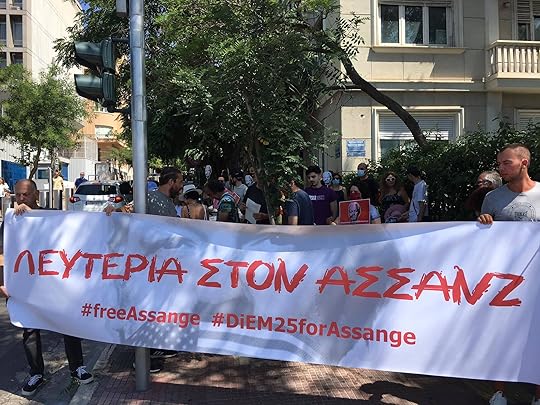
Ο καλός μου φίλος Τζούλιαν συνεχίζει να σιγοπεθαίνει στο κελί του στα βάθη του Βρετανικού Γκουαντάναμο, θύμα αδίστακτων Δυτικών κυβερνώντων αποφασισμένων να ρουφήξουν λίγο-λίγο την ζωή μέσα από το κορμί του έτσι ώστε να αποτρέψουν άλλες και άλλους από το να αποκαλύψουν άβολες για την ολιγαρχία αλήθειες. To DiEM25-MέΡΑ25, κίνημα του οποίου ο Τζούλιαν είναι συνιδρυτής, κινεί γη και ουρανό για να τους σταματήσουμε. Σήμερα, Σάββατο 3η Ιουλίου, διαδηλώσαμε πανευρωπαϊκά μπροστά από πρεσβείες γιορτάζοντας έτσι τα 50α του γενέθλια, απαιτώντας την άμεση αποφυλάκισή του, και ευχόμενοι στον Τζούλιαν να δημιουργεί για τουλάχιστον άλλα 50 χρόνια πρόβλημα στην παγκόσμια ολιγαρχία.

The post Ποιός φοβάται τον Τζούλιαν Ασάνζ; Κε Μπάιντεν, γιατί επιμένετε στον αργό του θάνατο; appeared first on Yanis Varoufakis.

 •  0 comments  •  flag
Share on Twitter
Published on July 03, 2021 02:37

Who is afraid of Julian Assange? Why are they so determined to suck the life slowly out of his body?

My dear friend Julian continues to waste away in Britain’ Guantanamo, the victim of ruthless Western governments determined to suck his life slowly from his body as a cautionary tale to anyone who dares expose inconvenient truths. DiEM25, the movement that Julian co-founded, is moving heaven and earth to stop them. Today, Saturday 3rd July, we were demonstrating in front of embassies to celebrate his 50th birthday, to demand his immediate release and to wish him at least another 50 years of being a thorn in the global oligarchy’s backside.

The post Who is afraid of Julian Assange? Why are they so determined to suck the life slowly out of his body? appeared first on Yanis Varoufakis.

2 likes ·   •  0 comments  •  flag
Share on Twitter
Published on July 03, 2021 02:32

June 24, 2021

FRAPORT: H Μεγάλη Ληστεία με υπογραφή τρόικας, ΝΔ, ΣΥΡΙΖΑ που θα μείνει στην Ιστορία μαζί με το δάνειο από τους Αδελφούς Ρικάρντο & το Κατοχικό Δάνειο

Φαντάσου να έχεις  μουσαφίρη στο σπίτι σου που, ξάφνου, σου λέει: «Ωραίο το σπίτι σου. Το παίρνω.” “Δεν το πουλώ”, του λες. “Ασ’ τα αυτά”,  σου απαντά κοφτά. “Το παίρνω!” Και σαν να μη έφτανε αυτό το σοκ, ο μουσαφίρης συνεχίζει:“Δεν έχω λεφτά να σου δώσω αλλά θα στο πάρω. Κοίτα να δείς τι θα κάνουμε: Θα πάρεις ένα δάνειο από την τράπεζα. Θα το δώσεις σε κάτι φιλαράκια μου. Εκείνοι θα μου δανείσουν τα λεφτά αυτά να στα δώσω. Εσύ θα τα δώσεις στην τράπεζα σε βάθος χρόνου, βάζοντας από την τσέπη σου τους τόκους. Επί πλέον, εγώ θα το νοικιάζω σε νοικάρη για ποσό μεγάλο για να αποπληρώνω το δικό μου δάνεια στα φιλαράκια μου και να μου μείνει κι ένα κέρδος. Αν ο νοικάρης δεν έχει κάποιους μήνες να μου δίνει το νοίκι, θα το πληρώνεις εσύ. Κατάλαβες;”Κάπου εκεί, φαντάζονται, θα φωνάξεις την αστυνομία να έρθουν να τον μαζέψουν. Σωστά; Μόνο που στην περίπτωσή μας, στην περίπτωση του χαρίσματος 14 αεροδρομίων μας στην Fraport, η αστυνομία που κατέφτασε ήταν η… τρόικα – η οποία, βεβαίως βεβαίως – πήρε το μέρος του και σου πήρε το σπίτι!

Το 2015 μετά την συνθηκολόγηση του ΣΥΡΙΖΑ έκλεισε ένας πολύ όμορφος κύκλος χρήματος για μία άλλη μορφή εθνικοποίησης, ούτε καν ιδιωτικοποίησης, αλλά από «λάθος» έθνος, το γερμανικό έθνος. Έρχονται λοιπόν μετά να κάνουν δήθεν επενδύσεις και τι επένδυσαν; 0! Από το ελληνικό ΕΣΠΑ και χρήματα Ελλήνων και ευρωπαίων φορολογουμένων έγιναν όλες οι «επενδύσεις».Η «καλή» Fraport πήρε ουσιαστικά δωρεάν τα 14 αεροδρόμια διαμάντια, έβαλε άλλους να κάνουν τις επενδύσεις γι’ αυτά και εν μέσω πανδημίας τους δίνετε κιόλας και τα κέρδη που μας λέει η ίδια η Fraport πόσο τα υπολογίζει! Δεν ντρέπεστε πραγματικά, δεν αισχύνεστε κ. Υπουργέ; Ακόμα και ο μεγαλύτερος καπιταλιστής δεν θα τα έκανε αυτά.Η Αριστερά όμως εδώ κάνει ένα λάθος, κακώς κατηγορεί την Κυβέρνηση για νεοφιλελευθερισμό, δεν είναι καν νεοφιλελευθερισμός όλο αυτό. Η Θάτσερ μιλούσε για ανταγωνισμό των ιδιωτικών εταιρειών, ενώ εδώ δίνετε και τα 14 αεροδρόμια σε μία κρατική γερμανική εταιρεία, πρέπει να ντρέπεστε ακόμα και ως θατσερικός κ. Σκυλακάκη. Επιπλέον, το κέρδος του επιχειρηματία δικαιολογείται υποτίθεται για το επιχειρηματικό του ρίσκο, πρέπει να ντρέπεστε που εξασφαλίζετε το κέρδος ιδιωτών επιχειρηματιών από το δημόσιο, αυτό είναι ο ορισμός της ληστείας.Όταν είχα ρωτήσει τον Βόλφγκανγκ Σόιμπλε αν θα έδινε ποτέ 14 γερμανικά αεροδρόμια σε μια κρατική εταιρεία άλλης χώρας, μου απάντησε: «σε καμία περίπτωση», κι όταν στη συνέχεια τον ρώτησα «και γιατί βάζετε εμάς να το κάνουμε;» Σήκωσε απλώς τους ώμους του σαν να λέει «ίσα κι όμοια είμαστε;». Σαν να λέει δηλαδή είσαστε κράτος υπό κατοχή και αυτό ήρθατε εσείς του ΣΥΡΙΖΑ και το επιβεβαιώσατε.

Ακόμα και πρώην Υπουργοί της Θάτσερ λένε πως τα όσα συμβαίνουν σε αυτή τη χώρα είναι ανήκουστα. Τη στιγμή που έχουμε και τον απόλυτο εξευτελισμό του κοινοβουλευτισμού. Δίνετε χρήματα που δεν έχει καν ο ελληνικός λαός στη Fraport. Δεν είστε νεοφιλελεύθεροι, θεραπαινίδες, ξεδιάντροπων αποικιοκρατών είστε. Αν ζούσε ο Κωνσταντίνος Καραμανλής και ο Ανδρέας Παπανδρέου θα σας καταριόνταν γι’ αυτά που κάνετε.Το σημερινό αίσχος όμως είναι η «φυσιολογική» εξέλιξη της αποικιοκρατικής σύμβασης που υπέγραψε ο συνθηκολογημένος ΣΥΡΙΖΑ του 2015.Υπάρχουν 3 ληστρικές συμβάσεις, θα μείνουν στην ιστορία ως συμβάσεις καθολικής εξάρτησης και υποταγής, αλλά και ως υπενθύμιση της βασικής ήττας του ελληνισμού:Το δάνειο του 1825 από τους αδελφούς ΡικάρντοΤο κατοχικό δάνειο που επιβλήθηκε από την ΒέρμαχτΚι η σύμβαση υποταγής στην Fraport, επιβεβαιώνοντας πλήρως τη Χρεοδουλοπαροικία και την υποταγή της χώρας στα μνημόνια.


Σήμερα, όσοι ψηφίζετε θετικά, ή κρύβεστε πίσω από ένα δειλό “παρών”, επιλέγετε να καταταγείτε στον βραχύ κατάλογο των δακτυλοδειχτούμενων του μέλλοντος. Έχετε μια τελευταία ευκαιρία: Καταφηφίστε όπως καταψηφίζει το ΜέΡΑ25!

The post FRAPORT: H Μεγάλη Ληστεία με υπογραφή τρόικας, ΝΔ, ΣΥΡΙΖΑ που θα μείνει στην Ιστορία μαζί με το δάνειο από τους Αδελφούς Ρικάρντο & το Κατοχικό Δάνειο appeared first on Yanis Varoufakis.

 •  0 comments  •  flag
Share on Twitter
Published on June 24, 2021 02:47

Yanis Varoufakis's Blog

Yanis Varoufakis
Yanis Varoufakis isn't a Goodreads Author (yet), but they do have a blog, so here are some recent posts imported from their feed.
Follow Yanis Varoufakis's blog with rss.