Jennifer Flanders's Blog, page 30
July 15, 2014
Lost & Found
 It was a stupid thing to do. That much is obvious.
Normally, I would have spent recess swinging or sliding or riding on the merry-go-round. But that day, I sat alone at the edge of the playground holding my new ring, admiring the way it caused the sunlight to dance in my hand.
The ring was a birthday gift from my parents — a tiny diamond (April’s birthstone) set in the center of a small gold flower.
I was seven at the time — too young for anyone to have mistaken it for an engagement ring — but my mother still insisted I wear it on my right hand.
Only that day at recess, I wasn’t wearing it at all. I was playing with it. I was playing a game I called “Digging for Buried Treasure.”
First, I’d bury my little ring in the sand, then I’d dig, dig, dig until I found it. Then I’d bury it a little deeper, and dig a little longer until I uncovered it again.
And so the game continued: the ring was lost, then found, then lost, then found, then lost… then the bell rang.
Frantically I searched as my classmates lined up to march back inside the school building, but to no avail.
The teacher called my name, tapped her foot, pointed to her watch, jerked her thumb toward the double doors behind her.
I tried to explain why I couldn’t possibly leave. Not now. Not yet. But she insisted, and I spent the rest of the day distraught and distracted in my little school desk, staring out the window and wondering if I would ever see my beautiful ring again.
When the final bell rang that day, I ran home in tears to tell my mother what had happened.
She listened to my hysterical cries and did her best to calm and comfort me. “Just wait until your Daddy gets home,” she soothed. “He’ll know what to do.”
And he did.
With eyes full of compassion, he tenderly took my hand and led me back to the school yard.
As we walked together, he didn’t scold. He didn’t lecture. He didn’t tell me how foolish I had been or how easily I could have avoided this situation or how it would serve me right if I never got the ring back.
He didn’t grouse or grumble or complain.
Instead, he acted as if he’d been waiting all day for a chance to come home and dig in the sand with his little girl. All I sensed was love and sympathy and a stubborn determination to find what was lost.
The playground sprawled across a good two acres, much of which was covered in 4-5 inches of sand. Daddy asked me to point out the general vicinity where I’d been playing, then told me to hunt there. But instead of digging beside me, he strolled to the nearest entrance and began combing through the sand with his fingers.
Slowly, systematically, he worked his way toward me, all along the retaining wall, sifting the sand as he went.
After about twenty minutes of digging, he uncovered a cut stone, but it was too big to be mine, so he kept searching.
Another ten, twenty, thirty minutes passed. The sun was sinking low on the horizon. But Daddy kept looking. Patient. Persistent. Unperturbed.
Then, just as it was growing too dark to search any longer, the last grains of sand fell through his fingers to reveal my beloved ring!
My father had the most beautiful smile — pearly white teeth with a small gap between the top two. The light was too dim and my eyes too flooded with tears for me to see his smile that night, but I could hear it in his voice as soon as he called my name, and I knew.
He had found what was lost.
He had accomplished what he’d set out to do. And my heart was filled to bursting with gratitude for that Daddy of mine.
My father wasn’t perfect. Like all parents, he sometimes made mistakes. His patience occasionally wore thin. There were plenty of times that I got the lecture (or other appropriate discipline) I so well deserved — dished out with love, to be sure, but without such obvious compassion.
But on that balmy night of yore, he was as perfect as a Daddy can get.
I cannot tell you how often I’ve reflected on that scene from my childhood, for my father’s pivotal response affected me in many unforeseen and far-reaching ways:
It affected the way I approach my problems:
My father’s calculated response impressed on me how important it is to remain calm and collected, even (and especially) during times of upset and stress. My frantic and random pawing at the ground earlier in the day had been completely ineffectual. Daddy’s slow, methodical approach took time, but yielded the exact result I was hoping and praying for. Daddy showed me that cool heads prevail, a lesson I’ve carried with me into adulthood.
It affected the way I parent my children:
I don’t remember everything Daddy ever said to me growing up, but I remember how he made me feel: Loved. Esteemed. Cherished. And I’ve done my best to communicate those same things to my own children. Sometimes I fail. Sometimes I fall short. But the example my father — and my mother — set for me has made it much easier to be a good parent myself. I can model what they did with full confidence that 98% of it was right and good.
It affected the way I perceive my Heavenly Father:
They say that children tend to view God in the same way they view their dad. Perhaps that is true. My earthly father was wise, benevolent, and completely trustworthy, so it has never been difficult for me to trust implicitly in the wisdom, goodness, and faithfulness of my Heavenly Father. My dad’s loving response to my lost ring has given me confidence to boldly approach the Throne of Grace with other burdens and requests, great and small (including another diamond I lost forty years later). And that’s a rich heritage, indeed.
It was an incredible blessing to have the father I had. I know that’s not been the case for a lot of people. Many children growing up today do not even know their father, much less enjoy such a close relationship with him. Others have had negligent or abusive dads. That grieves my heart. It makes life much more difficult for them, but it does not leave them without hope.
Having a good father may make it easier to understand and accept the goodness of God, but God is good regardless. You can choose to believe what the Bible says about God, even if it varies widely from what you’ve experienced in your home.
God loves you. He cares for you. He is patiently seeking — even now — that which is lost.
As I’m typing these words, I’m praying again, boldly making my request known unto God. (Philippians 4:6)
But this time, dear Reader, I’m praying for you. I’m praying that you will see God for the loving Father He is, and that you will bask in that love, fully assured that He is good and wise and worthy of your complete confidence and trust.
“See what great love the Father has lavished on us, that we should be called children of God! And that is what we are!” (1 John 3:1)
“For I am convinced that neither death nor life, neither angels nor demons, neither the present nor the future, nor any powers, neither height nor depth, nor anything else in all creation, will be able to separate us from the love of God that is in Christ Jesus our Lord.” (Romans 8:38)
“But as many as received Him, to them He gave the right to become children of God, even to those who believe in His name.” (John 1:12)





July 1, 2014
5 Lessons I Learned by Losing a Diamond
 Last month, I lost the diamond out of my wedding ring — an irreplaceable family heirloom. It made me feel sick when I glanced down at my hand while dining in a local restaurant and noticed it missing, for how long, I didn’t know.
Years earlier, my husband’s grandmother had taken the diamond off her own finger as soon as Doug announced his intention to marry me. She reached over, patted me on the knee with a twinkle in her eye and said, “Then we’d better go get the ring sized.”
Nanny and Poppy drove us to Taylor Brothers that very morning, then Doug “officially” proposed on bended knee in their living room as soon as the ring came back from the jewelers.
A rare antique cut, the diamond had been in my husband’s family for over 120 years when it was given to me (and almost 150 years when I lost it two weeks ago).
As soon as I realized it was gone, I called my mother and asked her to pray that it would be found. I also posted a prayer request on Facebook, where I received an incredible amount of encouragement from friends there, many of whom had lost-diamond stories of their own to tell:
One of my friends lost her ring at Walmart, and some good Samaritan turned it in.
Another friend had found her lost diamond two years later, in the mouth of a whale in a pop-up book that was on its way to Goodwill!
Someone else lost a custom-cut, heart-shaped diamond IN THE OCEAN while honeymooning in the Caribbean. If that isn’t about as hopeless as it gets, I don’t know what is. Yet her husband spotted it wedged in the crevice of a rock on the beach almost two weeks later, the day before they were scheduled to fly home.
Even friends who hadn’t lost diamonds promised to pray and gave great suggestions for searching:
Hunt in the dark with a flashlight
Empty the vacuum bag
Check your dryer lint trap, sink bin, clothes closet
Thoroughly search the car
Make sure it’s not caught in your broom fibers
Of course, I thought of a few more places to search on my own:
In the bed linens (maybe it fell out in my sleep?)
Under couch cushions (no diamond, but I did find several pennies and ink pens)
In the fishbowl (I emptied out all the decorative rocks in the bottom and searched one by one)
In the flower beds (I’d spent a couple of hours there, trimming back ivy and azaleas the day before)
In the garbage disposal (It’s a cramped, slimy job, but the peace of mind was worth it)
Unfortunately, my diamond didn’t surface through any of that, but I kept praying, kept hoping, kept looking….
I also did a little therapeutic writing. I began a (not-yet-published) post about a diamond I lost forty-two years ago and the lessons I learned through the experience. (Watch for that story soon. It still makes me cry every time I tell it.) And I wondered what lessons God might be trying to teach me this time around. Here are a few I’ve identified thus far:
The insufficiency of good intentions
My house has been in need of a deep cleaning for some time now. It has been on my to-do list for months, yet I lacked motivation to follow through with the job. In the past two weeks, however, I’ve cleaned out closets, organized drawers, scrubbed counters and cabinet fronts, dusted baseboards, defrosted my freezer, vacuumed under furniture, and culled through, sorted, and put away all manner of misplaced miscellany. My lost diamond provided just the boost I needed, as I’ve always considered systematic cleaning to be the fastest, most effective way to find things.
The lesson, I think, is that we should go ahead and do the thing we know we need to do, instead of waiting until something drastic drives us to it. (James 4:17) Let’s reduce our stress levels before we have the heart attack. Let’s invest in our marriage before the divorce papers are served. Let’s get in shape before our health fails. Let’s make memories with our children before they grow up and leave home.
The value of hope:
My big-hearted husband was completely unfazed by the fact I had lost this priceless heirloom. Being the think-outside-the-box sort of guy he is, he took me straightaway to the jewelers, ready and willing to trade in what was left of my wedding set for something entirely new and different — and more than a little surprised that this idea was not met with more enthusiasm on my part.
But thankfully, thankfully, the jeweler convinced him to wait. “You’re going to find it,” he assured us. “Give it a few days. I’ll bet that diamond will wink at you. When it does, you can bring it back in, and we’ll repair it for you.”
Isn’t hope an amazing thing? It gives us peace when we’re troubled, strength when we’re weary, and courage when we’re frightened. That jeweler’s confidence, together with the testimonies of so many friends whose lost stones had been miraculously restored, served to buoy my faith that I’d eventually find mine, too. (Hebrews 10:23-25)
The heart of God:
The Bible tells us that Jesus “came to seek and save that which was lost.”(Luke 19:10) Only, He wasn’t searching for something as insignificant as an inanimate rock. Oh, no! He’d set his sights on eternal souls — Christ came to redeem you and me.
That sense of urgency I felt about finding my lost diamond? The concern that it might be lost forever? The determination to stay alert to any sign of its whereabouts? How is it that I can retain such focus when it’s a shiny little stone in question, but am often oblivious to the infinitely more valuable treasures all around me? Those lost sheep Christ came to save. People are more important than things, and the way I live my life should reflect that fact.
The importance of checking those prongs
This wasn’t the first time I’ve lost that diamond. It also fell out fourteen years ago while our family was on a 2500-mile road trip. That time, it was miraculously recovered a week later by one of our children — subsequently dubbed “Diamond Dave” — who spotted it under the back seat of our Suburban amid broken crayons and cracker crumbs at a pit stop in Virginia.
The stone was originally set with four prongs (which held up remarkably well considering all the scrubbing, painting, kneading, and digging I’d done with that diamond on my hand); however, we decided to remount with six, assuming that would be sufficient to keep it safe. Obviously, it wasn’t. Had I been smart about it, I would have taken my rings back to the jeweler more routinely, so he could inspect the prongs and make sure everything was still secure.
A similar thing sometimes happens in our spiritual walk. We get baptized in infancy or pray a prayer in childhood and mistakenly believe our future is secure because of it — regardless of how we’ve lived our lives since. We know that God saves us by grace through faith, and not because of any works done on our part (Ephesians 2:8-9), yet we are still called to bear fruit, and that fruit will only come when we are in close communion with the God who produces it. (John 15:1-8) If we are smart about it, we will check in with Him routinely, allowing Him to inspect us, prune us, and keep us secure in Christ.
The power of prayer:
Isn’t it amazing that through prayer, we have the privilege of conversing with the Creator of the Universe? I am so blessed to have so many friends and family members who are willing to pray with and for me, even about the little stuff. And I am so grateful to serve a God who promises that when we pray, He will hear and answer (Matthew 7:7-8). Sometimes He answers right away. Sometimes He asks us to wait. With respect to my diamond, it was enough for me to know that God knew exactly where it was (even if I didn’t), that He could keep it safe, and that He would give it back to me if doing so would be for my good and His glory. (Romans 8:28)
As it turns out, between all the prayers and all the cleaning, my diamond finally did resurface. Praise the LORD! It had evidently fallen out in our bathroom where it rolled under a cabinet and into a small gap in the grout between the tile and the wall (there’s one more place to check if you ever lose yours!). I’d already swept the bathroom several times in search of the lost stone, but because our pastor’s family was coming for dinner Saturday night, I decided to lay down on my stomach to scrub those hard-to-reach tiles by hand. I still couldn’t see it, but the diamond was there all the same, safe and sound, just waiting for my fingers to dislodge it from its hiding place.
Now, isn’t that a happy ending?





June 21, 2014
A Christian Father’s Rules for Dating My Daughter

In the past, several readers have asked how our family handles dating/courtship, so I thought I’d share my husband’s perspective with you. Enjoy!

 Originally posted on All Truth Is God's Truth:
I spotted a photo in my newsfeed yesterday of the T-shirt a feminist father made to explain his expectations to anyone interested in dating his daughter. His “rules” sent a clear message: “What my daughter does is her own business, and you’ll answer to her, not to me.”
As the father of four daughters myself, I found this man’s laissez-faire attitude to be a little unsettling. I believe a dad has a moral obligation to protect his children from harm, to prepare them for life, and to provide wise counsel along the way — all of which calls for a hands-on approach to parenting.
I agree with Feminist Father on his first two points (I don’t make the rules and You don’t make the rules). However, I disagree with his conclusions, so I decided to create a little T-shirt of my own — a Christian Dad’s…
View original 161 more words





June 8, 2014
Life with You is Awesome
The kids and I have been working on this little surprise for Father’s Day, based on the theme song from The Lego Movie. Of course, it’s almost impossible to keep a secret in a household our size. Since Daddy already found out about it, I decided to publish a week early.
You’ll have to excuse the audio. Rap music is clearly not the forte of this classically trained soprano, but we had a great time putting it together, anyway… because “everything is awesome when you’re part of a team.”
And for those who are inclined to sing along, here are the lyrics for our version:
Life with You Is Awesome!
Life with you is awesome.
Life with you is cool — I’m so glad we’re a team!
Life with you is awesome, ‘cause we’re living our dream.
Married life is better when we work together.
Side by side, you and I gonna stick together, in all kinds of weather.
Man and wife, I love you, you love me, we’re both working in harmony.
Life with you is awesome.
Life with you is cool — I’m so glad we’re a team!
Life with you is awesome, ‘cause we’re living our dream.
(Woooo!) 3, 2, 1. Go!
Have you heard the news? Everyone’s talking.
Life is good and people are gawking.
Baby’s due, our family is growing.*
We’ve got love and joy overflowing.
Life with you is full of adventures
I’ll love you even when you have dentures.
Food in my teeth? Oh, that’s just awesome.
Next time, tell me when I need to floss ‘em.**
Love is blind — now I know that’s true.
It’s so awesome to be loved by you (be loved by you)
Married life is better when we work together.
Side by side, you and I gonna stick together, both now and forever.
Man and wife, I love you, you love me, we’re both working in harmony.
Life with you is awesome.
Life with you is cool — I’m so glad we’re a team!
Life with you is awesome, ‘cause we’re living our dream.
Marriage vows, wedding rings,
I just named two awesome things.
Pledged my love, said, “I do.”
You know what’s awesome? Life with you!
Clean, fresh sheets upon our bed, a feather pillow for my head.
Let’s go soak in a hot jacuzzi.
Not too long, or we’ll get woozy.
Pools, tools, jewels.
They’re awesome.
Girls with curls and pearls.
They’re awesome.
Boys enjoy their toys.
That’s awesome
Every day of life as man and wife
Is awesome!
Life with you is awesome.
Life with you is cool — I’m so glad we’re a team!
Life with you is awesome, ‘cause we’re living our dream.
* As far as we know, there are no babies currently on the way, although it is probably just a matter of time, at least as far as grandchildren are concerned!
** This really did happen, although (thankfully) not at the wedding. It was actually on one of our first dates, when I got a whole black peppercorn lodged between my top central and lateral incisors and didn’t realize it was there until the date was over. Doug still claims he never noticed.





May 30, 2014
I Married a Sinner (and So Did He)

What follows is an excerpt from my book, Love Your Husband/Love Yourself. I am posting here at the request of a blogging friend from Thankful Homemaker.
The letter quoted at the end of this passage is a personal one that Elisabeth Elliot sent me in response to a letter I mailed to her over a quarter century ago.
That was in the days before the Internet, when handwritten correspondence was still in fashion.
The ink on that correspondence has faded a bit and the stationery yellowed with age, but the advice Mrs. Elliot gave me therein is as timely today as it was then.
It deserves to be shared and taken to heart — for in a world filled with Hollywood chick-flicks and high expectations and Harlequin romances and (even) homeschool courtships, it is easy to lose sight of reality.
That reality is this: Your husband is human. He has flaws (as do you). And forgiveness will be essential if you ever hope to look beyond those flaws and build a happy, successful marriage.
~ Words of Wisdom ~
We know that “all have sinned and fall short of the glory of God” (Romans 3:23), but there is a difference between philosophically acknowledging your husband’s inherent sin nature, and experientially coming face to face with a particular offense which affects you. This is where the rubber meets the road, where forgiveness becomes more than a theoretical platitude.
I first grappled with this distinction back in 1986, the year I finished college. Doug and I had met two weeks before graduation and become fast friends. We held so many things in common — values, goals, beliefs, even mannerisms — that my own mother told me she would fear we were siblings had I been adopted as Doug was.
We were soon making plans for the future, determined that our life together should be built on trust and transparency. Against the advice of all his friends, Doug was completely candid with me about his past failings, and I am eternally grateful for his honesty.
Although the events he described had occurred in the distant past, his confession was difficult for me to bear; it consumed my thoughts by day and tormented my dreams by night.
Careworn and weary, I finally wrote to Elisabeth Elliot for counsel. With her permission, I close this chapter with her response, dated September 30, 1986.
Dear Jennifer:
How my heart went out to you last night as I read your letter, just received. I understand perfectly how you felt…. Even God, who forgives the sin and casts it into the depths of the sea, does not undo the effect of that sin, nor can you…. The tears, the nightmares, the unbidden imaginary pictures that torment you — how well I empathize with all of that, and pray for your comfort and healing.
First let me say that Doug is to be commended for not allowing himself to deceive you. He must have been in an agony over the decision to tell you, knowing at least a little bit how much it would hurt.
Second, you suffer not alone, but actually and redemptively with Christ (see Colossians 1:24, Philippians 1:29, 1 Peter 4:12-13, and many other passages). This aspect of suffering is a real life-changer. Study it for the rest of your life.
Third, you suffer quite literally because of another’s sin, which is exactly what Christ did. Because He paid the price for yours, you too must be willing to pay the price for Doug’s — the price of sorrow, heartbreak, the sense of irremediable loss…. Forgiveness means absolute relinquishment of all that. It is a laying down of your life. Your dream of the “perfect” man has to go — it is this man God has given you, another sinner (there isn’t anything else to marry!) — it is this gift you receive in thanksgiving, acknowledging the fact that in this fallen, broken world, there is no place where the heart may be perfectly at rest and wholly filled except at the Spring of Living Water. Drink there, dear Jennifer, and be at peace.
Doug’s admission will always be a reminder to you that he needs your sacrificial, self giving love. When you sin against him, as you certainly will, any wife does, you will then know, when you have to ask his forgiveness, that you are two human beings in need of the Amazing Grace that saves WRETCHES!! You are, as Peter wrote, “heirs together of the grace of life.”
So forgive him freely, utterly, joyfully — for that is how Christ has forgiven you (Ephesians 4:32). Bring all those awful thoughts and imaginations under the Lordship of Christ (2 Corinthians 10), and receive this man as your God-given husband, promising to honor, which means, among other things, never to bring up again that which has been put under the Blood.
I know a young woman who steadfastly refused to forgive her husband…. She has, in spite of Christian profession, destroyed her marriage, destroyed her own life, and blighted the lives of others. Don’t refuse the grace of God for your own deep needs, nor refuse to Doug the grace He will give you to forgive him.
Lovingly,
Elisabeth Elliot
I’m not sure what I had expected Elisabeth Elliot to say to me, but — twenty-eight years and twelve children later — I am so very grateful that she gave me the advice she did… and that I had sense enough to take it.
If this is an area of struggle in your life, I pray God will give you the grace to take it, too.
Want to read more? You can find Love Your Husband/ Love Yourself at Barnes & Noble, Amazon, and many other fine booksellers. It is also available for Kindle or the Nook.
 What readers are saying:
“This book is the talk your mom never had the nerve to have with you.”
“I wish I had read it years ago…”
“Don’t miss this one.”
“…a message openly opposed by our culture and sadly sidestepped by the church.”
“…one of the most candid, honest, beautiful books on marriage I have ever read.”





May 28, 2014
Forever After (Free Printable Subway Art)
[click on image to download]
Wedding season is upon us: We’ve been invited to three weddings in four weeks, and it’s not even June yet!
What’s more, at least two of those brides are in their early twenties, which gives me hope that the trend toward delaying marriage an extra decade (or forgoing it altogether) may be starting to turn.
That makes me happy.
To celebrate, I decided to create a new piece of subway art.
You can print the design in the original 8×10 size for framing, or if you’re the crafty sort, you may want to print four copies per page, trim, and then mount them on cardstock to make your own wedding cards.
This is what all the brides we know will be getting with their gifts from us this season (along with a copy of my book).





May 25, 2014
Praying for Your Unborn Child
[click on image to download]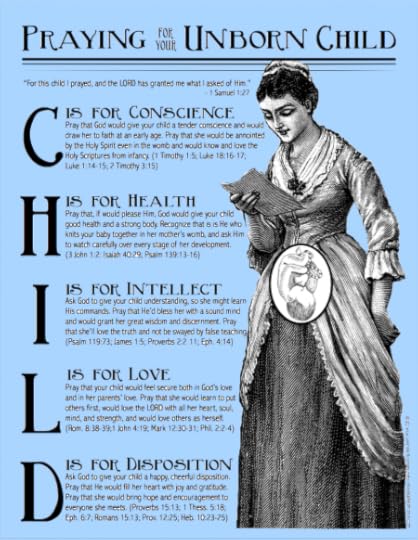
God granted that request, but the little girl was also quite stubborn. She was so headstrong, in fact, that by the time she was two years old, my friend was wishing she’d spent more of her pregnancy praying for her daughter’s character than for her physical features!
Of course, I don’t think praying for a baby is like ordering off a menu, but I do know that God delights in giving us the desires of our heart (Psalm 37:4-5) — especially when those desires are in line with His own.
While it never occurred to me or my husband to pray for a child’s hair or eye color, or even for a particular sex, we certainly sent up many other heartfelt petitions for our children, beginning from the first moment we learned we were expecting, if not before.
Here are the things for which we most fervently prayed:
Prayer for an Unborn Child
C is for Conscience
Pray that God would give your child a tender conscience and would draw her to faith at an early age. Pray that she would be anointed by the Holy Spirit even in the womb and would know and love the Holy Scriptures from infancy. (1 Timothy 1:5; Luke 18:16-17; Luke 1:14-15; 2 Timothy 3:15)
H is for Health
Pray that, if would please Him, God would give your child good health and a strong body. Recognize that is is He who knits your baby together in her mother’s womb, and ask Him to watch carefully over every stage of her development. (3 John 1:2; Isaiah 40:29; Psalm 139:13-16)
I is for Intellect
Ask God to give your child understanding, so she might learn His commands. Pray that He’d bless her with a sound mind and would grant her wisdom and discernment. Pray that she would love the truth and not be swayed by false teaching. (Psalm 119:73; James 1:5; Proverbs 2:2-11; Ephesians 4:14)
L is for Love
Pray that your child would feel secure both in God’s love and in her parents’ love. Pray that she would learn to put others first. Pray that she would love the LORD with all her heart, soul, mind, and strength, and would love others as herself. (Romans 8:38-39; 1 John 4:19; Mark 12:30-31; Philippians 2:2-4)
D is for Disposition
Ask God to give your child a happy, cheerful disposition. Pray that He would fill her heart with joy and gratitude. Pray that she would bring hope and encouragement to everyone she meets. (Proverbs 15:13; 1 Thessalonians 5:18; Ephesians 6:7; Romans 15:13; Proverbs 12:25; Hebrews 10:23-25)
“For this child I prayed, and the LORD has granted me what I asked of Him.” (1 Samuel 1:27)
Do you (did you) pray for your babies before they were born? On what things were you most likely to focus your requests?
Parents should never underestimate the power of prayer. Even if you’ve not prayed consistently in the past, you can start now. Here are a couple of our other free printable guides to help you do that:
Praying for Your Children from Head to Toe
Praying for Your Teenager
We invite you to check out our printables page for even more!





May 23, 2014
Pray for Your Teen!
[click image to download]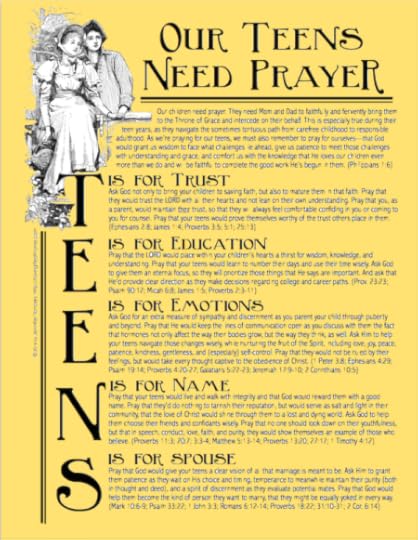
Thank you so much for your head-to-toe prayers! I’ve been using your husband one to pray for my husband for a few months and it’s been powerful! I like the one for children, also, which I just found today. I’d love it if you made one specifically geared toward teenaged children. I currently have five in that age range and never has there been a time in their lives when they need more prayer.
She’s right, of course.
Our children need prayer at every age and stage of life. They need Mom and Dad to faithfully and fervently bring them to the throne of Grace and intercede on their behalf. This is especially true during their teen years, as they navigate the sometimes tortuous path from carefree childhood to responsible adulthood.
And as we are praying for our teens, we must also remember to pray for ourselves — that God would grant us wisdom to face what challenges lie ahead, that He would give us patience to meet those challenges with understanding and grace, and that He would comfort us with the knowledge that He loves our children even more than we do and will be faithful to complete the good work He’s begun in them. (Philippians 1:6)
- A Prayer Guide for Your Teens -
T is for Trust
Ask God not only to bring your children to saving faith, but also to mature them in that faith. Pray that they would trust the LORD with all their hearts and not lean on their own understanding. Pray that you, as a parent, would maintain their trust, so that they will always feel comfortable confiding in you or coming to you for counsel. Pray that your teens would prove themselves worthy of the trust others place in them. (Ephesians 2:8; James 1:4; Proverbs 3:5; Proverbs 5:1; Proverbs 25:13)
E is for Education
Pray that the LORD would place within your children’s hearts a lifelong thirst for wisdom, knowledge, and understanding. Pray that your teens would learn to number their days and use their time wisely. Ask God to give them an eternal focus, so they will prioritize those things that He says are important. And ask that He’d provide clear direction as they make decisions regarding college and career paths. (Prov. 23:23; Psalm 90:12; Micah 6:8; James 1:5; Proverbs 2:3-11)
E is for Emotions
Ask God for an extra measure of sympathy and discernment as you parent your child through puberty and beyond. Pray that He would keep the lines of communication open as you discuss with them the fact that hormones not only affect the way their bodies grow, but the way they think, as well. Ask Him to help your teens navigate those changes wisely, while nurturing the fruit of the Spirit, including love, joy, peace, patience, kindness, gentleness, and (especially) self-control. Pray that they would not be ruled by their feelings, but would take every thought captive to the obedience of Christ. (1 Peter 3:8; Ephesians 4:29; Psalm 19:14; Proverbs 4:20-27; Galatians 5:22-23; Jeremiah 17:9-10; 2 Corinthians 10:5)
N is for Name
Pray that your teens would live and walk with integrity and that God would reward them with a good name. Pray that they’d do nothing to tarnish their reputation, but would serve as salt and light in their community, that the love of Christ would shine through them to a lost and dying world. Ask God to help them choose their friends and confidants wisely. Pray that no one should look down on their youthfulness, but that in speech, conduct, love, faith, and purity, they would show themselves an example of those who believe. (Proverbs 11:3; Proverbs 20:7; Proverbs 3:3-4; Matthew 5:13-14; Proverbs 13:20; Proverbs 27:17; 1 Timothy 4:12)
S is for Spouse
Pray that God would give your teens a clear vision of all that marriage is meant to be. Ask Him to grant them patience as they wait on His choice and timing, temperance to meanwhile maintain their purity (both in thought and deed), and a spirit of discernment as they evaluate potential mates. Pray that God would help them become the kind of person they want to marry, that they might be equally yoked in every way. (Mark 10:6-9; Psalm 33:22; 1 John 3:3; Romans 6:12-14; Proverbs 18:22; Proverbs 31:10-31; 2 Corinthians 6:14)
These are the things my husband and I pray for our teens. Can you think of anything we’ve left off the list? Maybe “S for Safety” — especially as they start to drive? You may just have to flip the page over and continue the list of specifics on the back!
You can download all our other prayer guides here:
Free Printables.“The LORD is near to all who call upon Him, who call upon Him in truth. He will fulfill the desire of those who fear him; He will also hear their cry and will save them.” (Psalm 145:18-19)





April 24, 2014
Emphasizing Your Husband’s Good Points
 Pop quiz: Which would you prefer?
(a) That your husband focus his thoughts on your loveliest, most noble and praiseworthy characteristics?
(b) That he ignore your good points completely and concentrate instead on your most annoying and bothersome flaws?
Then do for him as you’d have him do for you….
What attracted you to your husband in the first place?
Express verbal admiration for those things.
In what areas has he grown and matured since you met?
Let him know you’ve noticed and appreciate the progress.
What things would you miss most if he were gone?
Thank him for everything he does for you and your family.
Never take him for granted. Live each day as if it were your last.
Dwelling on the positive isn’t so hard, especially when you consider that even negative behaviors can sometimes stem from positive traits. Trace them back to their source.
Case in point: When we were first married, it often bothered me that my husband would make what I considered frivolous and impulsive purchases (back then, it was sodas and candy at the corner gas station, later it would be new cars and cutting-edge technologies).
But I eventually came to realize that my husband’s spending habits go hand-in-hand with his giving habits: figuratively, since he views money as a tool, not as a treasure to be clutched or loved or horded; but also literally, because he usually gives away to some grateful person in need whatever good-as-new thing he is upgrading or replacing.
That lavish generosity, that willingness to share God’s blessings with those around him, that ability to give cheerfully, hilariously even, is something very good indeed. It is one of the traits I admire and appreciate most about my husband. And now I am reminded of that fact every time he buys something I think he shouldn’t.
It’s okay for us to be different. His strengths are not my strengths, and vice versa. Much of this is by design, as God intends for man and woman to complement one another. Different is not necessarily bad. It is just… different.
 So don’t focus on the areas where you are strong, but your husband is weak – areas where, in your opinion, perhaps he doesn’t quite measure up.
That focus will lead only to contempt, bitterness, and resentment, which will deal a deathblow to your love and intimacy, if not to your marriage itself. Think instead on the areas where you are weak but your husband is strong, areas where he complements and completes you.
Is your husband flawed? Certainly. He is a sinner. (In the words of Elizabeth Elliot, “There isn’t anything else to marry!”)
But beyond praying for him, that fact cannot — it must not — be your focus.
So look for the good in your spouse. Search for it as you would search for buried treasure. And keep those traits at the forefront of your mind.
If focusing on the positive has been a struggle for you in the past, pray that God will help you see your husband with new eyes.
Praise and admire your spouse verbally and often. Are you glad God brought him into your life? Tell him so! Would you feel you were missing out without him? Let him know it!
Emphasize his good points in your thoughts and in your speech, and you will see more of the same flourish in his character, his life, and his manner.
 This post is excerpted from my book, 25 Ways to Communicate Respect to Your Husband, winner of CSPA’s 2014 “Book of the Year” Award!
Available from Amazon, Barnes & Noble, and through fine booksellers everywhere.





April 15, 2014
Kirsten Dunst: She’s Simply Stating the Obvious
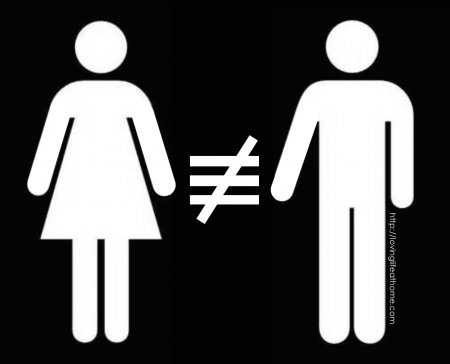
Equal? Yes. Identical? No.
Actress Kirsten Dunst made headline news last week for her comments concerning traditional gender roles.“I feel like the feminine has been a little undervalued,” she told Harper’s Bazaar UK. “We all have to get our own jobs and make our own money, but staying at home, nurturing, being the mother, cooking – it’s a valuable thing my mum created.”
The interview is published in the magazine’s May issue. As May is also the month most of the world celebrates Mother’s Day, these sweet comments about the choices her own mother made seem altogether fitting and appropriate.
But Dunst didn’t leave it at that. “Sometimes,” she continued, “you need your knight in shining armour. I’m sorry. You need a man to be a man and a woman to be a woman. That’s why relationships work.”
That’s the part that really got feminists’ dander up. The most militant of this movement want us to believe that men and women are not only equal, but are also identical — or, at least, they would be if society didn’t keep imposing gender-based expectations upon them.
Anyone who dares suggest that sex-based differences do exist (and to our benefit, even) is ridiculed.
Despite all the so-called progress that has been made toward masking such differences, women have lost far more than they’ve gained in the sexual revolution. In attempting to style ourselves as men, we’ve squandered the power we have as women.
The more women behave like men, the less inclined men are to stick around (or to exhibit the more virtuous of masculine qualities when they do). Instead of being cherished and protected, girls are being used then dumped, in the wake of which they grow lonely, depressed, bitter, and/or angry.
Dunst may not realize it, but her comments underscore some important scientific findings. Cutting edge research has demonstrated that — lo and behold — men and women actually are different. They are different in the way their bodies are built (a fact that seems obvious to any two-year-old, but eludes elitist academicians), in the way their brains process information, and in the way they respond to stress, to name just a few.
Furthermore, relationships do work better, last longer, and provide greater satisfaction when traditional gender roles are embraced. The studies that support such notions are numerous, rigorous, and well-documented. You can read more about them in the following excellent books, all of which I highly recommend.
Four (More) Must-Read Books for Women Who Think:
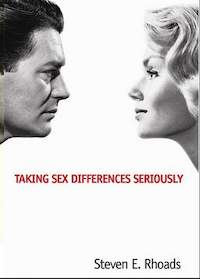
 If you’d like a better appreciation of just how different men and women really are, TAKING SEX DIFFERENCES SERIOUSLY provides a great starting place.
To be totally honest, I didn’t care much for Chapter 3 (in the section aptly named “Men Don’t Get Headaches”). It’s not that I questioned the validity of what is there written; it’s just that I felt a little uncomfortable with so graphic a glimpse at the way (many) men think. The rest of the book, however, is riveting, and the chapters on Fatherless Families, the Sexual Revolution, Day Care, and Title IX Sports are particularly enlightening.
EXCERPT: “There is a certain unworldly quality to the suggestions that a just world would be one in which men and women do all things equally. This understanding would require that parents who are trying to tease out their children’s natural abilities should instead do their part to help achieve a society in which a higher percentage of people do things they are not interested in and not very good at…. In the real world, any society will and should want to encourage people to do worthwhile things that they enjoy and do well. This means that natural inclinations will have policy and normative relevance, although they will not always be conclusive.”

 Mary Eberstadt’s ADAM AND EVE AFTER THE PILL is a tightly written treatise which examines many of the devastating if not unanticipated consequences of the sexual revolution, including the erosion of the nuclear family, the rise in production and consumption of pornography, the disturbing social trends on college campuses across the continent, and society’s shifting ideologies concerning both food and sex.
As bleak as the subject matter may sound, Eberstadt ends every chapter on a hopeful note by presenting evidence, however scant it may be, that the tide is slowly beginning to turn.
EXCERPT: “In the postrevolutionary world, sex is easier had than ever before; but the opposite appears true for romance. This is perhaps the central enigma that modern men and women are up against: romantic want in a time of sexual plenty. Perhaps some of the modern misery of which so many women today so authentically speak is springing not from a sexual desert, but from a sexual flood — a torrent of poisonous imagery, beginning now for many in childhood, that has engulfed women and men, only to beach them eventually somewhere alone and apart, far from the reach of one another.”
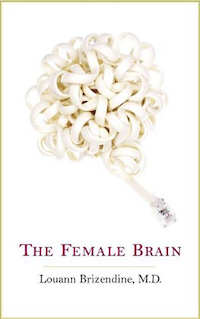
 Louann Brizendine tackles the topic of THE FEMALE BRAIN with a no-stone-unturned thoroughness one would rightly expect from a medical doctor such as herself. Almost a third of the book’s 279 pages are devoted to endnotes and reference citations. She tackles the topics of love, trust, sex, hormones, mothering, depression, and aging, all from a neurological standpoint that is both scientifically accurate and simultaneously easy to read and understand.
EXCERPT: Most women find biological comfort in one another’s company, and language is the glue that connects one female to another. No surprise, then, that some verbal areas of the brain are larger in women than in men and that women, on average, talk and listen a lot more than men. The numbers vary, but on average girls speak two to three times more words per day than boys. We know that young girls speak earlier and by the age of twenty months have double or triple the number of words in their vocabularies than do boys. Boys eventually catch up in their vocabulary but not in speed. Girls speak faster on average — 250 words per minute versus 125 for typical males…. Even among our primate cousins, there’s a big difference in the vocal communication of males and females. Female rhesus monkeys, for instance, learn to vocalize much earlier than do males and use every one of the seventeen vocal tones of their species all day long, every day, to communicate with one another. Male rhesus monkeys, by contrast, learn only three to six tones, and once they’re adults, they’ll go for days or even weeks without vocalizing at all. Sound familiar?”
 Dr. Brizendine’s
  THE MALE BRAIN is a fast and enjoyable read. This book is significantly shorter than its counterpart, THE FEMALE BRAIN — despite the use of a larger font and wider line spacing, it is only 132 pages (excluding appendices and footnotes) as opposed to 187. However, given the fact that a man’s brain apparently remains fixated on one consuming thought from puberty to the golden years and beyond, perhaps the book’s brevity should come as no surprise. Still, Brizendine draws upon numerous scientific studies to paint a fascinating picture of how a boy’s brain develops and changes, beginning in utero and continuing through every stage of his life. She includes chapters on The Boy Brain, The Teen Brain, The Mating Brain, The Daddy Brain, and the Mature Male Brain, with several others interspersed between. It would be a helpful read to anybody who must deal with boys or men on a regular basis.
EXCERPT: “By age five, according to researchers in Germany, boys are using different brain areas than girls to visually rotate an object in their mind’s eyes. The boys mentally rotated the pictures of the objects by using both sides of their brain’s spatial-movement area in the parietal lobe. Girls used only one side to do the task. While that in itself is revealing, what I found most intriguing is that this spatial-movement area in the male brain is locked in the ‘on’ position. That means it’s always working in the background on autopilot. But in the female brain, this parietal area is ‘off,’ waiting in standby mode, and not turned on until it’s needed.
“Curious to find out how this applies practically in the classroom setting, researchers studied students in a grade-school math class to see how girls and boys solved conceptual math problems and how long it took them. The boys solved the problems faster than the girls. But what was most surprising to the researchers was that most of the boys, when asked to explain how they got the answer, gave an explanation without using any words. Instead, they squirmed, twisted, turned, and gestured with their hands and arms to explain how they got the answer. The boys’ body movements WERE their explanations. Words, in this instance, were a hindrance.
“What also got my attention about this study was what the researchers did next with the girls. In the following six weeks of the experiment, they taught the girls to explain their answers with the same muscle movements the boys had made without using words. At the end of the six weeks, once the girls stopped talking and started twisting and turning, they solved the problems as quickly as the boys. The male and female brains have access to the same circuits but, without intervention, use them differently.”
If you think these titles look interesting, you’d probably enjoy the ones recommended in this post, as well: 5 Must-Read Books for Women Who Think