Victoria Olsen's Blog, page 7
April 11, 2011
Dog Days
In honor of beginnings, the '70s, and the recent passing of Sidney Lumet, I give you the first three minutes of Dog Day Afternoon. The film begins with New York City in motion, cued to the music of Elton John (of all people!). The camera sweeps down these city streets without lingering or pausing anywhere. It's the city seen from a car window, but it takes us all over–from the boardwalks to the tenements. Shot like a documentary, it reminds me most of Martin Scorsese's opening to The Last Waltz, filmed at a similar time on the other coast. The mood is elegiac, but not sentimental.
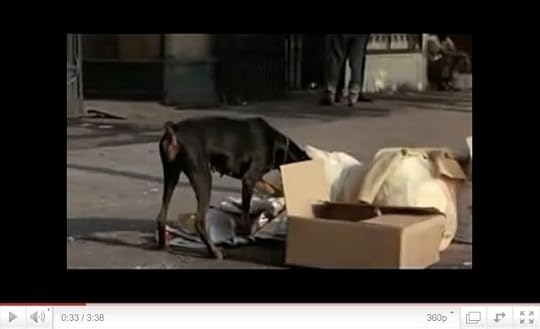
Lumet's film remains unsentimental. Its sensational material ("Brooklyn Man Robs Bank to Pay For Lover's Sex Change Operation") is handled as just another day in the city. "What you are about to see is true–it happened in Brooklyn, New York on August 22, 1974," the opening tells us helpfully. It's real life that interests Lumet and this film never really aims for action. As Sonny, the amateur bank robber, Al Pacino is alternately brash and sullen. He once had a plan, but it left by the front door. A.O. Scott, the film critic for The New York Times, nailed Sonny in a video appreciation of the film: Sonny is basically responsible and he loses control of the robbery when he becomes responsible for his hostages as well as his partner in crime, his straight wife and kids, his gay wife, his mother, and the pizza guy. He's out of his depth before the plot begins, but he sweats it out (dare I say doggedly?) until the last shot. Yet just as the hostages end up indulging Sonny's fantasies of escaping to Algeria (of all places!), we can't help but root for Sonny too. The film cannot, and does not, end happily, but Lumet makes it real for a while.



April 6, 2011
Sound and Vision
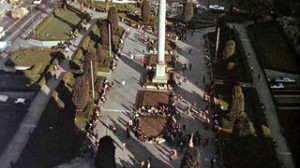
opening of The Conversation (1974)
Today in class we looked at the opening credit sequence of Francis Ford Coppola's The Conversation (1974). It's a masterful long, slow, single shot descending from above to zoom in on Union Square Park in San Francisco. We instantly feel disoriented — where are we positioned? who are we supposed to look at? The audio track, which indiscriminately picks up all the ambient noise in the plaza — from street musicians to the garbled conversation of the title, underscores this confusion and cacophony. The needle-like pillar divides the frame in symmetrical halves, one in the light and one in shadow, and there is an immediate sense of moral stakes. Something is not right, but we don't yet know what.
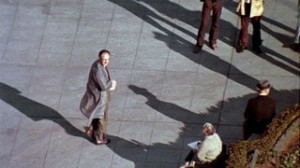
Gene Hackman in the opening of The Conversation (1974)
Deliberately, the camera begins to follow people as it closes in. We watch a mime working the crowd. Then he hands off the focus to a man in a raincoat (Gene Hackman), whom we follow next. Then, there's the first cut and we see a sniper on a rooftop, surveilling the scene. The layers of voyeurism become complicated. We were the watchers, but now watching is suspicious and threatening. The man in the raincoat seems to be our target, but he seems to be following someone too. In the first few minutes the film has set up a visual idea and left us without a stable perspective. We will later discover that our man in the raincoat is just as disoriented as we are, that he too is not sure of what is going on and struggling to see and hear clearly. This economical opening encapsulates the whole.
NB: check out another good blog post on this opening sequence and an excellent article on writers' use of this "zooming in/out" technique.
March 28, 2011
Two Characters in Search of an Ending
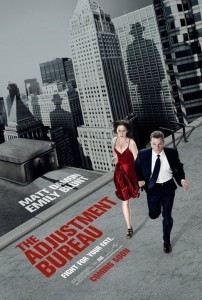
The Adjustment Bureau (Universal Pictures, 2011)
The Adjustment Bureau (Universal Pictures, 2011) is not a great movie, but it's not a bad one either. The press compared it to Inception, but the films are only superficially similar: both create alternative conceptual worlds. The Adjustment Bureau is not driven by its concept though: instead the romance between David (Matt Damon) and Elise (Emily Blunt) drives the plot and it builds to a conventional chase scene (as shown in the movie poster at left). Based on a Philip K. Dick story and directed by George Nolfi, the film plays with the idea of free will. In its world, David and Elise are not meant to fall in love and so their lives must be "adjusted" to conform to their predetermined destinies, each suitably glamorous.
But David and Emily, like Adam and Eve before them, resent the invisible authority that governs their futures and rebel. They insist on changing the master plan and choosing for themselves; they insist on becoming actors.
That is really where the movie gets interesting: we watch two likeable characters desperately trying to escape their own stories, opening door after door in the hopes that one will take them out of the film itself. The parallels are easy to draw: the vague and powerful master-planner is a faceless bureaucrat we never meet. His minions walk the earth in suits and hats making sure that no one strays from the plans that are literally visualized as maps on the pages of a book. It's a small leap to see an Author in this, whether secular or sacred. Then the drama becomes a metaphor for acting or writing itself: an all-powerful director or author creates realistic characters who seem to make choices for themselves but are really carefully scripted. It's a clever premise made more entertaining through romance and action. Except that there is nowhere to go. The characters obviously can't be allowed to leave the world created for them, and the director must stay in charge. So how can it end? With a sleight of hand, a magic wand, an exception to the film's own rules. That's disappointing, but not surprising. Like these characters, we too live in a world of limited possibilities.
March 22, 2011
Faces in a Crowd
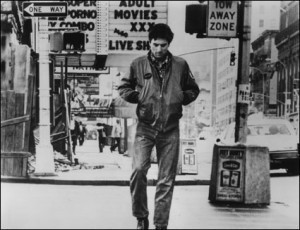
Taxi Driver (1976)
I saw a restored print of Taxi Driver this last weekend at the Film Forum in the Village and thought that it's starting to look like a documentary about New York City in the 1970s. To see Martin Scorsese's iconic film again, now, is to see whatever you didn't see before: the traffic, the sidewalks, the passersby….Those streets are reappearing in the film just as they are disappearing from the city itself. Nedick's? I had forgotten to forget that place. 42nd Street? It "was once" sleazy, I hear.
This time around the face was front and center too. Scorsese's camera lingers on faces for unnaturally long takes. It feels eerie and abnormal, so it makes sense in the depiction of Travis Bickle (Robert De Niro). But Scorsese also lingers on Betsy (Cybill Shepherd), an enigmatic woman in white who somehow agrees to go out with Bickle more than once. Why? The only plausible explanation seems to be that she, like Iris (Jodie Foster), is a modern girl fleeing the suburbs to make it in the city and finding she's out of her depth. That was feminism then– all promises. Betsy is a blank canvas for our projections as well as Bickle's. They converse and the camera stays close to her face. What is she thinking, with that enigmatic smile? Who is she really? It's impossible to know, perhaps because she doesn't know either. As the film ages, whatever was once novel (De Niro's performance, Bickle's character, the urban realism, and horror-film violence) now seems normal. It is what was once normal (Chuckles, pay phones, open fire hydrants, and innocent young working women) that now seems strange.
February 28, 2011
Three Acts
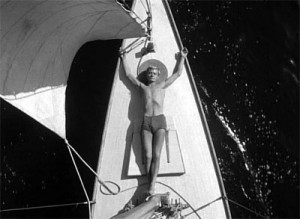
Roman Polanski, Knife in the Water (1962)
The image at left, from Roman Polanski's film Knife in the Water, is perfectly poised between geometry and iconography. The Jesus figure is a hitchhiker picked up by a married couple on their way to a sailing excursion on their boat. Polanski's early film is as taut and carefully composed as this shot. The camera works around severe constraints as almost all of the action takes place on a moving sailboat, at close quarters. But the screenplay reinforces this compression. There are only three characters in a slow-moving drama that allows each pair in the trio its own moment of conflict and release. The hitchhiker is the hinge. He is the new element in the couple's ritualized lives and he (temporarily?) breaks them out of their routines. Polanski plays with the suspense, as the actors circle each other warily and the knife of the title appears over and over again without resolution. It will, in fact, play a major role in the denouement, but not as one would expect. In respecting the classical unities of time, place, and action, Polanski created a beautifully-balanced three act play. Translated to black and white film, Knife in the Water is also a study in visual storytelling, with little dialogue or exposition. This image is self-consciously composed to highlight its religious allusions: the pointed arch, the mid-range view from on high, and the dramatic symmetry. It positions the nameless hitchhiker as a sacrifice, but the story becomes more complicated than that. The conventionally asymmetrical situation — two men, one woman– cannot be easily resolved. The final shot leaves us literally at a crossroads, in the same kind of paralyzed limbo as the man in this image.
February 22, 2011
Higher Love
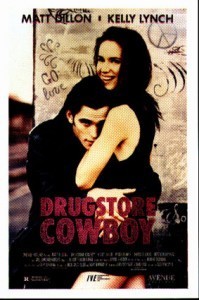 When I watched Drugstore Cowboy (1989) last week I hadn't seen it since the '90s, when I lived on the West Coast. The film is set in the Pacific Northwest in the '70s and it brought back memories of vintage clothing stores and pastel-painted houses. It made me realize how much Darren Aronofsky had borrowed from Gus Van Sant in making Requiem for a Dream (2000). The close ups on needles and flames? The hallucinogenic fantasies? Done.
Drugstore Cowboy is a love story without a happy ending. Bob (Matt Dillon) and Diane (Kelly Lynch) have been in love since high school. They have stayed together through crime sprees and prison terms. Bob's voiceover starts the film and his introduction to his wife is prescient: "I loved her and she loved dope. So we made a good couple." As the two drive through Oregon knocking off drug stores and hospitals just to stay high, their crew falls apart. But Van Sant drives the plot inexorably toward its inevitable conclusion, which is not the one William S. Burroughs threatens in his cameo (that Americans can't believe that anything but disaster can come from using drugs). Instead, the ending is more complicated. Bob, who is both superstitious and smart, has devoted all of his energy and ability to drugs, but eventually the stars realign. And when he decides to go into rehab, Diane leaves him. She tells him implacably that she cannot quit. We can see on her face that she won't even consider it and she isn't sorry either. For her, it is Bob who is destroying their compact. So they're done and it's neither a happy ending nor a tragic one. There is a final turn of the screw though, when Diane visits Bob in rehab and brings him drugs. You can see each of them circling the other hopefully, but Diane stays true to her real love and the scene ends with Bob watching her walk away. Kelly Lynch plays the scene beautifully, as if this is a triumphant, if sorrowful, moment for Diane, when she gets to show her strength and integrity. And perhaps it is.
February 15, 2011
Native Intelligence
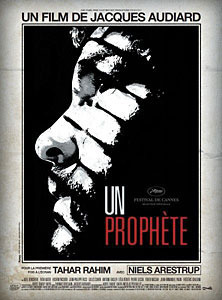
Un Prophete, Sony Pictures, 2009
For something completely different, here's Un Prophete (Sony, 2009). This low-key movie, directed by Jacques Audiard, is an interesting take on the prison and mafia movie genres. The story of Malik El Djebena, an illiterate French Arab imprisoned for attacking a police officer, the film documents a fragile and fractured community within the French prison. As Malik gets drawn into the dominant Corsican gang, he is not so much driven by a will to power as by circumstances and his native intelligence. The prison is organized strictly by ethnicity and Malik's ability to cross the boundaries between them becomes an asset for him, although it is because of his very lack of strong ethnic affiliation that he works with the Corsicans at all. The Corsicans degrade and humiliate him, but they become his path to power, from which the other Arabs are excluded. In the end, then, Malik is able to reach beyond the ethnic divide within the prison and even reach past the bars to snatch at power and authority outside it. We watch this evolution happen almost despite himself, and the film manages a careful balance between sympathy and cynicism as the character becomes more and more like his oppressors. Audiard documents a complicated, morally gray world with great restraint, subtly suggesting that "prophets" are just people in the wrong place at the wrong time.
February 6, 2011
An Eyeful
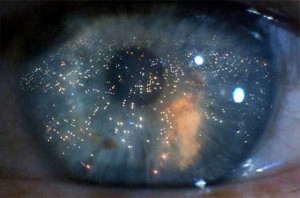
opening image of Blade Runner (Warner Bros, 1982)
I've seen Blade Runner many times, but on my last, recent viewing I was most struck by a scene I had paid little attention to before. In this scene Deckard puts a photograph into an image reader and studies it. He is hunting replicants, machines made to look and act like humans, and this photograph once belonged to one. Photographs are important in this film: one replicant tries to prove her humanity by showing Deckard an old photograph of herself with her mother, which only proves that both memories and photographs are unreliable. "Zoom in," Deckard says. "Pan left." "Enhance." The scanner obeys and the camera (our camera) follows the directions too, like an eye tracking across the print, the room, and the smudges that are too small to be identified. It makes a satisfying clicking and whirring sound as it moves, echoing a camera shutter opening and closing. Deckard pauses. He zooms in on an arm. He pans again and zooms in on a blurry circle on a far wall. It is a mirror and it reflects another replicant in a snakeskin costume. Deckard has his clue, and the movie (our camera) moves on to the next scene.
But that scene lingered with me. The painted mirror is a conventional trope of art history: it shows off the painter's technical skill with light and perspective while also playing with what is inside and outside the frame. In Las Meninas Diego Velazquez famously used a similar mirror on a back wall to reflect images of his royal patrons, who were otherwise "off stage." In Blade Runner director Ridley Scott seems to use this device to show how seeing makes meaning. Deckard becomes our director, using cinematic language to guide our eyes toward the significant clue. If so, then that figure in the mirror is us, gazing into the frame within a frame from outside. The film insists that those replicants don't just look like us, they have become us, and we them. It asks us to prove our humanity too.
January 31, 2011
Winner Takes All
Plowing through Oscar-nominated films for the next few weeks. So it was time to see The Social Network (is that title a pun on The Facebook?). I had avoided it in theaters because it sounded so dull, but the miracle is how much David Fincher does visually with this cliched and overtold story. The pacing and rhythm are beautifully executed, and timed to match both score and plot. Sometimes the film takes it time: as in the detour to England to watch Mark Zuckerberg's alter egos, the Winkelvoss twins, race in the Henley Regatta.
The scene only serves to inform the twins that Zuckerberg's Facebook has made it to Europe….a fact the audience already knows. So what is it doing there? It shows us the elite world Zuckerberg rejected in dropping out of Harvard; it shows us a literal race to match the metaphorical races to finish coding and get a product to market; and (paradoxically) those pulling oars slow the film down, briefly, between snatches of frenetic cutting to speeding music. It shows how some races can be so close that they are won almost by chance. This scene does all that while keeping us in almost constant motion with the crew. Their faces heave toward and away from us, as we see the race from every point of view. It works.
Most of the film cuts back and forth between the development of Facebook and the lawsuits it spawned later, when the twins and Eduardo Saverin sued for their contributions to the company. The alternating structure is very effective. It is what makes a suspenseless story about an unlikeable guy into a watchable film. Of course, this is made by David Fincher, who is not only a great storyteller and action director, but also a master stylist. The film has a beautiful quality, with a soft, smeary focus and the reddish-greenish palette of glowing computer screens. Perhaps that is due to using digital video, but perhaps that is just Fincher's keen eye.
[Speaking of eyes, check out the cool blog post about this film on David Bordwell's blog....]
January 23, 2011
Uphill
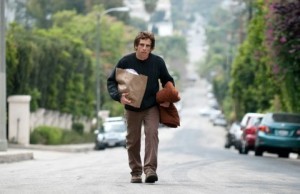
Greenberg (2010), Focus Features.
I am still working my way through Roger Ebert's Best of 2010 list. This weekend I got to Noah Baumbach's unprepossessing Greenberg, which is technically on Ebert's Second Ten Best List…. The movie got little attention when it came out, and one can see how hard it would be to market. Ben Stiller cranky and unlikeable? No plot to speak of? No female name-brand star? The film trudges uphill as perversely as Roger Greenberg in this film still: he is a man in L.A. who can no longer drive a car. Yet the film is good: well written, very well performed. with its own quiet charm. Baumbach was not nearly as understated in his first success, The Squid and the Whale, as he is here, where nothing gets "explained" or "worked out." The main characters–Greenberg, his brother's personal assistant, and his college buddy–struggle through complicated, enmeshed relationships with credible awkwardness and grace. Their actors–Stiller, Greta Gerwig, and Rhys Ifans, respectively–deliver subtle, complex performances. Stiller is an especial surprise since we think we know him already. Here he is physically changed, his whole body slumped, his manic energy mostly tamed. He holds on to just enough charm to make you believe that these people put up with him.
The film begins, somewhat perversely too, by following Greta Gerwig's character around on her odyssey of errands in L.A. The camera stays close to her face, but she is utterly unselfconscious. At the steering wheel, she turns to face us. "Will you let me in?" she asks an unseen driver. Yes! She celebrates. Then, later, again: "will you let me in?" No, not this time. She sighs. The scene seems a microcosm of the film as a whole: as difficult and unpredictable as Greenberg himself, but earning its tiny triumphs.