Victoria Olsen's Blog, page 5
June 1, 2012
What’s Next?
These are some of the best five minutes of a film’s beginning that I’ve ever seen. The exposition is flawless, concisely setting up all the film’s themes. The camera work is confident and well paced. (Note how the camera initially backs away from policeman Dave Brown in the first thirty seconds or so as he drives. The film opens with a close up and retreats. This will anticipate our own response to him.) The acting and character development are both careful and natural…. This is the opening of Rampart, Oren Moverman’s follow up to the critical success of The Messenger. Rampart received strong reviews too, but it came and went in the theaters. Although the material and the cast overlap in both films, Rampart is much darker. As Dave’s problems pile higher and spread further one wonders how the movie could possibly end.
Written by Moverman and James Ellroy, Rampart is the story of a corrupt cop whose police station is already under the pall of scandal. When Dave gets caught on video beating an unarmed man he becomes an embarrassment to the department. The film reveals Dave to be a man unable or unwilling to change; he refuses on principle to change so it is hard to tell what is choice and what is limitation. We watch as Dave’s career and family explode before his baffled and angry gaze. Woody Harrelson, who plays Dave, does bottled rage and defiance perfectly and has just enough vulnerability to suggest redemption. He doesn’t get it.
This becomes an organic problem within the film: if it is the story of a man who can’t change then things happen to him but he has no real response. The first five minutes above open with a tantalizing ambiguity. Dave torments the female police cadet he is training ruthlessly, for example when he orders her to finish her french fries. He is patronizing, insulting, and arrogant. But then he suddenly retrieves the fries he has pushed at her and feeds them to a dog. Was he only interested in her acknowledgment of his power? Are there limits to his cruelty? Is he sensitive to her story of never having met her father? Later his own conflicts with his daughters mark the end of his long free fall. “Did I hurt you?” he asks, baffled again, when they visit him at his hotel room and complain about his behavior. He’s left alone with his confusion and his gun. Where can he go from there?
The character and the film toy with suicide, but they both know it’s what Dave would scornfully call the “coward’s way out.” Moverman knows this too so the film struggles towards it inconclusive conclusion. Perhaps that’s realistic (what does happen to people like that in real life? They just keep ticking), but it’s not quite satisfying. The first five minutes suggest some tentative humanity that never re-emerges.



May 21, 2012
Who is That Masked Man?
The last assignment of my semester asked students to explore what made an artist (of their own choosing) special. In other words, they had to figure out for themselves what makes Scorsese Scorsese? Sondheim Sondheim? Vonnegut Vonnegut? If we were starting on Joss Whedon, for example, I would say study the trailer below for Marvel’s The Avengers (2012): how does Whedon connect his pieces of evidence (the six Avengers) together? how does he transition between them? how does his craft (camerawork, art production, screenwriting etc) reinforce these moves? how do the pieces assemble into a larger narrative or idea? These questions are sometimes best approached through a comparison: for example, why is this film by Joss Whedon and not Quentin Tarantino? or Michael Bay?
The Avengers resists that question,though, and leaves Whedon relatively masked. He shares Tarantino’s obsession with pop culture but he does not plaster his name all over the screen or disrupt the narrative sequence or editing of his film. He sets up blockbuster explosions and extended fight scenes but makes relatively modest use of CGI and special effects. In a featurette about a central fight scene between Thor and Iron Man he focuses on the head butts. Thor and Iron Man. Those words in the same sentence, and those characters in the same scene, say something about Whedon’s style and preoccupations. He seems to be interested in putting disparate pieces together, assembling a film from an assortment of traditions and sources. It’s a style that works well for our self-referential popular culture, especially the world of comics. But unlike Tarantino, Whedon is less interested in drawing attention to his sources than in making them fit together seamlessly.
The pieces in this case are a motley crew of superheros–Captain America, Iron Man, Black Widow, Hawkeye, Thor, and the Hulk– whose only common denominator is outside the film: their maker is Marvel. Whedon makes this necessity into a virtue, contriving a plot about individual heroes having to become a team in the face of danger. It’s hackneyed, but it serves his purpose and he does a good job of emphasizing that lesson without headbutting his viewers. Whereas the evil Loki proposes a world of “every man for himself,” by the end of the film (and trailer) the individual superplayers have learned how to spell “team.” The clip above ends with the camera circling the six avengers standing together against an assault. Whedon lingers on classic shots like three avengers marching toward the camera in arrow formation, with Captain America in the lead. The film must do justice to the complicated sources of comic books, from the mythic to the patriotic to the robotic, and Whedon gives each of his leads a chance to solo while insisting by the end that they “play well with others,” as Robert Downey Jr’s Iron Man says self-deprecatingly. (Watch how carefully even the trailer gives each star/character screen time. Whedon creates seamlessness by insistently rotating through his pieces.) Some reviews have touted Iron Man as the franchise leader–he is given the final world-saving moment–but it is actually Chris Evans’s Captain America who issues the orders despite the fact that he is not the most powerful. In his comically outdated red, white, and blue costume, he represents the good ole American norm, genetically modified for specialness. This is made obvious in one of the most viewed clips from the film: Captain America taunts Iron Man by saying “big man in a suit of armor, take that away and what are you?” and Tony Stark answers “genius, billionaire, playboy, philanthropist?” Cut to Thor laughing.
It is Whedon’s trick to make these Avengers, whom Loki calls “lost creatures” and Samuel L. Jackson’s ringmaster calls “remarkable people,” both bad ass and vulnerable. As Loki says to Thor in the middle of the film, ‘humans think us immortal. I guess we’ll find out.” Surprisingly, that is the tone of the film throughout: not quite mocking (though it makes great use of Robert Downey Jr’s smirky oneliners) or earnest (though Captain America does his best), but questioning. It’s as if we watch Whedon wondering “what if,” as he says in the featurette mentioned above. How would Captain America, defrosted from the 1940s, adjust to today’s society? How would Black Widow fight if tied to a chair? If Iron Man’s life were at stake who would save him? These questions and their answers are interesting, even if the film’s worldview is not, and they let us see Whedon thinking on the screen….which may be what makes Whedon Whedon.
March 11, 2012
What’s All the Fuss About?
It’s hard to live up to expectations like those created by The Artist (2011), directed by Michel Hazanavicius. Coming late to this film means having to wonder whether or not it’s the best film of the year…. and it doesn’t hold up to that promise. It’s a film with a cute premise and more technical virtuosity than it needs for such a simple story. In fact, The Artist seems to imply that silent films were simpler than today’s films, just as the past was simpler than the present. That seems suspect to begin with, despite the film’s passion for its own history.
In the meantime, the production is beautiful and assured, as is the acting. Jean Dujardin(as silent film star George Valentin) and Berenice Bejo (as starlet Peppy Miller) ham the hell out of their parts, and they can’t help but be charming anyway. The film milks its silent-era effects shamelessly– from the intense chiaroscuro of the close ups to the broad jokes about speaking and voices throughout. The scene above seems one of several hat tips to Singin’ in the Rain (1952), where our heroine sings behind a curtain as the silent-movie star lip syncs for the audience. There the curtain was a sign of the duplicity of the film world, which favors appearances over reality. Here the curtain is more of a flirtatious device to advance the romance. The collaborative dancing anticipates the film’s last scene even as it suggests the main plot conflict: the rise of the “talkies.” Obviously, this plot has been done before, and very well. Hazanavicius adds little to it, nor does he seem to try to. The characters are not particularly well developed and the plot is predictable. The story, in fact, gets rather bogged down in George’s long slide into failure, though Peppy never seems to tire of it. Somehow the complexity of this film history ends up tied with a bow in a song and dance. Somehow the tragic dimensions of change and loss are given a happy ending, like in the movies.
What's All the Fuss About?
It's hard to live up to expectations like those created by The Artist (2011), directed by Michel Hazanavicius. Coming late to this film means having to wonder whether or not it's the best film of the year…. and it doesn't hold up to that promise. It's a film with a cute premise and more technical virtuosity than it needs for such a simple story. In fact, The Artist seems to imply that silent films were simpler than today's films, just as the past was simpler than the present. That seems suspect to begin with, despite the film's passion for its own history.
[There is a video that cannot be displayed in this feed. Visit the blog entry to see the video.]
In the meantime, the production is beautiful and assured, as is the acting. Jean Dujardin(as silent film star George Valentin) and Berenice Bejo (as starlet Peppy Miller) ham the hell out of their parts, and they can't help but be charming anyway. The film milks its silent-era effects shamelessly– from the intense chiaroscuro of the close ups to the broad jokes about speaking and voices throughout. The scene above seems one of several hat tips to Singin' in the Rain (1952), where our heroine sings behind a curtain as the silent-movie star lip syncs for the audience. There the curtain was a sign of the duplicity of the film world, which favors appearances over reality. Here the curtain is more of a flirtatious device to advance the romance. The collaborative dancing anticipates the film's last scene even as it suggests the main plot conflict: the rise of the "talkies." Obviously, this plot has been done before, and very well. Hazanavicius adds little to it, nor does he seem to try to. The characters are not particularly well developed and the plot is predictable. The story, in fact, gets rather bogged down in George's long slide into failure, though Peppy never seems to tire of it. Somehow the complexity of this film history ends up tied with a bow in a song and dance. Somehow the tragic dimensions of change and loss are given a happy ending, like in the movies.
March 8, 2012
Film Lessons
Big Machine
Hugo
— MOVIECLIPS.com
This scene from Martin Scorsese's latest film, Hugo (2011), can stand in for the mixed success of the whole. The lighting and visual production are breathtaking. The cut to the obviously phony skyline of Paris under that big yellow moon is audacious and charming. But what's with the ridiculous speech in which our young hero suddenly intones the moral of the story: the world is a machine and each insignificant piece is really significant after all? The clumsiness of this moment is underlined by the visual sophistication of the two small children dwarfed by the oversized clock face and gears. What had been an amazingly executed experiment in 3D storytelling starts morphing into pedantic mush.
If I write about a film here it's because I like something about it or something about it makes me think. And that is true too of Hugo, which is visually stunning. The opening sequence was wondrous: a sweeping camera cut through space to bring us intimately close to that faraway time and place. Suddenly we were there, with the oddball characters and the constant motion of the train station. And the film hardly paused as it quite literally raced after its artful dodger. From the start the situation was hardly realistic, but that made sense for a film so interested in its own relationship to magic. Where it lost me was when its fascination with film history shifted from helping us see differently to cramming us with as much information as possible. You know a film is in trouble when characters start reading aloud from reference books and narrating their memories in flashbacks.
It's hard not to like a Scorsese movie, even though he can be so uneven and disappointing when he doesn't have a solid screenplay to work with. Even then his eye is so interested and interesting, and you can almost always see him thinking…. it's a shame that Hugo fails as both story and history by trying too hard to be both.
February 20, 2012
Dance in the Round
Pina (2011) is a stunning film, especially in 3D. Directed by Wim Wenders, it presents dance in the round, but even better than on stage–closer, more intimate, and with a roving camera that seems animated with its own intelligence. I can't but think that films like this will revolutionize how we watch dance, which has such a relatively small audience in the U.S. that it could really benefit from a proliferation of HD and 3D films, as opera has.
The film begins with repetition: a Mardi-Gras-esque conga line of company dancers weaves its way through various sets throughout the film, making the same patterns of hand gestures over and over. This flexible line unifies the film, as do the dancers themselves whom we get to hear in individual interviews. Choreographer Pina Bausch has introduced these gestures at the very beginning, tying them to the seasons, but Pina explains little in the film. Her choreography tends to speak for itself, though the occasions when we see her dancing roles she originated are very moving.
Wenders takes advantage of the repetitive vocabulary of dance forms to structure his film, insofar as it is structured at all. The line of dancers recurs, as the camera zooms into pairs of dancers and out again for broad shots of dancers lining an auditorium wall in Chorus Line fashion. These dancers advance and retreat as the camera does, taking full advantage of the 3D technology to fill the imaginary space as much as the literal space in the room. The risk in repetition, of course, is boredom, but to my taste the dance of choreography and cinematography here precludes that. There is always something interesting to watch on screen, even if the blank-faced interviews with each dancer reveal little about Pina's work. Wenders undercuts our expectations of documentary by making those interviews particularly unhelpful. All the action is on stage, or in the beautifully contrived spaces that count as stages in Pina's work, as below.
[There is a video that cannot be displayed in this feed. Visit the blog entry to see the video.]
January 30, 2012
“Kill Your Darlings”
William Faulkner’s famous phrase “kill your darlings” was on display in last night’s episode of Downton Abbey, the latest British phenomenon to cross the Atlantic to wide acclaim. Faulkner (and those who attributed the quote to him and repeated it, including Stephen King) insisted that authors must be ruthless with their characters. Authors should be able to sacrifice their fictional characters when required by the plot, or by the emotional necessities of narrative. Think of J.K. Rowling and Dumbledore….it’s an underrated gift.
In last night’s grim episode of Downton Abbey author/creator Julian Fellowes cut down two heroic characters at once (see the scene above). One darling dies but the other is left as good as dead at the end of the episode: the series’ only romantic hero crippled and impotent? Suddenly the serene expectations of the period costume drama (and perhaps this historical class) are upended and we viewers aren’t sure of our ground…. What could possibly come next? Will Lady Mary become Lady Chatterley? We remember that D.H. Lawrence, and Faulkner himself, were also marked by the “Great War.”
It takes a confident writer and producer to take such risks with viewers’ feelings. When Charles Dickens killed off the angelic Little Nell his readers deluged him with letters of protest. In Downton Abbey the footman William must remain a heroic sacrifice to narrative probability (as the maid Rose says in this episode, it would be too much to expect that theirs would be the only household left untouched by war…). But Matthew Crawley must be saved somehow, and this turn toward tragedy must become his unexpected route back to Lady Mary. One senses here the sort of romantic negotiations that occur in 19th-century literature from Jane Austen to Charlotte Bronte: the lovers must be humbled before they can live happily ever after. At least, that’s what our new great expectations hope will happen.
"Kill Your Darlings"
William Faulkner's famous phrase "kill your darlings" was on display in last night's episode of Downton Abbey, the latest British phenomenon to cross the Atlantic to wide acclaim. Faulkner (and those who attributed the quote to him and repeated it, including Stephen King) insisted that authors must be ruthless with their characters. Authors should be able to sacrifice their fictional characters when required by the plot, or by the emotional necessities of narrative. Think of J.K. Rowling and Dumbledore….it's an underrated gift.
In last night's grim episode of Downton Abbey author/creator Julian Fellowes cut down two heroic characters at once (see the scene above). One darling dies but the other is left as good as dead at the end of the episode: the series' only romantic hero crippled and impotent? Suddenly the serene expectations of the period costume drama (and perhaps this historical class) are upended and we viewers aren't sure of our ground…. What could possibly come next? Will Lady Mary become Lady Chatterley? We remember that D.H. Lawrence, and Faulkner himself, were also marked by the "Great War."
It takes a confident writer and producer to take such risks with viewers' feelings. When Charles Dickens killed off the angelic Little Nell his readers deluged him with letters of protest. In Downton Abbey the footman William must remain a heroic sacrifice to narrative probability (as the maid Rose says in this episode, it would be too much to expect that theirs would be the only household left untouched by war…). But Matthew Crawley must be saved somehow, and this turn toward tragedy must become his unexpected route back to Lady Mary. One senses here the sort of romantic negotiations that occur in 19th-century literature from Jane Austen to Charlotte Bronte: the lovers must be humbled before they can live happily ever after. At least, that's what our new great expectations hope will happen.
January 8, 2012
Could Be
Meek's Cutoff begins demurely. Three wagons, and several oxen, horses, and people forge a river, the women carrying baskets on their heads to keep them dry. They move without speaking or interacting with each other — or with us. The camera presents them quietly. We don't know who they are, where they are, or where they are going. We don't know much more than this at the end of the film either, except that we hardly noticed the most important element in the scene: the water.
[There is a video that cannot be displayed in this feed. Visit the blog entry to see the video.]
Directed by Kelly Reichardt, this understated, underrated film redirects our attention from the conventions of film viewing (plot, action, character, dialogue) to the constraints of the film frame itself. What is in the frame and what is left just outside it? The story of a westward migration along the Oregon Trail in 1845, the subject matter is well suited to grappling with this question. Outside the frame there may be desert, gorges, cliffs, hostile peoples….the terrain is literally unmapped around the edges. Inside the frame are three different families and their guide, Stephen Meek. Inside are wagon wheels, tin pans, buckets, kindling, rifles. There are daily routines of scouring, knitting, cooking, fixing, and walking, walking, walking. What is knowable is only what is right in front of your eyes and feet.
Reichardt emphasizes this by her visual choices. In an inteview she discussed using the 4:3 aspect ratio of television shows because it cuts off peripheral vision from side to side. This limited vision echoes the view from the narrow bonnets the women wear, as well as the settlers' situation in the wilderness. The effect is unsettling and tensions spiral for characters and viewers. We want to see more, and know more, but Reichardt refuses to indulge us. In this commitment to uncertainty and ambiguity the film seems deeply anti-cinematic. Indeed, by the end we know little more than we did at first, and neither do the embattled characters, now desperate for water.
Within the film's frame there are a few particular enigmas. One is Meek himself, who may be as lost as the settlers feel. As performed by Bruce Greenwood, his bluster sounds hollow but it is impossible to know for certain what he knows. As one of the women remarks, "I don't blame him for not knowing the way, but for saying he did." This woman, almost nameless and storyless, gradually becomes the central figure of the film, as if emerging organically from the hills and dust. When a nameless Native American enters the frame she is the only character who tries to engage with him. It is a testament to Michele Williams' performance and Reichardt's direction that this character too remains enigmatic: is she right in suspecting Meek, in trusting the Native American? The balance of power between these three semi-articulate figures comes to a head in the formal confrontation above. The camera cuts between close ups of different faces, resisting long shots until the three opponents are shown in their triangular stand off. Between Meek's arrogant threats and the "savage's" silence the film seems to side with the woman's simple action. When Meek taunts her with what could be "over those hills" she accepts it laconically: "could be." Perhaps that is the ultimate message of the film: in desperate straits, when there is no way of knowing what is true or right, one must simply act. It is bold and confident filmmaking.
October 10, 2011
It’s a Metaphor
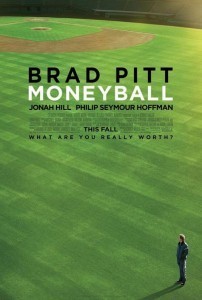
credit Columbia Sony Pictures 2011
My students are writing their first papers of the semester now and struggling with Mark Doty’s essay “Souls on Ice,” in which Doty describes metaphors as “containers” for emotion, or tangible vessels for intangible ideas. This definition functions much like metaphors themselves: making the complex simpler, if not simple.
Baseball, of course, is a game made for metaphors, and Moneyball (2011) is full of them. In one of the last scenes of the film, the Oakland A’s assistant general manager (Jonah Hill) tries to show the general manager, Billy Beane (Brad Pitt), that some experiences that may feel like failures are really successes. He shows a great clip (is it from a real game?) of a baserunner scrambling to get to first base, then belatedly realizing he had hit a home run. There’s a pause until the Jonah Hill character says “it’s a metaphor.” Billy/Brad, exasperated, says “I know it’s a metaphor!” and we have to wonder what isn’t a metaphor in this idea-driven film. The poster at left, with its tiny figure on the great green grass, puts the main idea on display: how much difference can one man make in a giant system? or, as the slogan puts it, more commercially, “what are you really worth?” The smallness of Pitt’s figure seems to be in ironic juxtaposition to the huge black letters of his name, which tell us exactly what he’s worth.
The movie, directed by Bennett Miller from a book by Michael Lewis, is admirably cautious in answering these questions. Since historical narratives like this one can’t really have “spoilers” I feel safe in saying that Beane does make a difference to the old established ways of running baseball teams, but he still isn’t exactly victorious. The big questions asked in the film– how do you evaluate talent? what is your biggest fear? what does it mean to win or lose?– are only sketched, not reduced to glib cliches. It’s refreshing to see a film so comfortable with complex ideas and so ready to grapple with them respectfully. In that regard this film reminds me of Miller’s last, Capote, which did an equally good job of rendering abstractions on film.
The idea that drives Doty’s essay is very similar to the tentative conclusion that Miller gives us as well: “our metaphors go on ahead of us…” and they know more than we do.