
Michelle Van Loon's Blog, page 7
June 20, 2018
Book Review: Near Christianity
Historically, Evangelicals have been those who’ve planted their flag well within carefully-defined spiritual boundaries. People are either “in” or “out”, based on their stated relationship with Jesus. On the inside of that boundary line, there are dozens of other fissure lines based on denomination, worship style, and doctrinal difference. Boundary-crossing words like “interfaith” and “ecumenical” are usually viewed by those in the Evangelical world with great suspicion, as they seem to speak of human-engineered truces and kum-bay-ah emotions. And most Evangelicals I know believe the prayer for unity Jesus prayed for his followers hours before his arrest is something that will be realized at some misty date in the future, but not today. As a result of all this, we have been trained to stay far, far away from boundaries.
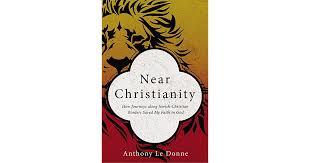 Anthony Le Donne, Associate Professor of New Testament at United Theological Seminary, has not only devoted himself to exploring the spiritual boundary that exists between Evangelical faith and Judaism, but finding new life there. His new book, Near Christianity: How Journeys along Jewish-Christian Borders Saved My Faith in God (Zondervan, 2018) is not a book about apologetics or Jewish evangelism. Instead, it offers a compelling description of how Professor Le Donne has become a student of various streams of contemporary Judaism, and how his own Christian faith has deepened as a result.
He opens the book with a helpful description of the differences between the way Christians and Jews understand their faith identities, noting that while Christians view themselves in terms of belief, Jews tend to name themselves in terms of heritage and blood line:
Many Jews do not attend synagogue. And many Jews who attend synagogue regularly are openly agnostic. Also, it is becoming increasingly popular for Jews to study and practice Buddhism. And whether they are secular, observant but agnostic, or Buddhist, their status as Jews is not in jeopardy. Among my Jewish conversation partners, it is not uncommon to speak of “Jewish Atheists” (Jews who deny the existence of God) or “JewBus” (Jews who practice Buddhism). There is no perceived contradiction here as there would be in the title “Christian Atheist”.
Though Le Donne doesn’t mention it, I would be remiss if I didn’t note here that this seemingly-expansive view in the Jewish community about who is a Jew almost always stops short of including people like me – Jews who believe that Jesus is the Messiah and have committed their lives to serving him. I’ve been called a traitor enough times by my fellow Jews to know that this historically has been one boundary line guarded by an electrified fence.
Because I’ve been living on that boundary line for more than forty years and know what it is to exist in both Jewish and Evangelical worlds, I was keenly interested to see what Le Donne discovered as he mapped the border from the Christian side of the line. He tackled topics including American culture’s consumeristic approach to Christmas, genocide, how Christian theology contributed to Nazism, the deeply entrenched tendency in the Church to either demonize or fetishize the Jewish people, the link between laughter and intimacy, and the relationship between tolerance and love.
His chapter on the border between pilgrim and stranger offers a good sampling of the approach he took throughout the book. As I recently wrote a book on the topic of exile and pilgrimage, I was keenly interested in Le Donne’s approach to a subject core to Jewish identity. He shares his surprise at discovering an armed guard at a synagogue he attended with a friend, but used the experience as an opportunity to reflect on the numerical disparity between Christians (2.7 billion) and Jews (14 million) in the world. He notes, “Extinction is not a necessary concern for Christianity. We may have unhealthy denominations, but there is no danger of Christianity’s imminent demise. In contrast, Jewish extinction is a real-world concern for many Jews.” He cites reasons including Middle Eastern politics, intermarriage with non-Jews, the impact of the Holocaust on the Jewish community, and evangelism, adding, “…there is little comfort in the knowledge that these borders are populated by Christians.”
Though in the Middle East, the concern about who is on those borders tends to focus on Muslims, I understood Le Donne’s point here. The chapter went on to note that many Jews in the first century were awaiting a return to the full blessing of being in the Land, living the commands of Torah under the rule of a Davidic king. He notes that after the Resurrection, the apostles asked the risen Jesus if now was the time that the kingdom of Israel would be restored (Acts 1:6). They were homesick for the blessing of the life their forebears had enjoyed in the Land. “So when did this mentality change for Christians?” he asks. “When did Christians stop hoping for a way of life in the Land and seek, instead, a way to the afterlife? When did Christianity become an outward-focused mission with little regard for a single holy place?”
This focus on mission rather than place has allowed Christians to cross geographical and cultural bodies with ease, though, he notes, “…it is often because we are unaware of the fault lines we have imposed on the Western landscape.” Le Donne’s interactions with Jewish people and various streams of Jewish thought have called him to a humbled approach to faith in contrast to the triumphalistic Evangelicalism of his youth:
The borders of Christian identity are renegotiated, redefined, indeed crossed over as motivated by suffering…they do perhaps strike closer to the heart of Christian beginnings. While we were still strangers, while we were still enemies, St. Paul tells us, God through a ‘son of God’ suffered. This will seem banal to most Christian ears, but it must be heard in a different way. Acquiring cultural, political, and religious power has not worked well for Christianity.
He recognizes in the Christian impulse toward accumulating worldly power a kind of kingdom-building that completely erodes a healthy understanding of our shared life with God and one another. I’d add that even when the children of Israel lived unfettered in the Land during the reign of David, the three pilgrim feasts named in Leviticus 23 were a reminder to them of their core identity as spiritual pilgrims.
Near Christianity wraps with a solid discussion about the relationship between belief and belonging. Le Donne recognizes that even when he’s wished to run in frustration from the Christian world in which he lives, his exploration along this boundary line has strengthened his understanding of who God is and who he is as a follower of Jesus.
While I wish he would have included a bit of dialogue with a Messianic Jew or two in the book because I believe this could have added an additional measure of illumination about what it means to journey along Jewish-Christian borders, I do honor the thoughtful approach to those borders Le Donne took in Near Christianity. The book is relevant to those struggling to make sense of their Evangelical roots, those interested in the way some of the many variations of contemporary Judaism interact with Christianity, and those believers involved in study, dialogue, or shared community concerns with members of the Jewish community.
Photo by Jonas Jacobsson on Unsplash


June 14, 2018
Who Do They Say That You Are?
You’re the smart one.
You’re the lazy one.
You’re the pretty one.
You’re the useless one.
Those kinds of messages from our respective families of origin form us. I’d heard throughout my childhood that I was ugly, and responded by (a) becoming promiscuous to prove them wrong (b) seeing a deformed image of myself every time I looked in the mirror and (c) believing at the cellular level I was taking up unnecessary space on the planet.
When I began attending church in my late teens, there was something deep inside of me that was starving to discover a new script for my life. I looked to my new family in the faith to help me learn to live to live into my new identity as a born-again child of God. I heard a lot of mystical talk about being “in Christ”, but came to understand this was usually a statement of judicial fact: Innocent Jesus paid for my sins with his atoning death, and the Father sees me as “not guilty” in the same way he sees the risen Son.
I think I imagined that this reality was supposed to automatically overwrite the lies I’d heard from infancy. While being “in Christ” gave my life a new origin story and destination, frankly, I needed a little more description for how to live in the in-between. As a young adult, I was still trying to figure out who I was, and since I’d entered that life stage at a definite emotional deficit, I looked intently to new friends and leaders from the various churches/congregations we attended to tell me something about who I was and how this new me could learn to follow Jesus.
In other words, I was longing to be discipled.
And I was, because we’re all in the process of being discipled by something or someone else. That “something” can be anything from our peer group to our favorite band to our favorite cable news source. I was discipled by the Church by learning that I had value:
As a regular attender at all church events
As an enthusiastic helper with church programs and tasks (nursery, VBS, Sunday School teacher)
As an always-supportive-of-leaders member
As an obedient wife and a perfect mother
There was always talk of spiritual gifts, but in reality, I learned early on that the gifts the church valued most was that of service and attendance, plus financial giving. In other words, the church taught me my identity was not all that different than that of a good employee.
Honestly, I don’t think any of the pastors or church leaders I knew in my early years ever intended to communicate this to members. (That’s what cult leaders do, and none of those people had designs on starting their own cult.) But most didn’t think in terms of forming disciples. They thought in terms of building their organization. I know – I’ve been a leader in a couple of churches, and I learned it was my job to fill the org chart, not shape people. We hoped that doing church stuff would disciple people, but I learned quickly that the two have at best only moderate overlap.
God has used great books, access to some thoughtful radio programs, good friends willing to go deep with me (and who had no designs on turning me into a good soldier in their congregations), and sorrow to teach me who I am and how to follow Jesus when I’m not at church – and even when I am.
I am not made by my Creator for the purpose of being a regular attender, an enthusiastic helper, a supportive member, an obedient wife or a perfect mother. Each of those things is an expression of true identity, not the identity itself. At their worst, they are the suffocating fear-filled fibers that get woven together into a mask of religious performance.
Our identity is learned as we learn to follow Jesus. For example, I am a writer by vocation, but that is not my identity. I began writing in order to pray and learn to make sense of my life with God. My life seeking God is my identity, and it took a number of different voices (rarely from any of the churches we attended) to affirm and challenge me to use “my way with words” to serve others. I follow him, and I leave a trail of words in my wake.
This is why I believe in the message of Born to Wander: Recovering the Value of our Pilgrim Identity. So many of us live as spiritual exiles, even if we’re the most popular people in town and we busy ourselves checking all the boxes on religious performance that makes us beloved employees in our local churches. Others of us live as spiritual refugees, branded as an unwanted, unloved “other” because we don’t measure up to some sort of human expectation. The shadows that hide our true selves and masks we don to tell the world who we are by what we do, or who we vote for, or what we love are very fancy fig leaves that cover our nakedness.
But Jesus is pursuing us even as we wear those false identities and calls us to follow him. He said, “Follow me” many times, to many different kinds of people, throughout his ministry. This is how he speaks to us today, and this is what he asks of us. Pilgrimage is is our birthright as his beloved children, though it is rarely a soft, comfy existence. More on the challenges and rewards of this existence in my next post, and some thoughts on why we hear so little about it from many pulpits.
If you are a follower of Jesus, what has your discipleship journey looked like? How has your local church formed you?
Photo by Micaela Parente on Unsplash
June 7, 2018
June 2017 Newsletter
Shalom, friend!
Nearly a year ago, I took an epic fall on a rain-slicked deck, and ended up with a broken knee and tailbone. As I went through surgery, post-surgical complications and a rehab that took place in the shadow of ongoing medical treatments for my serious immune system deficiency, I dreamed that someday Bill and I would return to Israel for an eighth time.
 As it has for countless others over the centuries, Israel has been for me a place of pilgrimage. It has also been a place of service as we’ve been involved in the work of the Caspari Center for Biblical and Jewish Studies for the last few years. Finally, Israel has also been a compass in my life. It orients me to the bigger story of which I am a part – the story unfolded in Scripture and authored by God.
By His grace, Bill and I just returned from a trip I wasn’t entirely sure I’d be able to make again at this time last year. If you’re interested, I captured some reflections about this journey here. While the trip may have come to an end, my pilgrimage continues as I learn to follow Jesus each day. (Even to my local Aldi grocery store.)
I’ve been meditating on the subject of exile and pilgrimage for a long time. On July 3rd, the fruit of this focus – in the form of a book – will launch into this world. You can pre-order your copy (or copies!) of Born to Wander: Recovering the Value of our Pilgrim Identity from Amazon, Christianbook.com, Barnes & Noble, or directly from the publisher.

The book has gotten some wonderful pre-release buzz, including this review from Publisher’s Weekly. Here’s a sample of what a few others have said:
There’s nothing quite like knowing where you belong in the world, but in an age of constant change, sudden shifts, and unexpected transitions, this is an increasingly elusive experience. In Born to Wander, Michelle Van Loon writes to all those who can’t quite seem to find their place, offering hope that our restlessness echos a more significant journey. Drawing on Scripture and her own history, Van Loon reminds us that as much as we’re making our way through this life, we’re also making our way to Him–and in finding Him, we’ll finally find our way home.
—Hannah Anderson, author of Humble Roots: How Humility Grounds and Nourishes Your SoulBorn to Wander is a beautiful book. In its pages, Michelle Van Loon connects the universal instinct to wander to the Bible’s theme of pilgrimage. Van Loon understands that wandering is a double-edged sword, prompted both by a thirst for adventure and an unfulfilled longing for home, “the ache of the uprooted plant.” Her lyrical, wide-ranging exploration of the topic will help you find meaning in your own journey, no matter how halting and haphazard it has seemed to be.
—Drew Dyck, contributing editor at CTPastors.com and the author of Your Future Self Will Thank You: Secrets to Self-Control from the Bible and Brain Science
We are all wanderers, whether literal, figurative—or both. With wisdom as deep as the waters of the sea and prose as sharp as the needle of a compass, Michelle Van Loon guides her readers out of exile and back into the arms of God—our only true home.
—Karen Swallow Prior, author of On Reading Well: Finding the Good Life through Great Books and Fierce Convictions: The Extraordinary Life of Hannah More—Poet, Reformer, Abolitionist
If you read it, I’d really appreciate it if you take a moment or two to post an review after July 3rd on the book’s Amazon and/or Goodreads pages. Even one or two sentences from a reviewer like you really makes a difference in how those mysterious algorhithms present the book at the sites.
I’m hoping to share the message of this book in a workshop format with small groups, Bible study groups, retreat gatherings, and churches. Many of us struggle to make sense of our wanderings, and it is my prayer that many will begin to see with fresh eyes how God has been at work in their lives, and discover the wonder of wandering in his company. Contact me here if you’re interested in scheduling a Born To Wander event at your church next fall.

FINALLY, if you’ve read this far (thank you, thank you!), here’s your chance to enter a drawing to win your own hot-off-the-press copy of Born to Wander! I’ll be giving away FIVE copies. All you have to do is click here to send me your mailing address. And good news: no “U.S. addresses only” limitations for this contest. No matter where in the world you live, I want to put a copy of this book in your hands if your name and snail mail address is drawn.
You and I were born to wander.
In Him,
Michelle Van Loon
michellevanloon.com–Author of If Only: Letting Go Of Regret and Moments & Days: How Our Holy Celebrations Shape Our Faith
–Co-founder of ThePerennialGen.com website for those at midlife and beyond. You can follow ThePerGen on Facebook, Twitter, and Instagram.
Photo by Mathyas Kurmann on Unsplash
June 2, 2018
In No Particular Order…
While they’re hot off the press, I wanted to pass on some observations about church, conflict, and coincidence-that’s-not-coincidence that didn’t quite fit into any of my wobbly Facebook Live videos or Instagram posts I launched into the world from Ashdod or Jerusalem in Israel. Feel free to weigh in in the comments section if you have some thoughts on any of these particularly on numbers 1 and 3:
The believers with whom we interacted while in Israel have been following the stories about disgraced American church leaders Bill Hybels and Paige Patterson. The internet carried the stories there, of course, but I was struck that people halfway around the world are talking about these events.
I saw a number of pro-Trump posters plastered around Jerusalem, placed side by side with ubiquitous handbills proclaiming that the late Menachem Schneerson is the Messiah. Insert your own wry conclusion here.
The Christ At The Checkpoint (CATC) conference took place during part of the time we were in Israel for board meetings for the Caspari Center. CATC is sponsored by Bethlehem Bible College, which says on its website is located in Bethlehem, Palestine, which gives you an idea of where they’re coming from. While the event, which launched in 2009 and is now held biannually, has always had a strong pro-Palestinian political orientation, it has gotten increasingly contentious toward those who support Israel. Chelsen Vicari’s summary of this year’s CATC captures the flavor of what my husband Bill and I experienced at the airport as we boarded a plane in Tel Aviv to return home yesterday. A number of people who’d attended the event were on our flight. The sanctimonious anger that sounded weirdly just like unvarnished anti-Semitism we heard from those all around us while we waited at the gate from directed at Israel/all Jews was both painful and a little scary. It seemed especially off-putting that these folks from the U.S. and Canada were sitting IN ISRAEL while committing to work for Israel’s demise.
Related to #3: Shortly before we left for Israel a little more than a week ago, I found myself contemplating the idea that my enemy is precisely the neighbor Jesus calls me to love. The entire Middle East is filled with people who know how to be one another’s enemies. Whether it is the most radical wings of ultra-Orthodox Jewish community threatening Jewish believers in Jesus, Muslim-on-Muslim war and violence, or a relatively (in comparison) mild bit of verbal vitriol at an airport gate, I am convicted about how easy it is to hate, how impossible in the flesh it is to love a neighbor-enemy, and how remarkable Jesus’ life and ministry is – especially in light of the fact that it took place in an ancient version of this culture.
Twenty years ago, the Caspari Center surveyed the Messianic Jewish community in the State of Israel. This study is in the midst of being redone as the movement has grown significantly during that time. The update will give a current sense of how many Jewish believers and congregations exist in Israel, as well as providing data about the scope of practice, theology, demographics, and more. Though there is much to discover and analyze in the information currently being gathered, one thing is certain: there are more Jewish believers in Israel today than at any time since the first century.
Many people were praying for our trip – for productive and meaningful meeting times for the Caspari board, for physical requirements (stamina, health, safety), and that we could be a blessing to those with whom we interacted. He more than provided for the first two prayer requests, and even though we had a couple of awkward social/cultural stumbles during the week, I am grateful we’ve had the opportunity to learn with each step of the journey.
The trip was bookended by two unexpected encounters, both in Toronto’s Pearson airport. On our way to Israel, we were walking through the airport to our next gate when we heard a man call, “Michelle Van Loon!” I couldn’t place him at first, and he introduced himself to me. It was Michael Rydelnik, a Moody Bible Institute professor of Jewish Studies who’d been kind enough to endorse my book but had never actually met in real life. (He recognized me from my Facebook picture.) On the way home yesterday we were sitting at our gate after the 11-hour flight from Tel Aviv when Bill recognized a face from our church in Wisconsin. We hadn’t talked with this couple since we left the state in 2004, but had an interesting time catching up with them for a couple of hours. Turns out, they were on the way back to O’Hare on the same flight as us after a Grecian vacation with two of their children.
Finally, while we were in Israel, I learned that Born To Wander received a wonderful pre-released review from Publishers Weekly. (PW is the Bible of the publishing industry; a positive review from them is a big deal.) Click here to check it out.
Cover photo: Robert Indiana’s Ahava (Love) Sculpture, Israel Museum, Jerusalem.
May 22, 2018
Christian Culture’s Socially-Acceptable Household Idols
I first ran across a mention of household idols years ago when reading Genesis 31. The little statues were common in cultures across the Ancient Near East, and figured prominently in the story of Jacob’s separation of his family from his father-in-law Laban. This isn’t just an ancient practice, as I’ve visited Hindu homes, where there are shrines to the gods the family worships. These kinds of small “g” gods promise protection and prosperity for adherents, with the bonus that they are visible to the worshipper. When I think of idols, I first think of these unblinking figures carved from wood or stone.
The Unseen Holy God confronted our desire to have gods we could touch, see, and manage, even as we’re tempted to rely on them to bring order to what feels like a dangerous, unpredictable world. The first and second commandment of the Ten reads:
You shall have no other gods before me.
“You shall not make for yourself an image in the form of anything in heaven above or on the earth beneath or in the waters below. You shall not bow down to them or worship them; for I, the Lord your God, am a jealous God, punishing the children for the sin of the parents to the third and fourth generation of those who hate me, but showing love to a thousand generations of those who love me and keep my commandments. (Exodus 20:3-6)
In modern American Christian culture, we like to think we have moved past the superstitious worship of idol-figures promising us fertility, good weather, and fortune. We may not have shrines filled with statues set up in our homes, but our big blind spot has been the living shrines that leave dishes in the sink in our homes.
 Preorder here.
As I noted here, in our culture it is easy to point to the big three—money, sex, and power—as idols. Some may recognize the control these things have over their lives. But I’d like to suggest that most of us have a personalized collection of housebroken idols vying for our love every single day. They may be destructive little gods, like unforgiveness or addiction. They may be good gifts—like affirmation, appearance, ministry, or a relationship—that have become toxic because we’ve given them the power to define our worth and receive our worship.
One pervasive and oh-so-familiar idol in Christian subculture is the nuclear family. In case you doubt this, ask a Christian single to talk with you about their experience in the church. Most have some pretty sad tales to tell. Same goes for empty nesters. Former pastor Dan Bouchelle shared his observations about the focus on family in most evangelical congregations:
A good friend of mine, who has a Ph.D. in marriage and family therapy, commented a few years ago that we have a near family cult in church. There is a vast supply of family material through Christian bookstores, radio, and TV. There are countless family seminars. . . . Some churches build their whole visions around strengthening family. “Traditional family values” is now synonymous with the gospel for many. It is almost as if the primary purpose of the church is to serve family.
If you would have asked me when my kids were young (three decades ago) if I was guilty of idolizing my family, I would have said no way, then trotted out a bunch of verses about the importance of passing on my faith to my kids and raising them in the fear and admonition of the Lord. Our suburban Christian church culture supported this, as almost every ministry activity was either directly focused on the kids (endless pleas for the congregation to help with Sunday School/Children’s Church and VBS, intense focus on youth group activities), or on encouraging us parents to build a strong home and family (never-ending sermon series about marriage, parenting, finances; seminars, and Bible studies). This focus on the family (pun intended) in the Church was intensified when we stepped into the home schooling movement. The messaging we heard consistently in those circles was that that a strong family would preserve the faith of the next generation, and the next generation’s faith was the key to saving our crumbling culture. We were told we were spiritual exiles in a hostile culture.
My husband and I examined ourselves to make sure we weren’t electing to home school because we were afraid of the Evil Secular Agenda being pushed by our local school district, as we heard again and again from home school proponents. We were clear that this wasn’t a factor. Overcrowded classrooms and administrators indifferent to the academic needs of one of our three kids drove us into that choice. But whirled into the mix was a deep desire to obey God and pass on our faith to our kids. Home schooling promised to offer a way to do that in the context of our family’s life, as well as allowing us to individualize curriculum and goals for each child.
Today, with the vantage point of three decades of life experience, I can see more clearly the idolatry of family cultivated by the church and home schooling subculture. I recognize how my own fears of losing my children to the world’s allure made this a socially-acceptable form of idolatry in my life. The sneaky thing about this kind of idol is that it doesn’t run counter to Scripture’s dictates to train up our children in the way they should go, but it is an unhealthy emphasis on the gift of family over the Giver of those gifts – an emphasis that ends up de-emphasizing trust in the work of the Spirit in favor of the endless sacrifice of parental vigilance. Idolatry promised we could save our kids if only we got the formulas right.
As my children moved through their teen years, I learned how little control I really had over my kids’ choices. Releasing them to the Lord also required me to name and renounce the idolatry I harbored in my own heart toward my living, breathing household idols. I loved them more than my own life and still do, but recognize that in all kinds of subtle (and probably a few not-so-subtle but socially-acceptable ways) gave family a place of worship in my heart reserved for God alone. An unexpected consequence of my repentance came as I realized how tightly I’d wrapped myself in the identity of an exile by focusing on my family. As I shed that protective cocoon, I discovered there was no going back. It was for me the beginning of understanding what it was to be a pilgrim instead – surrendering my household idols to God, trusting his work in the lives of my children, and trusting his work in my life as well.
Have you experienced the effects of this focus on the family in your circles? How have you dealt with it?
Photo by Cheryl Winn-Boujnida on Unsplash
May 15, 2018
A Lot of Evangelicals Have “Unhitched” From the Old Testament
Andy Stanley’s recent sermons contending that we must “unhitch” from the Old Testament in order to get to know Jesus brought a wave of response from the Christian online world. Some were supportive, noting that he was just trying to introduce his hearers to Jesus. Others recognized in his words the ancient heresy of Marcionism, which celebrated Jesus and Paul, and dismissed the entire Hebrew Bible. My first response was that of the latter group, but I also realized that in the Evangelical congregations of which I’ve been a part over the last four decades, I have seen less-overt (but no less toxic) versions of Stanley’s teachings in all of the following ways:
Speaking as though the God of the Old Testament had a different, much angrier personality than the God of the New Testament
Speaking about the Law as though it is completely irrelevant
Insisting the Old Testament is just for the Jews
Insisting that only the Ten Commandments are relevant, and really meaning that only nine of the ten are binding on Christians’ lives today. (This one? Maybe not so much.)
Using the Old Testament in sermons only anecdotally if at all, rather than teaching or preaching from it on its own merits
Calling the Old Testament “legalistic”
Treating the Old Testament, particularly the book of Genesis, as a tool to be used in apologetics debates that are more about scoring points than they are about pointing people to their Creator and Redeemer
Claiming that all the promises God made to the Jewish people in the Old Testament now belong to the Church
Praying promises (such as the trusty graduation card favorite, Jeremiah 29:11) completely out of context, and using them as though they were intended for an individual
Speaking about the Law as though it is the enemy
Using the Pharisees to represent the Old Testament, insisting that the way Jesus spoke to and about them “proves” his feelings about the Law
Not preaching or teaching regularly from the Old Testament
Preaching or teaching from the New Testament as if it exists in a vacuum, rather than recognizing that as much as a third of its texts reference the Old Testament (chart)
Andy Stanley didn’t wake up one day and decide to start talking about “unhitching” Jesus from the only Bible Jesus had during his lifetime – a Bible Jesus obeyed to the letter, and about which he told his followers he came not to abolish, but to fulfill. Stanley is a product of an Evangelical culture that has treated the Old Testament as something to be used when it is convenient, and ignored when it is not. And frankly, it’s mostly treated as an inconvenience instead of a gift.
For all those who are decrying Stanley’s teaching, I’d suggest this might be a teachable moment and an opportunity for some self-reflection. Pastors, don’t assume your congregation understands that you value the Old Testament if you don’t preach from it. Teachers, don’t keep leaning on the same parts of the Bible you know well without ever demonstrating that you’re willing to be a student of the parts you don’t know as well. If you say you love the Bible, then please, please make it your goal to love the whole Bible.
Photo by Nathaniel Shuman on Unsplash
May 7, 2018
Fruit Inspection
What do unscripted charismatic prayer meetings have in common with carefully-crafted public relations statements on behalf of a leader accused of wrongdoing?
When I saw these words posted by Jen Hatmakermaking the rounds on social media recently, I recognized in their well-meaning sentiment an “end justifies the means” thinking I’ve seen at play in both settings. Hatmaker said, “I read of a priest asked about what is godly and what is not – How do we discern between good & bad? He said, ‘I look for where there is life.’ When people are flourishing, valued, honored, & restored, there is Jesus.”
At first glance, Hatmaker seems to be saying there are many excellent efforts – some faith-based, some secular – at work in this world to bring value, honor, and restoration to people God loves. But do these good things equal Jesus? Is the fruit equivalent to its source?
Certainly, the priest’s words seem to point to the false fault lines some create between orthodoxy and orthopraxy. Those on one side of the divide put the emphasis on determined polishing of their doctrinal positions. Others land squarely on the side of rolling up their sleeves in God’s name to care for the hurting and oppressed in the world. While this is a conversation that has been going on since the first century, Scripture never frames the relationship between thinking rightly about God and doing rightly in his name as an either/or question. Instead, the narrow road to which Jesus calls us means embracing the tension of living both/and.
But this isn’t really what I heard in this quote shared by Hatmaker, which I’ve seen repeated in various forms over the years. What I hear in these words is a celebration of pragmatism wrapped in Christian-y language: If “it” – a ministry, a gathering, a group of people – looks like what we most like about God, then it must be of him. Full stop.
Though pragmatism is everywhere in American Church culture, I saw a particularly virulent form of it in the charismatic circles where I once worshipped when I saw an audience focused on “fruit” in the form of people anxious for a first-hand, electric experience with God and warm fuzzy feelings of “love” as a sign of his blessing. Theological rigor there tended to be branded a sign of spiritually-dry intellectualism and a cold heart. When I questioned some leaders about extra-biblical practices (such as roaring like a lion during worship services) or about the way in which prosperity teaching shamed the suffering, I was told, “Revivals can be messy, and sometimes people can respond in the flesh to what God is doing, but we are not bringing any correction here because we don’t want to quench the Holy Spirit. Look at all the fruit!”
Pragmatism seemed to have the final word in every conversation that touched on topics of orthodoxy and orthopraxy: “It’s working for us, so we know God is blessing it!” It didn’t seem to matter that the least of these in this community – the poor, the chronically troubled, the mentally-ill, the sick – weren’t counted in the same way (which is to say, not at all) when “fruitfulness” was being measured by leaders. If you only count your success stories, you’re always going to be a winner.
Though this may be the most dramatic example, it is far from the only one. More recently, I’ve noticed this same kind of pragmatism when it comes to conversations about leaders of large Christian organizations, denominations, or church networks who are being accused of moral compromise. Defenders of these leaders point to the fruit of their ministry. “Look at all the good they’ve done in God’s name,” they say. “New believers have come into the fold, gospel work is being done, and the kingdom is advancing!” When tabulating the fruit, no one mentions the high cost of lives changed or ruined by an abusive leader’s ambitions. And let us remember that damaged fruit may be of far higher value in God’s sight than all our typical measures of ministry “success”.
While Jesus taught his friends to assess the teaching they were hearing in light of the fruit it bore, our Western versions of this notion tend to match our culture’s ways of measuring popularity, even if we use a gentler word for it like “flourishing”. In doing so, we disconnect the fruit from its source in the same way as the shrink-wrapped, genetically-modified, pre-packaged fruit we purchase in grocery stores.
I am struck that Jesus made a point of including the tree of origin as an integral part of measure they were to use in assessing the value of the fruit: “By their fruit you will recognize them. Do people pick grapes from thornbushes, or figs from thistles? Likewise, every good tree bears good fruit, but a bad tree bears bad fruit.” (Matthew 7:16-17) I cheer secular and religious efforts alike that bring care to people in need, but at the same time, I recognize that the fruit Jesus says has eternal value is both sourced and measured in relationship to himself.
What do you think? Does the priest’s quote resonate with you? Why or why not?
This post first appeared here. Photo by Clint McKoy on Unsplash
April 21, 2018
After A Leader’s Sin Has Been Revealed
When a church leader chooses sexual sin, the effects of that sin are like a boulder dropped into a still pond. The ripples engulf everything in its path.
Though my husband and I have enjoyed a faithful marriage of nearly 39 years, the sexual sins of our church leaders have been like a series of boulders being catapulted into our lives at regular intervals. When I reflect on our church experiences over the last four decades, I realize that a disproportionate amount of our time and emotional energy has been spent dealing with the coverups of various church leaders. To put it mildly, it’s taken a toll:
We’ve been thrown under the proverbial bus when I inadvertently got too close to the truth our lead pastor had been hiding: we later learned he was addicted to internet porn and had been having an affair. To protect himself, he ruined my reputation by branding me a malcontent and gossip, driving our family from a church we loved. We discovered the elders knew all about his sin, and covered for him for years because they believed he was “anointed to lead” the fast-growing congregation.
We’ve witnessed the spectacle of victim-shaming first hand when a struggling young woman I was mentoring confessed to me that she was in a “friends with benefits” relationship with her ex-boyfriend, the youth pastor of our church. I encouraged her to share her story with the pastor and other church leaders. She was presumed guilty by church leaders, while the youth pastor was protected from losing his job because he was related to some of the church leaders. He lost his position only after it was revealed he was also secretly dating an underage youth group student.
We’ve watched sentiment attempt to overrule common sense when my husband, then an elder in a non-denominational church, had to deal with a man who wanted to serve in children’s ministry while was still on probation for statutory rape. Some in the congregation believed he’d evidenced a changed life and “deserved” a second chance. Never mind that this would have violated the terms of his parole and put the church in serious legal jeopardy.
We’ve been asked to keep toxic secrets – and refused. A church leader and her husband confessed to us they’d both had affairs in recent years, and didn’t want the rest of the church to know about it. She told us she believed the church would fall apart without her in her leadership role. We could not agree to this. As relative newcomers, we chose to leave the church quietly, stuck lugging their secret out the doors with us.
We’ve been called upon to support many people devastated by pastoral sexual abuse. I know too many #churchtoo stories, but perhaps the most painful came as my husband and I walked for more than a year with a woman reeling from the revelation that a male youth pastor had been sexually abusing her teen son (and several other boys) for years. The truth about the abuse came out after the youth pastor committed suicide. The woman’s son plunged into a deep depression as he struggled with feeling responsible somehow for the man’s death.
We’ve had to stand with a powerless victim of a lecherous pastor before a board of his peers. The truth eventually came out that this leader had a history of inappropriate relationships that had stayed just this side of full-blown physical affairs. He was removed from his position and the church sent him to counseling, which was a more hopeful ending than most we’ve witnessed.
I’ve wondered if my husband and I were sending off some kind of beacon that drew these troubles to us like moths as though we were lamps on a summer night. I don’t wonder anymore. For every big name celebrity pastor whose name hits the headlines because of unholy sexual behavior, I’ve heard more stories than I can count of those wounded by the selfish actions of leaders they trusted. (Thankfully, we have also known men and women of integrity and humility to counterbalance the bad leaders we’ve encountered.)
We well know there was no five-step quick fix to resolve any of these situations. Even as a bystander, I’ve brought my own sin into these situation in the form of angry frustration and words I’ve carelessly spoken out of turn. I’ve also been tempted to self-pity (“Why us? AGAIN?”). But as I reflect back, what makes me saddest about this string of stories is that the amount of time my husband and I have expended on them is time we have not been able to use for other, more life-giving pursuits.
In fact, we all suffer the effects, either directly or indirectly, of a leader’s fall. Those in a congregation not directly involved experience the effects of distracted leaders who are spending too much time either hiding their sin or having too many meetings, negotiations, and conversations once their sin has come to light. Teaching, worship, and discipleship are less than they could be for every member in a congregation when leaders are using their time and energy in dealing with sexual sin in the inner circle.
Another tidal wave ripple in the pond we’re all experiencing is the erosion of trust in our spiritual leaders. Earlier this year, Christianity Today reported the results of Gallup poll that noted that only 40% of the people they surveyed trust clergy to be honest and ethical, down from 67% in 1985. Once trust has been violated, it is triply-tough to rebuild that trust: a bit of innocence has been stripped from every member of a congregation when a leader falls, and the reputation of the Church tarnished in the local community and beyond.
Once the truth about a wayward leader emerges, every one of us in the Church is given a bit of additional baggage to schlep with us as we must process the hypocrisy of those we trusted to guide us spiritually. We in the Church may use occasions where a leader’s sin has been exposed to remind ourselves they’re clay-footed humans – just like the rest of us. That’s true, but so is the warning in James 3:1: “Not many of you should become teachers, my fellow believers, because you know that we who teach will be judged more strictly.” The well-meaning coaching to seek to trust God no matter what a fallen leader may do is helpful only up to a point. We have every right to expect faithfulness to God and the people in their care from our leaders. As a result, we also have every right to feel anger, confusion, and grief when one among us falls. We are all members one body. Of course we’ll feel it. We should.
I do. And I sorrow. Even as sin is being revealed among us, I recognize this spotlight as nothing less than the holy love of God searching us out, calling each one of us and all of us to confession, repentance, and humble pilgrimage forward. Truly, every single one of us carries a nest of sin within our brokenness. In that, we are not different than our leaders.
I contend that none of us are helped toward maturity when a leadership team’s response is a single, all-church meeting or elders’ letter informing us of a leader’s sin. We will not be able to org chart our way out of our current state. The boulders of sexual misconduct are all around us, threatening to shipwreck victims and bystanders alike. I remember well the folksy quote of a lay preacher I heard years ago: “You can do it God’s way, or you can do it God’s way.” We can submit to God’s ways right now or accept his discipline and re-formation later. The God who can move mountains (and boulders) can bring cleansing and renewal to us, and it will not look much like the minimal or nonexistent processing of leader’s s sins we see happening in some streams of the Church – the beautiful Bride – in this moment.
Questions for you: I don’t have many positive experiences to report when it comes to the way in which local churches handle sexual sin/power abuse by a leader. Have you seen a local church processing the revelation of a of a leader’s sexual sin in a healthy, redemptive way? What would that look like?
March 27, 2018
Nurturing the Spiritual Life of Older Adults
I’ve been writing about faith at midlife since…well, since I hit that life stage more than a decade ago. I discovered that when I sought support and encouragement from my local church as I was facing a string of disorienting changes and losses directly tied to this stage of my life, the answer I received (and I’m paraphrasing a bit here) was: “Just keep doing what you’ve always done. Serve your way out of that funk. We always need help in the nursery!”
I recognized that while serving is an essential component of a healthy spiritual and emotional life, my fragile health and family responsibilities combined to mean that working in the nursery was no longer a good fit for me.
But that was about all the church had to offer. I discovered that suburban church was pretty typical in that most of the focus of community life was on families with children under 18. About this time, I started noticing stats that reported that Millennials weren’t the only ones leaving the church; people in my age demographic were, too. The statistics proved what I already knew: many committed Boomer and older Gen X believers were quietly slipping out the doors of their church, never to return. I began asking a lot of questions about the way in which we think about discipleship through every stage of life. I’ve blogged on the topic of midlife spirituality on my own website, on Christianity Today’s blog for women, and now at a website a friend and I launched a year ago, and occasionally, here in this space.
Over the years, many people have talked to me about the challenges and changes they’re facing in their faith journey at midlife – things including ministry burnout (say, from years of serving in the nursery), unhealed wounds from bad congregational politics, health issues, financial worries, sandwich generation caregiving responsibilities, and being neglected or marginalized by their local churches. There are good, if heartbreaking, reasons many are drifting away from congregational life.
During this decade, I’ve sought examples of congregations doing meaningful work to support and challenge those in the second half of their lives. While being involved in church leadership and mentoring younger believers are both tried-and-true ways older members can serve the body, certainly not all are called to these roles. There are many other ways to re-engage and strengthen those at midlife and beyond, though they come with this caveat: Older members chafe at being treated as a project or problem to be fixed. And really, isn’t that true for all of us? People can tell the difference between a church offering that comes from a whole-life discipleship orientation versus being a slot to be filled on someone’s org chart, creating more church-y busywork for everyone.
That said, you may find some inspiration from one or more of the ideas below if you’re a church leader wondering if you’ve neglected outreach to some of your older-but-not-yet-old members.
Resource your congregation with names of trained spiritual directors. While spiritual direction has become more mainstream, for some conservative churches, the notion of a spiritual director may be outside their tradition or experience. (If this is you, I commend to you Sharon Garlough Brown’s Sensible Shoes series; her hybrid of fiction and instruction in these books helps de-mystify what a spiritual director does.) Older members may especially benefit from time spent with a trained, trusted spiritual director who can journey with them as individuals or even in some small-group experiences.
Create book groups, conversation groups , movie-watching + discussion groups – These offer options for congregants and community members alike to engage ideas. They each require a sensitive leader who is better at asking questions than delivering conclusions (or sermons!); each of these can also be a great intergenerational activity among adults of varying ages.
Form groups committed to serving the community outside the church. One church was involved through a local ministry with gathering and delivering fresh food to needy families in a lower-income suburb about 45 minutes away. An older man led the group, and together they worked hard to build mutual friendships with a couple of people living in an apartment complex. Over time, that food delivery came to include a small weekly Bible study led by a couple of members from the church. They worked to connect Bible study members (and others) with a nearby church located nearby, and the kingdom of God grew both numerically and relationally – all because the sending church encouraged this group of older adults to serve beyond its own four walls. Integral to their success was the fact that their home church frequently celebrated the work of this group, soliciting both prayer and funding from the congregation for this ministry. Many older adults who serve ministries outside of their church do so without much attention or prayer from the congregation. This church embraced the work of this group, and the entire congregation benefitted from their example and testimony.
Develop instruction that addresses the unique challenges of second-half-of-life faith and experience. Kim Post Watson wrote her master’s thesis on midlife faith formation. That thesis was the foundation for a group she convened last fall at her church. The group is discussing issues of vocation and self-knowledge, learning about classic spiritual disciplines, and will end in a time of retreat and pilgrimage next summer. She wrote a bit about her plans here. When I checked in with her recently, she said the group is going very well. Other congregations are being proactive in helping their members face and plan for end-of-life issues.
I’d love to hear from you if you know of a church caring for its second-half-of-life members well. I’m always searching for thoughtful, pastorally-sound, real-world examples.
This piece first appeared here. Photo by Evie Shaffer on Unsplash
March 26, 2018
Faith Conversations Recipe: “Skyline” Chili
I’m a guest on this week’s Faith Conversations podcast. Host (and conversationalist extraordinaire) Anita Lustrea and I talked about a bit about Born To Wander, and then we spent some time talking the way we pass on family stories through food. I referenced one of my family’s traditions, what we call “Skyline” Chili. It doesn’t taste exactly like the delicious stuff served at the Cincinnati-based chain of chili parlors, but it comes sort of close. My version, like the original, is a meat-based sauce that’s a hybrid of Greek and Mexican flavors. The recipe sounds a little strange, as the ground beef is not browned, but simmered in water, but that’s how the recipe really works. I got this recipe from a coworker at Harper College nearly 40 years ago, and it has been a family favorite ever since. My sons now make their own version, and my grandsons frequently request this as a meal when they’re with us.
“Skyline” Chili
Combine in soup kettle:
2 pounds ground beef
1 quart water
1 square unsweetened chocolate
2 bay leaves
1 tablespoon cider vinegar
1 tablespoon Worcestershire sauce
1 6 oz. can tomato paste
2 medium onions, chopped
2-4 cloves garlic, chopped
1/2 teaspoon cinnamon
1/2 teaspoon nutmeg
1-2 tablespoons chili powder
1 teaspoon oregano
1 tablespoon cumin
cayenne, to taste
salt, to taste
Simmer over low heat for 2 hours or so, skimming off fat during the first half of cooking. Serve it:
– Two way – over spaghetti
– Three way – over spaghetti topped with grated cheddar cheese (This is how we usually eat it.)
– Four way – over spaghetti, topped with pinto beans and grated cheese
– Five way – over spaghetti, topped with cheese, beans, and chopped onions


