
Michelle Van Loon's Blog, page 6
November 11, 2018
Meet the Pelican Project
Years ago, I attended a women’s Bible study where the leader would read a few verses, ask us how we felt about what the passage said, and then read the notes from her pink women’s Study Bible to us if something seemed unclear. We had wonderful prayer times and warm conversation. But the “study” part of our Bible study always seemed to be more of a good intention than a reality.
No one ever said any of these things outright, but this group (and so many others I’d attended at various churches) seemed to communicate these messages to the women who attended:
Serious Bible study is too difficult for laypeople
Theology is for boys
There were no female models to show us what it meant to love God with our minds
As a result, the emphasis in these groups was in loving God with our emotions and our service to others, often substituting conformity to the group’s norms – all really good Christian women are stay-at-home-moms, for example – as the standard for discipleship
I was introduced to theology at the church I began attending at age 19 when a visiting lecturer from Dallas Theological Seminary unrolled a gigantic dispensational chart and began explaining that system of interpretation to the congregation. Everyone else was smiling and nodding, and I was frothing with questions: Where does a Jewish follower of Jesus fit on this chart? If this system was unfolded in the mid-1800’s by one John Nelson Darby, what did believers believe about God’s time and eschatology before then? Were they are wrong? If Dispensationalism is God’s Revealed Truth, why isn’t it clearly stated in my Bible? Those may have been my first theological questions, but they aren’t my last.
I married a man who was as interested in theology as I was. We read books, we debated, and I found myself irresistibly drawn to the study of God, his works, and his Word. Aquinas called theology the queen of the sciences, but she was often a queen without a country at some of the women’s Bible studies I’ve attended. If it wasn’t reader response of the type I described in my opening paragraph above, women’s Bible studies were pre-packaged video + discussion guide offerings that required nothing more from a leader than to pop in a DVD and assign homework. While some of these pre-packaged programs had good content, their proliferation communicated that only a skilled, attractive, on-screen communicator could be trusted to “teach” a Bible study. Outsourcing presenting duties to a program vetted by a publisher (and rarely, by the church leadership team of the congregation planning to use it) may have seemed a convenient solution, but it did little to cultivate the gift of teaching among the women sitting and watching said videos.
By 2004, I’d resigned myself to the idea that my love of theological learning was a liability when it came to women’s Bible studies. I assumed there was something wrong with me because I felt as though I was the only one wired the way I was in these groups.
Three things conspired to change that narrative for me. First, I was shifting from writing home school curriculum reviews and Sunday School material to writing for an adult Christian audience, mostly devotional material and pieces about church practice. Second, when my husband was finishing his M.A. in Religion (Christian Ministry) at Trinity International University, I got a part-time job in the school’s bookstore, where I had access to meaty books and a few co-workers with whom I could discuss them. Third, thanks to the internet, I began connecting with other women who were not afraid to love God with their minds. The latter moved to hyperdrive for me when I became a regular contributor to Christianity Today’s Her.meneutics (now CTWomen) site. At first, I felt major Imposter Syndrome emotions as I was out-I.Q.’d and out-degreed by the other contributors, but eventually began to believe that I had something of value to add to the conversation at the site. That set of online connections led to others; some of those online communities became IRL (in real life) friendships.
I discovered I wasn’t alone. There were many others who shared the same concerns I did regarding women’s discipleship in the church. Because we didn’t all swim in the same theological streams, we may never have connected if it wasn’t online. While discipleship is a whole-life, heart-soul-mind-strength ongoing process that requires physical presence, my online networks allowed me to learn, ask questions, reflect on current cultural trends, and discover people and resources I might never have found on my own.
And they gave me courage to raise my voice regarding discipleship in some of the churches we attended during those years.One thing led to another. After we lost our home to a short sale in 2012, I landed at an excellent Tuesday morning Bible study facilitated by a woman with a theological education behind her. I assisted with a women’s theology conference at the school where I once worked. I kept writing and reading. I discovered there were many other women like me in the church.
With last week’s rollout of ThePelicanProject.com, I am rejoicing that many more women like me will have a place to network, discover resources, share experiences, and learn from one another so they can carry out the work of discipleship in their local contexts. We are a guild of women fostering commitment to Christian faith and practice across cultural, denominational, and racial lines. It has been a privilege working together with a group of brilliant and faithful women to create an online space for small-o orthodox believers to seek unity in the essentials of the faith, practice liberty regarding second- and third-order doctrines, and learn to express ourselves with charity in all things.
If you are someone who might benefit from this kind of online connection, or you’re a leader who is in search of solid resources to cultivate maturing disciples in your congregation, invite them to stop by ThePelicanProject.com for a look-see.


November 4, 2018
Unburying that one “talent” I stashed
During the financial meltdown in 2008, I got on the phone with the financial advisor (let’s call him Frank for the purposes of this post) as the stock market was in what looked to a lot of us like a near free-fall. “I am watching the news every day and am freaking out. I told you before that I’m risk-averse! If there was such a thing as a Mattress Fund, where I could stick my money in a mattress like they did in the old days, that’s what I would do right now.”
I’d never before had anything of worth to discuss with a financial advisor, nor had I ever paid a whiff of attention to the stock market. But I’d just recently received a small inheritance after my mom’s death the previous year, and needed some professional assistance with moving the funds from Point A to Point B. Frank convinced me to set up some kind of mutual fund thing that was tied to what he described as their most conservative financial instrument. The whole enterprise felt a little like a pinstriped, buttoned-down version of a Vegas bet to me, but everyone in my life convinced me that this was wise financial move.
That inheritance money had a different meaning to me than the money my husband and I earned. It was a tangible reminder of my parents’ hard work. I could not gamble it away just because Frank told me I had a sure thing.
Frank was silent for a moment. “Your money is in our most conservative fund. You really need to take a long view, and not be rocked by the ups and downs of the market. You need to think about your future.”
I thought about it for maybe seven seconds. “I am taking a long view. I want to move those funds into an insured savings account or C.D. today.”
“But you won’t earn any interest.”
“Yeah, but I won’t lose any more money, either.”
At that point in the conversation, something in my voice must have convinced him to stop trying to sell me on his wonderful plan for the money and kiss his commission goodbye. We worked through the paperwork to move the funds to our bank, where it went into a very boring Mattress Fund savings account.
For a long time, I wondered if my extreme aversion to financial risk made me like the guy in the parable – the one who took the single talent (worth the equivalent of 20 years’ labor) – and buried in a hole for safekeeping. Jesus told this parable in order to encourage his disciples not to sit on the treasure of the gospel with which they’d been entrusted, but to multiply it, investing it in the lives of those to whom they were about to be sent. He’d shown them just how to do this for three years.
Still, I wondered if my Mattress Fund thinking meant I was given to some form of hoarding. Was I burying treasure in a proverbial hole because I was afraid of the future? Of the present?
Yes. I am afraid. Not paralyzed, but hesitant. Unsure about the future. Mistrustful of the world’s solutions.Simultaneously unsurprised and brokenhearted at so many leadership failures and abuse stories being revealed in the church. I know I’m not alone. I think a lot of us are feeling it these days. And here’s one thing I know for certain in the midst of all this uncertainty: It’s tough to live as a pilgrim when you’re so scared of taking a step that you decide to dig yourself a hole and hide in it until Jesus returns.
Quoting verses trying to convince myself not to bury my life in a mattress doesn’t make the fear go away. In fact, I find myself fighting my old nemesis, Shame, who hisses the lie at me that if only I had a little more faith, I wouldn’t be afraid.
Invest in seven ventures, yes, in eight; you do not know what disaster may come upon the land. (Ecclesiastes 11:2)
Not long ago, I realized that maybe I’d missed a deeper message in my visceral reaction to the financial crisis a decade ago. It turns out my subsequent financial decisions about those funds weren’t made because I was burrowing into my own fears about the future. Instead of doing what a perfect stranger with a corner office told me to do, I think I’ve honored both God and my parents’ hard work by using about half those funds to help with college expenses for two of our children, pay for our portion of a wedding, provide some practical assistance to our grandsons, cover some living expenses during my husband’s unemployment last year, help some people along the way, and travel to Israel to serve and learn. I may not have earned much interest, but I’ve tried to invest in things that have value.
Maybe there’s a word of encouragement to all of us who are feeling scared about what the next week (or year, or ten minutes) might hold. Don’t hide yourself in a bunker, or under a bushel. Tell God you’re afraid. I promise you will not surprise him with this confession. (And please seek medical care if the anxiety is swallowing you alive.) But if you ask him to help you find some way to give a little of what he’s given you to someone else – a word, a cup of coffee, a bag of groceries, a prayer, or even a check. It might be the best investment you can make with the talent that is the life he’s given you.
Cover photo by Meghan Holmes on Unsplash
October 28, 2018
The 2,500 Year-Old Battle Cry
We all heard the battle cry loud and clear on Saturday, October 27th. The Anti-Defamation League reports a marked uptick in anti-Semitic incidents in the U.S. during the last two years, rising 57% during the last year alone. (Click here for their explainer.) I grieve today for the victims of yesterday’s attack: Joyce Feinberg, Rich Gotfried, Rose Malinger, Jerry Rabinowitz, Cecil Rosenthal, David Rosenthal, Bernice Simon, Sylvan Simon, Daniel Stein, Melvin Wax, and Irving Youngner. Among the last words they heard were the words that have chased my people through place and time for more than 2,500 years, since Judah was taken captive by Babylon. You can hear it first in Esther 3: “All Jews must die!”.
This act and those sentiments touch trauma at the DNA level for most Jewish people. As I checked in with a few Jewish friends yesterday, and watched how others I know through social media processing yesterday’s events, our responses were eerily similar: It’s happening again, like we always knew it would.
I don’t know if I can fully explain to you what it feels like to carry 2,500 years of trauma due to anti-Semitism within your body. Most of it to this point has not been my own trauma though I’ve had a bunch of painful encounters due to bad theology from fellow church members, and a couple of doozy experiences with honest-to-goodness white supremacists in recent years. But it is within me nonetheless. I carry it with me from my forebears. I was not at all surprised by recent studies in the emerging field of epigenetics (literally, “above the gene”), which reveals that trauma can be transmitted from generation to generation through physiological means.
I wrote in Born to Wander about the trauma I know I bear within my body:
(My people have) faced the Inquisition, waves of persecution, expulsion en masse from various countries, the pogroms in Russia, and the Holocaust. In a 1996 speech, then- President of Israel, Ezer Weizman, said, “I am a wandering Jew who follows in the footsteps of my forebearers. And just as I escort them there and now and then, so do my forebearers accompany me and stand with me here today.” (1)
To live as a member of a diaspora community means you are a part of a people group scattered from their ancient homeland. My people have been imprinted—perhaps all the way down to the cellular level—by generations of terror and trauma, by our diaspora experience…Epigenetics researchers note that trauma changes the chemical structure surrounding our DNA. One generation’s experience of suffering can be transmitted genetically to successive generations, heightening and intensifying physiological responses those descendants have to trauma and stress. The focus of current studies in this area include the descendants of Holocaust survivors and members of the Native American community, which also has a long history of generational trauma. (2)
Maybe the best way to explain how yesterday’s news felt to me was a combination of adrenaline-fueled fight or flight, heavy on the “flight” side of the equation (“Run! Hide!”) along with a grief I can’t figure out how to express. Holocaust survivor Elie Wiesel said, “To forget the dead would be akin to killing them a second time.” Even if I do not know the names of the 6 million who died in the Holocaust, the or the countless others who perished during the pogroms, my body carries an echo of the terrors they experienced. I remember them all.
During my years worshipping in Charismatic churches, I heard a lot (too much!) about generational curses. A lot of what I heard boiled down to a need for a dramatic quick fix to replace the long journey of faithful obedience. Even so, I believe the truth is somewhere between “no such thing” and “this explains all your problems“. However, generational issues have to do with choices, patterns, and addictions. On the other hand, the kind of trauma that may be explained by epigenetics has everything to do with terrible things that were done to past generations.
God has preserved his wandering people to this day. Human history affirms it, and my faith rests in the word of the One who made that promise. This preservation is exactly the opposite of a generational curse, isn’t it? But the wandering – and all the suffering, all the terror and loss – has marked us indelibly with trauma. The trauma lies dormant, like a 17-year cicada, and it can be easy to forget it’s there.
Until a day like yesterday.
For those who feel the shadow of “It’s happening again” in the headlines, a prayer:
“Save your people and bless your inheritance; be their shepherd and carry them forever. (Ps. 28:9)
Notes:
(1) Rabbi Ken Spiro, “History Crash Course #67: The Miracle of Jewish History,” March 10, 2002, http://www.aish.com/h/iid/48964091.html.
(2) Tori Rodriguez, “Descendants of Holocaust Survivors Have Altered Stress Hormones,” Scientific American, March 1, 2015, https:// www.scientificamerican.com/article/de...- survivors-have-altered-stress-hormones/. “Intergenerational Trauma: Understanding Natives’ Inherited Pain,” Indian Country Free Reports, https://indiancountrymedianetwork.com... intergenerational-trauma-understanding-natives-inherited-pain/. Note that this field of study is still emerging, and the data is still being debated in the scientific community: Seema Yasmin, “Experts debunk study that found Holocaust trauma is inherited,” Chicago Tribune, June 9, 2017, http://www.chicagotribune.com/lifesty...- not-inherited-20170609-story.html.
October 17, 2018
You say ‘Horseface’, and I hear…
…every stick-and-stone word ever flung my way.
Yesterday, our Tweeter-in-Chief lobbed one of his never-ending word grenades at a woman with whom he’d had a consensual intimate relationship, calling Stephanie Clifford/Stormy Daniels “Horseface”. We all know this wasn’t a one-off thing; he has a long history of giving opponents all sorts of demeaning nicknames, with what seems to be a special focus on verbally trashing his female enemies. His political fan club loves the spectacle, and celebrates the way he “punches back ten times harder” when he feels he’s been disrespected or attacked.
During the last two years, I’ve read an ocean of words explaining why his supporters love him so, and why such a large percentage of self-identified Evangelicals back (and in some cases, seem to worship) him. Though I am not among them, and remain staunchly in the #NeverTrump camp, I try to listen to the concerns and hopes of those with whom I disagree. (The operative word here is “try”. I’ll be the first to admit I don’t always succeed.) But I can’t listen when names like “Horseface” are applied to a human being made in the image of God. I just can’t.
Some of Trump’s supporters claim to hold old-fashioned values like chivalry and human dignity in the context of Biblical morality. They cling to the hope that once just the right mix of laws and judges are in place, America will return to a golden age that once existed in the latter years of the Eisenhower administration, at least for white people. (People of color didn’t enjoy the greatness of 1950’s America in the same way that white people did.) With a brutal ends-justifies-the-means approach, it means that no matter who gets mowed down on the way there, it’ll be worth it when America is finally, finally great again.
I can not imagine what equation would lead someone to believe that if you dehumanize people, you will somehow magically be on the road to greatness. How can “Horseface” ever lead us anywhere good?
In middle school, some boys called me an animal name, and my overreaction to that mean name, no doubt emerging out of the name I’d been called by my mom my entire life, branded me with it for the rest of one miserable school year. Even now, I can not bear to put it in print. (I also know that the internet is populated by people with the emotional bandwidth of middle school boys, and by putting it out there, I might find it resurrected by someone who decides he or she has an axe to grind with me.) There was no one to stand up for me, and by the end of the school year, I was beginning to contemplate suicide.
I’d grown up hearing how homely I was, often with the asterisk that when I got old enough, a plastic surgeon could fix my appearance. My mom had two nose jobs as a teen because she believed she was ugly. When she looked at me, she saw her pre-nose job face staring back at her. I came to faith in Jesus in high school, and one of my first acts of faith was cancelling my plastic surgery appointment. I still saw a homely [insert mean animal name here] face staring me back in the mirror, but I started to believe just a little bit that maybe I wasn’t quite the freak show my mom and those boys said I was. It has taken me my entire adult life (and a couple of rounds of counseling) to find any sort of beauty in the mirror, and to believe I am made in the image of God just as I am. A core piece of the good news of Jesus is in reclaiming all it means to be created in the image of God.
Our words have power, and every time we smirk or go silent in the face of a bully’s words, we are diminished.
Donald Trump’s name-calling is waging war on every one of us, no matter who we voted for in 2016. Because as Adolph Hitler proved, if you can brand a person “less than” by pasting them with dehumanizing nicknames, eventually you can justify getting rid of them. The history of genocide always, always, always begins with dehumanizing individuals and groups.
“Horseface” is one more step in that direction.
Photo by Marc-Olivier Jodoin on Unsplash.
October 4, 2018
Pastor, does your church really need its own church building?
Not long ago, I listened as a pastor laid out his big dreams for a building of its own for his congregation. The church had been renting worship space from another church in the community, holding its main corporate worship service at another time during the week so as not to conflict with the host congregation’s traditionally-scheduled 10 a.m. Sunday service.
Not having a brick-and-mortar church building can be challenge to a congregation for all kinds of reasons. Meeting in rented space can be expensive and inconvenient. Setting up and tearing down each week in that rented space requires a number of committed volunteers. Rented space can be a deterrent to some potential visitors. A building says “We’re a part of this community” in a way that a couple of pull-behind trailers of equipment never could.
This was underscored for me when I visited a friend serving on staff of a 15-year old congregation that had just moved into its own building. The church had sought to express care and commitment to its community via after-school tutoring programs as well as providing home repairs for seniors, as well as offering an ongoing menu of outreach programs including grief support groups and VBS. When they moved into their new building, they heard from several visitors, “Is this a new church?” These visitors were surprised to hear that the congregation had been in existence right under their noses for a decade and a half. My friend said that it seemed until the congregation had a building, they were viewed as peripheral – or invisible entirely – to some in their community.
However, church buildings have their downsides, too. Some ambitious building projects have divided congregations. (More likely, the financial pressure and internal politics that tend to accompany these projects expose the already-existing fissures within a congregation.) It takes lots of resources, both human and material, to build and maintain a building. There is always the temptation to focus on “church as building” instead of “church as people”. Unchecked, this temptation leads to an inward focus. The church building becomes a religious clubhouse. Pilgrim people focus on being settlers instead.
Currently, Evangelical congregations do not appear to be experiencing the same kind of numerical decline as mainline churches. But we are facing challenges from within (the ongoing discovery and revelation of sin among some of our leaders) and without (a shifting culture that often sees conservative churches as nothing more than a wing of a political party). These pressures make me wonder if building is a wise use of resources. I live in an area that has several shopping mall-sized megachurches, and I wonder if these spaces will be sustainable in the coming years.
Of course, I say this as a person who has for the last four decades attended many church services in borrowed space of all kinds: movie theaters, elementary-school cafeterias, and a rented hotel conference room or two, industrial space adjoining an auto body business, and even an old barn. None of these were home churches or small groups, but the corporate worship spaces of organized 501(c)3 congregations who didn’t have a building of their own. While I savor worshipping in beautiful dedicated church spaces, I am also aware that from the church’s beginnings, the space in which they worshipped was not the important thing. The most important thing was that they gathered together for worship, prayer, fellowship, and the breaking of bread. This happened in houses, caves, in the clearings of forests, in and around the Temple in Jerusalem, and eventually, in dedicated buildings as well.
When I listened to this ambitious pastor share his dreams of an expansive church building with his congregation, I remembered a question posed by the leader of a local church networking ministry with whom I once served. He regularly gathered with groups of local pastors and would ask them, “What can we do together that we can’t can do on our own?”
It sounds like such a simple question, but it often surfaced old turf wars, enmities, and subtle mistrust of another congregation or denomination’s doctrine. I admired my former boss’ conviction that guided his commitment to help his fellow leaders push through the discomfort to begin imagining ways they might be able to minister together without losing their own unique identity and calling.
As a result of his efforts, several congregations collaborated on developing a community garden to serve an urban food desert, and to bring low-cost health care screenings to their community. Two small churches in the same town begin holding a joint VBS every summer. Many other leaders began gathering to pray together for each other and their communities every month.
Instead of “When should we build – or buy and repurpose an existing building?”, I wonder if it is idealistic on my part to wonder if a better question might be, “What can we do together with another local church?” Could it be that some building-less churches can find a way to share space with another congregation, as many small, ethnic churches already do? Certainly the rapid growth, activity level, and location of some start-up churches requires a different answer to that question than a long-time small congregation in an area already saturated with church buildings.
Am I being idealistic in posing this question? How have you seen building-less churches address the question of building/buying their own worship space?
Photo by Debby Hudson on Unsplash
August 21, 2018
Review: Why Can’t We Be Friends?
Man and woman are made in the image of God, so we should long for complementarity in our friendships as we seek God above all things. – Aimee Byrd
The thesis of the 1989 movie When Harry Met Sally is that a man and a woman can’t be friends. Sexual attraction will always be a third party in the relationship. In the Evangelical world, there have been two solutions sparring like a set of mismatched boxers. In one corner, the heavyweight champion of this world, also know as the Billy Graham rule. In the other corner, the contender: “Cross-Gender Friendship” advocates who insist that intimate, one-on-one soul-baring friendships with a member of the opposite sex are the mark of evolved spirituality.
Both tend to be based in reaction, rather than response. The Billy Graham rule is based on a view of women as temptresses and men as weak as Samson the day after he got his first haircut. A few of those calling for us all to embrace “deep” cross-gender friendships spend a lot of time railing against traditional Christianity’s supposedly repressive Freudianbl hang-ups. In other words, both support the idea that Harry and Sally can’t be trusted.
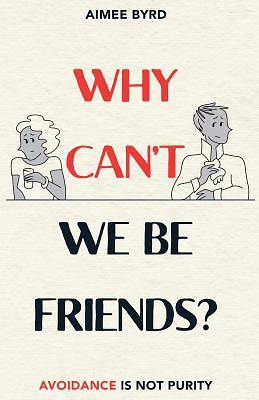 Aimee Byrd challenges this notion in Why Can’t We Be Friends? Avoidance Is Not Purity. Byrd, a wise thinker is involved in ministry alongside men both in her Orthodox Presbyterian church and on the popular Mortification of Spin podcast, pushes past the question of male-female friendship to bring us to the paradigm that seems to have been forgotten in all of the debate about the the Vice President’s adherence to the Billy Graham rule or, on the other hand, whether you and your Christian cross-gender pal should go on a road trip without your spouse.
Byrd reminds us that we are first and foremost siblings in the household of faith, and crafts a theology of siblinghood that extends far beyond whether Harry and Sally can have a cup of coffee together without a chaperone. She comes from a very conservative, classically-Reformed stream of the church, so her discussion is oriented primarily to addressing the culture surrounding the Billy Graham rule. However, her insights apply to each one of us who are trying to faithfully navigate relationships in a hyper-sexualized culture and in a church world pockmarked with wolves in sheep’s clothing, preying on innocents in their care.
She notes that some of our current dysfunction is rooted in a warped understanding of our human identity:
…our understanding of human identity – our anthropology – is a crucial factor in influencing how we will view the possibility of friendship between men and women. The sweeping proclamation that men and women cannot be friends because “the sex part always gets in the way” is a statement about our very selves…if we look at it from a theological perspective, we see that it not only reduces the sexes to their ability to provide sexual pleasure but also diminishes God’s eternal purposes for men and women in our relationships both with him and with each other. We need to grasp that mission in order to pursue the communion that he has called us to, even while living under the struggles on our way there.
What is that mission? We are created for communion with the Triune God and with one another…Our sexuality is expressed in more places than the bedroom. In particular, Scripture show that it is expressed as we live as brothers and sisters in relationship.
Byrd does not write as an ivory-towered theoretician, but as a practioner; she is frank about the challenges and pitfalls we are facing in male-female dynamics. However, as she addresses both righteous concern and unholy fear, she tackles the issue of attraction head-on, noting, “When immature people have feelings for someone, they interpret them as sexual and romantic.” She noted that the desire for relationship is a good one, but without a healthy anthropology mixed with fear, we are prone to misinterpret those feelings as sexual. “The truth is that we are attracted to more people than our spouses. Attraction is not impurity,” she says, adding that if we are tempted toward a particular person, we need to avoid putting ourselves in situations where we’ll cause that person to stumble. This response based on fear of God is a very different one than the fear at the heart of the Billy Graham rule. Byrd is not dismissing prudence and wise boundaries in this book. She is instead asking us with to consider our choices in light of the bigger question of what it means to be siblings in Jesus.
Neither rigid adherence to a rule nor libertine flaunting of that rule leads us to maturity. Byrd is presenting a case for thoughtful growth that will create space for the Harry and Sallys in our congregations to be friends, fearlessly expressing the pure, chaste love of Christ to all.
August 17, 2018
The Questions Few Are Asking
The newest wave of reaction to megachurches was sure to come in the wake of a string of moral failures of both charismatic leaders and the “yes man” approach of the elders/board members responsible for governing the organization. A number of pundits have noted that the megachurch built on a business model is a faulty structure not unlike a McMansion built on a foundation of sand. There is a renewed hue and cry to get back to small, local churches in order to prevent the kinds of failures we’ve witnessed among super-sized congregations in recent days.
While I have great sympathies for those sentiments – and am sympathetic to them – I also hear in some of these expressions two troubling motivations: nostalgia and pragmatism. I’d like to see both confronted in this moment before they take root among us, because neither will lead us in a healthy direction.
The first, nostalgia, is a wistful, filtered view of the past. Journalist Doug Larson said, “Nostalgia is a file that removes the rough edges from the good old days.” Every time Scripture exhorts us to remember, it is a clear-eyed, present-tense participatory engagement with God, not a call to a sanitized, comforting yearning for the “better” ol’ days.
Though I’m not much of a fiction reader, I have enjoyed author Jan Karon’s Mitford series. They trace the story of middle-aged, diabetic Episcopal priest, Father Tim, as he seeks to minister to those in his small-town (and, occasionally, to assist other churches). The books are set in the present, and tackle contemporary problems including addiction, abuse, abandonment, and various incarnations of the seven deadly sins among those in Father Tim’s care – and in Father Tim himself. They are lovely books, and create an accessible picture of a man continuing to grow in his faith. But even with a heaping helping of modern-day problems, Father Tim’s world is at its heart a deeply nostalgic portrait of a small-town church and community – a place where everyone knows your name, and they’re always glad you came.
Some who are calling for a return to small churches have a longing for a Mitford-like oasis in our coarse, often-inhospitable culture. Truthfully, I share that desire, and I suspect many of you reading these words do, too. A smaller church can be an amazing extended family. But it can also be a place of loneliness or deep dysfunction that is simply a scaled-down version containing the very same problems we see in the megachurch world. I’ve been a witness to sexual sin coverup and abuse of power in several small churches. Size alone is no guarantor of a healthy community. Nor will trying to recreate an idealized vision of a past that never really existed.
The other temptation I see in this moment may at first glance seem an odd bedfellow with nostalgia. However, pragmatism fuels Evangelicalism and, to a lesser degree, many other streams of church in the West. We love what “works”, and nowhere has this been more evident than in the business of church growth books, conferences, and coaching that has shaped the way in which we think about our congregations and denominations for a generation.
Sadly, I hear a new pragmatism in some of those calling for smaller churches now. I live less than 15 minutes from 3 different megachurches, including Willow Creek. I grew up in this area, and remember 40 years ago there were many, many small and mid-sized churches here. That number has shrunk dramatically, in direct proportion to the rise of the megachurches that have been built in the Northwest suburbs of Chicago. We may rightly lament the notion of transfer growth fueling the rise of the megas and multi-site churches, but it is worth noting that at least some of these smaller local congregations weren’t all that healthy in the first place.
As megachurches shrink from problems from within as well as perhaps reflecting a societal trend away from church attendance and membership. it is inevitable that new expressions of smaller, local churches will arise. However, trying to capitalize on the failures of this church or that one is a reaction, not a calling, and is at the heart fueled by pragmatism.
There are many wounded sheep milling around right now in the body of Christ – those who’ve been hurt by leadership failures and abuse, in large and small churches alike. Neither nostalgia nor pragmatism offer a cure. I long to hear of more current and would-be leaders asking the question of how to provide care, rest, and healing for those wounded ones. It is a question I’m not hearing asked nearly often enough right now, and it might well be the most urgent question we face as we move forward from here.
This post first appeared here.
July 21, 2018
What’s In The Stack, Summer 2018 Version
Books are the plane, and the train, and the road. They are the destination, and the journey. They are home. – Anna Quindlen
I’ve been honored to receive a great big stack of wonderful books during the last couple of months – some from publishers, others from friends who know that books are my plane, train, and road. Below you’ll find mini-reviews of the books I’ve read so far this summer, and a sneak peek at the ones waiting for me in my “Yet To Read” pile.
In no particular order, I’ve read:

Alan Noble’s Disruptive Witness: Speaking Truth In A Distracted Age takes on the the way in which our addiction to distraction has marred our souls and damaged our ability to engage in substantive ways with the world around us. Noble is no Luddite. He is a lively presence on social media in addition to his day job teaching philosophy at Oklahoma Baptist University and his work as an editor with the online journal, Christ and Pop Culture. This book takes the ideas of philosopher Charles Taylor and interprets them for a popular audience. He is calling readers to first recognize the ways in which our modern world flattens and muffles our ability to think, feel, and love, suffocating our ability to relate to God, others, and ourselves. The second half of the book offers a look at intentional practices that will jolt us out of our soul-slumber. It is not a list of to-dos, but an invitation to being present to what loving God heart, soul, mind, and strength looks like here and now.
* * * * * * *
 I had the opportunity to read an advance copy of Karen Swallow Prior’s On Reading Well: Finding the Good Life through Great Books. This excellent volume releases on September 4th, and it is just the book we all need right now. Prior is an English professor at Liberty University, and a writer with loads of credits in publications for popular audiences offering insightful analysis of cultural trends. On Reading Well is where the Venn diagram circles of those two groups overlap. Each of its twelve chapters illustrates the way in which a classic piece of literature (including Fitzgerald’s The Great Gatsby, McCarthy’s The Road, and Bunyan’s Pilgrim’s Progress) illustrates a moral virtue (such as courage, love, humility). Prior reminds us that good literature tells us not what to think, but teaches us how to think: “Reading well adds to our life–not in the way a tool from a hardware store adds to our life, for a tool does no good once lost or broken, but in the way a friendship adds to our life, altering us forever.” Reading well can translate into greater moral clarity and courage, and isn’t that what we all need most right now? (YES.)
* * * * * * *
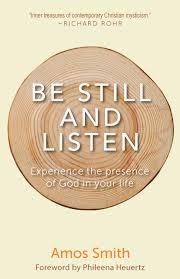
Pastor Amos Smith has written a book that de-mystifies contemplative prayer. I say this with a note of irony and a smile, because Smith, a United Church of Christ pastor who teaches on the subject of contemporary mysticism, would be the first one to say there is much about prayer that is a mystery. Be Still and Listen is not a how-to book, though it offers plenty of user-friendly ideas throughout. It is a why-to book that describes in short chapters the process, challenge, and reward of paying attention to God through silence and stillness – disciplines that are anathema in our culture, and are too rarely cultivated in our churches. Theologically-conservative readers may stub their toes on the way in which human sinfulness is discussed in this book (in short, before we were sinners, we are good at our core) and the language of self-emptying, which drifts toward a Buddhist understanding of meditation. That said, I am a theological conservative and found Be Still and Listen a helpful, gentle description that shows how practicing the presence of God is not a rarified thing reserved for monks locked in ancient, silent monasteries, but belongs to each one of us who claim the name of Jesus.
* * * * * * *
 Kathy Khang wants her readers to use their words with intention, passion, and precision. Raise Your Voice: Why We Stay Silent and How to Speak Up is a book designed to confront the things that keep some from speaking out when confronted with injustice, as well as offering some helpful coaching about how to take simple steps to begin speaking up and speaking out. Khang draws on her own experience as a woman of color, an immigrant, an activist, a person of faith, and a parent to graciously challenge readers to recognize the ways in which their own family story and social location may have silenced them. In our current hyper-polarized culture, the chapter entitled “Everyone Has A Part” was packed with practical suggestions for how each one of us might take a single step toward exercising our voices in meaningful ways. I would have liked to have seen a fuller discussion about the role prayer and contemplation can play in activism, but otherwise found this book a useful exploration of a timely subject.
* * * * * * *
 Vindicating the Vixens: Revisiting Sexualized, Vilified, and Marginalized Women of the Bible is a book written by academics for primarily academics and serious Bible students – but most of its 14 chapters are not so information-dense as to render them unreadable. I credit editor Dr. Sandra Glahn, an associate professor at Dallas Theological Seminary, for this. Glahn has written for popular audiences, and managed to coax out of each chapter’s contributor an essay that is accessible by laypeople while being spiritually meaningful. Reexamination of the biases and faulty assumptions about some of the Bible’s “bad girls” is long overdue, notes Henry Rouse in the introduction: “Reexamination either confirms that something is right and strengthens our understanding and faith, or it points out where we have been wrong and enables us to correct our course, leading us closer to conformity to Christ. We can’t lose. But it might require us to change some of our views, confess our mistakes, and admit that we were wr-wr-wr-wr…Can you say it? Wrong.” The chapters cover the stories of women including Tamar, Bathsheba, Deborah, Vashti, Mary Magdalene, and more. A close examination of Scripture plus scholarship that draws on cultural and linguistic backgrounds offers readers a way to discover they were wrong. I appreciated the scope of the book, and found the chapter on Hagar especially compelling. Millenia ago, God spoke with this used, abused, marginalized woman and vindicated her – and he hasn’t changed.
* * * * * * *
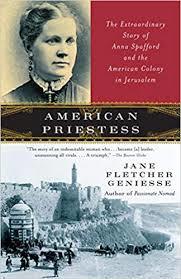 One of my favorite hymns is Horace Spafford’s “It Is Well With My Soul”. I’d heard that he wrote the enduring lyrics after a string of tragedies befell his family, including the death at sea of four of his children. While true, there was far more to the story both before those events occurred – including a string of shady business deals in which Spafford was involved, and his increasingly inventive and unorthodox take on theology. The combination of financial woes and his rise as the leader of a small Christian-ish cult led he and his followers to migrate to Jerusalem in 1881, where they eventually founded what was dubbed The American Colony, servicing pilgrims who came to the holy city. Jane Flether Geniesse details this unbelievable story in American Priestess: The Extraordinary Story of Anna Spafford and the American Colony in Jerusalem. After her husband’s death, Anna proved to be a shrewd, controlling leader who kept the group going for decades. The American Colony Hotel, now a luxury hotel about a mile from the Old City, is the last remnant of the Spaffordites’ presence in Jerusalem. It is a fascinating read for anyone interested in Evangelical history and/or the city of Jerusalem.
* * * * * * *
Two books waiting in my “yet to read” stack include Larry Osborne’s A Contrarian’s Guide to Knowing God: Spirituality for the Rest of Us and Aimee Byrd’s Why Can’t We Be Friends? Avoidance Is Not Purity. The Osborne book was a gift from a friend. She told me her small group went through it, and she was really encouraged by it. I’ve been a long-time reader of Aimee Byrd, who writes for the Alliance of Confessing Evangelicals and co-hosts a popular podcast. I am looking forward to reading her take on the minefield of male-female relationships in the church.
And really, you’ll see that I end up reading A LOT of non-fiction. I say this every time I post one of my reading lists, but I really need to read more fiction. I have a friend who challenged me to mix in more fiction. I have some sitting on my Kindle, and I may declare a moratorium on non-fiction reading for a bit to savor a story that takes me somewhere new.
What are you reading right now? Any recommendations?
July 15, 2018
Doctrine? Music? Or Relationships? Why People Stay In A Congregation
I’ve always heard faith in Jesus is about relationship, not religion. The relationship to which this statement refers is having “personal relationship” with God. Though that kind of language is not found anywhere in Scripture, it is a shorthand way to refer to being born again and committing to follow God wholeheartedly rather than relying on either church membership or religious ritual for salvation.
Though this kind of talk leads some to believe it’s about “Jesus `n me 4evr”, modern-day populist pietism discounts the fact that the whole of Scripture reminds us that we exercise our faith primarily in the context of community. God’s dealings with the Chosen People as well as other people groups across the region as recorded in the Old Testament, and the up-close description throughout Acts and the Epistles of the challenges of becoming a “fellowship of differents” tell me that relationship is at the core of how we learn to work out our salvation with fear and trembling.
Which is why I think I saw something different in a recent Lifeway survey than the statisticians emphasized. First, they noted that on any given week, 15% of the people sitting in a weekend worship service have considered finding a new church in their area:
…churchgoers don’t like to see changes in their church’s doctrine. More than half (54 percent) say they’d seriously consider leaving if church doctrine changed.
Researchers asked about other factors that might cause churchgoers to switch churches. Nearly half (48 percent) would change churches if the churchgoer moved to a new home.
Some churchgoers would leave if the preaching style changed (19 percent), if the pastor left (12 percent) or if a family member wanted a new church (10 percent). Nine percent say they would leave over politics. Fewer would leave if they didn’t feel needed (6 percent), if the music style changed (5 percent), if they had a conflict (4 percent) or if a friend stopped attending (3 percent).
While I don’t disagree that doctrinal changes may be a leading cause for people to consider leaving a congregation, I’m surprised that the relational issues (not feeling needed, conflict, or if a friend stopped attending) had such low percentages attached to them. Because they didn’t clearly define what kind of politics to which they referring here, I’m going to assume that this 9% figure is referring to inter-congregational politics, not U.S. politics. If I group interpersonal factors together, including that of a a family member wanting to attend a new church, fully one-third of the reasons a person might leave a congregation have to do with their network of relationships.
Doctrine matters. Forms of corporate worship, such as preaching style or music, shape a congregation as well. But my own observation is that the relationships we form in a church can keep us there even when doctrine or worship style might be changing…or drive us from a congregation when the relationships fail, wound, or disappoint. I made this observation about “church stayers” in Born to Wander:
I’ve done an informal survey among people I know who’ve been long-time members of their local church. It seems those who stay for decades fall into two groups. Some stay because they value the familiar rhythms of congregational life or have a sense of owner’s loyalty to their friends or even the building itself… These are not bad things, but they are the choices made by settlers.
Others stay long-term because they are pilgrims. Sometimes staying put in a church is far more difficult than leaving one, especially if the congregation is going through a period of transition or division. It is possible to “pilgrim in place,” blazing a trail of faithfulness through a landscape marked by disruption and confusion. And it is just as possible to be a soul in motion, pursuing God during the placid, stable times while learning to discern the difference between His peace and the settlers’ temptation toward spiritual stagnation.
In the last decade, I’ve been invisible while attending a mega-church with our grandsons, and just as invisible in a church of 125 attenders. The painful, lonely experience of invisibility has showed me that sanctification – the journey of discipleship – is indeed about relationship. It is at its core about relationship with God.
But it is inextricably bound in our relationships with one another as well. Our relationships with one another can not save us, but destructive or invisible ones may sap our growth and the flourishing of God’s work in the world.
What do you think? How do your relationships with others in your local congregation…or the big C “Church”, for that matter…shape your discipleship experience?
June 30, 2018
Why Respond When You Can React?
One thing the current American political climate has revealed in many followers of Jesus how easy it is to react to events, and how difficult it is to respond to them. While social media fuels the problem, and highlights our flea-sized attention spans and hippo-sized thirst for hot takes, I believe it is also a symptom of a flaw in the way in which we’ve practiced discipleship over the last couple of generations.
A reaction: “Can you believe what ____ said about ____?!”
A response: “I’ve spent some time considering what _____ said about ____, weighed it in light of what Scripture says, reflected on it in light of wise voices with whom I agree and with whom I disagree, and am now prayerfully prepared to speak and/or act. Or I may feel led to hold my thoughts to myself for the time being.”
I am prone to reaction, and fight the battle daily to walk what is a tightrope-width narrow path. Here’s the thing: discipleship is about the narrow path, not just in regards to political discourse, but in every area of life. This includes the car that cuts you off in traffic, the co-worker who sabotages 6 months of your hard work, the two-year old who melts down in the cereal aisle of the grocery store, or the omnipresent lure of the internet click for a quick peek at porn. In my last post, I noted:
So many of us live as spiritual exiles, even if we’re the most popular people in town and we busy ourselves checking all the boxes on religious performance that makes us beloved employees in our local churches. Others of us live as spiritual refugees, branded as an unwanted, unloved “other” because we don’t measure up to some sort of human expectation. The shadows that hide our true selves and masks we don to tell the world who we are by what we do, or who we vote for, or what we love are very fancy fig leaves that cover our nakedness.
But Jesus is pursuing us even as we wear those false identities and calls us to follow him. He said, “Follow me” many times, to many different kinds of people, throughout his ministry. This is how he speaks to us today, and this is what he asks of us. Pilgrimage is is our birthright as his beloved children, though it is rarely a soft, comfy existence.
How many of us have learned from our fellow church members that discipleship little more than mastery of a set of accepted religious behaviors and vocabulary? While we learn how to follow Jesus in what Dallas Willard aptly called an apprenticeship, too often we’ve substituted peer pressure for the real thing. In too many local churches, this has meant emphasizing things like church attendance/giving, “volunteering“, and learning the unwritten rules of your congregation’s subculture so as not to stumble over a social no-no like drinking a beer among a non-imbibing group or voting against the political party affiliations of most of your fellow members.
When we are new believers, we do learn by imitation. I’ve shared the link to this chart of spiritual growth stages based on the work of Hagberg and Guelich before, but it bears repeating here. We imitate at first – think of babies repeating the sounds they hear as they’re learning to talk. But then we grow past imitation toward more mature forms of self expressing. Church leaders can not take people where they haven’t gone themselves in terms of true spiritual growth and maturity, and a fair percentage of
 Reactor or responder? Exile or pilgrim? Let’s talk more about this in our churches. Click here to learn more.
those I’ve known over the years are just as susceptible to the temptation to peer pressure as their congregants – though it may be masked because they’re the ones holding the microphone and delivering answers. This is common to the human condition, and, in the case of church leaders, they may be even more sensitive to peer pressure because their paycheck, social status, and relational capital are often wrapped into the equation.
God didn’t create us to be isolated islands. God designed us for fellowship. But our relational needs can cause us to stop just short of what it means to be a disciple, whether we’re a leader or a follower. We settle for peer pressure instead of cultivating a culture in our churches designed to encourage following Jesus.
A “discipleship program” will not fix this problem, because it runs as deep in each one of us as our fear of being abandoned or left behind. Let’s face it – for most of us, that fear exists at a pre-verbal level, deep in our souls. It is at the heart of our sense of exile. That unexposed, undiscipled fear keeps us reacting to the world around us, rather than responding. Discipleship is response, not hair-trigger reaction. Jesus welcomes us as reactors (Exhibit 1: Peter), but his “follow me” is meant to move us from living as exiles toward the kind of pilgrimage that moves us toward faithfulness, love, and maturity – as individuals and as the Church.
Jesus has now many lovers of the heavenly kingdom but few bearers of His cross.― Thomas a Kempis
Photo by Gemma Evans on Unsplash


