
Michelle Van Loon's Blog, page 2
April 27, 2021
The Unmaking of Our Biblical Womanhood
To my younger sisters in the faith:
Perhaps you grew up in the church, and have chosen with joyful intention to continue in the same tradition or denomination now that you’re an adult. Maybe you’ve deepened your faith commitment as you’ve moved into your twenties or thirties. Maybe you’ve made a big change in your life, and have found stability and community among other believers who seek to take the Bible seriously.
In a time when many of your peers are moving away from the church, I commend you for your countercultural decision. When I came to faith in Christ more than four decades ago, 68% of Americans maintained some kind of church membership. A recent Gallup poll reports that less than half of Americans now identify as church members. If you are sticking around, you are swimming against the tide. That takes strength and conviction.
There is a temptation in that place of strength and conviction. It’s subtle, and it masquerades as virtue or even victory. But it is a terrible lie, and it will, in broad daylight, steal pieces of your soul from you.
 It is the myth of Biblical womanhood. If you’re in conservative church circles, and sometimes, even if you’re not, there is the idea that there is a certain way to be in the church as a Christian woman. Men are the spiritual leaders of the church. Women aren’t. Some call it complementarianism. Others call it patriarchy. Historian and author Beth Allison Barr, whose new book, The Making of Biblical Womanhood: How the Subjugation of Women Became Gospel Truth, describes how thoroughly this teaching saturates our subculture:
Men lead. Women follow. The Bible tells us so.
For a time, I believed this too. It echoed all around during my teenage and young adult years. I heard it attending a Bill Gothard conference, which some people in my small-town Southern Baptist church invited me to. I heard it from my Bible study leaders in college. I heard it from the hosts of Christian radio stations. I heard it from the notes in my study Bible. I heard it at almost every wedding ceremony I attended, spoken loud and clear as each preacher read Ephesians 5. Male headship was a familiar hum in the background of my life: women were called to support their husbands, and men were called to lead their wives. It was unequivocal truth ordained by the inerrant Word of God.
I’m not writing you to debate the Bible passages and translation choices at the center of this debate. Barr’s book, along with books like this and this, are great starting places if you want to further explore those questions and how they play out in your own church context. But I am writing you to tell you that the subculture in which you find yourself is shaping you not only by the words you hear in a sermon or from a Bible study leader, but also from casual comments, programming choices, attitudes, and lifestyle decisions of those in your Christian circle.
Even if the content wasn’t focused on teaching about gender roles and expectations, decisions like these in the churches my family attended created a web of unwritten rules that taught me who I was allowed to be within that particular subculture:
Women’s programming focused on events like teas and craft projects.Ministry to women based primarily on some combination of Proverbs 31 and Titus 2:3-5, emphasizing roles and attitudes unique to women.The elevation of marriage and motherhood above all else. (If you’re not sure if this is the case in your community, ask a single friend at church if this is true.)Women not permitted to preach, teach teens or adults, or have any kind of involvement in organizational direction or policy discussions.The expectation that women will do all childcare and most, if not all, teaching of children younger than middle- or high-school age.The idealization of 1950’s suburban gender roles as the truly Biblical way to live.A heavy emphasis on authority and submission.I spent years in conservative circles, because they claimed to be, if not the one true church, at least the most Biblically-faithful one. I valued my role as a wife and mother, and I wanted to honor Jesus with my life. There were gifts of being in this conservative world: I learned to love the Bible. I found purpose in taking seriously my relationship with Jesus. (I still do.) I found companionship with other mothers, some of whom have become lifelong friends.
But the boundaries lines in that world meant I had to dial down my leadership gifts and my desire to learn about theology and church history. I heard from men and women alike variations of “What are you reading that for?” if I mentioned a book or topic that wasn’t on the prescribed list for women. (It wasn’t an actual list, of course, but a grouping of blessed, discussed, and celebrated titles within women’s circles that included syrupy Christian books long on emotion and short on Biblical content or G-rated Christian novels that were sermons in the form of stories.) I was marginalized, branded as a problem, or dismissed entirely when I tried to move outside those rigid boundary lines.*
My own reading of Scripture led me to wonder over the years if my church leaders were really interrogating the questions of gender roles, or whether they were simply maintaining their own comfortable kingly status quo. It wasn’t Scripture that led me to support complementarianism, to be honest. My support was primarily pragmatic. I used to believe that if women led, men would abdicate involvement in the church. Though in the complementarian world, I was told that men were the protectors and women needed to be defended, underlying my belief was the idea that I needed to protect the men by playing my prescribed role. Meanwhile, I carried a great deal of shame about who I was as I absorbed every cue from my subculture telling me that the ideal Christian woman was submissive, quiet, soft, modest, and sweetly pretty – a damsel who needed rescuing by a dashing prince. I didn’t fit that mold. Though I am bright, I believed I needed to hide my lamp under a bushel so as not to intimidate the men at church.
Because I supported the complementarian system for the first half of my Christian life, I played a role in perpetuating it. I am sorry I did that, because I can tell you there are many older women like me who wish they would have embraced the freedom from complementarian role-playing – freedom God was offering them all along. You don’t need to wait for the crises of midlife to receive that freedom.
I understand these are different days, and that you might not feel the strictures of conservative Evangelical social boundaries in the same way women of my generation did. But I know the power of peer pressure, and I want to alert you to its effect on you. I want you to shine! I’m connected with many women from all over the country (and world), and hear younger women like you who are trying to figure out this stuff. You want to live the way your peers and mentors at church say is good and right. Maybe the complementarian formula is working for you. (Beth Allison Barr confessed to that very thing in her book.) If your husband is a moral and kind man, and your church leaders are not bullies, the formula may indeed work for you.
But I can tell you that it isn’t working for some of the women in your circles. Power imbalances in relationships are a fertile breeding ground for abuse. Your church can’t have true community if everyone knows they must play an assigned role…or else. Some have elevated complmenentarianism to a first-order dogma, as though it is a central tenet of the faith like the virgin birth or the resurrection. It is not, nor is a complementarian lens the only Biblically-faithful, wholly-orthodox way in which to read God’s Word.
I have spent the last couple of decades recovering what I traded away in a fruitless quest to find true community in those circles. The love offered to me there was conditional on me playing a role God never asked me to play, which is to say, it wasn’t really agape at all. I want more for you, my younger sister, and for your friends at church. I’m cheering you on as I pass the baton to you. The closing words of Beth Allison Barr’s book are my prayer for us all:
What if we finally stood together, united by our belief in Jesus instead of divided by arguments over power and authority?
What if we followed the example of Jesus, who let Mary of Bethany sit at his feet like a male disciple and who overruled his disciples to make sure he heard the words of the woman of Canaan? What if we realized that, even when the male disciples pushed women away, Jesus always listened to women speak? Complementarianism is partriarchy, and patriarchy is about power. Neither have ever been about Jesus.
I don’t remember when I started it, but for a long time now, I have been dismissing my students from class with this phrase: Go, be free!
…Jesus set women free a long time ago.
Isn’t it time for evangelical Christians to do the same?
*Thanks be to God, my husband never bought that party line, and encouraged me to read, write, learn, and lead. “I didn’t marry one of those docile Christian women for a reason,” he told me.
Cover photo by LOGAN WEAVER on Unsplash


April 20, 2021
Reflections on The Cost of Discipleship – Chapters 14-17
Tom Wolfe wrote an essay in 1976 called “The New Man and the Me Decade“. He described the narcissism he saw driving much of American culture at the time, noting the roots of the self-indulgence stretched back to choices made by the previous generation: “The saga of the Me Decade begins with one of those facts that is so big and so obvious (like the Big Dipper), no one ever comments on it anymore. Namely: the 30-year boom. Wartime spending in the United States in the 1940s touched off a boom that has continued for more than 30 years.”
The Me Decade of the 1970’s has a default setting in popular culture as virtue instead of vice, the offspring of Enlightenment philosophy and post-war prosperity. The church has reflected that cultural value in ways ranging from the music it sang to the services it created and marketed. Without the ongoing prophetic challenge to live counter to the dominant culture, we in the church will almost always slip into some sort of hybrid version that mixes our current culture with Christianity – and the real, radical life of Jesus becomes a supporting character in that script. Here we are today, with another four decades of Me Generation belief shaping both church and culture, and it’s clearer than ever that we are all so used to narcissism driving things all around us that its hard to see where we aren’t held in its sway.
My recent reading of Chapters 14-17 of Dietrich Bonhoeffer’s The Cost of Discipleship exposed one of those areas of narcissism in me. (I’ve been blogging my way through this essential book this year. For earlier posts in the series, click here.) Chapter 15 focuses on the Lord’s Prayer, and though I’ve long understood Jesus intended this as a corporate prayer (“Our Father”, not “My Father”), Bonhoeffer’s words exposed a huge blind spot in the way I’ve prayed this prayer throughout my life.
The disciples are told to ask for bread not only for themselves but for all men on the earth, for all men are their brethren.
…they bring all their guilt before God and pray as a body for forgiveness. God forgive not merely me my debts, but us ours.
Deliverance from evil and for the inheritance of the kingdom of heaven...is a prayer for a holy death and for the deliverance of the Church in the day of judgement.
A confession. While I’ve prayed the beginning and end of the prayer with the understanding that these words are first-person plural, I shift right back to my Me Generation assumptions when I get to the middle part of the prayer, which focuses on seeking God for provision of daily bread, forgiveness, and deliverance. Though Jesus didn’t shift to the first person in this section, I always have.
Certainly I can present my specific needs and concerns to my Father as an individual, and he welcomes them (because that’s what a good dad does!), but the words of the Lord’s Prayer are intercession for all of us – the entire body of believers and for all the world. My blind spot has been in disconnecting the beginning and end of the prayer from the middle as if I was eating the center of an Oreo. Bonhoeffer notes, “God’s name, God’s kingdom, God’s will must be the primary object of Christian prayer.” Reconnecting the middle of the Oreo to the beginning and ending has convicted me (again) of the all-encompassing, radical nature of life under his reign.
The other chapters in this section focus on themes of intentional, holy secrecy in our acts of service and devotion, and a word about the purpose of our possessions (“Earthly good are given to be used, not collected”). There are lots of good thoughts in these chapters, but the one I’ll be carrying with me into prayer is the reality that a kingdom orientation will change the way this member of the Me Generation prays the Lord’s Prayer from now on.
Reflect: How do you approach the Lord’s Prayer? Do you see it primarily as an individual prayer to God or a corporate one?
Prayer:
Our Father in heaven, hallowed be your name,
your kingdom come,
your will be done,
on earth as it is in heaven.
Give us today our daily bread.
And forgive us our debts,
as we also have forgiven our debtors.
And lead us not into temptation,
but deliver us from the evil one.
Cover photo by Caroline Veronez on Unsplash
February 18, 2021
Reflections on The Cost of Discipleship – Chapters 12-13
Ted (not his real name) saw me as a rival, set me up for failure, then watched from the sidelines as his manipulative plan unfolded. When I confronted him, Ted gave me the verbal equivalent of a cold shoulder, saying, “I’m sorry you feel that way.”
Fast forward a couple of years. He was applying for a position with a local non-profit, and someone connected with the organization had heard that I knew Ted. A representative from the organization called me to ask questions about Ted’s qualifications.
Ted was qualified for the job, but I could have chosen to give him a lousy reference to even the score for what he’d done to me. The words, “This is a test” flashed across my mind like a warning light. I took a slow breath, long enough to pray and ask for God’s help. I measured my words during the call, and heard a couple of weeks later that Ted had gotten the job. I still had a long way to go in my process of forgiving Ted 70 x 7 times, but at some point on my ongoing uphill climb, I was more than a little surprised to discover I’d relinquished my desire for revenge. I am not telling you this so you’ll think I’ve figured out how to love an enemy. I am telling you this because it was a hard, repetitive journey to get to that point in the process, and continued to be difficult for a long time after that phone call.
Jesus bluntly calls the evil person evil. If I am assailed, I am not to condone or justify aggression. Patient endurance of evil does not mean a recognition of its right. This is sheer sentimentality, and Jesus will have nothing to do with it. The shameful assault, the deed of violence and the act of exploitation are still evil. The disciple must realize this, and bear witness to it as Jesus did, just because this is the only way evil can be met and overcome.
In those words, Dietrich Bonhoeffer is not advocating passivity in the face of evil, but the effects of the intentional decision to walk with Jesus through the valley of the shadow and toward the cross. I have been blogging through Dietrich Bonhoeffer’s The Cost of Discipleship (click here for previous links), and am up to the point in his exposition of the Sermon on the Mount where he talks about how we are to engage with our enemies.
Bonhoeffer takes on the distinction made by the Reformers, noting that they “…distinguished between personal sufferings and those incurred by Christians in the performance of duty as bearers of an office ordained by God, maintaining that the precept of non-violence applies to the first but not the second.” He noted that this convenient bifurcation was used by those Reformers to justify war and other civil actions, and then points out that Jesus never made this kind of distinction anywhere in his body of teaching. “Jesus…tells us that it is just because we live in the world, and just because the world is evil, that the precept of non-violence must be put into practice.”
Chapters 12 and 13 in The Cost of Discipleship cover Matthew 5:38-48. Jesus has some scorching and difficult words about how we’re supposed to deal with our enemies. He says our propensity to love those who love us has an earthly reward, but calls us to the kind of maturity that goes the second mile and gives sacrificially to an enemy. It feels heroic to read those words; it is another thing entirely to have to do the impossible thing and love the way Jesus is asking us. This love has nothing to do with warm feelings and Hallmark sentiment, but is the kind of excruciating action that requires communion with the Lover of our souls in order to do.
This commandment, that we should love our enemies and forego revenge will grow even more urgent i the holy struggle which lie before us and in which we partly here have already been engaged for years. In it love and hate engage in mortal combat. It is the urgent duty of every Christian soul to prepare itself for it.
With those words, Bonhoeffer names a big gaping hole in the way in which some approach discipleship today. Positive, encouraging Christian lifestyle choices will never lead us to prepare for our role in that kind of warfare, but the cross will. Every time.
Reflect: Have you ever desired revenge? Have you acted on that desire?
Prayer: Jesus, i can not love my enemies. Not the way you’re asking. Not in my own strength. And so I come to you now, and ask for the strength to take the first step as I begin to walk that second mile. I can not do this without you.
Cover photo by Stillness InMotion on Unsplash
January 22, 2021
Reflections on The Cost of Discipleship – Chapters 9-11
(1) The soccer ball was kicked by the player.
(2) The player kicked the soccer ball.
Sentence #1 is written in the passive voice. When the subject of the sentence is acted on by the verb, it not only mutes the action, but tends to distance both writer and reader from what is happening in the sentence. While not grammatically incorrect, the passive voice drains writing of its energy. In contrast, the active voice in sentence #2 shows a clear relationship between the subject of the sentence and what they do.
I’m journeying through Dietrich Bonhoeffer’s classic The Cost of Discipleship, and have come to the section of the book that digs into the part of the Sermon on the Mount where Jesus uses his words to crack open the Law and reveal its living heart to his hearers. (Click here to read earlier posts in this series.) Jesus frames his teaching in this section of the Sermon and in verses following with words of contrast: “You have heard that it was said to people long ago…but I tell you…”
That contrast is heightened by the use of the passive voice in the first part of his sentence (“You have heard it said…”) versus the active voice he uses to tell his hearers that they’re not distant spectators of a religion parsed by elite faith leaders, but are participants in a kingdom that encompasses every area of life, and requires full allegiance from them.
…however liturgically correct our services are, however brave our testimony, they will profit us nothing, nay rather, they must needs testify against us that we have as a Church ceased to follow our Lord. God will not be separated from our brother; he wants no honor for himself as long as our brother is dishonored.
Bonhoeffer’s three short chapters address Jesus’s words about harboring grievance against our siblings in faith, diminishing the sanctity of marriage, and remaking truth in our own image. In these words in Matthew, Jesus points to five of the Ten Commandments (along with the other parts of the Law that expound on what obedience to those Commandments looks like) and says, per Bonhoeffer, “Only those who apprehend the law as the word of Christ are in a position to fulfill it.”
What Jesus is saying is far more difficult and clarifying than the interpretation of the Law the religious leaders of his day were teaching. It removed “whatabout” and the incessant search for a loophole – or a noose.
Jesus said we don’t reserve the right to hate another person. “Anger is always an attack on a brother’s life for it refuses to let him live and aims at his destruction. Jesus will not accept the common distinction between righteous indignation and unjustifiable anger.”
This means if we marry, we don’t have the right to defile that relationship with lust, division, or making up our own rules about what it is and isn’t. “Even our bodies belong to Christ and have their part in the life of discipleship, for they are members of his Body.”
And this means we don’t get to decide what is and isn’t true, or act as though we get to write the script for our future. “If lying were unknown, there would be no need for oaths. Oaths are intended as a barrier against untruthfulness…since (a believer) is never lord of his own future, he will always be extremely cautious about giving a pledge (e.g., an oath of allegiance), for he is aware how dangerous it is to do so. And if his own future is outside his own control, how much more the future of the authority which demands the oath of allegiance!”
In light of what Bonhoeffer faced in 1930’s Germany, that final category – about “oath-making” (Chapter 11 in the book) is especially haunting. This isn’t about a passive approach to truth – raising your hand and swearing to tell the whole truth in court, or saying the Pledge, or repeating a “white lie”. He sees in Jesus’ words something more all-encompassing: “The commandment of complete truthfulness is really only another name for the totality of discipleship. Only those who follow Jesus and cleave to him are living in complete truthfulness. Such men have nothing to hide from the Lord.” That allegiance will put us at odds with any one else who tries to claim our lives and affections.
“But I tell you,” Jesus says. And when he does, he shows us not only what he thinks, but who he is, and who he knows we can be in fellowship with him.
Reflect: What is most disruptive to your thinking in Jesus’s words in this passage?
Prayer: Lord, it is easy for me to default to a passive approach to your Word. Your active voice disrupts my desire to create and maintain the status quo. Please help me to hear what you are saying and to act on your words by remaining in fellowship with you, Father, Son, and Holy Spirit. Amen.
January 5, 2021
Reflections on The Cost of Discipleship – Chapters 7 and 8
“The Old Testament God is punitive and judgmental. The New Testament God is merciful and loving.”
A couple of years, megachurch pastor Andy Stanley delivered a sermon series that reminded a lot of people of an old, old false teaching that has dogged the church for nearly 2,000 years. I wrote about it here, noting that Stanley’s modern take on the ancient heresy of Marcionism didn’t exist in a vacuum. Too many people view the Old Testament as a confounding first draft of the New Testament – either explicitly teaching this, or, more commonly, as I noted in my post about the controversy, by many other “softer” (but no less noxious) versions of this theological error.
I was interested to see how my Lutheran brother Dietrich Bonhoeffer would approach the subject, especially since diminishing the Old Testament and reappropriating the New was core to the nationalist theology that flourished in Germany in the 1930’s. (I’m blogging my way through Bonhoeffer’s classic, The Cost of Discipleship. Click here to read earlier posts in this series.)
…Jesus vindicates the divine authority of the law*. God it is giver and its Lord, and only in persona communion with God is the law fulfilled. There is no fulfillment of the law apart from communion with God, and no communion with God apart from fulfillment of the law. To forget the first condition was the mistake of the Jews, and to forget the second the temptation of the disciples.
In these two short chapters, Bonhoeffer wades into the depths of the Sermon on the Mount. Chapter 7 covers Matthew 5:13-16, and Chapter 8 tackles Matthew 5:17-20. In these verses, Jesus reminds his audience made up predominately or entirely of Chosen People of who God has called them to be: salt of the earth, light of the world. This was not news to his hearers. It was the message they’d been hearing since Sinai. He wasn’t innovating with these words. He was reminding them of what they already knew, and telling them in unvarnished terms that this is who God’s people are meant to be individually and corporately in this world. Bonhoeffer explains:
It is not for the disciples to decide whether they will be the salt of the earth, for they are so whether they like it or not. They have been made salt by the call they have received. Again, it is ‘Ye are the salt,’ not ‘Ye have the salt…Nor does Jesus say, ‘You have the light’. The light is not an instrument which has been put into their hands, such as their preaching. It is the disciples themselves.
They can only BE those things by living in communion with God, Bonhoeffer underscores in both of these chapters. He calls out those who would disconnect Jesus from the Law he gave, the Law he loves, and the Law he came to write on the hearts and lives of his followers, noting, “(Jesus) tells us to abandon the law would be to separate ourselves from him.”
To be salt and light means loving the Law-giver – the one who himself filled-full the Law with all that he is.
Righteousness…is not a duty owed, but a perfect and truly personal communion with God, and Jesus not only possesses this righteousness, but is himself the personal embodiment of it. He is the righteousness of the disciples. By calling them he has admitted them to partnership with himself, and made them partakes of his righteousness in its fullness.
Those who frame the conversation as some sort of spiritual WWF featuring a cage match between Law and Grace is an exercise in missing the point, nor is it the message Jesus was giving. The Law isn’t about “earning your way to God”, but describes how to live as salt and light, in full communion with God. Jesus, through the Holy Spirit, graces us to live the Law in partnership with him.
Reflect: How has the Law been treated in the teachings at your church or in the books you’ve read?
Prayer:
The instructions of the Lord are perfect, reviving the soul.
The decrees of the Lord are trustworthy, making wise the simple.
The commandments of the Lord are right, bringing joy to the heart.
The commands of the Lord are clear, giving insight for living.
Reverence for the Lord is pure, lasting forever.
The laws of the Lord are true; each one is fair.
They are more desirable than gold, even the finest gold.
They are sweeter than honey, even honey dripping from the comb. (Psalm 19:7-10 NLT)
Communion with you is sweet, Lord. I crave it, through your beloved Son. Amen.
* The word “law” is in lower-case form in Bonhoeffer’s book. In my own writing, I treat Law as a proper noun and capitalize it.
Cover photo by Sagar Chaudhray on Unsplash
December 22, 2020
Reflections on The Cost of Discipleship – Chapter 6
I admit it. My relatively comfortable life in America gave me a distorted lens through which I used to read the Beatitudes, the opening salvo in Jesus’ longest recorded teaching in the New Testament. Jesus said things like “Blessed are the poor in spirit, for theirs in the kingdom of heaven” (Matthew 5:3) and I would think, “There are some words of consolation from Jesus if poverty happens to me. It’s nice to have these promises of God in the bank, just in case poverty or any of the other conditions listed in the Beatitudes comes to pass in my life.”
I know that’s not what he said. And I know that Jesus wasn’t speaking in terms of a fall-back plan or a spiritual rainy day fund. He was describing what his kingdom would look like in this world until his return, says Dietrich Bonhoeffer. He was describing the cruciform life. He was describing himself.
I’m blogging my way through Bonhoeffer’s classic The Cost of Discipleship. (To read earlier posts in this series, click here.)
…we naturally ask if there is any place on this earth for the community which they describe. Clearly, there is one place, and only one, and that is where the poorest, meekest, and most sorely tried of all men is to be found – on the cross at Golgotha. The fellowship of the beatitudes is the fellowship of the Crucified.
Bonhoeffer notes that those who would renounce the world in order to try to live the kind of excruciatingly impossible life Jesus describes in these words are missing his point. So are those like me who see in these words a safety net if things go south in their lives. In both cases, he notes, error resides in “looking for some kind of human behavior as the ground for the beatitude instead of the call and promise of Jesus alone.”)
This is his kingdom:
Members of his body on earth are poor in spirit because they have “no security, no possessions to call their own, not even a foot of earth to call their home, no earthly society to claim their absolute allegiance.”
They are mourners because they “do not shake off sorrow as though it were no concern of its own, but willingly bear it. And in this way they show how close are the bonds which bind them to all humanity.”
They are powerless because who now rule the earth have done so by violence and injustice. “The powerless here and now received a plot of earth, for they have the Church and its fellowship, its goods, its brothers and sisters, in the midst of persecutions even to the length of the cross.” He notes that the renewal of the earth begins at the cross, and when the kingdom comes in fulness at the return of Jesus, the meek will possess the earth.
They hunger and thirst for righteousness by renouncing their rights and their own righteousness, foregoing praise for achievements or sacrifices, and are fulfilled instead by the one who is Bread of Life.
They have renounced their own dignity in order to live a life of mercy, willingly choosing “the distress and humiliation and sin of others” in order to clothe them with honor.
They are “undefiled by their own evil – and by their own virtues too.”
They are told not only to receive God’s peace, but to pursue peace with those at war with God by “enduring suffering themselves rather than inflict(ing) it on others.”
They are persecuted for their faithfulness because the world is offended by them. “It is important that Jesus gives his blessing not merely to suffering incurred directly for the confession of his name, but to suffering in any just cause. They receive the same promise as the poor, for in persecution they are their equals in poverty.”
The Beatitudes describe Jesus’ earthly life. And ours, when we live into what he alone can give us.
Reflect: In what ways have you been tempted to treat the Beatitudes as either a spiritual aspiration or a rainy day fund if life heads south?
Prayer: Messiah Jesus, your life not only modeled the Beatitudes, but was the Beatitudes. You showed us what a blessed life looks like, and it doesn’t look like a bail-out plan or a selection of lovely parting gifts. It looks like the self-emptying life of the manger and the self-giving love of the cross. I can not offer you a Beatitudes-imprinted life, but I can receive yours, and I want to do so.
Cover photo by Michael Longmire on Unsplash
December 14, 2020
Reflections on The Cost of Discipleship – Chapter 5
Just because you’re standing in a kitchen doesn’t make you a toaster. Or a Pop-Tart.
When I hear people tell me that their lifelong membership in a church means they’re automatically and obviously Christians, I have to do a little quick translating. I understand that some church traditions teach this, and can explain the theological reasoning for this belief, but my own convictions on this particular topic overlap that of the renegades of the Reformation, the Anabaptists. We may well belong to a congregation, but that does automatically make us followers of the risen Messiah. I had to tap my understanding of Lutheran theology and church history to decode Chapter 5 in Bonhoeffer’s The Cost of Discipleship. (I’m blogging my way through this contemporary classic. Click here to review earlier posts in the series.)
…at least this is certain: in one way or the other, we shall have to leave the immediacy of the world and become individuals, whether secretly or openly.
Most of us in this country are really, really good at being individuals. At least, we think we are. So the language found in Chapter 5 encouraging people to come out from the herd and be individuals in order to follow Jesus faithfully can seem a little strange to our American ears. It is helpful to remember Bonhoeffer’s context in 1930’s Germany, where the state-aligned Lutheran church had become a vehicle for “Christian” patriotic nationalism. The majority of German citizenry were born and baptized into the church, and belonging was just a piece of what it meant to be a member of society. Bonhoeffer challenged that default setting:
There can be no genuine thanksgiving for the blessings of nation, family, history and nature without the heart-felt penitence which gives the glory to Christ alone above all else. There can be no real attachment to the given creation, no genuine responsibility in the world, unless we recognize the breach which already separates us from it.
He cites Abraham as an example of the kind of individual response which should be normative for each person responding to the call of God in their lives, noting that it was only Abram who heard the specific call, not the entire group of people surrounding him. Those who went with him were bound to him by fidelity to their relationship, as Lot and his people were, or via the one-flesh covenant of marriage, as Sarai was. But Bonhoeffer notes that the model for us is not the group who traveled with him, but the reality that God called Abram as an individual and Abram responded as an individual. We see the same individual call and response in Abraham’s life when it came time to walk up Mt. Moriah with his teen son, Isaac, and offer the child to God.
Perhaps the most important message of this chapter is reminding us of the order of things: we must respond to God as individuals first, and then find our place in the family of God. This isn’t to say that there isn’t a place of welcome in a healthy church community for not-yet-believers – there most certainly is! – but to allow the message that church membership automatically equals following Jesus is spiritual malpractice. You might be in the metaphorical kitchen by attending church, but it takes a spin in the toaster to make that a single strawberry Pop-Tart into something new.
Reflect: What is your understanding of the relationship between individual response to God and membership/belonging to a church body?
Prayer: God, please give me ears to hear your call, and the will to respond to that call. If I am a life-long church attender, help me to gain clarity on what that means and doesn’t mean in my relationship with you. I ask this in the name of Jesus, who calls each of us as individuals to follow you, and then invites us as our head to be living members of his body. Amen.
December 7, 2020
Reflections on The Cost of Discipleship – Chapter 4
Last weekend, New York Times reporter Ruth Graham held up a mirror to the celebrity culture that formed around former pastor Carl Lentz at the New York franchise of Hillsong church. Though Lentz was canned by the church a few weeks ago after his recent affair became public, the privilege bubble that formed around him took years to create:
When (Lentz) did appear on Sundays, he rarely mixed with churchgoers. On Sundays, a team of congregants working as volunteers prevented anyone without the right badge from wandering backstage, and only a few had clearance to enter the green room stocked with a lavish catering spread and changes of clothes to fit Mr. Lentz’s increasingly particular tastes.
This may sound extreme to some readers, but I’ve had a peek at the inner workings of a few mega churches and can say that many marquee-name pastors have some kind of bubble around them. While there are plenty of good reasons for a body of believers to assist in stewarding the time and energy of a leader, none of those reasons requires designer sneakers and a caterer.
It was against the backdrop of the Lentz story that I read Chapter 4, entitled “Discipleship and the Cross”, from Bonhoeffer’s scorching book about discipleship. (Click here for earlier posts in this series.) Bonhoeffer writes, “…the very notion of a suffering Messiah was a scandal to the Church, even in its earliest days. This is not the kind of Lord it wants, and as the Church of Christ it does not like to have the law of suffering imposed upon it by its Lord.” He notes that in addition to suffering, friends of Jesus can also expect rejection and shame.
We may scorn the excess of a Hillsong, but may be prone to a different kind of spiritual poverty by believing that regular church attendance is what the cross means for us today. Going to church services can form us, remind us of our identity as a member of the body of our Messiah, and nourish us spiritually through Word and Sacrament, but Jesus didn’t describe discipleship in terms of what happens in a church service. We may reenact and remember his story together as a community, but discipleship requires much more of us or it isn’t really discipleship, according to Bonhoeffer:
As Christ bears our burdens, so ought we to bear the burdens of our fellow-men. The law of Christ, which it is our duty to fulfill, is the bearing of the cross. My brother’s burden which I must bear is not only his outward lot, his natural characteristics and gifts, but quite literally his sin. And the only way to bear that sin is by forgiving it in the power of the cross of Christ in which I now share. Thus the call to follow Christ always means a call to share the work of forgiving men their sins. Forgiveness is the Christlike suffering which it is the Christian’s duty to bear.
These words are not calling us humans to make martyrs out of ourselves, nor are they imbuing us with special spiritual status (or designer threads). They are calling us to recognize that the sins of others fuels much of our experience of suffering, and forms our cross in this broken world. As we draw upon the power of Christ’s forgiveness, given freely to those who come to him to receive, we become free to forgive those who sin against us.
I grew up in a home where I was taught that unforgiveness was a virtue, that it would defend me from further hurt. It’s taken me a long time to understand the difference between forgiveness and trust. I’d be foolish to give my trust unreservedly to someone who has attempted to hurt me. But forgiving again and again (and again) as I’ve been forgiven has been the place I’ve begun to learn the way of the cross.
Reflect: What does the language of “carrying your cross” mean to you? Have you ever thought of the cross God is asking you to bear in terms of the ongoing process of learning to receive and give forgiveness?
Prayer: Jesus, you willingly bore my sin on the cross. I can not comprehend this kind of love, and I scarcely know how to receive it. One thing I do know – I can’t forgive in my own strength. I don’t know how – not really. But to follow you means I will go with you to places I’d never choose and to live in a way that strips me of my carefully-cultivated defenses. I crave the comfort of a green room and a caterer, and I pray for myself, Mr. Lentz, and each one of us who recoils from the suffering of your cross. We do not suffer alone. You have promised to be with us, to the end of this age. Amen.
Cover photo by Markus Spiske on Unsplash
December 1, 2020
Reflections on The Cost of Discipleship – Chapter 3
I was gossiping with a friend, but if I called it “processing” and “debriefing”, then it couldn’t be considered gossip, right?
It takes a certain kind of moral gymnastics to pretzel blatant sin into a perfectly reasonable and completely justifiable act of self-care. I could say I’m an Olympic-level gymnast in this regard, but I think most of us are pretty good at creating comfortable loopholes for ourselves in God’s “thou shalt not” commands. We human beings have been rationalizing sin of all kinds for a long time.
I’m blogging through Dietrich Bonhoeffer’s classic The Cost of Discipleship. (To read earlier posts in the series, click here.) Chapter 3 calls my bluff on my propensity to rationalize my sin:
Jesus might say: “Seek ye first the kingdom of God,” and we should interpret it thus: “Of course we should have to seek all sorts of other things first; how could we otherwise exist? What he really means is the final preparedness to stake all on the kingdom of God.” All along the line we are trying to evade the obligation of single-minded, literal obedience.
How is such absurdity possible What has happened that the word of Jesus can be thus degraded by this trifling, and thus left open to the mockery of the world? When orders are issued in other spheres of life there is no doubt whatever of their meaning.
Bonhoeffer calls this kind of thinking exactly what it is: “…an excuse for shirking the necessity of concrete obedience.” When I resort to believing that God couldn’t possibly mean what he says, and that I have the liberty to interpret his words in a way that allows me to avoid actually obeying them because, heavens, he couldn’t possibly want me to be at all uncomfortable, I mute the Holy Spirit and turn up the volume on the foolish trinity of me, myself, and I. When I view Scripture’s truth as an abstraction or a metaphor, and attempt to domesticate God, I disconnect myself from an active life of faith.
Obedience is the remedy for that disconnect, and, it is something that involves both our surrendered will and God’s sovereign work. I’ve heard it said that it takes God to love God. The idea is that it is not something we can muster on our own, but as Bonhoeffer reminds us in this chapter, this kind of communion with God is possible because with God, all things are possible.
Reflect: In what area of your life are you most tempted to look for a loophole in God’s clear command? Why might this be so?
Prayer: Jesus, you do not separate belief from action in the same way we are often tempted to do. To believe you is to obey you; to believe you is to act. There are no loopholes in your word. So I pray the words of the man who contended for his demonized child, “I believe, help my unbelief.” Help my inaction, and convict me of my tendency to rationalize and diminish what I know you are calling me to do, for my ultimate good and your glory. Amen.
November 24, 2020
November newsletter
Shalom, friend!
During the Passover Seder, there is a section of the service called the Four Questions that launches the recounting of the story of God’s deliverance of the Hebrew people from slavery. The first question is “Why is this night different from all other nights?”
There will come a day when we may ask, “Why were the holidays different in 2020 than all other years?” So much of what infuses holidays with meaning for many of us is the repetition of our cherished rituals from year to year – or at least, the memory of those rituals. This year, most of us will be experiencing a very different Thanksgiving than in years past. We may ache for the comfort of the familiar (Campbell’s Soup green bean casserole, anyone?) on in a year that has turned life upside down for many of us. I share a wonderful piece of counsel from Tara Owens of Anam Cara Ministries:
I have a proposal. Since many of us are not going to be with family the way we usually are over the holidays, can we make a pact?
We don’t have to make the dish that we hate just because it would be something someone else (who is probably not at your table this holiday) wants. If you hate turkey, don’t make turkey. If the green bean casserole disgusts you, don’t do it. If creamed corn is traditional but you just don’t understand it, don’t figure it out. If the whole thing stresses you out, order it in (or skip the planning of it altogether.)
Conversely, if the weird jello mold your aunt always makes would make you feel nostalgic and comforted, Google the heck out of that recipe and go jello-wild. If your in-laws taught you to make apples and cheese (which is just deconstructed apple pie, I’ll have you know) and it makes you happy, make a whole tray.
This year all bets are off. This isn’t about “making new traditions,” or whatever weird pressure that is. It’s about treating yourself and your family with kindness, practicing healthy choice around food, and giving ourselves a darn break when it comes to holiday pressure.
I am ordering a couple of ready-made Thanksgiving meals for Bill and I from a nearby local restaurant. For a dedicated cook like me who has always cooked with joy and many sticks of butter for the holiday, it will be a different kind of Thanksgiving. And that’s the point. Things are different this year.
 Leaning into the difference has been freeing. I am finding afresh I’m best able to give thanks to God when I also know I am also welcome to come before him to name the losses of 2020 and express my confusion, fear, and disorientation.
I am deeply grateful for each of you reading these words. Whether you’re an “in real life” friend or a digital connection, know that I thank my God every time I remember you. And I pray that this different holiday season will bring unexpected consolation to you – and maybe even a bite of a Googled version of your aunt’s weird Jello-mold.
Do you know someone who could use a word of encouragement – and who couldn’t right now?
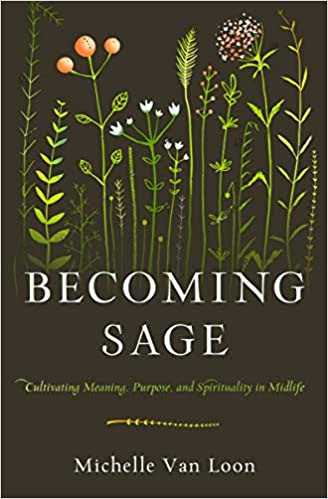
I am giving away two signed copies of Becoming Sage: Cultivating Maturity, Purpose, and Spirituality in Midlife. The book is about spiritual growth, and a number of readers have told me that the words of the book have given them all kinds of “ah ha!” moments of understanding about the Lord, themselves, and the others in their lives. Enter the drawing for yourself, or to gift someone you know this holiday season.
To enter, simply click here to email me. I’ll draw two names next Monday, November 30th, and reach out to you for the name and address of the recipient.
Free online devotional to read and share

When unexpected challenges upend the good plans we’ve made for our lives, how can we begin to respond in faith? This five-day devotional is available here, and offers a thoughtful, compassionate exploration of the subject of how we can take first steps in processing those losses with honesty and courage. Bookmark it, and share it with someone you know who might find comfort and strength in these words.
Advent begins this Sunday, November 29th

I Wonder As I Wander: Devotions For Advent
This affordable little booklet is designed to share with groups at church or in your community. These daily devotions capture the surprise, truth and wonder of God’s pursuit of each one of us. Contemporary examples mix with ancient, unchanging truth to guide readers to the One born in Bethlehem who has been pursuing us every step of the way.

Moments and Days: How Our Holy Celebrations Shape Our Faith
This book is about more than Advent, but Advent is included. Learn the feasts and festivals of the Bible, and discover the beauty of the Church calendar. Both the Jewish festal cycle and the Christian year have much to teach us about holy days and every day.
Finally, have you ever heard the 17th century hymn Jesus Christ, the Apple Tree? The haunting melody includes these words:
For happiness I long have sought
And pleasure dearly I have bought:
I missed of all; but now I see
‘Tis found in Christ the apple tree
According to Ye Olde Wikipedia, “The song may be an allusion to both the apple tree in Song of Solomon 2:3 which has been interpreted as a metaphor representing Jesus, and to his description of his life as a tree of life in Luke 13:18-19 and elsewhere in the New Testament including Revelation 22:1-2 and within the Old Testament in Genesis.” It is a song full of life and longing, and I really enjoy Bob Bennett’s gentle contemporary version: https://www.youtube.com/watch?v=G9JcDON8vHA&list=RDG9JcDON8vHA&start_radio=1
This hymn is often sung during the Christmas season. It’s not one you’ll hear in a mall, but since we’re not going to malls in quite the same way as years past, sit back for a few minutes, breathe deep, and let these words of love wash over you.
With great gratitude to God for you,
Michelle Van Loon
To contact me about speaking at your church or ministry event, click here. It would be my privilege to serve your group. I can Zoom, Skype, FaceTime or use two empty toilet paper rools strung together if you like.
Cover photo by Mathyas Kurmann on Unsplash


