
Michelle Van Loon's Blog, page 4
May 21, 2020
Translating the past
When author Dani Shapiro took a DNA test at age 54, she discovered that the man who’d raised her wasn’t her father. Her 2019 book Inheritance: A Memoir of Genealogy, Paternity, and Love, details her search for answers surrounding her conception and her painful and miraculous journey toward a gaining a truer expression of her identity. I have long been fascinated by the stories our genes tell us, even when we don’t have a code-breaker translating their messages from the past to us.
Shapiro reflected on the clues embedded in her own writing:
I had reread some of my early books in recent weeks and was taken aback, again and again, at the choice I’d made, the language I’d used – particularly in my fiction – that pointed to some sort of consciousness lurking just beyond my ability to perceive it. The truth had been inside me all along.
In my first, highly autobiographical novel, the narrator is aware that she is out of place in her father’s Orthodox Jewish family and longs to be a part of them. But she is haunted by the fact that no one ever recognizes her as part of the family by her face. In a much later novel, a secret wears away at a family until it is very nearly destroyed, parents with the best of intentions make selfish decisions affecting the fate of their child. What had I known without knowing?
I grew up knowing the outline of my mother’s story: Her mother, my maternal grandmother Molly Klopman, died shortly after giving birth to her in 1938 in New York City. Her father, George, wasn’t able to care for a newborn. An infertile cousin and her husband in Chicago agreed to adopt the baby with the proviso that the adoption remain a secret. Everyone in the family agreed it would be for the best. But shortly before my mother was to marry, George called and spilled the truth in 1957. He wanted to come to the wedding to see Molly’s baby walk down the aisle.
That explosion blew up my mom’s life, though no one really understood precisely how deep the damage was at the time. Instead, the shrapnel was reconfigured in time for happy family pictures with the parents who’d raised her. I’ve been told George came to the wedding and sat in the back of the room. He’s not in any of the pictures in the wedding album.
Though we didn’t talk about it much, that secret shaped my family’s experience in ways I’m still discovering. But it wasn’t until I read Shapiro’s words about her own early writing that I realized that Molly had been talking to me even when I didn’t know how to translate what she’d been saying.
When I first started writing as an adult during the 1980’s and 1990’s, I focused almost entirely on playwriting. When the opportunity was presented to me to try my hand writing some radio scripts, then to put together a play that senior citizens could perform, I gave myself an immersion course in scriptwriting by cleaning out the shelves on the topic at my local library, reading plays, and eavesdropping on conversations to study the rhythms of speech. And then wonder of wonder, miracle of miracles, things that I wrote made it to the radio and to the stage.
No one in my immediate family had the slightest inclination toward theater. I’d never been in a school play. Though I’d always loved to write, there was no logical reason that I should have been drawn to playwriting. It wasn’t until I read Shapiro’s words that I understood what the scripts I was writing were telling me.

After my mom died in 2007, a cousin sent me some pictures of Molly and George Klopman. Only then I learned that Molly Klopman was active in Yiddish theater in Poland before she came to the U.S. in 1920. She is third from the left in the cast picture above, acting in the play Mirele Efros.
What had I known without knowing?
Some may mark this merely as a coincidence. But I suspect that just as eye color or lactose intolerance gets transmitted through DNA, so do other things that can’t be measured or quantified. Like how to tell a story in 3-D.
The lines have fallen to me in pleasant places; Indeed, my heritage is beautiful to me. (Ps. 16:6)
We bear pain in our lives, the result of generational trauma. We transmit some kinds of disease via errant genes. But there are also gifts of our heritage, clues buried below the surface of our conscious experience, like a love letter in a time capsule.
How about you? Have you discovered some surprising connection between your life and the life of a relative from an earlier generation?
Cover photo by Jason Wong on Unsplash


May 7, 2020
The end of “friend”?
The morning after the 2016 election, I expressed shock and sorrow about the results of the voting on Facebook. I did not vote for Donald Trump. Someone I’d thought of as a friend for more than 15 years responded in anger by telling me, using these exact words, to “put on your big girl pants and get over it”. Like many of the people I’d called my friends from that period of my life, she saw Trump as a miracle, a modern-day Cyrus, God’s anointed man for this hour in our country’s history. After I challenged her ice-cold response to me, she promptly unfriended me.
I still feel sad about that. But not for the reasons you might think.
There were people who voted for Trump in 2016 because they hoped he’d be a disrupter who’d drain the swamp or make good economic deals, people who voted for Trump because they detested Hilary Clinton, and those who saw in Trump someone who would be used to lead this country into spiritual revival via conservative Supreme Court Justice picks and religious liberty legal protections. Certainly for many voters, the categories overlapped. But that third group, those who believe Trump to be their God-chosen defender and friend, have sequestered themselves in an iron bubble crafted from the threads of Fox News opinion, triumphalist pronouncements from their pastors and those claiming to be prophets, and a tsunami of angry memes and YouTube conspiracy theories, the latter of which have ramped up significantly in this era of COVID-19.
I’ve always viewed myself as a loyal friend. I’ve maintained relationships with people I’ve known since the age of 13. Through all our moves, jobs, and church affiliations, my life has been enriched by the mix of most of the people God has brought into my life. I’ve also managed to make a few enemies along the way, either because I’ve been put in the role of a whistle-blower or because my high-octane blend of extroversion and and strong opinions can be exhausting. (Heck, sometimes I exhaust myself.)
However, I used to think I knew precisely who my friends were. I noted in Becoming Sage,
We do not select our families, but those we call our friends reflects a powerful chosen love. Scripture highlights unforgettable friendships like that of Ruth and Naomi or David and Jonathan. We recognize great friendships in literary classics like that of Sam and Frodo in the Lord of the Rings series or Anne Shirley and Diana Barry in Anne of Green Gables.
Friends are people who cherish one another, sticking “closer than a brother” (Prov. 18:24). The best kind of friendships create safe zones that allow us to reveal the truth about ourselves (Prov. 27:5–6). Friends provide mutual support (Eccl. 4:9–10).
Scripture also reveals that one friend can betray another with the knowledge they’ve gained from relational closeness, as we see in the case of Judas’s stunning disloyalty to Jesus. And yet, as Judas was on his way to betray Jesus, Jesus spoke these words to His disciples: “Greater love has no one than this: to lay down one’s life for one’s friends. You are my friends if you do what I command. I no longer call you servants, because a servant does not know his master’s business. Instead, I have called you friends, for everything that I learned from my Father I have made known to you” (John 15:13–15).
This kind of friendship Jesus offers us is marked by perfect love expressed in sacrifice and intimacy. All of our other healthy friendships can reflect a measure of that love.
Can true friends disagree on politics? On faith?
Can true friends disagree…period?
It seems that the kind of digital relationship I’ve had with a number of people from my past have as a litmus test unblinking adherence to their chosen political leader. Were they always like this? Was I? I try to remember what it was like to be among them, but at the time politics seemed to take a back seat to spiritual issues, save our shared concern about conservative social issues.
Do friends humiliate others in order to force them to comply with their political views (“You should pray for the president like I do rather than criticize him”) or attempt to grind them into silence by accusing them of arrogance because they perceive the “offender” to be an intelligent person?
I have examined myself repeatedly, asking God to reveal if any of their words may be true of me. I think they’d be surprised by how much I have prayed for the president and other leaders, but probably not from the same songbook from which these super-supporters are using. While pride can be a lure for an intelligent person, it is a trap for all of us no matter what our I.Q. might be. I confess my sinfulness regularly. I repent. I am grateful for my Father’s mercy. The level of vitriol I’m seeing from this crowd doesn’t have anything to do with loving correction in the context of true friendship. It is meant to shame and silence me.
If an enemy were insulting me, I could endure it; if a foe were rising against me, I could hide. But it is you, a man like myself, my companion, my close friend, with whom I once enjoyed sweet fellowship at the house of God, as we walked about among the worshipers. (Ps. 55:12-14)
I recently had an “ah ha” that might seem obvious to some of you reading these words: These people are not my friends. I’ve continued for too long to think of them as friends, and have tried to relate to them as such.
The sadness I now feel about this comes from recognizing that all these years, my motivation in doing so has been because I’ve been hoping to redeem something of value from a time in my life that was filled with so much hurt and sorrow. At least these people still like me, I’d think. At least they still want to maintain some sort of connection. “At least” is not a basis for a friendship, even one on Facebook.
I’ve come a long way from the worst of the codependent tendencies that formed me as a younger person, but my “ah ha” revealed to me that old ways of thinking and being die hard. It has been helpful to realize that a better category in which to keep these “friends” from the past is that of enemy. Jesus’ words about enemies do not allow me to attempt to cancel these people and pretend they don’t exist (though “unfriending” or blocking abusers on Facebook is common-sense), but in some ways ups my responsibility toward them to go the second mile both in prayer and in the way in which I may choose to engage them in the future. It doesn’t at all mean more engagement, but it means wise, clear-eyed engagement about the nature of the relationship.
I’d love your thoughts on this, especially if you’ve experienced fractured friendships as a result of political differences. Do you believe “enemy” is a helpful category to use when relating to these people? Is it too harsh?
March 30, 2020
To Tell The Truth
Shalom, friend!
As a result of one too many nights of 3 a.m. channel-surfing, I happened upon a network that showed reruns of 1950’s vintage game shows. Despite its cheesy sets, To Tell The Truth captured my modern imagination. Three people would in turn use the same name to introduce themselves to the audience, then the host would read a job description for a position that one of the three actually held. A panel of celebrities would interrogate the three same-named contestants, trying to suss out which two were imposters. The host would conclude the questioning by asking the real person to stand up and tell the world the truth about who they were.
I thought about this show when I was talking to female ministry leader who’d recently received a cancer diagnosis. When I asked Linda (not her real name) how she was doing, she answered quickly, “I’m great! God is in control!”
As the conversation continued, I heard a number of “shoulds” simmering just beneath her victorious facade that hinted that some of her courage might have been fueled by religious performance: “I have to be strong”, “I want to have a good testimony”, and “My faith is on display”. Her seemingly-upbeat, positive approach was celebrated by many of the women to whom she ministered. But a few others expressed shame and sadness that they weren’t as strong and brave as Linda appeared to be. Linda’s heroic public persona made it a little more challenging for some other people around her to be honest about their own struggles.
So many of us reading these words have come from churches where it hasn’t always been easy to tell the truth. The Lindas among us have often been the exemplars of what a strong faith should look like. We haven’t always been quick to recognize that fear can somtimes masquerade as performance. But as we are all navigating a world in which Coronavirus is raging and spreading exponentially, few of us can muster a heroic facade. This kind of faux front has never been true to the One who is Truth incarnate, and donning it has fit the Church as poorly as a cheap Halloween costume.
I’ll say it: My name is Michelle and I’m afraid.
As this story has unfolded over the last weeks, I’ve spent too much time scrolling, scrolling, scrolling through a torrent of scary news reports, which bring no solace but instead serve as a fear accelerator. Each one seems to invite me to play my favorite fear-based game, “Imagine The Worst-Case Scenario”. For some strange reason, my own personal game show, which I often play solo at 3 a.m., has never been picked up by a network.
You might be afraid, too. You might be full of questions about when this will be over, how your life will change, what will happen to you and your loved ones, and why God has permitted this. What fills the space between these questions and the silence of no ready answers can be fear and confusion for most of us.
Psalm 56:3 says, “When I am afraid, I put my trust in you.” King David had plenty of reasons to be afraid during the time he first sung this Psalm in the darkness and confusion of a life on the run. I am heartened by the fact that he didn’t use the bravado of saying “If I am afraid…” His “when” tells me he was regularly blunt with God about his fear, and fought his way back to trust as he poured out his anxiety and confusion before him.
We hear that perfect love drives out fear (1 John 4:18). I once used these words as a metric that assessed my own imperfect and fearful love. No more. Instead I am consoled by these words. What is translated here as “perfect” is the same Greek word (teleios) that means finished, complete, or fully grown. It describes the process of a Jesus follower’s journey with him, not the destination.
Naming our fears before God, sharing them with a trusted friend or family member who will listen without trying to fix it (because there is no quick fix for COVID-19 and its still-unfolding effects on our world, and because most attempts to “fix” fear tend to drive it underground, not away), and if the anxiety is consistently paralyzing, reaching out for professional help can all be a part of what will make us all truth-tellers right now.
Yes, I am afraid, and I am learning to trust God in new ways. And in this, I am standing up to tell the truth together with you, my friends.
Sage words for hard times
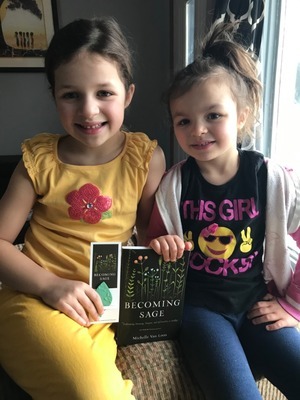
My friend Marlena Graves, author of a forthcoming book about humility and dependence called The Way Up Is Down: Becoming Yourself By Forgetting Yourself (you’ll want to add her book to your list!), wrote some gracious words of endorsement for my book: “Becoming Sage is for all of us who are famished, who long for sense amid so much ‘Christian’ nonsense…I want to stick this book in the hands of every pastor, church leader, and seminary professor.” She sent me this sweet picture with two of her sage daughters holding the book.
Publishers Weekly gave Becoming Sage: Cultivating Maturity, Purpose, and Spirituality a wonderful review. Click here to read it.
I never imagined when I was writing this book about loss, challenge, upheaval, and spiritual maturity that it would be releasing in the middle of a worldwide pandemic.
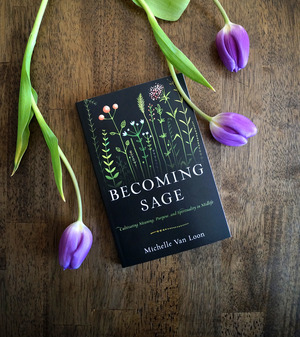
Becoming Sage uses the lens of midlife transition to describe the process of change and growth in our lives. We are all experiencing crisis right now, and I’m praying that the words in this book might be of help in a disorienting time.
It is scheduled to release April 7th. It’s available from Amazon in both print and Kindle formats, though I am hearing that some may experience a week or two of delay of delivery of the print book due to the way Amazon is repriotizing some shipments right now.
There are other sources if you’d like to get your copy hot off the press including:
Moody Publishers (40% off if you order before 4/7; free shipping if your order is over $30)
Hearts & Minds Books
Christianbook.com
Barnes & Noble
Target.com
Let’s Zoom!

I’d love to facilitate a series of book discussion from Becoming Sage starting the last week in April. More and more of us are using technology to meet up during this era of social distancing and shelter-in-place mandates. It’s not the same as being together in person, but it does allow people to be present with one another in new ways. Though I’ve long used Zoom for meetings and when I’ve been a guest on some podcasts, I’m currently co-leading a Bible study at our church using this online tool, and it’s been a life-giver as it helps our group stay connected.
If you’re interested in a 4-6 week book discussion, click here to email me. I’ll reach out to those who email me to see if we can find a mutually-agreeable time that will work for all.
Praying you and yours stay well.
With great gratitude to God for you,
Michelle Van Loon
To contact me about speaking at your church or ministry event, click here. It would be my privilege to serve your group. I can Zoom, Skype, FaceTime or use two empty toilet paper rolls strung together if you like.
Have you visited The Perennial Gen, a website for midlife women and men I co-founded with Amanda Cleary Eastep? The site has lots of encouraging posts on a wide variety of relevant topics by many thoughtful writers. Stop by and say hey!
Some have asked about the Wonder Years Gathering, an event for midlife women that took place in Mt. Hermon, CA in February. It was remarkable in every way. We are prayerfully looking ahead to see how and when we might continue this ministry.
Finally, a big shout-out to Andrea Miyares of Iconic Design. Once upon a time (about 20 years ago), Andrea was one of my writing students. She is now a designer who helped refresh my michellevanloon.com website. I am grateful for her patience and resourcefulness.
March 11, 2020
Social distancing with Jesus
He was weary of watching the world from afar.
He’d never made peace with the fact that he had no choice but to be an observer, not since that first snow-white patch appeared on his foot. He obediently presented himself to a priest for examination, never really imagining the verdict that would be pronounced over him: unclean. Leper.
His status in the world changed instantly. No longer was he part of the community. No longer was he free to worship as he’d always learned, in community. He was untouchable, as unwelcome as a roasted pig at a holiday meal. Or any meal.
Shock faded to anger, then shame, then at last resignation as the disease spread slowly and steadily across his extremities, his rotting flesh emitting a stench that was the opposite of the intoxicating, rich scent of the sacrifices ascending from the Temple – a Temple where his diseased body was no longer permitted to present itself before a holy, unblemished God.
What had he done to deserve this life? Was he paying the price for his parents’ sin, or his own? God didn’t answer his questions any more readily than he’d answered the questions of Job. He survived as a beggar in his small village in the Galilee, the recipient of the charity of others – others, he thought ruefully on more than one occasion – who were whole, thus free to go to the Temple in Jerusalem to worship God.
When he heard that a Rabbi with a healing gift was coming to his village, the man dragged his broken body to a place where he’d be sure to cross paths with Jesus son of Joseph the carpenter. When Jesus came near, the leper crawled like an infant to Jesus, the humiliation of his decaying limbs on full display.
The leper had survived for years by begging. And he begged Jesus, declaring with certainty that Jesus could make his body not only whole, but pure. “If you are willing, Jesus….”
Jesus touched the untouchable, the ritually-unclean, the outcast man and said, “I am willing”, then spoke in the imperative: “Be clean!”
In one blink of the eye, the man’s body was made whole.
Jesus sent him immediately to the Temple, to fulfill the ritual laws regarding cleansing, and warned him not to blab about his experience to the world. Jesus well knew desperate people would be flocking to see him for what he might do for them, rather than hearing his whole message.
The overjoyed man couldn’t keep silent. Though bad news has a reputation for traveling fast, so, it seems, does good news. (See Matthew 8:1-4, Mark 1:40-45, Luke 5:12-15)
*******
Bad news is all around us. This morning, the World Health Organization declared COVID-19 a pandemic. No one can predict how this will affect and reshape our world. Travel is down. Schools are closing. Employees are being urged to work from home. Public gatherings are being curtailed or cancelled. “Social distancing” has entered our common lexicon. And there is no end in sight – no promise of a return to “normal” anytime soon or maybe ever – as this silent virus leaps from person to person, unfettered by human-drawn boundaries.
Yes, I am concerned. I’m in a high-risk category because of my age and primary immune deficiency. Some of the protocols I try to observe as a result (hand sanitizer, care to avoid crowd) are now standard operating procedure. We can sing “Happy Birthday To You” twice as we scrub our hands with soap, but the invisible menace still seems to lurk in every touch and cough around us.
We are all being urged to keep our distance from one another, and some of us (with more to come) are being told to self-quarantine. And it is here, in these days when we’re all living a bit of the untouchable’s experience, I’ve found comfort in Jesus’s response to a man who was required to isolate from his community.
Jesus did not keep his distance from this man. He touched him. He healed him. He restored him to community. It began, though, by Jesus first drawing near to this diseased, disfigured man, his loving hands extended in scandalous willingness.
It is an image I want to hold onto in the coming weeks – for myself, and for each one of you reading these words.
January 7, 2020
What remains after the whirlwind of revival?
Twenty years ago, a friend invited me to attend a worship event at a church that had been experiencing revival. The church was once a standard-issue Bible church that held the position that the sign gifts of the Holy Spirit, such as healing, prophecy, deliverances, and tongues, had ceased with the death of the final disciple named in the New Testament. Then those things started happening in the church in around 1999 or so. There was crisis and controversy as some long-time members left, but the church’s numbers exploded with weary seekers like our family.
We’d been looking for over a year for a new church home after our last church imploded. This congregation seemed to have what we thought we longed for in a church: passionate spiritual community, a hunger for the things of God, and a pastor who’d been willing to thoughtfully, systematically reexamine the cessationist theology he’d learned in seminary. We’d been in Charismatic churches before, and it seemed those congregations valued signs, wonders, and goosebump-inducing experiences over thoughtful and faithful Bible study. We were hopeful that this church would be different.
The early days were a little like stepping into a whirlwind. Some of that wind was the activity of the Holy Spirit. And some of it was toxins stirred up like trash in a tornado. We ended up staying at the church for four years until we moved from the area. I served for two years on staff. My husband was an elder. My kids, teens at the time, witnessed some beautiful moments of grace during those years. But sadly most of it was buried underneath the debris of an environment filled with much emotional and spiritual excess that left each one of them with some serious wounds. I continue to grieve that deeply.
It may be more accurate to call what happened at the church a renewal and theological redirection instead of a true revival. Though most of the staff from those days, including the pastor, are no longer at the church, the church is now firmly entrenched in the Charismatic world – taking its theological and praxis cues from the New Apostolic Reformation crew, Bethel Church, the International House of Prayer, and a variety of traveling Charismatic circuit preachers.
Though I am still connected with a few of the people from the church during the years we were there thanks to the signs and wonders of Facebook, I don’t know any of them well enough today to ask them what their reflections are of those days. (If any of you from that Milwaukee-area church happen to be reading this, I’d love to hear your thoughts on how those heady days two decades ago affected your life.)
Here are seven lessons I learned from worshipping in the whirlwind:
(1) Displays of spiritual power tended to trump sound theology. Those who questioned were too often silenced with the equivalent of a “Get thee behind me, Satan!”
Lesson: This attitude shut down spiritual formation and created a culture of spiritual immaturity.
(2) Instant, dramatic results were valued above perseverance and faithfulness. Transformation was exalted, discipleship minimized.
Lesson: Even those who’d experienced a dramatic result could not sustain a spiritual life from that transformational moment. Fireworks dissipate. Candles have the fuel to burn for a long, long time. The fire of revival/renewal should be lighting candles, not setting off fireworks.
(3) Prosperity preaching, in the form of naming Scripture’s promises and claiming/demanding results from God over everything from problems to desires, didn’t leave any room for mystery, waiting, or a flat-out “no” from God because the notion of delighting in God and being given the desires of one’s heart (Ps. 37:4) seemed to reduce prayer into a transaction between equal parties.
Lesson: This grave error malforms our understanding of who God is and who we are. There’s much more to say about this one, but for the purposes of this summary, let’s just say that this grave error is not limited to the Charismatic streams of the Church, but is everywhere in American Christian culture and it is a SERIOUS PROBLEM. It is leading people astray.
(4) Concurrent to prosperity preaching, a heightened focus on spiritual warfare tended to communicate to people in the pews that God and Satan were fairly well-matched combatants in a cosmic battle, and we are pawns of one side or the other.
Lesson: Yes, spiritual warfare exists. But the focus, underlying practices, and unexpressed fear of losing conditioned the congregation to see the world in terms of us versus them. It was a logical next step to apply the hubris of this thinking to American politics, and to look for a champion who could protect them and guarantee them a “win”, rationalizing away the leader’s blatant immorality in the process.
(5) Though the pastor was seminary educated, there was a huge disdain for the life of the mind. The mind was viewed as being in opposition to the life of the Spirit.
Lesson: This is the old heresy of gnosticism, repackaged for a modern audience. Jesus called us to love God heart, soul, mind, and strength, and to love our neighbors as ourselves. He never, ever elevated one over the others. Nor should we.
(6) Things happen fast and with greater intensity in a whirlwind.
Lesson: As a result of this speed and intensity, it is easy to fall into the temptation to be reactive, not responsive to events as they unfold. A culture of reaction sets up innocent people up to get hurt – and they did. As my husband and I learned when we challenged some of the reactive practices that emerged in the church, whistleblowers (and their children) get hurt, too.
(7) When God moves, a mess often ensues as he upends the status quo.
Lesson: The status quo can be an idol, and it needs to be toppled. We can do this whether the wind is blowing or whether the weathervane is still every time we choose humility and repentance on the daily.
If you’ve been in a church experiencing renewal, or been a part of a revival movement, what would you add to this list?
Cover image by Jonny Lindner from Pixabay
November 7, 2019
Not OK Boomer
Boomers grew up hearing we shouldn’t trust anyone over 30. We were the generational revolutionaries living in the Age of Aquarius. We were gonna speak truth to power, fight The Man, and change the world.
That revolution ushered in change both positive (an end to the Vietnam War, incremental progress in the area of civil and women’s rights, the Jesus Movement) and negative (the shift in sexual mores, the roots of today’s incredible social and political polarization). And in the end, our self-focused generation morphed us from revolutionaries to consumers. We became known as the Me Generation, and the revolution was rebranded by the words of the fictional character Gordon Gecko in the 1987 film Wall Street: “Greed, for lack of a better word, is good.” Frankly, I don’t think greed was a 1980’s aberration to the purity of the 1960’s-70’s revolution, but the fruit that grew from the seed of post-war prosperity in our country. So much of that prosperity was poured into Boomers that our often-entitled, pampered generation expected we had it coming to us.
And all the generations that have come in our wake – Gen Xers, the Millennials, and now Gen Z – have had to deal with the culture created by Boomers. I don’t think Boomers as a group recognize what that is like. I think many of us still see our cultural identity as revolutionaries fighting The Man. On the other hand, our children and grandchildren recognize us as The Man.

The New York Times and a number of other media outlets have reported on the clapback that has become a Gen Z shorthand for frustration with Baby Boomers. A recent New York Times piece discusses the OK Boomer phenomenon. In the piece, researcher Josh Citarella explains the financial roots of the frustration with those they believe are responsible: “Essentials are more expensive than ever before, we pay 50 percent of our income to rent, no one has health insurance…Previous generations have left Generation Z with the short end of the stick. You see this on both the left, right, up down and sideways.”
It is not just economic issues fueling the anger. It is the perception that Boomers are unresponsive to the social concerns of younger people. (In other words, the exact things that torqued off us Boomers when we were chanting “Make love, not war” in the late 1960’s.) Another Gen Z source in the article, Jonathan Williams, describes how he views Boomers: “You don’t like change, you don’t understand new things especially related to technology, you don’t understand equality…Being a boomer is just having that attitude, it can apply to whoever is bitter toward change.”
I have talked to some in my generation who appear tone deaf to the concerns of the next generations. The reasons include frustration with not yet getting what they believe life or our economy owes them, a nostalgic view of their own “good ol’ days”, anger or concern about cultural change, and the general narcissism embedded in our shared experience as Boomers. Some are quick to dismiss discussions of social, political, or spiritual issues as settled and non-negotiable, thus shutting off any possibility of listening, learning, or growing. The temptation we Boomers face at this point in our lives is believing that our youthful radical mindset and catalog of life experience will keep us not only relevant, but make us automatically wise. Instead, a significant number of those younger than us view us as fools, brushing us off with a shrug: OK Boomer.
Four or so centuries before the birth of Jesus, the prophet Malachi said, “Remember the law of my servant Moses, the decrees and laws I gave him at Horeb for all Israel. See, I will send the prophet Elijah to you before that great and dreadful day of the Lord comes. He will turn the hearts of the parents to their children, and the hearts of the children to their parents; or else I will come and strike the land with total destruction.” (4:4-6). This prophetic passage points to Messiah’s advent. But it also calls us who bear his name to remember not our own good ol’ days, but God’s ways. When we do, he will turn us toward the next generations in a substantive manner. It’s not about us, and it never has been. Real relevance and wisdom starts here.
OK?
October 21, 2019
Your Husband May Not Be a Preacher – But Are You a “Preacher’s Wife”?
After I got engaged in 1979, I went to the Christian bookstore in search of marriage preparation advice, and had a visceral reaction to all of the books written by women with giant teased blonde hair telling me in very specific terms how to be a sweet Christian wife. As I recall, most of the advice had to do with treating my husband as though he was my king by Biblically submitting to him in everything, and then there was the Marabel Morgan bit about greeting him at the door with Saran Wrap around my naked body to keep things spicy. I decided before I dove into any of their advice, I would first use a concordance to look up every instance of the word “wife” in Scripture, and see what the Holy Spirit might have to say on the subject.
Thankfully, my husband didn’t want to marry a woman who adorned herself with Biblical Saran Wrap.
After the wedding, I quickly discovered that the Evangelical Christian culture where we spent the next 40 years didn’t place much value on my Yentl-like approach to theological study. I desperately wanted to fit in to my new spiritual family, and looked to older women to show me the way. From them, I learned that Proverbs 31 was a checklist I could use to order my life. I didn’t need to ask questions about calling, because my calling was supposed to be wife and mother. They taught me that Bible study for women wasn’t meant to be theologically rigorous, but keep things inspirational and motivational. I learned that if I performed my faith properly, it would transform me into a soft, gentle, girly-girl.
No one ever talked about ambition and power. In her new book, historian Kate Bowler’s The Preacher’s Wife: The Precarious Power of Evangelical Women Celebrities describes in great detail how those who had it (platform speakers, writers, musicians, heads of women’s ministry) either married it or possessed a platform-worthy skill set that usually included some winning combination of musical ability, a dramatic life story, and physical attractiveness. Early on, I received the messaging that I was too opinionated, read too many books, wasn’t pretty enough, and wasn’t very good at coloring in the lines that defined the Ideal Christian Woman. Since I didn’t have the recipe to make the secret sauce, it was my job to be a good audience member for those blessed few who were recognized as leaders of other women.
Because we didn’t admit these things were happening, some women with leadership aspirations would either imitate the ministry style of someone whose role she coveted, her performance turning her into a harsh, brittle shell of who she really was, or (in Charismatic congregations) tell the rest of us God had anointed her for the role. We all knew better than to question that declaration. No woman in the conservative Evangelical or Charismatic circles I traveled was permitted to preach a mixed crowd of men and women, though in some congregations, occasionally women were invited to “share”. And it simply wasn’t deemed seemly for a woman to have ministry desires beyond being an excellent wife and mother per Titus 2:3-5.
Though I am in a different place today – more confident of my voice, more clear about the gifts God has given me to share with others, more aware of those toxic unwritten rules that shaped my understanding of what it is to be a woman in the church – I have been formed and sometimes broken by those rules throughout the 45 years I’ve been a follower of Jesus. Even when I’ve been in positions of leadership, I remained painfully aware that I needed to try really hard to follow those unwritten rules, and that I wasn’t ever going to be very good at doing so.
 I realized when reading Bowler’s book that I still have more work to do to process the effects of years of unhelpful messaging. The bulk of the book covers the movements and personalities from the 1970’s through today, mapping my own years in the church. I recognized almost every single woman named in the book from Kathryn Kuhlman to Kay Arthur to Jen Hatmaker. Bowler’s book documents the way in which women have navigated ambition and handled power in the church, with a particular emphasis on conservative Evangelical and Charismatic/Pentecostal streams.
I found myself feeling deeply sad and oddly exposed by the narrative in this exceptional book. The messaging I heard through the years about being a gentle, quiet woman didn’t match the paths alpha women took to the top. Though I am hardly a household name, I recognize that because I write and do some speaking, I could now be classified as having made the jump from audience member to “platform” person. However, because I’ve been writing for publication mostly in anonymity since I was in my 20’s, and because I’m now older and living with a chronic illness, platform and popularity aren’t the same kind of lures that they once might have been in my life – not to say that I don’t have occasional flashes of envy for those whose books sell better than mine do.
But as I read Preacher’s Wife, I realized afresh that female Christian celebrity hasn’t always been born of virtue but from the same sorts of things that fill the pages of People magazine: connections, looks, talent, or a dramatic story. Bowler does a good job detailing why this is. As ambitious Evangelical women haven’t had a clear ladder to climb, those with leadership desires have had to figure out how to vault themselves onto the rungs in American Christian-acceptable ways. Her analysis may have been hard to read, but it was also filled with healing moments as some of the trends and people that shaped my experience were placed in a broader context. These things didn’t happen in a spiritual or social vacuum.
These last few years have been marked by an avalanche of #metoo #churchtoo horror stories about predominately male church leaders who’ve abused their position and/or traded it for a bowl of political pottage. As a result, I’ve heard some discussion about the need to do some serious theological and practical work around the subject of power. We are long overdue for this kind of reckoning and redirection. But the discussion will be incomplete if we focus only on male leaders. Bowler’s excellent, thoroughly-researched and readable book needs to be a part of this discussion. And it belongs in the hands of every female ministry leader willing to consider how her ambitions and her use of power have shaped her journey and affected all those in her orbit.
In your relationships with one another, have the same mindset as Christ Jesus: Who, being in very nature God, did not consider equality with God something to be used to his own advantage; rather, he made himself nothing by taking the very nature of a servant, being made in human likeness. And being found in appearance as a man, he humbled himself by becoming obedient to death—even death on a cross! (Phil. 2:5-8)
Cover image by StockSnap from Pixabay
October 6, 2019
Stranger In A Strange Land: Church Search, Part 137
We’ve been here in Sarasota for three and a half months, and not too long ago, someone asked me how the church search was going.
“It feels like we’ve been looking for a church for the last four decades,” I answered. Maybe because we have.
Between moves and various unhealthy situations that often served as an unwelcome catalyst to begin searching for a new congregation, Bill and I have done way more than our share of church searching. I understand why those who’ve been burned or burned out by the church head for the exits, rarely or never to return. Despite all the garbage we’ve experienced, I still trust that connection with other believers is essential to learning the way of Jesus, though we are unlikely to ever go through a formal membership process again.
I’ve visited (and Bill, who has made a few visits with me when he’s here*) several congregations including an artsy start-up non-denominational, a troubled Messianic fellowship, a small Episcopal congregation that functioned as a family church, and a large, very traditional conservative Episcopal (Anglo-Catholic) church smack-dab in the middle of town. We’re also currently attending a Community Bible Study that draws from Baptist, Nazarene, and various non-denominational congregations in the area, giving us a way to meet believers from a variety of local bodies.
So after ruling out the sermon-centric non-denominational churches in the area (we’re weary of all that talking), we find ourselves back in the Anglican stream. We’re attending the large, very conservative Episcopal/Anglo-Catholic congregation in downtown Sarasota. Though we’ve been in many different kinds of worship settings over the years, including an Anglican congregation that used formal liturgy, we’ve never attended a church where (a) they use a pipe organ instead of a piano, guitar, or band (b) they have a gowned and very well-trained choir performing sacred classical music (c) the prayers and responses are mostly, but not entirely, canted (sung) and (d) the congregation wears suits and dresses to worship services.
I love and miss Jewish liturgy, but traditional Anglican liturgy echoes some familiar Jewish worship themes and styles – understandable, as distinctly Christian liturgy emerged out of the Jewish soil of Jesus and the early church. I’ll probably never like organ music, though in this setting and performed by someone who knows what he’s doing, at least I don’t feel like I’m at a depressing 1950’s-era roller rink. It is weird to be in a place where people get DRESSED for church, and it did freak me out at first to be the most underdressed woman in the place. I wear long shorts or capris (with an occasional casual skirt, just to mix it up), and a dressy tee. I don’t have the wardrobe, funds, or the inclination to join the fashion parade. The homilies during the service have been refreshingly Jesus-centered and less than 15 minutes in length. You can’t beat a liturgical service for the amount of Scripture read/proclaimed as part of worship.
But the real moment for me in these services is walking forward each week during communion, holding my hands open like a beggar, and having a pastor or deacon place in my extended palms the body of Christ, broken for me, and then another pastor or deacon taking that unleavened wafer from my hands, dipping it into the cup of wine, blood shed for me, and then placing it in my opened mouth. It is an enactment of the reality that Jesus has done for me what I can not do for myself. This is not “worm theology“. It is good news. In that moment, the organ music, the pomp and ritual, and the suits and dresses don’t matter at all. Every single one of us comes to Jesus as beggars, and he loves us just as we are.
I do feel like a stranger in a strange land, but it’s not a bad place to be. Bill and I aren’t alone there. God is with us.
If you’ve been in a church that doesn’t use formal liturgy, and then moved to a church that does, what surprised you most about the switch?
* Note: Bill is still commuting back and forth to Chicago for work. His current contract ends in December. His other full-time job is looking for his next job. Please pray for him as he searches for a job that will bring in some income, use his skills, and allow him to live here full-time.
August 15, 2019
At the end of the spiritual tether
A couple of high-profile people in the Evangelical ecosphere have recently released statements explaining that their faith is changing and they no longer identify as Christians. These announcements from author-turned-pastor-turned-seminary-student Josh Harris and pop worship songwriter Marty Sampson have provoked plenty of discussion in the circles in which I travel. Their stories echo ones we’ve been hearing for the last couple of decades in the world of leavers and #exvangelicals.
While a few Christians have engaged in blame-shifting and judge-y name-calling of those who’ve declared their independence from the Church and/or Jesus, I think most of us are feeling the same sorrows over the current spiritual condition of the Church in this country. Emotionally-toxic or foolish, immature leaders, #churchtoo sexual abuse and subsequent cover-ups, the unholy alliance between politics and religion (particularly between the Republican party and those who identify as conservative Christians), addictive habits of culture warring, and the sense that there is no place for those plagued by doubt or confusion have left many of us trying to navigate a very complicated spiritual landscape.
I feel as though I’ve been living adjacent to the community of leavers for a long, long time. By 2004, I’d survived a couple of decades of young adult faith formation that included spiritual abuse, an excruciating church split in the place that seemed to promise healing, and the emotional mess and excess (with a side of epic nepotism) of a once-moribund congregation experiencing spiritual renewal. At the same time, I was experiencing midlife crisis and many significant challenges in my family life.
It was the peak of what was then called the Emerging Church Movement, and I devoured books by authors who articulated my concerns about the Church and captured some of the questions I was asking about God. It was comforting at first to find out I wasn’t alone. Writers back then had plenty of empathy for people like me who’d been hurt by the Church, but seemed woefully short on solutions, relying instead on theory about how to move forward in the faith instead of showcasing time-tried practice. In other words, it felt as though most of them were experimenting on the rest of us.
That said, there was no doubt I was in spiritual motion, propelled from the congregations and practices that had shaped my early experience of faith. And as Newton’s First Law reminds us, an object in motion will remain in motion until it meets something more powerful than itself to stop or redirect it.
When I reflect on what was happening in my soul fifteen years ago, I now recognize that I was in a period that was at once a “dark night of the soul” and a time of faith transition. And I recognize that we in the Church don’t really know how to make space for this process of change and growth. We hasten to call it “falling away from the faith”, or apostasy – and yes, in some cases, it is. We’re seeing it in spades.
But in other cases, we would do well in the Church to recognize that sometimes, this trajectory away from certainty about every single jot and tittle is not decline, but may be a mark of spiritual growth. One small example: I learned from the fundamentalist folk with whom I hung around in my early years of faith that drinking alcohol was a sin.* Period. Full stop. I never had to think about the issue because my leaders did my thinking for me. Eventually, as I grew, I started to consider for myself the question of whether a margarita was Wrong. I came to the conclusion that enjoying an occasional adult beverage with friends was not a sin, but that loving God meant I always needed to prioritize and respect the convictions and temptations of others.
We must recognize that growth may look like the fire of young love for Jesus has been drowned in malaise and compromise. (Throw an extra lime wedge in my margarita.) But we’d do well to ask the Holy Spirit to help us discern the difference between apostasy and a dark night of the soul. Hint: at first glance, they may not look all that different from one another.
Please note that I am not talking here about the kind of total deconstruction that results in adopting another faith altogether, such as atheism or Buddhism, but of the kind of growth that looks like what Paul described in 1 Corinthians 13:11: “When I was a child, I talked like a child, I thought like a child, I reasoned like a child. When I became a man, I put the ways of childhood behind me.” My core convictions – captured well in the Apostles’ and Nicene creeds – held me during several dark, confusing years, even when it felt like the tether had been cut to my youthful faith expression. Even if I wanted to, I couldn’t go back to that kind of margarita-free simplicity or I would have lost the wisdom God was teaching me through those difficult early experiences in the Church. He was calling me to grow up.
I learned 15 years ago that many church leaders don’t put much thought into what the growth process looks like, or the implications it may have on their congregation or ministry. (As I have before, I commend to you this chart as a helpful introduction to recognizing that faith will look different as it – and we – grow.)
Too many have made faith into a zero-sum game: you’re either all in with us, or you’re not. I understand that congregations and denominations must define themselves by what they believe and how they practice their faith. But at least for some of those who’ve come to the end of their tether, it might be helpful to recognize that some aren’t quitting the faith but may in fact be maturing. If the faith communities around them can learn to recognize that some are leaving behind non-essentials that have once served as spiritual training wheels, then those who are telling us they’re deconstructing their faith may find that the tether that holds them to the God who loves them is longer and stronger than they might have imagined.
* You guys, this post is not about drinking; it is about outgrowing the sometimes-rigid expressions of faith we learn as young believers and instead growing into greater faithfulness to both Jesus and his Bride. If you’re fuzzy on what I’m trying to say, please leave me a comment or send me a note here.
Cover photo by Will O on Unsplash
August 14, 2019
Uprooted
In varying degrees, we humans live as moving targets, trying to escape the existential grief of separation from God and others. This reality is at the heart of our wandering. Even if we have a relatively healthy family story, we all still experience the painful disconnect that comes from our uprootedness, our exile from Eden.
One of the big questions of life is “Who am I?” We may use physical, cultural, economic, or ethical responses to answer this question. While those externals can provide helpful clues to the question of who we are, they are not reliable reflectors of truth.
We are more than just the sum of our own life experiences. We also carry within us the exile history of our forebears.
I am a Jewish follower of Jesus. My people, the Jews, have been wanderers for a very long time. We’ve lived far from home throughout most of our history, dispersed among the nations of the world yet preserved as a people.
We’ve faced the Inquisition, waves of persecution, expulsion en masse from various countries, the pogroms in Russia, and the Holocaust.
To live as a member of a diaspora community means you are a part of a people group scattered from their ancient homeland. My people have been imprinted – perhaps all the way down to the cellular level – by generations of terror and trauma, by our diaspora experience. [Read more at Elisa Morgan’s blog]


