
Michelle Van Loon's Blog, page 3
November 21, 2020
Reflections on The Cost of Discipleship – Chapter 2
Something tells me Dietrich Bonhoeffer wouldn’t have been a fan of the Four Spiritual Laws tract.
More than 2.5 billion of these tracts have been printed and disseminated over the last few decades. The little booklet sketches four core talking points about the person and work of Jesus (God loves you and has a wonderful plan for your life, humans are sinful and separated from God, Jesus is God’s provision for your sin, and we must individually receive Jesus as Savior and Lord – only then can we know God’s wonderful plan for our lives.) and offers a short prayer of commitment for those who can affirm those truths. The tract was meant to be a conversation starter, and it and others like it have launched many people including my own husband into a new life of faith.
But it offers an incomplete sketch of what this new life will require of us. I’m blogging through Dietrich Bonhoeffer’s The Cost of Discipleship. Originally published in 1937, Bonhoeffer’s unflinching words stand in contrast against the backdrop of the stranglehold of fascism in his beloved Germany. And, I’m rediscovering as I read, they are an equally-jarring contrast to our own political and religious landscape.
You can only learn what obedience is by obeying. It is no use asking questions; for it is only through obedience that you come to learn the truth.
In Chapter 2, Lutheran pastor Bonhoeffer addresses the soul-killing effects of the “all grace, all the time” messaging of too many of his fellow Lutherans. Four hundred years of living off of Luther’s revelation of salvation by grace had left the German church spiritually lopsided. “The call goes forth and is at once followed by the response of obedience,” Bonhoeffer writes. “The response of the disciples is an act of obedience, not a confession of faith in Jesus.” To contextualize it for our culture, affirming a set of propositions about Jesus is not what discipleship is about, contrary to the Moral Therapeutic Deism and prosperity messaging that has saturated too many of our churches in the last few decades.
Obedience is an unflinching word, Bonhoeffer reminds us. Those who would divorce faith from obedience end up sending their followers down one of two wrong paths – and ironically, both of those divergent paths end up at the very same destination:
‘Only those who believe obey’ is what we say to that part of a believer’s soul which obeys, and ‘only those who obey believe’ is what we say to that part of the soul of the obedient which believes. If the first half of the proposition stands alone, the believer is exposed to the danger of cheap grace, which is another word for damnation. If the second half stands alone, the believer is exposed to the danger of salvation through works, which is also another word for damnation.
He then underscores his point by looking at Jesus’ interaction with a wealthy young man, found in Matthew 19:16-22. The young man was looking for loopholes. Bonhoeffer of this man, “He neglects the unmistakable command of God for the very interesting, but purely human concerns of his own moral difficulties.” Jesus tells him that there is no loophole. Following Jesus means we can no longer choose our own Religious Adventure, deciding for ourselves what is good and what is evil based on our circumstances, feelings, or schedule. Following Jesus isn’t what we do when we don’t have anything better to do. Nor does it come with a safety net (like a big bank account). Jesus “bids him embrace voluntary poverty…(this) springs from Jesus’ love for the young man, and it represents the only link between the old life and the new.” Jesus was calling him into full, unfiltered relationship; the money was this man’s master. There can be no other gods in a life of obedience.
Bonhoeffer then ends the chapter by noting that this exchange was paralleled by Jesus’s exchange with a lawyer looking for a loophole in the definition of a neighbor in Luke 10:25-29:
The final question “Who is my neighbor?” is the parting shot of despair (or else of self-confidence); the lawyer is trying to justify his disobedience. The answer is: “You are the neighbor. Go along and try to be obedient by loving others. Neighborliness is not a quality in other people, it is simply their claim on ourselves. Every moment and every situation challenges us to action and to obedience.
Even if your experience of Jesus is based on the equivalent agreeing with a few words in a tract, Bonhoeffer would urge you to know God by learning what obedience to him looks like, and then to watch your faith deepen and flower into a full, costly, beautiful life of discipleship.
Reflect: Have you been in church circles where faith (via mental assent to a set or propositions about God) was emphasized over obedience? Conversely, has action been emphasized to the detriment of relationship with your Savior?
Prayer: Lord, you call me to faithandobedience, a single word, an unbroken response to you. I want to love you with faith leading to obedience, and obedience leading to faith. I receive your love in faith, and release it to the world around me in obedience. I pray these things in the name of the One who is calling me to follow him in these things. Amen.


November 15, 2020
Reflections on The Cost of Discipleship – Chapter 1
Self-help pep talks instead of sermons in church.
Spiritual leaders intoxicated by access to power.
Marrying nationalism with an edited form of Christianity.
This was the world in which dissident German Lutheran pastor Dietrich Bonhoeffer lived during the 1930’s and 40’s. He was among those who broke away from the deeply compromised national Lutheran Church to form the underground Confessing Church during Adolph Hitler’s reign. He was accused of being part of a plot to assassinate Hitler, arrested, sent to prison and then a concentration camp before being hanged just days before the camp’s liberation by Allied soldiers. I believe he was a modern martyr.
I think Bonhoeffer would be pretty horrified to see how a couple of high profile American conservative media voices who are aligned with “Christian” nationalism have used his story to insist they, too, are being persecuted for their faith. Frankly, my years of reading accounts of actual martyrs throughout Church history do not in any way support their victim-y claims.
Bonhoeffer’s writing and example offer a powerful rebuttal to notions of self-help, intoxication with power, and syncretization of Christianity and nationalism. I’m hoping to blog through his classic The Cost of Discipleship in the coming weeks. Maybe you read it once upon a time. Maybe you never have. I’d love to have you join me as I read and respond to Bonhoeffer’s salty, life-giving words.
Chapter 1: Costly Grace
“Cheap grace is the deadly enemy of our Church. We are fighting to-day for costly grace.”
This is Bonhoeffer’s first sentence, his thesis, and his mission. And though the target of his words might have been a deeply compromised state-sponsored “church”, he is talking to us in 2020 America, too. We pursue blessings instead of Jesus. We treat the Church like a fan club gathering or a museum to cherished traditions instead of a people who are astonished and humbled by what God did for us: “…it is grace because God did not reckon his Son too dear a price to pay for our live, but delivered him up for us.”
He then delves into a bit of church history, noting the the monastic movement preserved the notion of discipleship as a gift to the Church, but portrayed it as “the individual achievement of a select few” instead of the norm for a life of faith. He celebrates what Luther brought to the Church in reminding us that discipleship is meant for all, and is both corporate and individual in nature. As a Jewish follower of Jesus, Luther brings me both helpful theological insight and incredible sorrow and anger of the toxin of anti-Semitism he propagated. In the case of Bonhoeffer’s words in this chapter, I can agree that Luther restored to the Church the truth the first followers of Jesus knew – discipleship is inexorably linked to grace.
Bonhoeffer takes mainstream German Lutherans to task for “leaving the following of Christ to legalists, Calvinists, and enthusiasts…we justified the world, and condemned as heretics those who tried to follow Christ.” He states that pristine orthodox doctrine in the mainstream German Lutheran Church has not resulted in people who are living as if Jesus is Lord. It’s not really pristine, then, he contends, if it cheapens the grace that Jesus died to offer us, and costs us nothing but lip service in return.
Reflect: Have you been at a church where believing in the right information about Jesus or doing the right rituals or activities, disconnected from following him, was emphasized? If so, what was the effect in your life?
Prayer: Jesus, thank you for your poured-out life, given for me, given to me. I recognize that I have disconnected areas of my life from you. I name those areas now, and recognize that in the confessing of these things, your grace is calling me to follow you fully. I can not live this surrendered life in my own strength, but because of who you are and are renewing me to become.
Cover photo by Gil Ribeiro on Unsplash
October 12, 2020
Review: A Church Called Tov
Church culture matters. As we live in our culture and also into our culture, our culture begins to live in and into us. A good culture will shape us toward goodness; a toxic culture will shape us toward evil. Yes, we can resist and change the culture of a church, but resisting, at times, is like trying to slow down a hurricane.
–Scot McKnight and Laura Barringer, A Church Called Tov: Forming A Goodness Culture That Resists Abuses of Power and Promotes Healing
I’ve stood directly in the path of not one, but two Cat 5 spiritual hurricanes in my life, and the fury of the storms has nearly destroyed me. I’ve been in a number of other storms (too many) that have done significant damage to the lives of everyone in their path, and alongside too many others who’ve experienced collateral damage from the flying debris.
Dr. Scot McKnight and his daughter Laura Barringer stood in a hurricane as the abuse of power and sexual sins of alpha leader Bill Hybels, the founder of influential megachurch Willow Creek Community Church, were brought to light in early 2018. McKnight had attended the church for many years and maintained many relationships there after he’d moved on to another congregation. Barringer was involved in the church for more than 20 years. Scot’s series of posts about the issues at his popular Jesus Creed blog offered important analysis as the story first unfolded. One key discussion point in not only the Willow story, but the story of neighboring megachurch Harvest Bible Chapel (and too many other unhealthy smaller congregations that don’t merit a headline) is the way in which noxious church cultures form and persist around unhealthy leaders.
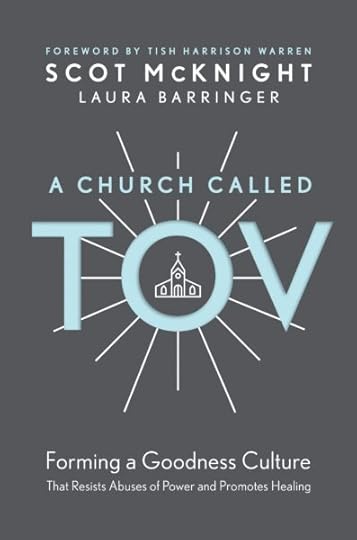
A Church Called Tov addresses the way in which church cultures of all kinds form members, warning signs of toxic church culture including narcissism and power through fear. Scot and Laura also name the ways toxic church cultures respond to healthy criticism. Their overview summarizes the core factors of toxic communities, but is not designed to be a full exploration of power dynamics, abuse, or cover-up. (There are a number of other books and blogs that have delved into these subjects in greater detail, many of which are referenced in Tov’s endnotes.)
The book’s emphasis isn’t on sketching out the rotten, but instead focuses on what it takes to create a goodness culture in a church – tov, in the book’s title, is the Hebrew word for good. Scot and Laura contend that good churches are not perfect churches, but they are committed to cultivating empathy, grace, people above institution, truth, justice, service, and Christlikeness in and into their unique culture.
…creating a grace-based family of siblings requires trust, the invisible glue that binds people together. Power and fear can undermine trust, but grace creates it. Without trust, there can be no genuine siblingship. To trust someone is to believe in that person in ways that make the world safe. Sadly, in fear-based power cultures, trust breaks down and makes life as siblings nearly impossible. When a collection of siblings called a church has untrusting relationships, the family breaks down into cliques and tribes and interest groups.
I was brought to tears more than once as I read their descriptions of tov culture, in part because my old scars still ache when I read words like these, and in part because I have tasted tov in enough other faith communities to know what Scot and Laura describe is not ivory-tower theory, but submission to the kingdom of God at work shaping and refining church culture.
When I was a student at Northern Seminary, I was privileged to take a New Testament course with Scot in 2014. He invited us to read and comment on the manuscript for his then-forthcoming book on the church, A Fellowship of Differents: Showing the World God’s Design for Life Together. Published in 2016, the book’s thesis was that “The church is God’s world-changing social experiment of bringing unlikes and differents to the table to share life with one another as a new kind of family.” I really enjoyed the book, but found myself wishing for a bit more in one key area. I wrote about that area in my response paper at that time:
The book ends with a note about suffering. “The Christian who endures becomes a more mature Christian because of the endurance. Suffering, in other words, becomes a means to flourish.” I appreciated this conversation and affirm that suffering is spiritually formative. However, I wished for further clarification on this in your text. I have suffered at the hands of other Christians. My need to be a part of a family, for instance, left me vulnerable to the machinations of a spiritually abusive pastor when I was in my twenties. It took me years (and work with a counselor) to recover from the trauma. Because I am a woman with a teaching/writing gift, I have been shamed, gossiped about and marginalized by a few male leaders over the years who used their theology as a club to verbally shove me into a dark, silent corner. Should you decide to revamp this section (of your manuscript), I would welcome an expanded discussion about how to navigate the suffering we in the church may experience with one another. What does fellowship look like when there’s been a split over doctrine? Or an elder has stolen money, or a youth pastor has been sexually abusing middle school boys?
What I was looking for then was the material found now in A Church Called Tov.
The book is filled with empathy for those who’ve resisted toxic culture, as well as practical guidance for all of us – leader and member alike – who are involved in creating culture in the local church. The book is both diagnostic tool and love letter, and deserves to be discussed honestly and prayed through with unflinching humility by every kind of congregation: aging denominational churches, megachurches, and church plants.
October 7, 2020
Making Change: Navigating Life’s Challenging Transitions
When unexpected challenges upend the good plans we’ve made for our lives, how can we begin to respond in faith? This five-day devotional offers a thoughtful, compassionate exploration of the subject of how we can take first steps in processing those losses with honesty and courage. Click here to read through this free resource or share it with a friend.
October 1, 2020
Fighting for peace
I don’t remember what the argument was about. It was just one in a string of those “But everyone else is doing it” versus “If everyone else was jumping off the Brooklyn Bridge, would you follow?” skirmishes that often come with parenting young teens. (I also don’t remember actually using the Brooklyn Bridge as a reference in a debate, but I do remember my mom saying it pretty regularly to me when I was a teen. Of course, it’s been a while since I’ve had teens in the house.)
My husband Bill and I were doing a post-mortem. “I’m so tired of the conflict,” I said. He nodded. We both were. We wanted to say ‘yes’ as often as possible, but we also shared the conviction that ‘no’ was one of the tools we had to use at times in order to help prepare our kids for adulthood.
“But sometimes fighting with someone is how you fight for them.” Bill’s words clarified for me how to proceed the next time a potential conflict happened.
Am I trying to “win”? Am I trying to maintain a sense of control over a person or situation? Am I merely seeking what’s best for me?
Or am I fighting for the other person?
It’s an uncomfortable question that has shaped the way in which I’ve approached conflict in relationships. Conflict will happen in our exiled-from-Eden world. I’ve cried out, “Can’t we all get along?” At times, we’ve all chosen delicate truces in order to buy some respite from conflict. Sometimes it works. Other times, it ends up a stalemate, an artificial demilitarized zone guarded on both sides by parties who simply don’t trust one another. A truce can be helpful in terms of de-escalation, but the impermanent nature of it doesn’t create an environment where relationships can flourish. A truce means there’s something to guard, and a careful, scripted way in which to be with the other party. It may allow us to function in some spheres for a time, and it is certainly better than an all-our war, but it is not a great long-term strategy.
No one likes conflict except for arms manufacturers and internet trolls. But avoiding conflict doesn’t lead to peace.
The writer of Hebrews said, “Make every effort to live in peace with everyone and to be holy; without holiness no one will see the Lord.” (12:14 NIV) The translation “make every effort” seems a gentle version of the Greek word dioko, which carries the meaning of an intense pursuit, and is also used in other contexts to communicate harassment or even persecution. There is a correlation between pursuing peace and growth in holiness, probably because pursuing peace will cost us, and it will change us. The apostle Paul’s letters are a master class in dioko, as he disrupted the status quo in the young churches because that status quo included false teaching, unaddressed sin, and entrenched division. Many of us in the church have learned to believe that being nice and having good manners is the same thing as pursuing peace, and as a result, we don’t have much practice at handling conflict well. We’ll accept a truce and call it being in fellowship with one another. When it becomes impossible to maintain that truce, we’ll ghost or we’ll divide.
I’ve learned that pursuing peace doesn’t guarantee it will happen. Both parties have to be willing. There are times when pursuing peace may mean waiting in silent prayer, like the father in the parable of the prodigal son. (Imagine what the run-up to the younger son’s departure might have been like in that household!) Sometimes fighting for a relationship requires a courageous silence, which can mortify the flesh as much as an intense verbal battle might. But other times, pursuing peace demands the courage to violate the terms of the truce with truth spoken in love.
As we head into a period we know will be marked by even more division than we already have in this country, I am contemplating what it looks like to chase shalom like a bloodhound on a fox hunt – whether it is in the comments thread of a Facebook post or in a fractured relationship. I need to learn from others who’ve given their lives to this practice. Though I am one of the presenters at the event below, I am coming to learn from the other presenters and from those who will be joining us that day.
If you’re approaching, at, or beyond midlife and are looking for some practical encouragement about how to pursue peace in our fractured world, why not plan to join us at the Wonder Years Live! 3-hour Zoom event on October 24th? Click here for all the info.

Cover photo by Markus Spiske on Unsplash
September 15, 2020
Plagued by prayerlessness?
We wept. We fasted. We knelt in prayer. We stepped outside of our usual local church schedules and gatherings to join hands with other believers in our city. We gathered in sync with Christians across the nation to intercede for our shattered county.
It appears those days are relics from another time, and it’s not just because of current COVID-19 social distancing restrictions.
In the wake of the September 11, 2001 terror attacks that took the lives of 2,977 people, we saw a groundswell of congregational, regional, and nationwide prayer gatherings in this country. At that time, Bruce Wilkinson wrote these words for Christianity Today:
These are times that strip away the places, routines, and assumptions that had seemed most real to us, and had been most often the measure of our wealth. We’re left feeling impoverished, vulnerable, and perhaps abandoned by God. Feeling, in other words, utterly mortal.
These are times when we turn to prayer. And in that turning I find great hope. My friend Max Lucado wrote recently, ‘This is a different country than it was a week ago. We’re not as self-centered as we were. We’re not as self-reliant as we were. Hands are out. Knees are bent. This is not normal. And I have to ask the question, “Do we want to go back to normal?” Perhaps the best response to this tragedy is to refuse to go back to normal’.
There is no “back to normal” in 2020.
In the face of the ongoing public health crisis, the response of the church to the COVID-19 crisis doesn’t look anything like the unified, prayerful response we witnessed in 2001.
Or for that matter, looking anything like it has during earlier times in our nation’s history when the church across a region or nation has come together to seek God, whether via single-event concerts of prayer or ongoing prayer meetings that preceded or accompanied times of spiritual renewal.
While there have been some large-scale, cross-denominational efforts to call God’s people to prayer around COVID-19 (including this, this, and this), it seems that most of the focus in in the Evangelical world has been on how and when to safely assemble in person, the politics of mask-wearing, disputes and lawsuits around the topic of religious liberty, and how to faithfully care for the vulnerable in a community. Those conversations frequently have been contentious and typically framed in terms of winning a debate – or at least “owning” the opposition – rather than as a call to seek God.
In fact, the closest thing I’ve seen that represents a call to Christian unity during the pandemic has been the sharing of various versions of the Elevation Worship song, The Blessing. Penned by Chris Brown, Cody Carnes, Kari Jobe, and Steven Furtick, dozens of versions of the song have been uploaded to YouTube, often recorded on Zoom by a variety of worship leaders from countries around the world including Singapore, Nigeria, and Uzbekistan, as well as cities or regions in the U.S from Hawaii to Washington D.C.
While these videos have offered solace and encouragement to many during this difficult year, they are not the same as unified, ongoing prayer for comfort for the suffering and grieving, for strength and protection for the front-lines workers, for insight for those working on treatments and vaccines, for provision for those facing financial losses, and most of all, for an end to the pandemic.
Prayer alone will posture the church to learn what God wants us to know about him during this time of testing and empower us to respond to him and the community around us with faith, courage, and creativity. But we are transformed as God’s people only as we allow change to take root in our lives. As a cautionary note, when the flurry of prayer meetings faded in the wake of 9/11, studies revealed there was little lasting change in church or culture. Many of us were looking for comfort in those prayer gatherings, not change. When the shock faded, it was easy to resume our regularly-scheduled patterns of church life.
I don’t believe we’ll be resuming our regularly-scheduled programs any time soon. What is God calling his people to do and to become as a result of this plague? I recognize that the comparisons between prayer activity in September 2001 and today aren’t equivalent, as 9/11 was a single event, and the pandemic in our country is one of many simultaneous ongoing crises happening in our midst including racial unrest, political division, and revelations of immorality from a few high-profile Christian leaders. COVID-19 has intensified the fault lines already existing in this country.
If a majority of a congregation holds the position that reports of the virus are #fakenews or part of a deep state conspiracy, then praying about COVID-19 would seem for them to be an exercise in praying about a dark fairy tale. If a region is not experiencing high infection rates, then there is no sense of right-here, right-now urgency to pray. Who can blame a congregational leader for wanting to sidestep controversy, especially when keeping the doors of a church open is an existential challenge for many congregations this year? However, true leadership always requires spiritual courage in the face of the lure toward self-protection.
Certainly, many local churches are praying about some aspects of the pandemic. But I believe the lack of a unified call to ongoing prayer from Christian leaders may be a reflection of the grip politics has on us all right now. When I informally queried some friends about what their congregations and denominations are doing, one friend noted, “We’ve turned into news reactors versus prayer responders. We take sides instead of coming before God together.” Social media exacerbates these tendencies among us, but it also highlights what isn’t happening as well. I recognize my own temptation to mindlessly, and therefore prayerlessly, amplify bad news on Facebook and Twitter.
I am restrained (somewhat, anyway!) by what I’ve experienced in corporate prayer gatherings through the years. In particular, I saw the importance of regional corporate prayer gatherings during the years I volunteered, then worked part-time for a ministry that brought together church leaders and congregations for prayer, learning, outreach, and service to the community. Praying together with people from dozens of local congregations to adopt the principle behind Jeremiah’s prophetic words to God’s people exiled in Babylon to seek the good of our city brought together people in prayer from congregations ranging from Assemblies of God to members of independent Bible churches. Though the ministry eventually shifted in focus and leadership, those years gathered in prayer bore fruit in relationships that lingered in the region for a long time.
Even if we haven’t been focused on corporate prayer, it is not too late to change course. I celebrate that a number of organizations and denominations that have put together prayer and resource guides in response to the coronavirus including the Southern Baptists, the Presbyterian Church (USA), the Salvation Army, and World Vision. Intervarsity Christian Fellowship shared the prayer below written by Kerry Weber, the executive editor of America magazine. It offers us all a place to begin – and remain – even after the pandemic fades:
Jesus Christ, you traveled through towns and villages “curing every disease and illness.” At your command, the sick were made well. Come to our aid now, in the midst of the global spread of the coronavirus, that we may experience your healing love.
Heal those who are sick with the virus. May they regain their strength and health through quality medical care.
Heal us from our fear, which prevents nations from working together and neighbors from helping one another.
Heal us from our pride, which can make us claim invulnerability to a disease that knows no borders.
Jesus Christ, healer of all, stay by our side in this time of uncertainty and sorrow.
Be with those who have died from the virus. May they be at rest with you in your eternal peace.
Be with the families of those who are sick or have died. As they worry and grieve, defend them from illness and despair. May they know your peace.
Be with the doctors, nurses, researchers and all medical professionals who seek to heal and help those affected and who put themselves at risk in the process. May they know your protection and peace.
Be with the leaders of all nations. Give them the foresight to act with charity and true concern for the well-being of the people they are meant to serve. Give them the wisdom to invest in long-term solutions that will help prepare for or prevent future outbreaks. May they know your peace, as they work together to achieve it on earth.
Whether we are home or abroad, surrounded by many people suffering from this illness or only a few, Jesus Christ, stay with us as we endure and mourn, persist and prepare. In place of our anxiety, give us your peace.
Jesus Christ, heal us.
August 6, 2020
Peeling away the veneer
What’s under the surface?
We had a home inspection before we purchased our 1970’s-vintage mobile home in April, 2019. The inspector told us he saw evidence of a bit of termite damage, but assured us it was par for the course in a sub-tropical climate like Florida. We planned to get an exterminator after we did a bit of renovation, which included installing some new floors. The house was a patchwork of laminate flooring. The first surprise when we peeled back the layers was to discover a couple of other layers of flooring (below).

That would have been little more than an interesting bit of late twentieth-century archaeology if that was the only surprise lurking beneath the cheap veneer flooring. But when we peeled back those layers of flooring, we discovered there was no floor at all along major portions of the east side of our house. The picture below is the day the contractor had torn out not only the floors but the walls to reveal the extent of the damage before they could begin rebuilding.

My regular viewing of HGTV renovation shows could not prepare me for the shock of discovering that I could see the ground through my living room floor thanks to the hearty appetites of the termites who’d used our house as a bed and breakfast. Not only had the home inspector missed the extent of the problem (it wasn’t the only thing he missed!), we realized that if we hadn’t elected to tear up the flooring and replace it with something from this millennium, it is likely we would have fallen through the old floor at some point. After the house was repaired and new flooring installed, we had the house tented and the contents gassed so that we could kill off any termites who hoped to stay.

In the first weeks of the stay-at-home orders, as the shock of the effects of COVID-19 were first becoming known, one thing became evident: this invisible enemy would reveal what was lurking just beneath the veneer of each one of our lives, as well as cultures, systems, institutions, and nations.
We’re still at an early point in this veneer-stripping period, and just beginning to have a good look at what’s under the top layer of our lives. I’m a little surprised at what’s I’m finding just beneath the surface.
I’m discovering there’s fear I didn’t even realize was there, chewing away at my soul.:
Fear of losing a loved one or friend.
Fear of ending up on a ventilator, not being able to breathe, and not being able to call out for help.
Fear of taking another big hit to our finances; we lost a house during the Great Recession a decade ago.
Fear of the effects of poor leadership decisions from government leaders.
Fear of church leaders trying to hold onto the past and not doing the deep work of seeking God for where he’s leading his people now.
Fear of being lonely.
Fear of dying.
I’m also discovering under the surface I have some significant pockets of anger:
Anger at the foolishness of people I once respected sharing conspiracy theories.
Anger at the mean-spiritedness and name-calling of people with whom I once worshipped questioning the salvation of anyone who didn’t agree with them politically.
Anger at the gleeful embrace of those who explained away moral inconsistency (pro-life for babies in the womb but not children in cages or medically-vulnerable older adults).
Anger at those who say they are Christians but have substituted membership in a political cult of personality for living out their role as a member in the kingdom of God.
And a little anger at my own anger..
Old grief lurking under the surface was reawakened as I mourned new losses big and small – not seeing my family, a trip to Israel, a book releasing at a time when people were hunting for toilet paper and losing their jobs by the millions, coffee with a new friend at a sidewalk cafe, browsing the stacks at the library, a speaking engagement, a Target run. I had some wonderful plans for my life in 2020.
It turns out those plans were a veneer.
Now listen, you who say, “Today or tomorrow we will go to this or that city, spend a year there, carry on business and make money.” Why, you do not even know what will happen tomorrow. What is your life? You are a mist that appears for a little while and then vanishes. Instead, you ought to say, “If it is the Lord’s will, we will live and do this or that.” (James 4:13-15)

There is much I can not understand about God’s purposes in this world. But I do trust his character. He is peeling away the veneer, and I believe he is in the midst of it all, near to the sick, the suffering, the weak, the afraid, the angry, the grieving…you…me…and he is repairing the world he loves.
I will leave you with this prayer from our Greek Orthodox siblings in the faith for this COVID-19 era. May it bring you consolation today: https://www.goarch.org/-/prayers-of-protection-from-the-coronavirus
July 9, 2020
Rebuilding after the storm?
These words I speak to you are not incidental additions to your life, homeowner improvements to your standard of living. They are foundational words, words to build a life on. If you work these words into your life, you are like a smart carpenter who built his house on solid rock. Rain poured down, the river flooded, a tornado hit—but nothing moved that house. It was fixed to the rock.
But if you just use my words in Bible studies and don’t work them into your life, you are like a stupid carpenter who built his house on the sandy beach. When a storm rolled in and the waves came up, it collapsed like a house of cards. (Matthew 7:24-27 MSG)

Building on the wrong kind of site is complicated by the choice of shoddy building materials. Some in the church have used things to erect fast-build structures that look impressive and sturdy, but aren’t meant to last:
Abuses of power by toxic leaders
Covering up sin
Forging an unholy alliance between nationalism and faith
Focusing on building an organization or reputation
Neglecting life-long discipleship
Compromising orthodox belief to attract people
Unhealthy attachment to our particular tradition (“but we’ve always done it this way”)
COVID-19 is a superstorm. As it blows through our world, it is exposing our shoddy construction practices is exposing our idols and showing what has been built on the sand. The question before us right now is whether we’ll attempt to gather up those old building materials that have been scattered by the storm in order to rebuild on the same sandy foundation – or whether we’ll recognize that some of what we’ve been doing simply isn’t worth saving, and do the humbling, hard work of building on Rock.
In these early days of this pandemic, I’ve seen many churches treating the time away as a bookmark, a placeholder until we can go back to our regularly-scheduled program. No one in this world was really prepared for the invasion of this invisible enemy, and in those early, hopeful days of imagining that maybe COVID-19 could be contained, trying to tread water for a few weeks until it was safe to return to “normal” seemed a logical emergency plan. I do not envy the decision-making responsibility of good church leaders who are trying to create church services and learning opportunities on the fly, while navigating increased pastoral needs, and trying to decipher and apply a whirlwind of public health recommendations and regulations. Those things are necessary for the short-term.
But I am praying that many congregations and denominations will engage in some big picture thinking and prayer for both repentance and discernment. If we are called to be pilgrim people, where might God be leading us next? If we can’t rebuild on sand, then we have the opportunity to leave those shoddy building materials behind and build on a foundation that will withstand the storms forming in the distance, just beyond our ability to forecast them.

We will see If we are willing to leave behind the idolatrous building materials and unstable sandy site. When then goes with us? Here are a few of my hopes:
A renewed commitment to love God heart, soul, mind, and strength – as individuals and as a church community.
Fewer full-time people in paid vocational ministry.
Fewer C.E.O. leaders, more shepherds.
Fewer church buildings, particularly those of mega-church/shopping mall size.
Simplicity, creativity, and beauty.
An ongoing focus on healing and reconciliation – individual, relational, racial, and social – for all ages and life stages, as an expression of a kingdom-focused culture within the church.
Not everyone currently sitting in our pews or standing behind our pulpits will want to make this particular pilgrimage to a new building site to do the difficult work of building a house on the Rock. Many will want to try to recapture their good ol’ days, or will succumb to the temptation to join the strange new religion being birthed out of politics and a power-focused nationalistic “Christianity”. I am afraid we may be in the birthpangs of that new religion, and I am certain adherents will have no problem at all using the stock of shoddy building materials piled on that sandy building site to build a garish monstrosity that’s a museum containing past glory.
I can’t predict the future, but I am praying for all of us, that as the storm blows, we will find ourselves freer than we have been to follow. He never intended us to build a museum of faith on a sandbar. We are his living building materials: “As you come to him, the living Stone—rejected by humans but chosen by God and precious to him— you also, like living stones, are being built into a spiritual house to be a holy priesthood, offering spiritual sacrifices acceptable to God through Jesus Christ.” (1 Peter 2:4,5 NIV)
What is your prayer for the church as you look to her future?
June 20, 2020
Spit
I sat on an empty bench on a busy city sidewalk while I waited to meet up with some friends, soaking up the midday sunshine and enjoying that delicious sense of invisibility that comes with people-watching. Everyone was on their phones, leaving a trail of bits of conversation in their wake, their purses and backpacks and shopping bags swinging in cadence with their steps.
Three young teen boys were jostling each other, teasing one another as they passed me. I noticed them first because none of them were on tethered to cell phones but were laughing and chatting with one another. I noticed them stop about a half block after they passed me, conferring about something, before one of them came running back in my direction. When he reached me, he stopped, cursed me, and then spit on me before running back to join his friends. The adults on their cell phones who witnessed the event avoided making eye contact with me as I wiped the boy’s angry spittle from my face and hair.
I was in the Arab-majority city of Nazareth in Israel. “Do you think he spit on you because he could tell you were an American?” someone asked me later.
While it’s possible, my soul knew that wasn’t the case. I am an Ashkenazi Jew, my features marking me as the loathed Other on that busy street. Though I didn’t understand the precise words the boy yelled at me, my heart heard animosity that stretched back through millennia to the fissure between half-brothers Isaac and Ishmael.
There are a lot of ways to spit on someone who is different than you. You can ignore them. Hassle them. Patronize them. Exclude them. Objectify them. Lie about them. Disempower them. Laugh at them. Redline them. Imprison them. Cancel them.
Maybe even kneel on their neck for 8 minutes and 46 seconds.
One thing that never fails to thrill me when I read the Gospels is watching how Jesus interacts with those excluded from social, religious, or political power – criminals, messed-up people, the chronically-ill, demon-imprisoned, the invisible. At the beginning of his ministry, he read the words of the prophet Isaiah in his local synagogue in Nazareth, and told the family members and neighbors who’d assembled that Shabbat morning as they had every week of his life that he came to fulfill that ancient promise:
The Spirit of the Lord the Eternal One is on Me.
Why? Because the Eternal designated Me
to be His representative to the poor, to preach good news to them.
He sent Me to tell those who are held captive that they can now be set free,
and to tell the blind that they can now see.
He sent Me to liberate those held down by oppression.
In short, the Spirit is upon Me to proclaim that now is the time;
this is the jubilee season of the Eternal One’s grace. (Luke 4:18-19 The Voice paraphrase)
During the next three years, he did just what he said he would. And he still is, through his imperfect, willing, forgiven followers.
I’ve dealt with the oldest form of racism, anti-Semitism, both in the church and in the world at large throughout my life. The experience has been a tutor that has trained me to be ready to speak truth to power when I’ve seen power abused in the church, and occasionally but not consistently, to take small, personal actions regarding political issues that concern me. The last few years – and especially, the last few weeks – have underscored that following Jesus means continuing to press into the discomfort of these times. I recognize that in many places in America, my white skin affords me some measure of protection as I go about my daily life – protection that is not afforded to those in my family’s circle who are Hispanic or Asian, and certainly not to those I know who are African-American.
But I’m not racist, I hear people say. The truth is that all of us carry some measure of discomfort with those who are strangers to us. We learn it at home, and have it underscored by socialization as we grow. (Think back to your own school days and what it was like to be left out or bullied. No one wants to be the outsider, left-out kid.) Collectively and over generations, some have spit their own bile on their fellow citizens and, and in many cases, fellow believers, because they are the Other. And those who aren’t doing the actual spitting are too often walking by and glancing away, perhaps swallowing their own spit as they move on to their next appointment. It’s time to stop swallowing, spit into our own hands, and then take a long, hard look at what’s there.
Between the pandemic, the economy, and racial unrest, there is little in our lives inviting us to comfort right now. What is the Holy Spirit saying to us in the midst of this discomfort?
O Lord, give us eyes to see, ears to hear, and hearts willing to obey.
All of us can follow Jesus into the discomfort of these times by taking a new first step, even if it makes us feel wobbly and uncertain:
By looking hard past our cliques at church and in our denominations to recognize, befriend, and invite to the table those who’ve either been invisible or treated as “projects”
By reading a book or watching a movie about the experience of those who’ve been marginalized
By following voices and organizations on social media that might be unfamiliar, in order to learn
By asking God to give each one of us and all of us collectively the gift of repentance. We are all sinners in need of a Savior.
June 6, 2020
Praying the Lord’s Prayer in the first person singular
My Father, who art in heaven, hallowed be thy name.
Thy kingdom come, thy will be done, on earth as it is in heaven.
Give me this day my daily bread,
forgive me my trespasses as I forgive those who trespass against me,
and lead me not into temptation but deliver me from evil for yours is the kingdom, the power, and the glory forever.
Amen.
Yes, I know the prayer Jesus gave to his disciples is meant to be prayed in the plural form. “Us” and “our”, not “my” and “me”.
Though my lips may have said the correct words, my heart had a long-standing habit of translating it into an individual expression to God, my very own personal Father.
America is a country that has always focused on the individual over the group, and discipleship here for believers has taken root in that same soil. Over the years, I heard that I needed to make Jesus my own personal Savior, and that salvation was a transaction between me and God. I was told that God had a wonderful plan for my life. I affirm that each one of us must respond to God on an individual basis. We can not outsource our faith, nor can we borrow another person’s relationship with God.
The famous opening line from Rick Warren’s gazillion-seller The Purpose Driven Life was “It’s not about you”, urging readers toward a God-focused, others-serving life, but those words underscored an uncomfortable truth: The unholy trinity of me, myself, and I might be more than a statement about my own sin, selfishness, and pride. Thinking it is (or isn’t) about me has hampered me from being able to think deeply and well about the corporate nature of discipleship.
An example: I internalized the statement that the Bible is God’s love letter to me. I am not alone. Without context, and when it is all about us, we end up treating passages addressing groups of people as being primarily about ourselves. Though the truth extends to all of humankind, throughout every age, we disconnect ourselves from the larger Story when we don’t consider the context and audience for these words when they were originally spoken.
Yes, God deals with individuals, specifically and particularly. This is a wonderful reality! But he also deals with individuals as part of families, communities, and nations. A sizable percentage of Scripture is addressed to we, not me:
Israel/Judah, and within the larger national group, family groups – the twelve tribes
Nations surrounding, interacting, warring, allying with Israel (such as Philistines, Egyptians, Amorites, Assyrians, Babylonians)
A group of twelve disciples
Assemblies of believers in living various locations; most of the New Testament epistles were written to specific groups of people located in specific places. The churches mentioned in Revelation 2-3 were also addressed to particular, unique groups.
A whole lot of Scripture focuses on our shared life together. The Apostle Paul’s words to the church in Rome are not “New Testament” words, but capture a very Jewish, and, in fact, an ancient Near East perspective on the relationship of the individual to the corporate: “For just as each of us has one body with many members, and these members do not all have the same function, so in Christ we, though many, form one body, and each member belongs to all the others.” (Romans 12:4-5)
We see the individual and the family/community both in the essential discipleship text of Deuteronomy 6:4-9, the Shema. Discipleship is more than just growth in personal piety; it is a shared, corporate reality as well. We’ve all seen corporate discipleship turned toxic, as in the many contemporary accounts of churches and Christian organizations that had for years not only covered up the sins of a noxious leader, and eventually became rancid throughout as a result. And certainly, the same sort of hell-birthed toxicity can warp not only individual churches, but people groups and nations.
Which brings me back to that uncomfortable “our” that begins the Lord’s Prayer. That single word is a loving cattle prod to my soul. Who else are my siblings in faith, calling God their Father? What are their needs, their hurts, and their temptations? When together we cry out, “Thy kingdom come”, just what are we collectively asking of God?
Praying the word “our” must change the way “I” live.
Photo by Giulia Bertelli on Unsplash


