
Nancy Wilson's Blog, page 48
October 13, 2011
Let's get Specific.
 Since I so generously shared with you that last picture of Blaire having a misbehave, many of you have wanted to hear some specifics of how to discipline. I wanted to clarify that there is a reason we don't usually share them. While there are a number of helpful resources for these sorts of questions, I think that it is all too easy for parents to slip into trying to tick off the boxes of the discipline flow chart, and quit looking at the child they are actually dealing with. It is better that discipline be something you need to really think about. It is better that you feel a little lost sometimes. It is a wholesome feeling. You should never rush into discipline thinking you have it all, like your child is a computer and all you needed was a keyboard shortcut. People are complicated, and this is why principles are what we need to be armed with. Sometimes parents need to change it up. Sometimes you see that what you are doing isn't working, and you need to reevaluate it in light of the principles you know. Sometimes the fool-proof method of another family will not even begin to help yours. That is all well and good.
One thing that is often mentioned about discipline is the value of consistency. Just be consistent, and it will work. This is true on some level. But it isn't necessarily true that whatever you are doing will work if you just keep on doing it. Children need consistency, but the most important thing to be consistent on is caring for them. If you are faithfully dealing with them, then the consistent thing is you. Your presence in their life, you working through their issues with them. If your methods change, you are still there. If you try something different, you have not thrown everything out the window. It can actually be an encouraging sign that you are still there. That you are still engaged in dealing with them.
When your kidlets are little like Blaire, keep it simple. Use the same words. For Blaire, we say, "No, no" and "No flopping." When she is rough with the other kids – scratching, biting, pulling hair, etc., we always say, "No, no. Be gentle," and then we practice touching softly. When push comes to shove and a discipline situation is upon you, stick well within the child's range of understanding. Even little children are very smart. But this doesn't mean they will track with you as you talk a lot about self control, or change the command continually. It is easy to add frustration that wasn't there before by talking too much. With Blaire (17 months), when she flops, I stand her back up right away and say, "No flopping." If she has gotten carried away with it and this does not affect her, I hold her on my lap. This is usually not what she wants, and she will not take too kindly to it. But, she has to sit on my lap until she stops the crying and is willing to give me high five. The important thing is that she should be running into a wall of parent when trying to indulge herself this way. She will not give a high five unless she is in fellowship, and for her, sitting on my lap without fighting is letting it go. The high five is just something that we know she knows how to do, and know she is able to do.
It is a perfectly clear, baby-level lesson: "You are not in charge, I am. I love you, you are my buddy and you can't get out of that. You may not be miserable, you may not be alone with your drama. Let it go, I love you."


Some Soul Food.
Check out this marvelous guest post at DG. I told you all to rush out and purchase "The Dragon's Tooth" by good old N.D. Wilson, and this post of his will give you yet another reason to do so. Seriously. Read the post, then buy all of his books, then read them aloud to your children, then send them to people for Christmas.
The best part: it is all really fun to do!
October 9, 2011
Thoughts on the Front Row
I have sat in the front row of church now for many years, in all the different locations our church has met in, including a body shop back in the early years. (In those days the men had to move the cars, hose down the floors, and set up the folding chairs!) Lately I have been reflecting on the front row, with some practical and some symbolic thoughts about it.
First of all, in secular events, front row seats are prized. Think about concerts and sporting events: the front row seats are the most coveted seats. But at church, many people shy away from the front row. Now I'm not talking about a conference with a big-name speaker up in front. At that kind of event, the front rows are taken. I'm talking about church. (And I suppose, if a worship service is conducted like a concert or spectator sport, the front rows might be crowded.) But how often do most folks shy away from sitting in the front row Sunday morning? And why do they do that? What's the difference between a rock concert and a worship service? A whole lot, that's what.
Now from a human level, when you are the speaker, it's difficult to speak over three or four empty rows. One of the duties of the speaker is to overcome the rhetorical distance so he or she can connect with the audience. But at church, the saints are not an audience; they are worshipers. But if the minister has to preach over a few empty rows, it is more of a challenge than if he has a crowded front row.
The front row is the most vulnerable spot in church. Not only are you under the pastor's eye, but the rest of the congregation can watch you from the back. It's much more comfortable in an obscure back row seat. The front row can make you feel like you are exposed. At a concert or a football game, this is not the case. Worship is when we meet with the living God, so it's tempting to draw back.
But let's look at this from a spiritual or symbolic angle. When we sit in the front row, we are crowding in to meet with God, eager to be near Him, hungry for His word. Consider these verses:
"Draw near to God and He will draw near to you" (James 4:8).
"It is good for me to draw near to God. I have put my trust in the Lord God, that I may declare all thy works" (Psalm 73:28).
"But now in Christ Jesus you who once were far off have been brought near by the blood of Christ" (Ephesians 2:13).
When we sit in the front row (or rows), we are drawing near to God. We are near the pulpit and near the table, eager to receive the Word, hungry for the bread and the wine. We are drawing near to God so He will draw near to us.
An empty front row suggests fear. Or apathy. It could also come from a false sense of politeness: Who am I to sit in the front row? But we are invited to come, so we should crowd in!
Of course we could sit in the front row for all the wrong reasons, and we could sit in the back for all the right reasons. But my point is this: feeling vulnerable isn't bad. Draw near to God. Sit near the pulpit. Crowd in. Be eager to be fed.
We worship with our bodies: "Present your bodies a living sacrifice, holy, acceptable unto God which is your reasonable service" (Romans 12:1). We worship with our bodies, and this certainly includes where we put them. This implies a glad surrender, a sweet resignation to God.
You may feel vulnerable, exposed, in the front row. But if you are there for the right reason, you are most protected, sheltered under His wing as you draw near to Him. And certainly, if you are in the back for good reason, you can draw near just as well, and you should. Wherever we sit, we should be crowding in, eager for His blessing and hungry for His food.
October 5, 2011
Happy Fall!
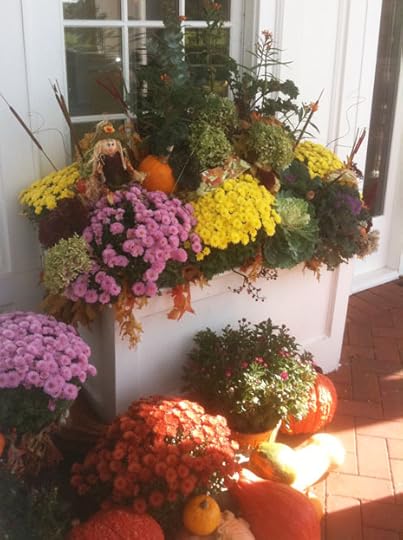 So, Mom is out of town. At Presbytery. Well, technically Dad is at Presbytery, and Mom has been out with the girls, shopping and generally whooping it up. She sent me this pic of somewhere that they went for lunch, and she'd like you all to think that it's her front door.
September 30, 2011
Ungraceful Parenting

This is Blaire, captured via iPhone throwing her first drama queen tantrum. She was full of angst about not getting to eat the wormy pear she snagged outside. The good news is that Blaire has a Daddy who loves her, so she won't be doing much more of this. Limited time release and all that. Of course she will be doing a great many more things for years to come, but sufficient unto the day is the trouble thereof!
Many of us come from backgrounds of rigid discipline and high expectations. Others of us may not have ever experienced house rule, and have no idea how to set them up for our children. It is easy for us to be in one ditch or the other – either all law and no grace, or all "grace" and no law. But the point is really to be somewhere in the middle. How do we do this?
The central thing that we need to see is our own temptations, and parent in a way that sanctifies us, and that fights against those temptations. If you are prone to massive chore charts, laminated couches, and military whistles, maybe your parenting could use a little finger painting, and a little laughter. But if you are prone to smile tenderly at a child who is throwing a full on tantrum (see my exhibit A), and toss them a cookie, perhaps you should look into disciplining yourself to follow through on something.
Now clearly half the battle here is figuring out what you are actually doing. If your home is a sort of military regime for drones, you could feel like all that was ever happening is insurrection and disobedience, because every little step out of the lines you created seems monumental. And you made so many lines that half the steps your children take are outside them. You might not see yourself as too disciplined, but rather very disordered. When someone suggests you loosed up, you might think "What!! We are already going to the bad place in a disobedient hand basket! Loosening up would be the end!" You might think you need to do some serious tightening up, but that will only make things worse.
And if your child is throwing routine tantrums, you might still see yourself as a hard line parent because sometimes you yell and scream and discipline in anger. But the truth is, you are just hard in the wrong way. You need to loosen up somewhere, and tighten up a whole lot somewhere else. While other people see you bribing and arguing and threatening and then not following through, you might feel like you do nothing but discipline. You might think that you follow through because you threaten, or take things away, or generally dislike your children.
Or maybe you think that you are the most generous, kind hearted, and understanding parent around. You think you are ladling on the grace by letting your six year old lie down on the floor during church, or your two year old hit you (venting their frustrations and all that). You feel like your children will love you because you always give gentle admonitions that are never heard. But anyone else could tell you that your children look unhappy and unloved.
But here is the thing. Law and grace are friends. They were always meant to go together. If the law is the skeleton, grace is the flesh. Without the law in there, the grace is just a blob. And without the grace, the law can't move. It can't carry grace anywhere. If there is not law, there is no grace. And without grace, the law is dead. Now parenting needs to represent both the law and the grace to your children.
Think honestly about the law in your family. Do your children obey you? Your first instinct might be to say "Of course they do!" But think a little deeper than that. When you tell a child to do something, do they do it? Or do they do it after you begin threatening? Do they do it when you start to look serious, or when you stand up? Do they do it after you bribe? Are you bolstering up your commands with dangling carrots or looming paddles? Do you find yourself talking and talking and talking about it? Does it take you twenty minutes to get a child to take a bite? Twenty intense minutes with furrowed eyebrows and raised voices?
What tends to happen with situations like this is that the parents get aggravated, and end up disciplining. They may still feel like they really enforced the old law. But the truth is, they bullied. Instead of simply, cheerfully enforcing a standard, they eventually resorted to force to get their way. That is not the way authority acts. When parents see themselves as an authority, they are enforcing their position, not their personal whims. God wants you to be in authority over your children, he put you there. This is not a position you are striving to get into. You are in it. Act like it.
If you do not have a solid structure of godly authority and law and you try to just be easy on your kids, the problem you will have is one of boneless grace. You think that you are ladling on the love and acceptance and grace, but you aren't. When God gives us grace, it results in fellowship with Him, forgiveness, and joy.
When we ignore sins our children are caught up in, that is not giving them grace. That has a different name, and it is judgement. Think of Romans 1:24, "Therefore God gave them over to their sins". That was not an example of grace. Sin is like water. Children can drown in even a little bit. Looking away when your kid is stuck in some petty sin is like walking away from a kid floundering in really shallow water, and it is not grace. If you love your children, you grab them and haul them on out of that. You get them all the way out. You don't watch from the house to see if it gets a lot worse. You don't decide that it is their problem, and wish them the best. You don't decide that there will be more time another time to get them out of that water another day. You don't sit beside the pool and chat to friends or post about it on Facebook. Grace is action.
Grace is not changing your mind about that bite of broccoli because you know you aren't going to win. Grace is not deciding to let a kid stay outside because they stomped at you when you told them to come in. Grace is not deciding that it isn't a big deal that your daughter is yelling at you. Grace is not a coward.
Grace is not a facilitator of sins, it is a solution to them. A good parent has two weapons to help them fight sin on behalf of their children. One is law, and one is grace. The point of both is restoration, forgiveness, and joy. If you don't see those fruits in your home, then you need to reevaluate what you are wielding.
September 26, 2011
Think…
before you believe…billboards.

Nate and I drove by this today. No idea who did it but that billboard's been asking for something for a while.
Girls, girls, girls
So I had a special request from someone that I write a little something about raising older daughters. "Older" in this case means something more along the lines of upper elementary age . . . I don't yet have any teenage girls. (But when I do I'll have them in spades . . . my girls will be 13,14, and 15 all at the same time!)
"Daughters" is kind of a big topic actually, and a whole lot of things spring to mind. I'm not even going to try to say everything all at once – I thought maybe I should pick away at it and just mention a couple of things right now.
The first thing I thought of is "foolishness." This is something that we've worked on from the time our girls were very small – it's not only relevant to older girls. However, I've been very grateful that we have been working on it for years . . . because we're now hitting the age where this category actually matters. Basically, you reap what you sow. You harvest what you plant and tend. If you don't want a harvest of foolishness when your daughter is grown, don't tolerate foolishness when it's small. Picture a garden. That enormous stink-weed there amongst the lettuce didn't just appear there overnight. It started out as a seedling, and you let it grow for months and months. Not only did you neglect to pull it up, you probably watered it diligently every day. If you don't want the big stink-weed, learn to recognize the little baby stink-weeds and get rid of them as they appear. Hint: they don't look nearly so dire when they're smaller. They might possibly even be cute. But they're much, much easier to pull up when they're small and cute.
So how does this apply to foolishness? Well, what does folly look like in a grown woman? Now rewind . . . how did that folly get there? It didn't magically appear overnight. Rewind and ask yourself what it looked like when she was 10. What did it look like when she was 8? The fact that it suddenly blossomed and everyone noticed when she was 22 does not mean that it wasn't there all along. It just means that no one took the time to pay attention to what was actually growing. Turns out it wasn't a lettuce.
Here are some examples of the things that we've focused on and labeled as "foolishness." We're trying to train our girls to see these traits in their friends as well as themselves. We want them to be able to identify folly in others so that they can refrain from participating, or try and steer the activity in a different direction. I'm purposely picking things here that are not obvious sins (hopefully those things are straightforward enough!) – and I'm not trying to say that these are officially sins at all. I'm just saying that as we try to train our girls away from folly, these are some of the things we've identified.
1. Babytalk / weird voices. Yeah – this may seem uptight. I'm not talking here about girls playing a game with a baby doll. I'm talking about the situation where you have a group of 10 year old girls talking babytalk to one another. We're not into that. If it pops up, we remind our girls to not use foolish voices and to talk like big girls. We're trying to train our girls into maturity, and this seems to be an obvious area where people tolerate and encourage immaturity. I'm not trying to say girls shouldn't laugh and have fun together – I'm all about that. But I think this is one area where folly looks so completely innocent that people feel ridiculous making a deal out of it. But once again, what does this turn into? If you nurture this one, where does it go? If you've ever seen a group of college girls squealing and hugging and jumping up and down and using babytalk, I hope you'd agree that it's utterly unbecoming and foolish. And embarrassing. And cheap. And not cute at all. And I never want my girls to be those girls. So when the baby version of that shows up, we work on it. Sometimes it seems tied to one particular friend – after playing with her our girls seem more inclined that way. That's a great learning opportunity, and it means that we can remind them before playing with her again that they need to make sure to guard against using foolish voices.
2. Coarse Jesting. "Neither filthiness, nor foolish talking, nor coarse jesting, which are not fitting, but rather giving of thanks." This segues right out of the previous point. It's amazing to me how "foolish talking" almost immediately turns to "coarse jesting" in children, and I remember being incredibly struck by this verse in Ephesians when our kids were small. Those two things almost always go together. The babytalk girls almost always inevitably descend to potty humor. And as they get older, the coarse jesting "matures" along with them. If you don't want them making sex jokes with the boys in high school, don't let them get away with potty jokes right now. It may seem innocent, but learn to recognize the weeds when they're small. For us, coarse jesting is a disciplineable offense, not just if you made the joke . . . but also if you laughed at it. If your friend says something off color, you have to look them in the eyes and tell them that they need to not talk that way. Again, recognize that your small girl needs to take a stand when her friend makes a joke about buns . . . because you want her to be able to take a stand later when it's a sex scene in a movie. Help them fight the battles when they're small – and remember that he who is faithful with little will be faithful with much. Give your girls all kinds of encouragement when they make that stand – be proud of them and realize that it takes a lot of courage to stand up to a friend, no matter what age you are. It's also a good reminder to watch what you yourself joke about. Most of the time that our kids have to stand up to friends for coarse jesting, it turns out that it's actually the parents who are pretty free and easy with what they joke about at home.
That last point can be taken very wrongly by the way. Girls inclined to be Goody Two Shoes are a whole other problem requiring a whole different plan of attack. If your daughter is inclined to the foolish talking and coarse jesting, then that is where you need to focus your attention. But if your daughter is inclined to be better than everyone else, you have a whole different situation that needs a lot of wisdom. Definitely a topic for a whole separate post.
September 25, 2011
The Minister's Wife
For any of you ministers' wives out there who have recently joined us, I send out an email newsletter from time to time called "The Minister's Wife." If you would like me to add you to the mailing list, just leave a comment here. (You don't have to leave your email address, as it is included with your comment.) My mailing list is around 300 wives from a many denominations and a few continents. So if your husband is a minister, feel invited!
Projecty things
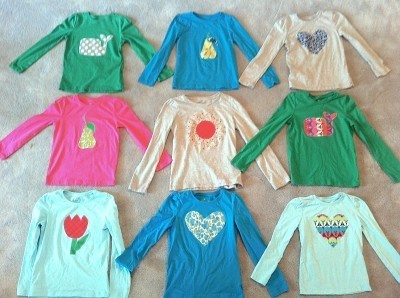
The weather is changing, revealing that there are not any clothes for the kids. For reals. None. Turns out kids grow three or four inches of leg over the summer. The clothes that we have been wearing have no life left. They should all simply be destroyed, and we should start over. We are trying. I ran to Old Navy on the first cold day and discovered that they have no children's clothes right now. Ack. So I ended up grabbing a bunch of cheap t-shirts at WalMart for the girls and did an assortment of appliqués on them. I'm hoping these buy us a little time!
I also finished knitting a little sweater for my niece Zoe, a marvelous little person whom we just got to meet this weekend. She looks quite nice in it, although it is hard to tell what she thinks of it!
September 23, 2011
Get in to Ashtown

"To the traveler's eyes, the motel is dead and useless, a roadside tragedy, like the remains of some unfortunate animal in a ditch – glimpsed, mourned, and forgotten before the next bend in the road. But to the lean boy with the dark skin and the black hair struggling in the thick brush behind the pool, the motel is alive, and it is home."
I know I am biased. I just am. Can't help it. When your brother writes a great book, people just expect you to like it. And I do. But I like it more than that. I like it so much that I am willing to tell you all that you absolutely need this book. Get it! Don't live another minute without it!
The thing that I love about Nate's books (all of them) is his sense of place. He writes stories that are mysterious, exciting, and provoking, but they all occur here. In our very own backyards. In our very own country. With our very own people.
This isn't an accident. American children have grown up in a literary tradition that leads us to believe that if something magical was ever going to happen in your life, you would need to live in England. Nate anchors the magic of the real world to the magic of his written worlds. He points us not into the magic of some imaginary world to get us lost, but he uses that world as a lens to point back to the magic of our world. The one that God created. The one that is right past your back deck. The one that is on country roads and in pizza places. The kind of magic that we live in every day, immersed so completely that we forget to see it.
The thing that really stands out to me in the Dragon's Tooth (beyond the brilliant characters) is how many pieces of world history are linked in to this story. Ancient stories of explorers and villains, all the way down to Daniel Boone. They all have apart. They are all connected. They are all pieces of a story, fragments of something that we didn't understand before. Connected to each other – not because Nate wrote a story in which they all fit together (although he did), but because a much greater Author wrote them in to a much greater story.
I want my children to see that kind of story as we drive by some run down motel. I want them to see magic when they see dolphins. I want them to feel the kind of wild life that this world is made of as parts of a wild story that God wrote. I want them to wonder, to ask, to look. I want them to be explorers of our own world.
Books are like training wheels for wonder, and first our children have to be explorers of places like Narnia, and Bag End, and Ashtown. They need to practice seeing along side someone who does. Nate does.
You can buy this marvelous book here. If you don't have cash right now, sell something on Ebay. I'm not even joking.
This is not a book to wait on. This is medicine for rainy days (you know they are coming), therapy for tired people who forgot to enjoy having options for breakfast. This is the good stuff! Go get it!
For all you people in Spokane or Coeur d' Alene, Nate will be doing an event at Costco this weekend. What a great opportunity to stock up on good reading, Christmas gifts, and paper towels, all at the same time!
Nancy Wilson's Blog

- Nancy Wilson's profile
- 292 followers

