
Regina Scott's Blog, page 5
March 14, 2023
Twenty-Five Years Ago This Month
 I have wanted to be an author since about third grade, when I first realized that the wonderful stories I was reading were written by someone, and I could be that someone! But it wasn’t until many years later, with the tough-love encouragement of my husband, that I submitted my first Regency romance to Kensington. I was working as a communications manager for the environmental arm of a large research and development laboratory at the time. My husband had gone home for lunch and listened to a message on our answering machine (yes, those used to be a thing). He promptly called me and held the phone to the machine so I could hear it too.

“This is John Scognamiglio of Kensington Books. I’d like to talk to you about your manuscript.”
I knew enough to know that when an editor calls, it’s with an offer.
I was a mess. I ran around the corner of the building to where my critique partner worked and blabbered out my excitement.
 “By the time you get home, New York will be closed,” she said. “Go now. We’ll cover for you.”
 I went. And I called, and he offered me a two-book deal.
And so, 25 years ago this month, The Unflappable Miss Fairchild was published. She has had a couple of updates since, as you can tell by the covers, but she’s still one of my favorites, and readers tell me she’s one of their favorites as well.
The ever-practical Anne Fairchild knows the proper way to seek a husband. So why is it one moment in the presence of the dashing Chas Prestwick, and she’s ready to throw propriety to the wind? Chas excels at shocking Society with his wild wagers and reckless carriage racing. But his bravado masks a bruised and lonely heart. Can the sweet-natured Anne convince him to take the greatest risk of all—on love?

You can get her ebook for 99 cents
Directly from me through my store
Already have her? What about The Emperor’s Aeronaut, the first book in my Regency-set steampunk trilogy co-authored with Shelley Adina? Until March 25, the ebook is free on all major retailers. It will be up on my store later in the week.

In 1819, Celeste Blanchard, daughter of the Emperor’s disgraced Air Minister, is blown off course in a daring and desperate test flight to prove a balloon can reach England and washes up in the heart of enemy territory. Loveday Penhale, cosseted daughter of gentry, has her own inventions to build, even as pressure mounts to behave like a proper young lady. But when she helps rescue an unconscious young woman on the beach, she discovers an aeronaut and an inventor as skilled as she is. Could their collaboration result in the first air ship? And does this war hinge on the bravery and daring of a Cornish debutante and the Emperor’s aeronaut?
“A witty and whimsical flight of fancy.” Booklist
Happy anniversary!


March 7, 2023
Retro Blast: Queen Victoria Goes to Kokomo
I wish I were going somewhere warm where one can unironically drink things with slices of pineapple and little umbrellas stuck on top! It's the time of year when spring seems so close, but still so far...an opinion shared by Queen Victoria. Enjoy!
* * * * *
Well, not quite. But sort of. :)
I’m lucky enough to be looking forward to a visit to warmer climes in the near future—when you live in the chilly north, a few days spent in a place where it’s not necessary to wear heavy down coats is a Very Good Thing.
 I’m not the only one to think so. Queen Victoria started taking an annual holiday somewhere in sunny southern Europe, usually for six or seven weeks from the beginning of March to mid-to-late April. Her first trip, in 1879, was shortly after the death of her daughter, Princess Alice; the Queen felt that she needed a complete change of scene, and decided it was high time she visited Italy, which she had never seen. She was lent a villa, Villa Clara, at Baveno, on Lake Maggiore, which though close to the Alps has a mild, Mediterranean climate year round.
  The Queen was delighted with her decision. The scenery was gorgeous (though she invariably compared it to Scotland), so she spent a lot of time sketching and painting watercolors, went boating on the lake all the way up to its end in Switzerland, visited Milan to see the artwork (not a success as she was mobbed while visiting the cathedral). It whetted her appetite for more travels, and three years later, she went to the French Riviera, a trip that eventually became an annual event.
 Her first visit there was to Menton, where she saw the Mediterranean for the first time. Once again she compared the scenery to Scotland, but as anything that reminded her of Scotland was definitely a good thing, it was high praise indeed. She was an indefatigable sightseer, taking little trips to Monte Carlo (though not to gamble) and other places, with her English coachman and Scottish servant, John Brown, in full Highland regalia (how the sight must have bemused the French!)…perhaps to visit a quaint nunnery, or a pottery factory, or to have a picnic in a secluded spot by the side of the road. In future years she stayed at Hyères, Grasse, and Cannes before finally settling on the Hotel Excelsior Regina (it added the “Regina” to its name with the Queen’s permission), in Cimiez, Nice. She always travelled “incognito” as the Countess of Balmoral, which of course fooled nobody but permitted her to avoid making visits of state—this was, after all, supposed to be a vacation. Family members descended on her for visits while on their own winter vacations, so that at times the poor Queen was quite exhausted from entertaining.
Her last visit was in 1899; the Boer War kept her home the following spring, which was her last before her death in January 1901. I’m sorry she had to miss that last year; she took great delight in her annual visits south, away from “the sunless north”. I know I’ll enjoy mine!
February 28, 2023
The Granddaddy of All Confidence Schemes: Poyais
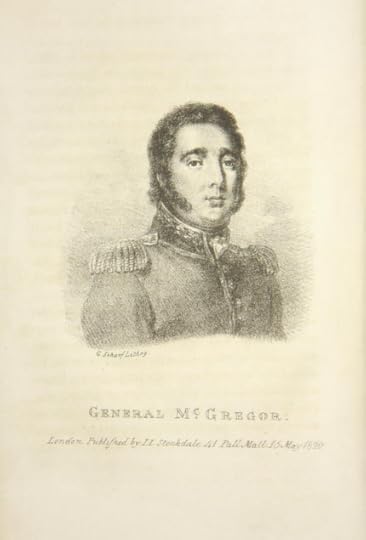 Confidence schemes have been in the news lately, and I know there have been some doozies in the past. But I never dreamed when I was researching (lovely, lovely research!) for Never Beguile a Bodyguardthat I would find one of the most audacious and chilling schemes ever enacted in the Western World.
 Poyais.
Never heard of it? According to its guide for immigrants, it was a paradise. The 8,000,000-acre Republic of Poyais lay along the Caribbean. Its capital city, St. Joseph, had tree-lined streets, mansions, and an opera house. It was the center of culture and elegance. The fields surrounding it would grow any manner of food, three crops a year. The oceans in front of it teemed with fish. The mountains at its back were so filled with gold and gems that one might merely bend to pick them up.

Better yet to the people of nineteenth century England, its Cazique (leader) was a decorated hero of the Napoleonic Wars! Colonel (or General, depending on who was his biographer) Gregor MacGregor had gone on to fame in South America, fighting battles for independence there. He was said to have been given charge of his own country in thanks for his services to the king of Mosquito Coast: Poyais.
So when the colonel arrived in London in 1821, graciously seeking investment and immigrants for his new country, hundreds jumped at the chance. Banks offered him loans in astronomical amounts for that time (as high as a quarter of a million pounds). The gentry feted him in their homes. Would-be settlers quit their jobs, sold all they owned, cashed in their savings for notes from the Royal Bank of Poyais, and prepared to set sail. They had been promised positions like clerk, military leader, or banker in the new government. A few had been given titles. They had paid for lands on which to farm or ranch. More than 250 left on two vessels in September 1822.
_SCAM.jpg)
Only 50 ever made their way back to England.
You see, Poyais didn’t exist.
The first settlers arrived to find no city, no country, no anything! A storm ended up sending their ships back out to sea for safety, stranding them on an inhospitable shore. Most died from sickness or starvation. The king of the Mosquito Coast denied he had ever given MacGregor a kingdom. A few hardy souls stayed in neighboring countries, and the other survivors ultimately found their way back to England in October 1823.
Amazingly, many refused to blame Colonel MacGregor! They were certain they’d simply mistaken their way and that Poyais was out there somewhere, beyond the horizon. They blamed the captains of the ships and MacGregor’s agents, who had come with them, for misleading them.
MacGregor swore he was innocent, but he still fled from England to France, where he continued his scheme. He was arrested in 1825 and tried for his crimes but gave such a passionate defense that he was acquitted. He retired to South America and lived out his life in style, though not in his beloved Poyais.
It seems even he could not find his way back to it.
February 21, 2023
Celebrity Endorsements, Regency Style
In November we looked at a riding habit from La Belle Assemblée for June 1816. That was clearly a good month for fashion plates, because we’re going to have a look at the month’s other plate, The Cobourg Walking Dress.
.jpg)
(Does anyone but me think it funny to depict a walking dress on a seated model?) Here’s the accompanying text: Round dress of fine French cambric under a pelisse of amber shot sarsnet, elegantly ornamented in a novel style with blue satin ribband. Oatlands hat to correspond with the pelisse, tied with a chequered ribband of blue on white, and the hat surmounted with a bunch of tuberoses or Passion flowers. Morocco shoes or half boots of light blue the colour of the pelisse trimming. Limerick gloves; and the hair dressed forward in curls.
What’s going on here is a royal wedding: Princess Charlotte, daughter of the Prince Regent, married Prince Leopold of Saxe-Coburg (or Cobourg)-Saalfeld on May 2, 1816. This particular issue of La Belle Assemblée included lengthy articles on gowns in the princess’s trousseau and on the Queen’s Drawing-Room held in honor of the wedding, both copiously descriptive…which was hardly surprising given the magazine’s target audience and the large number of silk warehouses and other stores given to fashion who advertised with it. And of course, the inimitable Mrs. Bell, “inventor” of the fashions depicted in La Belle Assemblée’s plates, had to get in on the act…which is why we have a Cobourg pelisse and an Oatlands hat, Oatlands being the country estate of the Duke and Duchess of York, where Charlotte and Leopold spent their honeymoon. And of course Passion flowers…need one say anymore?

Let’s have a look at what can see of the outfit (can I say I’m very cross that we can’t see the front?) The back is very handsome, however, with what looks like ruched ribbon in a yoke over the shoulders and on the garment’s edges (and even sewn into the shoulder seams. The gathering at the back of the waist is attractive as well: I wonder if the garment is actually gathered by the ribbon, or if the gathers are sewn in.

I’m not quite sure what’s going on with the hat, however. It starts out as a conventional straw bonnet trimmed with the blue ribbon…but what’s going on at the back of the crown? It rather looks like a large bag has been sewn into it… Any thoughts on what’s happening here?
We all know that Charlotte’s happy marriage was short-lived—sadly, she would die in childbirth a year and a half later. Reading the account of her trousseau and the celebrations around her wedding make for melancholy reading: they’re so full of excitement, of fairy-tale magic “and they lived happily ever after”, and of hope—Charlotte was the heir presumptive to the throne after her father. I wonder if Charlotte herself ever paged over a copy of this edition of La Belle Assemblée and examined this plate, and the walking dress created in her new husband’s honor? Alas, we’ll never know.
What do you think of the Cobourg Walking Dress?
February 14, 2023
Blast from the Past: Today, My Heart Belongs to . . . the Letter Carrier
 [I originally penned this post 10 years ago around Valentine’s Day, but I thought it was time to bring it to the forefront. Happy Valentine’s Day!]
Valentine’s Day was eagerly awaited by many a young nineteenth century lass and lad in England. Thousands of Valentine letters were exchanged in London alone. In fact, the 1835 Post-Master General’s report cites an additional 50,000 or 60,000 pieces of mail through the London Twopenny Post around Valentine’s Day. The hundred or so letter carriers in London had to be given additional money for refreshments just to see them through their arduous work. In a bigger city, they might make deliveries as many as six times a day!
However, even with their help, figuring out how to get your Valentine from your fingers to your true love wasn’t for the faint of heart. You could hand it to the postman, if you caught him on one of his rounds, or you could take it to the Post Office near you, which could be at a shop or an inn if you were in a smaller town or village. Later in the century, post boxes appeared to collect letters in certain areas. Some villages didn’t even have post offices or boxes, requiring you to walk miles to post a letter or to take the chance of paying a private firm to deliver your message for you. Many such firms went bankrupt before letters were even delivered.
Then too, each sheet of paper cost money to send, to be paid by the person who received it. While England was at war with France, postage costs kept increasing. Postage was also higher the farther the letter had to travel. As you can imagine, the cost put a burden on the average working man or lady, not to mention the underemployed teen.
 So, letter writers got creative. Instead of using more than one sheet, they wrote on both sides of the one, vertically, horizontally, and then kitty corner! Such cross writing was notoriously difficult to read, particularly squinting over candlelight. Then too, some friends or family who lived far apart arranged a code. If a letter arrived from the friend with your name misspelled or perhaps the address lettered wrong, why you knew that the friend was well and you could refuse to pay for the letter. There were also tales of people writing with milk along the margins of newspapers, which were free to mail, so that a friend could read the note over the heat of a flame.
 Letters that were refused ended up in the Dead Letter Office. I can imagine it looking something like the Library of Congress in Indiana Jones and the Raiders of the Lost Ark, although this is what one looked like in America in the early twentieth century. (Tires? Really?) Post Office employees often had to open the mail to determine how else it might find it rightful home. But in the early nineteenth century in England, Post Office employees were allowed to open and read your mail under other circumstances too, such as if you were suspected of being a traitor to England (“Dear Napoleon—I love you!”), evading Customs (“Dear Aunt Charlotte, that case of Brussels lace is safely stored in the cave under Peasbury Abbey.”), or involved in a robbery (“Dear Susan, I am delighted to relate that I was able to make away with that diamond ring you always wanted.”). If you were in jail for bankruptcy, the Post Office even sent all your mail to the solicitor in charge of prosecuting the case!
I’m just thankful for mail carriers today. They deliver author copies, fan mail, royalty statements, and all manner of things designed to make a writer’s heart go pitter-patter, even when it isn’t Valentine’s Day.
February 7, 2023
A Lot of Gas…or Was It?

My dear nephew (thanks, Ian!) sent me the following item, which first appeared in the Northampton Mercury on July 23, 1808, and again on the blog of the website britishnewpaperarchive.co.uk roughly two hundred years later. I cannot vouch for its veracity (one of the principals being named "Monsieur Le Pique" does ring a few quiet BS-o-meter alarms in my head), but by gosh, what a story!
I’ll let you be the judge:
Novel Duel.—A very novel species of duel has lately taken place at Paris. M. Grandpree and M. Le Pique having quarreled about Mademoiselle Tirevit, a celebrated opera dancer, who was kept by the former, but was discovered in an intrigue with the latter, a challenge ensued. Being both men of elevated minds, they agreed to fight in balloons, and in order to give time for their preparation, it was determined that the duel should take place on that day month. Accordingly on the 3rd of May the parties met in a field adjoining the Tuilleries [sic], where their respective balloons were ready to receive them. Each, attended by his second, ascended his car, loaded with blunderbusses, as pistols could not be expected to be efficient in their probable situations. A multitude attended, hearing of the balloons, but little dreaming of the purpose: the Parisians merely looked for the novelty of a balloon race. At nine o’clock the cords were cut, and the balloons ascended majestically amidst the shouts of the spectators. The wind was moderate, blowing from the north north west, and they kept, as far as could be judged, within about 80 yards of each other. When they had mounted to the height of about 900 yards, M. Le Pique fired his piece ineffectually; almost immediately after the fire was returned by M. Grandpree, and penetrated his adversary’s balloon; the consequence of which was its rapid descent, and M. Le Pique and his second were both dashed to pieces on a house-top, over which the balloon fell. The victorious Grandpree then mounted aloft in the grandest style, and descended safe, with his second, about seven leagues from the spot of ascension.
See the original post here: https://blog.britishnewspaperarchive.co.uk/2012/08/24/the-first-duel-fought-in-hot-air-balloons-paris-1808/
What do you think? Did it really happen, or did an editor at the Northampton Mercurythink that the July 23 issue needed a little sprucing up and concocted the tale out of whole cloth, journalistic rigor not yet having the importance it does in modern times?
Whether it did or not, dear readers, this is what makes studying history so much fun!
January 31, 2023
Meet Me at the Café!
A few weeks ago Regina pointed out to me that I had never blogged here about my publisher, Book View Café, and that I really ought to. After I stopped calling myself names, I decided I would, because BVC is really kind of a cool thing.
 Book View Café is a cooperative publisher, meaning it is run and managed by its members and publishes their books. That means the members (including me) wear a lot of different hats at different times: we’re business managers and bookkeepers and technology managers and marketers and editors and designers and cover artists. Basically, we do all the tasks that any publishers does, but we’re doing them for ourselves.
 Book View Café was founded in 2008 by a group of science fiction and fantasy authors—among them Ursula K. LeGuin and Vonda N. McIntyre who wanted to bring out their books that were no longer in print, but also to find a way to publish on their own terms. Fifteen years later, BVC has published hundreds of its members’ books, which it sells from its own online store as well as on Amazon, Barnes and Noble, Kobo, and elsewhere, and makes available to multiple library distributors. Of note is the fact that each author receives 90% of the cover price of their titles sold in the BVC bookstore—unheard of in a publishing world where authors receive a tiny percentage of the profits from their books.
 We publish primarily genre fiction—fantasy, romance, science fiction, and mystery—with a smattering of other types of fiction as well as some non-fiction, in particular books on writing. We periodically bring out short story anthologies as well—our last was
Murmurs in the Dark
, the ghost story anthology I co-edited with Shannon Page—and we’re noodling around with a cookbook idea, mostly for fun…
We publish primarily genre fiction—fantasy, romance, science fiction, and mystery—with a smattering of other types of fiction as well as some non-fiction, in particular books on writing. We periodically bring out short story anthologies as well—our last was
Murmurs in the Dark
, the ghost story anthology I co-edited with Shannon Page—and we’re noodling around with a cookbook idea, mostly for fun…
 That’s a key concept at BVC, now that I think of it: fun. We take our business practices and the running of our co-op very seriously…but when we take off the business hats and put on our writing hats, we can write what we want to write, what we enjoy writing, without being constrained by the opinions of a marketing committee somewhere. It means that Sherwood Smith could write a Wuxia fantasy series just because she wanted to, that Shannon Page can co-write mysteries set in her beautiful home island community because she wanted to, and I can write my Regency/fantasy-of-manners/mystery/romance Ladies of Almack’s series because I might have exploded if I hadn’t.
 And that’s Book View Café. Thanks for nudging me, Regina.
And speaking of just for fun…remember my post a few weeks back about Ladies of Almack’s Regency meme calendars? Well, I did it: 2023 calendars (featuring all new, never before published memes) and magnets are available at my Etsy store here. Because Regency snark? How could I not? 😀
January 24, 2023
Beguiling the Bodyguard
 Fortune the cat is back with another set of matches to make, this time with the Batavarian Imperial Guards. These four elite soldiers find themselves up to their medals in romance and adventure as they start new lives in Regency England. First up is Finn Huber.
When Finn was released from his duties to his king and crown prince, he never dreamed his first position in England would be bodyguard to a governess whose sweet nature calls to him. He fell for a lady he was guarding years ago, with devastating consequences. He learned the hard way that bodyguards must be vigilant, valiant, and in control, always. Loving who they guard is strictly forbidden.
Governess Abigail Winchester beguiles her charges with warm smiles and gentle words, but her composure is hard won. Someone knows about her connection to a family scandal and is bent on destroying her. How kind of her benefactress, Lady Belfort, to hire Finn to keep her safe as she hides at the lady’s country estate. He is everything a lady might admire, but she cannot give in to her growing feelings for him. Finn’s honor and her past can never be reconciled.
But Lady Belfort and her cat, Fortune, are renowned for making matches—in employment and in romance. With their help, Finn and Abigail must uncover who is threatening her and stop the villain before it’s too late. In the end, will honor or love prevail?
5 Stars! “Well written, engaging, and does not slow down.” The Huntress Reviews
You can find Never Beguile a Bodyguard at fine online retailers and bookstores near you as well as directly from me! My store has ebook versions of all my books published through Edwards and Williams, delivered via Book Funnel. Or try
An independent bookstore near you (paperback)
The Book Depository, free shipping worldwide
January 17, 2023
So I Did a Thing...
Some of you may have seen the fun I’m having with creating silly Regency memes from my collection of Ackermann's Repositoryand La Belle Assemblée fashion plates—a new one goes up every few days on my Facebook and Instagram pages.
But I couldn’t stop with posting them on social media. That, dear readers, would be much too simple.
So I did this:


The magnets happened for a couple of book-signings I did last summer. The calendars were a brainstorm on December 27 after someone showed me the customizable calendars that could be made at Snapfish, and I just couldn’t stop myself. I mean, doesn’t everyone need a calendar with sassy Regency memes that also tells them when Sally Jersey’s birthday is and on what day Pride and Prejudice was first published?
I’ve given several to friends, but the question is…should I make these more widely available? Would NineteenTeen readers or fans of The Ladies of Almack’s series (either books or memes) buy them? I’m afraid I would have to keep this for US purchasers only; the time (filling out customs forms) and expense of mailing them outside the US would be prohibitive. But if these appeal to you, leave me a comment and I’ll figure out what’s next.
And in the meanwhile…Sassy New Year!

January 10, 2023
The Sad State of Governesses in 1818, According to “An Observer”
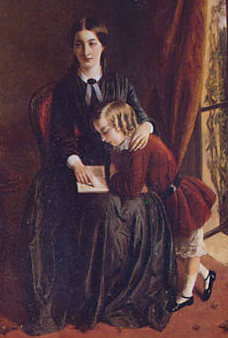 In my upcoming book, Never Beguile a Bodyguard, the heroine is a governess forced by a family scandal to seek protection from an unlikely source. As I was researching (lovely, lovely research) for the story, I ran across an article from the May 1818 European Magazine and London Review. Some of the insights were priceless, so I thought I’d share them with you!
 Written by someone identified only as “An Observer,” the title of the piece is “Thoughts on the Present State of Governesses.” It seems the profession, once employed solely by those with wealth and privilege, had proliferated, thanks to the growing middle class. As a result, the status of being a governess appears to have plummeted.
“Let us consider the qualifications and probable fate of the modern governess. She enters (as a necessary recommendation) some fashionable establishment… and she vies with her schoolmates in dress and their indulgences at theatres or splendid parties; to which introductions are the chief care of the modern governess. If, which is equally probable, she springs from the lowest class, she becomes during a few miserable years an apprentice or half-boarder; and combined with the envy excited by her superiors, learns the meanness and stratagems required to gain their favour. Here, if the business of adjusting their frocks and curls allows time, she may possibly learn to paint shells and Ottomans, net purses and empty them at cards, to play a sonata without understanding a single rudiment of its composition, copy the attitudes of a favorite singer, and waltz. At eighteen or possibly sooner she undertakes the tuition of a numerous family or of one favourite child.”
Doesn’t sound like much fun, does it?
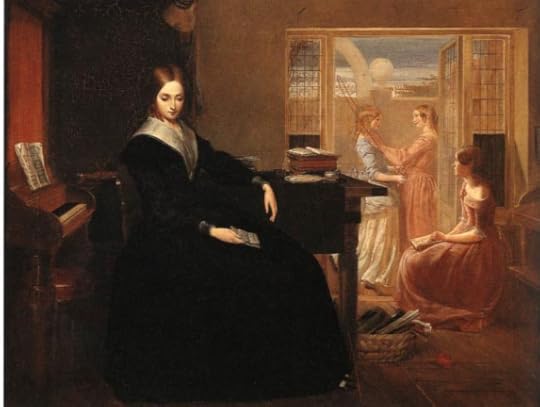
The Observer paints an equally dire future, when everyone from the chamber maid to the child’s mother and siblings view her with scorn and expose her to “a thousand grievances, which have no refuge except silence, and no worldly remuneration but a stipend of the most uncertain kind.”
Well!
I have no doubt some governesses were cherished companions who received a thankful pension when their work was done. The Observer goes on to urge the creation of a plan to aid those who are not so fortunate:
Those governesses who are well off should put some of their money in a fund not only for their future upkeep but for those not so well off. Mothers who employ governesses should pay for their pensions or at least stop asking them to dress fashionably so that they can put some money aside themselves. The government should build almshouses for “decayed governesses” and give them charge of female orphans currently in the poor house to teach them, perhaps one on one.At a time when unions were just beginning to be conceived, these are novel concepts.
Governesses of the world, unite!


