
Regina Scott's Blog, page 2
October 31, 2023
Posts That Go Bump in the Night

We’ve not had very much to say about Halloween on NineteenTeen, mostly because it wasn’t all that much of a “holiday” to the 19th century misses we often write about....though I can't imagine that they wouldn't have enjoyed parts of it as celebrated in the 21st century.
But that doesn’t mean that our 19th century misses didn’t enjoy a shiver or two, whatever day the calendar said it was … and those shivers could generally be found in a circulating library. Spooky stories had become to come into their own in the second half of the 18th century, and authors such as Horace Walpole, Ann Radcliffe, and Matthew Lewis wrote hugely popular "horrid" fiction—stories that would eventually be gently lampooned by Jane Austen. Later in the century and up to this day, tales of ghosts and the supernatural were more likely to be popular in Britain around a different holiday; authors like M.R. James wrote ghost stories for the Christmas season that still raise goosebumps on readers today.
And, after all, maybe Halloween was not widely observed because unexplained phenomena—ghosts and other echoes of the past—are so common in Britain. When unexplained footsteps and cold drafts happen every day, who needs a special spooky holiday?
 Hmm. Then again, if Reece's Peanut Butter Cups are involved, I just may have to raise my hand...
Have a sweet, shivery evening, everyone!


October 17, 2023
Not a Slippery Slope
Here’s a bit of a riddle to introduce today’s topic: can you guess what it is?
What is it?
It is one of these: writing slopes!

 Writing slopes are elegant little boxes (generally twelve to fourteen inches wide and ten to twelve inches deep.) They’re called slopes because they open like so, providing an angled surface (generally around twenty-five or thirty degrees), usually covered with fabric (blue velvet is a favorite) that provides an absorbent surface on which to write—in short, a portable desk.
 The interiors are divided into small compart- ments in which one could keep writing paper, pens, ink, penknives, sealing wax, and all the other appurtenances of writing. The tiny ink bottles just slay me!
 They could be relatively plain, like this one:
 Or elaborately inlaid with decorative woods, bone, mother of pearl, and metal. They often had locks, so that one could store private correspondence in them; some even had secret compartments.
 The world is fortunate that Jane Austen's writing slope, a gift from her father in the 1790s, has been preserved—along with are purported to be some of her spectacles! It is in the collections of the British Library; go here to see a couple of really cool 3-D manipulative images of it.
And as for writing slopes today, physical therapists, teachers, and orthopedists have found that using a slanted surface to write, read, or draw at, which is why slanted surfaces are readily available today. However, I’ve yet to see one as pretty as those from the 19th century!
* * * * *
 Speaking of slopes…slide your mind back to March 2022, when NineteenTeen welcomed guest blogger Katie Kennedy to talk about which president she would most prefer to go bathing suit shopping with (among other things!) I’m happy to report that Katie’s The Presidents Decoded: A Guide to the Leaders Who Shaped Our Nation is out today! You can find it at Amazon, Barnes and Noble, or your favorite independent bookstore.
October 10, 2023
Why Celebrate One Regency Holiday When You Can Celebrate Six?
 We’ve talked about a number of Regency holidays over theyears such as Christmas and Easter. I’m delighted to report that I have aRegency steampunk story, in the Regent’s Devices universe, out this Thursday. Likethe other stories, which are more-traditional Regencies, it centers around a Regencyholidays. We cover from May Day to Twelfth Night, featuring some of your favoritetropes—enemies-to-lovers, second-chance romance, forbidden love, friends-to-lovers,and more! The collection includes the following stories:
May Day Mayhem by AnnChaney—Intrigue,death, and love come to Horsham-Upon-the-Thames as the small English villageanticipates their May Day celebration. Home Office agents the Duke of Doncasterand governess Helen Stokes join forces to uncover a missing list of Frenchagents before an enemy discovers it. Mired in May Day preparations whilechasing hoodlums and gentry, Helen and Doncaster try to fight their mutualattraction in a romantic farce worthy of Covent Garden.
My Favorite Mistakeby Courtney McCaskill—Sixteenyears ago, lady’s maid Fanny Price was swept off her feet by a handsome horsetrainer named Nick Cradduck. The very next day, he shattered her heart. Butnow, at the Cooper’s Hill Cheese Rolling and Wake, who should Fanny encounterbut the man she crossed all of England to avoid… A second-chance love storyfeaturing Fanny, the scene-stealing lady’s maid from How to Train YourViscount!
His Damsel byCharlotte Russell—Duringher annual visit to Bartholomew Fair, Eliza Cranstoun is mistaken for a lady indistress when in fact she was attempting to avenge the honor of her cousin.Now, she insists Anthony Ripley, her savior, help her bring down a lordlyscoundrel. Amidst the scheming however, the independent Eliza and the confirmedbachelor Anthony, discover that love finds even those who choose not to seekit.
When I Fall In Loveby Cora Lee—TheHarvest Festival is a chance for reunions and love, but perhaps not for childhoodfriends Sylvie Devereaux and Kit Mathison. When Kit returns to renovate thehome he inherited, Sylvie’s financial burdens prompt Kit to propose a marriageof convenience. But Sylvie has always wanted to marry for love, and they don'tlove each other…do they?
Remember by ShannonDonnelly—Over theyears, Beatrice Foxton keeps meeting up with Andrew Cliffs on Guy Fawkes Night,but these two friends are separated by her family’s expectations for her tomarry a well-born lord and his family’s background in trade. And, yet, theycan’t stay away from each other...
The Aeronaut’s Heartby Regina Scott—JosephineAventure was on her way to earning a place in England’s Aeronautical Corpsuntil the dashing smuggler she’d once loved showed up. Etienne Delaguard riskedmuch to help England win the war against France. Over a Twelfth Nightmasquerade, can a gentleman of the sea win the heart of a lady of the air?
You canfind all the links to your favorite online retailers here.
Time to celebrate!
October 3, 2023
Regency Fabric, Part 36
Here’sanother post in our ongoing series on Regency fabrics.
As I have in previous posts, I’ll be examining actual fabric samples glued intoseveral earlier editions of Ackermann’s Repository, samples supplied bythe manufacturers and published by Ackermann in order to boost the Britishcloth-making industry at a time when exporting British goods to Europe was almostimpossible because of the Napoleonic war. I'll give you a close-up scan of eachsample, the published description if available, and my own observations of the color,weight, condition, and similarity to present-day materials, to give you as closea picture as possible of what these fabrics are like.
Today’sthree samples are from the December 1813 issue of Ackermann’s Repository. The overall condition of my copy is very good: the paper itself is only lightlytoned and has minimal spotting.
Herewe go!

No. 1 and 2 is a new pattern forfurniture, from the extensive warehouse of Mr. Allen, No. 61, Pall-Mall; wherea great variety of new designs, of the most tasteful and attractive invention, arecontinually succeeding each other; and where many elegant patterns, of last season’sintroduction, are selling at reduced prices.—The specimen here given, admits ofalmost every shade of lining and fringe, from the brilliant rose-colour, to themore cool and softer shades of pea-green and jonquil. Drawing-rooms, boudoirs,and sleeping-rooms, appear to advantage decorated with this species offurniture.

My comments: This does not quitefeel like a chintz—the threads are not as fine and even as most chintzes—but seemsweighty enough to drape nicely. It’s a touch drab, though—nothing I’despecially want in my drawing room.
No. 3 is a superfine orange Merinocloth, calculated for ladies’ dresses, mantles, and pelisses, which weconfidently expect to be the favourite colour for the season, in compliment toour new friends the Dutch. It admits of a great variety of trimming, as fur,satin, velvet, or Chinese floss, and gimp ornaments. It may be purchased ofevery colour, and is sold by Messrs. Kestevens, York-street, Covent-Garden.

My comments: I certainly can’taccuse this sample of drabness! It’sautumn woven into fabric—not a color one usually associates with Regencydresses. Being Merino, I imagine it would make a warm and lightweight garment. Notas smooth as a challis, say—the weave is not as smooth. But very cozy!
No.4 is a delicate and choice articlefor gentlemen ’ s waistcoats; and, when trimmed with sable or other Russian skin,offers a becoming and seasonable article for gentlemen ’ s winter wear. It issold by the same house as the preceding.
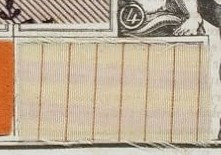
My comments: A very handsome fabric indeed—a sort of heavy cordedsilk, perhaps?—with a fine brown stripe…but what I want to know is how thewriter of this description thought fur should come into the picture. As alining, perhaps? I certainly can’t imagine a fur trim as we think of “trimming”,but a sable-lined waistcoat would be seasonable indeed!
What do you think of this month’s fabrics?
September 26, 2023
Attending the Revolution, in Sequim
 Washington State wasn’t even a glimmer in its namesake’s eyewhen Americans revolted against Britain. So, it surprised me to learn that thetown of Sequim, Washington (one of my favorite places ever!), hosts areenactment every summer (cancelled during COVID, of course). It has long beenon my bucket list to attend, so I was delighted when the event returned thisyear. My mother, who is a card-carrying member of the Daughters of the AmericanRevolution, joined me on the excursion. She’s as much a history buff (and loverof romances set in the nineteenth century) as I am.
The Colonial Festival is held on the grounds of the GeorgeWashington Inn, a gorgeous faux Georgian manor and bread and breakfast set on acliff overlooking the Straits of Juan de Fuca.

Dozens of reenactors as well asmembers of the local chapters of the Daughters and Sons of the AmericanRevolution host booths, and the reenactors have both British and Americanencampments. They also stage a skirmish with musket and cannons.

We couldn’t have asked for a lovelier day in terms of bothweather and company. Here are a few more shots.


If you’re ever in Sequim in August, be sure to join the revolution!
September 12, 2023
Happy birthday, Nineteen Teen!
 In September 11, 2007, Marissa authored our first post onNineteen Teen. We promised to talk about how teens lived in the 19thcentury (mostly 1800 to 1840 then and focused on England), our writing andbooks, and “other stuff.” Since then we’ve expanded. A lot.
We’ve now talked about teens and their older counterparts.We’ve shared information from the late 1700s to the early 1900s, in the U.S.and England. We’ve squealed about new publishing contracts and new directionsand new books. We’ve let you know about some astonishingly good deals.
Marissa’s given you fashion forecasts and displayed anddescribed fabrics from her extensive collection.
I’ve given you insights into real-world heroines from thetime period.
Marissa’s shared 33 posts of fun language I can’t wait touse in a book, or with my husband. 😊
I’ve taken you on the Grand Tour of Europe.
Marissa gave you insights into the Royal Family, from beforeVictoria to beyond.
We both led you through the various summer spots and beachspas of England.
We watched movies together; read books together.
We had some highly entertaining guest bloggers!
Along the way, we’ve answered your comments and questions,and tried to implement your suggestions.
Most of all, when this blog started, we promised to havefun. We have. Have you?
Happy birthday, Nineteen Teen!
September 4, 2023
The Best Kind of Summer Storm
I'm popping in a day early with a short post (lots going on this week with visiting family) to say this:
 Book View Cafe, the author co-operative publisher of which I am a member, is having its Summer Lightning Sale today!
All e-books in our store are half off today, September 4.
That means hundreds of books by Patricia Rice, Sherwood Smith, and two dozen other authors (including me) in multiple genres such as romance, fantasy, mystery, and science fiction are available at substantial savings. No codes or coupons needed: put books in your cart, and the sale price will show up automagically. Planning a fall weekend getaway? Stock up on reading material now. Wanting to explore some new authors? This is a great chance to maybe find a new favorite. Or just pop over and treat yourself to a fun read or two. Happy shopping!
Book View Cafe, the author co-operative publisher of which I am a member, is having its Summer Lightning Sale today!
All e-books in our store are half off today, September 4.
That means hundreds of books by Patricia Rice, Sherwood Smith, and two dozen other authors (including me) in multiple genres such as romance, fantasy, mystery, and science fiction are available at substantial savings. No codes or coupons needed: put books in your cart, and the sale price will show up automagically. Planning a fall weekend getaway? Stock up on reading material now. Wanting to explore some new authors? This is a great chance to maybe find a new favorite. Or just pop over and treat yourself to a fun read or two. Happy shopping! August 29, 2023
Guest Blogger Amanda Cabot Explains the Horrors of 19th Century Medicine
 Excited to have with us bestselling historical romance author, Amanda Cabot! You may have seen my glowing review for the first book in her series, Secrets of Sweetwater Crossing, After the Shadows. Amanda has learned a thing or two about medicine in the nineteenth century. I'll let her share more.
------
If you’re one of my longtime readers, you may have wonderedwhy a number of my protagonists are involved in the medical profession. Theanswer is simple: I’m fascinated – and yes, horrified – by the state ofmedicine in the 19th century, particularly the practice of heroicmedicine.
Heroic medicine. That sounds like a good thing, doesn’t it? Afterall, the hero of a novel is a good guy, so heroic medicine must be good. Thereality is, it was anything but good and was in fact considered to be one ofthe contributing factors in George Washington’s death. Yes, trusted physicians’attempts to heal him may have actually hastened the death of the father of theAmerican nation. Now that I’ve got your attention, let’s take a step back anddefine “heroic” so we can understand why that might have happened.
My dictionary has a number of definitions for “heroic”including “exhibiting or marked by courage or daring” and “supremely noble andself-sacrificing.” Those could apply to the heroes we all know and love. Butthere’s another meaning that’s less benign: “of great intensity, extreme,drastic.” That’s where heroic medicine comes into play.
In the eighteenth century and well into the nineteenth,physicians believed that the body had four humors – blood, phlegm, yellow bile,and black bile – and that disease occurred when one or more of them was out ofbalance. The goal of all medicine was to restore the balance.
How did they do that? If you’re squeamish, you might want tostop reading right now. There were five elements to heroic medicine: bleeding,purging, vomiting, sweating, and blistering. Any one of those sounds gruesometo me, but when you combine them with the fact that this was heroic in thesense of extreme and drastic, you realize that the cure might well have beenworse than the illness itself.
Bleeding was the most commonly used technique, and although ithad lost popularity in the eastern United States by 1860, it was still used onthe frontier. As you can guess from the name, the goal was to reduce the volumeof blood either by applying leeches (shudder) or by cutting veins and lettinglarge quantities of blood drain from the body (perhaps into the bleeding cup in the picture).
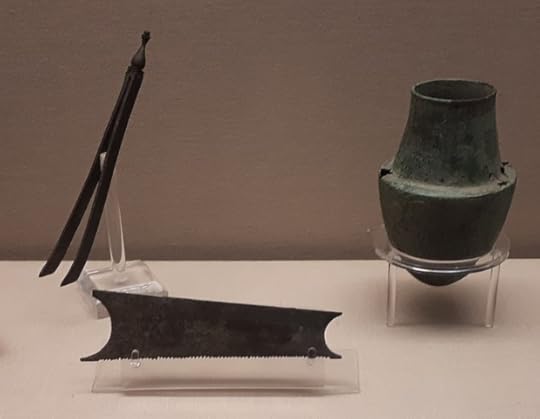
Next came purging, which consisted of givingthe victim … er, the patient … large quantities of calomel or jalap. You canguess what happened next.
If that didn’t work, the physician might try to induce vomiting,again by giving the patient ipecac and tartar emetics. In large quantities. Onceagain, I’m shuddering.
Sweating sounds as if it would be the most innocuous of theheroic procedures until you learn that it was induced by giving the patientDover’s Powder, a concoction of opium, ipecac, and lactose, which served as adiaphoretic. (I couldn’t resist including that word, since it was a new one forme. As you may have guessed from the context, a diaphoretic is a substance thatinduces sweating.) I’m still shaking my head over the fact that opium was usedso often, although considering the pain that must have been involved in theseprocedures, it was probably the kindest thing a doctor could offer a patient.
Lastly comes blistering. Hot plasters were placedon the patient’s body with the goal of producing blisters that could be lancedand drained. And, of course, since this was heroic medicine, it was done on alarge scale.
This was the world of medicine well into the nineteenthcentury. Even though new techniques were being introduced, there were stillold-timers who believed in the value of heroic medicine … or no medical treatmentat all. Add that to the fact that many residents – both men and women – didn’tbelieve that women should be doctors, and you have the dilemma that confrontsLouisa, the heroine of the second of the Secrets of Sweetwater Crossingbooks. She’s a midwife and doctor-in-training facing more than her share ofchallenges. Louisa’s story, Against the Wind, is scheduled to release onOctober 3 and is available for preorder at all the usual places.
Before I end this, I have a question for you. How do you thinkpeople will regard 21st century medical practices 150 years fromnow? Will they shudder when they read about some of our treatments? If yes,which ones do you think will disturb them the most?
Author Bio
Amanda Cabot’sdream of selling a book before her thirtieth birthday came true, and she’s nowthe author of more than forty novels as well as eight novellas, four nonfictionbooks, and what she describes as enough technical articles to cure insomnia ina medium-sized city. Her stories have appeared on the CBA and ECPA bestsellerlists, have garnered starred reviews from PublishersWeekly and Library Journal, were a Woman’s WorldBook Club selection, and have been finalists for the ACFW Carol, the HOLTMedallion, and the Booksellers Best awards.
For moreinformation about Against the Wind and buying links, click here.
And to sign upfor Amanda’s monthly newsletter and receive a special gift, click here.
August 22, 2023
Save a Bundle, This Week Only
 Okay, so I run sales once in a while. Maybe more than oncein a while. I love to see books flying off the virtual shelves! So, this weekonly, August 21 through 25, 2023, I am putting an entire series bundle on salefor 99 cents.
Gasp!
Shock!
If you haven’t tried the Spy Matchmaker series, this is yourchance. The three-book ebook bundle generally costs $9.99, so this is 90% off coverprice. What’s included in the series?
The Husband Mission (formerly published as LordBorin’s Secret Love). Lord Borin cannot understand why he’s under surveillance, but it seemsto be connected to the intriguing Katherine Collins. He’s been encouraged byEngland’s spymaster to marry, but what wife can compare to espionage? Unless, ofcourse, she’s up for a little espionage too. “I highly recommend thisbook to all romance readers who like heart-warming, unique love stories with delightfullyoriginal characters.” Romance Fiction Forum
The June Bride Conspiracy (once a novella, now afull-length book). England’s top intelligence agent Allister Fenwick, Lord Trevithan, isshocked when a mysterious stranger attempts to stop his marriage to the sweetJoanna Lindby. Though he promised to leave espionage behind, he must take thiscase. Can a little espionage unmask hidden hearts in time for a June wedding? ATop Pick from RT Book Reviews.
The Heiress Objective (formerly published as TheBluestocking on His Knee). Heiress Eugennia Welch is stunned when charmingCorinthian Kevin Whattling proposes marriage. Once a spy, Kevin is deep indebt. But as he tries to convince Jenny he is besotted, he falls for her. Whendanger threatens, can they trust each other to win a love greater than anyfortune? “A very entertaining story with a fresh approach.” Rendezvous
You can get the ebook bundle
Amazon (affiliate link)
Enjoy!
August 15, 2023
Show and Tell Again

Aren’t they?
 The silver one on the left is a dainty two and a half inches long, with the chain and ring for wearing adding another six inches. The ring and chain indicate that this was intended to be a dance card and not just a note pad. There is a tubular holder for a pencil, now missing, and six thin leaves made of what looks like bone.

And the filigree! I’m not sure if it’s sterling or not—there does seem to be a tiny hallmark on one edge—but the intricate looping is marvelous.
 The one on the right is four inches long and made of bone or ivory with silver edging (also hallmarked) all around on both covers and elaborate silver ornamentation with room for a monogram.

This one still has its tiny pencil for writing on the six bone leaves, which are held together by a silk ribbon woven through them. A delightful confection to carry to a ball…but what is even more delightful is the pencil inscription it still contains.
 Reading across the leaves, from the leftmost leaf to right, it says14th August 1897Wishing you many manyreturns of the dayHEPL
So some lucky young woman received this as a birthday present exactly 126 years ago yesterday. This inspires so many thoughts—who was she? Had she just made her entrance into society? Was it a gift from a family member, or a suitor? Did she treasure it so much that she refused to erase the message (there are signs that the other sides of the pages have been used and erased)? What do you think?


