Hal Young's Blog, page 39
March 25, 2013
Teaching Geography Inexpensively – and Effectively!
Several of our sons have done well in state-level geography bees, including one who ranked no. 2 for the whole state. When a public school teacher turned to Melanie in amazement and asked “What curriculum do you use?” she had to admit a dark secret … we seldom use a geography curriculum at all!
 So how do we help our children learn it?
Make it accessible: For years, we kept a world map and a U.S. map under plastic on our kitchen table (you can get tough, clear plastic in home improvement stores and fabric counters of discount stores). As we talked about current events over dinner, we’d simply illustrate them where we sat. “There’s flooding in the Hunan province of China. That’s over there, under the green beans.” One family we met had a world map which covered the wall of their playroom, from floor to ceiling!
Make it personal: Use your family’s history and your child’s experiences to make geography real for them. Our four-year-old son once stepped to a chalkboard and sketched a very accurate map of the eastern U.S. We were shocked! When we asked how he could do that, he told us a short story about each state, just like we’d told him: “Grandma and Grandpa live here, Uncle Stan lives here, this is where we went on vacation …” And he had learned the shapes from a jigsaw puzzle!
Make it memorable: Much of history is connected to geography, whether it’s the western expansion of the U.S., the military campaigns of Napoleon, or the growth of colonialism. We are fans of the novels of G.A. Henty, who wrote historical fiction with loads of geographical detail. Look for map clues in all your children’s reading and point them out – follow the Ingalls family in the Little House series, explore the lands visited in missionary biographies, trace the Mediterranean travels of the apostle Paul or the journeys of Marco Polo! And don’t overlook the maps in the back of your Bible – many of those countries, from Israel and Eqypt to Babylon and Persia, are frequently in the news today.
Make it fun: Kids love maps and globes. Get them! There are puzzles, games, memory songs and books galore, where geography is either taught or caught. All of these can be effective tools for sharing the outlines of God’s world!
Whatever you do, point out that knowing something of geography can be an opening for sharing God’s love with others. You may find, like we have, that most people haven’t even heard of Kyrgyzstan or can tell you where Saskatchewan is, but knowing geography can give you more opportunities for friendship and ministry than you may have dreamed.
“[God] hath made of one blood all nations of men … and the bounds of their habitation …”
Acts 17:26
Hal

This article first appeared in The Homeschool Minute, 3/13/13 … Photo “Map Reading” by Bart Groenhuizen
Need ideas for teaching boys without going crazy? Get our workshop recording, “Ballistic Homeschooling: Teaching Sons” for a pile of good ideas!


March 21, 2013
Putting Faith in Shoe Leather
 I know that God can, has, and will take care of us. I have seen the healing hand of God protecting and providing for us through every heartbeat, every breath, every moment, every day of the year. I know that God will be our strength, our fortress, our mighty rock – but do I believe it? My father fought Stage IV Hodgkin’s Lymphoma three years ago. When he was diagnosed, he had a tomato-sized tumour between his lungs, and spots of cancer and his lymph nodes, liver and spleen. The oncologists at Duke only gave Dad a 55% chance of making it until June – 6 months. Thankfully, the Lord saw fit to preserve my Father for a while yet, and Dad’s had two and a half years of clean scans. This week, though, his oncologist called with some disturbing news. He had been looking over the results from Dad’s last panel of blood tests, and they showed a higher level of a specific antibody that might indicate a return of Dad’s cancer. I’m struggling with my emotions again – I can barely stand the thought of losing my Dad. I have faith, but now it’s being tested.
My football coach often finished our team devotionals with an exhortation to put “Virtue in shoe leather”. It’s easy to talk about faith; it’s that much harder to walk in it. It’s easy to trust until we think our lives and happiness depend on it. A theologian said “We may have atheistic hearts without atheistic minds.” We can easily have a solid knowledge of something, based on experience and fact, yet still doubt that truth in our hearts. Is not that doubt evidence that we are short changing God’s power in our minds? Is it evidential of our thirst, our lustful desire for control – that we can’t stand the thought of placing our full trust in God because that equates to an admission that we can’t trust ourselves to take care of it?
Blaise Pascal, a French philosopher, once posited an idea that later became famous as “Pascal’s Wager”. Christianity seems like a collection of half-truths and fairy tales on the surface, he argued, but it makes logical sense to believe in it. After all, the Atheist has nothing to gain if he is right, and everything to lose if he’s wrong; conversely, the Christian has nothing to lose by being wrong, but everything to gain of he is right. True, merely deciding that it’s better to bet on God’s existence doesn’t foster true belief, but Pascal suggested that through that conscious decision to believe, and the constant affirmation and repetition of the idea the soul could be led to true belief. Thus, a man might become a Christian when he could have never brought himself to that point through regular paths. While I might disagree with Pascal’s stance on Salvation, I would suggest that his theory has everything to do with learning to trust God.
I think back to how I felt that spring three years ago when I thought my dad would die. My emotions swung from fear, to panic, to depression, to quiet hope. I felt like I was further lost than ever before, but somehow also closer to home. As a Christian, I knew that we had nothing to fear from death. If my father died, we would just be apart for a time, and he’d be in a far better place. For me, there’s no doubt about what will happen at the end of this mortal life – and absolutely nothing to be afraid of. It might sound selfish, but I was never afraid for my father; I was afraid for myself. I knew that whether the Lord chose to take him home at that time or not, that Dad would be okay. I was afraid that I wasn’t man enough to step into his place, to help provide for my family, or to hold my family together. I was afraid that I would be tested in fire and rather than come out purified, and tempered, that the heat and pressure would melt my resolve and destroy me. For one of the first times in my life, I really understood that I was being faced with an obstacle that I could never overcome by myself. I was a young man, barely old enough to work a part-time job, scared for the future, and overcome by doubt and fear. Yet, looking back, I see how God carried me – and my entire family – through that time. As 2 Corinthians 12:9 says, “My grace is sufficient for you, for power is perfected in weakness.” God used my weakness to show his power and complete a work of providence and healing in my father’s body and our family. During that period of stress, I learned a lot about responsibility, problem solving, and most importantly, trust.
Now, our future is once again filled with doubt and uncertainty. My dad is scheduled for a scan and appointment with his oncologist tomorrow morning. It’s been far too easy to let my overly-active imagination lead me down a depressing path of worry and fear. It’s right to be concerned, and to take all the logical steps indicated to remedy the situation – that’s why Dad’s having a scan tomorrow – but it’s wrong to let legitimate concern turn to paralyzing fear. There’s a lot of wisdom in the wartime poster the British Government created for distribution in case of a German invasion during WWII. In disaster/emergency response classes, they teach that the most important thing is to stay calm and focused, then isolate the problem, and respond appropriately – to “Keep Calm and Carry On”. So, now, when questions about my dad’s health are frantically awaiting answers, I still have a responsibility to stay focused on my duties. I know that, ultimately, the Lord will continue to provide for us, but my faithless heart still doubts. So, following Pascal’s advice, I’m repeating the assurances of Scripture that God will provide for and care for his people. As I feel alarmed or worried about what the test may show tomorrow, I find myself bringing the events of Dad’s earlier bout with cancer back to mind. I may have trouble trusting in my heart, but my doubts can be assuaged by remembering how God has taken care of me, time and time again. I have seen the healing hand of God, and I have no reason to doubt that whatever happens will be a part of His perfect will. Whatever tomorrow brings, be it life, death, or any other thing, I will trust in God. I know that there is nothing which is able to separate us from the love of God which is in Christ Jesus our Lord. I’ve probably talked long enough about doubt and uncertainty. It’s time to put faith in shoe leather.
“I have a sin of fear, that when I have spun
My last thread, I shall perish on the shore ;
But swear by Thyself, that at my death Thy Son
Shall shine as he shines now, and heretofore ;
A nd having done that, Thou hast done ;
I fear no more.”
~John Donne: A Hymn to God the Father
P.S. — Please pray that we would receive an accurate (and hopefully clean) report back from Dad’s scan.
Matthew Henry Young
(Hal & Melanie’s Son)

March 18, 2013
I Want to Give Up (But I Won’t!)
 Melanie has a recurring dream that she is back in college, final exams are approaching, and suddenly she realizes with horror that she’s been signed up for a class that she’s forgotten to attend all semester. Thankfully, that never actually happened to her, but that kind of panic feels pretty familiar sometimes.
We’ve had a few really challenging years in our homeschool as our family faced cancer, a baby in ICU, starting a new business and ministry, and so many other trials it sounds like bad fiction. There are days we’ve had that “What are we doing? What are we even supposed to be doing?” fear. Now, our children have always been homeschooled; it’s a commitment we made before the first was even born, so we don’t think, “Maybe we ought to put them back in school.” There’s no school in their past to go back to! That doesn’t stop us from having doubts and anxieties, though, does it?
So, what do you do when it seems everything is falling apart around you? Here are a few things we’ve learned along the way:
God’s curriculum for our children is often different than ours and that’s not just okay, it’s good. We’ve had to simplify and let extras go in our schooling at times, but the character and life lessons our children have learned are amazing and humbling.
God will stand in the gap. We’ll never forget the time we weren’t able to prepare our son as much as we’d hoped for the state National Geographic Bee. The historical novel he read the week before was set in the very location they asked him about. We have tons of stories like that.
Simplify your home and life. Fish sticks on paper plates won’t kill you, and if they leave you the time to teach and disciple your children, be thankful for them. We try to eat healthy, too, but sometimes you just have to survive. After all, it’s “Not what goes into the mouth defiles a man; but what comes out of the mouth, this defiles a man.” (Matthew 15:11 NKJV) In the same way, focus on getting the basics done in your school and add more as things get under control.
Suffering has purpose. Our trials have allowed us to reach so many hurting people because we’ve “been there.” We’re told to comfort one another in the way that we’ve been comforted (2 Corinthians 1:4) and we’ve found this to be such a blessing. Trust that this time is for your good (and your children’s!) and for His glory.
So, don’t quit! Homeschooling is about so much more than school. As your children watch you in the fire of trials, they’ll see your Christ just as when Shadrach, Meshach, and Abednego were thrown in the fiery furnace (Daniel 3). We wouldn’t have chosen to go through the trials we have, and Melanie often wishes it hadn’t taken such a toll on our schooling, but we can thank God when we see what it has done in our children’s characters. May the Lord bless your family the same way in your trials.
==========
For more on Just As I Am: Homeschooling in Hard Times, download our workshop by that title here: http://www.raisingrealmen.com/orders/ourstorealt/workshop-cds/on-family-life/
This article originally appeared The Homeschool Minute, 3/6/13 … photo “Tree On Rock” by Mitch Law
March 11, 2013
Preparing for College
 When we were thinking about high school and preparing for college with our first, we were worried about academics, but now that we’re graduating our third, we’ve realized there are other things, sometimes even more important, that you need to pay attention to along the way.
Teach your young adults to be responsibly independent. It’s easy for homeschooling parents, who’ve been on the job 24/7, to miss this one. We need to allow our children to make decisions and even to fail while we are still there to give advice and help them along.
Teach them to work independently. As your children progress to and through high school, you need to allow them to do more of the planning and be responsible for their own day to day work. This is something our sons reported a lot of college students weren’t able to do well, and their friends’ grades suffered because of it.
Help them to figure out their talents and interests. Many students go into majors that they have little aptitude for or little real understanding of what is involved in those fields. Career testing helps, as does shadowing others at work.
Teach them to manage money. Long before they leave home, they need to have a checking account and some form of plastic (a debit card, perhaps) and understand how each works. An awful lot of college students make financial mistakes that affect their future. VS: Because “they” was used in same sentence as a pronoun for kids or homeschoolers, I changed the second “they” because it was referring to two objects.
Prepare them to stand alone for Christ. Encourage them to study the Bible themselves and pray daily. Teach them to defend their faith. Make sure they are well-instructed in the areas likely to be challenged–creation, the dependability of Scripture, the uniqueness of Christ as the one way to reconciliation with God. Teach them of the importance of being in a church body and seeking the fellowship of other Christians. Help them to find a church and campus Christian group.
Homeschool graduates can and do succeed and can even thrive in college, but we need to understand that often they face even greater social and philosophical pressure than we did and we need to prepare them for it and support them in it. Let’s pay as much attention to releasing those arrows as we did to shaping them!
==========
Need some practical help in these areas? See our page of resources On Teens! We have practical resources to help you in academics, character, career testing, and college admissions. http://raisingrealmen.com/teens
This article originally appeared in The Homeschool Minute, 2/27/13
March 8, 2013
Risk and Reward
Most of us have been frustrated at some time or another by our boy’s love of risk-taking and adventure. They seem to do the craziest things and seldom think enough about them first. As a mom, I want to protect them and coddle them and keep them completely safe. What they need, though, is balance!
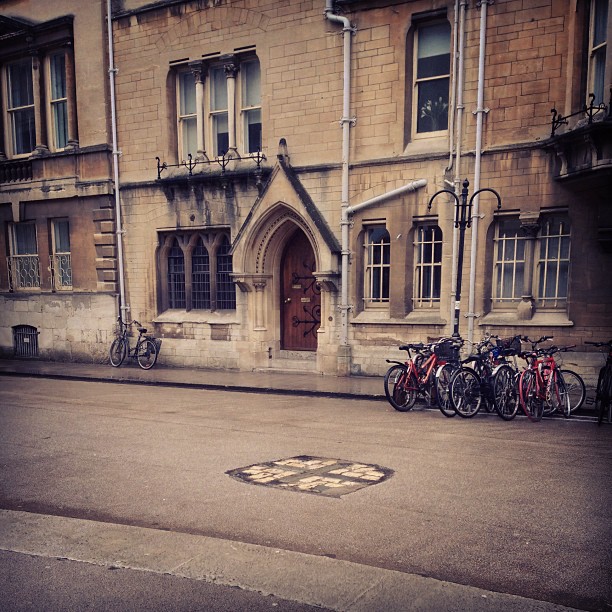
Martyr’s Memorial, Oxford by John Calvin Young
The stones in the middle of the street mark the site of the martyrdom of Latimer and Ridley.
You see, we want our men to be ambitious and bold, to take reasonable risks that will make them successful in life. A man afraid of risks will have difficulty finding a wife, succeeding in business, or reaching out for Christ. Unfortunately, boldness and adventurousness in a boy often looks like sliding down the stairs on a box lid. (Good thing his head was harder than drywall! It took awhile for him to earn the money to fix it, but he learned a little caution.) It’s our job as mothers to help them figure this out. We learn to bite our tongues and let them be adventurous and they learn to engage the brain before the body.
God made our guys adventurous, bold, and courageous. They need to learn to think before they act and to make sure the risk is worth the reward. Ultimately, they shouldn’t risk their lives unless it’s for something worth dying for.
I thought of this today when our eldest son, John Calvin, who is in Oxford, England this week posted a picture of the Martyr’s Memorial there. Hugh Latimer and Nicholas Ridley were godly pastors. Ridley was Bishop of London and was known for encouraging Scripture memory among his parishioners. Latimer, Bishop of Worcester, taught that the English Bible should be known among the people and that they should serve God from their hearts and not as a matter of outward show. He was known for visiting the prisoners in his area. These men, though, were protestants and their sovereign, Queen Mary, was not. They were sentenced to be burned at the stake.
The burning was bungled and the men suffered horribly. As he died, Latimer cried out to Ridley,
“Be of good comfort, Master Ridley, and play the man! We shall this day light such a candle, by God’s grace, in England, as I trust shall never be put out.”
And so they did. The light of their testimony impacted all of England, and Scotland, and influenced those who sought asylum in the New World, the Pilgrims and Puritans.
Now don’t misunderstand me. I have no desire for my boys to become martyrs! I don’t think any mother could. If God calls them to that, though, I hope they will glorify God like Latimer and Ridley. Those were real men!
Melanie
For more on reaching this balance, read our book, Raising Real Men: Surviving, Teaching and Appreciating Boys, 2011 Christian Small Publishers Book of the Year. There’s a whole chapter on this topic!
Shipping is free in the United States and APO, FPO addresses.
February 6, 2013
What Curriculum Do You Use? Preschool Plus Thirty-Three Classic Picture Books
This series of articles is in response to the question, “What curriculum do you use?” which we’re freqently asked. Read the first in the series here.
Preschool is a time when you can really hardly fail. You have years and years and years to make up for what you don’t teach. Unfortunately, though, we find it is one of the most bollixed times out there with stressed out parents and tired children. It is so easy to succumb to the race to prove your child smarter than all others. Or for fathers to panic, “How will they get into college?” I always think, “Hello. Reality check time. The child is THREE!”
 After shepherding eight children in this stage, here are the things we think of when we are deciding what to do in the preschool years:
We’re careful not to start too soon or too formally. Made that mistake with our first and we learned that you really don’t want your little student to burn out by seven! Don’t think by this that we are loosey-goosey folks that recommend you just wander through all their years schooling. Our oldest son went to a top 15 university on a full ride merit scholarship and studied at Oxford University. Just remember, though, you have plenty of time and these are not the years to push.
So, if we’re no pushing workbooks and formal schooltime on our preschoolers, what do we do? Let me tell you the story of Maria Montessori. You’ve heard of Montessori schools, right? Montessori developed her ideas in an effort to help the children in daycare have the same developmental advantages of those home with their mothers. That’s why you’ll see folding and polishing cloths, child-size brooms and mops, button boards and dishes in a Montessori school. You can have the most elite Montessori-type school in your area right there in your own home. It’ll be so elite you have to be born into it!
The key is to begin discipling and teaching intentionally. Instead of “Run along and play while I fold the laundry,” try “Look, when I fold this square washcloth in half, it becomes a rectangle. Fold it again and it’s a square. Here, you try one!” In the same way, teach basic math casually in real life. “Honey, put the forks on the table. How many will we need? Grandma and Grandpa are coming.”
On the way to the courthouse to pay your taxes, talk about why we pay taxes (both practically and Biblically), about government, government services, democracy, the mayor and the town council and more.
It’s really just a matter of grabbing hold of your role as your child’s foremost teacher. Look for opportunities to share, to talk, to discuss. This makes a tremendous difference in teaching them to love learning and giving them the basic background that makes it easy. Let them work alongside you. It’s okay if it’s not done perfectly; you’re raising an eternal soul, not a house. All those lessons we learn following our mothers around – diligence, patience, love of beauty, creativity, obedience, orderliness, and more – are the foundations for learning.
It’s also a great time to begin memorizing. We love the Catechism for Boys and Girls for its simple, clear introduction to theology:
“Who made you?” “God made me.”
Books? This is the time to buy books for yourself. Learn all about the different philosophies of homeschooling. Subscribe to a homeschool magazine. Grow in the Lord. It’s also a great time to start collecting all those fantastic classic picture books and to read them aloud (again and again) to your children. Here are some of our favorite classic picture books:
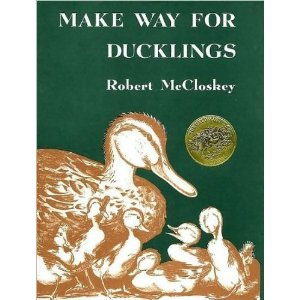
Make Way for Ducklings by Robert McCloskey
One of our all time favorite books, this sweet story of the travails of Mr. & Mrs. Mallard will leave you longing for Boston’s Public Garden.
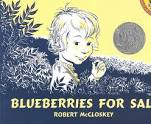
Blueberries for Sal by Robert McCloskey
The parallelism between the adventures of Sal and the bear cub make this story so funny! Notice the expressions on the mother’s faces.
Goodnight Moon by Margaret Wise Brown
This weirdly wondeful book captures so well the delaying tactics of those avoiding bedtime. Still a punchline in our house. “And a little old lady whispering HUSH!”
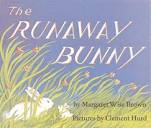
Runaway Bunny by Margaret Wise Brown
Deals with those confusing emotions of wanting to run away from your “mean” mommy, but also wanting to know you never can, that her love will always follow you.

Freight Train by Donald Crews
Donald Crews does a wonderful job of illustrating the sounds and speed of that boy-favorite, the freight train.
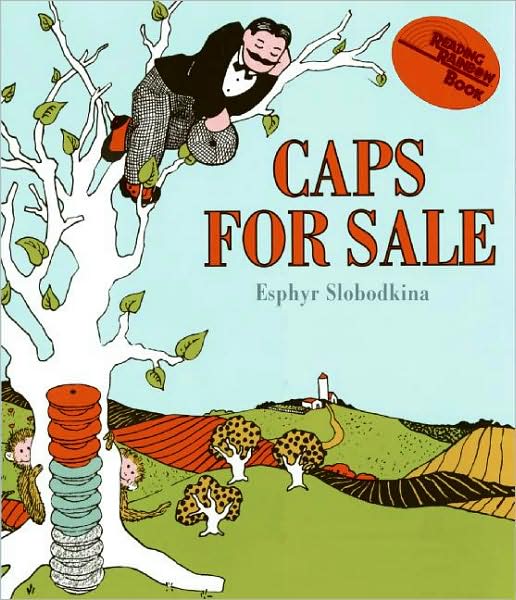
Caps for Sale by Esphyr Slobodkina
Another odd, but wonderful book, you can hardly help but be delighted with the antics of the monkeys when they swipe the caps.
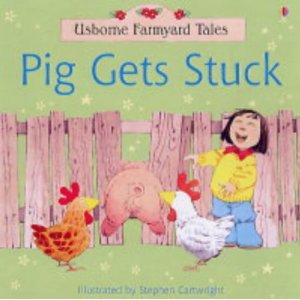
Pig Gets Stuck by Stephan Cartwright and Heather Amery
The illustrations in this book are so fun as we see Pig learn the lesson of contentment.

The Story About Ping by Marjorie Flack
Teaches an important lesson that taking your discipline is way better than the alternative.
Brown Bear, Brown Bear, What Do You See? by Bill Martin
A fun book that teaches reading comprehension and listening as the children anticipate the next animal.
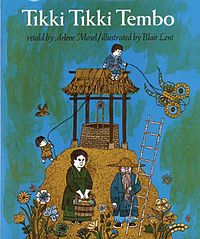
Tikki Tikki Tembo by Arlene Mosel
So, so funny to read aloud, especially if you get into the story and read fast when you are supposed to. A lesson the advantages of humility.
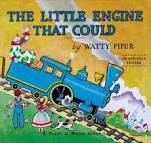
The Little Engine That Could by Watty Piper
Oh, this books gets old fast, but the children never, ever tire of it!

Cordoroy by Don Freeman
You’ll fall in love with the little bear with the loose button.

Katy and the Big Snow by Virginia Lee Burton
A great story about a snow plow that finally gets her chance. A natural way to learn about maps.
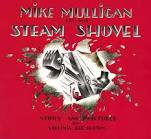
Mike Mulligan and His Steam Shovel by Virginia Lee Burton
An exciting story about usefulness. We’re always so happy to see Mike and his steam shovel find a place to fit in.
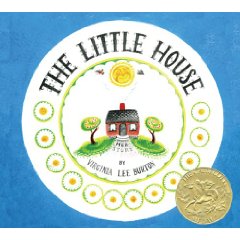
The Little House by Virginia Lee Burton
Another great story about adjusting to change.

The Tale of Peter Rabbit by Beatrix Potter
Get the original illustrations and enjoy this classic with your children – and see Peter suffer the consequences of his foolishness.
Winnie the Pooh and the Honey Tree by A.A. Milne and Ernest Shepherd
Hunt until you find the original words and illustrations. The Winnie-the-Pooh books are delightfully witty and much more complex than the Disney adaptations. Teach your children to love words!
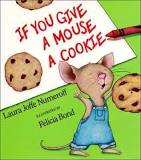
If You Give a Mouse a Cookie by Laura Numeroff
Does your child ever act like this book? Mine do! Once you’ve read this, head off the “gimmees” by just saying, “Ooooooh, it’s give a mouse a cookie, is it?” with a great big smile.
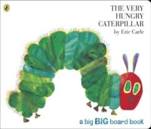
The Very Hungry Caterpillar by Eric Carle
Delight with your children in the caterpillars prodigious appetite and miraculous change.
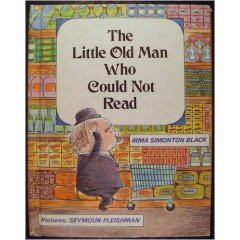
The Little Old Man Who Could Not Read
Great motivation for persisting no matter how hard it is! An all-time favorite around here.
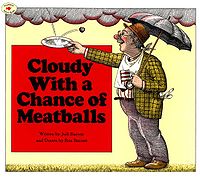
Cloudy with a Chance of Meatballs by Judi Barrett
This is one of those wonderful “what if” books. So much fun to think about food falling from the sky — remind your children, that once upon a time, God provided manna!
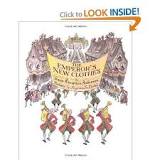
The Emperor’s New Clothes by Hans Christian Anderson
In a world where all too often the emporor is naked as a jaybird, your children need to understand that just because “everyone” says it, it ain’t necessarily so. 
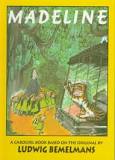
Madeline by Ludwig Bemelmens
The rhythm and pace of this story is delightful!
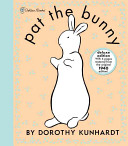
Pat the Bunny by Dorothy Kunhardt
A toddler classic, your little ones will never forget touching Daddy’s scratchy face.
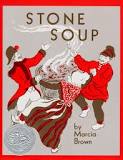
Stone Soup by Marcia Brown
Another great commentary on civilization.
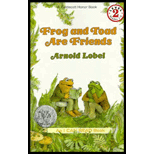
Frog and Toad are Friends by Arnold Lobel
One of those you may tire of, but your children won’t. They love the repetition of “That is not my button!”
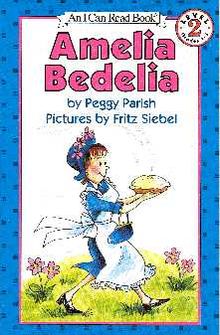
Amelia Bedelia by Peggy Parish
Poor Amelia Bedelia’s misinterpretations of her orders are hilarious.
The Napping House by Audrey Wood
A sweet and funny book about a whole houseful of family napping.
The Ugly Duckling by Hans Christian Anderson
A reassuring story, particularly for little girls, that things are not always what they seem.
Where’s Spot? by Eric Hill
Children delight in opening the flaps and crying out, “That’s not Spot!”
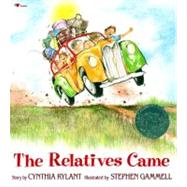
When the Relatives Came by Cynthia Rylant
A wonderful story about the pleasures of a visit with extended family.

Monkey in a Lion’s Skin (A Jungle Doctor Picture Fable) by Paul White
Love, love, love the Jungle Doctor books, all of them.
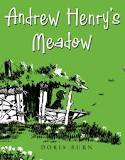
Andrew Henry’s Meadow
Although you have to explain to your children that running away isn’t the answer, I think all children fantacize about having a house all theirs, just like they want it. A favorite from my childhood.
One set of books that will help you think of easy and natural ways to begin teaching phonics and math to your children is The Three R’s Series by Ruth Beechick.
Enjoy these short years. I really believe that lots of reading aloud and lots of interaction with mom and dad while they work beside you is the very best preparation for school there is. Those that grow up with a love of learning and the character learned at mom’s knees will be lifelong learners!
Cherish these years!
Melanie
For more on making the preschool years count, download our workshop, Homeschooled From the Beginning: Teaching Your Little Ones
January 31, 2013
So, What Curriculum Do You Use?
Folks ask us all the time, “So, what curriculum do you use?”
Let me begin to answer by telling you a story. Many years ago, one of my dear friends asked me the same thing as she began homeschooling her children. I was happy to tell her because I believed I’d found the very best curricula in each subject. It was only when she called utterly frustrated months later that I realized my error. Her children hated the programs we loved and so did she! What could be the problem? As we talked more, it became obvious to me: Her children were as quiet as mine were outgoing, as cautious as mine were bold. They could hardly be more different. That curriculum that required learning crazy songs was meat to my guys, but poison to hers!

“Okay,” I thought, “each family’s different. What works for one family won’t necessarily work for another.” I became a lot more careful about recommendations. Then I learned another lesson.
When I started teaching our oldest Latin, I did a lot of research and chose what looked like the best elementary Latin curriculum out there. Never mind that it was the only one. He took to it like a duck to water, so when other programs came out, I wasn’t even tempted. Then his younger brother got to be that age. He just couldn’t get it. It was like a foreign language to him.
He hated it and I finally started looking for something else. I found another program he just loved and I thought, “Wow, that first program really fooled me. This one is so much better!” Then the third son came along. He hated that program then hated the first, and neither seemed effective with him. I began looking for another program and found one he loved. This time, though, I was finally beginning to get a bit of wisdom, “Oh…Each child is different!” I know, it took me awhile. Know what? I also figured out some of our guys really weren’t ready for Latin in elementary school, either!So, I’m just not comfortable telling other families what is best for their children. Every family, every child, and every year is different. Some years, we’ve needed simpler things because we are struggling with health or business issues. Some children need more hands on, or more audio, or more reading. Look around a lot, try different things, keep what works. That’s the important part. Don’t let it make you uneasy if “everyone” is using something different than you are. If everyone is using the same thing, probably half or even three-quarters or more would do better to use something else. Besides, next year “everyone” will be off on another fad.
I will share with you, though, the principles we use to choose curricula. Maybe these principles will help you find the right things sooner. Check in tomorrow for principles for the preschool years and I’ll keep posting over the next few days until we get to high school.
See you next week!
Melanie
For more information on how to incorporate research and experience in the differences between boys and girls to make your homeschool more boy-friendly, get our workshop recording, Ballistic Homeschooling: Teaching Boys!
For instant download, click “Return to The Great Waters Company” after you have paid to be taken to an instant download page, or you will be sent an email with download links and codes.
January 30, 2013
Internet Safety and Accountability: Visiting the Big City
If you wouldn’t drop your son or daughter off in New York City or Shanghai to explore on their own, you need some kind of supervision for their internet use. The internet is just like a large city – there are fantastic museums, libraries, and churches, but there are also red light districts, gambling parlors, and criminal hideouts. It’s a place your children need to visit, but safely!
 We highly recommend Covenant Eyes. We have used them as a family for years and have actually visited their facility and talked to their staff. Here’s what we like about them:
You can very cheaply get everyone in your house who has internet access their own login – that means no way for someone to claim, “It was somebody else!”
You can install it for no extra charge on as many computers and devices as you like–even grandma’s–making sure you aren’t leaving any chinks in your armor. You can even install it on Android and iPhones.
 It has accountability only options
, so adults are not limited in their searches (Melanie is a lactation consultant by training and still helps moms occasionally. Her searches would bring on bells and whistles in most filter programs though they were just about feeding babies!)
Accountability only options are best for older teens who need to learn to say, “No! I won’t click on that,” *before* they are out in the world.
There is also a filter option *and* you can add it only on the logins that you want to – so a younger teen can be filtered, and an older one has only accountability. If you’ve heard us speak or read our book, you know we *love* step by step growth in responsibility because it helps prevent disasters!
The reports are super easy to read. In fact, if there’s no question, you don’t even have to open the email because the subject line will say, “Such and such’s report looks good!” Time saved! If there’s something questionable, it’ll say, “Such and such’s Report Needs Review” or “Such and Such’s Report Needs Urgent Close Review” then when you open them it shows you only the things that might be a problem (not pages and pages of returns). The report even tells you why that site might be a problem and tells you how many similar things they went to. As parents of many, with six people old enough to be on the Internet, we just *can’t* wade through pages and pages. We love this part!
You can adjust the sensitivity of the reports, too! If you find it’s notifying you about things you don’t care about, such as pinging for someone old enough to go to YouTube or Facebook responsibly, then you can adjust the sensitivity so it won’t notify you of things like that! Click on the sample report on the right to see a report up close.
It is a fantastic service and the heart of the people running it is just right – let’s work together to protect the purity of our children and train our young people to live righteously in a world without filters – for the Lord’s sake!
If you want to try it out, you can use the promo code raisingrealmen or click on this link and get a month free. If you decide to go with it, a portion of your fees as long as you use the service will help to support our ministry. That’s not at all why we said it, though, it’s because this is the program we’ve used ourselves for years before we even began writing this blog or speaking!
Yours in the battle,
Hal & Melanie
For more about keeping your son safe and helping him seek righteousness in a depraved world, get our workshop recording. Shining Armor: Your Son’s Battle for Purity, and our book, Raising Real Men.
If ordering downloadables, click “Return to the Great Waters Company” after you’ve paid for instant download
or check your email box for download codes.
January 29, 2013
Character-Building Books for Boys
Someone just recently asked on our Facebook page:
Do you have a list of book recommendations for building character and vocabulary? My son reads about 200 to 300 pages a day and I cannot keep up with the previewing.
We had the same question when our oldest boys were younger. They could race through books while we were desperately trying to find time to preview the next, then nag unceasingly sweetly ask, “Are you done yet? Can I read it yet?” Arrrggghhh! The few times we just handed them a book, “Whatever,” when they were young we later found things we wished we’d talked about with them first. (By the way, if you find a great book that has just a few questionable things in it, feel free to use stickers and black markers to Bowdlerize it, or make a note something like this at the end of a chapter, “Come talk to me when you get to this point. We need to talk about what this character said about his behavior.” It’s not Holy Writ – it’s a kid’s book!)
Just as we’ve benefited from the recommendations of likeminded parents over the years, here’s our list of great character-building books for boys:
 G.A. Henty novels – G.A. Henty was a war correspondent and historian who began telling stories to his own children over a hundred years ago. His novels are based very carefully on historical events. Great for learning history, geography and how to be a man. There are dozens of them and your guys should read them all! They are challenging reads, though, so for many boys, they are more enjoyable in audiobook form. We love un-abridged audiobooks because that challenging vocabulary and sentence structure builds reading comprehension and mental strength. You can now buy those here in our store, we’re the only authorized resellers of our favorite audiobooks. Click here to get them. The only caveat at all we have is that he used the language of his time and a few words have changed meaning or value over the years. Just tell your guys to bring you anything that doesn’t sound right (and you can mark through it or change it!).
Sugar Creek Gang series by Paul Hutchens – Based on his life growing up with six brothers, the Sugar Creek Gang is a great way to show your boys what it means to be a Christian as a boy. Fun, funny, and enjoyable, these are an essential part of childhood in our family. We don’t like as much the new series by Pauline Hutchens Wilson and Sandy Dengler – they are updated to fit modern culture and lose much of the charm. These are aimed at younger guys than the Henty novels. We love the audiobooks for listening to in the car. Our friends at Beloved Books carry them.
 Jungle Doctor series by Paul White – These are absolutely fascinating! The account of a missionary doctor in Tanzania, these books are very respectful of the indigenous peoples without pulling punches toward their enslaving false religion. Boys will love the grosser aspects of life in the bush. Exciting, funny, and engaging. Ages 7 or 8 and up. Some stories are more alarming than others so reading aloud is great if younger children are around. Our friends at Grace & Truth Books carry these.
Childhood of Famous Americans series – Tells the stories of the childhood of many of our American heroes. Our guys just love these at about 8-10 years old. There are a very few about folks I don’t consider heroes. Some are out of print, some have been reprinted.
Landmark series – A most remarkable series of books about history written for children. The thing that makes them great is they asked real adult experts on each subject to write them. Irresistable. A very, very few mention evolutionary ideas – the ancient history ones. Some are out of print, some have been reprinted.
Little Britches series by Ralph Moody – The poignant, entertaining story of a boy whose father dies after they move to the West and how he helps support his family and then himself. He doesn’t always do what’s right, but he learns better! Great read alouds! There are some things you will want to discuss with your children, particularly after Ralph grows up, but still great.
 Hero Tales from American History by Theodore Roosevelt (yes, the President) and Henry Cabot Lodge - written specifically to teach virtue and character through the stories of America’s own heroes. We loved these so much, we turned them into audiobooks. They’re a little challenging to read (written over a hundred years ago) so we added sound effects to keep their attention. Nothing like cannonfire and angry French mobs to keep boys tuned in. You can get these here at our site, too. Click here to get them.
Swiss Family Robinson – Make sure you get the unabridged version; it was written by a pastor to entertain and teach his children and the full version is incredible. A terrific read aloud.
Robinson Crusoe – Get the unabridged version for your older sons to read. Did you know the original version begins with Crusoe’s repentance and turn to God? It’s terrific! A more challenging read, and more suspenseful than Swiss Family Robinson.
 Sir Knight of the Splendid Way by W.E. Cule – An allegory along the lines of Pilgrim’s Progress, but more accessible to younger boys. They’ll love it. Available at Grace & Truth Books.
Pilgrim’s Progress by John Bunyan – When we first handed this to one of our sons, we expected it would be too difficult for him, but he read it in a couple of days and still talks about it years later.
Narnia series by C.S. Lewis – A childhood classic in our home, it’s great to read aloud or discuss after each book so they don’t miss the allegory! We don’t let them watch any movie version until they’ve read the books.
The Phantom Tollbooth by Norton Juster – An amazing math allegory; Join Milo, an apathetic young man, as he journeys to strange lands by way of a magic tollbooth, encountering Tock, a watchdog, a divided kingdom, unabridged kings and Mathmagicians, small giants and large midgets, Kakafonous Dischord and his Awful Dynne, Spelling Bees and Humbugs as he endeavors to return Rhyme and Reason to the fair city of Wisdom. A fantastic and funny story, much loved by our guys.
The Space Trilogy by C.S. Lewis – Really not science fiction at all, but more allegorical fantasy, this one is probably better for your older teen sons as deeper meanings abound. A favorite of our guys – they enjoy enjoy discussing them!
The Cowboy Sam books by Edna Walker Chandler – For the youngest readers, these limited vocabulary cowboy stories are guaranteed winners. Out of print. If you see them, buy them. And sell them to us if you don’t love them!
The Billy and Blaze books by C.W. Anderson – Just a tiny bit harder than Cowboy Sam, these books will drive a reluctant brand new reader to try his best. Great.
And if they read all those, they’ll have some great stuff tucked away in their minds! Got any additions to our list?
Hal & Melanie
January 24, 2013
If Mopping Floors Isn’t Manly, Why Do They Call Sailors Swabbies?
“I never ask my son to do housework! That’s a woman’s role, so the girls do that. He only does outside chores,” a friend once said. Uh oh! Melanie thought, I’m sunk. We didn’t have any girls back then, just a not-so-neat dad and a houseful of very active and thoroughly messy boys. Actually, though, we’ve found plenty of Biblical warrant for men doing “women’s work” as the old saying calls it. What we might call housework, men did in Scripture. Men cooked for themselves, family, and colleagues (Genesis 18:7, 27:4; 2 Kings 4:38, 2 Chronicles 35:14-15). They were bakers (Genesis 40:1, Hosea 7:4). They were weavers, tailors, and even made decorative textiles (Exodus 35:30-35, 39:1). They were laundrymen, or at least, washed their own clothes (2 Kings 18:17, Mark 9:3, Leviticus 11:25). They might even be caring for a baby or young child (Numbers 11:12, Isaiah 29:43-43).
So, how do you get them work around the house?
Make it manly. Mom, you look cute and domestic in a gingham apron with lace trim; your son will not. How about a Tabasco apron, instead? Buy the heavier gloves without flowers on the cuff. Get cleaners which smell powerful — pine oil and bleach beat lilac when the guys are working. Instead of asking, “Honey, please make the kitchen pretty for me,” you’ll get a lot more response if you say, “Son, rescue me from that kitchen! I need you to conquer that nasty mess!”
Give them a goal. Boys, like their fathers, tend to focus on one thing and overlook the rest. Be specific – your goal may be “Three full loads, washed, dried, and folded” instead of “Wash some clothes.” Make it a challenge: “I can finish the dishes in fifteen minutes.”
Inspect, don’t just expect. If they know you probably won’t check on them, they probably won’t finish the job. We’re all sinners – follow up!
And be sure to explain that housework is mission essential. On a ship or in an army, there are tasks which just have to be done–troops have to be fed, sailors have to have uniforms, the decks need swabbing to keep them safe for action–to make the fighting possible. (Did you know canned food was invented to supply Napoleon? After all, he’s the one who said “An army marches on its stomach” — that is, it will only be as effective as its logistical support.)
Your family has a mission, too, and every job is important. David rewarded the soldiers who guarded the baggage, not just the swordsmen and archers (1 Samuel 30:24). Make sure you really appreciate the housework – no matter who does it!
So, do your guys do housework? What kind of chores do they do?
Hal & Melanie Young
For more on getting boys to do chores, see our book, Raising Real Men. The chapter called “K.P. isn’t Women’s Work” has lots of ideas! You can buy it below or click here for more information.
This article was first published in the September 19, 2013 edition of The Homeschool Minute. Thank you to aeropw for the perfect picture!