Hal Young's Blog, page 37
August 21, 2013
Strangers, Mamas, and True Hospitality
It was terrible timing. We were just 15 minutes from the church where we were speaking that night and we were running late. We were in the “turn here, go two-tenths of a mile and bear to the right, then make an immediate left” part of the GPS directions. We’d just driven through and grabbed some fast food on the run. When I opened my sandwich the phone rang. “We’re okay,” he started. That’s the way you start a call in our family when there’s been a catastrophe, but no one is dead. Uh oh. “The car died.”
 “Where are you?”
“I’m not sure. Somewhere between near …”
And we had to go. We had just barely enough time to set up and speak. Thankfully, there were two of them together. Matt’s big brother took off work to ride with him to meet us at his new college. We gave him the phone numbers of friends that lived within a couple of hours, posted what we knew to our Facebook page and did what we had to. It was awful stepping up there to speak, knowing the boys (They’d laugh at me calling them that, but they’ll always be our boys!) were on the side of the road over 160 miles away and not even knowing if they had anything to eat or drink. “If you can’t get any help, we’ll race over there just as soon as we’re done, but we probably can’t leave before 10.”
I prayed someone would help them.
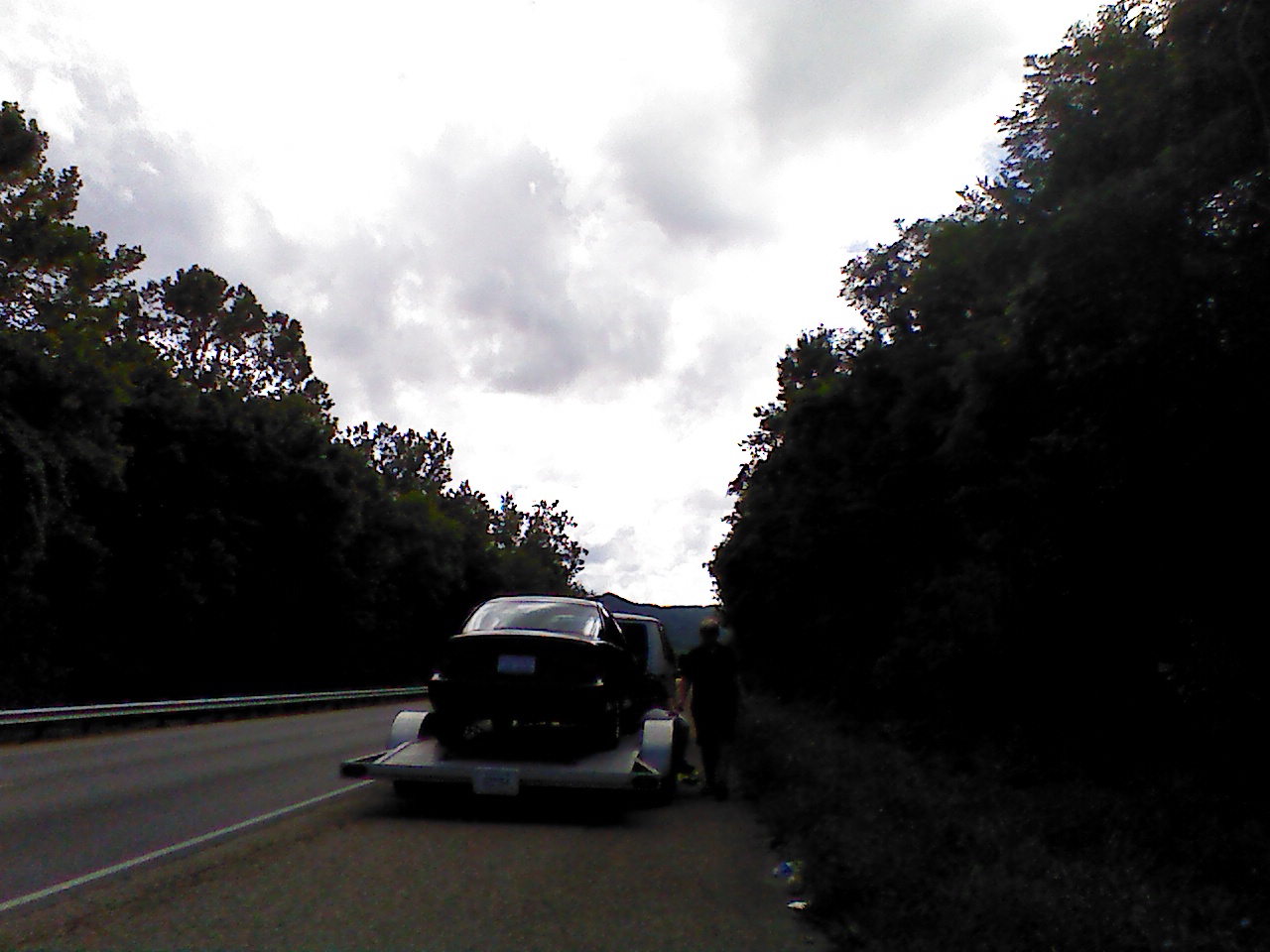
 Thankfully, they had landed next to a family farm. The men of the family came down and tried all sorts of things to get them going, including pulling the car up a hill with a tractor to try to roll start it. Nothing worked and Matt and John Calvin were in despair. The car, bought after a long summer earning money, was Matt’s first and he’d only had it a week.
They talked about how they wished they’d stopped for food earlier when they first talked about it. After awhile, a long car purred down the hill and stopped next to them, a little elderly lady rolled down her window and said, “I’m Aunt Helen. I brought you some food.”
We allow each of our children to hate one food — they don’t have to eat that one at all, but must eat a reasonable portion of anything else. Matt’s has always been mayonnaise. He can’t stand the stuff. When they’d slurped some ice cold sweet tea, they opened their sandwiches and took a bite. Matthew turned to John, “You know what? This sandwich has about three tablespoons of mayonnaise on it and it tastes wonderful.”
 When we went to pick up his car, I had to go thank Aunt Helen face to face. She stopped me with a hand on my arm and tears in her eyes and said, “You don’t understand. Back in March, my son was moving back to Virginia from Denver, Colorado. A huge snowstorm came and they started turning people back to Denver. In the confusion, his huge U-Haul truck ran into the ditch. It was cold and snowing and no one could even get to him to help. An elderly couple walked down from their house and took him in – fed him and kept him safe and warm. I was thrilled to be able to do something for your boys like someone had done for mine.” Before long, I had tears in my eyes, too.
Blessed be the God and Father of our Lord Jesus Christ, the Father of mercies and God of all comfort, who comforts us in all our affliction, so that we may be able to comfort those who are in any affliction, with the comfort with which we ourselves are comforted by God. 2 Corinthians 1:3-4
Thank you, Aunt Helen. Thank you, thank you, thank you!
Melanie Young


August 14, 2013
Doing What’s Most Important
 This week we’re seeing another one of our (not-so) little birds leap out of the nest and try his wings on his own. It’s time to take another young man to college for the first time. It’s times like this that make me so thankful we homeschool. He and I have both struggled with our emotions a bit as we’ve driven all over shopping for the last minute things. We’ve become really good friends, as well as mother and son, in the last couple of years when he’s been the senior brother at home.
When we get back, we’ll start back to school with the children still at home. Every time we help a child launch from home, though, we come back changed. The years seem to have just flown by. The time we have with our children is so brief – what is really important?
Do you ever have a day when you feel like pulling your hair out? Or, jerking your children bald-headed? Would you believe those are really the best days of homeschooling? Well, maybe not the best, but the most important?
I remember a day when homeschooling completely collapsed. One of the boys got caught (doing what isn’t important – now) and needed some serious instruction and counsel. The other children ran absolutely wild and did no school whatsoever while we focused on the needs of just one of them. It wasn’t the last time, either. But that day may have changed the course of that child’s life as he came to repentance and decided to change. Those heartbreaking, nerve-wracking days when you get to the end of the day and have nothing tangible to show for it are the days that you might have made the biggest difference in the spiritual realm.
 Our children always groan when they see us reach for our copy of For Instruction in Righteousness. We do that when we find ourselves saying, “They’re always ________.” That’s a sign we have a problem we need to address, so we call a meeting, have everybody grab a Bible, and using FIR, read through what God says about bickering, or sassing, or lying, or whatever the topic of concern is. It’s amazing to see those once-groaning children spontaneously apologizing and reconciling when the Word is driven home in their hearts. Then we’re reminded that really is the best way we could have spent our time.
Discipleship takes time. You can’t schedule “quality time.” Teachable moments come at the most inconvenient times. Melanie remembers walking way from a cart full of groceries to take a child home who needed some correction regarding behavior in the supermarket. I guess he didn’t think she’d do it, but he was wrong. That took a lot of extra time, but that little boy never threw another tantrum in public again.
That’s the beauty of homeschooling. It’s not that our children are better educated. Better education wouldn’t mean much to us if our children were becoming adults that grieved us. It’s that we have time – lots of time – to spend with our children. We can use that time to do the really important things – even if it means we don’t get math or spelling done that day because we were teaching character and virtue at the time it was needed, even if the house is a wreck because we took that time to go somewhere with our teens, even if we get to the end of the day bald-headed.
Yep, it’s worth it.

Yours in the battle,
Hal & Melanie
If you have nine to twelve year olds and life seems like one constant battle,
you might be blessed by our LIVE, online interactive webinar series Boot Camp 9-12, starting in just a few days.
Register now while it’s on sale, click here!
Many thanks to Doc of Stock Exchange for the adorable yellow bird!
August 12, 2013
Homeschooling on a Budget
 Boy, do we ever understand homeschooling on a budget. For the last six years, as we’ve fought cancer, coped with a baby with a heart condition and more, all of our budgets have been of the shoestring variety. We’ve found limited finances can be a blessing in disguise, deep disguise maybe, but a blessing anyway! It’s made us more creative, and given us opportunities we might have forgotten to seek out.
For example, as we’ve struggled with finances, we’ve had to do things ourselves we might otherwise have hired out. What an opportunity to teach your boys life skills they’ll need when they’re starting out! Once our kitchen cabinets were getting very grubby-looking and Melanie was getting more and more sick of them. One of our sons, who was 12 or 13 stepped up and said, “I’d like to paint them for you!” Uh oh! What if he messed them up? Well, he’d be hard put to make them look actually worse than they already did and after all, paint can be, well, painted over. So, we said, “Sure, go ahead!” He took them off the hinges, sanded them down and did a quite respectable job painting them with a little direction. Any mistakes were easily fixed and the lessons of initiative and diligence were a lot longer lasting than paint!
To save money last year, Melanie pulled out a history curriculum she’d used many years ago with the older boys. We had all the books handy, so there would be nothing to buy, even if it wasn’t as jazzy as something new. What a blessing it turned out to be. Reading those same stories again brought back so many happy memories that sometimes the high schoolers would drop in just to hear them again. We all enjoyed it so much, and so much more than we would have something new and unfamiliar. It became a shared experience for the little children and the grown ones that we didn’t expect.
Those unexpected blessings have taught us to welcome our limitations. They humble us and they teach our children and prepare them for life. One of ours said, “I’m thankful we’ve had hard times. It’s taken away my fear of not being able to support a family. I know the Lord will provide in whatever circumstance I’m in.” Now that’s a lesson worth learning!
Hal & Melanie Young
This article was originally published in The Homeschool Minute.
Many thanks to sulfinawaz at Stock Exchange for the photo.
August 8, 2013
Boy Secrets: School – What to Do About the Wiggles?
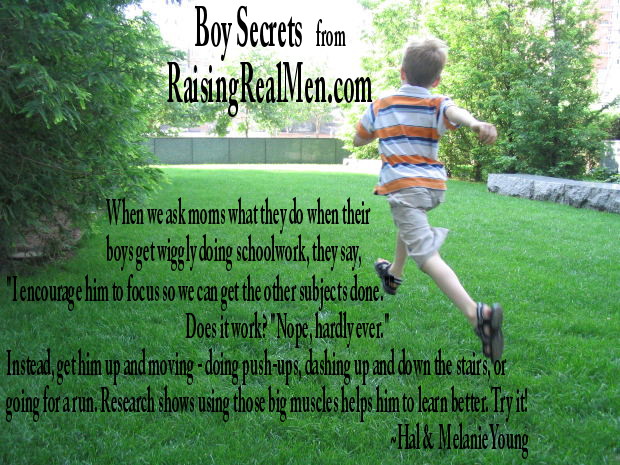
This is one of the hardest lessons for a mother of boys to learn. We just think, Buckle down for a little while and we’ll be done. Why can’t you just concentrate for a few more minutes?
What we’ve got to remember is that after a certain point, it’s taking all his energy and concentration to just sit still — there’s nothing left to learn with!
If instead, we tell him to “Give me ten on the stairs!” or “Do ten push-ups” or something else active, his blood gets pumping, he wakes up and he sits back down ready to learn. Research confirms it.
We used to be afraid that we were rewarding his wiggling with a break, but soon found that if we didn’t take a break, we didn’t keep working, either. We just both got more and more frustrated.
God made boys energetic because one day they’re going to have to be able to work hard all day to support their family and still come home with the energy to love his wife and children, lead his family, work in his church, and minister in his community. That takes a lot of energy! We need to work with it, instead of just wishing they’d be still. Try it!
Yours in the battle,
Hal & Melanie Young
For more on how to how to have a boy-friendly homeschool, get our workshop, “Ballistic Homeschooling!”
August 2, 2013
We Have a Winner! Excelerate Spanish goes to….
 So excited to announce a winner for the full Excelerate Spanish curriculum! Erin Kelly is our winner and we hope she’ll enjoy using it! We’re looking forward to trying it ourselves. With an emphasis on movement, it looks like a great curriculum for those active boys. Check it out at Excelerate Spanish’s website and like them on Facebook and Pinterest.
July 31, 2013
Boy Secrets: Laundry

Do you have any great laundry tips for raising boys? If you have boys, you’ll need to remove bloodstains, grass stains and neon stains you can’t imagine the source of! 
July 30, 2013
Hope When You Feel Like a Homeschool Failure

Have you ever wanted to leave a homeschool magazine unopened because it just reminded you of your failures?
Or felt sad instead of excited when you saw a homeschool catalog?
We’ve been homeschooling for nearly two decades. I’ve been that mom that was shirt-popping proud of my children and our homeschooling. I’ve also been that mom that hated to even think about the word homeschooling because it was so laden with guilt and sadness for me. How can that be?
We’ve some rough times along the way, like the year that our newborn had a life-threatening heart condition and spent weeks in ICU … and we wrote a book and marketed it … and three children had surgery … and we found out Hal had stage IV cancer. All. In. One. Year. We were in permanent survival mode that whole time and truthfully, school took a back seat. I didn’t think we’d ever get our feet under us again.
So, what do you do when the thought of homeschooling makes you feel like a failure?
Remember that God’s curriculum for your child may not be the same as yours. When I look back on those times when we were just surviving homeschooling and everything extra went out the window, I can also see so much that our children learned that wasn’t part of our plans. They learned how Christians respond to trials, even the threat of death. They learned how to draw together as a family in a crisis. They learned how to care for, comfort, and support people in need. They learned to step up to the plate and be responsible for more than they dreamed they could. They learned what God wanted them to learn.
Remember that God is longsuffering. His mercies are “new every morning.” There is forgiveness with Him. He is faithful and just to forgive us our sins. If you haven’t been as faithful to homeschooling your children as you should have, if you’ve been distracted by Facebook, or doctor visits, or goofing off, or illness–whether a little bit guilty or a lot, confess to Him all that is on your heart and just ask for forgiveness. His blood covers this, too, my sweet friend! Whether your fault is little or much, forgiveness is available from Him. Trust in Christ. Confess your sins and accept His forgiveness because of what Jesus did on the cross.
Remember we serve the God who is able to restore the years the locusts have eaten. You have more time than you think to make up what’s been missed along the way–especially if your children are younger. Homeschooling is flexible and your children are not locked into a school system’s calendar. It’s much, much easier for us to catch up lost time than a student who missed classes in a schoolroom setting. But when I read the passage in Joel, I’m reminded that God’s restoration came in response to Israel’s repentance. Let’s not miss that part; it’s not enough that we feel regret, God intends for us to change direction and go forward. Also, He doesn’t always remove the earthly consequences for what we have done. We may have to work hard to catch up in some areas, or to apologize for missed deadlines, or whatever we may have dropped along the way. But God is able to bring things back into order, to restore them, to make them better. As we came out of our year of trials, I remember asking one of our college-bound sons for his reading list to share with his applications. I was stunned at what he brought me: he had read far more than I would have assigned to him, and all on his own initiative. The family’s crisis had made him realize his education was his own and that ultimately, it was up to him to engage the learning process for himself. God is so good!
Pick yourself up and start anew today. I have this recurring nightmare that I’m back in college, it’s finals week, and I realize I’m signed up for a class I haven’t attended all semester. I don’t know why that’s such a horror to me, but I often feel that way in crisis: “I’m supposed to be in control of this thing and I have no idea what I’m doing or even what I’m supposed to be doing!” Stop. Take a deep breath. Start fresh.
Once we’ve laid any sin or failure at the foot of the cross, walk away from it and get busy doing what you were supposed to be doing. I have a tendency to beat myself up over my failures. That just paralyzes me with regrets and keeps me from working to do right. Instead, leave the past with the Lord and begin again today like it was your first day. Don’t worry about where you wish you were, but find out where you are and start there. What would you do in the coming year, given that you have the children you have, at the age they are, with the gifts and challenges they have, and where they are academically? Okay, that’s where we start.
Raising our children is so much more than spelling and math. Academics are important, of course. They’ll need those things as they grow to adulthood. What really matters, though, is the kind of people they grow up to be. What kind of character do they have? Are they walking with God? Those lessons in character and commitment aren’t the kind which grow out of packaged curriculum; they come from watching and working through the struggles and challenges of life. They are the stuff of discipleship.
We’ve made a lot of mistakes over the years, but God has mercifully and graciously given us adult sons who love Him and serve Him. It is amazing to see what God can create from our own pitiful efforts, our dismal failures, our inadequate attempts to follow Him. He is so good.
Starting right now, begin again and work hard to homeschool in a way that will leave you with few regrets (recognizing that God will stand in the gaps) … but work harder still to disciple your children, because that will leave you with the fewest regrets of all.
By His grace alone,
Melanie
If you are going through difficult times, our workshop, Homeschooling in Hard Times, may be a blessing to you. You can order it below in CD or in mp3. To download the mp3 immediately, click “Return to The Great Waters Company” in the lower left when you finish checking out.
July 27, 2013
Pushing Mama Up a Mountain
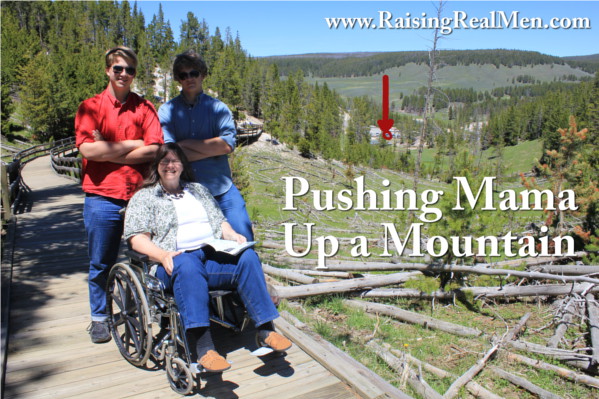 I was so excited about taking our children to Yellowstone National Park. I’d been there with my family as a child and some of the happiest memories of my father, who’s been in heaven many years are centered around that area. Unfortunately, I tore a ligament in my knee on one of our conference trips and the conference lifestyle (three days standing on concrete and four sitting in the van) wasn’t very conducive to healing. It got so bad that Hal bought me a wheelchair on Craigslist in the middle of one conference, so I reconciled myself to doing a lot of sitting in the van reading while Hal and the children hiked around and saw the sites. After all, I’d seen it before, right?
We reached the Mud Volcano area and I explained my plan.
Enter my teen sons. They absolutely insisted in pushing me along with the family. “It wouldn’t be the same if you weren’t there, Mama.”
But, there was this huge mountain… everyone we passed said, “You’ll never get up there with that wheelchair. It’s too steep!”
“Oh yes we will. We’ll carry her if we have to,” they said. And they meant it, much to my alarm!
It’s really hard to imagine just how steep it was and you could feel the heat from the geothermal vents in the ground, so it wasn’t easy. At one point coming down, one had to hold the handles and the other walk backwards holding on to the front of the wheelchair to keep me from careening down the mountain. They’re football linemen, though, big, tough guys and they liked the challenge. If you don’t think it was a challenge, take a look at the photo with the title on it again. See the red arrow? Follow it down. See the red circle? Look in the light center of the circle. That is a full size van! We are really, really high!
In the midst of the fun, I couldn’t help but think about my teenage years; about how badly no one wanted to be seen with their parents. It shames me to think of the contrast between my attitudes at that age and our boys, willing to make a spectacle of themselves to be with me. What’s the difference? I was raised in a Christian home, too, and I was taught to honor my parents. The difference is that pretty much everyone sent their children to public or private schools then and it doesn’t take long for a child to realize that their peers have more influence on their happiness or misery day-to-day than their parents. It’s sad, but my peers even made me ashamed of my very wonderful parents for a time.
I’m glad we’ve had the privilege of homeschooling our children. We don’t keep them isolated from the world by any means, but neither are they at the mercy of their peers for days on end before they are strong enough to do what’s right even if it hurts.
We had a wonderful time, laughing together and wondering in amazement at the variety of God’s creation in Yellowstone. It was a visit I’ll cherish as much as the time with my father. We aren’t perfect parents and we don’t have perfect children. They get disrespectful, and ornery, and lazy, too. Mostly, though, they are a blessing and a joy to us, one of the greatest pleasures on earth. Thank you, Father, for the incredible gift of our children. We’re so thankful for them!
And thank you, Matt and Sam, for pushing Mama up a mountain! It was fun!

Melanie
What have your children done lately that just amazed you and made you thankful? Let’s hear it for our children (and the God who gave them to us)!
July 19, 2013
Teaching Languages
This weekend we were at the HINTS Conference in Charlotte and I happened to have the most interesting conversation with Caryn Hommel of Excelerate Language. I thought I’d come back over and interview her so you guys could hear from her, too.
Hi Caryn, tell me again why you believe the way most language programs work isn’t really effective. I took three years of French in high school and don’t remember more than “Bonjour!” Basically, there are four components to traditional textbooks in any foreign language: Structure and Vocabulary, Lame Dialogues, Drill (Which many call kill and drill because they kill you with drill) and Cultural Notes. Then the books are dressed up with beautiful pictures and lots of busy to make it pretty. The order might vary but all those components stay the same no matter whether it is a Christian company or a public school textbook publisher. The reason why this doesn’t work is because there is a natural order of acquisition of language and that methodology doesn’t honor basic principles of brain functioning. They are learning about Spanish, but they are not learning Spanish.
 So, tell me what does work? What’s natural?
The way we acquired language as children is natural. We are designed to acquire language. We used all of our five senses in the process, from birth. We were designed to learn language because God wants to communicate with us. From the beginning, we are surrounded by language and experience it with all our senses. We aren’t expected to produce language in the beginning, but we begin to develop a mental graph and understand the language. We begin to respond non-verbally, then our ability builds into short answers and in sentences, paragraphs and finally won’t shut up! This all occurs without any formal grammar teaching, no flashcards, no formal instruction. Instructors can help us in the same way our parents do – by using caretaker language: simple words, lots of repetition, slower speech.
So, how did you develop your program?
When I began homeschooling my children I picked a traditional Spanish curriculum well-known in the homeschool community and invited some friends to have their middle school age children join my children to learn together. After three weeks, I gave the children an assessment and despite my best efforts, our good student-teacher ratio – and their hard work and attention, their results were very low. I was dismayed and they were frustrated.
I began looking into alternative methods, beginning with TPR: Total Physical Response. TPR has been around since the 1980s and was the brainchild of Dr. James Asher, a prominent brain researcher. Dr. Asher discovered that children with no previous exposure to Japanese were able to respond appropriately to complex and varied commands in Japanese after only a very few hours of instruction when taught by a fluent Japanese instructor who modeled his utterances with gestures and physical movement, which the children then imitated as opposed to reproducing the verbal utterances themselves. They were not expected to repeat what he said. So, I decided to this, pulling together private classes of homeschool students for TPR-based lessons weekly for an entire school year. Their attitudes, their ability to respond appropriately, their comprehension level were all so superior to anything I have seen before that we were all overcome with joy! We were smiling, we were laughing. They felt successful, confident and happy. This was radically different from our previous results.
What happened next?
 The next fall many of those same students returned for more classes, but I sensed that they were impatient to do more, that they were rearing to go in learning the language. They needed something more than what we’d been doing. I would have lost them if I’d kept doing the same thing, so I pulled one of Blaine Ray’s books off my shelf, one I’d never used, and gave his ideas a try. We used TPR for the vocabulary, then we acted out a completely crazy story.
When the students use their bodies, it causes their motor cordices to light up. When they do stories that engage their emotions, that uses the limbic system in the brain. So, we use Total Physical Response Storytelling, also known as Teaching Proficiency Through Reading and Storytelling. It’s a very natural, fun way to learn and it is very successful in building mastery and retention.
What age do you recommend your materials for?
I’ve taught classes using this material from ages six to adult. My younger children don’t do the workbook. Every child will pick it up according to their age and ability level. The main thing with younger children is to stop instruction before they get tired. Stop it and wait for later while they are still excited. On the other hand, with older children, I would feel very comfortable giving Spanish I credit.
We haven’t tried it yet, but this looks like a great way to teach boys – very active! We’ll be reviewing Excelerate Spanish in the next few months here, but in the meantime, Caryn has graciously offered to let us do a giveaway!! That’s right, one winner will win the ENTIRE EXCELERATE SPANISH CURRICULUM, DVDs and all! It’s a $149 value!
Have fun!
Melanie
July 3, 2013
Happy Independence Day!

Won’t you join us tomorrow in celebrating the glorious heritage of liberty in our country? Click here for our free guide to Independence Day Celebrations!