Hal Young's Blog, page 34
January 27, 2014
Explore Nature This Spring: Shining Dawn Books Giveaway
To enter these giveaways, join us for our free LIVE webinar, Ballistic Parenting: Surviving and Appreciating Boys on Monday, January 27th at 3pm Eastern OR download the workshop and listen any time before February 3rd. Register free here!
 Spring will be here soon…hang on! The Early Spring NaturExplorers Bundle includes Animal Signs, A Fungus Among Us and Remarkable Rain. This NaturExplorers bundle from Cindy West will help you to explore each of these exciting aspects of the spring season in-depth.
Early spring is known for its wonderfully rainy weather, leading to lots of beautiful fungi. It’s also the season when animals busily go about their regular activities after the relative quietness of winter. This bundle will help you to explore each of these exciting aspects of the spring season in-depth.
Learn more about each separate study by clicking the links below, then come back to this page to purchase your discounted package.
A Fungus Among Us
Animal Signs
Remarkable Rain
Add Cindy West of Shining Dawn Books on Google+
Follow the author Cindy West of Shining Dawn books on Pinterest
Follow Shining Dawn Books on Facebook


January 24, 2014
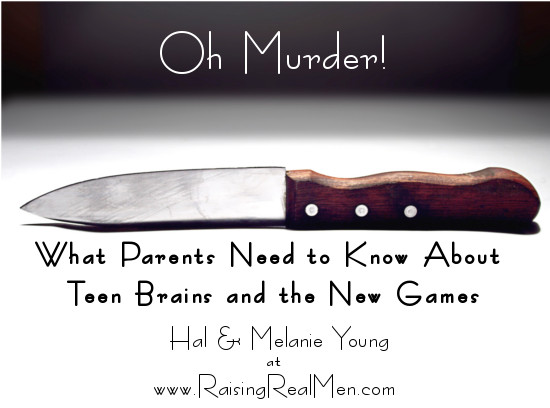
Oh Murder! What Parents Need to Know About Teen Brains and the New Games
The first night of Boot Camp 9-12 is always so entertaining. We start off by describing the early signs that your child is entering puberty (and no, peach fuzz and a cracking voice are actually late signs). We talk about how kids in that stage start having huge emotional swings, from rage to tears, get all addle-brained and can’t get their schoolwork done, and become very judgmental about anyone’s sins but their own.
The hormonal surges of puberty cause emotional ups and downs like PMS, only we call it Pre-Manhood Syndrome when it happens to the guys! The good news is, they are growing up and they’re going to turn out to be really neat people. The bad news is you may all want to jerk each other bald-headed before it’s done. When parents hear all this confusing behavior is normal – and won’t last forever, their relief is palpable.
It’s not just their interaction with us that is at issue, though. While our young people are going through these emotional changes their brains are changing. The pre-frontal cortex that regulates the emotions is developing throughout the adolescent years. We shouldn’t be surprised to find out teens struggle to manage these strong new levels of emotion before their brains are entirely prepared to deal with them.
Knowing that, we are pretty concerned to hear about a new turn in video game development that emphasizes engagement of the player’s emotions as if the game were reality. A prime example of this is DayZ, a multiplayer, zombie apocalypse game that’s sold a million downloads since it was released a month ago.
Now, if you’ve read our stuff for awhile, you may know that we generally don’t have a problem with recreational (as opposed to addictive  ) gaming. We just have to make sure that:
We recognize that God’s law is still valid in the virtual realm (sin is not ever acceptable) and
Our use of it is proper and healthy (gaming three hours a day while duties go undone is not healthy).
Games like this one, though, violate both of those standards.
The game was designed to engage the player emotionally in the same way as if the action were happening in reality. To accomplish that the designer incorporated permadeath, the idea that a player would only have one life in the game and would lose everything if they lost it. Add in a kill-or-be-killed storyline, in which characters have to take supplies from others to survive, and marauding zombies and you have a game designed to induce you to experience fear and loss.
This can be seriously problematic for teens that are already dealing with hormone-induced emotional storms, but when we add in the developing status of their brains, it becomes much more concerning. Games with a significant negative (fear, loss) component simulate trauma and trauma has a real effect on their development. Considering that teens already seem more susceptible than adults to the addictive nature of the dopamine cycle that gaming provokes in their brains – encouraging users to seek more and more intensive stimulation, games of this nature seem like a bad idea.
Consider the testimony of one player, irr1449, on Reddit.
As soon as I realized what I had done, I felt horrible. This wave of grief ran over my body…I took it away from him in a second and he didn’t even see me coming. We were not in a firefight and he wasn’t threatening me. I just shot him in the back…Then the worst thing happened. I started to rationalize my kill. “Well he probably would of tried to kill me.” “Well it’s only fair, I’ve been killed 10 times by players like him.” “It’s only a game.” Anything I could think of to make myself feel better.
He goes on to say,
It also shows you how people can do horrible thing to others as long as everyone is doing it. (Think Nazi Germany). How every time you kill someone that feeling of remorse and grief is a little less painful until one day you feel nothing at all.
This game trains you to detach your actions from their consequences.
This game is truly a murder simulator.
That’s quite different from a game like Call of Duty where players pretend to be soldiers fighting for their country and the opposition characters are clearly enemies that pose a threat. One situation is moral, the other is not. That makes a difference even when it is all pretend. After all, 1 John 3 tells us that even to hate someone is the sin of murder, “ Whoever hates his brother is a murderer, and you know that no murderer has eternal life abiding in him.”
Parents need to help their teens understand why some games are okay and some are not. Explain your rationale, help them to see your concerns, give them the Biblical viewpoint. When you talk to them as adults-in-training, there are several benefits:
Obedience. They are much more likely to comply with your standards when they understand you have thought this through and are acting in love for them.
Protection. Understanding your concerns gives them a basis for defending their actions (not playing that game) to their friends.
Preparation. Working through the decision-making with you models how they can make wise decisions as a Christian themselves.
And that’s the goal, isn’t it? To raise men and women of God who make wise decisions based on His Word.
How do you handle gaming in your household? What do you do if your children want to play a game you’re not sure about?
 Yours in the battle,
Hal & Melanie
For more real-life, practical help in raising godly sons,
Get our book,
Raising Real Men
or sign up for one of our LIVE, interactive webinar series,
Boot Camp 9-12
(for parents of nine to twelve year old boys)

(for parents of younger boys).
As a bonus, please join us in our First Ever FREE LIVE Event Online

January 22, 2014
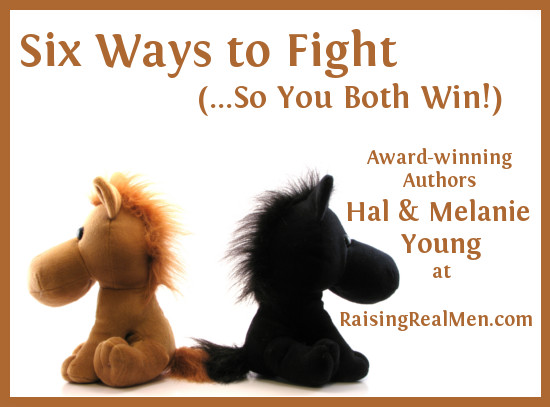
Six Ways to Fight So You Both Win
Conflict will come to our marriage. It might be small things like who leaves toothpaste trails in the sink or it might be earth-shaking conflicts that endanger your relationship, but conflict always happens when two sinners unite. So, what makes the difference between marriages that stay the distance and those that fall apart?
Mates that stay together – and enjoy it! – often have ground rules for conflict in their marriage. Here are ours:
Eliminate the Nuclear Option
Mutual Assured Destruction was a questionable strategy for the Cold War, all it does in marriage is destroy your family. Agree right now that divorce is not an option. “If you leave me, I’m going with you,” is the way we put it. When you commit to staying together no matter what, you stop storing up ammunition against each other, dragging out conflicts (because sooner or later you’re going to have to make up), and stop thinking of everything as mine or yours (you know, just in case).
No Cluster Bombs
Cluster bombs are a munition that breaks up into a bunch of explosive shells and just targets a huge area. Have one fight at a time! Don’t throw in all the other things that annoy you or talk about the last time he or she did this. Instead focus on the one thing you are in conflict about and it will be much easier to work it out.
No Assassination
Our children often answer, “What’s the problem here?” with the name of a sibling. Nope. Not true. And neither is your mate the problem. That means no name-calling, no character attacks, no disrespect or nastiness. Remember, this is the one you will grow old with and “sticks and stones will break my bones will never hurt me is a lie.” Words hurt. Badly.
No Extended Campaigns
We read early in our marriage in Ephesians 4, “do not let the sun go down on your wrath,” and decided we wouldn’t go to bed angry. That means we’ve had quite a few really late nights, but it also means we haven’t had much bitterness, either. When you let conflict drag out, you brood over it and it gets bigger and more dramatic. Deal with it quickly.
Victory is Not the Goal
When two people are one flesh, when one wins, they both lose. It’s hard to wrap your mind around it, but the goal shouldn’t be winning the argument, but instead restoring the relationship, and discerning what God wants you to do as a family. When we take our eyes off of the offense and focus on reconciliation it changes the whole thing.
Forgive like God Does
One of the most concerning verses we can think of is “And forgive us our debts, as we forgive our debtors.” Do we really want God to forgive us as we forgive others? We’d better start forgiving like He does! How is that? “If we confess our sins, He is faithful and just to forgive us our sins and to cleanse us from all unrighteousness,” we read in 1 John 1. Jesus paid the price for our sin on the cross and when we trust Him to forgive us, God promises, “For I will be merciful to their unrighteousness, and their sins and their lawless deeds I will remember no more.” How can we do any less?
You see where this is going. Maturity. Getting over it. Taking your relationship seriously. Doing what’s right. That makes conflict a lot less a war and more a fight you can both win.
Yours in the battle,
Hal & Melanie
For more on making even a good marriage great, get our brand new book,
My Beloved and My Friend:
How to be Married to Your Best Friend Without Changing Spouses

Tabitha Zehner at The Homeschool Four: “I’ve read a few marriage books ~ no, actually I haven’t. I’ve purchased a few books, read a few pages, got bored with them, and got rid of them. My Beloved and My Friend is different than all those other marriage books I’ve come across.”
Mrs. White at Legacy of Home: “The tone of the book is open, friendly, conversational – mixed with some powerful lessons, and incredible insight.”
Candy Foote at Strategic Shopping: “One of the things I really enjoy about the Youngs is how they always make you feel like you are one of their long time friends that has just stopped by for coffee and conversation.”
January 15, 2014
What’s The One Most Important Thing?
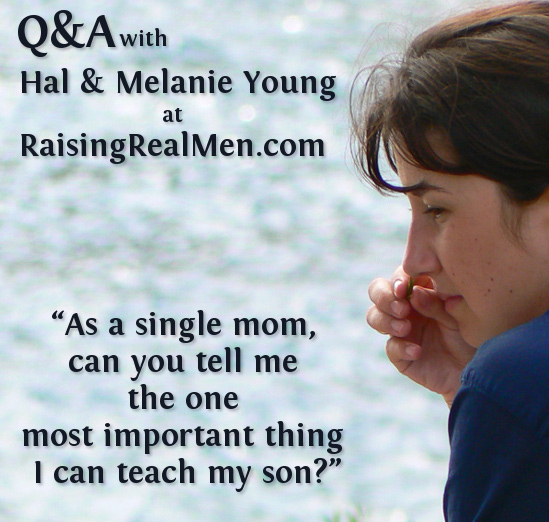
We recently reached a milestone online – our Facebook page Raising Real Men has gathered 20,000 fans. In the discussion that morning, one of our readers asked, “As a single mom, can you tell me the one most important thing I can teach my son?”
I have thought about that myself. When I had my cancer diagnosis a few years ago, I asked myself, If this is the beginning of the end of my time on earth, is there anything I want to be sure that my children have heard? I was really thankful that Melanie and I had finished our book on raising sons, so that whatever happened to me or her, our children would understand what we were trying to accomplish in their childhood. But was there anything else?
Part of the answer to that question was our second book, My Beloved and My Friend. We have been so blessed in our marriage, we wanted to share what we’ve learned in nearly thirty years as a couple.
But the best thing is to go back to the Scriptures. Are there any really succinct statements of what’s most important? Something you can easily reference and recall?
When Jesus walked in the Temple courtyard the week before His crucifixion, a scribe asked Him, “Which commandment is the most important of all?” Jesus answered,
“The most important is ‘Hear, O Israel: The Lord our God, the Lord is one. And you shall love the Lord your God with all your heart and with all your soul and with all your mind and with all your strength.’ The second is this: ‘You shall love your neighbor as yourself.’ There is no other commandment greater than these.”
(Mark 12:28-31, ESV; see Deuteronomy 6:4-5 and Leviticus 19:18)
 There are many other summary statements in the Bible. My theme for this year is Micah 6:8 –
He has shown you, O man, what is good;
And what does the Lord require of you
But to do justly,
To love mercy,
And to walk humbly with your God?
To me, that’s a reminder to do my duty with integrity, responsibility, courage, and diligence; to care for my family and other relationships with gentleness, humility, and love; and above all, to live in conscious obedience to the direction and guidance of my Heavenly Father.
Solomon wrote a dissertation on the pointlessness of worldly philosophy and empty pursuits—he had tried them in abundance—and finished the book of Ecclesiastes with an even briefer statement:
Let us hear the conclusion of the whole matter:
Fear God and keep His commandments,
For this is man’s all.
(Ecclesiastes 12:13)
What I’ve told our children is that we will do our best to prepare them to do whatever God calls them to do in life, but we will not measure their success in terms of academic achievement, wealth, recognition, or status. The one most important thing is that they learn to know and love the Lord Jesus Christ, and if they will serve Him and follow in His Father’s pathways, the rest will sort itself out.

Yours in the battle,
Hal
For more help in raising godly sons, get our book, Raising Real Men: Surviving, Teaching, and Appreciating Boys. It’s not just theory or principle, it’s real, practical help in a readable, conversational style from the parents of six sons. Shipping is FREE!
January 6, 2014
New Electronics and Temptations
 On tonight’s episode of Making Biblical Family Life Practical, we are discussing all those new electronics that our families got for Christmas. How can you make sure these are a positive influence in their life, not a dangerous one.
Here are some resources we are going to be talking about.
Covenant Eyes. Get it. Put it on all your devices. Honestly, don’t put this off. You wouldn’t drop your children off in Shanghai to find their way around, would you? Use our link to sign up and support this ministry.
Boot Camp 9-12: Getting Geared Up for the Teen Years, a live interactive webinar series for parents of nine to twelve year old boys.
Marriage Retreat Online, the only live marriage retreat that you don’t need to get a sitter for!
Statistics on internet purity (rather, the lack thereof)
Download our workshop on purity for boys, Shining Armor: Your Son’s Battle for Purity
A Christian Perspective on Gaming Addiction
Blog posts on these topics:
Grand Theft Auto V and Hoods In Training
Would You Leave Heroin Around the House?
Miley Cyrus, MTV, and Why It Matters (A Lot) to Christian Families
Internet Safety and Accountability: Visiting the Big City
When the Red Light District Is in Your Living Room
Two Rules Would Have Saved Paterno
From Facebook:
Playstation 4 and Live Twitch.tv danger (look in comments for link to lock it down)
January 1, 2014
When Bickering is Out of Control
A friend asked recently:
Ok ladies, it’s time for me to do some major/drastic behavior boot camp in this house. I am committing to staying home for several days, going nowhere and do nothing but set straight some major behavior issues we have here. I need some advice, though…How do I handle/tackle my 4 and 6 year old who fight CONSTANTLY all day, everyday? The tease each other non stop. They fight, yell, scream, hit, bite one another. They cannot seem to get along.
Here was my response:
 Here are a few thoughts from an older mom who has felt just the same way so many times over the years… and still does!
First, children need to be held to account. They need firmness and discipline and consistent standards. We’ve got to tell them what to do, give them little chunks they can manage and hold them accountable when they don’t. Be *sure* to differentiate between rebellion (which must be dealt with swiftly and firmly) and irresponsibility and childishness, which needs more natural consequences. For example, a whiny child may not be allowed to speak for a minute, then the second time he whines he can’t speak for two minutes, etc. That addresses the issue right at the heart – if you want attention, get it the right way or you can’t get it. On the other hand, a child who bites his brother has got to be punished.
Also, though, children desperately need you to delight in them; to light up when they come in the room, to hear that you love them, to hear that you like them and are grateful God put them in your family. This is the number one difference I see between Christians with rebellious teens and those with happy teens. The ones with happy teens do a great job of loving *unconditionally.* It’s super hard when they are acting like brats, but it’s even more important then.
You’ve got to praise progress, too. If they make any movement in the right, virtuous direction, praise it. They will work hard to earn your praise, but we tend to reserve it too long, praising only for perfection. Hint: We never reach that.
For bickering, some things that are particularly helpful are:
1 When they are speaking in an ugly way to each other, make them repeat what they’ve said until it’s the right words said with the right tone of voice with the right facial expression. If you can do this in a cheerful, smiling, but persistent way, all the better. Just say, “Let’s try that again,” until they get it right.
2 Use role play to show them how to handle conflict. The Young Peacemaker is wonderful for teaching this. Sometimes they really, seriously don’t know what to do. Make sure they do know.
3 Make them partners. Give them a task to do together. This is especially good if you can find something they really want to do, something that is a treat. That way they will want to work together to do it more than they want to fight.
4 Don’t allow name-calling. I always heard “Sticks and stones may break my bones, but words will never hurt me,” when I was growing up. It is a lie. Words hurt much worse for much longer than physical pain. Don’t let your children hurt each other this way.
5 In severe cases, making them stick together (using a ribbon or string between their belt loops, for example) for a time can make them madder at you then each other. :-) Seriously, eventually the humor of it gets to the most incorrigible bickerer.
6 Finally, those who provoke their brothers until a fight starts need to be punished as seriously as those who fight. We shouldn’t be leading one another into sin. Remember, causing trouble among brothers is something the Lord hates.
I hope that helps a little, my friend. Some children seem to bicker more at certain stages of life, though with others it’s a personality thing. We have a couple of children that have struggled with bickering between the two of them their whole lives. Amazingly, now as adults, even though they *still* get torqued off at each other, they frequently make real sacrifices to help one another because they love each other so very much. They just have a personality conflict. Kids like that need help understanding it’s okay for their sibling to see and do things differently than they do, really.
Just be sure to spend enough energy on delighting in them, I’ve noticed among those two that the more uncertain or insecure they feel, the more they lay into each other. {{{hugs}}}
How do you deal with bickering at your house?
 Much love,
Melanie
For more help with discipline, download our workshop “Who’s in Charge Here?” You can do that below.
Do you have nine to twelve year olds?
Then you should consider our wildly popular webinar series for parents, Boot Camp 9-12: Getting Geared Up for the Teen Years!
We start a new class series next week and it’s on sale!
Find out more by clicking here.
Lion Cub Photo Courtesy of Kimberlee Kessler Design
December 31, 2013
A *New* New Year’s Tradition
 When we think about New Year’s, what comes to mind? Glitzy parties, fireworks, watching the ball drop, Auld Lang Syne, or perhaps if you love classical music, the Vienna Philharmonic playing The Redetsky March. Oh, and resolutions. I always liked the idea of starting new when I was younger, but I had an appallingly bad record of keeping my resolutions. A few years ago, we came up with a new way to celebrate the new year that has been a real blessing for our family.
On New Year’s Eve (or sometimes first thing on New Year’s Day), we sit down together, sometimes in the afternoon, if we have a gathering to attend that evening, but tonight, it’s going to be in the evening – we have a houseful of sick folks! Those that keep journals, like Hal, bring notes, the rest of us bring our memories and we talk about all that God has accomplished in our lives that year. Year after year, we’ve been amazed when we hear it all at once. The blessings of God are so incredible – and so easily forgotten in all the hectic days that follow. When we think back over all the answered prayers, all the things the Lord took care of before we even knew we needed something, the links of providence in our lives, it builds our faith and helps us to trust Him more. I think this is what God had in mind when He commanded the Israelites to celebrate the Passover and told them to explain it to their children.
How can you do that with small children, though? It takes a little more planning! Come prepared with lists of the important happenings in the year and be sure to remember the things that are small to you, but important to your children like special outings or gifts. Bring photographs and a calendar. Give them a chance to share, too. You may be surprised at all they remember! Be sure there are snacks and don’t be hurt if the youngest just want to sit in the floor and play. I’ve been stunned many times by the things our youngest children have picked up when I thought they were paying no attention whatsoever.
Finally, stop and pray together and thank God for all He has done for you this year and repent of the ways we have failed Him and accept his love and forgiveness through the sacrifice of His son, Jesus Christ for our sins. What a great way to start a new year – forgiven and full of thankfulness!
 On New Year’s Day, we have a huge family brainstorming session. We are very frank with our children about the state of the family exchequer and exactly where our ministry/business stands. This has been great for preparing them for life and it’s been good for us, too. Our sons have come up with many terrific ideas – some of which you’ve probably seen on this site or even bought for your family! We even use a PowerPoint projector to shine reports up on the wall, so everyone can be on the same page. We don’t just talk business, though, we brainstorm about everything – managing the house, schoolwork, hobbies, the hopes and dreams of different members of the family. It is a fantastic time to support each other and encourage one another. It’s a great time to help the children understand that they are a vital member of the team and that God has a purpose for this family to accomplish. They are a part of that!
We do have to remind each other not to be too critical. If you stomp on a dream too quickly as impractical, you’ll miss some of the really revolutionary ideas! Instead, we encourage the children to entertain even the big, outrageous ideas for a time: Is there any way to make this work? If not now, maybe in the future? After all, a decade ago, none of us would have every dreamed we would become full-time authors and speakers. Who knows what God has planned for your family?
How do the little guys fit into this? Sometimes they jump in with ideas. Some are silly or impractical, but others are surprisingly good. Lots of times they get bored, but we encourage them to play or read in the room with us. We think it’s worthwhile for them to just be in that atmosphere.
One of the big payoffs of doing this is that our sons really “own” what we do as a family. They know the final decisions are their parents’, and ultimately Dad’s, but they know that they are valued members of our team, that they’re important in what they do, that they can make a difference. It’s changed the way they think about our work as a family and it’s made them far more creative and entrepreneurial themselves. They’ve learned to think about the future and to have vision. That’s a great thing for a young man!
What are you doing to help your sons think about the future? We’d love to hear your ideas, too!
Happy New Year!
Hal & Melanie Young
Want to learn even more?
Listen to this week’s podcast
where we talk about our tradition in a little more detail, with questions you can discuss with your family. And here’s a post discussing our tradition from a little different angle, a post from Hal on how his journaling came about, and a post reviewing a helpful tool for this time of year.
And if you have a boy in or approaching those challenging years between and 9 and 12, we are starting a new session next week of our exclusive, interactive online series for parents: Boot Camp 9-12: Getting Geared Up for the Teen Years. Register now at a $15 discount (the price is going up in a few days)!
And finally, spend some time on your marriage! Join us for Marriage Retreat Online – the only Marriage Retreat where you don’t need to hire a sitter. It’s LIVE, it’s practical, it’s Man-Friendly, too. On sale at the lowest price EVER. Click here now.
December 19, 2013
Thank You!
Click here to access our latest sale message.
Click here to head over to our Christmas Shop.

December 16, 2013
Learning the Carols: Hark the Herald Angels Sing, Verse 3
This is the third stanza in our Hymn of the Week series. To read the whole story, start with the introduction or the second stanza.
* * * * *
[image error]
Rembrandt
Hail the heav’nly Prince of Peace!
Hail the Sun of Righteousness!
Light and life to all He brings,
Ris’n with healing in His wings.
Mild He lays His glory by,
Born that man no more may die.
Born to raise the sons of earth,
Born to give them second birth.
In the third verse, we are once again called to praise the Messiah and Wesley directs us to Scripture after Scripture: Isaiah 9:6, the Prince of Peace; Malachi 4:2, “The Sun of Righteousness shall arise with healing in his wings,” and Philippians 2:6-8, which talks about how He set aside his reputation to become like us.
The last part of the verse explains Christ’s coming and our salvation. He came so we could have everlasting life; to raise us from the dead; and to give us the second birth – so we could be “born again.’ John 3 and John 6:39-43 are great passages to read here. What did Jesus mean when he told Nicodemus that he must be born again? John 3:16 tells us: “For God so loved the world that He gave His only begotten Son, that whoever believes in Him should not perish but have everlasting life,” and that is the most important thing our children can learn at Christmas.
* * * * *
We and our older children are really enjoying hearing our younger children begin to sing this song through and understand it. Are you? See you tomorrow!