Randy Susan Meyers's Blog, page 35
February 12, 2013
Debut Day: THE COMFORT OF LIES

Guest Post By Kathy Crowley
“Meyers’ women resonate as strong, complicated and conflicted, and the writing flows effortlessly in this sweet yet sassy novel about love, women and motherhood. . .the characters crackle with both intelligence and wit.”
—Kirkus Reviews
“An affair changes the lives of three women in the second novel by the author of The Murderer’s Daughters. Meyers has crafted an absorbing and layered drama that explores the complexities of infidelity, forgiveness, and family.”
—Booklist
*****
One of the great joys of belonging to Beyond the Margins is celebrating the successes of our members. Today we celebrate the publication of Randy Susan Meyer’s second novel, The Comfort of Lies. Her first novel, The Murderer’s Daughters, achieved both critical and commercial success. Despite events beyond any author’s control (see Randy’s post on the troubles between her publisher and Barnes & Noble booksellers) glowing early reviews and reader excitement make us confident that this book will reach similar great heights.
So, as we raise a toast (coffee mug, orange juice, whatever) to her achievement, read below as Randy tells us a little bit more this wonderful new novel.
*****
The Comfort of Lies
by Randy Susan Meyers
*****
The Comfort of Lies reveals the darkest struggles of families damaged by infidelity and lies. One affair changes their world forever.
Exploring lies is the backbone of my book—the lies we tell ourselves to feel better, and the lies we use to hide our darker side through the eyes of the four people most involved.
Tia falls into obsessive love with a married man. When she becomes pregnant, he leaves, and she gives up her baby for adoption.
From the beginning she knew it wouldn’t end well. She feels cursed by her mother’s words:
FROM THE BOOK
“If you give away your child, you might as well give away your legs, because you’re going to end up a cripple.”
Tia remembered her mother’s words as she studied her daughter’s face, captured in the photographs spread over the kitchen table.
Tia’s fantasies of motherhood weren’t grand visions. The comforts of pouring milk and braiding hair had become her daydreams. It seemed impossible that her daughter couldn’t feel her love on some cellular level.
Sometimes she prayed to be free of her yearning, but more often, Tia held that ache close. Longing was her connection to her daughter, and she couldn’t bring herself to wish it away
***
Juliette considers her family and marriage ideal until she discovers her husband’s affair. They reconcile, but she didn’t know about the baby, not until she intercepts a letter and picture of the now five-year-old girl. She tries to keep her knowledge secret until she has all the facts—but holding back is tough.
FROM THE BOOK
Swallowing back her unspoken words made conversation almost impossible. Keeping quiet required muffling herself with food: the brownies she’d baked late last night; the lasagna from Thursday: so thick with meat and mozzarella that when Nathan devoured it, an instant heart attack seemed possible.
After stuffing herself, she scoured the stove and scrubbed the counter until the granite screamed, pathetically, aiming her anger at appliances.
Cleaning. A women’s rifle range.
Clorox. A woman’s bullets.
Using subterfuge, Juliette meets the adoptive mother, who has a secret of her own: Caroline loves her daughter and husband, but hates the role of wife and mother, unable even to enjoy the simple act of making dinner.
FROM THE BOOK:
Caroline deeply regretted her decision to make a fun supper. Cooking was never fun. Perhaps she just wasn’t a particularly fun person, period. Savannah’s hands were disgusting: slick with fat from the raw meat, just as hers were.
She laid down the last meatball she could bear rolling and rushed to the sink. After squirting lemon soap on her hands she placed them under hot ? too hot ? water. “Come here, honey. Let’s wash your hands.”
“No. I want to put snakes on the casserole.” Savannah stuck out her lower lip. “And the round meatballs will be the maggots.”
“Sweetie, why would we want maggots on our food?”
Savannah shrank back. “You said we could do a silly supper, Mommy.”
“I didn’t say disgusting. We’re not making them. Put down the meat. Now.”
“No. You promised.”
Caroline slammed a pot on the side of the sink. “Jesus, Savannah. I didn’t promise you could make maggots.”
The Comfort of Lies explores infidelity, marriage, adoption, and how we balance work with parenthood. And, what’s it like to be the man in the middle of the triangle? Halfway through, Nathan’s point of view enters the book and he slowly begins to face his own lies:
FROM THE BOOK
There was nothing justifiable about his time with Tia, except that it had felt good, great, and he’d chosen not to deny himself. When he met her, life had become a round of chores piling upon chores, at home, at work.
With Tia, he’d gone from being the daddy who was secretly sick of reading Caldecott Medal children’s books, the husband tired of washing dinner dishes, to appearing smart, and exciting. What a god Tia seemed to think him. The young woman’s adoration became addictive. He fell in love with her loving him.
It sickened him, but if Nathan took up some retrospective truthfulness, they both fell in love with him.


February 11, 2013
“My Next Big Thing”

Tagged!
“My Next Big Thing” is a meme making the rounds, a series of questions about one’s work-in-progress. Many national and international writers have participated—and part of the fun is tagging someone else at the end!
I was tagged (almost simultaneously!) by Ania Szado, author of Beginning of Was and Diana B. Henriques, author of The Wizard of Lies. Both are great writers for whom I have tremendous admiration.
Certainly my next big thing is The Comfort of Lies, as it releases tomorrow (Tuesday, Feb 12) but in the obsession of my life that is writing, I’ve finished the first draft of my next book, so I’ll answer the questions for that upcoming (barely titled) book.
What is the working title of your book? Working title is certainly the phrase—as I have about ten of them. So far my editor’s favorite is Accidents of Marriage. Feel free to offer better ones!!
Where did the idea come from for the book? When I worked with criminals and batterers, my path to the job included driving around a dangerous rotary, with drivers fighting to cut each other off. I’d imagine someone with road rage jamming his way in, and then causing an accident that (unbeknownst to himself for a bit) damaged a member of his family. The idea evolved into a drama of how emotional abuse and unchecked temper can have consequences far worse than one ever imagined.
What genre does your book fall under? Contemporary fiction. Domestic drama. My books gets tagged as everything from women’s fiction to literary fiction to upmarket commercial fiction. I think of them as novels.

Which actors would you choose to play your characters in a movie rendition? There are three point of view characters. A husband, a wife, and their teenage daughter. I can see the husband played by Matthew Fox, for his undertones of anger just under the surface—Russell Crowe would also be perfect. For the wife I would choose Rachel Weisz. And Ariel Winter (the middle daughter on Modern Family could bring the combination of fragility and strength needed to play the daughter.
What is a one-sentence synopsis of your book? Maddy Illica shields herself with pills and work as she protects her family from her husband Ben’s temper, but when his reckless driving precipitates a car crash resulting in her suffering a brain injury and coma, she can no longer protect anyone and nothing is certain—not Maddy’s life, not Ben’s ability to sustain his son and daughters, and not their love for him.
How long did it take you to write the first draft of your manuscript? Eighteen months seems to be my standard time to get a working first draft in order.
What other books would you compare this story to within your genre? I’m awful at comparisons—it makes me feel as though I’ll be toppled by hubris, so I leave the comps to others!
Who or what inspired you to write this book? My inspiration came from a combination of working with batterers and taking their criminal behavior down to the more ‘everyday’ variety of men with anger problems. Road rage terrifies me and I often think of how little folks think of the possible consequences of their actions.
What else about your book might pique a reader’s interest? Issues of faith surface for the Jewish-Catholic children. As Maddy struggles to regain her body, the soul of her family seems lost. The novel’s three point of views (mother, father, teenager) illustrate how events impact each family member differently—and how children are often lost in the commotion of tragedy.
When and how will it be published? My editor has sent me her editing suggestions (the ever-brilliant Greer Hendricks from Atria Books.) I imagine it will appear in 14 to 18 months. (Of course, these are dates I pulled from thin air.)
And now it’s my honor to tag and introduce you to three wonderful writers. Please look for upcoming posts on their Next Big Thing:
1) M.J. Rose: “Rose is an unusually skillful storyteller. Her polished prose and intricate plot will grip even the most skeptical reader. “ —The Washington Post
Rose’s The Book of Lost Fragrances is releasing in paperback tomorrow, Feb 12.

“Rose’s deliciously sensual novel of paranormal suspense smoothly melds a perfume-scented quest to protect an ancient artifact with an ages-spanning romance. Rose imbues her characters with rich internal lives in a complex plot that races to a satisfying finish.”—Publishers Weekly, Starred and Boxed Review
Her next book, Seduction launches May 7th.
Seduction by M.J. Rose interlaces the tale of a bereft Victor Hugo, mourning the loss of his daughter over 150 years ago, with the present day chronicles of Jac L’Etoile, caught up in an ancient Druid mystery that is affecting the lives of everyone around her. Intriguing, absorbing, and utterly captivating, Seduction will leave you begging for a sequel.” —Books & Books Bookseller
2) Tish Cohen: “One of Canada’ strongest new talents” Maclean’s Magazine
Cohen’s new book, Search Angel, comes out in June 2013

“There are some books you can’t put down, and others that won’t even let you look away. Tish Cohen’s new novel is both. Try to read it while ironing, and you will perma-press a pinky; do the same while making a sandwich, and you will end up buttering the phone bill. But as the summer’s first terrific beach read, this isn’t really an indoor kind of book anyway. Both of Cohen’s previous novels (Town House and Inside Out Girl) are in development as films, and The Truth About Delilah Blue is sure to follow. She is clearly familiar with the cinema’s propulsive rhythms, and has an almost Hitchcockian sense of how to uncoil audience guts and play double dutch with them. And yet Delilah Blue is a purely domestic drama; no wild-bird invasions or psychotic moteliers in sight, though there may as well be...”—The Globe and Mail—
“Town House is everything you could ask for in a novel: touching, wry, bewitching, eccentric, and riveting to the end. I love this book and eagerly await Tish Cohen’s next.”
—Sara Gruen, NYT bestselling author of Water for Elephants
3) A.X. Ahmad: Ahmad’s debut novel, The Caretaker, releases May 21.

“Though A. X. Ahmad’s The Caretaker is a tightly wound thriller, it is equally concerned with themes of insiders and outsiders, race, culture and class.” Lisa Brackman, New York Times bestselling author of Rock Paper Tiger
“Told with propulsive narrative drive, The Caretaker weaves a compelling story, beguiling characters, and two exotic locales–India and Martha’s Vineyard–into a suspenseful whole. A wonderful debut.” —Richard North Patterson, #1 New York Times bestselling author
February 7, 2013
7 Ways 2 Anxious Writers Are Making Lemonade From Lemons

By Randy Susan Meyers & M.J. Rose
FACT: We are both releasing books on Feb 12 (yes, next Tuesday) (The Comfort of Lies and The Book of Lost Fragrances) from Atria Books/Simon & Schuster
FACT: Barnes & Noble is the largest chain of bookstores in the United States. (705 bookstores; 636 college bookstores.)
FACT: Our books will be in very few Barnes & Noble stores on release day, due to unresolved negotiations between Simon & Schuster and B&N.
FACT: This made us shudder, shake, swear, and take an Ativan (Randy) and Rescue Remedy (M.J.).
FACT: According to the ABA, there are about 2500 independent bookstores in the US.
What could two miserable authors do? How could we even begin to make up those sales? Just as important, how could we make up the loss of visibility in 705 bookstores? What would happen when readers browsed and found . . . nothing of ours?
After our version of veni, vidi, vici, we cried (copiously), we drank (somewhat), we ate (prodigiously), we took advantage of our combined puritan work ethics and anxiety-driven personalities and did the following:
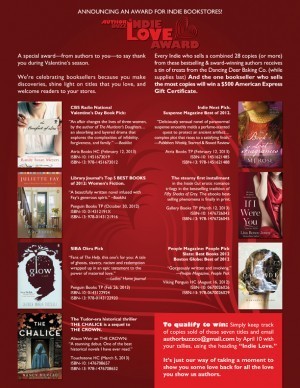
1) SHOWING INDIE LOVE
The idea for Indie Love came from a click moment, as we discussed the problem and both said, thank God for the Indies. It struck us how much we can count on them. Thus was born the idea to offer, along with 5 other authors, a Valentine’s Day reward, as thanks for always being there (with a very special shout out to Mark Nichols of the ABA who helped us get the message to the booksellers via the February Red Box.)
 2) Counting on friends: 20 BOOKS FROM 20 AUTHORS
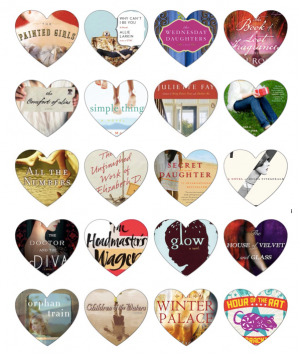
In a battle of the titans, nothing–absolutely nothing–beats being in a solid group of writer-friends, especially when that group is the Fiction Writer’s Co-op, a group of 50 authors who support each other., and member, Meg Waite Clayton led the Co-op into a 60-Book Valentine’s Day Giveaway, where readers have an opportunity to win a collection of books we jumped on it.
3) GIVING UP: SUNSHINE, SLEEP, SEX, FUN, (COOKED) FOOD–BASICALLY EVERYTHING EXCEPT AN HOUR OF TELEVISION A DAY
Both of us have spent hours upon hours each day writing essays, contacting independent bookstores, begging friends to spread the word, bombarding social media–all while trying to remain likable. Not sure if we succeeded in that last one.
4) PUTTING OUR TRUST IN OUR AGENTS
In every stage of a writer’s career, we must rely on our agents—in times of crisis, we pray they’re in the bunker with us. In this case, we had Stéphanie Abou and Dan Conaway not just with us, but teaming up together to keep us calm, informed, and from spinning into outer space with ideas such as how about if we use, um, a sandwich board on the subway?
5) PUTTING OUR TRUST IN OUR PUBLISHER
At times like this (our books won’t be in the largest bookstores in the country? ? ?) lashing out would be easy, especially at the bearers of the bad news (our editors Sarah Durand and Greer Hendricks.) It would be even easier to throw up our hands and curse our way into the darkness. Luckily, we do happen to work with (honestly) some of the nicest people in the industry (without exception, the Atria staff, led by publisher Judith Curr, is incredible). So, using lots of deep breaths, lots of mashing down of our natural tendencies towards needing instant solutions, we believed them when they said they were brainstorming, working, finding ideas, examining the ones we sent, and making the problem high priority.
And without taking you behind the door, we can say they are weaving magic as fast as possible.
Which brings us to the final ways we coped:
6) BEING NICE
Along with our novels, we’ve co-authored a guidebook, What To Do Before Your Book Launch where we highlighted advice from Randy’s grandmother, advice that will never steer you wrong:
“Grandma,” I asked on her 97th birthday, “what’s your best advice for life?”
She looked at me, this warm woman who’d never complained about a person in her life (I am not actually certain that she’s my biological grandmother, whereas there is no doubt that I received genetic material from my card-sharking kleptomaniac Grandma) and she said, “Be nice to people.”
If there is better advice for ways to comport yourself while making lemonade, we haven’t yet found it—except this:
7) DRIVING THE MESSAGE HOME
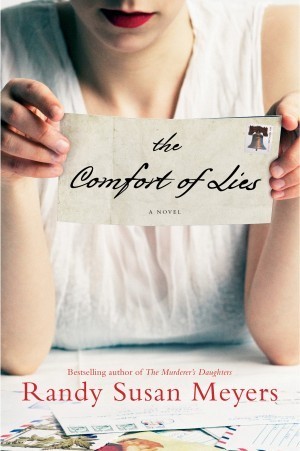
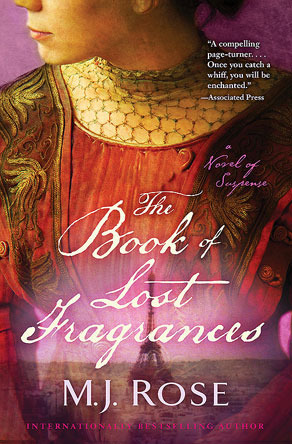
Fact: February 12, The Comfort of Lies & The Book of Lost Fragrances will launch from Atria Books.
Fact: They will be available at all online venues and all independent bookstores.
Fact: Until further notice, due to ongoing negotiations beyond our control, the books will not be available in most Barnes & Noble stores.
Fact: Below are our covers and the links.
February 5, 2013
Writers Needing Writers!

WHEN B&N AND SIMON & SCHUSTER ARE STUCK IN NEGOTIATIONS,
AND B&N DOESN’T HAVE YOUR BOOK
FOR IT’S LAUNCH!
THANK GOODNESS FOR WRITER FRIENDS
Last year saw story after story of authors (frantically trying to get readers) using sock puppet accounts to trash other authors with horrible reviews at Amazon and BN.com. We suppose desperate times call for desperate methods, and book sales are tough to come by these days.
So, yeah, you can destroy fellow authors. Or you can do the opposite.
The two of us penning this article (Randy Susan Meyersand M.J. Rose) happen to be releasing books (The Comfort of Lies and The Book of Lost Fragrances) on the same day (February 12) from the same publisher. But due to an unresolved negotiation between our publisher and Barnes & Noble, our books won’t be on display in the largest book chain in the country.
What could two miserable authors do? How could we even begin to make up those sales? Just as important how could we make up the loss of visibility in as hundreds of stores as thousands of readers browsed on display tables and noticed . . . nothing of ours?
When authors run up against something as frightening as being caught in a battle of the titans, nothing–absolutely nothing–beats being in a solid group of writer-friends, especially when that group is The Fiction Writer’s Coop, notable for it’s diversity, something Carleen Brice, author of Orange Mint andHoney and Children of the Waters noted when talking about the coop:
“One of the biggest pleasures for me is the Fiction Writers Coop’s diversity–women and men (though mostly women) of different races, writing in different genres. You still don’t see that in publishing much. We tend to promote in clumps as women writers, or black writers, or mystery writers, and it’s refreshing to be a group of writers who respect one another even though our work is dissimilar. It’s a great way to reach different crowds of readers.”
The founder of The Fiction Writer’s Coop is Cathy Marie Buchanan, author of the newly released, newly landed on the New York Times bestseller list, The Painted Girls, and The Day The Falls Stood Still. What made Cathy make the effort of put together this 50-member group?
“I initiated The Fiction Writers Co-op with the intent of forming a collective of writers who’d announce each other’s new releases on Facebook and Twitter, but our group has morphed into so much more. We’ve run campaigns to increase our newsletters subscribers and to spread the word among book clubs. Our group provides a lovely forum where we cheer each other on and share our experiences about writing and the writing business. With the recent Simon and Schuster / Barnes and Noble stalled negotiations, which will impact two co-op authors, the group is committed to banding together to do what we can to help spread the word about finding their books online and in independent bookstores. In our beleaguered industry, the co-op is a bright light.”
As publishing becomes more competitive and cut throat, Meg Waite Clayton, has led the Coop into a 20-Book Valentine’s Day Giveaway, where readers have an opportunity to win a collection of books by all the listed authors–national and international bestselling authors, including Clayton’s bestselling The Wednesday Sisters, and her summer release, The Wednesday Daughters. It’s a combination not just of diverse authors, but also of diverse publishing houses.
When asked about this effort, Meg laughed and then said, “If I’d known so much promotion was involved in being a novelist, I might have stuck with keeping track of my time in six-minute increments at a law firm! The art of marketing does not fall in my comfort zone. But so many authors have supported me that I’m always looking for ways to pay back or pay forward their generosity. I didn’t dream we’d get such an amazing response from readers!”
As opposed to the stories that usually make the news, this effort defines cooperation. But surely it must lead to competition along with the Kumbaya?
Allie Larkin, author of Stay and the soon-to-release Why Can’t I Be You, said: “Combining forces helps us raise our visibility collectively. And maybe our winners will be introduced to a new genre or dive into titles they wouldn’t have considered before. Working together benefits all of us, and possibly even the industry as a whole.”
On Friday, February 1, within moments of the 20 Book Valentine Contest going live, Meyers and Rose contacted their publisher Atria, who tweeted out the effort. Pam Dorman Books soon followed, along with Harper Collins, and then every other publisher involved.
Juliette Fay, author of The Shortest Way Home and Deep Down True said: “We’re all in this crazy business together, and our common goal is simply to get books into the hands of readers. This effort serves that purpose beautifully. My publisher, Penguin, was delighted with the effort, and was happy to help publicize it.”
“My publisher, Soho Press, was tremendously excited and impressed, as was my agency, Curtis Brown (about the contest.) They recognize that in today’s changing marketplace, it takes innovative thinking to break through the noise and get your book in front of an audience,” added Lisa Brackmann, author of Rock Paper Tiger and the soon-releasing Hour of the Rat.
“Working with writers I admire is a privilege, as is the knowledge that I have the support and advice of seasoned writer-friends. Sharing our readers is like sharing inspiration; it makes us all richer in the end,”said Eva Stachniak, the author of The Winter Palace: a novel of Catherine The Great.
“I’ve never felt that a colleague’s success means my failure,” Katherine Howe, author of The Physick Book of Deliverance Dane and the newly released The House of Velvet and Glass insisted. “A collaboration like this rewards our readers for loving books and exposes them to authors they may never have read before.”
Vincent Lam, author of The Headmasters Wager and Bloodletting and Miraculous Cures thinks we shouldn’t be afraid of promoting each other. “The real 21st century competition is books as a category vying with screen, print, and social media in a dynamic cultural landscape. The key challenge for authors and publishers is to vigorously inhabit a cultural space for books. The more room there is for books as a category, the better it is for all authors. It’s crucial, and thankfully also a lot of fun, to find ways to help each other.”
Catherine Mckenzie, author of Spin, Forgotten, and Arranged, pointed out that “In my experience, readers love hearing from authors about other authors and they like seeing us supporting one another, and my publishers love this.”
For debut author Jessica Maria Tuccelli, author of Glow, “the synergy is electrifying. Since Meg Waite Clayton pushed the contest live on the web last week, we authors have been generating idea after idea for promotion and functioning as a team on the follow through. I’m new to social media... [this] has enabled me to learn from authors who have greater experience with marketing and promotion, as well as to develop a sense of camaraderie. The generosity and ingenuity of my peers are inspiring. “
What began as an experiment in shouting out each other’s books into the vast blinding blizzard of social media, has become a virtual world of tight friendships and support–and proof that, among some authors, cooperation trumps competition.
Last year saw story after story of authors (frantically trying to get readers) using sock puppet accounts to trash other authors with horrible reviews at Amazon and BN.com. We suppose desperate times call for desperate methods, and book sales are tough to come by these days.
So, yeah, you can destroy fellow authors. Or you can do the opposite.
The two of us penning this article (Randy Susan Meyersand M.J. Rose) happen to be releasing books (The Comfort of Lies and The Book of Lost Fragrances) on the same day (February 12) from the same publisher. But due to an unresolved negotiation between our publisher and Barnes & Noble, our books won’t be on display in the largest book chain in the country.
What could two miserable authors do? How could we even begin to make up those sales? Just as important how could we make up the loss of visibility in as hundreds of stores as thousands of readers browsed on display tables and noticed . . . nothing of ours?
When authors run up against something as frightening as being caught in a battle of the titans, nothing–absolutely nothing–beats being in a solid group of writer-friends, especially when that group is The Fiction Writer’s Coop, notable for it’s diversity, something Carleen Brice, author of Orange Mint andHoney and Children of the Waters noted when talking about the coop:
“One of the biggest pleasures for me is the Fiction Writers Coop’s diversity–women and men (though mostly women) of different races, writing in different genres. You still don’t see that in publishing much. We tend to promote in clumps as women writers, or black writers, or mystery writers, and it’s refreshing to be a group of writers who respect one another even though our work is dissimilar. It’s a great way to reach different crowds of readers.”
The founder of The Fiction Writer’s Coop is Cathy Marie Buchanan, author of the newly released, newly landed on the New York Times bestseller list, The Painted Girls, and The Day The Falls Stood Still. What made Cathy make the effort of put together this 50-member group?
“I initiated The Fiction Writers Co-op with the intent of forming a collective of writers who’d announce each other’s new releases on Facebook and Twitter, but our group has morphed into so much more. We’ve run campaigns to increase our newsletters subscribers and to spread the word among book clubs. Our group provides a lovely forum where we cheer each other on and share our experiences about writing and the writing business. With the recent Simon and Schuster / Barnes and Noble stalled negotiations, which will impact two co-op authors, the group is committed to banding together to do what we can to help spread the word about finding their books online and in independent bookstores. In our beleaguered industry, the co-op is a bright light.”
As publishing becomes more competitive and cut throat, Meg Waite Clayton, has led the Coop into a 20-Book Valentine’s Day Giveaway, where readers have an opportunity to win a collection of books by all the listed authors–national and international bestselling authors, including Clayton’s bestselling The Wednesday Sisters, and her summer release, The Wednesday Daughters. It’s a combination not just of diverse authors, but also of diverse publishing houses.
When asked about this effort, Meg laughed and then said, “If I’d known so much promotion was involved in being a novelist, I might have stuck with keeping track of my time in six-minute increments at a law firm! The art of marketing does not fall in my comfort zone. But so many authors have supported me that I’m always looking for ways to pay back or pay forward their generosity. I didn’t dream we’d get such an amazing response from readers!”
As opposed to the stories that usually make the news, this effort defines cooperation. But surely it must lead to competition along with the Kumbaya?
Allie Larkin, author of Stay and the soon-to-release Why Can’t I Be You, said: “Combining forces helps us raise our visibility collectively. And maybe our winners will be introduced to a new genre or dive into titles they wouldn’t have considered before. Working together benefits all of us, and possibly even the industry as a whole.”
On Friday, February 1, within moments of the 20 Book Valentine Contest going live, Meyers and Rose contacted their publisher Atria, who tweeted out the effort. Pam Dorman Books soon followed, along with Harper Collins, and then every other publisher involved.
Juliette Fay, author of The Shortest Way Home and Deep Down True said: “We’re all in this crazy business together, and our common goal is simply to get books into the hands of readers. This effort serves that purpose beautifully. My publisher, Penguin, was delighted with the effort, and was happy to help publicize it.”
“My publisher, Soho Press, was tremendously excited and impressed, as was my agency, Curtis Brown (about the contest.) They recognize that in today’s changing marketplace, it takes innovative thinking to break through the noise and get your book in front of an audience,” added Lisa Brackmann, author of Rock Paper Tiger and the soon-releasing Hour of the Rat.
“Working with writers I admire is a privilege, as is the knowledge that I have the support and advice of seasoned writer-friends. Sharing our readers is like sharing inspiration; it makes us all richer in the end,”said Eva Stachniak, the author of The Winter Palace: a novel of Catherine The Great.
“I’ve never felt that a colleague’s success means my failure,” Katherine Howe, author of The Physick Book of Deliverance Dane and the newly released The House of Velvet and Glass insisted. “A collaboration like this rewards our readers for loving books and exposes them to authors they may never have read before.”
Vincent Lam, author of The Headmasters Wager and Bloodletting and Miraculous Cures thinks we shouldn’t be afraid of promoting each other. “The real 21st century competition is books as a category vying with screen, print, and social media in a dynamic cultural landscape. The key challenge for authors and publishers is to vigorously inhabit a cultural space for books. The more room there is for books as a category, the better it is for all authors. It’s crucial, and thankfully also a lot of fun, to find ways to help each other.”
Catherine Mckenzie, author of Spin, Forgotten, and Arranged, pointed out that “In my experience, readers love hearing from authors about other authors and they like seeing us supporting one another, and my publishers love this.”
For debut author Jessica Maria Tuccelli, author of Glow, “the synergy is electrifying. Since Meg Waite Clayton pushed the contest live on the web last week, we authors have been generating idea after idea for promotion and functioning as a team on the follow through. I’m new to social media... [this] has enabled me to learn from authors who have greater experience with marketing and promotion, as well as to develop a sense of camaraderie. The generosity and ingenuity of my peers are inspiring. “
What began as an experiment in shouting out each other’s books into the vast blinding blizzard of social media, has become a virtual world of tight friendships and support–and proof that, among some authors, cooperation trumps competition.
February 1, 2013
Author-Friends Valentine’s Day Book Giveaway: Win 20 Novels!!

To share our love of books this Valentine’s Day, we twenty writer-pals below are doing a joint book giveaway. To enter, simply click here and you’ll be guided through the (easy) process!
The Authors:

1. Meg Waite Clayton, author of The Wednesday Sisters and The Wednesday Daughters (July 30)

2. Randy Susan Meyers, author of The Murderer’s Daughters and The Comfort of Lies (Feb. 12)

3. Cathy Marie Buchanan, author of The Painted Girls and The Day the Falls Stood Still

4. Katherine Howe, author of and The Physick Book of Deliverance Dane and The House of Velvet and Glass

5. Christina Baker Kline, author of Orphan Train (April 2)

6. Shilpi Somaya Gowda, Author of Secret Daughter

7. Allie Larkin, author of Stay and Why Can’t I Be You (Feb 26)

8. Nichole Bernier, author of The Unfinished Work of Elizabeth D.

9. Carleen Brice, author of Children of the Waters

10. Juliette Fay, author of The Shortest Way Home

11. M.J. Rose, author of The Book of Lost Fragrances and Seduction (May 7)

12. Eva Stachniak author of The Winter Palace

13. Adrienne McDonnell, author of The Doctor and the Diva

14. Lisa Brackmann, author of Rock, Paper, Tiger and Hour of the Rat

15. Therese Anne Fowler, author of Z:A Novel of Zelda Fitzgerald (March 26)

16. Judy Larsen, author of All the Numbers

17. Kathleen McCleary, author of House and Home and A Simple Thing

18. Vincent Lam, author of The Headmaster’s Wager

19. Catherine McKenzie, author of Arranged and Forgotten

20. Jessica Maria Tuccelli, author of Glow (Feb. 26)
January 22, 2013
The Reader-Writer Covenant

What is the relationship between reader and writer? I’ve been a reader for far more hours of my life than I’ve been a writer. As a child, I made twice-weekly trips to the Kensington branch of the Brooklyn library nearest my home (my haul each time limited by the rules for children’s cards.) Writers were gods to me, purveyors of that which I needed for sustenance. Food. Shelter. Books. Those were my life’s priorities.
Naturally, I liked some books more than others. Some of the books I read as a child etched themselves on my soul (A Tree Grows in Brooklyn). I felt as if these books reached inside me and wrenched out truth.
As an adult reader I still feel that way; I’m constantly foraging for books that offer glimpses into a character’s psyche, that go deep enough to make me part of the choir, saying, “Oh yeah, me too, tell it, writer. True that, uh huh.”
Now that I am a writer, I’ve learned that reaching so deep isn’t always comfortable. Hey, my daughter’s gonna read this! Hey, husband: this isn’t you!It’s far easier to skate on the surface. And, honestly, there is a place on my shelf for those soothing books. Sometimes I want a comfort read, a total escape, a warm place to rest.
I believe there should be a covenant between writer and reader – an offering made by a writer to the reader. What it is that you, the writer, are offering to you, the reader? (Because I can’t imagine a writer who is not also a reader.) Are you making a covenant with the reader? Are you offering the reader the same qualities that you want when you’re the reader? Are you offering them your very best?
Sometimes I worry, that in the rush of wanting to publish, I could forget the importance of writing (in the inestimable words of Natalie Goldberg) down the bones.
My favorite books, the ones I return to time and again, are those ones gritty enough to have emotional truth (which is very different than the truth of events.) Thus, I try to write with a knife held to my own throat, so that my work will hold as much emotional truth as possible. Another reader/writer might prefer a thriller that sets their heart pounding–but every genre owns it’s own truth and depth. I suspect that the best writers in each genre are readers of the same.
Books are precious to me. Right now I am turning the pages of Game Change by John Heilemann and Mark Halperin in every spare moment. I schlepped the thing on Amtrak from Boston to Albany to Rhinebeck. I could have taken a lighter book, or simply read something on my electronic device. This is a controversial book – many have denounced it as no more than gossip. But whatever it is, it satisfies my hungry reader. I was so desperate to read this book that I was unwilling to leave it behind for 4 days. (I think Halperin and Heilemann put themselves on the good edge of their genre covering political intrigue in a presidential campaign.)
That’s exactly what this reader wants: writers who have dug deep, whatever their genre, and given me those best hours of my day. They kept their covenant with me.
January 19, 2013
Reviews Sending Me To The Bookstore

Good reviews excite me, bad reviews make me wonder, and sometimes make me buy (Curiosity? Pity?) Hello, my name is Randy and I am a review junkie.
Rick Bass’s new book is described in Kate Tuttle’s review at the Boston Globe as “a lovely and valuable book. For the most part, Bass avoids the dangers of non-Africans writing about Africa (though a good editor might have stopped him using variations on the word “inscrutable” four times in under 100 pages). His admiration of the Rwandans — for facing their national tragedy with such honesty and grace, for somehow moving on in optimism and love — is impossible not to share.”
Maria Arana’s review at The Washington Post’s is a beautiful essay about the memoir The Girl Who Fell to Earth” by Sophia Al-Maria beginning with: “Sleep under a ceiling, says an old Bedouin proverb, and your dreams will be only as high as the roof beam above you. Sleep under a sky, and your dreams will be as high as the stars. Half-Bedouin, half-American, born in a rustic valley of Washington state, Sophia Al-Maria was congenitally unable to look up as a child. It made her dizzy to glance at a tall building. Open skies made her feel like she was falling upward. Her dreams did not rise so much as plummet: She had a fear of being swallowed by stars.”
I dare you to read it and not want to grab this book off the nearest shelf.
Caitlin Kelly writes in the following New York Times review “It’s rare to come across a realistic and readable book about personal finance. Most are laden with rosy promises, followed by acronyms and turgid advice. Helaine Olen, a freelance journalist, offers an exception with “Pound Foolish: Exposing the Dark Side of the Personal Finance Industry” (Portfolio, $27.95). It’s a take-no-prisoners examination of the ways she says we have been scared, misled or bamboozled by those purporting to help us achieve financial security. . . . “When it comes to money, the vast majority of us are nuts. Bonkers.” She counts some of the ways: “We don’t open our 401(k) statements. We ‘forget’ to pay our bills or file our taxes until the last minute.” Financial literacy is alarmingly low. Many of us don’t budget at all.
Don’t tell my husband, but I know what book he’s getting for Valentine’s Day. Not that he’s one of the bonkers, but if I buy it for myself he’s bound to get suspicious about my already suspect habits.
Anyone out there not need to read this book?
Once you’ve mastered the art of finance, you can move on to applying logic and better decision-making in the rest of your life. Chuck Leddy’s Boston Globe review of Mastermind by Maria Konnikova (a review titled ‘Discovering the Sherlock Holmes in all of us) describes it as “Steven Pinker meets Sir Arthur Conan Doyle in this entertaining, insightful look at how the fictional London crime-solver used sophisticated mental strategies to solve complex problems of logic and deduction. Psychologist and author Maria Konnikova (who cites Pinker as a mentor) goes on to explain how we, too, can learn to develop Holmes’s habits of mind and how that training can help us make better decisions in our own lives.
Michael Dirda’s review in the Washington Post of Selected Letters of William Styron Edited by Rose Styron with R. Blakeslee Gilpin sent me leaping for my credit card–if the book is anywhere near as terrific as Dirda’s review, I’ll soon be very lost in this book.
“Personalia, literary gossip and stylish prose are what make reading collections of letters fun, and Styron’s contain all these. What writer today would dare say, as the youthful Styron does, that Eudora Welty’s short stories are “fairly pale. She doesn’t want to commit herself to anything, emotionally or intellectually, either, and thereby commits the crime” — and here young Bill is about to get himself into trouble — “of women writers in general — seeing life through pastel-tinted spectacles, lovely in its way but not in clear white focus.” . . . When his second novel, “Set This House on Fire,” is blasted by the critics, he confesses: “I did get one good review, however, in Amarillo, Texas, and I cherish it like an amulet, and someday, if you ask, I may show it to you.”
Those who know me well, know all things Madoff fascinate me. Since I’m also entranced by all things bookish, what could be better than Carolyn Kellog’s piece in the LA Times: The Bernard Madoff book collection: Rick Moody, Fyodor Dostoevsky: “The books provide a window into the intellectual life of Madoff and his family. There are big bestsellers by Leon Uris, Caleb Carr, David Baldacci and Sidney Sheldon, dictionaries and other reference books, and histories and biographies by David Halberstam, Walter Isaacson, David McCullough and Doris Kearns Goodwin. Classics by Cervantes, Willa Cather and Mark Twain.”
Here’s the review a writer dreams of getting: Me Before You by Jojo Moyes was reviewed by Liesl Schillinger in the New York Times, with this opening:
“When I finished this novel, I didn’t want to review it; I wanted to reread it. Which might seem perverse if you know that for most of the last hundred pages I was dissolved in tears. Jojo Moyes, the writer who produced this emotional typhoon, knows very well that “Me Before You” — a novel that has already floated high on Britain’s best-seller lists — is, as British critical consensus affirms, “a real weepy.” And yet, unlike other novels that have achieved their mood-melting powers through calculated infusions of treacle — Erich Segal’s “Love Story” comes immediately to mind — Moyes’s story provokes tears that are redemptive, the opposite of gratuitous. Some situations, she forces the reader to recognize, really are worth crying over.”
Sadly, it can’t all be perfume and caviar. Here’s an award finalist group where no writer wants to be listed. Pour a whiskey and read the short list for the other type of reviews, the ones that sent writers straight for the Ativan : “The Hatchet Job of the Year Award is for the writer of the angriest, funniest, most trenchant book review of the past twelve months.”
January 15, 2013
Characters Who Form You
 All of us voracious readers have favorite books—book we re-read, books that encouraged us, inspired us, challenged us, and soothed us. Not always the same (the book and the character) there are those members of the cast who never leave us. I wonder, is there a difference between most memorable books, and the individual characters who stay with us far after we finish the last page?
I’m not an academic scholar who can deconstruct the ‘why,’ but perhaps these are the characters who (as well as having a role in a favorite book) represent the best or worst of who we think we are, who we may become, or maybe they have the qualities we want or fear the most.
Could they be a litmus test for our personalities? Do they have a role in forming who we are?
If you are a person in constant “Word Love,” all the above could be true.
Caroline, Ben, Judith, and Jacob Reiser, the family from Before and After by Rosellen Brown, showed me how a family can remain loyal to their love for each other, even as their own versions of the truth lead them in opposite directions.
Anne Frank. Of course, the book, The Diary of Anne Frank was incredible (please insert this sentence all the way down the list, and help me not be repetitive!) But Anne, a character I met when I was so very young, moved into my head and never left. Despite her tragic end, she provided a ruler for open-eyed (very different from wide-eyed) optimism, which became a measure I attempt to emulate, even if I can only hope for the tiniest fraction of her ability.
Karen Killea, the main character of a memoir Karen, written by her mother, Marie Killiea, Karen and her parents overcame the conventional wisdom of what a child with cerebral palsy could achieve. From Karen I learned grit.
Francie Nolan lives in all my favorite book categories. Brave Francie of A Tree Grows in Brooklyn taught me that a frightening childhood plagued many girls.
Calliope, later Cal, Stephanides, the narrator of Middlesex, by Jeffrey Eugenides will forever stand out as an example of how a character suffering from the narrowest of problems (in Cal’s case, being inter-sexed) can become the most universal of role models in courage and significance.
Sissy Sullivan, the main character of Tin Wife, a novel by Joe Flaherty I read years and years ago, a worn paperback which still has a place of honor on my shelf of long-ago favorites, will forever represent an ordinary woman facing down a city wanting to bury her with lies.
This is just the tip of my particular iceberg of characters who will always live with me. Who’s living with you?
January 11, 2013
The Incredible Importance of Friends: LET’S TAKE THE LONG WAY HOME

When we were younger (in our twenties) my best friend and I talked about the unimaginable horror of being without each other. Now that we’re older, and the idea of folks our age dying is no longer as unthinkably shocking as it was back then, we barely talk about it—it’s too frightening, too awful, and too possible a thought.
Nevertheless, when we did talk about it, we’d wonder why there wasn’t a name for having your closest friend die. Who was the one left behind?
There is widowhood.
There is being orphaned.
We hear that someone has lost a sister or a brother and our hand flies to our heart in sympathy. We blink back tears at the thought of losing our own sibling. And, the phrase is almost impossible to write, that greatest of horrors, losing a child, those three words connote such horror, simply using them brings forth the images which turn our innards icy.
What is the word for the awful loss of a best friend, that friend who you can call daily, multiple times daily if the need arises; who is not only there for emergencies, but is willing to chew over the most mundane details of your day and listen to the details of your tooth extraction in excruciating detail?
How do you describe the death of that person who you can tell anything—absolutely anything—and know that not only will they still love you, but that your pain will not send them to a therapist, because they don’t swallow it in the same way as might your family. Family feels responsible for our pain, wondering if perhaps they caused it, or if they will suffer because of it—in the way that a child’s pain will trigger one’s own. This friend is family who doesn’t need to worry at same genetic fabric together.
The friends we love, the family of our heart, family we choose—we have no customs for mourning that loss. No leave from work. People don’t come to our home to sit shivah. Casseroles don’t show up at our door.
Gail Caldwell writes about this grief in Let’s Take The Long Way Home. She shows us the friendship she shared with Caroline Knapp (the author of Drinking: A Love Story) and then takes us through the heartbreak—as rending as the loss of any loved one—of Caroline’s terminal lung cancer.
The details of dying are sad and grinding: breathing and waiting and breathing and waiting. The body, brilliant machine, knows how and when to close up shop. But Caroline was so strong, and so determined, that even in this final task she moved toward the end with bracing force. I had watched her on the water for years; now she was in the midst of what Anne Sexton had called the “awful rowing toward God.”
Gail Caldwell writes with simple elegance of the love she and Caroline Knapp shared. I felt the joy of their connection, remembering similar moments with my closest friend. The circumstances were different, the blazing friend-love the same. Reading this story allowed me the same shock of recognition one feels when reading of a love affair that matches the depth of one’s own romantic love, and though Caldwell and Knapp’s story is eventually soaked in grief, reading their joy makes it worth the pain of going through their sorrow.
Experiencing the bleakness Caldwell faces, suddenly alone after having found the perfect partner, the most satisfying of friends, I felt I received more than was on the page. The writing is so finely rendered, that it seemed to provide vision beyond the words on the page.
December 31, 2012
The COMFORT OF LIES Begets THE COMFORT OF FOOD: Free with Pre-order
 When I was newly married (19!) my then-husband and I moved to a farm located between Binghamton and Ithaca, New York. His job was being a farm hand. Mine was reading, watching the one television station available (for a limited number of hours), and gaining weight as quickly as possible. The cookies below helped wildly in that last endeavor.
We lived far from any neighbors—other than the farmer and his wife, and the farmer’s son, his wife, and their children. When the farmer’s son’s wife invited me for breakfast one morning I was ecstatic. Upon arrival she offered me a 7&7(I had no idea what it was), a Pop-Tart, and a cup of her depression. This was my introduction to the shattering of the sort of idealization that only a girl from Brooklyn could have about life on a farm.Christmas week, the farmer’s wife invited me to a cookie party—where each guest brought enough packages of cookies (a dozen per beribboned bag) to exchange with all the guests. My excitement, though a teeny bit measured (based on my breakfast visit) was high enough for me to spend my next weekly library visit foraging for the most interesting and exotic cookie recipe I could find. My life was that much of a farm life void. (As my then-husband busily worked 16-hourdays, becoming buffer and buffer, I slowly morphed into a candidate for Weight Watchers, had one existed in the town of Center Lisle, New York.)
The cookies I made were everything I’d hoped. Complicated, sophisticated, delicious, and greeted with faces of horror. What were these lumpy brown things brought in by the Brooklyn Jew? Clearly, they resembled nothing close to Christmas cookies. I handed out my Plain Jane bags of cookies, sans ribbons curling down the sides of the bags. My New York bakery sophistication style sweets might as well have been wearing little yarmulkes and speaking Yiddish for how much they stood out. All the other offerings were variations on a Christmas butter cookie theme cut in the shapes of stars and Santa, and decorated (Sparkles! Red and Green Sugar! Glittering Gold Balls!) with the skill of holiday possessed Rembrandt.
My cookies looked like the homely third cousin your mother forced you to invite to the Bar Mitzvah. But they were the tastiest. (see the end for the recipe.)

(At my cousin Gary’s bar mitzvah)
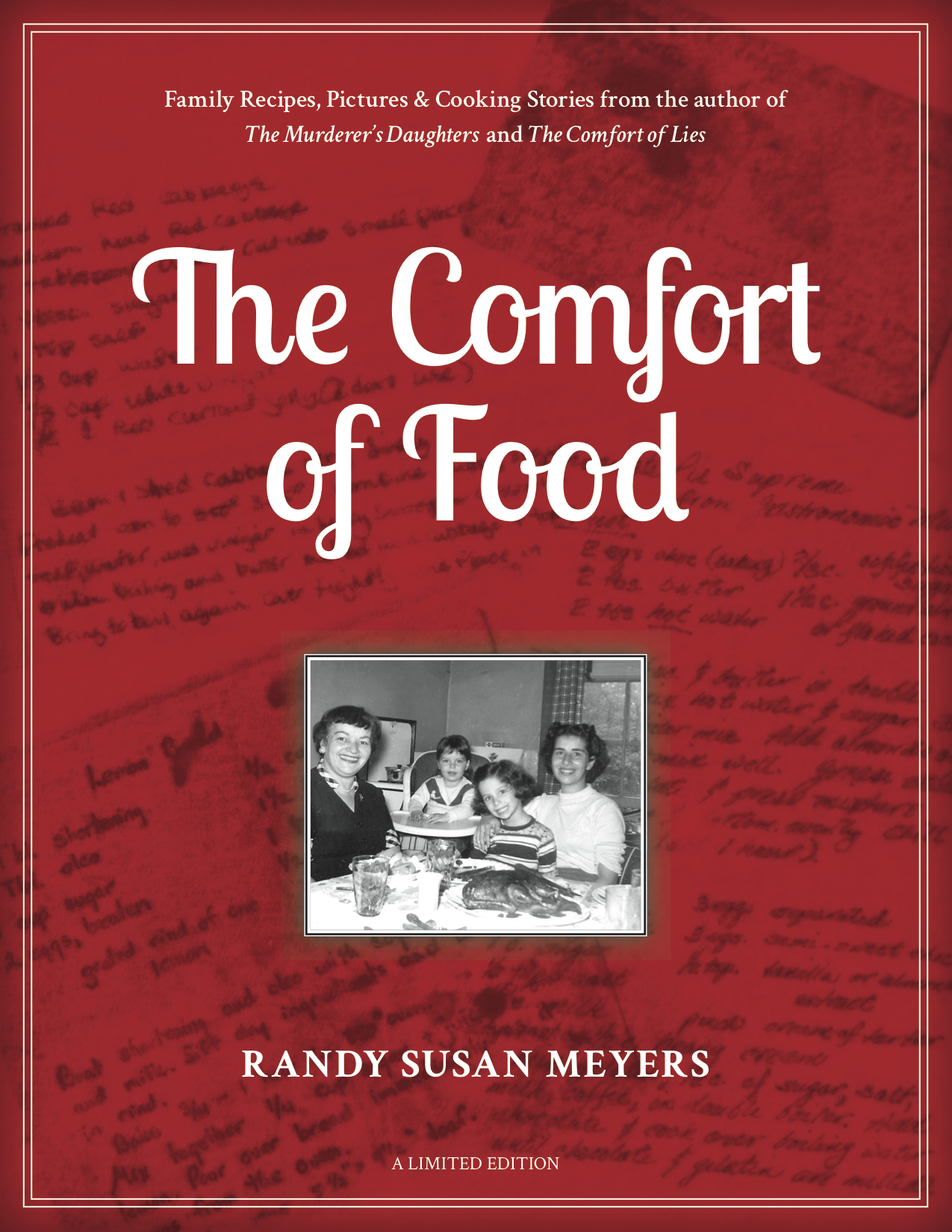
The Comfort of Food is a collection of the most comforting food I’ve ever cooked or eaten. Pre-order The Comfort of Lies (releasing 2/12) between now and 1/31/13, and you can share the recipes and stories (such as the one above and the recipe below)
Twenty-five people will be chosen at random to receive a printed version of this limited edition story and recipe collection, filled with recipes like that above; everyone who enters the drawing will receive a PDF of the cookbook .
The Comfort of Food started as a gift for my family—typing up my favorite and best recipes, complete with stories of how they came about (such as ‘Chocolate Pie Supreme,’ which I found in a mystery novel) and grew to a limited edition story and recipe collection that I wanted to share with readers. (Complete with recipes from the grandparent collection.)

All those who pre-order my new novel, The Comfort of Lies, between now and January 30,2013, can enter for a chance to receive a printed version of The Comfort of Food. There will be 25 winners of the printed book. PDFs of The Comfort of Food will be sent to all. Honor system.
And if you’ve already pre-ordered the book, you also can enter.
Here are the 3 simple rules:
1) Pre-order The Comfort of Lies
2) Email me at randy@randysusanmeyers.com
3) Include in the email the date you pre-ordered The Comfort of Lies and where you pre-ordered it from. (The pre-order link above will take you to Amazon, Barnes & Noble, Powell’s, and IndieBound—please specify independent store from whom you ordered) along with:
- Your name
- Your email
- Your mailing address
Your information will never be shared, except to add it to my own mailing list. If you prefer not to be on my mailing list (for notice of readings, touring, etc.) please let me know.
Easy-peasy. Like dancing.
 (An example of why my mother cooked so fast–she needed to leave time to dance.)
FRENCH LACE
1/2 cup corn syrup
1/2 cup butter
2/3 cup brown sugar
1 cup flour, sifted
1 cup finely chopped nuts
Dark chocolate, melted (if desired)
Preheat over to 325°. Combine corn syrup, butter, and sugar. Bring to boil.
Combine flour and nuts w/liquid. Place by teaspoon 4 inches apart and bake
for 8-10 minutes.