Randy Susan Meyers's Blog, page 36
December 31, 2012
“The Comfort of Lies” begets the “The Comfort of Food” (free with pre-order!!)
When I was newly married (19!) my then-husband and I moved to a farm located between Binghamton and Ithaca, New York. His job was being a farm hand. Mine was reading, watching the one television station available (for a limited number of hours), and gaining weight as quickly as possible. The cookies below helped wildly in that last endeavor.
We lived far from any neighbors—other than the farmer and his wife, and the farmer’s son, his wife, and their children. When the farmer’s son’s wife invited me for breakfast one morning I was ecstatic. Upon arrival she offered me a 7&7(I had no idea what it was), a Pop-Tart, and a cup of her depression. This was my introduction to the shattering of the sort of idealization that only a girl from Brooklyn could have about life on a farm.Christmas week, the farmer’s wife invited me to a cookie party—where each guest brought enough packages of cookies (a dozen per beribboned bag) to exchange with all the guests. My excitement, though a teeny bit measured (based on my breakfast visit) was high enough for me to spend my next weekly library visit foraging for the most interesting and exotic cookie recipe I could find. My life was that much of a farm life void. (As my then-husband busily worked 16-hourdays, becoming buffer and buffer, I slowly morphed into a candidate for Weight Watchers, had one existed in the town of Center Lisle, New York.)
The cookies I made were everything I’d hoped. Complicated, sophisticated, delicious, and greeted with faces of horror. What were these lumpy brown things brought in by the Brooklyn Jew? Clearly, they resembled nothing close to Christmas cookies. I handed out my Plain Jane bags of cookies, sans ribbons curling down the sides of the bags. My New York bakery sophistication style sweets might as well have been wearing little yarmulkes and speaking Yiddish for how much they stood out. All the other offerings were variations on a Christmas butter cookie theme cut in the shapes of stars and Santa, and decorated (Sparkles! Red and Green Sugar! Glittering Gold Balls!) with the skill of holiday possessed Rembrandt.
My cookies looked like the homely third cousin your mother forced you to invite to the Bar Mitzvah. But they were the tastiest. (see the end for the recipe.)

(Me at my cousin Gary’s bar mitzvah)
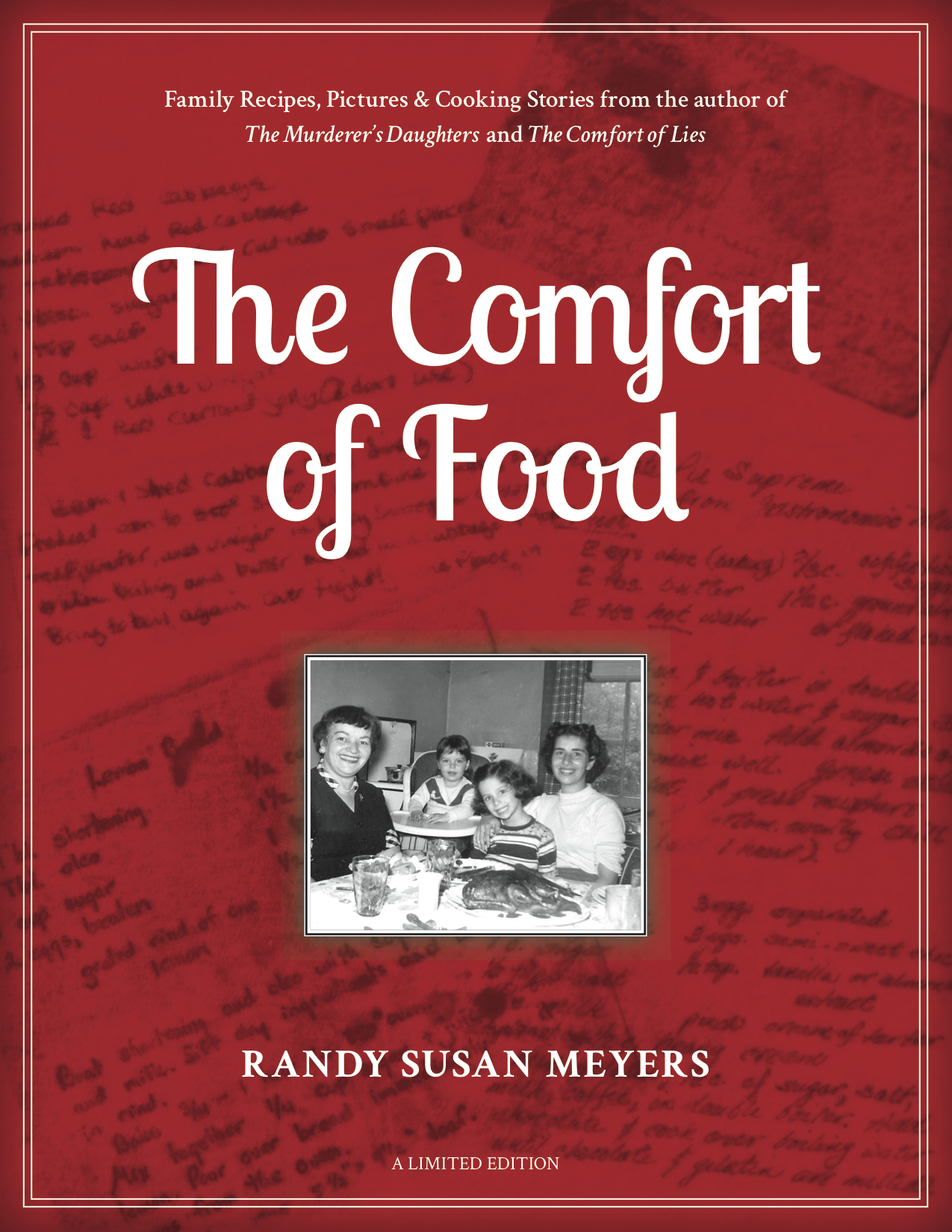
The Comfort of Food is a collection of the most comforting food I’ve ever cooked or eaten. Pre-order The Comfort of Lies (releasing 2/12) between now and 1/31/13, and you can share the recipes and stories (such as the one above and the recipe below)
Twenty-five people will be chosen at random to receive a printed version of this limited edition story and recipe collection, filled with recipes like that above; everyone who enters the drawing will receive a PDF of the cookbook .
The Comfort of Food started as a gift for my family—typing up my favorite and best recipes, complete with stories of how they came about (such as ‘Chocolate Pie Supreme,’ which I found in a mystery novel) and grew to a limited edition story and recipe collection that I wanted to share with readers. (Complete with recipes from the grandparent collection.)

All those who pre-order my new novel, The Comfort of Lies, between now and January 30,2013, can enter for a chance to receive a printed version of The Comfort of Food. There will be 25 winners of the printed book. PDFs of The Comfort of Food will be sent to all. Honor system.
And if you’ve already pre-ordered the book, you also can enter.
Here are the 3 simple rules:
1) Pre-order The Comfort of Lies
2) Email me at randy@randysusanmeyers.com
3) Include in the email the date you pre-ordered The Comfort of Lies and where you pre-ordered it from. (The pre-order link above will take you to Amazon, Barnes & Noble, Powell’s, and IndieBound—please specify independent store from whom you ordered) along with:
- Your name
- Your email
- Your mailing address
Your information will never be shared, except to add it to my own mailing list. If you prefer not to be on my mailing list (for notice of readings, touring, etc.) please let me know.
Easy-peasy. Like dancing.
 (An example of why my mother cooked so fast–she needed to leave time to dance.)
FRENCH LACE
1/2 cup corn syrup
1/2 cup butter
2/3 cup brown sugar
1 cup flour, sifted
1 cup finely chopped nuts
Dark chocolate, melted (if desired)
Preheat over to 325°. Combine corn syrup, butter, and sugar. Bring to boil.
Combine flour and nuts w/liquid. Place by teaspoon 4 inches apart and bake
for 8-10 minutes.


December 28, 2012
The Honor System Giveaway: “The Comfort of Lies” brings “The Comfort of Food”
 The Comfort of Food is a collection of the most comforting food I’ve ever cooked or eaten. Pre-order The Comfort of Lies (releasing 2/13) between now and 1/31/13, and you can share it with me.
Twenty-five people will be chosen at random to receive the printed version of this limited edition story and recipe collection; everyone who enters the drawing will receive a PDF of the cookbook .
The Comfort of Food started as a gift for my family—typing up my favorite and best recipes, complete with stories of how they came about (such as ‘Chocolate Pie Supreme,’ which I found in a mystery novel) and grew to a limited edition story and recipe collection that I wanted to share with readers. (Complete with recipes from the grandparent collection.)
All those who pre-order my new novel, The Comfort of Lies, between now and January 30,2013, can enter for a chance to receive a printed version of The Comfort of Food. There will be 25 winners of the printed book. PDFs of The Comfort of Food will be sent to all. Honor system.
And if you’ve already pre-ordered the book, you also can enter.
Here are the 3 simple rules:
1) Pre-order The Comfort of Lies
2) Email me at randy@randysusanmeyers.com
3) Include in the email the date you pre-ordered The Comfort of Lies and where you pre-ordered it from. (The pre-order link above will take you to Amazon, Barnes & Noble, Powell’s, and IndieBound—please specify independent store from whom you ordered) along with:
- Your name
- Your email
- Your mailing address
Your information will never be shared, except to add it to my own mailing list. If you prefer not to be on my mailing list (for notice of readings, touring, etc.) please let me know.
Easy-peasy. Like dancing.
(An example of why my mother cooked so fast–she needed to leave time to dance.)
December 20, 2012
Round of the Best of 2012 Books Roundup
Guest Post by Dell Smith
It’s mid-December already? Back the truck up! You know what that means. End of year book lists. The year’s best, worst, and in between books. We here at Beyond the Margins don’t go in for such pandering. I mean, who are we to judge a great book from a not so great book? Still, we’re not above linking to those who do. So let’s get to it:
Over at Pub Rants, Agent Kristin answers What Are The Big YA Debut Break Outs in 2012?
At the Daily Beast, Newsweek/Daily Beast books editor Lucas Wittmann lists the 10 books that wowed him this year. Elsewhere on the Beast, The 2012 Books You Missed But Shouldn’t Have and best coffee table books.
At Good Reads, it’s you, the book buying public, casting votes for most awesomest books of the year. Don’t listen to elitist media outlets for your zeitgeist-worthy choices. The people have spoken. And the people are readers! And the readers are you!!
NPR jumps into the fray with categories like best eye-catching gift books, best historical fiction, and the most outstanding backseat reads for kids 9 to 14.
 At Bloomberg and Business Week the name Nate Silver brings all the economists to the yard.
Spirituality Practice lists the best books of the year on spirituality (so far).
Poetry Magazine gets all busy with the best poetry books of 2012.
Retro Chick lists her favorite unique books of the year.
Brain Pickings has their take on the best history books.
For an overview of the best book covers of the year, check out The Atlantic.
I’m most fond of Book Riot’s list, which includes many choices not included in other lists, such as unheralded novels like What Happened to Sophie Wilder by Christopher Beha, Where’d You Go, Bernadette? by Maria Semple, Glaciers by Alexis Smith, the English translation of Laszlo Krasznahorkai’s Satantango, and perhaps most intriguing is their nomination for one of the best graphic novels of the year, Tale of Sand by Ramon Perez based on the screenplay by Jim Henson and Jerry Juhl. Huh? A graphic novel based on an experimental, unproduced screenplay Henson wrote with his soon-to-be creative partner on Sesame Street, Jerry Juhl? I’m in.
If you don’t care to scroll through all these lists, head on over to largehearted boy where he is aggregating every best of 2012 book list, adding to it every day. Don’t forget Pinterest and Tumblr, also getting into the best-of aggregation game.
For you completests looking for more best-of literary lists, then you’re in luck since almost all literary news outlets trumpet their versions, including:
Don’t care to look back? Join those looking ahead. Over at Writer Unboxed, Keith Cronin doles out 10 New Year’s Resolutions for Writers, which include reading more, expanding your horizons to try something new, and figuring out where the gaps are in your skills and building up that skill.
That’s about it for this year. Makes you wonder what lays ahead in the new year....Oh, well, since you asked, head on over to Book Page for their early 2013 fiction forecast.
(originally posted on Beyond The Margins)

Dell Smith is a fiction writer. He grew up on Cape Cod and left town to study filmmaking. He writes stories and novels, and works as a technical writer at a software company northwest of Boston. He has also worked as a videotape editor, cook, music video lackey, TelePrompTer operator, accounts receivable clerk, assistant film editor, caterer, roadie, flea market vendor, videotape duplicator, and wedding videographer. He has lived in Worcester, Bridgeport, Van Nuys, Billerica, Ithaca, Florham Park, Fairfield, and Simi Valley. He brings his life experience to bear in his fiction. His writing has appeared in Fiction, J. Journal, Lynx Eye Quarterly, and Grub Street’s 10th anniversary anthology Hacks. He is a regular contributor to The Review Review and maintains a blog, Unreliable Narrator at dellsmith.com, featuring essays on movies, writing, and the publishing biz, along with book reviews and author interviews. He is currently writing a novel.
December 10, 2012
Back in Baby’s Arms?

I had a visit from the ghosts of Christmas past, present, and future this year—but unlike Scrooge’s rattling guys, my spirits crept in on this first night of Hanukkah. They told me I’d been whining about my unrequited crush on Santa for too many years. Yes, he’d become my unavailable man. And it was time to get over it.
There are many (maybe most) Jewish people who grow up warm and secure in their faith, those for whom the eight days of Hanukah don’t have to compete with Christmas: Jewish nurses and firefighters who take Christmas Eve shifts to ensure that their Christian brethren are home for the holidays. These are the lucky Jews with traditions of Chinese food and a movie on Christmas.
I wasn’t one of them.
I grew up with my nose pressed right up to the glass. Like any other bird, blind to the barrier between the glowing scene inside and me, I banged and banged until my nose almost broke.
There were no Hanukkah traditions in my house. (I get teary and jealous when I hear Adam Sandler sing his song.) I longed for the Rockefeller Center sparkles of Christmas. My sister and I even hung stockings on year. (What were we thinking? That the keys to the kingdom lay in our old limp socks?) Mom was out on a date; we stayed up as late as possible, until, exhausted, we went to bed giddy with the prospect of what would be spilling out the tops of those socks. We didn’t know what Christmas stockings were supposed to hold, but we knew it must be pretty darn special for the entire world to talk about it—Merry Christmas! Merry Christmas! Merry Christmas,
(I’m sure my poor mother either didn’t notice the socks, or cursed Jill and I for leaving our clothes all over the house.)
As a teen, I went out with a similarly disposed Jewish friend and bought a pathetic Charlie Brown tree onChristmas Eve and smuggled it up to her room, decorating it with God knows what. Long dangling hippy earrings? Her mother was not happy. Other years I spent a Christmas with my best friend’s family, trying to be as adorably Christian as possible so they’d invite me back. Finally, I left home and gave up the Christmas ghost for a few blessed too-hip-for-holidays years.

Then I became a mother. Christmas reared its head. I was determined that my children would have a big old piece of the American pie. Why shouldn’t Santa love us? We lived with a non-Jewish couple in a rambling Victorian House and I fell into Christmas as though I were Jesus’ sister. Religion played no role for any of us: it was simply an orgy of food, presents, lights, good will, and Christmas stockings so full we needed overflow bags. However, there was always a fly in my Christmas pie. Friends, who hadn’t stepped in a church since they were baptized, exclaimed as though I were crashing their personal gates of heaven: “you celebrate Christmas?”
The kids got older. Christmas became firmly entrenched, including building up our own holiday family heirlooms (most straight from the Crate & Barrel collection.) Still, I felt as though I were crashing Jesus’ birthday party. At a certain point I began to get that Barbra Streisand in “The Way We Were” feeling with Santa as the goyishe Robert Redford I’d never truly possess. He’d hang out with me, for years even, but he’d never really make a commitment.

The kids got even older. I shrunk Christmas. A miniature rosemary tree replaced the light-crusted evergreen. Last year even that disappeared. Baking disappeared. Orgy of presents stayed, but they become Chanukah presents. Brisket and latkes, and just to make sure we stayed ecumenical, cookies from the local Italian bakery were our Hanukkah dinner. We lit the menorah and I was grateful for a husband who actually knew how to perform the ritual.
But after our lovely Hanukkah 2011, came Christmas 2011, and I missed it. Hanukkah and Christmas weren’t interchangeable. I envy those who can turn their backs, but it seems I don’t have the will to spend the day at the movies.
It’s hard growing up in a world where something is shining on a mountain, and you think everyone in the world except you is allowed up. Was it such a sin to dip my toe into this ocean of good will? My best friend in the world, who is as agnostic-verging-on-atheist as they come, becomes Sparkle-Plenty each December.
This Chanukah we turned it upside down again. My sister and her Italian spouse came. For them we went mainly vegan and the latkes were a failure of unholy proportions. I forgot to tell my Italian sister-in-law (who in her enthusiasm volunteered to make them) that you had to squeeze out the water from the potatoes and the vegan recipe didn’t include the information. My Danish son-law’s good manners came in very handy. Our Jewish cultural gift for joking in the face of adversity helped. Instead of a present orgy, we calmly drew-one-name gift exchange with a ‘winter warmth’ theme. A new family tradition was borne. (And my sister-in-law vowed that next year’s latkes would be the best ever.)
But where last year we followed Hanukkah with a Christmas of pan-fried ravioli, this year we’re taking it back.
Last year I asked, “Santa baby, just between us: are we breaking up or just on break?”

Turned out, it was a break. In a week I’m going to intersperse the menorahs (three, because I just can’t learn temperance) and the glittered Stars of David with another rosemary tree, white lights and some golden idols. We’re dragging the stockings out. Christmas dinner will be brisket and kugel.
This is what the Ghost of Christmas past told me: my family has grown to include many cultures, many beliefs, and many traditions. The Ghost of Christmas Present told me to get over myself. And the Ghost of Christmas Future said celebrating peace on earth is always splendid, and sparkles are just what my December needs.
Welcome back, Santa. I’ve got some macaroons waiting.
December 4, 2012
Love, Comfort, & Books

Guest Post by Kris Alden
My friend Kris is the most avid reader that I know. (Yes, perhaps even equal to Joe Queenan.) Lately she’s on an even great tear, as she’s been going through chemo—and I’ve been taking on the only helpful role I can, while living hours apart: sending and recommending books. (We’ve been exchanging books for more years than I can count.)
Last week she sent me a lengthy recommendation, and at the same time answered a question I’d been curious about: would “The End of Your Life Book Club” be a good read for someone in Kris’s situation? The joyous answer to my unasked question is below:

I read so many books I often don’t take the time to recommend them to anyone unless I am fortunate enough to read something extraordinary.
I have just finished a book that fits into that category” The End of Your Life Book Club” by NYT journalist Will Schwalbe. It is a memoir, I guess, of the two years that he spent accompanying his mother to chemotherapy treatments for pancreatic cancer. Sounds gloomy, right? Not so. It is so beautifully written, and his mother is so determined to both finish living her life and to die on exactly her own terms, that it is a joyful privilege to be able to bear witness (via his book) to the great love and comfort mother and son provided for each other.
Both voracious readers they begin a two-person ‘book club’ which they discuss during the endless chemo treatments. I admit to being a little hesitant to read it because of my own current health situation—do I need to, or want to, read about someone else’s chemo odyssey when my own is so trying? Opening this book was one of the best choices I’ve made in awhile. I finished it and immediately wanted to read it again. It’s that good. I urge you all to not only put this book on your nightstand, but put it near the top of the pile. It is a warm, funny, poignant, powerful and loving book.
Kris Alden is a collage artist, quilter, chef and a totally besotted grandmother. In 2008, after 17 years she shut the doors of her Boston catering business, packed her bags, her cats and her books and moved to Brattleboro, Vermont – where she immediately fell in love with the town and the people.
Kris has had a lifelong love affair with the written word and one of her fears is that the world will run out of books before she is done reading. When she isn’t creating collages, reading or thinking about reading, she runs a personal chef service, “Someone’s in the Kitchen.” She adores being a grandma, her kids, her friends, her cats, her art and oh, yeah...her books. She can be reached at Potluck3@gmail.com

November 26, 2012
Stupid Book Clubs, Depressing Libraries & Horrible Bookstores

Recently I listened to Joe Queenan—author of a book about his love of books and reading—on NPR (the soundtrack of my life) eager for the pleasure of hearing someone who reads as voraciously (okay, more) as I do, and loves books as intensely (not possible that it could be more) and who, like me, is obsessed with reading.
So I settled in (as much as you can “settle in” while cleaning the bathroom) ready to share my menial task with this fellow-book-lover. I’d only heard of him in the most peripheral of ways, but I was ready to love him. Ready to buy his book. Ready to shout it out—because when I love a book, I tend to go on and on until I bore people into buying the damn thing just to shut me up.
And then I heard: “Libraries kind of depress me and part of it is because you know you can’t read all of the books that they have, but a lot of it is because libraries used to have some kind of way of putting the kind of Graham Greene and Charles Dickens and Jane Austen stuff in one category, and then they’d have like Daphne Du Maurier and people — but they wouldn’t have the actual trash mixed in. And now it’s all just one big maul and it’s kind of depressing because most of the books you see in the library shelves are terrible books.”
Was he being cute?
No. I think he thought he was being clever. Or wise. Or perhaps he is clever; perhaps he’s the sole and only arbiter of taste librarians should use for recommendations.
Maybe he’s the smartest guy in the world. But I don’t think so. I think Joe wasn’t taught the lesson my grandmother passed on : Make sure the rocks in your head match the holes in his. Okay, she was talking about husbands, not books. But it works for books. One woman’s passion is another woman’s gruel.
And passion alone doesn’t make your choice grander. Not even if you’re Joe.
Libraries practically raised me. Libraries saved my life. Libraries were the only place I could get books for the longest time—cause the money wasn’t there.
Next he came out with why he doesn’t like bookstores. I don’t need to quote it, but it boiled down to “they were horrible to me.” However, compared to what he said about book clubs, he’s having a love affair with libraries and bookstores.
Joe on book clubs:
“They’re just stupid. They’re just ridiculous. I mean, my problem with book clubs, part of it is one week they discuss something like “Anna Karenina” and “War and Peace” and the next week they discuss the stupidest book imaginable. They just discover whatever book, you know, Anita Shreve just happened to write or something like that. It was like – there’s no theme to your pudding here.”
I thought of taking out Anita’s name above—but you might as well substitute my name (not that I have her fame. I only wish!) or any of a binder full of women authors. We get the message, Joe.
Would you prefer we stop writing, or are there some guidelines to an acceptable book you can send us?
Everyone has favored authors; preferred styles of books. Not everyone, however, uses their opinions as a vehicle to destroy or denigrate others. Was he being ironic? Smart-alecky? I really couldn’t tell except for one surety: he came across as mean.
I love book clubs. I’ve had the pleasure of meeting with many—though not as many as I’d like. Women in book clubs are smart, funny, busy, book-loving, interested, committed readers who enjoy each other’s company and read plenty and widely—in and out of their clubs.
Joe, you’ve inspired me to work my hardest to get my novels to more book clubs, more women—to increase our numbers and fight against MM’s (mordant misogynists).
In honor of Joe, I think I’ll set up the sort of give-away that I’m certain he’d find distasteful, filled with references to Wine! Cheese! Crackers!
God forbid . . . fun mixed with reading.
It’s probably just the kind of “stupid,” “depressing” and “ridiculous” effort Joe would hate. I’m guessing he won’t enter.
Hey, Joe. I love books. And I’m glad we share that love.
And I also love readers. It doesn’t matter to me what they’re reading. I don’t care if it’s Tolstoy, and I don’t care if it’s Fifty Shades of Anything. Reading is for pleasure, for escape, for joy, for depth, for learning—for anything from escaping poverty to becoming a philosopher.
But what it’s not? It’s not for me to judge what makes readers happy. It’s not for me to idealize them because they read only from one slice of the Library of Congress. Because actually, reading is a very solemn and private affair, whatever book you’re lucky enough to hold.
November 23, 2012
Books: Worth The Price?

Books are my life. Without reading, I’d be lost. Perhaps that’s why I’m baffled about the rampant indignation about the price of e-books. Are readers being forced at gunpoint to buy these books? Is there a cabal I haven’t heard about? Are publishers from Little Brown to Graywolf Press in cahoots to rob readers?
According to the NYT, “Over the last year, the most voracious readers of e-books have shown a reflexive hostility to prices higher than the $9.99 set by Amazon.com and other online retailers for popular titles.” Authors dread the not uncommon one-star reviews given by those who’ve never read a page of the title they’re slamming, reviews based solely on the fact that they consider the price to high. Others dread sniping from authors who choose to publish their own work—authors who rather than talking about the worth of the read they offer, denigrate the price of books offered by established publishers.
Ah, can’t we all just get along?
I’m weary of hearing e-books are too expensive, that their value should be based on no more than the barest bones. Some disparage money going to authors (is there any more intrinsic part of a book than the creator? Unlike cooks, designers, engineers, should we work for free?) with remarks made by “The Cheapskate” on CNET: “Now, I understand books cost money. There’s editing, publishing, and distribution. Paper, ink, trucks, gasoline. Storage, shipping, shelf space, sales staff. And the countless people involved in all those transactions. E-books, on the other hand, consume zero trees. They weigh nothing, occupy no physical space, and don’t get shipped in the traditional sense. Middlemen are few and far between. So you’re left with, what, editing costs and the pittance you pay the authors?”
The average price of a restaurant meal in the United States is roughly $10 per person. Thecost of individual meals range from $5.00 to $25.00 per person. My guess is the average person eats a meal in less than an hour and spends far longer reading any given book. (The average cost of a meal at a NYC restaurant is 41.76 per person.)
We have food choices. Duck into McDonalds and get a filet-o-fish for three bucks (sometimes 99 cents during Lent.) Shell out $10.99 for a mid-price entrée at a neighborhood restaurant. Anniversary? Get the equivalent of the hardcover and spring for the $30.00 lobster.
Should these meals all be priced the same? Do you see lines of foodies screaming that at the bestselling filet mignon should cost the same as a Big Mac?
In 2010 the average cost of movie ticket (according to the National Association of Theater Owners was $7.89. How long does a movie run? (And don’t you usually go with someone else, thus doubling the cost?)
The average cost of e-book on Ipad is $8.00 and though I couldn’t find an average across-the-board e-cost, I’m certain that it’s close. Some self-published books are available for 99 cents. Others, like the Janet Cromer’s heartbreaking chronicle Professor Cromer Learns to Read cost $9.99. The exquisitely written memoir In Her Wake by Nancy Rappaport is $11.92. State of Wonder, by Ann Patchett, a wonder to behold, is $12.99 for how many hours of riveting pleasure?
Average no-frills manicure: $10-$30.00
Average cost of a package of baklava: $20-50
Maple syrup can cost anywhere from $3 to $32 a jug.
Around the web there’s agreement that the average person takes 8-10 hours to read a book. Even taking into account length of book, varied reading skills, yada, yada, yada, for me the enjoyment received from a good book is longer-lived than the very best of meals and lives on in my soul rather than my waist. For me, books are probably third to food and shelter for what I need to survive and I’d forgo fancy food for books if asked to make the choice.
When my daughters were small, when they were in college, when I was a single mother, when I had two jobs so I could pay for college tuition, at that time I couldn’t afford my reading jones—I read too fast to keep up with my need. So I went to the library, gratefully lugging home 10-20 books a week for my daughters and me. I was then, as I am now, indebted to the taxpayers who provided libraries, the publisher who sold to them, and the authors who didn’t begrudge hundreds of patrons sharing one copy of their book.
And now, able to buy the books, I don’t complain about the money I spend on them: hard covers, paperbacks, or e-books. Instead, I am thankful beyond belief that these books are out there to keep me going, just as they always have.
There’s a good chance I’ll get some unhappiness from this. I’ll be told that I don’t understand. I’ll get tons of charts and analysis. And I hate to make folks unhappy, so I’ll need to relax. The average price of a massage is $60.00. Or I can get another book.
(from the rerun collection)
November 19, 2012
The Year Google (and Goya) Saved Thanksgiving
I don’t care how many people shed tears for the good old days, before we were so connected, before life sped before our tapping fingers: Web, thee did save me.
My sister and I may not have grown up rife with traditions–when when Jill and I hung our socks on Christmas eve, the flat unfilled sight of them the next morning may have reminded us that Santa didn’t stop for little Jewish girls–but darn it, we had the stuffing handed down from Grandma Millie. If we were on death row, our last meal would be the stuffing.
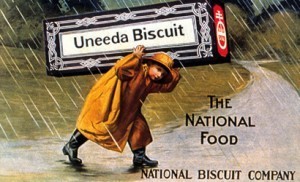
You could tweak it (Jill uses garlic, I don’t) but you never messed with the main ingredients: Uneeda Biscuits and stale rolls. The stale rolls might change from year to year—we’re flexible. Recently I’ve discovered that Bertucci’s rolls are perfect and we make sure to stop by the restaurant where our take out order is, um, 2 bags of rolls.
But don’t mess with the Uneeda biscuits.
In recent years, Thanksgiving became a little scary. The weeks before the hallowed meal I became obsessed with finding the suddenly difficult to find blue cardboard crackers boxes decorated with the little boy in the raincoat. Year round, the entire family went on the lookout for these increasingly rare crackers. What was going on with Nabisco?
One year I was able to order them from Amazon. Then not. Finally, I discovered that DeLuca’s Market in the Beacon Hill neighborhood of Boston stocked them (I think for nearby frail ladies in their nineties who crumbled them in their Campbell’s.) For years, I’d drive down and clean them out, sometimes, when only 4 or 5 boxes remained. I’d shudder, knowing how close I’d come to a Uneeda-less year.
A year ago, when we were already dangerously close to Thanksgiving, they seemed to have disappeared. My older daughter swore she’d seen them in a Market Basket in a suburb 40 minutes from our house. My husband and I raced over. We scoured the aisles. I called my daughter—oh, had she forgotten to mention the sighting had been months before? We drove to DeLuca’s, (surely they’d re-stocked) thinking it an auger of success when we found a parking spot in front (a Beacon Hill miracle.)
Nothing.
A wonderful clerk went to the order form.
Nothing. No longer being ordered.
Nauseated by fear, I went home to, of course, Google Uneeda Biscuits. Where I learned, on Chowhound (my new best friend) that it was over. They were gone. Discontinued. Kaput.
But, oh Lordy, it turned out that Grandma Millie’s secret ingredient was known by others. OMG! We were not the only family in America using Uneeda Biscuits for stuffing. We were not the only family in America for whom Uneeda Biscuits were the cure for stomach aches, depression, and holidays.
We were not alone.
But wait; there’s more. The miracle of Thanksgiving unfolded on my screen. Others, secret byte-sized friends, had already attacked the problem: Goya Snack Crackers. They weren’t a clone or a complete match, but, as my savior,Bicycle Chick wrote, they are quite similar in flavor.

She was correct.
We were saved. Because when it comes to keeping tradition alive, sometimes you have to go online.
Happy Thanksgiving to friends of all dimensions.
(from the rerun files)
November 10, 2012
My Amazing Jewish Book Fair Ride

(Rerun in honor of Jewish Book Month)
“Don’t forget; Jewish people read an enormous amount,” my lovely (and Jewish) literary agent said before my book launch. “We really love books.”
I nodded. Yes, I knew that—at least I knew it inasmuch as I was Jewish and I read—as did my mother, my sister, and my daughters, but could I raise that sample to the status of landslide? Discerning what was true in my culture was fraught with difficulty. I grew up with a slight case of anomie, surrounded by a cultural belief that all-things-Jewish=equals families-pushing-one-towards-great-achievement, while, among other family oddities, my grandmother taught me to shoplift.
I was unclear what being Jewish meant or if I belonged.
Then, a year ago, I had the great good fortune of being invited to participate in Jewish Book Festival and finally felt the full impact of being welcomed into the larger Jewish community.
Jewish Book Month, according to the overseeing Jewish Book Council is “an annual event on the American Jewish calendar dedicated to the celebration of Jewish books. It is observed during the month proceeding Hanukkah, thus the exact date changes from year to year.”
For writers, this translates to: if you’re a Jewish author, or wrote a Jewish-themed book, you can participate in a massive authorial version of American Idol. Call it Jewish Writer Idol, only rather than one winner, there are many, and the chosen ones speak at some number of the over 100 Jewish Book Festivals. If you scale the steps (applications, sending books, etc) you earn the right to sit in Hebrew Union College, crowded thigh-to-thigh in a roomful of other authors, seated before representatives of the various festivals. You’ll have 2 short (or, in some cases, seemingly endless) minutes to convince the audience to pick your book. The not-thanked-enough audience sits through endless afternoon and evening sessions, until the books must merge into one giant mybookillustrateswithdepthandcaring.
Afterward, the audience returns home to read boxes of books before the picks are chosen, traded, and who-knows-what. (I actually know almost nothing about what goes on behind the closed doors—but I imagine it as a giant book debate, perhaps like a continent-wide game of Monopoly.)
Meanwhile, I experienced the nerd equivalent of Rush Week, waiting to see if I got any invitations; then becoming totally Sally Field when they arrived: They liked me! They really liked me!
And then I flew around the country. How to describe the feeling of walking into these Jewish Community Centers filled with readers eager to hear from you? I felt as though I were finally meeting every aunt, uncle, and cousin I’d ever wished for.
Warmth and love was present everywhere: In Columbus, Ohio I had the pleasure of pairing up with local anti-domestic violence groups (based on themes in my novel) and within the event, moving from discussing my book to considering best practices for prevention. The JCC bookstore was heaped with books I wanted to read. Pure gold. (Plus I got to have dinner with my much-admired online author friend Carla Buckley.)
Unless I’m kidding myself, I made friends for life. Detroit knocked me over. I walked into their “Book Club Night” to be greeted by over 300 men and women. Somehow, in this large insightful crowd, we became an intimate group of friends discussing details of writing and life. (It’s also where I gushingly embarrassed myself by sharing with my 300 personal friends my admiration of the upcoming author Darin Strauss.
I’m still red-faced. Moral of story: 300 people do not hold secrets.
The world can be mighty small for a minority: I learned that playing Jewish geography in San Diego. Along with being spellbound by how enraptured they were with books, I discovered connections to high school, camp, college, and most important—to the Jewish Federation of Philanthropy, who saved my life as a child. I had the thrill of seeing that they nurtured authors from both large and small presses, such as my friend Ellen Meeropol, a Red Hen author. It was also here that I finally met Lois Alter Mark in person, who introduced me to Miriam Mendoza’s sad and yet emboldening story of her family’s encounter with domestic homicide.
Have I mentioned food? I flew at 6 AM from San Diego to St. Louis. There the joy of presentation and forming a mutual admiration society with co-panelist, author Alyson Richman (whose book gripped me the entire flight home) mingled with a hospitality that still warms me today. Local children’s author, Jody Feldman saved my life with coffee and caring when she greeted me (inside!) at the airport. The next morning, Alyson, the moderator, Ellen Futterman, editor of the St. Louis Jewish Light, and I, were treated to breakfast and an opportunity to meet each other before our event. After the incredibly well-attended and joyous morning (with Alyson and I now firmly in love) we were taken out to a magnificent multi-course lunch.
By now, I was considering moving to the Midwest.
The food theme continued in Virginia Beach. A tower of desserts gilded the Book Club Night. Seated in a stuffed armed chair, I spoke with a group of women and men who’d not only read my book, but came armed with deeply moving questions and consideration. Again paired with a local domestic violence group—and again I was struck by community connections, dedication to helping, and the commitment to books and life-long learning. I was picked up for the event by a woman filled with the spirit of generosity and family, and driven back to my hotel by her mother—a woman who dedicated part of her retirement to teaching children to read
Back home, I got a few snappish reactions from non-Jewish writer friends, usually along the lines of, “Why isn’t there a Wasp book festival?” (I bit my tongue against saying: There is. It’s called life,) put off by the exclusionary nature of the events. To me, it’s a way for a tiny percentage (.02 %) of the world, a percentage sharply cut by the Holocaust, to celebrate how despite a history of oppression and anti-semitism, we became strong at the broken places—and are diverse enough to include those as different as Dr. Izzeldin Abuelaish, an advocate for peace in the face of devastating personal tragedy, Susan Orlean, author of Rin Tin Tin: The Life and the Legend, and Rabbi Andrea Myers, once a Lutheran, now a member of the New York Board of Rabbis, as well as a lesbian who was active in New York’s fight to recognize gay marriage, in the celebration.
Every community I visited brought remembrance of the past and hopeful embrace of the future. On a personal level, they provided not only an opportunity to talk about my book, but my anomie is greatly ameliorated. Being Jewish means a host of things—including ensuring provision of a big tent. I was invited, I felt cherished, and I belonged.
And, as my agent wisely said: Jewish people really love books.
November 8, 2012
Reading Without Borders
 About when I turned ten I began crafting my library checkouts, hoping I’d look smart. I’d balance my Nancy Drew with a biography of Abraham Lincoln, so the librarian thought well of me. (It seems my self-esteem problem enacted early.) Today, reading Why Are So Many Literary Writers Shifting into Genre?, on The Millions, I felt that familiar shiver of what will the librarian think of me?
Commercial? Literary? Genre? Are genre books written by literary writers more acceptable than those written by genre writers, similar to men writing of domestic life being considered braver than women doing the same?
I’m revisiting material here that I wrote about last year—because the issue never dies, it only sheds skin and rebirths. In Sept 2010, Jodi Picoult and Jennifer Weiner stood up against the New York Times doubled coverage of Jonathan Franzen’s Freedom. Picoult weighed in at the Guardian on mainstream newspapers overwhelming coverage of white male authors. It doesn’t change: men telling domestic stories are writing art; women covering similar ground are crafting women’s fiction. Jennifer Weiner agreed and twitterized the issue.
Weiner’s directness started a new frenzy and the issue veered from Picoult’s premise (overwhelming review coverage of men vs. women and white authors vs. nonwhite authors) to literary fiction being weighed against commercial fiction, often with writers bloodying their own. Weiner and Picoult got trashed for daring to stand up for equality of coverage.
Many writers and reviewers denied the claim that newspapers ignore women and non-white writers and unfairly categorize mainstream novels (a topic well examined by Roxanne Mt Joy and Michelle Dean) asserting that they’re simply reviewing superior fiction, which quickly becomes a construct of healthy peas and carrots books versus sinful bad-for-you ice cream reads.
Michelle Dean wrote far better than I could on the danger of, as eloquently put by Nigerian writer Chimamanda Ngozi Adichie’s, “The Danger of A Single Story,” noting, “the silencing and devaluing of those voices has consequences, particularly when it tends to happen disproportionately to certain populations.
Some argue that commercial books find their audience without help, only literature needs reviewing—but how does that answer the male/white tipping of review scales? It seems a specious and power-retaining argument. Independent films survive even as movie reviewers include commercial films in their wheelhouse.
In a time when black writers are shunted to an African-American section, when men are deemed artists and women crafters, when science fiction and thrillers are better covered than woman-identified historical fiction, and romance is relegated to the deepest closet of shame reads, then the commercial-lit divide becomes nastily entwined within a gender and racial writing divide. Coloring this is the character versus plot battle, well described by author Chris Abouzied in his post, “The Decomposition of Language.”
In Kim Wright’s Million’s article, she worries: “Still, it’s hard to think of very many writers – save possibly Stephen King – who have moved from genre to literary. The floor seems to slope the other way, and Patriarche concedes that sometimes the difference isn’t so much in what the author has written as in how the publisher opts to describe it. “I’ve seen literary books blurbed as something like ‘the thinking woman’s beach read,’” she says. “And that’s a sign that the publisher is trying to appeal to consumers who are more mainstream. In this aspect the change is more industry-driven than author-driven.””
Please, let’s pray we don’t start having a stratification of literary genre vs. non literary genre.
Since I started reading at age four I’ve never been without books and I pray to have a TBR stack until the moment I die. On that heap I want it all: pounding plots, the wow of discovery, the comfort of recognition, and astounding characters. If I’m lucky, some will have all of the above. Whichever one I’m holding, I don’t want to be judged or lauded for it and I don’t want to shelve my books by race, class, or gender.
Tayari Jones, writing to fellow authors about the stratification of literature, said it very well: ‘other writers do not deserve your scorn.’ In the spirit of writer/reader heal thyself; I’m going to work on remembering those words. There’s room for all in the big tent of reading.
(first published in 2011)