Phil Simon's Blog, page 8
January 29, 2024
Tectonic Forces and Commerical Real Estate
Hybrid work. Dispersion. Employee empowerment. Thorny inflation and attendant interest-rate increases.
These are just a few of the forces that I cover in The Nine. In the book, I describe how the they’re colliding, and why the workplace will never return to its pre-COVID state. Landlords, banks, and others involved in commercial real estate are starting to realize as much.
As last night’s 60 Minutes segment showed, the societal and economic consequences are grave.
Give it a watch.
The post Tectonic Forces and Commerical Real Estate appeared first on Phil Simon.


January 15, 2024
Tectonic Forces and Commerical Real Estate
Hybrid work. Dispersion. Employee empowerment. Thorny inflation and attendant interest-rate increases.
These are just a few of the forces that I cover in The Nine. In the book, I describe how the they’re colliding, and why the workplace will never return to its pre-COVID state. Landlords, banks, and others involved in commercial real estate are starting to realize as much.
As last night’s 60 Minutes segment showed, the societal and economic consequences are grave.
Give it a watch.
The post Tectonic Forces and Commerical Real Estate appeared first on Phil Simon.
January 4, 2024
Can AI improve atrocious writing?
Way back in May 2021, I wrote a post about how not to start a book. Although not even three years ago, my rant reflected a very different world. For starters, generative AI tools like ChaptGPT didn’t exist in their current form.
I recently revisited that post and the cringeworthy prose that inspired me to write it. I asked Bard if it could simplify these two objectively awful sentences that introduce an unfortunate 2020 book:
Building on the arguments of our previous foray into this topic, this book envisions the emergence of the Fifth Wave in American higher education—a league of colleges and universities, spearheaded initially by a subset of large-scale public research universities, unified in their resolve to accelerate positive social outcomes through the seamless integration of world-class knowledge production with cutting-edge technological innovation and institutional cultures dedicated to the advancement of accessibility to the broadest possible demographic representative of the socioeconomic and intellectual diversity of our nation. The Fifth Wave primarily augments and complements the set of American research universities, which, for reasons that will readily become apparent, we term the Fourth Wave, but will also comprise networks of heterogeneous colleges and universities whose frameworks are underpinned by discovery and knowledge production, and institutional actors from business and industry, government agencies and laboratories, and organizations in civil society.
Here’s my prompt:
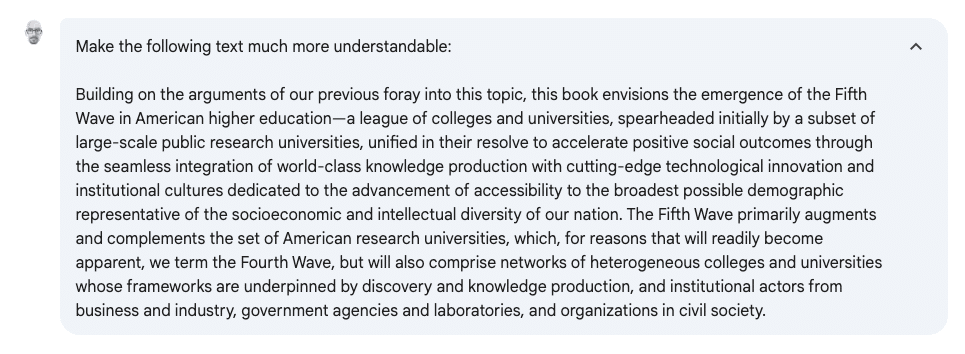
Click image above to embiggen it.
Not surprisingly, Bard was up to the task:
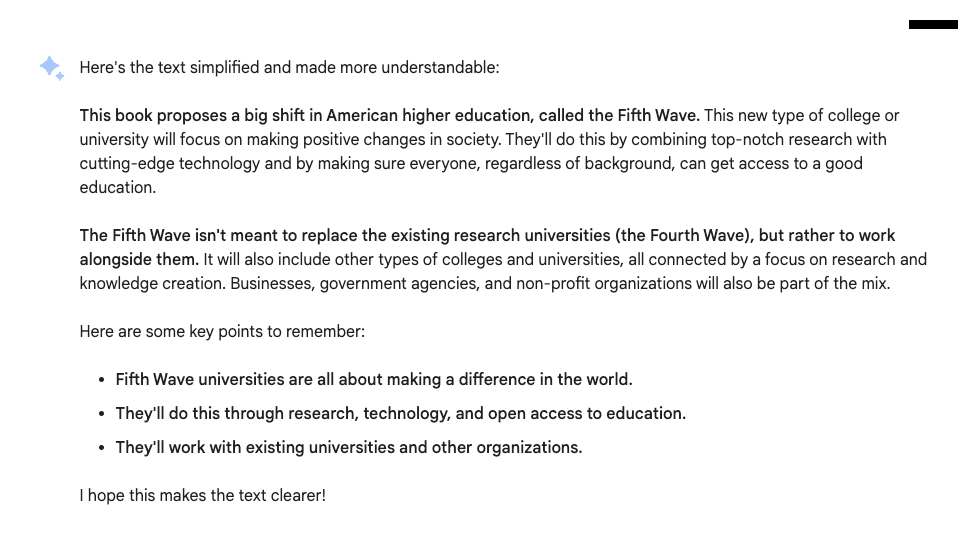
Again, click the image above to embiggen it.
This begs the question: Does Bard’s rewrite accurately summarize the author’s original intent?
I’m not sure. I sure as hell am not going to read the entire dense book or subject my ears to it. (My ears and eyes are thanking me as I type these words.) One can’t argue, though, that Bard’s output is at least more digestible than the original claptrap. It’s not even close.
Learn to write well—or hire a coach or ghostwriter who can do it for you.
As I write in The Nine, genAI tools are only going to improve and become more ubiquitous. Still, it’s presumptuous and counterproductive to make your readers need to use them to understand what you mean.
Simon Says: The onus is on authors before publishing their books, not on readers after those books arrive.The answer to the question I pose in this post appears to be an unequivocal yes, but so what? (At the very least AI can make stitled scribes write like humans.)
There’s still no excuse for submitting writing this horrendous. It reflects a remarkable lack of self-awareness. The presence of Bard, Claude 2, and their ilk does not change that simple fact. Here’s the money quote from this post, though: Authors need to make their messages clear before publishing. They cannot and should not expect readers to attempt to decipher their inscrutable words after a book goes to print.
If anything, the explosion of generative AI makes publishing gobbledygook like this even less acceptable than it was in 2021. (When presented with a mess, discerning readers will fairly ask a question like, “Why couldn’t you take a few minutes to run your text through Grammarly, for God’s sake?”)
Brass tacks: Learn to write well—or hire a coach to help you or a ghostwriter who can do it for you.
On a different note, RIP to Tom Wilkinson. This scene still blows my mind (NSFW).
The post Can AI improve atrocious writing? appeared first on Phil Simon.
Can AI improve atrocious writing?
Way back in May 2021, I wrote a post about how not to start a book. Although not even three years ago, my rant reflected a very different world. For starters, generative AI tools like ChaptGPT didn’t exist in their current form.
I recently revisited that post and the cringeworthy prose that inspired me to write it. I asked Bard if it could simplify these two objectively awful sentences that introduce an unfortunate 2020 book:
Building on the arguments of our previous foray into this topic, this book envisions the emergence of the Fifth Wave in American higher education—a league of colleges and universities, spearheaded initially by a subset of large-scale public research universities, unified in their resolve to accelerate positive social outcomes through the seamless integration of world-class knowledge production with cutting-edge technological innovation and institutional cultures dedicated to the advancement of accessibility to the broadest possible demographic representative of the socioeconomic and intellectual diversity of our nation. The Fifth Wave primarily augments and complements the set of American research universities, which, for reasons that will readily become apparent, we term the Fourth Wave, but will also comprise networks of heterogeneous colleges and universities whose frameworks are underpinned by discovery and knowledge production, and institutional actors from business and industry, government agencies and laboratories, and organizations in civil society.
Here’s my prompt:
Click image above to embiggen it.
Not surprisingly, Bard was up to the task:
Again, click the image above to embiggen it.
This begs the question: Does Bard’s rewrite accurately summarize the author’s original intent?
I’m not sure. I sure as hell am not going to read the entire dense book or subject my ears to it. (My ears and eyes are thanking me as I type these words.) One can’t argue, though, that Bard’s output is at least more digestible than the original claptrap. It’s not even close.
Learn to write well—or hire a coach or ghostwriter who can do it for you.
As I write in The Nine, genAI tools are only going to improve and become more ubiquitous. Still, it’s presumptuous and counterproductive to make your readers need to use them to understand what you mean.
Simon Says: The onus is on authors before publishing their books, not on readers after those books arrive.The answer to the question I pose in this post appears to be an unequivocal yes, but so what? (At the very least AI can make stitled scribes write like humans.)
There’s still no excuse for submitting writing this horrendous. It reflects a remarkable lack of self-awareness. The presence of Bard, Claude 2, and their ilk does not change that simple fact. Here’s the money quote from this post, though: Authors need to make their messages clear before publishing. They cannot and should not expect readers to attempt to decipher their inscrutable words after a book goes to print.
If anything, the explosion of generative AI makes publishing gobbledygook like this even less acceptable than it was in 2021. (When presented with a mess, discerning readers will fairly ask a question like, “Why couldn’t you take a few minutes to run your text through Grammarly, for God’s sake?”)
Brass tacks: Learn to write well—or hire a coach to help you or a ghostwriter who can do it for you.
On a different note, RIP to Tom Wilkinson. This scene still blows my mind (NSFW).
The post Can AI improve atrocious writing? appeared first on Phil Simon.
December 19, 2023
The Dangerous Democratization of AI
Image from Craiyon
In 2004, one of the world’s smartest techies made what seemed like a reasonable prediction. He promised that the powers that be would “solve” spam within two years.
That luminary was, of course, Bill Gates of Microsoft fame. You probably heard of him.
Last year, spam remained alive and well. The arrival of generative AI means many things. As I wrote in The Nine, unsolicited scams are about to become much more difficult to identify.
It was only a matter of time before ChatGPT faced stiff competition—and not just from Google, Meta, Amazon, and other tech giants. Open-source large-language models have arrived in earnest, as Ethan Mollick writes in his latest Substack:
since anyone can modify these systems, to a large extent AI development is also now much more democratized, for better or worse. For example, I would expect to see a lot more targeted spam messages coming your way soon, given the evidence that GPT-3.5 level models works [sic] well for sending deeply personalized fake messages that people want to click on.
So long, obvious Nigerian diamond-mining schemes. More people will fall for these increasingly plausible ruses, and the consequences should terrify us. Tricks can help, but nothing is failsafe.
Simon Says I’ve said it dozens of times in the past year: You can ignore any or all of the forces in The Nine, but they sure as hell are not ignoring you. Foolish is the soul who pretends otherwise. Blockchain technologies will help combat spam, but your best weapon will continue to be that old-school organ between your ears.
Image from Craiyon
In 2004, one of the world’s smartest techies made what seemed like a reasonable prediction. He promised that the powers that be would “solve” spam within two years.
That luminary was, of course, Bill Gates of Microsoft fame. You probably heard of him.
Last year, spam remained alive and well. The arrival of generative AI means many things. As I wrote in The Nine, unsolicited scams are about to become much more difficult to identify.
It was only a matter of time before ChatGPT faced stiff competition—and not just from Google, Meta, Amazon, and other tech giants. Open-source large-language models have arrived in earnest, as Ethan Mollick writes in his latest Substack:
since anyone can modify these systems, to a large extent AI development is also now much more democratized, for better or worse. For example, I would expect to see a lot more targeted spam messages coming your way soon, given the evidence that GPT-3.5 level models works [sic] well for sending deeply personalized fake messages that people want to click on.
So long, obvious Nigerian diamond-mining schemes. More people will fall for these increasingly plausible ruses, and the consequences should terrify us. Tricks can help, but nothing is failsafe.
Simon SaysI’ve said it dozens of times in the past year: You can ignore any or all of the forces in The Nine, but they sure as hell are not ignoring you. Foolish is the soul who pretends otherwise. Blockchain technologies will help combat spam, but your best weapon will continue to be that old-school organ between your ears.
The post The Dangerous Democratization of AI appeared first on Phil Simon.
The Dangerous Democratization of AI
Image from Craiyon
In 2004, one of the world’s smartest techies made what seemed like a reasonable prediction. He promised that the powers that be would “solve” spam within two years.
That luminary was, of course, Bill Gates of Microsoft fame. You probably heard of him.
Last year, spam remained alive and well. The arrival of generative AI means many things. As I wrote in The Nine, unsolicited scams are about to become much more difficult to identify.
It was only a matter of time before ChatGPT faced stiff competition—and not just from Google, Meta, Amazon, and other tech giants. Open-source large-language models have arrived in earnest, as Ethan Mollick writes in his latest Substack:
since anyone can modify these systems, to a large extent AI development is also now much more democratized, for better or worse. For example, I would expect to see a lot more targeted spam messages coming your way soon, given the evidence that GPT-3.5 level models works [sic] well for sending deeply personalized fake messages that people want to click on.
So long, obvious Nigerian diamond-mining schemes. More people will fall for these increasingly plausible ruses, and the consequences should terrify us. Tricks can help, but nothing is failsafe.
Simon SaysI’ve said it dozens of times in the past year: You can ignore any or all of the forces in The Nine, but they sure as hell are not ignoring you. Foolish is the soul who pretends otherwise. Blockchain technologies will help combat spam, but your best weapon will continue to be that old-school organ between your ears.
What say you?
Image from Craiyon
In 2004, one of the world’s smartest techies made what seemed like a reasonable prediction. He promised that the powers that be would “solve” spam within two years.
That luminary was, of course, Bill Gates of Microsoft fame. You probably heard of him.
Last year, spam remained alive and well. The arrival of generative AI means many things. As I wrote in The Nine, unsolicited scams are about to become much more difficult to identify.
It was only a matter of time before ChatGPT faced stiff competition—and not just from Google, Meta, Amazon, and other tech giants. Open-source large-language models have arrived in earnest, as Ethan Mollick writes in his latest Substack:
since anyone can modify these systems, to a large extent AI development is also now much more democratized, for better or worse. For example, I would expect to see a lot more targeted spam messages coming your way soon, given the evidence that GPT-3.5 level models works [sic] well for sending deeply personalized fake messages that people want to click on.
So long, obvious Nigerian diamond-mining schemes. More people will fall for these increasingly plausible ruses, and the consequences should terrify us. Tricks can help, but nothing is failsafe.
Simon SaysI’ve said it dozens of times in the past year: You can ignore any or all of the forces in The Nine, but they sure as hell are not ignoring you. Foolish is the soul who pretends otherwise. Blockchain technologies will help combat spam, but your best weapon will continue to be that old-school organ between your ears.
What say you?
The post The Dangerous Democratization of AI appeared first on Phil Simon.
December 11, 2023
The Amazon Coffee Rebellion
Lauren Rosenblatt \/ The Seattle Times\n
Last month, rank-and-file employees at OpenAI vociferously lobbied for the return of their axed CEO.\n
Fast-forward five tumultuous days. Sam Altman was back (called it), and most of OpenAI’s board was out on its ass.\nMeanwhile, in Seattle …\n On an ostensibly different level, Amazon is forcing employees back to the office. A good chunk of them opted to quit rather than forgo their newfound flexibility.\n WFH is hardly the only employee amenity under siege at The Everything Store. Management had offered employees unlimited free coffee but recently announced a one-cup-per-day maximum. Ten thousand miffed workers expressed their displeasure at the policy shift.\n Would Amazon stick to its guns or cave?\n If you read\u00a0The Nine, you know the answer.\n [image error]As Lauren Rosenblatt writes for The Seattle Times, “Less than a month before it was set to end, though, Amazon reversed course and extended the program.” (I’m no procurement expert, but $20 says that it will just order more of its own brand.) Trust me. Near-record profits mean that the company can afford to splurge a little these days.\nConnecting the Dots\n At first glance, a company reinstating its CEO over its board’s objections and employees getting few extra cups of free joe might seem unrelated\u2014even polar opposites. Let’s zoom out, though. Both events are manifestations of the unprecedented employee empowerment I describe in the book.\n Many things defined the 2023 workplace. The continued rise of empowered employees sits at the top of the list, and I suspect that it won’t wane in 2024. Much like the other forces in The Nine, expect it to intensify. Exhibits A & B: Much like actors and screenwriters, doctors are unionizing, and pharmacists aren’t far behind.","tablet":"[image error] Lauren Rosenblatt \/ The Seattle Times\n Last month, rank-and-file employees at OpenAI vociferously lobbied for the return of their axed CEO.\n Fast-forward five tumultuous days. Sam Altman was back (called it), and most of OpenAI's board was out on its ass.\nMeanwhile, in Seattle ...\n On an ostensibly different level, Amazon is forcing employees back to the office. A good chunk of them opted to quit rather than forgo their newfound flexibility.\n WFH is hardly the only employee amenity under siege at The Everything Store. Management had offered employees unlimited free coffee but recently announced a one-cup-per-day maximum. Ten thousand miffed workers expressed their displeasure at the policy shift.\n Would Amazon stick to its guns or cave?\n If you read The Nine, you know the answer.\n [image error]As Lauren Rosenblatt writes for The Seattle Times, \"Less than a month before it was set to end, though, Amazon reversed course and extended the program.\" (I'm no procurement expert, but $20 says that it will just order more of its own brand.) Trust me. Near-record profits mean that the company can afford to splurge a little these days.\nConnecting the Dots\n At first glance, a company reinstating its CEO over its board's objections and employees getting few extra cups of free joe might seem unrelated\u2014even polar opposites. Let's zoom out, though. Both events are manifestations of the unprecedented employee empowerment I describe in the book.\n Many things defined the 2023 workplace. The continued rise of empowered employees sits at the top of the list, and I suspect that it won't wane in 2024. Much like the other forces in The Nine, expect it to intensify. Exhibits A & B: Much like actors and screenwriters, doctors are unionizing, and pharmacists aren't far behind.","phone":"Last month, rank-and-file employees at OpenAI vociferously lobbied for the return of their axed CEO.\n Fast-forward five tumultuous days. Sam Altman was back (called it), and most of OpenAI's board was out on its ass.\nMeanwhile, in Seattle ...\n On an ostensibly different level, Amazon is forcing employees back to the office. A good chunk of them opted to quit rather than forgo their newfound flexibility.\n WFH is hardly the only employee amenity under siege at The Everything Store. Management had offered employees unlimited free coffee but recently announced a one-cup-per-day maximum. Ten thousand miffed workers expressed their displeasure at the policy shift.\n Would Amazon stick to its guns or cave?\n If you read The Nine, you know the answer.\n [image error]As Lauren Rosenblatt writes for The Seattle Times, \"Less than a month before it was set to end, though, Amazon reversed course and extended the program.\" (I'm no procurement expert, but $20 says that it will just order more of its own brand.) Trust me. Near-record profits mean that the company can afford to splurge a little these days.\nConnecting the Dots\n At first glance, a company reinstating its CEO over its board's objections and employees getting few extra cups of free joe might seem unrelated\u2014even polar opposites. Let's zoom out, though. Both events are manifestations of the unprecedented employee empowerment I describe in the book.\n Many things defined the 2023 workplace. The continued rise of empowered employees sits at the top of the list, and I suspect that it won't wane in 2024. Much like the other forces in The Nine, expect it to intensify. Exhibits A & B: Much like actors and screenwriters, doctors are unionizing, and pharmacists aren't far behind."}},"slug":"et_pb_text"}" data-et-multi-view-load-tablet-hidden="true" data-et-multi-view-load-phone-hidden="true"> Lauren Rosenblatt / The Seattle Times Last month, rank-and-file employees at OpenAI vociferously lobbied for the return of their axed CEO. Fast-forward five tumultuous days. Sam Altman was back (called it), and most of OpenAI’s board was out on its ass. On an ostensibly different level, Amazon is forcing employees back to the office. A good chunk of them opted to quit rather than forgo their newfound flexibility. WFH is hardly the only employee amenity under siege at The Everything Store. Management had offered employees unlimited free coffee but recently announced a one-cup-per-day maximum. Ten thousand miffed workers expressed their displeasure at the policy shift. Would Amazon stick to its guns or cave? If you read The Nine, you know the answer. At first glance, a company reinstating its CEO over its board’s objections and employees getting few extra cups of free joe might seem unrelated—even polar opposites. Let’s zoom out, though. Both events are manifestations of the unprecedented employee empowerment I describe in the book. Many things defined the 2023 workplace. The continued rise of empowered employees sits at the top of the list, and I suspect that it won’t wane in 2024. Much like the other forces in The Nine, expect it to intensify. Exhibits A & B: Much like actors and screenwriters, doctors are unionizing, and pharmacists aren’t far behind.
 As Lauren Rosenblatt writes for The Seattle Times, “Less than a month before it was set to end, though, Amazon reversed course and extended the program.” (I’m no procurement expert, but $20 says that it will just order more of its own brand.) Trust me. Near-record profits mean that the company can afford to splurge a little these days.
The post The Amazon Coffee Rebellion appeared first on Phil Simon.
December 5, 2023
Department Names Don’t Matter. Just Help Me.
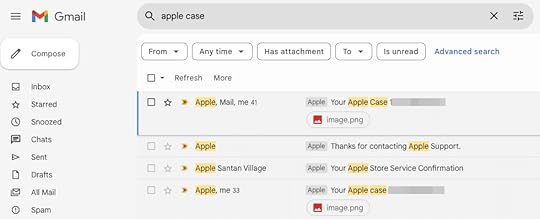
I was thinking about his words last week in the context of my resurgent Mac issues.\u00a0After last week’s MacOS updates, I again experienced the same massive issues with Handoff and Continuity I described here.\n After spending yet another 30 minutes screwing around with my computer, I called support and quickly blew through the poor rep’s cursory recommendations. I requested an escalation to a senior rep. Ten minutes later, Antonio proved undecidedly helpful. Among his lame suggestions:\n Sheesh. As I had told all reps over the past few months, I had done each thing at least two times. Knowing the vexing nature of the problem, I had also posted on Reddit and brainstormed with a few tech-savvy friends. Oh, and then there’s the tsunami of e-mails to Apple support:\n [image error]\n But back to my call …\n If you want your employees to be rude and unhelpful, do it the right way.\n\n Antonio seemed hell-bent on getting me off the phone and repeatedly refused to let me share my screen with him. I never do this, but I hung up on him.\n There’s a happy ending\u2014at least for now.\n I ultimately resolved the issue on my own. Logging out of iCloud on my iPhone and resetting Bluetooth and Handoff appears to have cleared things up until Apple breaks it again. I’m guessing a month.\n I’d wager that most companies have rebranded customer service as customer success or customer experience. (Smack me if I ever use the initialism CX.)\n Ultimately, the department’s name doesn’t matter. Call it whatever you like, but make sure that your employees actually do something to help solve customers’ problems. And if you want your employees to be rude and unhelpful, do it the right way.","tablet":" [image error]In one of my favorite bits of his, the legendary George Carlin rants about jargon and soft language. It's worth watching if you've never seen it.\n I was thinking about his words last week in the context of my continued Mac issues. After last week's MacOS updates, I again experienced the same massive issues with Handoff and Continuity I described here.\n After spending yet another 30 minutes screwing around with my computer, I called support and quickly blew through the poor rep's cursory recommendations. I requested an escalation to a senior rep. Antonio proved undecidedly helpful. Among his lame suggestions:\n Sheesh. I had done each thing at least two times over the past five months, never mind posting to Reddit and asking tech-savvy friends for tips, but back to my call ...\n Antonio seemed hell-bent on getting me off the phone and repeatedly refused to let me share my screen with him. I ultimately figured it out. Logging out of iCloud on my iPhone and resetting Bluetooth and Handoff appears to have cleared things up\u2014at least for now and until Apple breaks it again.\n Most companies have rebranded customer service as customer success or customer experience. (Smack me if I ever use the initialism CX.)\n The name doesn't ultimately matter. Call it whatever you like, but make sure that your employees actually do something to help solve customers' problems.\n What say you?","phone":"[image error]In one of my favorite bits of his, the legendary George Carlin rants about jargon and soft language. It's worth watching if you've never seen it.\n I was thinking about his words last week in the context of my resurgent Mac issues. After last week's MacOS updates, I again experienced the same massive issues with Handoff and Continuity I described here.\n After spending yet another 30 minutes screwing around with my computer, I called support and quickly blew through the poor rep's cursory recommendations. I requested an escalation to a senior rep. Antonio proved undecidedly helpful. Among his lame suggestions:\n Sheesh. I had done each thing at least two times over the past five months, never mind posting to Reddit and asking tech-savvy friends for tips. Oh, and the tsunami of e-mails:\n [image error]\n But back to my call ...\n Antonio seemed hell-bent on getting me off the phone and repeatedly refused to let me share my screen with him. I ultimately figured it out. Logging out of iCloud on my iPhone and resetting Bluetooth and Handoff appears to have cleared things up\u2014at least for now and until Apple breaks it again.\n Most companies have rebranded customer service as customer success or customer experience. (Smack me if I ever use the initialism CX.)\n The name doesn't ultimately matter. Call it whatever you like, but make sure that your employees actually do something to help solve customers' problems.\n What say you?"}},"slug":"et_pb_text"}" data-et-multi-view-load-tablet-hidden="true" data-et-multi-view-load-phone-hidden="true"> In one of my favorite bits of his, the legendary George Carlin rants about jargon and soft language. It’s worth watching if you’ve never seen it. I was thinking about his words last week in the context of my resurgent Mac issues. After last week’s MacOS updates, I again experienced the same massive issues with Handoff and Continuity I described here. After spending yet another 30 minutes screwing around with my computer, I called support and quickly blew through the poor rep’s cursory recommendations. I requested an escalation to a senior rep. Ten minutes later, Antonio proved undecidedly helpful. Among his lame suggestions: Sheesh. As I had told all reps over the past few months, I had done each thing at least two times. Knowing the vexing nature of the problem, I had also posted on Reddit and brainstormed with a few tech-savvy friends. Oh, and then there’s the tsunami of e-mails to Apple support: But back to my call … If you want your employees to be rude and unhelpful, do it the right way. Antonio seemed hell-bent on getting me off the phone and repeatedly refused to let me share my screen with him. I never do this, but I hung up on him. There’s a happy ending—at least for now. I ultimately resolved the issue on my own. Logging out of iCloud on my iPhone and resetting Bluetooth and Handoff appears to have cleared things up until Apple breaks it again. I’m guessing a month. I’d wager that most companies have rebranded customer service as customer success or customer experience. (Smack me if I ever use the initialism CX.) Ultimately, the department’s name doesn’t matter. Call it whatever you like, but make sure that your employees actually do something to help solve customers’ problems. And if you want your employees to be rude and unhelpful, do it the right way.\n
What say you?","tablet":"
[image error]In one of my favorite bits of his, the legendary George Carlin rants about jargon and soft language. It's worth watching if you've never seen it.\n I was thinking about his words last week in the context of my continued Mac issues. After last week's MacOS updates, I again experienced the same massive issues with Handoff and Continuity I described here.\n After spending yet another 30 minutes screwing around with my computer, I called support and quickly blew through the poor rep's cursory recommendations. I requested an escalation to a senior rep. Antonio proved undecidedly helpful. Among his lame suggestions:\n Sheesh. I had done each thing at least two times over the past five months, never mind posting to Reddit and asking tech-savvy friends for tips, but back to my call ...\n Antonio seemed hell-bent on getting me off the phone and repeatedly refused to let me share my screen with him. I ultimately figured it out. Logging out of iCloud on my iPhone and resetting Bluetooth and Handoff appears to have cleared things up\u2014at least for now and until Apple breaks it again.\n Most companies have rebranded customer service as customer success or customer experience. (Smack me if I ever use the initialism CX.)\n The name doesn't ultimately matter. Call it whatever you like, but make sure that your employees actually do something to help solve customers' problems.\n What say you?","phone":"[image error]In one of my favorite bits of his, the legendary George Carlin rants about jargon and soft language. It's worth watching if you've never seen it.\n I was thinking about his words last week in the context of my resurgent Mac issues. After last week's MacOS updates, I again experienced the same massive issues with Handoff and Continuity I described here.\n After spending yet another 30 minutes screwing around with my computer, I called support and quickly blew through the poor rep's cursory recommendations. I requested an escalation to a senior rep. Antonio proved undecidedly helpful. Among his lame suggestions:\n Sheesh. I had done each thing at least two times over the past five months, never mind posting to Reddit and asking tech-savvy friends for tips. Oh, and the tsunami of e-mails:\n [image error]\n But back to my call ...\n Antonio seemed hell-bent on getting me off the phone and repeatedly refused to let me share my screen with him. I ultimately figured it out. Logging out of iCloud on my iPhone and resetting Bluetooth and Handoff appears to have cleared things up\u2014at least for now and until Apple breaks it again.\n Most companies have rebranded customer service as customer success or customer experience. (Smack me if I ever use the initialism CX.)\n The name doesn't ultimately matter. Call it whatever you like, but make sure that your employees actually do something to help solve customers' problems.\n What say you?"}},"slug":"et_pb_text"}" data-et-multi-view-load-tablet-hidden="true" data-et-multi-view-load-phone-hidden="true"> What say you?
The post Department Names Don’t Matter. Just Help Me. appeared first on Phil Simon.
November 27, 2023
How Fancy Text Helps Me Identify Spam
Like millions of people, I’ve been off Twitter for months now. I now spend much of the time that I used to spend tweeting and reading tweets on a different social network: LinkedIn. I suspect that I’m hardly alone here.
A second-order effect of my switch has been increased spam. If I’m more active on LinkedIn, bots and bad actors see me as a bigger target for their inane pitches, phishing schemes, and the like. Making matters worse, AI makes it even easier for spammers to do their thing.
It doesn’t take smart cookies long to recognize spam or a scam, but a little trick simplifies this process even more. I use fancy text in my profile name. As a result, when I post and comment, my name looks a smidge different than others’. See below:
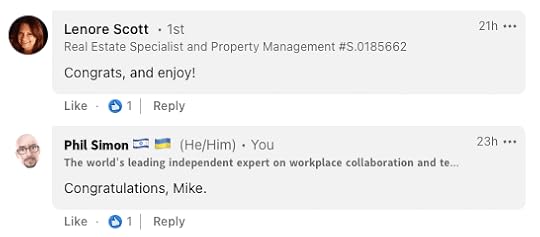
Yeah, my name stands out a bit, but I realize the primary benefit when I receive messages like this one:
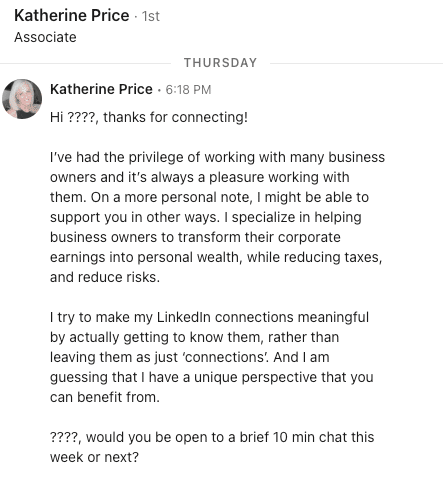
Note not one, but two, instances of ???? as my name. I soon removed “Katherine” and reported her to the LinkedIn safety team. If the app ever added filters à la Gmail or Outlook, then I wouldn’t even have to do that much. I’d just immediately route them to the spam folder
Simon SaysAnyone who doesn’t spend two seconds realizing this error isn’t worth keeping as a connection, much less doing business with.
FeedbackWhat say you?
The post How Fancy Text Helps Me Identify Spam appeared first on Phil Simon.
November 19, 2023
On OpenAI and Employee Empowerment
Updated: November 20, 2023
It turns out that Altman isn’t returning—at least for now. Still, the mere fact that the board considered the notion undercores the main point of this post. If staffers depart en masse as promised, I could still see it happening.
Late Friday, OpenAI announced that it had shitcanned CEO Sam Altman. The word shocking is entirely apropos, but not unheard of. Uber and WeWork are just two recent examples of valuable decacorns whose boards and investors forced their CEOs to walk—although after much more protracted battles.
Evidently, news of the unexpected departure isn’t sitting well with OpenAI’s workforce. Many employees threatened to resign if Altman isn’t reinstated. As Alex Heath and Nilay Patel write on The Verge, “If Altman decides to leave and start a new company, those staffers would assuredly go with him.”
Can OpenAI stand to lose a significant portion of its employees? Hell, no. I suspected that recruiters at Google, Amazon, Anthropic, and Meta are probably trolling these folks on LinkedIn as we speak. I would.

Photo from AI tool Craiyon.
By the time you read these words, who knows where things will stand? Does Altman even want to return? The situation is nothing if not fluid.
I do know, however, that we’re arguably living in an era of unprecedented employee empowerment. (It’s the first of the nine forces I cover in The Nine.) With historically low unemployment, all workers are holding better cards than, say, March of 2020 or January 2009. I’m hard-pressed to think of any employees in greater demand than those crafting the generative artificial intelligence tools that are all the rage.
Simon SaysStay tuned. My sense is that OpenAI employees will soon win out, not unlike the autoworkers who received some surprising concessions.
FeedbackWhat say you?
The post On OpenAI and Employee Empowerment appeared first on Phil Simon.