Phil Simon's Blog, page 7
July 2, 2024
The Miscellaneous Mindset
A month ago, a woman contacted me about writing some short- and long-form content for her company’s website and marketing department. The organization needed to find someone to generate quality blog posts and white papers about unified communication. A Google search revealed yours truly, among others.
Any seasoned comms vet will tell you that UC is old hat. Definitions of it run the gamut. For here, suffice it to say that it’s an umbrella term that encompasses the many different types of—wait for it—communication that takes place within an organization’s physical or virtual walls. (I mention UC briefly in the early pages of Zoom For Dummies.)
I spoke with her for about half an hour to assess her firm’s needs and provide a rough estimate. I created one in Notion and quickly fired off a proper PDF.
And then, crickets.
I followed up with her a few times and, about six weeks after our chat, finally read the inevitable response:
Thank you, but we’ve decided to go with someone who specializes in UC. Your background is too varied for us.
I immediately thought to myself, “Good. I’m doing something right.”
Embracing the Miscellaneous MindsetTo be fair, the woman’s criticism or reason wasn’t inaccurate. I’ll be the first to cop to taking many paths over the course of my professional career. (Serving as a college professor and starting Racked Publishing are my most recent sojourns.) Like you, I know writers, consultants, and speakers who don’t. Instead, they focus on a single, narrow topic: marketing, project management, and customer experience. That’s their jam, and they lean into it.
While the miscellaneous mindset ostensibly hurt me with this prospect, I wouldn’t have it any other way—and I have been banging this drum for years. A single topic doesn’t intrigue me enough to exclude all others for years at a time. As but one example, my 2011 book on platforms led to an interest in—and subsequent book on—Big Data in 2013. That, in turn, fueled a desire to write data visualization text in 2014.
I am not alone in thinking that a deliberate willingness to explore different subjects makes a person more interesting. (Check out David Epstein’s excellent book Range: Why Generalists Triumph in a Specialized World.)
Balancing the Upsides and DownsidesA propensity to be curious and learn new things will deter some prospects, but it will attract others. The benefits can be manifold and significant. For example, I can chat with serious would-be authors about ghostwriting books about something other than our friend unified communications.
So, I can write or speak about everything, right?
Being able to write well supercedes my current knowledge on events, issues, and trends.
Hardly. I’m not remotely qualified to write or ghostwrite memoirs, fiction, and a bevy of non-fiction topics. I can think of dozens of conceivable business or tech subjects about which I’m just not the write candidate. (I’ll never understand why a conference organizer or event planner would hire a speaker who claims to be able to give a rollicking talk about anything.)
At the same time, though, it’s not a stretch to apply this miscellaneous mindset, wrting acumen, research proficiency, curiosity, and skills to other dynamic areas. Recent topics for my writing clients have included cryptocurrencies, public policy, DeFi, and blockchain. With my ideal client, being able to write well supercedes my current knowledge on events, issues, and trends.
All things considered, the miscellaneous mindset has borne plenty of fruit.
The post The Miscellaneous Mindset appeared first on Phil Simon.


June 15, 2024
On AI, Psychedelics, and Spinal Tap
I was thinking about those musicians in the context of playing with AI. Can their failures give us crazy ideas and help us brainstorm?
To this end, I recently took Luma Labs‘ buzzy new image/video generation for a spin. As you’ll see, the results were decidedly weird.
Since I’m a fan of the breed, I started with a simple image of Teddy the Bulldog:

Here’s what Luma created:
Pretty neat, I suppose. When I handed it a cover of The Nine: The Tectonic Forces Reshaping the Workplace, though, the profound weirdness of AI manifested itself. Here’s the cover:
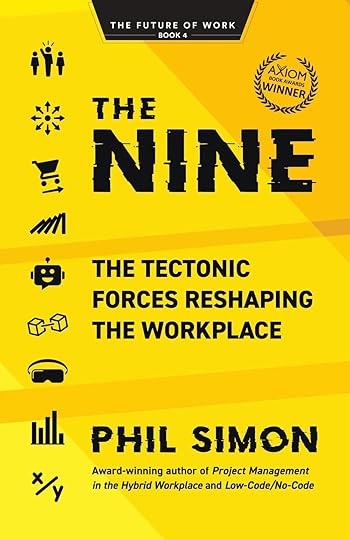
As you can see below, the book’s iconography confused the hell out of our AI overlords:
I’m sure that these tools will improve, but videographers and graphic designers need not worry about losing their jobs just yet.Simon SaysStill, for creative types, maybe their failures aren’t totally worthless. Could they serve as modern-day hallucinogens? I could see how crazy, incoherent output like the one above might inspire ideas otherwise obtained via acid trips. After all, there’s a fine line between stupid and clever.
FeedbackWhat say you?
The post On AI, Psychedelics, and Spinal Tap appeared first on Phil Simon.
June 4, 2024
Three Freelancing Models
Starting in my late twenties, I started doing freelance consulting work. Since that time, I’ve hopped in and out of full-time gigs—most recently as a college professor. Even then, I kept a few side hustles going. My prior employer allowed it then and still does now.
These days, I pay my bills by speaking, writing, and consulting. Book sales don’t hurt, either. #passiveincome Although the type of work I do differs compared to when I started, I still work on a discrete or project basis. Nothing is guaranteed. The fleas come with the dog.
In today’s post, I’ll describe three different freelance models and their advantages and disadvantages.
Model 1: The Big Fish The idea here is simple, even if its execution isn’t: Find a single, lucrative, and long-term client. That person or organization may, in fact, represent your primary one. In the extreme, it’s your exclusive one—at least for the duration of the project.
In 2008, I chose this model—or, rather, it chose me.1 Although only two clients paid me during those 12 months, they did so for 51 weeks of the year. As a result, I earned more than I ever had in my life. Color me lucky, considering the housing crisis was unfolding at the time.
ProsThe sense of stability of working on only two major projects set me at ease. What’s more, I didn’t have to scramble to find other gigs. Although my clients could be demanding, at least I knew where my bread was buttered. I enjoyed a sense of clarity in knowing that you need to placate a single person or group of people at any given time.
ConsNate Silver has famously said, “Trust the process—not the outcome.”
Tru dat.
Despite my best results, my approach was risky. Losing one would mean a big financial hit.
At any point, one of my few large clients could have decided that it didn’t want to keep paying me or couldn’t afford to do so. As a result, despite my best results, this approach was risky. Losing one would represent a big financial hit. It’s also challenging to find new work when you’re effectively unavailable for most of the day.
Pro tip if you’re deciding to freelance: Ensure that you can cover all of your expenses for at least six months.
Model 2: Guppies This is the antithesis of the first model. In it, hedge your bets by signing up a series of small to mid-ranged clients—each of whom will pay you a fraction of what a large one would.
If you sport a dozen small clients, you’re far more insulated if one or two go away. In the early 2010s, I made most of my money via writing. I booked anywhere from $1,000 to $4,000 per month from about five different clients. When (as expected) one ended its engagement with contributors like me, the hit wasn’t particularly devastating.
ConsThis approach inheres far less risk than number one. Concurrently, though, there’s less clarity. That is, you’ll have to simultaneously please multiple masters and use different tools. With respect to the latter, some of my clients preferred using Slack and Google Docs. Others explicitly prohibited it. (Maybe that’s why I’ve learned how to use so many productivity and collaboration applications. I’ve had to adapt to my clients’ needs.)
There was also the administrative tax. I had to submit a boatload of forms to my clients from the get-fo; they had to set me up in their systems to remit payment. Income tax prep wasn’t exactly easy.
Model 3: Hybrid/FlagshipLastly, you can mix and match. You might land a flagship client and several smaller ones. Since leaving academia a smidge more than four years ago, I’ve done a good number of speaking gigs and plenty of ghostwriting. Still, meeting the intermittent needs of a five- or six-figure client leaves plenty of time for smaller-scale work.
ProsIn theory, you’ve minimized your risk. You lock in large monthly payments, and smaller ones hit your bank account. Even if the big fish gets away, your income doesn’t drop to zero.
ConsIf your primary client needs you at the same time as one of your secondary ones does, you’ll be tempted to satisfy the former at the expense of the latter. That conflict can cause you agita. Ideally, though, all of your clients—regardless of size—respect the fact that your relationship with them isn’t monogamous.
FeedbackWhat say you?
Icons courtesy of The Noun Project.
The post Three Freelancing Models appeared first on Phil Simon.
May 14, 2024
Notion and Slack for … Relationship Management?
 Think about the tasks or goals you need to accomplish this weekend—that is, when you’re not on the clock. Maybe you’re planning a wedding or vacation? Writing a book or trying to shed 15 pounds? Coordinating an event or upcoming trip? Hitting the links? Or what about more mundane tasks, such as picking up groceries?
Years ago, you probably went old school with pen and paper. The truly tech-savvy among us might have gone the spreadsheet route. As for the completely obsessed, don’t ask.
New Tools for Old ActivitiesToday, Google Sheets isn’t so high-tech after all. In fact, it’s so 2012. There are new, far better arrows in our quivers. As Erin Griffith points out in her recent NY Times article, even non-techies are increasingly using Notion, Slack, Todoist, and Trello to do all sorts of decidedly personal things. In the extreme, some folks formally manage their romantic relationships in a very Salesforce-like way.
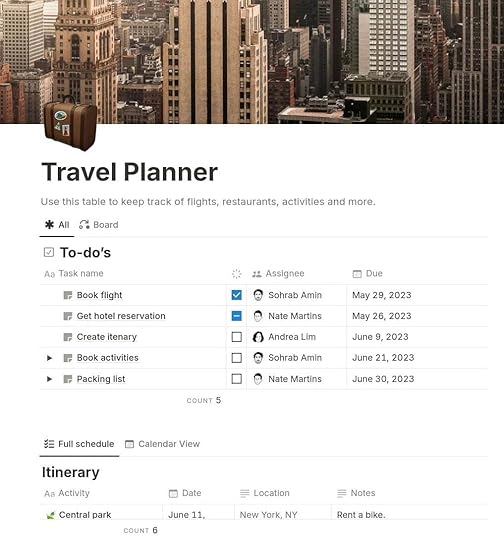
Notion Vacation Template
The gap between a business and personal app isn’t all that wide anymore.
Give the piece a read, and one theme emerges: The gap between business and personal use isn’t all that wide. In fact, the parallels between the two are significant. Case in point: If you regularly use Notion to manage key projects at work, is it that weird to use it to tackle a major home renovation? (Of course, the rub remains getting others to adopt that new tchotchke.)
It didn’t always used to be this way. In the 1990s, for instance, no one used PeopleSoft, Oracle, Siebel, or other enterprise systems for personal reasons. As I write in The New Small, the arrivals of SaaS, cloud computing, smartphones, and open-source software democratized app development ushered in this era. Today’s low-code/no-code apps represent its national extension—but that’s a post for another day.
Simon Says: Expect the virtuous cycle to continue.Brass tacks: More people than ever are relying upon low-code/no-code tools at work—spawning increased use at home. Just as important, consider the converse. Say that Notion or Coda helps you successfully complete personal projects, take notes, and collect ideas. Why wouldn’t you use the very same application while at the office?
FeedbackWhat say you?
The post Notion and Slack for … Relationship Management? appeared first on Phil Simon.
April 11, 2024
Does writing a book resemble the Waterfall method or Scrum? Yes.
I first started blogging and writing books in 2008. Since that time, I like to think that I’ve become a more effective writer. If I hadn’t, I would have thrown in the towel years ago. Cue Rocky IV reference.
 When I think about writing a book today, I often bounce back and forth between two antithetical ways to develop software development: Agile methods such as Scrum and the Waterfall method. My longstanding antipathy to jargon prevents me from fusing the two into some horrible portmanteau.
At the same time, though, when I built RacketHub, I thought long and hard about adding a Gantt chart before ultimately deciding against it. Doing so would imply that writing a book represents either sequential or serial process. Here’s a quick figure demonstrating their differences:
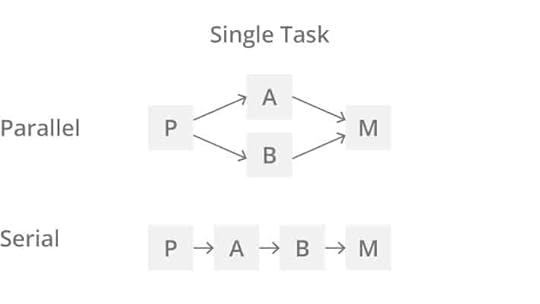
The key is knowing the difference between a serial and parallel process.
In truth, you can and should accomplish certain tasks concurrently. For example, you can conceptualize your cover with your designer while banging out your book’s table of contents. You should absolutely be thinking about marketing from the get-go, after your book is live. You get my drift.
It’s essential to understand the difference between a serial and parallel process. If you insist that your designer completes the final galley before your editor has completed her job on the manuscript, you’re in for a world of pain.
When I wrote my For Dummies books, I struggled a bit with fulfilling my publisher’s requirement: Creating the requisite outline months in advance because—spoiler alert—software products have been known to change from time to time. It’s not 1995. Software doesn’t ship in boxes anymore.
Simon Says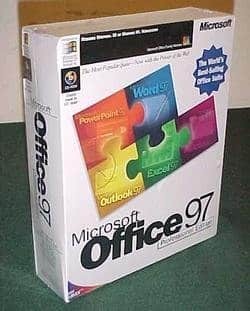 Know this much going in: It’s virtually impossible to write a comtemporary non-fiction text with an iron-clad outline. By the same token, if you lack any signposts, you run the risk of submitting an utter mess to your editor.
It’s not easy, but try to find a balance—or find a coach who can help you do so. Twenty bucks says that AI rockstar Ethan Mollick struggled with this very tension with his new book.
FeedbackWhat say you?
The post Does writing a book resemble the Waterfall method or Scrum? Yes. appeared first on Phil Simon.
April 9, 2024
Episode 83: Slack at Scale With Ksenia Boyer
 Ksenia Boyer joins me to discuss about collaboration, culture, internal product management, and change management.
The post Episode 83: Slack at Scale With Ksenia Boyer appeared first on Phil Simon.
April 2, 2024
Meet RacketHub
 Over the past year or so, I’ve been building a system that makes lives easier for people involved in writing books. It’s called RacketHub and it’s now available for pubchase. Early feedback has been exceptionally positive. It’s the tool I wish I had back when I started writing books back in 2008.
I wrote a lengthy post on the Racket Publishing site explaining it.
Let me know if you’re interested in becoming an affiliate.
The post Meet RacketHub appeared first on Phil Simon.
March 12, 2024
Episode 82: A Personal Update
I’ve been on a self-imposed podcast hiatus since June of last year. In this quick episode, I tell you why I needed a break, what I’ve been up to, and my future plans for the pod.
WANT EARLY ACCESS TO PODCAST EPISODES? ➡️The post Episode 82: A Personal Update appeared first on Phil Simon.
March 10, 2024
Mac Power Hour
Back in 2010, a series of events made me ditch PCs once and for all. I made the jump to a Mac and never looked back. I even created a few amusing cartoons to chronicle my journey.
It went well. One month after getting my first MacBook Pro, I visited the Apple Store in Wayne, NJ. The genius there asked me how many years I had used Macs. He didn’t believe me when I said only a month.
Yeah, it was a match made in heaven.
Since that time, I’ve spent thousands of hours on my Macs. I’ve noodled with different settings, installed some great third-party apps, and developed and refined an ideal way of working. This method:
Eliminates distractions.Allows me to routinely achieve flow state.Keeps me organized.Lets me easily locate files and conversations.Maximizes my productivity.During Zoom screenshares, my clients have often asked me to explain how I did something on my Mac. Of course, I would show them. A few even booked an hour with me to show them most of the most useful clubs in my bag. Their feedback was exceptionally positive.
Today, I’ve decided to formally offer my Mac Power Hour to the world. New Mac users and even experienced ones will benefit a great deal. I promise.
LEARN MOREThe post Mac Power Hour appeared first on Phil Simon.
March 8, 2024
The Nine Wins Two Axiom Awards
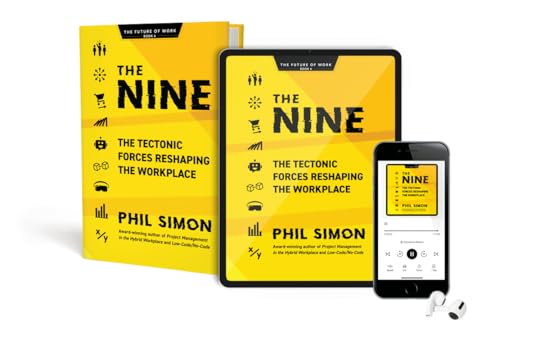
I’m pleased to announce that The Nine: The Tectonic Forces Reshaping the Workplace has won two Axiom awards:
Gold, Business TechnologySilver, Business CommentaryThis puts my total Axiom awards at five. Reimagining Collaboration, Message Not Received, and The Age of the Platform also won individual awards.
Mic drop.
The post The Nine Wins Two Axiom Awards appeared first on Phil Simon.