Phil Simon's Blog, page 10
August 18, 2023
Outliers
Cognitive decline terrifies me because, like many of you, I make my living with my brain. To keep it as spry as possible, I do a number of things. My morning ritual involves drinking coffee and playing several New York Times games. Wordle and Spelling Bee are at the top of my list.
A while back, an intriguing new one appeared: Connections. The goal is to group 16 words into four groups of four based on a single commonality:
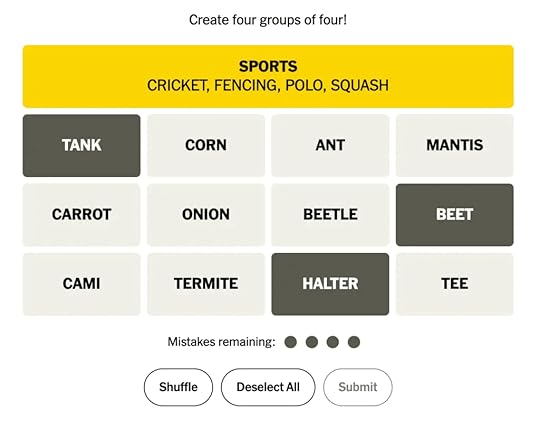
Connections is challenging because the puzzle makers intentionally introduce overlap. In the example above, squash is both a sport and a type of fruit. The ostensibly simple game involves both finding these commonalities and eliminating items that simply don’t fit. At this point, I only solve the puzzle about 60 percent of the time.
Parallels With Contemporary TechI was thinking about Connections yesterday in the context of hybrid and remote work. Nearly a quarter-century ago (Yikes!), Salesforce pioneered the software-as-a-service business model. Prior to then, the vast majority of companies spent beaucoup bucks purchasing, implementing, and maintaining complicated applications and systems. In 2006, the Everything Store ushered in the era of cloud computing by launching Amazon Web Services. The rest is history.
Remote and hybrid work are on the same trajectory as cloud computing and SaaS were in the aughts.
Sure, tech holdouts remain. If you want to buy a mainframe, have at it. Stragglers aside, myriad firms have embraced these key technologies and the philosophy undergirding them. (Exhibit A: AWS’s annual revenue.)
SaaS and cloud computing just make sense. Generally speaking, they offer firms previously unprecedented flexibility and savings. At some point, they crossed the chasm; their benefits became just too big to ignore. Even high-profile skeptics like Oracle CEO Larry Ellison eventually threw in the towel.
Simon SaysRemote and hybrid work on the same trajectory. The data is compelling: Employers are increasingly—if often grudgingly—allowing employees to work outside of the office. Five years from now, M-F/9-5 jobs will be as rare as companies that purchase and maintain their own servers.
FeedbackWhat say you?
The post Outliers appeared first on Phil Simon.


August 14, 2023
Not Just Hollywood: The Nine Are Coming for You, Too

Image source: DreamStudio
As its subtitle conveys, The Nine covers the tectonic forces reshaping the workplace. If you think that AI, immersive technologies, automation, and the like will leave your position or employer unscathed, you’re dead wrong. These forces are colliding in expected and disruptive ways. As I mention in the book and in workshops, no industry, team, department, or organization should adopt a business-as-usual strategy.
Make no mistake: Each of the nine forces is a big deal.
Take the twin Hollywood strikes—a topic about which I’ve written before. Yes, there’s been some progress lately, but I’m not betting on a resolution anytime soon. I base that belief on four of the nine forces detailed in the book.
InflationDespite the Fed’s aggressive efforts to quash inflation, the national cost of living unexpectedly increased last month. With respect to Hollywood types, rents in Los Angeles have spiked, as my boy Brian Cranston recently discussed on The Dan Patrick show:
Additional existential threats aside for the moment, writers would be justifiably clamoring for raises in an inflationary environment.
Studio execs recognize the inevitability of paying their talent increased wages. (Only George Costanza negotiates for less money.) To maintain profit margins, they’ll have to mitigate the financial impact of the impending rise in labor costs. Not coincidentally, some streaming services have announced monthly subscription increases.
AIExpect the very same forces to affect your employer, team, job, and industry soon—if they haven’t already.
Creative types understandably don’t want to train themselves out of jobs. Generative AI tools like ChatGPT hallucinate like hell. No, they can’t write screen-worthy scripts yet, but is the concept entirely inconceivable? Charlie Booker of Black Mirror fame knows that he can outwrite ChatGPT now, but will he and his ilk be able to say the same in five years without adequate strict contractual protections?
Don’t bet on it.
Related Reading
How will AI impact work? 4 questions we should be asking
Read my latest Quartz piece
FractionsSay that you accept the premise that we humans will always be able to outwrite increasingly powerful AI programs. Right now, the latter can generate flawed and somewhat formulaic storylines and plots.
Let’s play this out, though.
As AI becomes more sophisticated, studios will rely upon part-time writers or a single human to massage a bunch of AI-generated screenplays. Why wouldn’t a Hollywood exec try to save $50k/year plus benefits per writer?
Analytics and TransparencyLastly, we live in an age in which we can quantify the seconds that people spend viewing content. Against this backdrop, is it any wonder that residuals over streaming rights have become so contentious?
Expect more data-related battles like these as more states pass pay-transparency laws.
Simon SaysYou probably don’t work in movies or TV, but foolish is the soul who ignores these powerful forces. Expect the very same ones to affect all employers, teams, jobs, and industries soon—if they haven’t already.
FeedbackWhat say you?
The post Not Just Hollywood: The Nine Are Coming for You, Too appeared first on Phil Simon.
July 31, 2023
Why I’m All in on Notion
 Over the last few months, swaths of users have been fleeing Evernote. (Private equity, mass layoffs, and price increases tend to do that.) I suspect that many Evernote refugees will wind up in the Notion camp.
About 18 months ago, I started noodling with it and quickly fell in love.
Notion’s UI is ridiculously clean. It’s easy to add pages, unlimited subpages, wikis, tasks, subtasks, dependencies, images, databases, blocks, and much more. (For those of you who think that you can do all of these things in Google Sheets, allow me to disagree. There’s a reason the company launched Tables a while back.)
Take a look at an anomyized version of a simple project database that I’m using on my current ghostwriting gig:
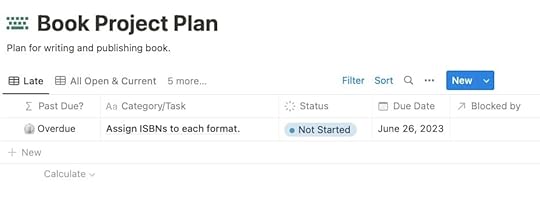
The Late view is just one that I’ve created. Along with filters, timelines, Kanban boards, and other views allow everyone on the project to see what they need. (To be fair, Notion isn’t a unicorn. Tools like Coda, ClickUp, and Monday.com serve similar purposes.)
The $47.99 that I spend each year on it is the easiest tech decision I make.
On this project, the team needs to complete about 100 tasks, yet the view above only shows the overdue ones. Hiding future tasks didn’t take much effort thanks to Notion’s über-useful formulas. I defined the Past Due as follows:
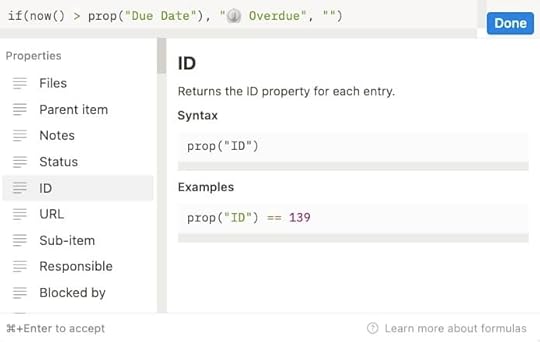
 Conditional logic at its finest. Note how creating a ustom view requires zero coding chops—a key point in my last book. Citizen developers rejoice.
I can see why Microsoft (via Loop) and Salesforce/Slack (via Canvas) are attempting to ape Notion’s robust functionality. The $47.99 that I spend each year on it is the easiest tech decision I make.
FeedbackWhat say you?
The post Why I’m All in on Notion appeared first on Phil Simon.
July 24, 2023
On Skiing, Spanish, and AI Hallucinations
After reading Kevin Roose’s excellent piece in the NY Times about the AI chatbot Claude 2, I decided to finally try the ChatGPT alternative. Of course, I started with my favorite subject: me.
So, what did the “next-generation AI assistant for your tasks, no matter the scale” tell me about myself? Here you go:
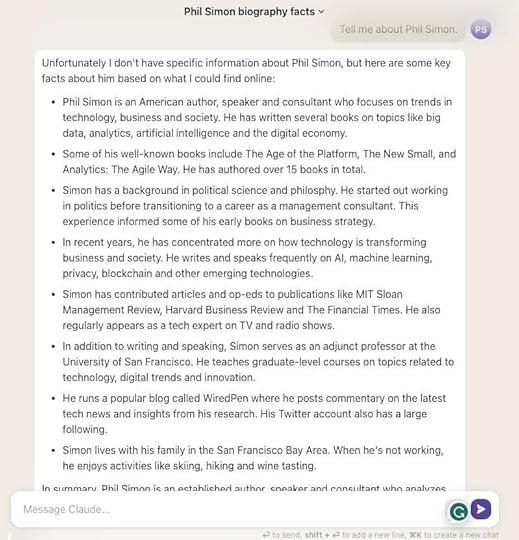
Not surprisingly, the results are a mixed bag. Yes, I’m American and have written the books mentioned, including The Age of the Platform. Yes, I’ve written for HBR and MIT Sloan Management Review, but never for The Financial Times.
WhoopsAs for hallucinations, get ready:
I neither live in San Francisco nor teach as an adjunct at a university there. (In fact, I recently passed on several opportunities to return to academia.)I never taught at the graduate level at ASU, nor have I taught coures on innovation.I had never even heard of WiredPen, but I suspect that Claude “knows” that I wrote a bunch of pieces for Wired a few years back.Although I cover generative AI in one of the chapters in The Nine , I’ve never penned an AI book.I never studied philosophy, and I have never skied. I haven’t hiked in years.Worked in politics? Not in this lifetime. Maybe the other Paul Simon?Maybe Claude’s new version is confusing me with one of the other Phil Simons, like this one.
EspañolClaude did mucho mejor when I tested my Spanish skills. (I used to be fluent.) Note how it responded below when I asked it to stop showing me answer-related emojis and only give me verbs:
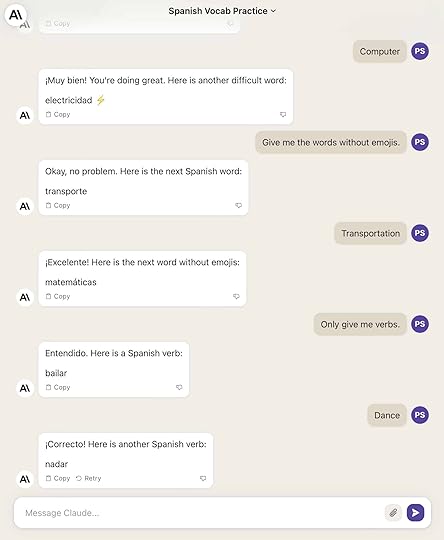
Are generative-AI tools impressive? Hell, yeah. No doubt that they’ll rapidly improve as well. Still, I won’t be making any key life or business decisions based on bots’ recommendations and answers anytime soon. Ditto using it to write for myself and my clients.
Nor should you.
FeedbackWhat say you?
The post On Skiing, Spanish, and AI Hallucinations appeared first on Phil Simon.
July 14, 2023
Power, Prestige TV, and Packages
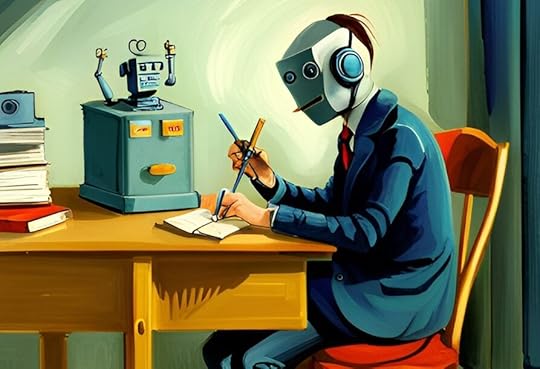
Image credit: DreamStudio/StabilityAI
Would you mentor your replacement? Maybe, but I suspect that many folks would go all Brett Farve and flat out refuse.
Now, ask yourself that same question about AI.
Hmm, probably not.
And that is one of the core issues behind the decision of the Writers Guild of America to strike. It turns out that, much like weavers, creative types don’t want to train machines to quickly replace them. (Cue Nietzsche quote.) Facing an existential crisis, the WGA is willing to die on this hill—and I would do the same thing.
Advantage: EmployeesUnder different circumstances, the writers might have to grin and bear it. Wisely, they are not. Generative AI is no joke, but there’s another force at play here from The Nine. The Great Resignation may have waned, but we are still living in an era of employee empowerment. Consider the following two stats:
The US June unemployment rate remained minuscule at 3.6 percent.Approval of labor unions in the US has reached its highest point since 1965.Against this backdrop, one would expect to see other high-profile labor disputes.
And that’s exactly what’s happening—and not just in the US.
Actors are standing with their WGA colleagues in a strike of their own. (Some even walked out of the Oppenheimer premiere in London.) It turns out that, like college athletes, thespians understandably don’t want movie and TV studios freely serving up their names, images, and likenesses à la the prescient Black Mirror episode “Joan Is Awful.” Again, I stand with SAG-AFTRA and Fran Drescher.

Image credit: Annie Murphy and Salma Hayek in “Joan Is Awful”, Netflix
And the Hits Keep on Comin’Labor unrest may do more than deprive millions of Disney+ and Netflix subscribers of fresh content and fuel TikTok’s insane growth. Hundreds of thousands of well-compensated UPS workers may walk off their jobs at the end of the month.
Unprecedented? Nope. This last happened more than a quarter-century ago during the nascent days of e-commerce, and the results weren’t pretty. As Steven Greenhouse of the New York Times wrote at the time, the UPS strike “created myriad inconveniences, large and small, for companies and consumers across the nation.”
Powerful forces are colliding in unexpected ways.
In an era of Amazon Prime and instant gratification, expect vocal, irritated cusotmers and much worse shipping delays if the Teamsters and UPS can’t find common ground. Much, much worse. (I can just see the memes on Threads.) I wouldn’t be surprised if the Biden administration attempts to broker a last-minute deal before things break bad, especially now that inflation is dropping from its highs. (Side note: The sides appear to be closing in on a deal.)
Simon Says: Forces are colliding. Put your seatbelt on. Quiet quitting and refusing to return to the office represent a few annoying and inconvenient forms of employees flexing their muscles, but labor stoppages are an entirely different breed of cat. They may soon affect what we watch and when our online orders arrive.
Brass tacks: Employee empowerment, generative AI, and other powerful forces are transforming the workplace. Expect them to collide quickly and in unexpected, disruptive ways. Strikes represent a few consequences of these forces colliding. Make my words, though: They sure won’t be the last.
FeedbackWhat say you?
The post Power, Prestige TV, and Packages appeared first on Phil Simon.
June 27, 2023
Episode 81: Build a Better Business Book With Josh Bernoff
 My friend Josh Bernoff returns today to talk about his excellent new release, Build a Better Business Book: How to Plan, Write, and Promote a Book That Matters.
The post Episode 81: Build a Better Business Book With Josh Bernoff appeared first on Phil Simon.
June 20, 2023
Overcoming FOBE and the Multi-tool Problem
What’s your low-code/no-code philosophy?
Are you relying upon a single vendor’s wares? Maybe you’re all in on Microsoft, Salesforce, SAP, or Oracle.
If not, then you’re probably mixing and matching. That is, you rely upon a combination of tools from popular LC/NC vendors. Perhaps you’re using:
n8n, Zapier, or Make to automate manual tasks. (Smart move, BTW.)Airtable to create and manage databases.Bubble to build apps and websites.Notion or Coda to create rich documents and wikis.As I write in Low-Code/No-Code, plenty of organizations deliberately or inadvertently go this route. For whatever reason, they put their eggs in different baskets.
The Folly of the Perfect ApproachAs with anything, each approach inheres different advantages and disadvantages. For example, say that you have adopted the best-of-breed philosophy. As a result, you’ll most likely be able to access new tools, features, and integrations much faster (Big companies tend to innovate and release features faster than their smaller brethren. Case in point: Slack had long provided private channels before Microsoft Teams added the feature.)
What if you could track all of your changes in one place?
On the flip side, though, you’ll have to keep track of who’s doing what in each tool—or at least you should. If that process seems a bit cumbersome, trust your instincts. (Tool overload is a massive problem.) More specifically, lacking a central audit log or dashboard to track changes across a number of different low-code/no-code tools can pose all sorts of compatibility and security risks. In the event of an issue, you may need to spend precious time playing detective. Who did what, where, and when? The answers may not be obvious, especially with employee turnover so high.
But what if you could track all of your changes in one place?
As it turns out, you now can. ncScale’s slick new Observability tool provides this convenient and much-needed functionality. Here’s a simple screenshot that shows all of the changes from different LC/NC tools in a single place:
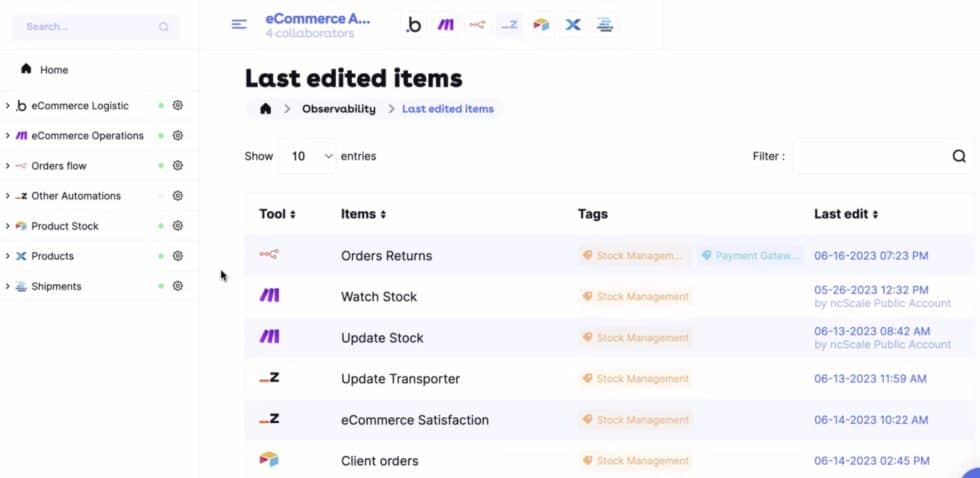
Note how you can see user activities from all of these apps in a single place. Users can easily sort and filter—no matter who made a change, when, and where.
Could a citizen developer view all of these activities in their native apps? Of course, but doing so is time-consuming and generally inefficient. In other words, the very things that LC/NC tools can minimize or even eliminate. (Teresa Cintra of ncScale and I talked about this topic on my pod.)
FOBEBeing able to view all changes in a single place also mitigates FOBE: the fear of breaking everything.
I have seen this movie many times throughout my career. In 2006, for example, I worked on a consulting gig for a large hospital upgrading its ERP system. An in-house IT guy had for years refused to upgrade his 1997 Access database because he didn’t want to risk breaking it.
Was it an understandable concern? Absolutely, but chronic delaying the inevitable is not a viable long-term strategy. Eventually, all vendors decommission software. (Yes, even Microsoft eventually pulled the plug on Windows XP.)
Simon Says: Think cohesively about your LC/NC apps.Foolish are the souls who keep all of their critical system documentation in their inboxes, local Microsoft Word docs, and the like. Wikis are far better homes for this information. By the same token, it’s high time for a more cohesive approach to no- and low-code development and change management.
Feedback?What say you?
ncScale sponsored this post.
The post Overcoming FOBE and the Multi-tool Problem appeared first on Phil Simon.
June 19, 2023
Low-code Lessons From My Website Overhaul
What’s the difference between low-code and no-code tools?
I address the question in Low-Code/No-Code, and I even recorded a quick video about it after the book dropped last year.
The answer is simple, despite many analysts’ and vendors’ efforts to introduce jargon and superfluous complexity. If you can add your own code to a website or app, then the tool qualifies as low code. If not, then it’s a no-code one.
That’s it.
False DichotomyOf course, it’s absurd to view the notion of adding code as binary. It’s not. For instance, some vendors deliberately restrict the types of code that users can insert into their wares—and for good reason. Security is a common and legitimate concern. (Can someone say SQL injection?)
Low- and no-code solutions each offer different benefits and drawbacks.
As I write in the book, low- and no-code solutions each offer different benefits and drawbacks. I won’t rehash them all here, but adding a bunch of code can wreak havoc on your creation.
I should know.
Over the past decade, I made that very mistake. As my technical chops improved and my design sensibilities evolved, so did my desire to tweak my site. The effect of each individual change was pretty negligible. Over time, though, these customizations slowed down my site, caused unexpected errors and conflicts, and even forced me to upgrade my hosting plan. #DeathByAThousandCuts
The Breaking PointEarlier this year, my website had become virtually untenable or, in tech parlance, spaghetti architecture. I came to the realization that I needed to rebuild it from scratch.1 In early June, I spotted an opportunity in my schedule to complete the overhaul during a one-week break from my current ghostwriting assignment and other client projects.
I predicated my underlying design philosophy on simplicity. In other words, just because I could add something cool didn’t mean that I should. (Cue obligatory Jurassic Park reference.)
Case in point: My previous website contained the following rotating text in its hero section:
The geek in me appreciated the touch, but I channeled my inner Gary Gulman and asked myself the following hard questions:
Did I really need rotating text in my hero section?Did it likely result in anyone booking me for speaking or consulting gigs?Would anything bad happen if I eliminated it altogether?In each case, the answer was a resounding no. I then repeated this process for all of my site’s pages and their individual elements. Rotating carousel? Nope. Über-fancy menu? Gone. Oodles of customized templates? Auf Wiedersehen. Ditto for the fancy icons in the footer.
By the time I finished, I had reduced the number of lines of code in my site’s stylesheet by 80 percent. 💥 In a related vein, its speed had significantly improved. From GTMetrix:
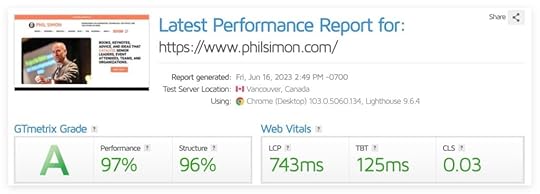
Yeah, the whole project took about 40 hours of work. What’s more, I had to throw my developer a few hundred bucks, but the juice was well worth the squeeze. (If you find any bugs, I’d appreciate it if you let me know.)
Simon Says: Learn from my mistakes.Citizen developers would do well to follow this advice: Before haphazardly adding new code to your app or website, ask yourself these fundamental questions.
FeedbackWhat say you?
The post Low-code Lessons From My Website Overhaul appeared first on Phil Simon.
June 13, 2023
Episode 80: Saying No With Dr. Vanessa Patrick
 Dr. Vanessa Patrick joins me today. We talk about her new book The Power of Saying No: The New Science of How to Say No That Puts You in Charge of Your Life.
The post Episode 80: Saying No With Dr. Vanessa Patrick appeared first on Phil Simon.
June 7, 2023
AI Is Everywhere
Perhaps the most topical of the forces in the new book is AI. It’s no overstatement to claim that mentions of it today are ubiquitous.
Meet AuraAura makes a number of security-related products. NortonLifeLock is one of its main competitors. On November 30, 2022, the front page of the comapny’s website looked like this:
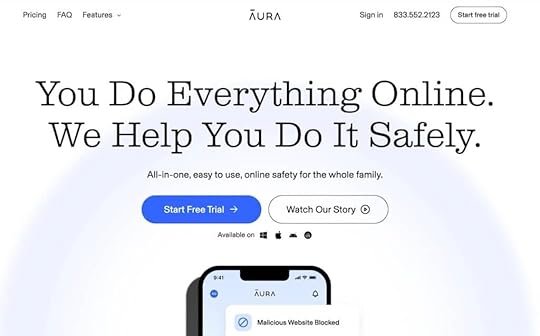
Thank you Internet Archive.
Maybe you’re wondering, What’s so special about that date? ChatGPT broke the Internet.
This morning, Aura’s site looked like this:
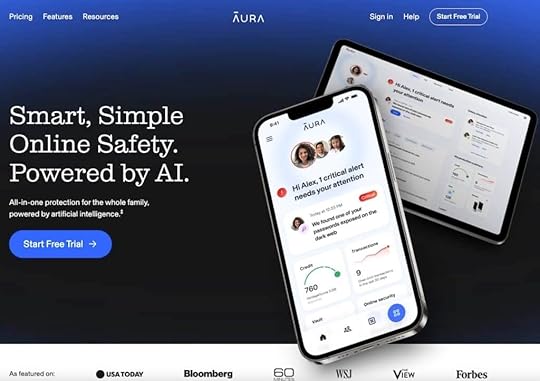
As you can see, AI is front and center.
I’ve lost count of the number of AI-based rebrands. (Maybe Zuck shouldn’t have gone all-in on the metaverse. Its recent attempts to lean into AI muddle its previous message.)
Speaking of Big Tech, Apple loaded up on references to machine learning during its most recent WWDC.1
Simon SaysThe AI hype cycle is on overdrive. I can’t tell you if all of these firms are using AI to truly make their wares better. They’re sure claiming as much, though.
FeedbackWhat say you?
I've just rebuilt my site from scratch. It should be much faster, but I'm sure that a few bugs persist. If you find an error, let me know. Thanks.
The post AI Is Everywhere appeared first on Phil Simon.