Matthew Dicks's Blog, page 44
September 14, 2024
Childhood hobbies return
Schembari was having a hard time remembering what joy felt like, so she returned to something she loved as a child:
Singing.
She was never very good at it but loved it just the same.
I don’t suffer from this particular joyless affliction — I am relentlessly joyous and constantly cultivate my joy in a multitude of ways — but I can attest to the joy of returning to childhood hobbies.
When the pandemic struck, I was suddenly unable to visit the gym on a daily basis. In need of daily exercise and despising running because I am not a sadist, I turned to my bike, which had been gathering dust in the garage for quite a while.
As a child, I spent my life on my bike. I rode my bike so often that I could ride for miles without touching the handlebars. A simple shift in my weight would steer the bike absent any intervention of hands or arms.
I loved riding my bike.
It didn’t take long for me to love it again during the pandemic, and four years later, I have yet to return to the gym. Instead, I ride a bike every day — often more than once a day. On colder days, evenings, and when time is limited, I ride a stationary bike, but whenever possible, I am on my bike, riding down tree-lined streets just like I did as a kid.
It’s joyous.
I recently purchased a flute in hopes of playing it again as I did as a child. Before switching to the bassoon and the drums in high school, I was a flutist. Though I haven’t played in decades, I remember most of the fingerings and can still produce a sound.
Carnegie Hall is surely next.
I also dream of joining a high school pole vaulting team and attempting to pole vault one more time. My goal would be to clear opening height once again.
I hope to turn this pursuit into a book that chronicles my success or failure.
Riding horses would be pretty great, too. I grew up on a horse farm until my parents divorced, so I spent my first seven or eight years on a horse. A few years ago, Elysha surprised me with a horseback ride, and I fell right back into it, instantly knowing how to move with the horse so we could move as one.
I’d also like to play more basketball — a game I played endlessly as a child. We have a hoop in our driveway, and I dream of the day when Charlie loves the game as much as I do, and we can spend our evenings going toe to toe.
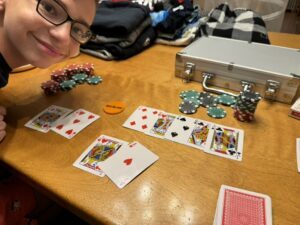
And poker. I need a lot more poker in my life. Charlie is playing with me now and seems to like the game a lot, and I have a game scheduled with friends (and maybe Charlie) for next month.
Marian Schembari is right. Returning to your childhood hobbies can be pretty joyous, even when your life is already filled with joy.


September 12, 2024
Entitlement stunts growth and produces yucky people
Thanks to privilege and entitlement, those born near or at the finish line often fail to understand how challenging getting there can be. They’ll never know the feeling of standing on the edge of oblivion, forced to make their own way, relying only on their effort, intellect, experience, and force of will.
They’ll never know what it’s like to live without a safety net or a fallback position. They’ll never feel the raw independence of knowing that you alone will determine your future.
As a result, they often don’t work nearly as hard as others, rarely engage in meaningful personal development, fail to develop tenacity and grit, lack empathy for those less fortunate, and rarely reach their full potential.
There is a great deal of research demonstrating this truth, but that research was never needed.
They should’ve invested that money elsewhere.
Anyone who knows anyone who grew up with wealth and privilege — a seemingly endless and everlasting safety net, and parents who carved a clear path ahead for them, rescued them from their own laziness and stupidity, handed them a job, and maybe even launched them into the world with most of their material needs — likely knows someone who is insufferable, arrogant, small-minded, bigoted, lacking confidence and grit, and perhaps worst of all, boring.
These are the people who lack empathy for others. Discount struggle. Believe that playing fields are level. Somehow think that hard work alone will allow anyone to rise to the top.
This is not always the case, of course.
Many people born in privilege are decent, kind, empathetic human beings with perspective and understanding. These are people born on third base with all the advantages that come with wealth and privilege but routinely acknowledge their good fortune, use it to help others, and honor the struggle of those less fortunate.
On some days, however, these more enlightened people seem few and far between. Perhaps it’s because the aeful ones are so much louder. But the reason is simple:
Entitlement often stunts personal and professional development. Clear paths often lead to people who can never clear paths for themselves.
Soft landings result in soft people.
Struggle yields strength. Obstacles produce grit. Challenges result in an interesting life.
The problem as a parent:
How much do you allow your child to struggle? How much help is too much help?
I was homeless for a period of my life. Hungry many times in my life. I was arrested, jailed, and tried for a crime I did not commit. I was the victim of a horrific, violent crime. I put myself through college by managing McDonald’s restaurants full-time while earning degrees at two different colleges simultaneously.
That struggle has helped me immensely. It has given me tenacity and grit that have served me well. I feel fortunate to have faced so many challenges in my past, but I also recognize how easily I could have fallen into darkness.
Had I struggled with addiction, my life might be very different.
Had people not helped me at key moments, things might have turned out very differently.
Had I not been a straight, white, neurotypical American man with no physical disabilities or mental illness — the most genetically and geographically fortunate human being to ever walk the planet — my life would have assuredly been different. Thanks to little more than the luck of genetics and geography, I have managed to avoid racism, sexism, and bigotry of every kind. I was never impacted by discrimination based on any disability or neurodiversity.
I would never wish my struggle upon my children — or anyone else — yet some struggle is essential.
The question is, “How much?”
Charlie once played an entire baseball season without winning a single game. I’m happy it happened. He learned a great deal that season — perhaps more than any baseball season he has ever played.
I wish I could clear a path for my children, offer them every opportunity to succeed, and come to their rescue at every misfortune.
I suspect I will from time to time. I’ll probably do it quite a bit. I already have.
But not always. And hopefully not too often.
Too often, entitlement and privilege breed misanthropes, malcontents, and monsters.
I see it all the time.
My children need not be hungry and homeless to develop grit, empathy, and a strong work ethic. They need not be victimized by violent crime to develop an appreciation for the preciousness of life. They need not be jailed for a crime they did not commit to understand their own genetic and geographic good fortune.
That is all too much.
I will instead hope for struggle without suffering.
Disappointment without despair.
Failure backed by relentless love.
That is what I hope for my children, even though part of me would prefer pristine and perfect lives for them.
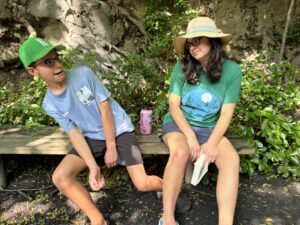
My Eagle Scout service project — I’ve decided to complete it.
Back in 1988, I was in the midst of completing my service project — the final step in becoming an Eagle Scout – when I went through a windshield during a head-on collision.
I was hospitalized for a week — including two surgeries on my legs — and spent the next three months recovering from serious head, leg, and chest injuries. During that time, I turned 18 — the deadline for earning the rank of Eagle Scout.
I had aged out of the possibility of making my childhood dream come true during my recovery.
I was aware of this, of course, so I asked my parents to apply for a waiver, an exemption, or an extension that would allow me to recover and then complete my project.
They told me my request was denied.
For almost 25 years, I was angry with the Boy Scouts of America for denying me the opportunity to achieve my childhood dream. I still loved the organization that, in many ways, helped me become the man I am today and never waivered in my support for their good work. For a time, I served as an assistant Scoutmaster for a local Boy Scout troop, and today, Clara and Charlie are members of Scouting, but I could never understand why they would deny me the opportunity to earn the rank I had dreamed about for so long.
It really was my dream, too. Throughout my time in Scouting, I earned every merit badge I could find — well over the required number to earn the rank of Eagle. I quickly ascended the troop’s leadership ladder, moving from patrol leader to assistant senior patrol leader to senior patrol leader by the age of 14 — the highest level of leadership a boy could attain in a Scout troop. I could tie all the knots, swim all the strokes, pitch all the tents, and perform all the life-saving skills that my first aid merit badge demanded. I hiked for miles, built shelters using only twine and the natural elements, and spent hundreds of nights sleeping outdoors.
Scouting was my passion.
Then a car accident derailed me from attaining my final goal.
For 25 years, I was angry about their decision, and then one day, just a couple of years ago, it hit me:
My parents never requested that waiver or extension.
Why would parents who had never spoken the word “college” to me, never attended a track meet to see me pole vault, never watched me compete in a marching band competition, and nearly missed my high school graduation make the effort required to ask the Boy Scouts of America for an extension.
Two years after this realization, while visiting my former Scoutmaster at a reunion, I asked him about it. He said he had no recollection of the request.
“That was a long time ago, so it’s possible, but I don’t remember one.”
Failing to earn the rank of Eagle Scout is one of the greatest disappointments of my life. I know it sounds silly, but when you dream of something for so long and work so hard to attain a goal, failing to make that dream a reality is devastating.
Though it’s impossible to turn back the clock, and even though I suspect I will always feel disappointed for failing to achieve this goal, I decided to complete the service project I began as a boy to at least bring me some closure and perhaps help me feel a little better about my boyhood failure.
At last, I’m ready to go.
My original service project was beautifying a local cemetery where I had taught my friends—including my former Scoutmaster’s son—to drive.
It’s the cemetery where my mother is buried today.
Rather than returning to my hometown, I have moved the project to my current hometown—Newington, CT—to a cemetery where Charlie and I have wandered many times, examining headstones, exploring history, and planting flags on Memorial Day.
On October 12, from 11:00 AM to 2:00 PM, I’ll complete my Eagle Scout service project by removing the lichen and debris from headstones in Center Cemetery in Newington, CT. The cemetery is located on the corner of Main Street and Cedar Street, directly behind the Congregational Church.
After meeting with the people in charge, they thought that this act of service—maintaining and cleaning the headstones of the deceased—would be especially appreciated.
It’s also something they don’t do as a part of cemetery maintenance, so the work is also needed.
If you’d like to join me in this small act of service — for 15 minutes or three hours — I invite you to join me on October 12 in the cemetery to clean a headstone, clear debris, or simply say hello.
My family will be helping, of course, and I will have all the supplies needed to complete the job, as well as refreshments for anyone volunteering.
I’m excited about this project. I’m thrilled to be finishing something I began 36 years ago. I hope that its completion brings peace to the part of me that remains disappointed in myself and the circumstances that prevented me from making this dream come true many years ago.

September 9, 2024
Shortcomings and Flaws 2024
More than a decade ago, a reader accused me of being materialistic after I wrote about my lack of a favorite number. The reader specifically criticized me for saying that when it comes to my salary, my favorite number is the largest number possible.
After properly refuting his charges of materialism, I acknowledged that I had plenty of other shortcomings and offered to list them to appease my angry reader. Then I did. Then I added to the list when friends suggested I had forgotten a few.
Nice friends. Huh?
So began an annual tradition of posting my list of shortcomings and flaws, starting in 2011 (the list only had ten items that year) and continuing for the past 14 years, including this year.
Every year, I review the list for possible additions and deletions, and I allow my friends to add even more items to the list.
I tried to remove these three from the list this year, thinking I’d made significant progress in these areas, but Elysha said no. The three I attempted to remove were the following:
It is hard for me to empathize with adults with difficulties I do not understand or would’ve avoided entirely.I have difficulty putting myself in another person’s shoes. Rather than attempting to understand the person, I envision myself within their context and point out what I would’ve done instead.I am exceptionally hard on myself when I fail to reach a goal or meet a deadline that strikes me as reasonable.She admitted that I was improving with the first one, but she looked at me like I had lost my mind when I proposed eliminating the third one.
I’ve also added three items to the list, which should have been on the list for a long time:
I can’t hit a driver more than 200 yards, and my average is a paltry 160 yards.I’m exceptionally susceptible to my children’s guilt trips.I am deeply uncomfortable quoting a fair market price for my services and expertise.I am, however, removing one item from the list:
Despite my loathing of typos, my blog entries contain far too many typos.Thanks to the combined powers of Grammarly, better blogging software, and a husband and wife team who report on typos, misspellings, and the like — independently but often simultaneously— my blog entries have been free of many of the typos that once plagued them.
Huzzah. I’m improving.
And so, I offer you, yet again:
Matthew Dicks’s List of Shortcomings and Flaws – 20241. I have a limited, albeit expanding palate (though I’d like to stress that my limited palate is not by choice).
2. It is hard for me to empathize with adults who suffer from difficulties I don’t understand or would’ve avoided entirely.
3. I have difficulty putting myself in another person’s shoes. Rather than attempting to understand the person, I envision myself within their context and point out what I would’ve done instead.
4. I do many things for the sake of spite.
5. I become angry and petulant when told what to wear.
6. Bees kill me dead.
7. I become sullen and inconsolable when the New England Patriots lose a football game they should’ve won.
8. I lack adequate empathy for adults who are not resourceful or are easily overwhelmed.
9. I cannot make the simplest of household or automobile repairs.
10. I eat ice cream too quickly.
11. I am uncomfortable and ineffective at haggling for a better price.
12. I am exceptionally hard on myself when I fail to reach a goal or meet a deadline that strikes me as reasonable.
13. I drink too much Diet Coke.
14. My dislike for ineffective, inefficient, or poorly planned meetings makes me unproductive, inattentive, and obstructionist.
15. Disorganization and clutter negatively impact my mood, particularly when I cannot control the clutter myself.
16. I am overly critical of my fellow storytellers, applying my own rules and standards to their performances.
17. I lack patience when it comes to assisting people with technology.
18. I don’t spend enough time with my best friend.
19. I have a difficult time respecting or celebrating someone’s accomplishments if economic privilege, nepotism, or legacy assisted in their success in any way.
20. I believe there are some right and wrong ways of parenting.
21. I love saying, “I told you so” so freaking much.
22. I am far too confrontational in moments when it would be safer and wiser to avoid the confrontation entirely.
23. Rule followers annoy me.
24. I think less of people unwilling to sacrifice sleep or violate a comfort zone to experience something new or potentially memorable.
25. I wrongfully assume that a person’s job performance can be assessed by their ability to speak publicly while performing that job.
26. I can’t hit a drive more than 200 yards, and my average is a paltry 160 yards.
27. I’m exceptionally susceptible to my children’s guilt trips.
28. I am deeply uncomfortable quoting a fair market price for my services and expertise.
September 8, 2024
Charlie asks good questions
Charlie was reading a book about the wonders of the world:
Pyramids. Great Wall of China. Stonehenge. The Great Barrier Reef. Taj Mahal.
He asked, “Why doesn’t our country have more cool things?”
Before I could point out that he’s personally visited the Statue of Liberty, the Golden Gate Bridge, the Redwood forest, Disney World, Ellis Island, the Empire State Building, the USS Intrepid, The Metropolitan Museum of Art, Yankee Stadium, Times Square, nearly every Broadway theater, and nearly every monument in Washington, DC, he asked:
“And why does our country have so many guns?”
I had an answer to that question, but it was not so simple and a lot less joyful.

September 7, 2024
Not always true but sometimes true
Some problems are complex and require real work to solve.
Many also require the assistance of professionals, such as mental health experts, religious advisors, social workers, and others.
I wouldn’t be living with post-traumatic stress disorder as well as I am today without the intensive intervention of therapists, so I understand the struggle.
But sometimes — perhaps more often than we think — this kind of therapy is all we need.
September 6, 2024
A company unafraid of taking a stand
I admire a company that isn’t afraid to take a political stand.
Avery Beverages — a local soda company — produced two new sodas for the upcoming election:
None of the Above, which features cartoon images of Trump and Biden, which has become unexpectedly obsolete in its messagingTrump Tonic, featuring a cartoon image of Trump and is notably a “sour grape” soda.Bold and brilliant. Also unafraid and unabashed.
Bravo, Avery Beverages.

September 5, 2024
When it’s okay to be alone
When a student’s answer to a math problem differs from the rest of their classmates’ answers, I always celebrate that student.
Their answer may be wrong, and they might even be the only student to solve the problem incorrectly, but they were brave enough to offer it as a possibility.
They are known in my classroom as heroes.
When their answer is correct, they are heroes who saved the world.
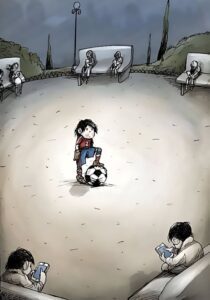
I thought about this when I saw this image. Although I don’t think the artist intended the image to be inspiring when it was originally conceived, I find it incredibly inspiring.
Yes, it’s tragic that most of the children depicted are staring at their stupid screens — and yes, that reality is deeply depressing — but the kid in the middle with the soccer ball is my hero.
I wish that kid had someone to play with.
I wish that kid were playing in an actual game.
I wish that kid didn’t feel so alone.
But I also know that kid is going to conquer the world.
September 3, 2024
Elysha renegotiates terms
More than twenty years ago, Elysha decided to move from her teaching job in a private Jewish Day School to a public school.
Thanks to this decision, we would one day meet and, about two years later, begin dating.
Part of the interview process for a teaching position is often a model lesson — an asinine piece of buffoonery. Candidates are asked to walk into a classroom filled with students they’ve never met before and teach a random lesson outside the current curriculum for 30 or 45 minutes, and somehow, this artificial piece of moronic minutiae is supposed to tell an administrator something about the person’s ability to teach children with all its complexity.
It’s ridiculous.
Happily, I was not required to jump through this hoop of stupidity when I was hired to teach, but sadly, Elysha was. She was asked to come to the school where I was working and teach a model lesson to a classroom of random children on a topic of her choice.
Perhaps recognizing the stupidity of this request, Elysha did something impressive:
She renegotiated the conditions of the lesson.
She agreed to teach the model lesson but asked to teach her own students. Since she already had a teaching job and a classroom of her own, she asked the hiring committee to come to her school.
They agreed.
Rather than teaching a lesson to students she didn’t know in a random classroom, she taught a lesson to her own students that she was planning to teach anyway.
And it worked. She got the job.
Hooray for her!
Hooray for our school!
Most importantly, hooray for me!
It’s a good reminder that the parameters, limitations, and expectations in almost every situation are negotiable.
What is offered to you is only the opening bid. While some situations may be decidedly less flexible, wiggle room can often be found.
I see Elysha do this all the time. In restaurants, for example, the table offered by the host is only the opening bid. It’s a proposal of where we might sit, but often, she will counter with a choice of her own.
Sometimes, I don’t even bother sitting down, knowing we will move shortly.
Negotiation is expected when purchasing a car or a home, determining a salary, outlining the parameters of a divorce agreement, and dealing with children and terrorists. However, recognizing that negotiation is often helpful in less expected situations is important, too. While I don’t think haggling over the price of a cup of soup or a speeding ticket is a good idea (though Elysha also managed to talk her way out of her only speeding ticket ever), opportunities exist — more than we might expect — when we can turn the balance of power in our favor or improve our situation considerably simply by asking for something different or better.
Elysha understands this.
I’m so grateful.
Not only has she taught me this lesson, but it has also led to my finding the best spouse in the world.

Strangest Uber ride ever
My strangest Uber ride of the summer:
In August, I arrived at Bradley International Airport at 5:00 AM to discover that my flight had been canceled due to the CrowdStrike issue.
I own stock in CrowdStrike, so this was a real punch in the face.
The Delta ticket agent solved my problem by arranging for an Uber to drive me to Logan Airport in Boston — about two hours away — so I could catch a flight there instead.
“You’re going to put me in an Uber and drive me to another airport?” I asked.
“Yes,” she said. “Right now. I’ve already ordered it.”
Crazy. Right?
Just wait. It gets crazier.
The Uber driver was a woman who had never driven outside Connecticut. She was nervous about driving me to Boston and told me so as I climbed into the car.
I suggested she reject the ride and let me find another.
“No,” she said. “I’ll be fine.”
“Do you have a fare coming back from Boston?” I asked. “Does this even make sense for you?”
“I’ll be fine,” she repeated.
She was not.
It started raining as we exited the Mass Pike, and the combination of heavy traffic and a downpour caused her to panic. Within minutes, she became weepy —actual tears in her eyes —and began audibly praying to God for help.
“Please, God, help me through this terrible decision.”
“Please, God, stop this rain and keep us safe.”
“God, I need all your help right now to keep this car on the road.”
You can imagine how I was feeling in the back seat.
Ten minutes later, she turned on the radio and tuned to a religious station playing upbeat music about Jesus and God.
It did not help.
As her panic increased and her weeping continued, I decided to get actively involved. I started by assuring her I had made this drive many times before. In fact, I had been performing in Boston the previous night and had just made the trip in reverse a few hours ago.
Then I began breaking the trip into smaller, more manageable parts.
“First, we’ll get to Grafton. Grafton is our target. Just a few miles down the road. Once there, we’ll start thinking about Framingham and then eventually Natick, but let’s just start with Grafton. One small piece at a time.”
It helped a little.
Eventually, she called her sister to receive spiritual support.
Her sister was on speakerphone, so I heard the entire conversation. Lots of talk about the Lord being on her side and having faith that he was watching over her. Eventually, the talk of faith in God turned into a conversation about making better choices in life, taking accountability for your actions, and “Growing the hell up.”
Not exactly supportive, but I didn’t disagree.
Then she noticed she was running out of gas—enough to maybe make it to the airport, but not much more.
“I can’t put gas in your car,” her sister said. “So figure it out after you drop that man off.” Then she said goodbye and hung up.
We arrived at Logan Airport without a moment to spare.
“Where can I get gas?” she asked as I climbed out of her car.
“Not here,” I said. “Logan Airport is on an island. You need to go back through the tunnel and find gas in Boston.”
She began to cry again. “I don’t think I’ll make it.”
There was nothing I could do. I needed to sprint to catch my plane, so I said, “God wants you to find gas, so don’t worry. Go back through the tunnel, and you’ll find what you need.”
As a self-described reluctant atheist, it felt disingenuous to offer these assurances, but she needed something, and her sister was done helping her.
Then I was off. Since the airline arranged for and paid for the ride, I couldn’t even offer her a tip, though if anyone deserved additional compensation for the ride, it was me.
I assume she eventually made it home to Connecticut.
When I arrived in Denver, I discovered that Delta had accidentally booked my connecting flight to Calgary for the next day, so I was forced to purchase another ticket to Calgary on the correct day. But because that next-day ticket was never canceled (even though the Delta ticket agent said she would), Delta classified me as a “no-show” and canceled all my flights home.
If you don’t make your flight to a destination, the airline automatically cancels your return flights at that destination — assuming you no longer need them — and resells the tickets without ever refunding or notifying you.
I’m unsure if this is Delta policy or an industry standard, but it’s criminal either way.
I did not discover this until two days later — at 4:00 AM, at a ticket counter in the Victoria airport — as I was trying to fly home.
Quite a couple of days of travel.
We say in storytelling:
“You have a good time, or you have a good story.”
I’m not sure if I had either.