Matthew Dicks's Blog, page 43
September 22, 2024
Why the fire swallower worried me so much
More than a decade ago, I was officiating a wedding for a couple at a cabin on a campground in Maine.
I’d call her a friend, but until I arrived in Maine, we had never actually met. She had read my novels, connected with me online, and eventually became part of my world.
After marrying the couple on the edge of a lake, a party began that lasted all night. Part of the festivities included a demonstration of a fire swallowing by one of the couple’s friends. When I learned about what would be taking place, I grew concerned.
Fire swallowing? Here? Miles upon miles from the nearest hospital? In the middle of the Maine woods?
I found the fire swallower. I asked if she was really going to swallow fire or if some kind of illusion was involved.
She assured me that she would be swallowing fire. She explained that just before swallowing the fire, she would coat her mouth and throat with a jelly-like substance to protect her skin when the fire entered her mouth. She’d done it many times. She wasn’t a professional, but it was a party trick she performed often.
“Can it go south?” I asked.
“I’ve burned my mouth and tongue before,” she said. “Sometimes pretty badly. But I’ve never hurt myself badly enough to need the hospital or a doctor.”
“But could it happen?” I asked.
She smiled and told me that anything was possible.
An hour later, I stood behind the cabin with the rest of the wedding guests, ready to watch this woman swallow fire. I looked into the faces of everyone around me.
Not a hint of worry or concern.
All smiles.
Joyous anticipation.
I was terrified.
Ever since that night — more than a decade ago — I have wondered why I was the only person at that party who was worried about the safety of the woman preparing to swallow fire. To say that the question has plagued me over the years would be an exaggeration, but not by much.
I have wondered about the answer to that question again and again and again over the years.
Yesterday, it finally hit me. While coming down a flight of stairs in the Peabody Museum in New Haven, Connecticut, I saw a woman slip on a stone stair and begin to fall. She caught the railing as she began to topple and managed to regain her balance, but for a second, I had already started to move, thinking about all the possible injuries that I might be contending with at the bottom of the stairs.
That’s when I knew. Right there on those stairs.
I was worried about the fire swallower because I always feel responsible in every situation. Even though the museum was full of visitors and employees, I instantly assumed that I would be responsible for that woman’s medical care until an ambulance arrived.
I always make this assumption.
On those stone steps, the reason why was clear as day.
I grew up as the eldest of three children and later five when my mother remarried. I grew up in a time — the 1970s and 1980s — and in a family where children were often running free, unattended, unwatched, and seemingly forgotten. Every day, I felt like the safety and happiness of my brothers and sisters were entirely my responsibility.
As a Boy Scout, I was a patrol leader at an early age and quickly rose to the level of Senior Patrol Leader. Day after day, younger boys looked to me — just a year or two older than them in many cases — for help with homesickness, cooking, shelter, and more.
I spent my boyhood days constantly looking out for people younger than me. I was a boy forced to assume responsibility for others at a very young age.
When I turned 16, I was hired to work at McDonald’s, and within six months, I was promoted to manager when most of my friends were goofing off, skipping shifts, and laughing the day away. While they were high school students with part-time jobs, I was calculating food costs, monitoring service times, and hiring and firing people twice my age.
I was in charge. When the most important supervisors and corporate wonks from the regional office would come to our restaurant, I was assigned to run the shift because I understood how to be in charge. I knew how to assume responsibility for everyone and everything in the restaurant, even when I was still in high school.
Since graduating from high school, I have lived every waking moment without a safety net. I left home at 18 with no family or childhood home to return to. No financial support and no guidance of any kind.
I was entirely responsible for myself.
Somewhere along the way, probably as a boy, but maybe later in life, I began assuming responsibility in every situation. In every emergency, I always assumed I needed to take charge and lead the way. I would be the one capable of seeing the pitfalls, dodging the perils, and contending with disaster.
On those steps in the Peabody Museum, I saw flashes of moments from my life when something unfortunate, terrible, or disastrous happened, and I ran into the fray.
Someone is hurt. A fight has broken out. A child has gone missing in a crowd. A motorist is in trouble. Someone is choking. The line isn’t moving. Confusion reigns.
In each instance, I ran into the fray and attempted to take charge, not because I thought highly of myself or believed that only I could save the day, but because I thought it was my responsibility. I assumed that I was supposed to be in charge.
I was worried about the fire swallower that night because if something went wrong, I assumed — rightly or wrongly — that I would be the person dealing with the problem.
In every situation, I am always responsible.
I don’t know if this ingrained belief is a good thing or a bad thing, but it took me a decade to understand it. It took more than ten years for me to figure out why a late-night party in the Maine woods has remained so ever-present for so long.
Watching a woman stumble on the stone steps of a museum, I finally understood why.
This is what happens when you’re curious about yourself. It is what happens when you are self-centered in a positive way, meaning you afford yourself time to think about yourself.
This is what it means to be a storyteller.
Whether you tell stories on stages or pages or only to yourself, this is what it means to live the life of a storyteller.
Storytellers seek to understand themselves. They refuse to ignore those nagging questions. They never look away from the lingering moments of the past. They never stop seeking an answer.
A storyteller spends their life rowing a boat — constantly moving forward while always looking back.
The fire swallower swallowed her fire without a problem that night. When I asked her later how it went, she told me that she’d burnt the roof of her mouth a bit, but only in the same way you might burn your mouth on a baked potato.
“No biggie,” she said.
It turned out to be a biggie for me, though. A decade-long question finally answered with a new understanding about myself and how I’ve lived my life. I’m not sure what I’ll do with this newfound information yet:
Continue on as I’ve always lived or seek to course correct?
That will be the next question in need of answering:
Is it okay for me to assume responsibility in every situation, or should I find a way to relinquish this burden?
I’m not sure. It might take me a decade to figure this one out, too.
But I’ll keep rowing my boat forward fairly relentlessly while keeping my eye on where I have been, what I have done, and what I am still wondering.



September 21, 2024
Termites are better than us
A new study of termite mounds near the Buffels River in Namaqualand, South Africa, has dated the mounds to be 34,000 years old and shows that they are still inhabited by termites today.
That means that bugs have built and maintained a civilization that has lasted exponentially longer than any human civilization.
Granted, they have yet to invent minor-league baseball, poker, or ice cream cake, but 340 centuries is still pretty impressive.

September 20, 2024
Too much regulation isn’t nearly as bad as too little
When politicians — usually Republicans — and their corporate interests rail against government regulation, we should rightly point to incidents like the Love Canal, the Triangle Shirtwaist Factory Fire, the financial crisis of 2008, the oxycontin epidemic, the Deepwater Horizon disaster, the collapse of the levees in New Orleans during Hurricane Katrina, the Enron scandal, the Flint, Michigan water crisis, the Exon Valdez accident, and many, many more as instances where increased governmental regulation and governance could have prevented disaster.
This happens all the time.
One of the Trump administration’s first acts was to roll back parts of the Clean Water Act. For the first time in decades, landowners and property developers can dump pollutants such as pesticides and fertilizers directly into hundreds of thousands of waterways and destroy or fill wetlands for construction projects.
A primary proponent of this rollback was, not surprisingly, the developers of golf courses.
Of course, too much regulation can also create problems. Needless or overreaching regulation slows down businesses and decreases efficiency and profits, but too little regulation nearly collapsed the world economy. It poisoned the drinking water for an entire city. It allowed for a nationwide opioid epidemic that has taken the lives of half a million Americans.
When we reject regulations as unnecessary interference with business, people get sick, people die, and our environment is poisoned for generations.
Sometimes, “Better safe than sorry” makes for good policy
Just this year, an undercover report from Beijing News sent shock waves through China, alleging that the trucks that ship cooking oil and syrup are also used for fuel and chemicals and are not adequately cleaned between uses.
It’s not the first time this kind of scandal has occurred.
Fuel tankers in China have been caught repeatedly transporting cooking oil in the last two decades.
In 2008, fuel tankers were also found transporting baby formula, which led to a nationwide panic.
Why?
An absence of regulation and enforcement.
Without government oversight, businesses won’t always do the right thing. Believing that the invisible hand of the market will lead firms to make moral and righteous decisions is nonsense. While unnecessary regulation is deleterious to business and should be avoided whenever possible, too little is disastrous.
Too much evidence exists to prove otherwise. Too much damage has been done.
If given the choice, I’d err on the side of too much regulation every time.
September 19, 2024
Sometimes you need a coach
Almost two decades ago, a friend named Tom tossed a set of golf clubs into the back of my truck — purchased at a garage sale for $10 — and told me I was going to start playing golf.
Until then, I had rejected the game, seeing it as elitist and stupid.
Tom’s gentle nudge changed my life. I will be indebted to him forever.
Today, I love golf. One of my favorite things is spending time in the glory of the outdoors, bag strapped to my back, climbing rolling hills alongside my closest friends, and doing something incredibly hard.
For the first 15 years of my golfing career, I was a below-average golfer—terrible for a long time. I learned by doing, watching my friends, listening to the occasional tip, and endlessly practicing on the range.
I went from atrocious to bad to very below average. One friend told me, “If I played like you, I would’ve quit long ago.”
But three years ago, I decided to take lessons from a professional named Troy—someone who could play the game well and understood how to teach it exceedingly well. Troy combined excellent pedagogy, constant feedback, and technology into a package that changed my game forever.
Today, I am a blessedly average golfer. This past summer, I broke 90 for the first time—twice. I still don’t hit the ball nearly far enough, and the driver remains my nemesis, but I have beaten Tom four times this year — four times in a row — which is something I could not do for the first 15 years I played with him.
Today, I routinely score bogies and pars on the golf course. Even the occasional birdie. I never thought it would be possible.
Sometimes, you need an expert to show you the way.
This is why I’ve decided to launch Storytworthy’s first Mastermind. As we prepare to launch the new, expanded, and much-improved version of my Storyworthy for Business course, I began thinking:
This course is outstanding for people willing to learn independently — watch videos, experiment, practice, and improve at their own pace.
But what about those who want or need an expert—someone who does the job well and knows how to teach exceedingly well—to guide them along the way?
What about those storytellers and would-be storytellers who need a Troy?
That is why I am launching the first semester of the Storyworthy Mastermind — an opportunity for a dozen people to spend six months learning to tell stories alongside someone who does it well and knows how to teach it well — me.
By joining my Storyworthy Mastermind, you will receive more than 20 hours of group and individual instruction, weekly video and email updates and lessons, an invitation to a community of like-minded people to help you along the way, my brand-new Storyworthy for Business course (which will serve as our curriculum), and a one-year membership into Storyworthy’s VIP program, giving you access to every course I have and will produce.
If you’re looking for a more guided approach to learning to tell stories — complete with individualized instruction and constant feedback — this Mastermind may be for you.
Registration opens soon.
Click here to join the waiting list, be one of the first to learn about the Mastermind in detail, and have the opportunity to join.

Bored people are boring
I’ve heard a lot of people talk about the value of learning to be bored.
Kids, they say, need to learn to be bored from time to time.
I don’t understand this concept at all.
I haven’t been bored in a billion years. I always have something to do, something to think about, something to process, something to make, someone to call, something to see, something to learn about, something to read, something to solve…
Sometimes, I simply allow my mind to wander. I ponder, wonder, reminisce, remember, reflect…
None of this is boring. None of it is close to boring.
Why should anyone learn to be bored with so much to do?
I think the opposite. People should avoid being bored at all costs. Life is too precious and wondrous to ever be bored. People should learn the value of thinking, wondering, processing, seeing, listening, and learning.
I tend to think that bored people are boring, and that — being boring — should be avoided at all costs.

September 18, 2024
Online critics got you down? I have the solution.
Paul Theroux on criticism:
“In the short run, criticism seems to have merit; in the end, criticism is useless—a good book has a long life in spite of anything said about it. Critics at the time mocked Moby-Dick and many other masterpieces. I say: pay no attention, read the book. I used to forbid my literature students at the University of Singapore from reading any criticism at all. It was actually department policy (my department head was the distinguished English writer D. J. Enright). “Just read the text and respond.” Probably not a popular view in English departments now, but I must say that I have a low opinion of English departments in these days of the belief in “curriculum-based trauma”—silly fuckers.”
I must say:
I love this.
I want to append a similar thought when it comes to social media.
I listened to a panel of authors discussing the challenges of criticism and social media. Essentially, the authors said, “People say terrible things on social media. The social media mob can be awful. It’s so hard to listen to people criticize your work with such cruelty.”
My advice:
Stop listening. If you are impacted by the opinions of critics, readers, strangers, and idiots on the internet, stop looking. Why are you giving even a modicum of attention to some stranger’s opinion in Peoria?
If the critiques of strangers on the internet negatively impact you, don’t look.
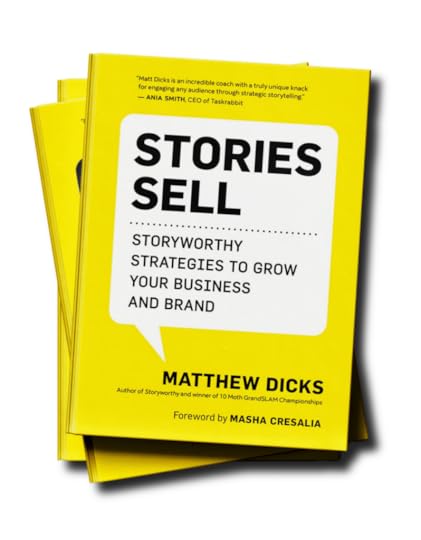
Charlie recently landed on the Amazon page for my latest book “Stories Sell.” He tapped me on the shoulder and said, “Hey, Dad, check it out. Your book has a 4.2 rating and no one-star reviews.”
“That’s great,” I said.
“You didn’t know?” he asked.
“I had no idea,” I told him. I explained that looking at those reviews does nothing to improve my life, so I rarely pay them any attention. I’d rather spend my time making the next thing.
Admittedly, I was happy to hear that readers liked the book, but if they didn’t, I couldn’t revise a chapter or ask them to reconsider their opinion, so why bother investing any time in looking?
And I’m someone rarely bothered by criticism. I’m blessedly immune to most forms of public attack and personal insult. If anyone can handle online criticism, it’s me. I’ve been victimized by some of the most relentless, unorthodox public attacks you could imagine.
Anonymous cowards trying to ruin my career. The MAGA mob hammering away at me online day after day. Angry readers of my blog, railing against one of my more ill-informed opinions.
I am an expert at managing and dismissing unwarranted and unwanted critiques.
Yet I mostly ignore it all.
So, if online criticism bothers you, why invest time and energy looking?
Most of the time, my interaction with social media amounts to this:
I step onto the platform, place my content, and leave. Often, I never return. Other times, I will briefly step back onto the platform to see if I’ve stirred up a hornet’s nest or made someone exceedingly happy. Sometimes, I will spend five minutes swatting at the hornet or expressing gratitude for the kindness of others, often while standing in line somewhere.
Other times, I ignore the hornets and walk away.
I do this because social media is ethereal, flimsy, and impermanent. If I write something that enrages one person or one hundred people, I know it will be forgotten in a day or two and sometimes an hour or two.
Noting on social media matters. It is a momentary blip — easily ignored and quickly forgotten.
So if it hurts you, why engage?
Sometimes, a thoughtful person will offer me a new perspective or engage in an intellectually honest debate, and in those cases, I may jump into the fray, but most of the time, I plant my flower for the day and move on.
Paul Theroux said it best:
“In the short run, criticism seems to have merit; in the end, criticism is useless.”
Play the long game. Ignore the daily shouts from the peanut gallery. Spend your time making stuff. Doing stuff. Establishing a reputation as someone who does these things.
You’ll be a lot happier.
Online critics got you down? I have the solution.





 SOME HAPPY CLIENTS



















 nothing short of transformative.
 “Matthew Dicks has been a guiding light in my journey as both a YouTuber and entrepreneur. His impact on my life and business has been nothing short of transformative.”
 — Ali Abdaal. Doctor, Entrepreneur, & YouTuber with 5.43M subscribers It’s all in this book. “Having mentored hundreds of corporate folks like me, Matt has developed unique, streamlined strategies to teach people how to use their personal stories in business. He’s taken everything he’s learned from years of consulting and put it all in this book.”
  — Masha Cresalia, Former Director of Corporate Marketing – Slack Matt provides The most value per minute. “I’ve received a tonne of advice from investors, founders, and other mentors…I always tell Matt he provides the most value per minute of anyone I spend time with.”
  — Alyhan Rehmatullah. CEO & Cofounder – Kalpa [Meet the Author, Matthew Dicks] WHO AM I?
 Matthew Dicks is an award-winning bestselling author, speaker, and marketing consultant to some of the world’s biggest companies including Amazon, Slack, and Salesforce.
For more than a decade, he’s been advising C-suite execs and their teams. Whether it’s a product launch, sales deck, or keynote, he surfaces the real stories behind the spreadsheets — stories that resonate and connect on a meaningful level.
He’s taught at multiple universities including Yale, MIT, and Harvard, and his work has been featured on Lenny’s Podcast, TEDx Talks, Newsweek, and many more.
 “The most powerful person in the world is the storyteller. The storyteller sets the vision, values, and agenda of an entire generation that is to come.” — Steve Jobs Why stories matter more than ever.
 People remember stories. Not graphs or endless lists of features.
Studies have shown that decisions are often made based on emotions first and rationalized with data, second.
Telling a meaningful story to frame metrics in the right light is how ideas are anchored on a deeper level. It’s how companies get funding, close deals, and rally teams.
Pre-order now Get the Free Sample Pre-order now Get the Free Sample What you’ll learn Unlike other self-help business books, “Stories Sell” was written concisely for busy professionals. It’s a fun read that uses anecdotes from consulting work to contextualize lessons and make them easily retainable.It draws from firsthand experiences to demonstrate the power of storytelling in solving important problems like how to: Craft and pitch sales decks that aren't boring. Communicate clearly with customers and colleagues Deliver crowd-pleasing keynotes Align teams on a shared vision “A year from now, you will wish you had started today.” — Karen Lamb Master the craft of storytelling today Pre-order now Get the Free Sample Pre-order now Get the Free Sample
  Honest, approachable “I laughed, gasped, took notes, and carried this book around like a dear friend — because that’s exactly what a storyworthy book should be. As a novelist, I’ve studied my craft in countless ways, but never before have I seen its marrow revealed with such honest, approachable charisma.”
  — Sarah McCoy, internationally and New York Times–bestselling author of Marilla of Green Gables and The Baker’s Daughter he leads you up the stairs to tell your stories. “With candor, humility, and bust-a-gut humor, Matthew Dicks shares his storytelling secrets and leads you up the stairs to tell yours. He already knows that they’re gems.”
  — Nichole Bernier, author of The Unfinished Work of Elizabeth D. the most interesting man in the world. “When I gave Matthew Dicks a recurring spot on my podcast, I billed him as ‘the most interesting man in the world.’ He really has lived quite a life. But what’s truly interesting is not necessarily what he’s experienced but how he makes you, the audience, experience it through him.”
  — Mike Pesca, NPR contributor and host of Slate magazine’s daily podcast, The Gist FAQ Who is this book for? The book is specifically tailored to professionals working in business and the corporate world. It’s meant to help marketers, salespeople, business leaders, entrepreneurs, and advertisers and teaches them how to use storytelling to grow their businesses. How can this help my career or business?
 The corporate world is flooded with data: spreadsheets, charts, graphs, and yawn-inducing PowerPoint presentations. But human brains are wired for stories.
The book teaches you how to combine stories with data to engage and persuade your audience. It gives examples and case studies on topics like:
Building slide decks for sales, investor pitches, and presentationsProduct narratives and positioningMarketing and advertising copySpeeches and keynotes for auditorium-sized crowdsBusiness communicationHow to align teams and build moraleHow to sell yourself for career advancementHow to build rapport and connect with your audience How does this book compare to other business books?Most business books on writing
Draws from outside stories and researchPadded with filler contentContent can be dry and clinicalWritten by ghostwriters or people from the corporate world who learned storytellingStories Sell
Draws from decades of firsthand experience consulting for companies of all sizesLean and concise for busy professionalsFun and insightful to readWritten by an award-winning novelist, StorySlam champion, and marketing consultant [I write and publish every single day.] Facebook X-twitter Youtube Linkedin Instagram Get your daily dose of stories Sign up to conveniently receive my daily blog post from “Grin & Bare It” into your inbox daily. Name Email Subscribe
 © 2024 Matthew Dicks
September 17, 2024
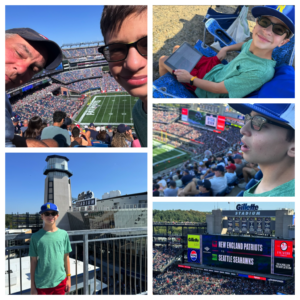
Charlie’s first Patriots game!
I took Charlie to his first Patriots game on Sunday. I had brought him to preseason games before, but this was the first regular season game that he attended.
Also, the home opener, which is always fun.
A few highlights:
Charlie was missing a Little League game to attend the Patriots game, but thanks to an app called Game Changer, he could follow the action on an iPad. As we tailgated with friends, he watched the game—balls, strikes, outs, and runs—as they were happening.
His team won 18-14 in a barn burner.
Last week, I watched the Patriots game on my phone while watching Charlie play in a Little League game.
It’s a brave new world.
Charlie is an aviation enthusiast. He attends an Aerospace Academy during the school day and hopes to one day be a pilot, so the flyover of four F-15s following the national anthem was one of the most exciting moments of the day for him. He spent part of the tailgate also tracking flights overhead thanks to another app and discussing origins, destinations, and aircraft types with one of our fellow tailgaters.
A lot of aviation talk for a football game.
The game went into overtime thanks to a blocked field goal that cost the Patriots three precious points, a miscommunication downfield that led to a Seattle touchdown, and two terrible pass interference calls. During overtime, the Patriots received the ball, failed to score, and punted it back to Seattle.
The Seahawks then marched downfield into field goal position. As they closed in on their game-winning kick, I suggested we leave now to beat the crowd.
“You’ve got to have hope,” Charlie said.
I thought he was crazy, but since it was his first game, I agreed to stay. But as we waited for the field goal to be kicked, I was reminded of a playoff game 12 years ago against the Ravens. Kicker Billy Cundiff missed a chip shot field goal that would’ve sent the game into overtime, thus sending the Patriots to the Super Bowl.
I was in the stadium that day, too, and I had hope as Billy Cundiff kicked that ball, and that hope was rewarded in jubilation. Just because it was a regular season game and our team isn’t nearly as good as it once was doesn’t mean that hope should be abandoned.
So I followed Charlie’s advice. I filled my heart with hope.
Then Jason Myers made the kick to win the game for Seattle.
Still, Charlie was right. Hope is a good thing.
As we left the stadium, we took a long, winding stairwell from the upper deck to the ground floor. As we descended, we passed individuals having difficulty negotiating the stairs, slurring their words, and mindlessly swearing. When we reached the bottom and exited the parking lot, Charlie said, “Well, now I know what a drunk looks like.”
He went on to expound upon the stupidity of public intoxication and the damaging effects of alcohol.
I’ve had friends with children older than mine tell me that as much as I’d like my kids to avoid alcohol until they are much older, it’s inevitable that they will drink at some point in high school — even though both Elysha and I did not drink alcohol while in high school.
I have repeatedly disputed this claim. While it’s possible that my kids might experiment with alcohol, I’ve always held out hope that they might follow in the footsteps of their parents, who avoided alcohol until after high school and barely drink today.
Clara is 15, and based on her current path, I suspect she will avoid alcohol throughout high school, and Charlie might, too. He’s clear-eyed on the subject in a way few people are.
Like Charlie said, I’ve got to have hope.
Despite the disappointing loss, it was a great and glorious day for Charlie and me.
A day, I suspect, that we will always remember.
September 16, 2024
Laura Dern’s “I told you so.”
Laura Dern — Academy Award, Emmy Award, BAFTA Award, and Golden Globe Award winner — was forced to drop out of UCLA film school at age 17 after being offered the role of Sandy Williams in David Lynch’s 1986 masterpiece “Blue Velvet.”
Dern had already appeared in several films, but “Blue Velvet” was her breakthrough role and launched a career-spanning collaboration with Lynch.
Dern had been on campus for just two days when she was offered the role in “Blue Velvet,” but when she went to speak to the head of her college department about getting a leave of absence so she could make the film, she was told, “Absolutely not.”
After some pestering, the head of UCLA’s film department finally agreed to read the script. When Dern was called back a few days later, she was told that if she left school to make the film, she would no longer be welcome at UCLA.She was also told that surrendering her college career for a film like “Blue Velvet” was insane.So Dern left UCLA to make the film, which scored an Academy Award nomination for Best Director and launched her acting career.Today, if you want to earn a master’s degree in film from UCLA, you must research and write a thesis on one of three films.One of them, of course, is “Blue Velvet.”Success is always the best form of revenge, but the ability to say, “I told you so,” is pretty fabulous, too.Laura Dern has one of the best “I told you so” moments ever.I’m so jealous.
September 15, 2024
Every moment can’t be a parade
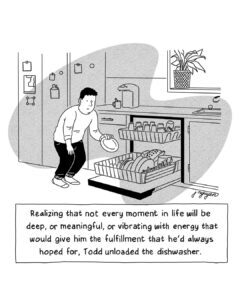
Elysha sent this to me. It made me laugh aloud.
It also worries me.
I encounter people who seem to expect every moment of life to be deep, meaningful, and vibrating with energy when, sometimes, you just need to empty the dishwasher.
Don;t get me wrong:
I’m the biggest believer in making something out of nothing. I look for joy in the tiniest things. I try to extract meaning wherever possible.
I’m relentless in this pursuit.
But every moment can’t be a parade.
Sometimes, we do what needs to be done or do the only thing we can to hopefully make it to the parade someday.