Matthew Dicks's Blog, page 46
August 21, 2024
Seven reasons people suck
I’m asked — almost on a weekly basis — if I can help someone become more confident. Someone sees me on a stage or reads something I’ve written or simply gets to know me and wonders if I can teach them to be equally confident.
To willingly share your failures and embarrassments.
To disregard the unwarranted opinions of others.
To give little thought to how someone might perceive your appearance.
Take risks. Move through life with less preparation. Find a way to be less nervous or anxious about performing in front of others, whether it’s public speaking, a job interview, meeting a new person, or playing golf.
I’ve been trying like hell to solve this conundrum.
I feel like if I could teach confidence, then I could be a billionaire.
It’s the drug everyone seems to want.
So, I’ve begun constructing a workshop on the subject along with a curriculum, exercises, and the like. I’m not actually sure if it’s going to help, but I think it’s worth a try.
Here’s one part of that curriculum that I think is essential:
Matthew Dicks’s 7 Truths About Terrible People
People will pretend you are a bad person so they don’t feel guilty about how they treated you.People will villainize you because they are incapable or afraid to do something you do well and desperately need to protect their own fragile egos.People will attack you when incapable or afraid of competing with you.People will say false and unkind things about you in order to build a coalition against you because they are afraid to find themselves alone someday.People will call you names because they lack the logic, rationale, and evidence to challenge your history, theories, and beliefs.People will try to undermine your success because they stupidly believe life is a zero-sum game.People will gossip about you because it makes them feel important.When you can internalize these truths and know they are as self-evident as those referenced in the United States Constitution, the journey to confidence becomes much easier.
When we know why people are terrible—and can accept that it has little to do with us—their words cease to hold power over us.
It’s not much, but it’s an important start.



August 20, 2024
300 feet?
I was driving behind this truck last week.
If you can’t read the sign, it says, “Keep back 300 feet.”
My thought:
What a stupid message.
I was driving at about 60 miles per hour down the highway. Did the person who affixed this message to this truck really believe that I would be able to judge 300 feet while simultaneously driving 316,800 feet per hour?
My car was traveling at 88 feet per second.
Judging 300 feet was impossible.
Honestly, I would have difficulty judging 300 feet from a standing position.
This is terrible storytelling. Ineffective storytelling. Incomprehensible storytelling.
A better sign might be, “Keep back 20 car lengths,” which amounts to 300 feet, but even then, judging 20 car lengths would also be hard.
Not as difficult as 300 feet, but still not exactly comprehensible.
“Keep back one football field” might make more sense, but now I’m wondering:
Do we really need to keep back 300 feet? Does this truck really require 20 car lengths or one football field of space behind it for motorists to be safe? Do we really expect this ever to be the case?
I’m starting to think the truck doesn’t belong on the road at all. I’m starting to think that it’s too dangerous to travel on any highway.
Maybe the best version of this sign would be:
“Stay the hell away from this truck.”
That might be the most comprehensible version of this message.
Or “Don’t drive behind this accident waiting to happen.”
Or “Treat this truck as if it might explode at any moment.”
A little wordy but still better than 300 feet.
Maybe the sign’s maker decided to choose a distance that would make a point. Perhaps 300 feet was an arbitrary number chosen because of its size.
“If I say 300 feet, that should keep people away.”
After all, do we really think someone road-tested this scenario with crash test dummies to determine that precisely 300 feet was needed to ensure safety?
Ultimately, it’s a ridiculous, meaningless, incomprehensible sign, which is why I hate it.
It’s bad storytelling. Words full of sound and fury signifying nothing.

August 19, 2024
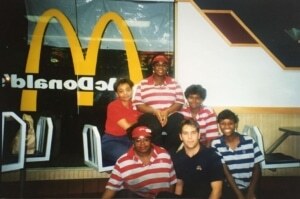
Vice President Harris, me, and McDonald’s
Vice President Kamala Harris could become the first U.S. President to have worked at McDonald’s. She worked under the Golden Arches for a summer while attending school.
It shouldn’t be surprising, given that 1 in 8 Americans have worked at McDonald’s at some point. Then again, most U.S. Presidents and presidential candidates tend not to emerge from the working class and fast food roots, so Harris’s election would really be something.
I started working for McDonald’s in the spring of 1987 as a junior in high school after my friend Danny told me they were paying $.4.65 per hour—ten cents more than the convenience store in our town. I was promoted to manager later that summer, and I worked nearly 40 hours per week during my senior year of high school, jamming ten-hour shifts into the weekends starting in the wee hours of the morning.
I worked for McDonald’s from 1987 through 1999, with two year-long interruptions when I went to work in banking and sales.
McDonald’s put me through college, allowing me to work a full-time, flexible schedule while also attending school full-time.
Not exactly an easy way to attend college — managing a restaurant full time while earning two degrees at two different schools simultaneously — but given that just before entering college, I had been homeless, jailed, the victim of a violent crime, and tried for a crime I did not commit, nothing seemed as hard.
I honestly felt blessed despite the outrageous, impossible workload.
McDonald’s also offered me extensive management training. It taught me many skills that have allowed me to succeed later in the classroom and in my businesses:
Delegation, organization, motivation, follow-up, cost-benefit analysis, customer service, and effective communication. My understanding of Mayo’s Human Relationship Theory and the scalar chain still inform my teaching today.
Understanding the Peter Principle has allowed me to avoid a career misstep and remain happy.
When I was 17, I was “calling the bin” on Saturday afternoons — a job that amounted to monitoring orders being placed at the counter and drive-thru and ordering food from the kitchen or “grill” based upon demand, anticipated demand and the need to keep waste as low as possible. It required understanding how every station in the restaurant worked so that you understood how long it might take to produce a run of Big Macs or McChickens. It required you to negotiate with the drive-thru staff — where more than half of all sales came — and cashiers, who faced scrutiny from customers standing before them, waiting for food. It required you to motivate kitchen staff, schedule breaks, and work as a cheerleader and taskmaster simultaneously. It forced you to process enormous amounts of information constantly and make critical decisions that determined service times, customer satisfaction, and profitability,
“Calling the bin” is a job that no longer exists. New processes have pushed it aside. But it was one of the most challenging jobs I’ve ever done. It prepared me well for managing a restaurant, a classroom, and, later, my businesses.
McDonald’s also allowed me to work with many different kinds of people.
In my first restaurant in Milford, Massachusetts, I managed people twice my age or more. In Brockton, Massachusetts, I was one of the only white people working in the restaurant. In Bourne, Massachusetts, many of my employees were teenagers, working on the Cape for the summer. In Hartford, Connecticut, most of my employees were immigrants from Peru, Mexico, and Central America who only spoke Spanish.
They taught me how to swear in Spanish.
The first person I hired was a formerly incarcerated man in a work release program.
He was also the first person I ever fired.
The first person I promoted to manager was a Chinese immigrant. When her mother arrived in America a year later, I hired her to make salads and do prep work.
I made my first Muslim friend while working at McDonald’s.
I made my first openly gay friend while working at McDonald’s.
I made my first Baháʼí friend while working at McDonald’s.
I made my first octogenarian friend while working at McDonald’s.
I made my first Jehovah’s Witnesses friends while working at McDonald’s, and they later rescued me from the streets.
While working in Hartford, I hired two high school dropouts and eventually convinced them to go back to school.
I met my best friend working at McDonald’s. He, too, was “calling the bin.” Ten years later, while I was still in college, still working for McDonald’s, still overwhelmed by work and school, we would somehow launch our wedding DJ company together.
It was another job that required us to process massive amounts of information quickly and make split-second decisions.
I’m confident our experience at McDonald’s helped.
Kamala Harris only spent a summer working for McDonald’s as a teenager, but I suspect she learned some skills during that short period. It likely reinforced her work ethic, introduced her to new and diverse people, and afforded her a window into the lives of people different from herself.
It’s happened before.
After selling his first company for $15 million, entrepreneur Scott Heiferman went to work for McDonald’s for a few weeks to reconnect with people.
He wrote:
“I spend a lot of time with bankers, lawyers, internet freaks, corporate wonks, and other people living strange lives. As a good marketing guy, that’s a bad thing. And as a practicing anti-consumerist, that’s a bad thing. I got a job at McDonald’s to help get back in touch with the real world.”
In writing about his time at McDonald’s, he said:
“Most of my McDonald’s co-workers did their jobs much better than I ever could. They just seemed quicker. They had various talents and intuition that I don’t have. I gained a bucket of respect for people that bust their butt for such low pay.”
It only took Heiferman a few weeks to gain that perspective.
I wouldn’t be surprised if Vice President Harris gained a similar perspective while working for McDonald’s.
Not a day goes by when a lesson I learned while managing McDonald’s restaurants does not help me in my work.
Perhaps Vice President Harris feels the same.
August 18, 2024
Book banning via minority stupidity in Utah
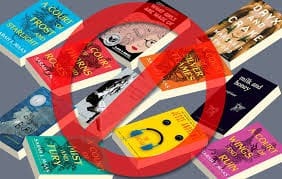
Books by Margaret Atwood, Judy Blume, Rupi Kaur, and Sarah J Maas are among 13 titles that the state of Utah has ordered removed from all public school classrooms and libraries.
The law requires the books to be disposed of, so they will likely be thrown into the trash rather than given to willing readers.
One book was a finalist for the prestigious National Book Award. One topped a nationwide list for “Best Fiction for Young Adults.” Another has sold 3 million copies and been adapted into a popular Netflix series.
Most titles they have flagged focus on race or the LGBTQ community.
The books on the list were prohibited under a new law requiring all of Utah’s public school districts to remove them if they are banned in (1) three school districts or (2) two school districts and five charter schools.
Utah has 41 public school districts in total.
So, a small number of idiots can trigger the banning of books statewide.
Thus minority rule is in effect. Very popular among people whose ideas have no purchase in mainstream America but nevertheless wish to foist them upon the masses.
The Electoral College is an excellent example of this. George W. Bush and Donald Trump — the only two Republican Presidents elected in this century — failed to secure the popular vote but still won the Presidency because of the Electoral College’s arcane rules.
Of the 13 books banned by Utah officials this week, 12 were written by women.
So the patriarchy also appears to be at work here.
Meanwhile, 53% of American children have a smartphone by age 11.
Over 95% of teens ages 13 to 17 years own a smartphone.
But this is apparently not nearly as dangerous as books by Judy Blume, at least according to the good folks of Utah. Early, unfettered access to the hazards of social media, pornography, and online predators is perfectly acceptable for children, but Judy Blume is not.
However, even some of those fans of minority rule don’t always think so.
Speaker of the House Mike Johnson installed “accountability software” on his smartphone and laptop to help him abstain from internet pornography and other unsavory websites. The software works by sending a report to an accountability partner about the websites he has visited, thus encouraging him to avoid anything nefarious, embarrassing, or otherwise harmful.
Mike Johnson’s accountability partner?
Jack, his 17-year-old son, who can apparently access any dark corner of the internet on his phone—thus the need for an accountability partner—but he cannot read Judy Blume or Margaret Atwood in school.
Political theater is so stupid. It seeks the public spotlight via ridiculous, meaningful, and frequently detrimental means.
It seeks to appeal to a politician’s base, even when that base holds an extreme, bigoted minority view.
Adults who engage in political theater are so stupid.
August 17, 2024
The intenet!
More than two years ago, I wrote about “Livin’ on a Prayer,” the Bon Jovi song that tells the story of Tommy and Gina, a struggling couple with little hope for the future. I was annoyed by Tommy’s use of the word “someday” in the song.
When Gina cries at night, Tommy whispers, “Baby, it’s okay. Someday.”
Someday is a trap. It’s a word people use to assure themselves that there is still time. It’s an excuse for inaction and procrastination. In most cases, someday remains a distant point on the horizon, never chased and never realized.
People who believe in someday rarely find it.
Then I noted that fourteen years later, Bon Jovi sang about Tommy and Gina again in “It’s My Life” — an anthem that rejects the notion of “someday.”
Three lines from the chorus say it all:
It’s my life
And it’s now or never
I ain’t gonna live forever
Tommy and Gina make their appearance in the second verse:
Yeah, this is for the ones who stood their ground
For Tommy and Gina, who never backed down
Jon Bon Jovi has said that their 1988 song “Born To Be My Baby” is also about Tommy and Gina, though their names aren’t explicitly mentioned in that song.
So I wondered:
Has a band or musician ever sung about the same characters in separate songs on separate albums?
I could not think of another example.
This week, I received an email from Ed in Holland, who answered my question.
He wrote:
_______________________________
Hi Matthew,
Just came across your blog post about Bon Jovi’s Tommy & Gina.
Fun fact:
There is a third song in which the couple is mentioned! In their 1988 album track “99 in the Shade,” these lines appear:
“Somebody tells me even Tommy’s coming down tonight
If Gina says it’s all right.”
Also, to answer your question in the same blog post:
“Is there another example of characters like this stretching across multiple albums, creating a universe of sorts for the musician or band?”
Yes, there is! John Mellencamp’s Jack & Diane are revisited in his 1998 song “Eden Is Burning”:
“Diane and Jack went to the movies
They went to see Richard Pryor.”
_______________________________
In December, I’ll celebrate my 20th anniversary of writing a blog post every day without missing a day.
7,735 and posts counting.
In preparation for writing about my blogging experience, I’ve been collecting some of the more extraordinary moments from two decades of posting my thoughts for the world to read—and there are some doozies—but moments like these are some of my favorites.
It’s kind of crazy:
About 850 days ago, I had a thought about a Bon Jovi song that led to me asking a question. I wrote the question on a blog that can be read by anyone on the planet with access to the internet.
More than two years later, a man living on the other side of the Atlantic Ocean — separated from me by about 3,500 miles of land and water — found and answered that question.
Crazy, right?
The internet is an amazing thing. It’s often terrible, dangerous, and destructive, but it can also be surprising, beautiful, and joyous.
People like Ed in Holland make it so.
I’ve experienced my share of stumbles, scrapes, and even stab wounds by writing daily on the internet.
Rotten, evil, and stupid people have done rotten, evil things over the years—genuinely awful and cruel attempts to harm me and my loved ones.
Not all interactions online have been positive or good.
But enough people like “Ed from Holland” exist to make it all worthwhile.

August 16, 2024
Universal healthcare at the Olympics but not in the United States
Ariana Ramsey won an Olympic bronze medal with the U.S. women’s rugby team at the Olympics last week.
Following her victory, she did not go to Disneyland.
She went to get a pap smear.
Following her team’s victory, Ramsey made appointments with the Olympic Village’s gynecologist, dentist, and ophthalmologist.
This is because the Olympics offer universal healthcare to all athletes staying within the Village – a policy that began in 1932 during the Los Angeles games — but something the United States of America does not offer its citizens.
The United States is the only high-income country on the planet without universal healthcare, so after winning bronze for our country, Ramsey wisely took advantage of the healthcare offered at the Olympics.
Ramsey has 20/20 vision, but her vision blurs at night, so the Olympic doctor gave her glasses.
During her teeth cleaning, dentists did a complete X-ray scan of her mouth.
In addition to a pap smear, she had a complete gynecological exam.
All for free.
The Olympic Village also offers cardiology, orthopedics, physiotherapy, psychology, podiatry, and sports medicine—all at no cost to the athletes.
This means that when the Olympics return to Los Angeles in 2028, a tiny island of universal healthcare will exist in a vast ocean of Americans who pay significant portions of their income for healthcare or go without healthcare because they can’t afford it.
Sadly, universal healthcare is too heavy a lift for America. Too complex a system to unravel at this point.
Yes, countries like Germany, France, Australia, Canada, China, Brazil, Botswana, Finland, Denmark, Norway, Israel, India, Mexico, Barbados, and many more offer universal healthcare to their citizens.
73 of the 195 countries on the planet.
But not the country with the largest economy, the highest GDP (seven times or larger than every country except China), and one of the highest GDPs per capita.
So if you’re looking for free, quality healthcare, you have time:
Find a sport that you can play well. Work like hell. Get onto the American team. Then, you, too, can enjoy the blessings of quality healthcare.
Five new sports are being added to the Olympics in 2028:
Flag football, baseball/softball, cricket, lacrosse and squash
Get in on the ground floor while there’s still time.

August 15, 2024
August 14, 2024
Bad names
The last name “Dicks” hasn’t always been easy, but it’s not so bad, either.
It taught me how to punch really hard.
It helped me find my sense of humor.
It’s a perfect jackass identification tool.
It’s a fairly decent means of determining someone’s intellect.
It’s likely contributed to my lack of concern over what others think.
And sometimes — rarely — it does seem nearly as bad as it once did.
Last weekend, Elysha, the kids, and I went to the Bronx Zoo, which is pretty great. I don’t recommend the Mouse House — a dark building filled with rodents — and you should be warned that the smell in the Aquatic Bird House might make you sick, but the rest was fantastic.
But when it came to the monkeys, I stumbled upon these two species, named for the color of their asses and faces.
I couldn’t help but think two things:
The zoologists of yesteryear really liked to name animals based on physical appearance. Especially monkeys. In addition to these poor souls, there is the proboscis money (with an enormous nose), the bald uakari (lacking hair atop its head), the black snub-nosed monkey, and the golden snub-nosed monkey, just to name a few.Red-rumped agouti is definitely worse than Dicks. Even worse than the names of my uncle and great-uncle, Harry Dicks, and my father, Les Dicks.Perspective is everything.

August 13, 2024
Dr. Ruth’s sex advice
A month ago, Dr. Ruth passed away.
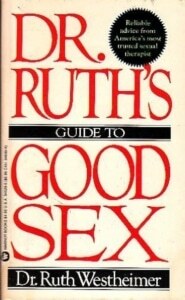
I wrote about my meeting with her in a green room years ago, which included a moment where she offered me advice on sex. I was asked by many readers what the advice was, and after searching the archives — which is to say my blog, my Homework for Life, and several journals — I managed to find it.
So by request, here is the advice Dr. Ruth offered me about sex in the green room at a TEDx Talk in 2015.
I’ve switched the word “wife” — which she used that day — to “partner” to make the advice applicable to anyone.
Hope it helps!
Don’t be goal-oriented. The journey to orgasm is just as important and sometimes even more important than the orgasm itself.Have sex before you go out to dinner. It will make for a lovely meal.You must talk about sex to have good sex. You must also talk about sex when you are not having sex.You and your partner must touch each other throughout the day. Touching is so important.You should be kissing a lot. During sex. Before sex. After sex. Anytime. Don’t forget how exciting kissing once was and can and should be again.
August 12, 2024
Andrew Wilkinson’s memoir
I read a lot of memoirs.
As a storyteller, I am drawn to the true-life tales of other human beings.
The problem:
So many memoirs are filled with self-praise and the recounting of significant accomplishments, absent the failures, embarrassments, and shame that fill our lives, but these less-than-moments are the stories people want to hear.
These are the stories people need to hear.
Even worse:
The more successful the person, the more likely the memoir is filled with personal accolades. I’ve read memoirs of musicians, politicians, comedians, and other public figures I liked a lot before I began reading, who I did not enjoy nearly as much when I finished.
I recently read the memoir of a television personality that included letters of praise from other people about their performance.
I cringed and groaned every time one of these letters appeared,
But last week, I read Andrew Wilkinson’s “Never Enough: From Barista to Billionaire.”
I know Andrew, have worked with him, and like him a lot, so I expected to like the book, too. Then again, Andrew is exceptionally successful — a literal billionaire — so I wondered if I would be faced with another book highlighting achievement and minimizing failure.
Instead, I was thrilled to discover an honest, unflinching, personally revealing memoir about Andrew’s bumpy, uneven rise to the top. The book is filled with stories of missteps, miscalculations, and abject failures. Andrew takes a clear and sharp look at his life and reveals things most would not. And along the way, he credits the many people who helped him succeed, making it clear his journey to success was not solely his own.
Andrew laid himself bare to his readers, and they will love him so much more for it.
It’s easy to say good things about yourself. It requires nothing except a lack of awareness of what others appreciate and want most.
It takes courage to speak the truth about your life, no matter how difficult, awkward, or embarrassing it may be.
I recommend Andrew’s book to anyone looking for a genuinely human rags-to-riches story. And if you’re looking to write a memoir or even tell a great story, take a page from Andrew and tell the story people want to hear.