Matthew Dicks's Blog, page 45
August 31, 2024
Clever but not so simple
This image seems clever—adults are so dumb for exercising indoors when the outdoor option exists—except the reality is very different.
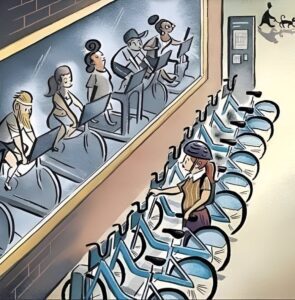
My primary and daily means of aerobic exercise is bike riding. I own a traditional bike and an indoor bike, but I ride the indoor bike about 80% of the time for a few reasons:
The stationary bike allows me to exercise anytime — a rainy afternoon, midnight, freezing temperatures, etc.
Stationary bikes offer a better workout than riding on the streets. I can ride like hell without stopping for 45 minutes on my stationary bike, but when riding outdoors, intersections and traffic force me to frequently stop and allow for rest I don’t want. While riding my outdoor bike engages muscles not required on a stationary bike, my primary reason for riding is aerobic exercise, so the harder I can ride, the better. The stationary bike affords me that opportunity.
My NordicTrack makes this even more possible by increasing tension and the angle of the bike, thus forcing me to ride in ways I could not on the streets. My bike often simulates uphill climbs with no opportunities to coast, which annoys me but is also exceedingly good for me. In real life, there is no consistency of terrain, and since I don’t live beside a mountain, these strenuous, endlessly uphill rides aren’t available to me outdoors.
Owning a stationary bike allows me to get quick workouts whenever I want. If a client tells me she’ll be 15 minutes late for our meeting, I can jump on the bike for a 12-minute ride, grab a two-minute shower, and still be sitting in front of the computer with a minute to spare.
Or, since my meeting is on Zoom, I’ll skip the shower altogether and grab one later, giving me even more time to work out.
This happens all the time. I’ll exercise for five or ten minutes if I have time to spare. Every bit counts. For those of us who understand and embrace incrementalism, this is huge.
None of this would ever happen if I only owned an outdoor bike. Not only would I have difficulty judging a ten or twelve-minute route and returning home on time, but going to the garage, pulling the bike onto the driveway, and donning the helmet would steal at least three minutes every time.
And I’d never be able to squeeze in a five-minute ride on an outdoor bike.
I can also entertain myself while riding. Elysha and I probably watch about an hour or two of television a week — not because we don’t love TV, but because we prioritize other things ahead of it. But on the bike, I can watch anything on the iPad while riding. I’ve watched hundreds of movies and many television shows, sporting events, and comedy specials while riding, making it one of the rare instances when multitasking actually works.
For these reasons, I sit atop my stationary NordicTrack bike far more often than my outdoor bike.
Though these reasons don’t apply to me, many people choose stationary bikes because they are nervous about riding outdoors, and rightfully so. The fatality rate is disproportionately high for cyclists on the road – on average, 30 cyclists die for every billion miles traveled, compared with just two per billion miles for car drivers.
I’ve had three accidents while riding outdoors in the past four years. Two were caused by uneven pavement, and one was caused by an overhanging tree limb that was more substantial than I thought. All resulted in only minor injuries, but they serve as a reminder that riding a bike in a random world can be dangerous.
Indoor biking studios like the one shown in the cartoon also offer motivation for riding hard. I can adequately motivate myself and can’t stand to be told what to do, so a spinning class would make me want to deck the person leading the class, but many people need someone to encourage them to work harder.
Indoor bikes in studios like the one depicted also allow for competition, camaraderie, and social interactions. It’s almost impossible to carry on a conversation with a fellow cyclist while riding on the road, but friends can be made before, during, or after a spinning class.
If I have a choice, I choose my outdoor bike whenever possible because as much as I love my stationary bike, I prefer the outdoors. The fresh air, my interaction with nature, and the additional muscles engaged while biking on the road are all good for me, and riding on the streets is much more fun.
But if I prioritize my health, my time with family, and my work-life balance, the stationary bike makes more sense.


August 30, 2024
Stop complimenting students
As an elementary school teacher, I have made it my policy to avoid commenting on a student’s physical appearance for over two decades. A student’s appearance should be the last thing of concern to a teacher, but more importantly, these comments, even when positive, can be damaging and hurtful to kids.
Many of my friends and colleagues have scoffed at this policy. I have been laughed at and criticized for my position. I’ve been told that I am taking things too far, becoming too politically correct.
Yet I have articulated this position to every class of students over the past two decades, and I have never had a single student scoff, laugh, or even question my policy. Every student has appreciated and supported my position, and some have tried to adopt it as well.
It’s only certain adults who think I’m dumb.
A few years ago, just before the school’s choir performance, I watched a teacher compliment a young man on his appearance. The boy wore an impeccable suit and tie, and even his dress shoes gleamed in the dull glow of the hallway’s fluorescent lighting.
The teacher who complimented the young man was aware of my “no commenting on physical appearance” policy. After praising his appearance, she turned to me and asked how her complimentary words could ever be construed as hurtful to the child.
I pointed out to the teacher that while the young man was probably feeling great about her compliment, the boy to his left and the boy to his right, who were not wearing suits and had not received a similar compliment and who were perhaps from families who could not afford suits, ties, and gleaming dress shoes for their boys, might be feeling very differently as they took the stage.
Therein lies the danger.
As one who grew up in relative poverty, I know how it feels to hear your classmates and friends receive compliments for their appearance while you do not.
Worse, I know how it feels to receive a compensatory compliment from a teacher who suddenly realizes that they have probably made you feel lousy while gushing over your best friend’s appearance.
That student in the three-piece suit was also about to perform in a concert. The teacher had an opportunity to compliment the students’ effort, focus, collaborative spirit, or positive attitude. Instead, she complimented him on his physical appearance, thus reinforcing the importance of looking good over many other more meaningful attributes.
There are too many other things worth complimenting for any educator to be discussing physical appearance. Effort, sportsmanship, empathy, helpfulness, rigor, respect, friendship, and charity are just some of the areas in which teachers can easily offer meaningful, productive comments.
Not to mention that a student’s choice of clothing and haircut, especially in elementary school, are often not entirely within the child’s control. Often, a teacher’s compliment about appearance amounts to little more than a comment on how the student’s parent chose to send their child to school, making the words even less meaningful.
So, more than two decades ago, I decided to stop commenting on students’ physical appearance, and I have held this line ever since.
It hasn’t been easy.
A girl walks into my class with a new haircut and asks me what I think.
I say, “I don’t know about your hair, but I love how you use that brain underneath your hair to solve math problems.”
A boy walks into class with a new shirt promoting his favorite basketball team and asks me if I like it.
“I didn’t notice the jersey,” I say. “But I noticed the way you played kickball yesterday. You were a great sport. Good job.”
Sometimes, these exchanges are a little awkward, and sometimes, the kids think I’m a little crazy, but I would choose awkwardness and crazy over the alternative.
To counter the furrowed brows and confused stares, I have made it a habit to tell my students about my policy now. In almost twenty years, I have never had a student disagree with my rationale or debate my decision. In fact, almost every student responds positively to my policy.
Nevertheless, many educators and parents have told me that my policy is unrealistic and unnecessary. They typically bolster their arguments with statements like, “My teachers complimented me when I was a kid, and we survived,” and “These kids are going to hear compliments for the rest of their lives, so there’s no reason for us to be sheltering them now.”
These types of arguments boil down to nonsense like this:
If it worked for me, it should work for them.Change is not possible.One person can’t make a difference.If it will be bad later, it might as well be bad now.I like what I do and don’t want to change, but I have no rational argument to support my position.But from tiny acorns, mighty oaks grow. That means someone needs to be an acorn. As awkward and crazy and divergent as that acorn may seem, someone must take the first stand.
Please don’t tell me my policy is foolish because no one else follows it.
Don’t tell me my policy is useless because everyone else in that child’s life will comment on physical appearance.
Change often begins with a few lone voices, and it turns out that I am not alone.
In a piece entitled One Hundred Things Restaurant Staffers Should Never Do, Bruce Buschel writes:
“Do not compliment a guest’s attire or hairdo or makeup. You are insulting someone else.”
This man understands the inherent hazard of a compliment, particularly when it addresses physical appearance.
In a piece entitled How to Talk to Little Girls, Lisa Bloom writes:
“Teaching girls that their appearance is the first thing you notice tells them that looks are more important than anything. It sets them up for dieting at age 5 and foundation at age 11 and boob jobs at 17 and Botox at 23. As our cultural imperative for girls to be hot 24/7 has become the new normal, American women have become increasingly unhappy. What’s missing? A life of meaning, a life of ideas and reading books and being valued for our thoughts and accomplishments.”
Or watched Meaghan Ramsey’s TED Talk “Why thinking you’re ugly is bad for you.” She would agree with my policy wholeheartedly.
In the end, regardless of whether or not you believe that physical appearance should be a matter of discussion with students, there are far too many more important things to comment on during a school day for me to waste an ounce of breath or a second of time on a student’s dress or hairstyle or shoes.
I am too busy, minute by minute, helping children attain the skills they need to be successful in the future to waste a single moment on how they look.
Perhaps you are, too.
August 29, 2024
A study published by Captain Obvious
Findings from a recent study on the use of tablets and smartphones in early life:
Child tablet use at the age of 3.5 was associated with more expressions of anger and frustration by the age of 4.5. This increased anger and frustration at age 4.5 was then associated with more tablet use by age 5.5.
These results suggest that early childhood tablet use may contribute to a deleterious cycle of emotional regulation.
In other words, giving a kid a tablet prevents them from developing coping strategies and emotional regulation, which results in more tablet use to manage their terrible behavior, which results in even more problems with emotional regulation and more tablet use.
A vicious cycle that results in suffering for the child and anyone who must parent, teach, or otherwise manage that child.
On the one hand, these findings are exceptionally important for promoting the health and welfare of our children.
On the other hand, DID WE REALLY NEED A STUDY TO TELL US THAT HANDING YOUR TODDLER A PHONE OR TABLET IS A TERRIBLE IDEA?
We haven’t yet studied the effects of playing in traffic, but I suspect we all know what the results of that study will be, too.
Is handing a toddler a tablet on a regular basis any different?
Did anyone truly believe that handing a screen to a small child was a great idea?
The same goes for social media and phone use in general:
Does anyone really think that Instagram, TikTok, or Facebook are good for any child at any age?
Does anyone really believe giving an 8, 10, 12, or even a 15-year-old a phone—complete with unfettered access to social media and the internet—was ever a good idea?
Or was it just easier to give the toddler a tablet to placate their immediate needs?
Was it simply less fraught and contentious to hand over a phone to your fourth grader and give them access to social media?
Did giving your child a phone feel necessary because everyone else was doing the same?
Yes, I’m sure some parents handed their toddlers and young children tablets and phones and thought, “This device will serve my child well and most assuredly promote their emotional development and help make them a far better person.”
But I suspect the number of parents who actually think this is in the single digits.
Studies about the effects of screens on toddlers are important, but sometimes, the outcomes are as obvious as sunrise, and what we need isn’t more information but more appropriate action on what we already know.

August 28, 2024
RIP Lester Maroney
Today, I begin my 26th year of teaching elementary school.
I also learned yesterday that Lester Maroney, my friend and former high school French teacher of four years, sadly passed away in February. Mr. Maroney and I reconnected two years ago after I managed to locate his address and send him a lengthy letter describing the positive, memorable, and still echoing impact he had on my life.
We’d been exchanging letters ever since. I had wondered when I would receive another, but sadly, I have received my last.
Lester Maroney was an enormous figure in my high school career and significantly impacted my life.
A week rarely goes by when I don’t think of him fondly.
His hilarity, sincerity, and exceptionally unorthodox behavior allowed me to flourish in his class. I found my voice in Mr. Maroney’s classroom. I was allowed to be myself. I was permitted to make people laugh, challenge authority, dare to be different, and turn every French class into an adventure.
Admittedly, I also spent much of my time in his classroom sitting on a platform beside him because of my behavior, but even that was okay.
It meant I got to spend more time with the man.
I developed a great deal of confidence under Lester Maroney’s guidance during the four years I spent in his classroom. He made it a place of safety, honesty, and connection and set an example of what real confidence can look like.
He was a man who did not care what others thought. He dressed flamboyantly, skirted the rules whenever possible, spoke his mind, and taught in ways that likely made clueless administrators cringe.
Years ago, I found a record of successful legal action he took against the school after the principal reprimanded him for an incident in which he “made use of a learning center to socialize with students and became embroiled with the person in charge of the center.”
This sounds exactly like Mr. Maroney.
Mr. Maroney shared stories about his life in a way I had never seen a teacher do before. Every day, he came to French class with some bit of ephemera from his life, and with every utterance, I grew to trust and love this man more.
Mr. Maroney would also hand out detentions as if they were candy and would smile while doing so.
Forgot your homework? Detention.
Laughed at a joke? Detention.
Tripped while entering the room? Detention.
At one point, I had amassed 87 detentions, which he claimed was a world record. I spent most of them playing chess with him and chatting about life. It interfered with track and field practice quite regularly, but otherwise, it wasn’t bad. In fact, I think Lester enjoyed those afternoons together and was liberal in handing out detentions to me as a result.
Lester would also assign a zero as a test grade for poor behavior, meaning that despite your ability to speak, read, and write French, you could fail if you did not behave well. Then, on the cusp of the end of the quarter, he would offer extra credit assignments to erase those zeros and save your grade.
Lester was also fond of nicknames, so early into my freshman year, he began to refer to me as “Dickus.” This oddly didn’t seem too bad considering the other variations of my name used throughout my school career.
I began calling him Lester in response, and he didn’t complain.
When my brother came along a year later, Lester modified the name to accommodate Jeremy’s arrival. I became “Big Dickus” and my brother became “Little Dickus.”
A victory of sorts for me, I suppose.
Mr. Maroney could not have survived in today’s teaching climate, and that is a damn shame.
My high school didn’t offer a fourth year of French, so when I asked about the possibility of taking another year of foreign language, Mr. Maroney created an independent study for me, allowing me to tutor a French 3 class (which my brother was taking) while working on some more advanced assignments independently.
As a result, Mr. Maroney awarded me the French Award at graduation. He handed me that plaque onstage, shook my hand, and I never saw him again.
As a teacher, the lesson I learned from Mr. Maroney was simple but important:
The lessons we teach outside the curriculum make the biggest differences in a kid’s life. The examples we set, the confidence we nurture, the trust we grow, and the encouragement we offer students to find their voice and develop tenacity, grit, kindness, empathy, and relentlessness are far more important than the content we teach.
Today, I can speak a little bit of French, read a little more, and still recite French poetry by heart, though I don’t always know what I’m saying.
All of that is fine, but what Lester Maroney taught me about myself has made a lasting difference in my life.
It’s often said that “Content is king.” This may be true in the publishing and online world, but in teaching, content is never king.
Teachers who think “Content is king” fail their students.
Teachers are in the business of helping young people become the best versions of themselves. We teach kids to read, write, solve math problems, and all the rest, but in the end, the quality of their character will be most important when it comes to giving them a positive, productive, and happy life, regardless of that skill they learn or knowledge they acquire in our classroom.
Content should always play second fiddle to the important stuff. Lester Maroney taught me that. He changed my life because he believed it.
My life has been positive, productive, and happy, thanks in part to Lester Maroney.
Rest in peace, Mr. Maroney.

August 27, 2024
Things can always be better
Two expressions I heard spoken yesterday:
“If it ain’t broke, don’t fix it.”
“Why reinvent the wheel?”
I hate these expressions.
These are words spoken by people who believe in complacency and stasis.
These are words spoken by people who don’t believe in making things better.
These are words spoken by people who can’t envision a better tomorrow.
These are words spoken by people who prefer to rest on their laurels.
Avoid these people at all costs.

August 26, 2024
What teacher’s need and deserve
The school year begins for me today. This will be my 26th year in the classroom—all in the same school and almost all in the same classroom. It’s a school where I met my wife, many of my friends, and many students who remain in my life long after their time in my classroom has come to an end.
How lucky I have been.
But it’s also a challenging time to be a teacher.
Emerging from the pandemic, children have enormous social, emotional, and academic needs. Many are struggling with trauma, the effects of prolonged isolation, and grief.
It’s all been incredibly, debilitatingly difficult.
It’s also been remarkably, joyfully, endlessly rewarding. Knowing that you make a difference in a child’s life—especially during these challenging times—has been a gift to most teachers.
In the face of these unprecedented challenges and sweeping changes, I would like to offer this advice on behalf of my fellow educators:
If you are an administrator — principal, superintendent, or anyone else occupying some place other than the classroom — and have not been a teacher for three or four years, please stop talking about what you think constitutes effective teaching and start listening to teachers. The pandemic has changed education — at least for a time — in profound ways. If you’re not in a classroom — especially not working in a school — your previous teaching experience is far less relevant than it once was.
If you are an administrator who hasn’t been in the classroom for a decade or more—especially if you’re not working in a school—please, by all means, shut the hell up and start listening to teachers. Your awareness of students’ needs and the challenges of a school day has all but evaporated with time.
If it’s been over a decade since you’ve stood before students daily, you honestly have little to say. You probably taught in an age before children carried cell phones. Maybe in an age before the internet became as ubiquitous as today. You’ve probably never had a class of students with laptops on their desks at all times. You probably didn’t teach during the extreme partisanship that has divided our nation. You may have been teaching before Sandy Hook or Parkland or Uvalde.
If it’s been longer than a decade since you last taught in a classroom daily, your job is to support teachers by constantly and carefully listening to them and working like hell to meet their needs. Your opinions on teaching are almost irrelevant unless they come from the people doing the job daily.
Here’s the thing about teachers:
None of us went into this profession to get rich.
None of us saw teaching as an easy job.
None of us want to fail.
For many teachers, the week before school begins is filled with sleepless nights, constant worry, and furious planning because they want to be the very best for their students and relentlessly worry that they might fail.
I once worked with a veteran teacher of more than two decades who would throw up the night before the start of every school year.
Teachers want to succeed on behalf of their students.
So if a teacher asks you for a tool, it’s because we know—better than you could—that we need it.
When we tell you that the curriculum is atrocious, it’s because we know — far better than you ever could — that the curriculum is atrocious.
If we tell you that an assessment is useless, it’s because we know—better than you ever will—that it is useless.
When we tell you a policy is not working, it’s not because we are trying to make our lives easier. It’s because your policy sucks.
Plato Karafelis, my first principal—who served for 25 years in the school where I am beginning my 26th year today—often pointed out in faculty meetings that he hadn’t taught in a classroom for 12 or 15 or 20 years. “How could I pretend to know what your job is like anymore?” he would say. “I need you to tell me what I need to know. Tell me what you need so I can do my best to support you.”
This impressed the hell out of me.
But that type of leadership is hard to find these days. Many administrators who once taught in bygone days—pre-pandemic, pre-digital, pre-computers in your pocket, pre-murder in the classroom, pre-social media—think they understand the job. They think their opinions on pedagogy, curriculum, and assessment are relevant in today’s teaching environment. They spout theories, opinions, and policies from ivory towers when they know nothing about the realities of a classroom today.
I was named West Hartford’s Teacher of the Year in 2006. If that same 2006 version of me appeared in my classroom today, I would be a tragically ineffective teacher for my students. It would take me at least a year and a lot of work to become highly effective again. The world has fundamentally shifted since my first few years of teaching. If you’ve been teaching in the classroom during that time, you, too, have shifted along with it.
But if you’ve spent your time outside the classroom, in some office or ivory tower, you know little about classroom instruction. You know lots of other things, I’m sure — essential and valuable, for sure — but if you don’t work with kids, you don’t understand the realities of the classroom in today’s world, and that, more than anything, is what teaching is about.
So, in these challenging times, I implore administrators—especially those not working inside schools—to stop thinking that they know anything about what is going on in the classroom and start relentlessly and religiously asking teachers what they need to be successful.
Ask them all—the compliant ones, the nonconformists, the rookies, the veterans, the rabble-rousers, and everyone in between.
Every teacher has a list of what they need to help students learn better. Ask them for their list, and don’t waste their time explaining why the items on their lists are unimportant, too expensive, unrealistic, or not needed.
Stop assuming you know anything and ask them. Listen to them. Act upon their requests whenever possible. When it’s not possible, find a way to make it possible. That is why your job exists.
If you can’t bring yourself to do these things, then be quiet. Don’t become an obstruction to good teaching. Stay the hell out of our way.
And please don’t make the mistake of thinking this is one person’s opinion or that I’m speaking about my school district. As a public figure, I hear from teachers all over the country. This is not a problem in a single school district or a small handful of school districts.
I hear from struggling teachers all the time. I listen to their stories of struggle, heartache, and the desire to do well in the face of administrators who fail to meet their needs daily. I hear about administrators who think they know something but know almost nothing.
There isn’t a teacher I know who doesn’t feel similarly. Teachers tend not to be boat rockers. Many are rule followers. Even more are people-pleasers. Most are simply too invested in their students to fight against blind, incompetent administrative buffoonery.
But they all are feeling these pressures. They all want more for their students. They all need more support. They all wish people who have not occupied a classroom for 5 or 10 or 20 years would do much less talking, a lot less demanding, and a lot more listening.

August 25, 2024
I want to stand on the highwire for one specific reason
My friend Chris and I entered a club in New York City last year. I was scheduled to perform in a storytelling show, but we arrived early and found ourselves in the middle of a comedy show.
A comedian onstage was bombing badly. Suffering. Making the audience suffer, too.
“I want to go up,” I whispered to Chris.
“What?” he asked.
It was true. I wanted to take the stage and save the show.
Please note:
I had nothing prepared. I had no idea what I might do once I took the microphone. And although I perform stand-up comedy—just last week in Ottawa—I’m not great. I can hold my own and make people laugh, but no one leaves one of my shows thinking I’m hilarious.
Still, I wanted to go up.
I told this story to Charlie while we talked about the desire to stand at the plate in the ninth inning with the game on the line.
I’ve always wanted to be in that position. Last at bat. Final shot. Must-make putt.
When I competed in debate competitions in college, I was always the anchor.
When I ran the 4 x 100 for my high school track team, I always wanted to be the anchor.
When my Boy Scout troop competed in the swim carnival at summer camp, I always swam the marathon—the last event of the competition and the one that offered the most possible points.
Charlie thinks I’m crazy. He never wants to be in that position.
I was surprised, but based on conversations with others since then, fewer people want to perform when everything is on the line than I had initially thought.
Almost no one, at least according to my limited anecdotal survey.
And it’s not because I expect to succeed every time. Striking out is always a possibility, and I know that well. Missing the shot, failing to sink the putt, falling short of the finish line, and losing the game or match is always possible.
I could’ve easily bombed just as badly as the comic on stage that night in New York.
Still, I always want to be at the plate if the game is on the line. Regardless of the competition, I wanted to be the one to decide the game.
I wasn’t sure why this was the case.
I wondered if it was because I don’t trust others as much as myself in these critical moments.
Maybe I suffer from some ridiculous hero complex.
Perhaps I just love the spotlight.
Sharing this story with a friend last week, he knew the answer instantaneously.
“You’re not afraid to fail.”
As soon as he spoke the words, I knew they were true.
I don’t expect to be the savior in every one of these moments. I don’t expect to succeed every time. But if I strike out or miss the shot or leave the putt short or bomb onstage or otherwise fail to rise to the challenge and win the day, it’s okay.
He’s right. I’m not afraid to fail.
My acceptance that I can’t always succeed, combined with my general lack of concern for what others might think and perhaps a little too much self-confidence, allow me to fail without my failure to bother me very much.
That’s why one of my favorite performances is “Matt and Jeni Are Unprepared,” a show where my friend Jeni and I improvise competitive stories onstage without any preparation.
If I fail in this ridiculous highwire act, it’s okay. Failure is part of life and does not impact my sense of self.
Someone once told me that he stopped playing golf because he couldn’t break 100 and was playing with people who were routinely breaking 90 and even 80. He couldn’t stand to be the worst player in the group every time he played.
That was the case for me for at least a decade. I started playing golf with people who had been playing well for years, and it took me years — a decade at least — to produce semi-reasonable scores.
But quit the game because everyone hits the ball longer and straighter than me?
Never.
I felt sad for the guy. His ability to play a game he enjoyed was predicated on his performance.
He was afraid to fail.
My advice:
Don’t be afraid to fail. Life is much more fun and a lot less stressful when your sense of self hinges on the outcomes of your endeavors.
This isn’t to say I’m not sad, disappointed, or even angry when I lose, but my feelings about the loss remain firmly entrenched within the confines of the contest and dissipate quickly.
As Marcus Aurelius said:
“How easy it is to repel and to wipe away every impression which is troublesome or unsuitable, and immediately to be in all tranquility.”
Easy indeed.
Experience the disappointment. Perhaps learn something from your failure. Move on.
But I suspect that not being afraid to fail isn’t like a light switch.
You can’t just switch it on.
I’m not sure where it comes from, but it makes life a bit easier and perhaps a little more fun.
If you can flip that switch, I highly recommend it.

August 24, 2024
A well placed piano
A beautiful piano just beyond the security checkpoint in Logan Airport.
Available for anyone to play.
Hopefully someone with at least a little bit of skill.
The Detroit airport has pianos, too, in celebration of its status as Motown, but those pianos are played by professionals and otherwise remain silent.
A public piano is a beautiful thing, I think. A lovely addition to a public space.
I wish we had more of them.

August 23, 2024
When ghosting is perfectly acceptable
Kristen Rogers of CNN wrote an article entitled, “Ghosting is usually a terrible thing to do. Here’s when it’s OK”
Rogers quotes psychologist Dr. Jennice Vilhauer, who recently wrote a book on ghosting. She asserts that ghosting is never acceptable except in cases when there has been abuse and further communication would put you in danger or when the other person is exhibiting inappropriate behaviors such as sending unsolicited explicit photos, showing up at your workplace, stealing from you, or showing blatant disregard for your boundaries.Otherwise, she asserts, ghosting is wrong.According to experts (including Dr. Vilhauer), ghosting lacks the clarity and certainty of an explicit rejection, which helps people process, feel closure, and move on. The absence of these things can be distressing, especially if you’re filling in the blanks with worst-case scenarios, as many do. People can become more guarded, which is detrimental to finding future love and friendship.
Ghosting can actually harm future relationships.
But I’m afraid I have to disagree with Dr. Vilhauer.
I think ghosting is perfectly acceptable because cowards must be afforded the latitude required to be themselves. Cowards lack decency, self-respect, and courage, which makes ghosting unavoidable. We must accept that these weak, pathetic, simple-minded losers are incapable of doing the right thing and can only do what’s possible for them.
Think about it:
We don’t allow toddlers to drive or operate heavy machinery because of their limited size and mental faculties. Similarly, we must acknowledge that cowards lack the fortitude, strength, moral clarity, and civility to behave like adults and communicate in a way that might make them feel uncomfortable or embarrassed or require them to find a backbone.
We can’t expect worms to rise up and do the right thing.
We can’t expect chickens to stop being chickens.
When I was dating, breaking up with someone over the phone or via a note was considered impolite. Both were grudgingly acceptable but not preferred. A real-life discussion was considered best. It was never easy, but as someone once famously and brilliantly said:
“The hard thing and the right thing are often the same thing.”
It was me. I said that.
And yes, Dr. Vilhauer acknowledges that in some situations, some people would prefer to be ghosted rather than know how much the “ghost” dislikes them, but she also said you can’t predict how someone will feel. So, whether it’s a friendship or romantic connection you’re ending, experts agree that providing some final communication so the recipient can at least process it is best.
So claiming the person you ghosted probably wanted to be ghosted doesn’t fly.
Besides, most of us know ghosting is wrong. It’s an act of cowardice. It is a self-centered, weak-willed decision by someone who probably also leaves dirty dishes in the sink and clips their toenails in public.
But as wrong as it may be, cowards exist, and they can’t help but be cowards, so we must accept that as pathetic and infantile as ghosting may be, some people can’t help it.
Dr. Jennice Vilhauer needs to stop acting like an ableist and accept the fact that some people suck and can’t help but do the cowardly, immoral thing.

August 22, 2024
I wrote to Justice Thomas this week
I wrote a letter to Supreme Court Justice Clarence Thomas this week.
I wrote more than I initially anticipated (novelists tend to do this), but it was born from genuine curiosity.
I don’t expect Justice Thomas to write back, but I wish he would because I absolutely, positively want to know his answer.
It makes me crazy not knowing.
____________________________________-
August 19, 2024
Dear Justice Thomas,
My name is Matthew Dicks.
For the last 25 years, I’ve been an elementary school teacher in West Hartford, Connecticut.
My wife is also a teacher.
We make a good living, but as you may know, no one gets wealthy on teacher salaries.
Over the last decade or so, as I’ve published novels and nonfiction and begun consulting in the corporate world, our income has risen considerably. We find ourselves in a much better financial position than ever before. But there was also a decade when my wife remained home with the children, cutting our income in half, and I wasn’t consulting yet, which made things difficult. Parts of our home remained unfurnished for years, and those furnished rooms contained many hand-me-down pieces of furniture.
Even today, our dining room table is a hand-me-down piece from a friend.
We didn’t travel much in those days. We didn’t splurge on things we didn’t need. Stretched pennies whenever possible.
During those days, we sometimes worried about how we might pay the mortgage. I also owned and operated a wedding DJ company at the time, so between my salary, the income from my business, and eventually my book deals, we made it all work, but it wasn’t always easy.
My wife and I have also been blessed with many great friends and still are today. Some of them are fairly wealthy people. They own more than one home, drive expensive cars, enroll their children in private schools, and travel the world. They are successful, hard-working people who we adore, but when my wife was staying home with the kids, and we sometimes struggled to make ends meet, our financial position compared to some of our friends couldn’t have been more different.
Here’s the thing:
Had any of those friends offered to take us on vacation, pay for our meal in a restaurant, or otherwise cover an expense, we would’ve thanked our friends for their kindness but rejected their offer.
Had one of those people been the parent of a student or someone for whom our influence as educators might have benefited their children or given that perception to others, we would’ve rejected their offer and explained how accepting it would be unethical.
I’m sure you can see where this is going.
My wife and I had far too much pride and integrity to allow our wealthier friends to foot our bill, even though doing so was absolutely within their means. I can’t begin to imagine allowing someone I like and respect to start paying for our needs in the same way a parent pays for the needs of a child. If this meant that our friends were traveling to Europe on vacation while we were visiting the Connecticut shoreline, public libraries, and playgrounds on our vacations, so be it. We may have missed out on the Eiffel Tower and Big Ben, but we maintained our dignity, integrity, and independence instead.
Today, we are lucky. The combination of my books, our businesses, and corporate consulting has supplemented our teacher salaries considerably, and we are in a far better financial situation than ever before.
We are planning a European vacation with our kids next summer.
We are happy and proud to be doing it on our dime. We worked hard and smart, making these things possible.
You knew that accepting gifts from wealthy friends was wrong. You knew it was wrong because you failed to report those gifts for years despite rules requiring you to do so, and even when pressed to do so, you still failed to report some.
You knew your actions were unethical, and the perception of influence they created damaged the Court. Your decision to hide these gifts makes all of this abundantly clear. And I understand this. While I don’t condone it, I know that human beings are weak, the trappings of wealth are appealing, and some people are more than willing to compromise their ethics to get what they want.
It’s morally reprehensible, but I at least understand it.
But here is what I can’t stop thinking:
How does Clarence Thomas — Justice on the Supreme Court of the United States of America — not feel small, pathetic, and infantile while accepting enormous gifts from others? How does he not lose all self-respect as another person pays his bill as if he were a child?
Flies him around the world in a private jet.
Feeds him.
Provides him lodging,
Purchases a home for him.
I can’t imagine accepting gifts like these as routinely as you do and still being able to look myself in the mirror. Our country was founded on rugged independence, idealism, and the belief that all Americans can succeed if they work hard enough and smart enough.
Instead, you repeatedly and publicly whined about your salary —which is more than five times the salary of the average American — not to mention the money earned from your seven-figure book deal, speaking fees, and more.
But because you didn’t think it was enough — and said so repeatedly — you accepted gifts from a Republican donor, thus compromising your integrity and the integrity of the Court and shaming yourself in the process.
I really want to know how you do it, Justice Thomas. How do you say yes to these gifts without hating yourself? How do you accept handouts like these without feeling like a loser?
Greed. Influence peddling. The wanton desire for more. I get that. I’ve seen that a million times.
But the shame you must feel while accepting enormous gifts from friends must be unbearable.
Truly… how do you do it?
I’d love a reply. Feel free to write, email, text, or call. I’ve included all of my contact information below.
Warmly,
Matthew Dicks